
HERMENEUTICS — Proper Bible Interpretation

Hermeneutics refers to the science of scriptural interpretation. Simply put, there’s a right way to interpret the Bible and a wrong way. This explains something the apostle Paul said to his protégé:
Do your best to present yourself to God as one approved, a worker who does not need to be ashamed and who correctly handles the word of truth.
2 Timothy 2:15
Timothy was a young minister and his mentor, Paul, was simply exhorting him to correctly handle the Scriptures. Other versions of the Bible translate the Greek for “correctly handles” as:
- “correctly explains” (NLV)
- “accurately handling” (NASB)
- “correctly teaching” (HCSB)
- “rightly dividing” (KJV)
The obvious reason Paul instructed Timothy to “correctly handle” God’s Word is because it’s possible to incorrectly handle it. If you can “correctly explain” it you can also incorrectly explain it. If you can “correctly teach” it you can also incorrectly teach it. If you can “rightly divide” it you can also un-rightly divide it.
So how do you correctly handle God’s Word? By learning and mastering the four simple rules of hermeneutics. Before looking at these guidelines, there’s something every believer needs to grasp, particularly in our day and age of ten thousand sects:
“The Truth [Reality] Will Set You Free” Not the Official Doctrines of a Certain Sect
Notice what Jesus said about discovering the truth:
So He said to the Jews who had believed Him, “If you continue in My word, you are truly My disciples. Then you will know the truth, and the truth will set you free.”
John 8:31-32
Christ said it’s “the truth” that will set us free as we continue in it and don’t give up. ‘Truth’ is translated from the Greek word alétheia (ah-LAY-thee-ah), which means “reality” or “the way it really is.” It’s the opposite of illusion, delusion or deception.
Here’s a gem of truth that all spiritually mature believers embrace: It doesn’t matter what one group believes or another group believes on any issue; the only thing that matters is what the truth is. Why? Because, again, truth literally means “reality.” It’s the way it really is. The point is that the truth is the truth regardless of what any person or group believes. So when you’re trying to discover the truth on a certain issue it’s irrelevant what this or that sect believes. All that matters is the truth and the truth is the clear revelation of the Word of God (John 17:17) as we continue in it, interpreting in context and in light of the greater context of the entire Bible.
The Four Rules of Hermeneutics
Here are the four common-sense rules of hermeneutics; that is, Bible interpretation:
- Context is king: Meaning the surrounding text reveals the obvious meaning of each passage. The context also includes obvious questions like: Who is speaking? Who is being spoken to? What is the topic? What is taking place at the time? And where? Whom does it involve? And what is their covenant (agreement, contract) with the LORD, if indeed they even have one?
- Scripture interprets Scripture: Meaning every passage must be interpreted in light of the context of the entire Bible and that the Bible itself is its best interpreter. In other words, one’s interpretation of a passage must gel with what the rest of Scripture teaches; the more overt and detailed passages obviously expand our understanding of the more sketchy and ambiguous ones.
- Take the Bible literally unless it’s clear that figurative language is being used: In which case you look for the literal truth that the symbolism intends to convey.
- If the plain sense makes sense—and is in harmony with the rest of Scripture—don’t look for any other sense lest you end up with nonsense: This includes the “plain sense” of the whole of Scripture on any given topic. In other words, if an individual or group comes up with an interpretation that is opposed to the plain-sense meaning that all the passages in the Bible obviously point to on that subject then it must be rejected. This fourth rule is essentially the other three combined.
These “rules” are really just common-sense guidelines for discovering truth and being set free from religious error. Although the Bible is simple enough that the simplest of persons can receive from it and be blessed, it’s also deep and complex, which means that as believers grow in the Lord they naturally grow in knowledge, understanding and wisdom. As such, one believer might have a grasp on a passage or topic and another might have a fuller understanding. A good example of this can be seen in Acts 18:24-26 where Apollos, a very learned man and powerful speaker, had a limited understanding of the message of Jesus Christ. What he knew was good and accurate, as far as he understood it, but it wasn’t a full or complete understanding. Aquila and Pricilla discerned this when they heard him speak; so they took Apollos aside, and “explained to him the way of God more adequately” (verse 26).
Staunch sectarians aren’t like this, however; they argue for or against a doctrine based purely on sectarianism. If what you teach doesn’t gel with what their sect teaches you’re automatically wrong; if what you teach is adhered to by a group they object to you’re wrong. What the Scriptures clearly and consistently teach on the topic is irrelevant to them, at least on certain subjects. Needless to say, this is a spiritually immature mindset and wholly unbiblical. You’ll notice in the above-cited 2 Timothy 2:15 that Paul instructed Timothy to do his best to “correctly handle the word of truth” and not to do his best to follow the doctrines of this or that sect. It’s an important distinction. Think about it.
Literalize Rather than Spiritualize the Scriptures (Unless You have Clear Justification)
The third rule (above) is important: Unless there are legitimate reasons to take a passage (or parts of a passage) figuratively or hyperbolically, God’s Word should be taken literally. Why is this important? Because without this rule people can take any passage and just spiritualize it into whatever they want it to mean based on their ideology. The result is inevitably a bunch of worthless gobbledygook.
Let’s take the “golden lampstands” in John’s vision in Revelation 1:12. Verse 20 reveals that they’re symbolic of the seven churches of Asia Minor, which are addressed in the next two chapters of Revelation. Similarly the “double-edged sword” that proceeds from Christ’s mouth in verse 16 obviously isn’t literal and other passages reveal that this is a figurative reference to the Word of God. You see? Taking the lampstands and the double-edged sword symbolically is justified in these cases, not to mention obvious.
Then there are obvious hyperbolic statements like when Jesus said: “If anyone comes to me and does not hate father and mother, wife and children, brothers and sisters — yes, even their own life — such a person cannot be my disciple” (Luke 14:26). We know Christ was using exaggeration for effect here — hyperbole — because elsewhere he stresses the great importance of loving others, including especially honoring one’s parents (Matthew 19:19).
Needless to say, beware of “teachers” who tend to write off plain passages of God’s Word by spiritualizing them (saying they’re symbolic or hyperbole). Why do they do this? Typically because their dubious ideology or sectarianism compels them to do so. In other words, their indoctrination by their pastor/church/sect/mentor prevents them from taking the words literally. They pre-suppose something is true and this determines how they interpret Scripture, even in cases where God’s Word flat-out contradicts their presupposition.
Those who teach God’s Word are accountable to the LORD for what they teach. They have the obligation to “rightly divide” it by putting the pieces of the scriptural puzzle together and drawing the sound conclusion on any given subject. It’s wrong to ‘write off’ plain passages as “symbolic” or “hyperbolic” just because they happen to conflict with one’s current indoctrination. Rather, we should allow the Scriptures to properly form our indoctrination with the clearer and more detailed passages trumping the more ambiguous, sketchy ones. This is common sense exegesis — which means drawing from the Scriptures — as opposed to eisegesis — reading into the Scriptures.
A good biblical example of people who ‘write off’ clear passages of Scripture due to their ideology — their theological indoctrination and the presuppositions thereof — is the Sadducees. They didn’t believe in a future resurrection, angels or demons even though the Hebraic Scriptures contain clear passages supporting each (Acts 23:8).
There are modern-day “Sadducees” in the Church. They may not disregard plain passages about the resurrection, angels or demons, but they “explain away” clear verses on other topics, typically by spiritualizing the texts.
The Clearer and More Detailed Passages take Precedence Over the More Ambiguous, Sketchy Passages
This concerns the second guideline: Any given biblical topic will have an amount of passages that directly or indirectly apply. Some topics have hundreds of relevant passages whereas others have only a handful. In either case, the clearest and most detailed verses override the more ambiguous and sketchy ones. It’s just common sense. You could call these relevant passages “pieces of the puzzle.” There are only so many “pieces of the puzzle” to draw sound conclusions on any given topic and they should all fit together somewhere in the big picture. It goes without saying that any conclusion you draw should be “water tight” (or, at least, as water tight as possible). Now, wouldn’t it be absurd to take a topic and discard the clearest, most relevant passages on that subject because they don’t gel with your current ideology? Wouldn’t it be equally absurd to draw a conclusion without these clearest, most relevant texts? Yet people who are erroneously indoctrinated (usually by their church/sect/camp) do this all the time.
Let me give an example: I was dialoguing back-and-forth with a Bible teacher on a topic where there were only five relevant passages. The clearest one was in the New Testament and the immediate context of the verse supported a literal reading of the text, as did the other four related passages. This conflicted with the man’s established ideology, however, and so he wrote the verse off as “hyperbole” (exaggeration for effect). I pointed out that the immediate context of the verse in question supported a literal reading because the words read as a straightforward statement; and the verses before and after the text were also literal statements. In other words, there was no reason — no justification — to take the verse in any kind of figurative sense, including wild exaggeration. Plus, like I said, the other four passages on the topic supported a literal reading of this verse and they all fit together, pointing to a sound conclusion.
None of this mattered to the man because he didn’t allow Scripture — God’s Word — to form his indoctrination, obviously with the plainest passages on the topic trumping the fuzzier ones. Rather, he allowed his current indoctrination to compel him to disregard the clearest and most detailed verse on the topic. Keep in mind that God has only supplied us with five passages on this particular subject in which to draw a conclusion. Now I realize we only “see through a glass darkly” in our current condition on this Earth, but — nevertheless — we can certainly draw a general conclusion from these small number of relevant passages that God has granted us on the topic, particularly when one of them is clear as day. These were the only “pieces of the puzzle” we had on the subject and the man threw out the most significant piece because of his erroneous theology.
Needless to say, the man was applying unsound hermeneutics in this situation and seriously needed to tighten up his interpretational methods. He needs to apply something Paul instructed ministers of the Word: “Watch your life and doctrine closely” (1 Timothy 4:16).
“Rightly-Dividing” the Scriptures does NOT mean Discarding Relevant Passages
This goes along with the above. Let me offer a quick example…
One minister wrote in an article:
“Rightly dividing” God’s Word means to emphasize certain scriptures over others, which means that it must be possible to wrongly divide the word by emphasizing the wrong scriptures over others.
While I understand where this man’s coming from, what he says here needs clarified, otherwise people will start cutting out relevant passages that they don’t like simply because the verses disagree with their current ideology (which is often driven by sectarianism, of course). To rightly-divide the scriptures — that is, properly interpret them — it’s necessary to follow the guideline “Scripture interprets Scripture” (amongst the other common sense “rules” above). As such, to draw a sound conclusion on any given subject, all the relevant passages on a subject must be considered and “fit in the puzzle,” so to speak.
Here’s an example: This same minister taught that all of our future sins are already forgiven even before we commit then. He then cited 1 John 1:7 & 2:12 as proof texts, but omitted one of the most relevant passages on the topic, which just so happened to be sandwiched in between these two verses from 1 John. I’m talking about 1 John 1:8-9, which clearly shows that future sins must be confessed after they are committed in order to appropriate forgiveness in one’s life. Yes, Christ died for all our sins, but forgiveness for future sins cannot be personally appropriated until after one commits them. First John 1:8-9 is one of the most pertinent New Testament passages on this issue and therefore it cannot be negated. It “fits in the puzzle” somewhere. How anyone could cite two verses from the first two chapters of 1 John — which is the context of those two verses — and totally disregard 1:8-9 is stupefying.
Needless to say, beware of preachers who omit the clearest, most relevant passages on a topic. It’s a red flag that they’re teaching false doctrine.
Those Who Teach Will Be “Judged More Strictly”
Let me close with something important James said:
Not many of you should become teachers, my fellow believers, because you know that we who teach will be judged more strictly.
James 3:1
Those who teach God’s Word are going to be “judged more strictly.” Why? Because the Word of Truth is God’s potent Word to humanity and therefore those who teach it will either bless people through accurately explaining it or mislead them through inaccurately handling it. Either way, those who teach are accountable to the Lord. Where will they be judged more strictly? At the Judgment Seat of Christ (2 Corinthians 5:10-11, Romans 14:10, 12 & 1 Corinthians 3:10-17 & 4:5).
It was for this reason that Paul said he knew what it meant to fear the Lord—because everything he taught was going to be evaluated at the Judgment Seat of Christ (2 Corinthians 5:10-11). Those who justify teaching false doctrine—that is, inaccurate teaching—on the grounds that “it’s the official doctrine of my church/sect” or “this was how my pastor taught it” won’t be excused. Needless to say, before teaching something from the Scriptures make sure it’s balanced and biblical. If you discover at some point that something you’ve been teaching is error then humble thyself by honestly ’fessing up and start teaching the truth, regardless of the consequences.
For details on hermeneutics and related issues see The “Berean Spirit” — What is It? How Do You Cultivate it?.
Here’s a 16-minute video on the Four Rules of Bible Interpretation:
Related Topics:
What’s the Difference between TEACHING and PREACHING?
What’s the Diff between “Milk” and “Solid Food” (or “Meat”)?
Who Wrote the New Testament Books? Who Authorized them as Scripture Canon?
What is “KJV ONLY”? What’s Wrong with It?
Sectarianism — What is It? What’s Wrong with It?
The Fivefold Ministry Gifts — Apostle, Prophet, Evangelist, Pastor and Teacher
SHEEP AND GOAT JUDGMENT — What’s It All About?

The Sheep and Goat Judgment, detailed in Matthew 25, naturally spurs questions because the Lord does not judge the people who undergo this judgment based on faith in response to the gospel of Christ but rather by their good works — specifically, how they treated Christians. Did they feed them? Give them something to drink? Show them hospitality? Clothe them? Take care of them when they were sick? Visit them in prison? Those who did so are blessed with eternal life whereas those who didn’t are condemned to the lake of fire and the corresponding eternal punishment (not eternal punishing; there’s a difference, as this article shows).
When I was in my 20s I remember asking a subordinate pastor at the assembly I was attending specific questions about this particular judgment and he just wrote them off with the conclusion that “we can’t get dogmatic about it [the Sheep and Goat Judgment].” I found this “answer” thoroughly unsatisfying and lost a little respect for the man. How so? Because he clearly didn’t have answers so he should’ve just been honest and admitted it rather than writing off Jesus’ elaboration on the Sheep and Goat Judgment as unimportant, wholly dismissing my questions in the process.
The passage is a fairly long one and it was given by Jesus Christ, the Living Word who is the truth (John 14:6). As such, this curious judgment fits somewhere in the puzzle of end time events. It’s not something to write off on the grounds that “we can’t get dogmatic about it” (whatever that means).
Let’s read the passage:
31 “When the Son of Man comes in his glory, and all the angels with him, he will sit on his glorious throne. 32 All the nations will be gathered before him, and he will separate the people one from another as a shepherd separates the sheep from the goats. 33 He will put the sheep on his right and the goats on his left.
34 “Then the King will say to those on his right, ‘Come, you who are blessed by my Father; take your inheritance, the kingdom prepared for you since the creation of the world. 35 For I was hungry and you gave me something to eat, I was thirsty and you gave me something to drink, I was a stranger and you invited me in, 36 I needed clothes and you clothed me, I was sick and you looked after me, I was in prison and you came to visit me.’
37 “Then the righteous will answer him, ‘Lord, when did we see you hungry and feed you, or thirsty and give you something to drink? 38 When did we see you a stranger and invite you in, or needing clothes and clothe you? 39 When did we see you sick or in prison and go to visit you?’
40 “The King will reply, ‘Truly I tell you, whatever you did for one of the least of these brothers and sisters of mine, you did for me.’
41 “Then he will say to those on his left, ‘Depart from me, you who are cursed, into the eternal fire prepared for the devil and his angels. 42 For I was hungry and you gave me nothing to eat, I was thirsty and you gave me nothing to drink, 43 I was a stranger and you did not invite me in, I needed clothes and you did not clothe me, I was sick and in prison and you did not look after me.’
44 “They also will answer, ‘Lord, when did we see you hungry or thirsty or a stranger or needing clothes or sick or in prison, and did not help you?’
45 “He will reply, ‘Truly I tell you, whatever you did not do for one of the least of these, you did not do for me.’
46 “Then they will go away to eternal punishment, but the righteous to eternal life.”
Matthew 25:31-46
The very beginning of this passage shows that this “Sheep and Goat Judgment” takes place after Christ’s return at the end of the Tribulation and before the Millennium, which is when He judges the living nations—i.e. the people around the globe who survive the Great Tribulation. This explains why the Sheep and Goat Judgment is also known as the Judgment of Living Nations or the Pre-Millennial Judgment of Christ (as I often call it). It’s important to understand the timing & place of this judgment because this reveals its context and “Context is King,” which is a hermeneutical rule (see this article for details on proper Bible interpretation).
With this understanding, the Sheep and Goat Judgment is not the Great White Throne Judgment where dead unregenerated people are resurrected from Sheol (i.e. Hades) to be judged after the Millennium (Revelation 20:11-15). Nor does it refer to the Judgment Seat of Christ, which is for believers or anyone who was in the kingdom of God at some point (2 Corinthians 5:10-11, Romans 14:10,12 & 1 Corinthians 3:10-17 & 4:5).
It’s important to point this out because people have been known to remove the Sheep and Goat Judgment from its context and misapply it to a wholly different judgment, which naturally results in false doctrine.
It’s also important to point out that Jesus’ elaboration on the Sheep and Goat Judgment is not a parable. I stress this because some ministers say it’s a parable, a symbolic story, on the grounds that Christ’s other two teachings from Matthew 25 are parables — The Parable of the Ten Virgins and The Parable of the Bags of Gold. While this is true it doesn’t make his commentary on the Sheep and Goat Judgment a parable. Rather, it’s a prophetic teaching. This can be seen in Jesus’ opening words: “When the Son of Man comes in his glory, and all the angels with him, he will sit on his glorious throne. All the nations will be gathered before him, and he will separate the people one from another as a shepherd separates the sheep from the goats.” You see? This is a prophecy of a future event that will take place when Christ returns to the Earth and judges survivors of the Great Tribulation from all nations. Remember, Jesus is “the prophet” whom the Israelites were expecting since the time of Moses (Deuteronomy 18:15).
I should add that the Lord will judge the people at the Sheep and Goat Judgment as individuals, one nation at a time. I say this because each person is responsible for his or her own sin or obedience (see Ezekiel 18).
Proof That the Sheep and Goat Judgment Applies to Living Non-Christians at the End of the Tribulation, Not Genuine Christians
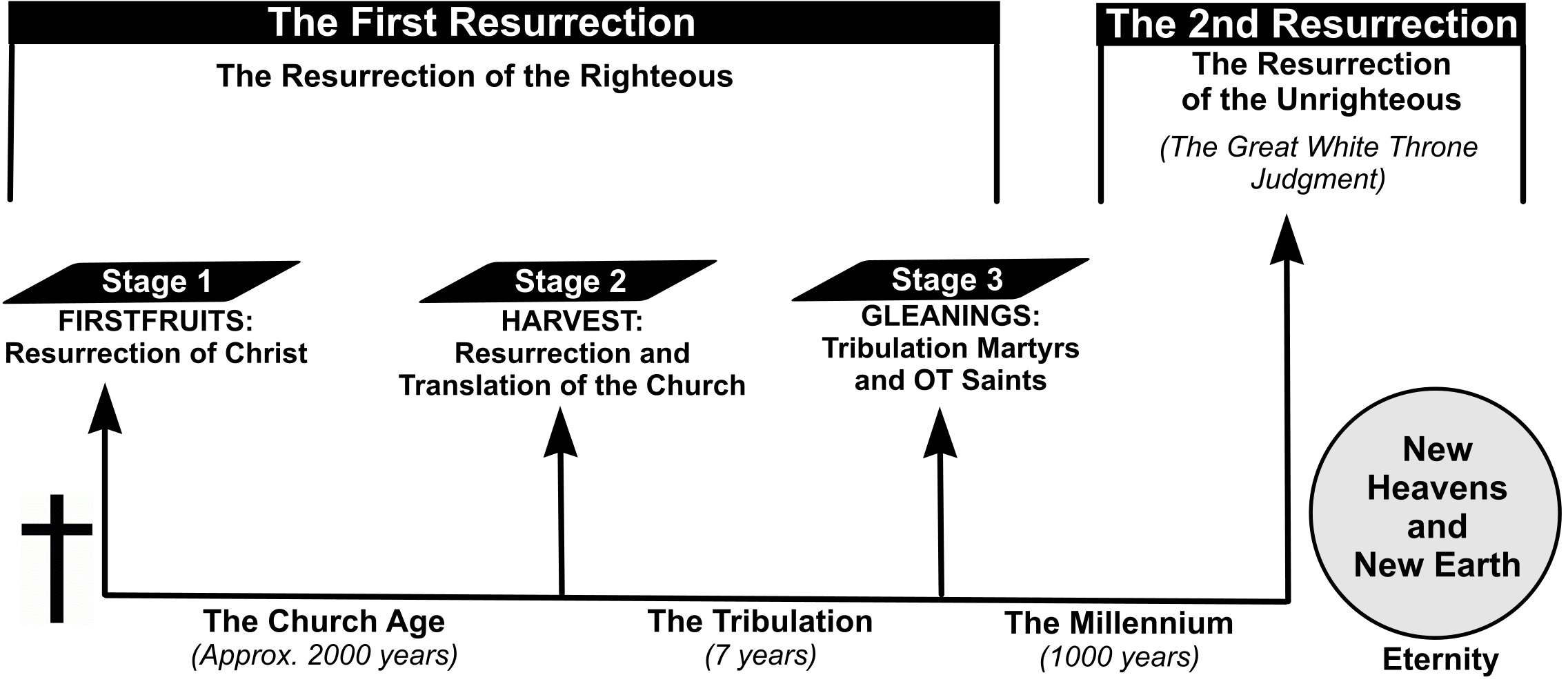
Revelation 20:4-6 speaks of the third stage of the resurrection of the righteous, which is called “the First Resurrection.” This stage of the First Resurrection takes place around the same time as the Sheep and Goat Judgment. Here’s a diagram explaining the three stages of the Resurrection of the Righteous; as well as the Resurrection of the Unrighteous:
(click image for enlargement and clarity)
The third stage of this resurrection is detailed in Revelation 20:4-6 and will be similar to the second stage, which takes place at the time of the Rapture: Living believers will receive their resurrection bodies and believers who died during the Tribulation (mentioned in Revelation 6:9-11 and 7:9-15) will receive their glorified bodies. For details on the resurrections go here.
I point this out to show that those judged at the Sheep and Goat Judgment are not born-again Christians, but rather the people of the world — non-Christians — who survive the Tribulation after Christ wipes out the Antichrist’s army with a mere word (Revelation 19:21). I’ll provide more support momentarily.
What Is the Sheep and Goat Judgment All About?
This judgment is all about judging these living, mortal unsaved people to determine who will suffer immediate damnation and who will receive eternal life and be allowed to enter into the Millennium as mortals, yet born-again spiritually, just like genuine believers in our era have eternal life while still physically mortal (John 3:36 & 1 John 5:11-12) and are promised a future resurrection with immortal, glorified bodies (1 Corinthians 15:42-44).
Those judged at the Sheep and Goat Judgment are all non-Christians. Yet it will be certain to them at this juncture that Jesus is Lord because he has literally returned to the Earth, taken authority of the situation, and is now standing before them. Thus the criteria Christ will use at this judgment is not belief in Christ, that is, the gospel (which will be preached during the Tribulation via the 144,000 Hebrew evangelists and their converts, not to mention an angel, as Revelation 14:6 shows).
So how does the Lord judge them? Those designated “sheep” will receive eternal life via spiritual rebirth (just like us today) and will be allowed to enter the Millennium — as mortals — because they assisted persecuted/needy believers during the Tribulation, which will include the aforementioned 144,000 and their millions of converts.
Not being part of the one-world Babylonian system, such believers during the Tribulation will naturally face hunger, thirst, outcast status, unjust imprisonment and need for clothes/shelter. Christ will judge the living nations as to how they treated him — his body, the Body of Christ — during the Tribulation. This is in line with the “cup of cold water” principle:
“And if anyone gives even a cup of cold water to one of these little ones who is my disciple, truly I tell you, that person will certainly not lose their reward.”
Matthew 10:42
The fact that Jesus says “Truly I tell you, whatever you [non-Christians] did for one of the least of these brothers and sisters of mine [believers], you did for me” (verse 40) shows that he’s talking about how these people treated the body of Christ during the Tribulation. This is similar to what Jesus said to Paul when unbelieving Saul persecuted the church:
Meanwhile, Saul was still breathing out murderous threats against the Lord’s disciples. He went to the high priest 2 and asked him for letters to the synagogues in Damascus, so that if he found any there who belonged to the Way (i.e. Christianity), whether men or women, he might take them as prisoners to Jerusalem. 3 As he neared Damascus on his journey, suddenly a light from heaven flashed around him. 4 He fell to the ground and heard a voice say to him, “Saul, Saul, why do you persecute me?”
5 “Who are you, Lord?” Saul asked.
“I am Jesus, whom you are persecuting,” he replied.
Acts 9:1-5
This shows beyond any shadow of doubt that the “living nations” whom the Lord judges at the Sheep and Goat Judgment are all unsaved non-Christians. I say “living” nations because Jesus says nothing about resurrecting the dead from Sheol at this judgment, as will be the case with the Great White Throne Judgment; and, furthermore, Matthew 25:31-32 specifically says: “When the Son of Man comes in his glory, and all the angels with him, he will sit on his glorious throne. All the nations will be gathered before him.” It’s referring to people of all nations still alive at Christ’s Second Coming. Again, this is the context.
This answers a point a minister made about this judgment:
Jesus won’t be saying to the sheep on His right, “Enter into the kingdom prepared for you from the foundation of the world, because your doctrinal positions were spot on.”
What this brother says is true because the people Christ evaluates at this judgment aren’t even believers to begin with; so it’s unlikely that they would know much, if any, biblical Christian doctrine, let alone be held accountable for it. The Lord will judge these people solely based on how they treated Christ’s “brothers and sisters” during the Tribulation, which — again — is in line with the “cup of cold water” principle of Matthew 10:42.
As for judging people for their doctrinal positions, this will happen to believers at the Judgment Seat of Christ. James 3:1 says point blank that those who teach God’s Word will be “judged more strictly,” which shows that they will be judged according to the true or false doctrinal positions they spread. This will even include any bible-themed Facebook & Twitter posts, etc. Whoever teaches from the Scriptures will be judged for it and rewarded or penalized accordingly, depending on if what they conveyed was true or false or (in some cases) somewhere in between. You can read more about the Judgment Seat of Christ here.
While you can certainly teach important principles from the Sheep and Goat Judgment (aka the Judgment of Living Nations), like how the Lord wants us to meet the immediate needs of suffering believers and people in general, this judgment is only applicable to the unregenerated living nations at the time of Christ’s Second Coming to the Earth. To take the Sheep and Goat Judgment and apply it to the Judgment Seat of Christ is a case of misapplying a passage. It’s not even applicable to the Great White Throne Judgment because that judgment comprises resurrected unsaved people from throughout history and at least half of them would never have even met a Christian, which means it would be impossible for Christ to judge them based on how they treated Christ’s “brothers and sisters” or anyone else in covenant with God, like Old Testament saints.
We’ll get back to the Sheep and Goat Judgment shortly. It’s necessary at this point to briefly touch on some related issues…
The Salvation Equation
While genuine believers’ works will be evaluated at the Judgment Seat of Christ they’re not saved by their works, as Paul declared: “at the present time there is a remnant chosen by grace. And if by grace, then it cannot be based on works; if it were, grace would no longer be grace” (Romans 11:5-6) and, of course, Ephesians 2:8-9: “For it is by grace you have been saved, through faith—and this is not from yourselves, it is the gift of God— not by works, so that no one can boast.”
So we are saved by God’s grace—His graciousness—through faith and not by works (deeds). This is a foundational truth and it’s absolutely imperative to grasp it, but some people have gotten off-balanced and misinterpreted it to mean that works/deeds are next to meaningless when nothing could be further from the truth. True faith always automatically produces works and this is obviously what James meant in James 2 in light of the clarity of the above passages:
You see that a person is considered righteous by what they do and not by faith alone… 26 As the body without the spirit is dead, so faith without deeds is dead.
James 2:24,26
With this data in mind, if we were to come up with a biblical equation to correspond to salvation in Christ (like 2 + 2 = 4) how would we phrase it? Here it is:
True Faith = Salvation (+ Fruit + Works)
All this equation means is that genuine faith results in eternal salvation and also fruit of the spirit & the corresponding works. You’re not saved by works; you’re saved by faith; and true faith produces fruit, which — in turn — produces works (deeds).
We already know by the above passages that faith naturally results in works or deeds. So let me explain why I added ‘fruit’ to the equation and how it ties into our topic.
Genuine faith will naturally produce the fruit of the spirit (Galatians 5:19-23) as the believer learns to put off the old self and live according to his/her new nature with the help of the Holy Spirit (Ephesians 4:22-24). Such believers will automatically start to produce the various fruits of the spirit, including love, kindness and goodness. This, in turn, results in good works, which means deeds or actions, if you look up the Greek word.
Here are a couple examples: I love some brothers who are in prison and so I sacrifice the time in order to write, phone & visit them periodically; or you may buy a sister a new pair of glasses because she lacks the funds. Such good works spring from the fruit we’re already bearing because we’re spirit-controlled and not flesh-ruled. This explains Paul’s prayer for the Colossian believers to “bear fruit in every good work” (Colossians 1:10), which shows that it’s possible to do a work without bearing fruit of the spirit. Meaning: We can do good works in the flesh; that is, produce good works while controlled by the sinful nature. Quasi-Christian religionists (e.g. Mormons & the Jehovah’s False Witnesses), Muslims and Sciencefictionologists do this all the time. This explains Paul’s observation in the love chapter: “If I give all I possess to the poor and give over my body to hardship that I may boast, but do not have love, I gain nothing” (1 Corinthians 13:3).
This all ties into something Christ taught:
15 “Watch out for false prophets. They come to you in sheep’s clothing, but inwardly they are ferocious wolves. 16 By their fruit you will recognize them. Do people pick grapes from thornbushes, or figs from thistles? 17 Likewise, every good tree bears good fruit, but a bad tree bears bad fruit. 18 A good tree cannot bear bad fruit, and a bad tree cannot bear good fruit. 19 Every tree that does not bear good fruit is cut down and thrown into the fire. 20 Thus, by their fruit you will recognize them.
21 “Not everyone who says to me, ‘Lord, Lord,’ will enter the kingdom of heaven, but only the one who does the will of my Father who is in heaven. 22 Many will say to me on that day, ‘Lord, Lord, did we not prophesy in your name and in your name drive out demons and in your name perform many miracles?’ 23 Then I will tell them plainly, ‘I never knew you. Away from me, you evildoers!’ ”
Matthew 7:15-23
As you can see, the Messiah said we can recognize false ministers by their fruit or lack thereof. These religionists who come before Jesus to be judged are proud of their good works and, incredibly, boast of them (it’s what proud religionists do). But the Lord says he never knew them because they were “evildoers” (i.e. “workers of iniquity”). Since Christ does not dispute their good works—prophesying, exorcising demons and performing miracles—we can assume that they really performed these religious deeds. The problem is that they were “evildoers” who practiced iniquity, which shows they were flesh-ruled with no care to “keep in repentance” (Matthew & Luke 3:8). In other words, their regular sinful actions testified against them despite their good works. We’re talking about people like the Pharisees who regularly performed good works (mostly as a show to convince themselves and others how “godly” they supposedly were) while unrepentantly living in the flesh in secret.
The “Sheep” Who Are Allowed to Enter the Millennium
Let’s get back to the Millennium and the “sheep” who are allowed to enter it as born-again believers: These mortals will breed throughout the thousand years all over the world and, despite the completely righteous government of Christ, many of their descendants will be susceptible to the devil’s deception when he’s released from the Abyss at the end of the Millennium to “deceive the nations in the four corners of the earth” (Revelation 20:7-8). Satan coerces them through deception to, amazingly, attack Christ and his righteous government in Jerusalem. These deceived descendants of the original “sheep” illustrate that they’re not truly believers and therefore not spiritually regenerated (even if they genuinely were at one point), just like there are confessing Christians in our midst who just go through the motions but aren’t actually born of Christ’s seed (1 Peter 1:23 & 1 John 3:9). Thankfully, this won’t be the case in the eternal age-to-come because there won’t be any mortals with ungodly natures.
While life during the Millennium will be a veritable utopia compared to our current age because of (1.) the righteous government of Christ and (2.) the absence of the devil and his filthy spirits to deceive people, there will still be sin because mortals will yet have sinful natures, which explains why many of them will be open prey to Satan’s deceptions when he’s released from the Abyss at the end of the thousand years. There will also be aging, pain and death despite the return of longer lifespans. Not to mention the earth and universe will yet be burdened by the bondage to decay, which is entropy.
For more on the Millennium go here.
“Produce FRUIT in Keeping With Repentance”
The Greek for ‘fruit’ in Matthew 7:15-23 (quoted above) is the same word for ‘fruit’ in Galatians 5:22-23 (karpos) and so refers to the fruit of the spirit, which of course includes holiness (as there are more than just nine fruits of the spirit and Ephesians 4:24 shows that holiness is one of ’em). One could even make the argument that holiness is the whole of the fruits of the spirit, indicating that the believer is spirit-controlled with the help of the Holy Spirit rather than flesh-ruled. You can read more about this here.
The “false prophets” Jesus refers to in Matthew 7:15-23 obviously weren’t naïve young believers, but rather seasoned people who proposed to speak for God in their “ministry” on earth. Yet Christ condemns them. Despite their great religious works and the boasting thereof, they will be damned. This passage shows that good works by themselves won’t save people.
While I suppose it could be argued that they were unbelievers all along, it’s more likely that they started out sincere, but were corrupted at some point, which is possible in light of clear passages like Galatians 5:21, Hebrews 10:26-27 and 2 Peter 2:20-21.
This, of course, begs the question: How long can a genuine believer walk in known sin without care of repentance before the Lord cuts him/her out of the kingdom? The Parable of the Barren Fig Tree shows us:
“But unless you repent, you too will all perish.”
6 Then he told this parable: “A man had a fig tree growing in his vineyard, and he went to look for fruit on it but did not find any. 7 So he said to the man who took care of the vineyard, ‘For three years now I’ve been coming to look for fruit on this fig tree and haven’t found any. Cut it down! Why should it use up the soil?’
8 “ ‘Sir,’ the man replied, ‘leave it alone for one more year, and I’ll dig around it and fertilize it. 9 If it bears fruit next year, fine! If not, then cut it down.’ ”
Luke 13:5-9
The symbolism in the parable is obvious: The owner of the vineyard represents God, the fruitless fig tree represents an individual in covenant with God who’s not bearing fruit, and the caretaker represents Jesus, the mediator between the owner and the fig tree. The owner (God) wants to cut the fig tree down because it hasn’t produced fruit in three years, but the caretaker (Jesus) intercedes and convinces the owner to give the tree one more year wherein the caretaker will do everything he can to get it to be fruitful. If the tree still hasn’t produced fruit by the end of the fourth year the owner and caretaker agree to cut it down and remove it from the vineyard. ‘Fruit,’ by the way, is the same Greek word Karpos (kar-POS) as above.
What we see in this story is patience, mercy and grace: The owner of the vineyard and the caretaker, who represent the heavenly Father and Jesus, are willing to give the tree a total of four years to be fruitful before ultimately removing it from the vineyard, if they must. The story is figurative so we can’t take it strictly literal, i.e. that God will pluck someone out of the kingdom if they’re fruitless for exactly four years. What we can get from it, however, is that God’s patience, mercy and grace are awesome and He will do everything He can to get us to be fruitful. He’s invested in us greatly and understandably wants us to be productive. Another thing we can get from the parable is that when the Lord’s mercy ends His judgment begins and he’ll cut off when/if necessary.
The New Testament instructs us to “produce fruit in keeping with repentance” (see Matthew & Luke 3:8 where ‘fruit’ is the same Greek word karpos). We produce fruit, of course, by walking in the spirit—being spirit-controlled rather than flesh-ruled. The book of Ephesians calls this “walking as children of the light” and adds “for the fruit of the light consists in all goodness and righteousness and truth” (Ephesians 5:8-9).
Obviously there’s a link between producing fruit and keeping with repentance: Believers who fail to “keep with repentance” are less likely to produce fruit since they’re obviously more flesh-ruled than spirit-controlled. Only when believers genuinely repent after being convicted will God forgive them and cleanse them from all unrighteousness (1 John 1:8-9). This is walking in God’s grace (favor). Those who stubbornly resist repenting, however, harden their hearts. The more they do this the harder their hearts become. The book of Hebrews refers to it as “sin’s deceitfulness” (Hebrews 3:8,12-13). It can get to the point where they stop producing fruit to God altogether because they’re in a state of non-grace due to the build-up of sin which isn’t forgiven and therefore they’re not purged of the corresponding unrighteousness. When believers backslide into this hardhearted, fruitless mode the Parable of the Barren Fig Tree applies: After a generous “grace period” these fruitless, unrepentant ‘believers’ will be cut out of the kingdom, just like the fruitless fig tree is rooted out of the vineyard. Such people would include the false ministers addressed in Matthew 7:15-23, detailed above.
The Judgment Seat of Christ—The Judgment of Believers
Speaking of that Matthew 7:15-23, it’s likely a reference to the Judgment Seat of Christ, which is where members of the Church will stand before the Lord and give an account.
The basis for eternal salvation at the Judgment Seat is not good works; if it were, the believing thief on the cross wouldn’t be saved. It all comes down to whether a person is in Christ or not in Christ—that is, in the kingdom on not. This explains The Parable of the Wedding Banquet from Matthew 22 where the person without “wedding clothes” is rejected and condemned, like the fruitless “prophets” of Matthew 7:15-23. Believers are either “clothed with Christ” or not. Those who aren’t are in for a rude awakening when they stand before the Lord because they’re no longer even believers, as far as God is concerned. They’ve been “rooted from the vineyard.” While good works and the motive for them will be evaluated at the Judgment Seat, and believers will be rewarded or penalized accordingly, their good works don’t determine their salvation.
Another Example of Misapplying the Sheep and Goat Judgment
As already covered, James statement in James 2:24 was later clarified by Paul—clearly the greater apostle—in Romans 11:5-6, Ephesians 2:8-9 and Colossians 1:10. Scripture interprets Scripture; and nowhere in the epistles do we see good works being the criteria for salvation. For instance, when Paul encourages believers to “excel in the grace of giving” he doesn’t add “because, if you don’t, you’re a wicked goat condemned to the lake of fire!” (2 Corinthians 8:7). In the same context of giving to needy believers he says “Whoever sows sparingly will also reap sparingly, and whoever sows generously will also reap generously” (2 Corinthians 9:6). Once again, he doesn’t link donating money to eternal damnation or salvation. While giving to the poor is important and obviously a focal point of some ministries it’s not the all-and-end-all of Christianity.
In the same context Paul says “Each of you should give what you have decided in your heart to give, not reluctantly or under compulsion, for God loves a cheerful giver” (2 Corinthians 9:7). The LORD only wants believers to give out of a giving heart that’s happy to give; he doesn’t want believers to give reluctantly or under compulsion—which includes being coerced by ministers preaching condo. There’s no condo in Paul’s request for funds for needy Christians in this section of Scripture (2 Corinthians 8-9). He shares the need, encourages the Corinthians to give, stresses that they’ll be rewarded, and then adds that they should only give what they decide to gladly give. This is the only way they’ll be blessed for their giving; otherwise they’d be giving from the flesh to earn salvation or whatever, which is what Hindus, Muslims, et al. do.
Another thing we can get from this passage is that Paul didn’t view believers as pawns to fund ministry projects that he considered important, including altruistic ones. He respected and loved the believers where they were spiritually and permitted them to make up their own minds as led of the Spirit (or not led of the Spirit).
I bring this up because I’ve heard the Sheep and Goat Judgment misapplied by some ministers for the purpose of manipulating believers into giving money for their altruistic ministry projects. These projects may be wonderful, but it doesn’t condone the practice of using condo by misapplying a passage in order to twist believers’ arms into donating money.
Of course it’s true that faith without deeds is dead, which would mean that the believer who lacks good works also lacks fruit of the spirit since authentic good works are always a natural extension of the fruit of the spirit and therefore any other good work is a dead work because it stems from the flesh. But, I should stress, a fruitless believer isn’t kicked out of the kingdom immediately; he/she is given a gracious time period to produce fruit because God is merciful & patient and greatly desires for them to be productive, as the Parable of the Barren Fig Tree shows.
The fact that good works are not the basis for salvation for believers at the Judgment Seat of Christ is further proof that the people judged at the Sheep and Goat Judgment are all unsaved non-Christians because they are all judged by their works.
Unsaved people aren’t judged according to the gospel because they never received it; as such, God judges them “according to what they had done as recorded in the books” where “their consciences (will) bear witness, and their thoughts will either accuse or excuse them” (Roman 2:12-16 & Revelation 20:11-15). “What they had done” would include rejecting (or, at least, ignoring) the message of Christ for those of whom this applies.
The False Prophets of Matthew 7:15-23 and the Judgment Seat of Christ
As stated earlier, it’s likely that Matthew 7:15-23 is a depiction of the Judgment Seat of Christ even though the Lord rejects the false ministers. How so? These people confess Jesus as Lord and illustrate that they performed great works, like prophesying, exorcizing demons and miracles, which implies that they functioned within church circles. The Lord doesn’t deny that they did these good works, but condemns them. The implication is that these confessing “Christians” are shocked by Christ’s rejection. We can therefore assume that the Judgment Seat is for anyone who confesses Jesus as Lord or were in the kingdom at some point. With this understanding, notice that Jesus doesn’t judge them by their good works because they had good works; instead he judges them by their fruit or lack thereof, which indicates that they were flesh-ruled “evildoers” despite their good works! This is in contrast to the Sheep and Goat Judgment where Christ judges the people solely on the basis of their good works; and, more specifically, by how they treated persecuted believers during the Tribulation.
This article is available in print form in chapter 6 of…
- The print book is available here for only $6.78 (155 pages).
- Or get the Kindle eBook here for just 99¢!
Both links allow your to LOOK INSIDE the book.
Related Topics:
Universalism, Inclusivism, Restrictivism, Purgatory and the Judgment Seat of Christ
RESURRECTIONS: Firstfruits, Harvest & Gleanings
Second Coming of Christ — Rapture and Return to Earth
Millennial Reign of Christ — Why?
The Salvation Equation: Faith = Salvation (+ Fruit + Works)
RESURRECTIONS: Firstfruits, Harvest & Gleanings

Whether believers know it or not, the resurrection of the dead is one of The Six Basic Doctrines of Christianity, as shown in Hebrews 6:1-2. Unfortunately, it’s rarely taught and so the body of Christ is largely ignorant on the topic. This article will help rectify the problem.
The Bible speaks of two types of resurrections…
The Resurrections of the Righteous and the Unrighteous
Jesus and Paul plainly declared two basic resurrections:
“for a time is coming when all who are in their graves will hear his voice (29) and come out—those who have done what is good will rise to live, and those who have done what is evil will rise to be condemned.”
John 5:28-29
having hope toward God, which they themselves also wait for, that there is about to be a rising again of the dead, both of righteous and unrighteous;
Acts 24:15 (YLT)
As you can see, there will be resurrections of both the righteous and unrighteous. This doesn’t mean, however, that there will only be two resurrections in number, just that there are two types of resurrections: 1. The resurrection of the righteous and 2. the resurrection of the unrighteous. The former is called “first resurrection” in Scripture (Revelation 20:5-6), which makes the latter the second resurrection.
The second resurrection takes place at the time of the Great White Throne Judgment, detailed here:
Then I saw a great white throne and him who was seated on it. The earth and the heavens fled from his presence, and there was no place for them. (12) And I saw the dead, great and small, standing before the throne, and books were opened. Another book was opened, which is the book of life. The dead were judged according to what they had done as recorded in the books. (13) The sea gave up the dead that were in it, and death and Hades gave up the dead that were in them, and each person was judged according to what they had done. (14) Then death and Hades were thrown into the lake of fire. The lake of fire is the second death. (15) Anyone whose name was not found written in the book of life was thrown into the lake of fire.
Revelation 20:11-15
This massive judgment concerns every dead soul contained in Hades (Sheol) after the thousand-year reign of Christ on this earth, which means it involves every unredeemed person throughout history. It does not include Old Testament holy people because they had a covenant with the LORD and will be resurrected after the 7-year Tribulation and before the Millennium, which we’ll examine later this chapter.
The second resurrection is covered in this article; or pick up my book HELL KNOW, for even more details. Both examine the nature of the “second death”—i.e. being thrown into the lake of fire (verses 14-15), but the latter also explores the question of whether or not every person who partakes of this resurrection will automatically be cast into the lake of fire. For instance, what about those who never heard the gospel? What about those who heard the gospel but didn’t understand it for one legitimate reason or another? What about those who rejected it because it was either a flawed, religionized version of the gospel or it came with serious baggage, like imperialism? Every legitimate minister of God’s Word must consider these obvious questions and try to answer them based on what the Bible says and simple common sense. I would be seriously skeptical of anyone who doesn’t do this, particularly those who write off such questions in preference to the official position of whatever group they adhere to, which is an example of rigid sectarianism. Staunch sectarianism actually hinders the truth and, in fact, is a form of legalism, i.e. counterfeit Christianity. Remember, Jesus said it’s the truth that will set us free (John 8:31-32), so anything that hinders the acquisition of truth is not good.
You can read more about this here (Scroll down to the sections on Post-Mortem Evangelization and Inclusivism and Restrictivism).
The Resurrection of the Righteous
The first resurrection is the resurrection of the righteous, meaning those in right-standing with God. Again, when Jesus and Paul spoke of two basic resurrections they were talking about types of resurrections and not numbers. While there’s only one resurrection of the unrighteous, the resurrection of the righteous takes place in stages, which correspond to the analogy of a harvest.
In biblical times the harvest took place in three basic stages: 1. the firstfruits, 2. the main harvest, and 3. the gleanings. The harvest began with the firstfruits, which concerned the first fruits and grains to ripen in the season and were offered to the LORD as a sacrifice of thanksgiving (Exodus 23:16,19). Later came the general harvest (Exodus 23:16) and, lastly, the gleanings, which were leftovers for the poor and needy (Leviticus 19:9-10).
Let’s examine the three stages:
1. The Firstfruits. Paul described Jesus as the firstfruits here:
But Christ has indeed been raised from the dead, the firstfruits of those who have fallen asleep. (21) For since death came through a man, the resurrection of the dead comes also through a man. (22) For as in Adam all die, so in Christ all will be made alive. (23) But each in turn: Christ, the firstfruits; then, when he comes, those who belong to him.
1 Corinthians 15:21-23
Just as the firstfruits of the harvest were a sacrifice to the LORD so Jesus Christ was sacrificed for our sins and raised to life for our justification (Romans 4:25); hence, he’s the firstfruits of the resurrection of the righteous.
2. The General Harvest. Verse 23 shows that the main harvest takes place when Jesus returns for the church—his “bride”—which is the Rapture, detailed in 1 Thessalonians 4:13-18. This harvest includes physically-alive believers translated to heaven.
3. The Gleanings refer to the righteous who were not included in the main harvest and are, as such, “leftovers.” This resurrection takes place at the time of Jesus’ return at the end of the Tribulation. Jesus’ return to earth to establish his millennial reign is separate from the Rapture, which is when the general harvest occurs. Remember, when Jesus comes for his church he doesn’t return to earth, but rather meets believers in the sky (1 Thessalonians 4:17). We’ll address this in a forthcoming section. The gleanings include the resurrection of Old Testament saints—at least a bodily resurrection, but more likely a soulish/bodily resurrection (more on this later)—as well as the bodily resurrection of believers who died during the Tribulation.
The “gleanings” will also include believers who physically die during the Millennium. Some argue that such a resurrection won’t be necessary because, as Isaiah 65:19-25 shows, lifespans will return to the lengthy durations of people before the flood, like Adam and Methuselah. However, this passage doesn’t actually say righteous people won’t die during the Millennium; notice what it says:
Never again will there be in it [Jerusalem] an infant who lives but a few days, or an old man who does not live out his years; the one who dies at a hundred will be thought a mere child; the one who fails to reach a hundred will be considered accursed.
Isaiah 65:20
The passage simply shows that lifespans will be greatly increased, as before the flood; it doesn’t say righteous people won’t die. In fact, it’s implied that blessed people will die by the reference to “an old man who does not live out his years.” Moreover, verse 22 says that God’s people will live as long as trees during the Millennium. Depending on the species, trees can live less than a hundred years or up to a few thousand, but they ultimately die.
Something else to consider: While it’s true that many people lived to be over 900 years old before the flood, it’s still not a thousand years, which is how long the Millennium will last. Also, some people died well short of 900-plus years; for instance, Lamech died at 777.
Someone might argue: How can both the resurrection of the righteous at the beginning of the Millennium and another resurrection at the end be considered “gleanings” since they’re separated by a thousand years? Answer: Because the very word “gleanings” implies more than one gleaning; after all, the poor gleaned the harvested fields more than once in biblical times. Also, Psalm 90:4 and 2 Peter 3:8 show that a thousand years is like a day to the LORD, so the two gleanings occur only one day apart from the Divine perspective.
Why is it Called the “First Resurrection”?
The resurrection of the righteous is called the “first resurrection” in this passage:
I saw thrones on which were seated those who had been given authority to judge. And I saw the souls of those who had been beheaded because of their testimony about Jesus and because of the word of God. They had not worshiped the beast or its image and had not received its mark on their foreheads or their hands. They came to life and reigned with Christ a thousand years. (5) (The rest of the dead did not come to life until the thousand years were ended.) This is the first resurrection. (6) Blessed and holy are those who share in the first resurrection. The second death has no power over them, but they will be priests of God and of Christ and will reign with him for a thousand years.
Revelation 20:4-6
The passage refers specifically to the bodily resurrection of Christian martyrs from the Tribulation, which John calls the “first resurrection.” By calling it the first resurrection is he saying that there were no resurrections before this? No, because Jesus Christ was resurrected at the beginning of the Church Age and believers will be resurrected bodily at the time of the Rapture while living believers will be translated; not to mention the resurrections of Enoch, Elijah and Moses as types, covered in Chapter Nine of SHEOL KNOW. Speaking of those three, their resurrections can be considered “taste-testing of the fruit” according to the harvest analogy.
Here’s a diagram that helps visualize the first and second resurrections and the three stages of the first:
(Click for enlargement and clarity)
By calling the resurrection of the righteous the “first resurrection” John may mean more than just first in order. The Greek word for “first” is prótos (PRO-toss), which also means principle, chief, honorable or most important. How is the resurrection of the righteous the more honorable resurrection? Because it entails the resurrection of people in right-standing with the LORD through covenant and spiritual rebirth (Titus 3:5 & Ephesians 4:22-24). Since this resurrection involves people who are in right-standing with their Creator, i.e. God’s children, it’s the more honorable resurrection and therefore the more important one to the LORD, just as the resurrection of your child would be more important to you than some stranger you never knew.
Someone might argue that all people are God’s children, even atheists. No, all people are creations of God, but only those born-again of the seed (sperm) of Jesus Christ by the Holy Spirit are children of God (1 John 3:9). Because of the death and resurrection of the Messiah, Old Testament saints who were in covenant with God automatically become spiritually-regenerated at the time of their resurrection.
‘Isn’t this too Complicated?’
Some might argue that the resurrection of the righteous, as mapped out in this chapter, is too complicated. This is perhaps one of the main reasons why the so-called “father of orthodoxy,” Augustine of Hippo, simplified human eschatology by inventing (or, at least, popularizing) the false doctrine of amillennialism. Believe it or not, this erroneous teaching suggests that we’re currently already in both the Millennium and Tribulation; and when believers or unbelievers die their immortal souls either go to heaven forever or suffer never-ending torment in hell. Incredibly, Augustine argued that biblical references to the new Jerusalem, new earth, new heavens and the believer’s new glorified body are all symbolic language for heaven! Talk about adding to and taking away from the Holy Scriptures, a practice repeatedly denounced in the Bible (see Revelation 22:18-19, Proverbs 30:6 and Deuteronomy 4:2).*
* See HELL KNOW for more information on Augustine and his false doctrines that corrupted the church, specifically Chapter Seven’s The Augustinian Corruption of Christendom and Chapter Nine’s The Good and Bad of Orthodoxy and Traditionalism (scroll down the section).
Getting back to our question: Is the resurrection of the dead too complicated? Think about it like this: When referencing a complex subject to someone who knows little about the topic it’s best to state the facts in the simplest of terms, which is how Jesus and Paul talked about the resurrection of the dead in John 5:28-29 and Acts 24:15 (both cited at the beginning of this chapter). Daniel did the same thing in Daniel 12:1-2. All three of these passages detail that there will be a resurrection of both the righteous and the unrighteous, which is true, but they don’t go any further than this. As such, we have to look to the rest of Scripture for more details and that’s what we’re doing in this chapter. This is in line with the hermeneutical rule “Scripture interprets Scripture” wherein the more clear and detailed passages offer necessary data that helps interpret the more ambiguous and sketchy ones.
Furthermore, the argument that “this is just too complicated” implies that truth—reality—must always be simple when this simply isn’t the case. Take brain surgery, for example. Is it simple or does it take years of schooling to master? How about computer technology, astronomy, world history, languages or law? How simple is the sewage system of any major city? How about the electrical grid of New York City? I could go on and on.
Yes, the resurrection of the dead is more complicated than what Augustine taught, but it’s certainly not too complicated for the average person to grasp. The above diagram illustrates that it’s actually not that complicated and it’s much less complicated than any of the topics just listed.
As noted at the beginning of this chapter, the resurrection of the dead is one of the six basic doctrines:
Therefore let us move beyond the elementary teachings about Christ and be taken forward to maturity, not laying again the foundation of repentance from acts that lead to death, and of faith in God, (2) instruction about baptisms, the laying on of hands, the resurrection of the dead, and eternal judgment.
Hebrews 6:1-2
Years ago I did a six-part series on these foundational doctrines, one sermon per each doctrine. A knowledgeable minister could easily do a series of teachings on every one of them. Unbelievably, in most Christian camps the six basic doctrines are almost utterly ignored. And then ministers wonder why many in their congregations act like spiritual babies. It’s because the pastors and teachers aren’t properly feeding them! This, by the way, explains the existence and mission of my ministry, Fountain of Life—to feed the body of Christ the rightly-divided Word of God; and to do this free of the constraints (hindrances, limitations) of rigid sectarianism (Matthew 4:4).
In any case, the writer of Hebrews was lamenting that the people he was addressing needed to be taught these basic doctrines all over again when they should’ve been teachers by this point (Hebrews 5:11-12). Now, think about it, if the topic of the resurrection of the dead was as simple as Augustine taught—that is, people just go to heaven or hell when they die to spend eternity in either bliss or torment—why would these people need to be taught the subject again? If the subject were that simplistic it’d take just a few minutes to teach and not a whole sermon or series of sermons. Moreover, if it were that simple how could the believers not grasp it the first time around?
Yes, the resurrection of the dead is sort of a complicated subject and that’s why this article exists.
This article was edited from chapter 11 of…

- The print book is available here for just over $10 (257 pages)
- The eBook is available here for just 99¢
- The more affordable Condensed Version is available here for only about $6.00 (153 pages); or get the eBook for just 99¢.
Related Topics:
Second Coming of Christ — Rapture and Return to Earth
Millennial Reign of Christ — Why?
Universalism, Inclusivism, Restrictivism, Purgatory and the Judgment Seat of Christ
Judgment Seat of Christ (the Judgment of Believers)
The Six Basic Doctrines of Christianity
Is Christ’s Body after Resurrection Physical or Spiritual (or Both)?
JUDGMENT SEAT of Christ (the Judgment of Believers)

I was corresponding via email with a “big-time” minister a year or two ago (a minister that has a TV show, etc.) and during our conversation it became clear that he wasn’t aware of the fact that believers will stand before the Lord to have our lives judged and rewarded or penalized accordingly. If he was unaware of this biblical truth then it’s likely that the body of Christ at large is as well. Let’s observe two of the main passages on the topic:
For we [Christians] must all appear before the judgment seat of Christ, that each one may receive what is due him for the things done while in the body, whether good or bad.
(11) Since then, we know what it is to fear the Lord, we try to persuade men.
2 Corinthians 5:10-11
You, then, why do you judge your brother or sister? Or why do you treat them with contempt? For we [believers] will all stand before God’s judgment seat… (12) So then, each of us [believers] will give an account of ourselves to God.
Romans 14:10, 12
These passages plainly show that all believers will stand before the Lord and be held accountable for how they lived their lives. They will receive what is “due” them for what they did while in the body—”whether good or bad.”
The Judgment Seat of Christ is the judgment that believers will experience; this is also called the Bema (BAY-mah) Judgment, named after the Greek word for “judgment seat.” Christians will not be evaluated at the Great White Throne Judgment, as that judgment only concerns spiritually-dead people (Revelation 20:11-15). The purpose of the Judgment Seat of Christ is to acknowledge and reward Christians for the good things they did while in the body and to rebuke and penalize them for the bad. The latter would include both sins of commission and sins of omission, as well as an appraisal of their works. A sin of commission is something that we do, like engage in malicious talk about people not present. A sin of omission involves something that we did not do that we should have done. For instance, if God prompts a lady to give someone in need a $100 and she doesn’t do it, or if the LORD calls a man into full-time ministry and he ignores the call. These are sins of omission.
Of course, the believer’s confessed sins are forgiven by the Lord (1 John 1:8-9). This means that God dismisses them when we ‘fess up — the penalty is canceled and He treats us as if we never committed them. Unconfessed sins, on the other hand, must be dealt with and judged for the Bible makes it clear that our Creator will hold Christians accountable for what we do or don’t do in this present age, as the two passages above show.
There’s something in the first passage that we need to consider. After stating Christians will receive what is due them for the good or bad things they did, the apostle Paul then says in verse 11: “Since then, we know what it is to fear the Lord.” The King James Version translates this as “Knowing therefore the terror of the Lord.” This statement makes no sense if people just receive rewards at the judgment seat of Christ (as I’ve heard some ministers erroneously teach). Knowing that Christians will be held accountable for the bad things they do in this life can inspire some healthy “terror.” For those of us who are Christians, it’s spiritually healthy to regularly remind ourselves that we will one day stand before the throne of God Himself and give an accounting of our lives. Needless to say, the fear of the Lord inspires holy (pure) living.
The fact that sins not dealt with in this age must be dealt with in the age to come is implied by Jesus’ declaration:
“Anyone who speaks a word against the Son of Man [Jesus] will be forgiven, but anyone who speaks against the Holy Spirit will not be forgiven, either in this age or the age to come.”
Matthew 12:32
The implication here is that some sins—sins not dealt with and forgiven in this age—must be dealt with and forgiven in the age to come. We will be held accountable for these sins at the Judgment Seat, penalized and ultimately forgiven. This does not in any way mean that the sufferings of Christ were insufficient to save us. All of our sins that are “under the blood” are forgiven; it’s the sins that are not “under the blood” when we die that must be dealt with at the Judgment Seat of Christ.
The Judgment Seat of Christ will also include an examination of our works. Some genuine Christians tend to be disinterested in the kingdom of God and consequently produce few “works” for the advancement of God’s kingdom in this life. Such an absence of works will be viewed as sins of omission. Regardless, our works will be examined and tested at the Judgment Seat.
In this passage Paul shows that a minister’s work will be judged:
If any man builds on this foundation (of Jesus Christ) using gold, silver, costly stones, wood, hay or straw, (13) his work will be shown for what it is, because the Day will bring it to light. It will be revealed with fire, and the fire will test the quality of each man’s work. (14) If what he has built survives, he will receive his reward. (15) If it is burned up, he will suffer loss; he himself will be saved, but only as one escaping through the flames.
1 Corinthians 3:12-15
This passage contextually refers to a pastor’s work of building a church congregation, that is, a group of Christian disciples (see verses 6-10 for verification). The foundation that the minister builds on is the foundation of salvation through Christ. The pastor can build on this foundation with gold, silver and costly stones or with wood, hay and straw. “Gold, silver and costly stones” is a metaphor for sound biblical doctrine and Christ-like leadership whereas “wood, hay and straw” represent unsound doctrine and ineffective or abusive leadership.
At the Judgment Seat of Christ every minister’s work will be tested by fire. If what they have built survives they will be rewarded. The only works that will survive are “gold, silver and costly stones.” If the ministers’ works are “wood, hay and straw” these works will be burned up. The ministers themselves won’t lose their salvation but they will certainly “suffer loss.” This indicates that even though it is technically their works that will be tested and burned up, these ministers will personally feel pain or discomfort as a result.
What about abusive pastors and teachers who administer “wood, hay and straw” to such a harmful degree that it severely damages people, even driving some away from the Lord—in effect destroying their Christian faith? Paul answers this question in the next two verses:
Don’t you know that you yourselves are God’s temple and that God’s Spirit lives in you? (17) If anyone destroys God’s temple, God will destroy him; for God’s temple is sacred and you are that temple.
1 Corinthians 3:16-17
This is a sobering warning for all Christian ministers. Paul makes it clear that every believer is “God’s temple”; every Christian is a sacred temple in which the Holy Spirit dwells. Verse 17 solemnly declares that God will destroy any person who destroys this temple. The context is referring to pastors and teachers who destroy Christians with their “wood, hay and straw,” which—again—represent unbiblical doctrine and abusive actions. Many have used verse 17 to preach against smoking and alcohol abuse but the context is plainly referring to ministers whose teachings and actions cause people to fall away from the Lord, in effect destroying God’s temple.
We all know what Paul’s talking about here. Jim Jones is a prime example of a supposed Christian minister whose work ultimately destroyed naïve believers and his work could therefore be categorized as “wood, hay and straw.” David Koresh is another fitting example. These are two well-known cases; I’m sure there are less extreme examples in your area.
Notice what verse 17 plainly says God will do to such a pastor or teacher whose work destroys people: “God will destroy him.” This means that God will cut the abusive, hypocritical minister off from salvation and cast him into the lake of fire where He will “destroy both soul and body,” as Jesus put it in Matthew 10:28. Please note that God will destroy such persons—eradicate them from existence, which includes the horror and torment thereof—not subject them to never-ending conscious torture. This is further support for the view of literal everlasting destruction.
Although this passage from 1 Corinthians 3 contextually refers to the testing of the work of pastors and teachers, we can apply it to all Christians because every believer is called to serve the Lord on this earth, even though the majority is not called to pastoral/teaching ministry. Each Christian will have works that God calls him or her to do and these works will be appraised at the Judgment Seat of Christ. For example, God will call Christians to witness to certain people in their lives; this work will ultimately be tested at the Judgment Seat. Their motives will be evaluated: Did they witness to these people because they love them as God loves them and are following the leading of the Holy Spirit or did they witness to them to fulfill an evangelistic quota or to appear pious? Needless to say, works produced from fleshly motives are “wood, hay and straw” and will be burned up.
All this explains why James said: “Not many of you should become teachers, my fellow believers, because you know that we who teach will be judged more strictly” (James 3:1). Those who preach and teach God’s Word will be held accountable for what they teach at the Judgment Seat of Christ. Needless to say, if you preach or teach the Word make sure that what you say is thoroughly biblical. Defending false teaching (doctrine) on the grounds that your mentor teaches it or your sect supports it won’t cut it. Don’t be a wimpy “yes man” or “yes woman” to the false doctrine others preach just because it’s popular and convenient to do so.
Jesus taught a parable that coincides with Paul’s teaching from 1 Corinthians 3:
“Who then is the faithful and wise manager, who the master puts in charge of his servants to give them their food allowance at the proper time? (43) It will be good for that servant who the master finds doing so when he returns. (44) I tell you the truth, he will put him in charge of all his possessions. (45) But suppose the servant says to himself, ‘My master is taking a long time in coming,’ and he then begins to beat the menservants and maidservants and to eat and drink and get drunk. (46) The master of that servant will come on a day when he does not expect him and at an hour he is not aware of. He will cut him to pieces and assign him a place with the unbelievers.”
(47) “That servant who knows his master’s will and does not get ready or does not do what his master wants will be beaten with many blows. (48) But the one who does not know and does things deserving punishment will be beaten with few blows. From everyone who has been given much, much will be demanded; and from the one who has been entrusted with much, much more will be asked.”
Luke 12:42-48
The “master” in this story is an obvious reference to Jesus Christ. He goes away and puts a “manager” in charge of his “servants” until his return. The “manager” refers to Christian ministers (apostles, pastors, teachers and so on) whom Christ puts in charge of believers, referred to as “servants.” The master (Jesus) instructs the manager (minister) to properly feed and take care of his servants (believers) until his eventual return. One of the primary tasks of Christian ministers is to “feed” the people under their care a proper scriptural diet so the believers can spiritually mature and learn to walk in newness of life in a living relationship with the Lord (see 1 Peter 2:2, Ephesians 4:11-15 and Hebrews 5:12-13). In verses 43-44 Jesus says that the minister who does this will be rewarded. He then brings up those ministers who will be penalized for their “wood, hay and straw” in verses 45-48.
Verse 45 shows an abusive minister who damages those under his “care,” not to mention indulges in gluttony and drunkenness. Verse 46 solemnly declares that such a minister will be “cut to pieces” and cast away as an unbeliever when Jesus returns.
Matthew tells the same story but adds that Jesus “shall cut him in pieces and assign him a place with the hypocrites; weeping shall be there and the gnashing of teeth (Matthew 24:51 NASB). As far as weeping and gnashing of teeth go, this is a solemn reminder that “It is a dreadful thing to fall into the hands of the living God” (Hebrews 10:31) for God’s enemies will experience “a fearful expectation of judgment and of raging fire that will consume the enemies of God” (Hebrews 10:27).
Concerning the weeping, if you were an unrepentant rebel against God, would you not be weeping the day you finally fell into His hands for judgment? And would you not be wailing as you are judged unworthy of eternal life and subsequently cast into a vast fiery furnace? Of course you would. This is why James warned rich oppressors to weep and wail for fear of God’s coming judgment, referred to as “the day of slaughter,” when fire will devour them (James 5:1-5).
As for gnashing of teeth, most of us might think that this is a reference to the experience of pain, but in the Bible “gnashing of teeth” describes the wrath of an adversary about to kill his victim – the teeth belong to the tormentor, not the tormented (see Job 16:9, Psalm 35:16, 37:12, Lamentations 2:16 & Acts 7:54). Psalm 112 is the only exception. The psalm starts by sharing how “Blessed is the man who fears the LORD” (verse 1), and goes on to describe such a person in verses 2-9. The final verse mentions the wicked person by contrast:
The wicked man will see and be vexed, he will gnash his teeth and waste away; the longings of the wicked will come to nothing.
Psalm 112:10
As in the other texts regarding “gnashing of teeth,” the wicked man’s gnashing of teeth is evidently an expression of his fury against the righteous. Yet even while he grinds his teeth in ineffective rage, he wastes away and comes to nothing. The phrase could, in this instance, be interpreted as a reference to pain.
Being “cut to pieces” refers to severe flogging. After this punishment is inflicted the recipient will be cast away to where all unbelievers and hypocrites (pretenders) are disposed of – the lake of fire where “raging fire will… consume the enemies of God” (Hebrews 10:26-27). This coincides perfectly with what Paul said would happen to abusive, false “ministers:” God will destroy them.
In verses 47-48 Jesus says that some “servants” will be beaten with many blows and some with few blows based on their level of spiritual maturity and awareness. The Messiah refers to these people as “servants” and not hypocrites, as is the case with the abusive minister noted in verses 45-46. So Jesus is talking about legitimate Christians who will be judged and penalized at the Judgment Seat. We can confidently conclude this because only believing Christians can be referred to as Christ’s “servants,” not unbelievers. The abusive minister in verse 45 is initially referred to as a “servant” but is exposed as a “hypocrite,” which literally means ‘actor.’ So we’re talking about a person who is only pretending to be a servant of Christ. He or she is a fake. This person may have begun as a legitimate Christian servant but somehow became corrupt over time. Position, power, pride, money, lust, etc. can easily corrupt any of us and cause us to fall away from the Lord if we fail to guard our hearts (Proverbs 4:23).
Whether the servant is punished with many blows or few blows, the fact is that this punishment is of a limited duration. The words “many” and “few” are not specific, but both indicate a limit to the “blows.” In other words, no one will sadistically suffer “many blows” without end throughout all eternity. Consequently, even if we were to misapply this passage to the damnation of unbelievers, it would still not support never-ending torment.
All the above lends support to the likelihood that this next passage refers to the Judgment Seat of Christ:
“Watch out for false prophets. They come to you in sheep’s clothing, but inwardly they are ferocious wolves. (16) By their fruit you will recognize them. Do people pick up grapes from thornbushes, or figs from thistles? (17) Likewise every good tree bears good fruit but a bad tree bears bad fruit. (18) A good tree cannot bear bad fruit, and a bad tree cannot bear good fruit. (19) Every tree that does not bear good fruit is cut down and thrown into the fire. (20) Thus, by their fruit you will recognize them.”
(21) “Not everyone who says to me, ‘Lord, Lord,’ will enter the kingdom of heaven, but only he who does the will of my Father who is in heaven. (22) Many will say to me on that day, ‘Lord, Lord, did we not prophesy in your name, and in your name drive out demons and perform many miracles?’ (23) Then I will tell them plainly, ‘I never knew you. Away from me, you evildoers!’ ”
Matthew 7:15-23
Jesus is warning people here about “false prophets.” ‘False prophets’ in the Greek is one compound word pseudoprohetes (soo-doh-prah-FAY-tus); pseudo of course means “false” and prophetes refers to “inspired speakers” or “those who propose to speak for God.” Hence, pseudoprophetes or “false prophets” refers to people who falsely speak for the LORD.
Jesus doesn’t want believers to be misled so he warns us in this passage about those who falsely speak for God and reveals how to recognize them. How do we recognize them? As you can see, Jesus twice says that they can be recognized by their fruit (verses 16 & 20). “Fruit” in this context refers to the “fruit of the spirit” or lack thereof, as shown in this passage:
The acts of the sinful nature are obvious: sexual immorality, impurity and debauchery; (20) idolatry and witchcraft; hatred, discord, jealousy, fits of rage, selfish ambition, dissensions, factions (21) and envy; drunkenness, orgies, and the like. I warn you as I did before, that those who live like this will not inherit the kingdom of God.
(22) But the fruit of the spirit is love, joy, peace, patience, kindness, goodness, faithfulness, (23) gentleness and self-control.
Galatians 5:19-23
As you can see, this passage contrasts the works of the flesh and the fruit of the spirit.* How can you tell if people are living out of their flesh or out of their spirit? By the “fruit” they bear on a consistent basis: Are they sexually immoral? Hateful? Quarrelsome? Jealous? Have childish fits of rage? Selfish? Envious? Given to drunkard-ness?** Rigidly sectarian (which is what “factions” refers to)? If so, they’re obviously walking according to their flesh. We’re not talking about someone who stumbles, then humbly confesses and gets back up (1 John 1:8-9), we’re talking about people who regularly produce these types of fleshly acts with no concern to repent or change, even when corrected. It’s stubborn, selfish arrogance, impure and simple. People who live out of their flesh like this are fleshly and therefore carnal. A confessing believer who regularly manifests these traits without care of repentance is a carnal-Christian—a Christian ruled by his/her carnal nature. Of course, a “carnal Christian” is a total oxymoron and, if a lasting condition, would indicate that the person isn’t even saved. After all, didn’t Jesus say we could distinguish the true from the false by their fruit?
* Since there is no capitalization in the original Greek, translators have to discern whether “spirit” should be capitalized in reference to the Holy Spirit or not capitalized in reference to the human spirit (e.g. Matthew 26:41). I maintain that whenever a text contrasts flesh and spirit, like Matthew 26:41 or Mark 14:38, “spirit” obviously refers to the human spirit. It makes little difference, however, in light of the fact that the believer’s human spirit is indwelt and guided by the Holy Spirit; hence, if we’re living out of our human spirit (uncapitalized), we’re automatically following the Holy Spirit and therefore living by the Spirit (capitalized).
** I should point out that being a drunkard is not the same as drinking a sip of alcohol. See Deuteronomy 14:26.
The point is that we can determine if people are living out of their spirit simply by the evidence and quantity of fruit of the spirit. Do you see love? Joy? Peace? Patience? Kindness? Goodness? Faith? Meekness (not weakness)? Self-control? If you generally see these fruits in people’s lives, they’re obviously living out of their spirit, meaning they’re spiritual. The more fruit you see, the more spiritual they are. You could also describe them as godly.
The false ministers that Christ notes in Matthew 7:15-23, however, are not godly. They confess Jesus as Lord and are now standing before Him in judgment. They boast of performing great works, like prophesying, exorcizing demons and miracles, with the implication that they functioned within church circles. The Lord doesn’t deny that they did these good works, but condemns them on the grounds that he “never knew them” because they were “evildoers.” These confessing “Christians” are no doubt shocked by Christ’s rejection.
This passage and others covered in this section show that the Bema Judgment is for anyone who confesses Christ as Lord or were in the kingdom at some point. With this understanding, notice that Jesus doesn’t judge the salvation of such people based on their good works because these false ministers had good works; instead he judges them by their fruit or lack thereof, which indicates that they were flesh-ruled “evildoers” despite their good works!
‘What About Eternal Security?’
This question is a natural response to the above data. I want to assure you that the Bible supports the doctrine of eternal security 100% in light of what Jesus said:
“My sheep listen to my voice; I know them, and they follow me. (28) I give them eternal life, and they shall never perish; no one will snatch them out of my hand. (29) My Father, who has given them to me, is greater than all; no one can snatch them out of my Father’s hand.”
John 10:27-29
Eternal security is true in the sense that no one can steal legitimate believers from their Father’s hand—no person, no circumstance, no devil, no demon. We have eternal life and we will never perish, that is, suffer the second death (Revelation 2:11). This is awesome! However, we must keep in mind the hermeneutical rule that Scripture interprets Scripture. Consequently, this passage must be interpreted in a balanced manner, taking into consideration all relevant passages on the topic, like this one:
Here is a trustworthy saying: If we died with him, we will also live with him; (12) if we endure, we will also reign with him. If we disown him, he will also disown us; (13) if we are faithless, he will remain faithful, for he cannot disown himself.
2 Timothy 2:11-13
Verse 13 is encouraging in that the Lord remains faithful even in light of our unfaithfulness; he won’t disown us. But verse 12 plainly declares that he will disown us if “we” disown him. This corresponds to Jesus’ statement: “Whoever acknowledges me before men, I will also acknowledge him before my Father in heaven. But whoever disowns me before men, I will disown him before my Father in heaven” (Matthew 10:32-33).
A skeptic once asked: “Could God make a stone so big He couldn’t lift it?” The answer is yes, the human will. You see God has blessed humanity with the power of volition. No one can snatch us from our Father’s hand except ourselves. We have a will and therefore the liberty to choose. This is why the LORD made this statement to the ancient Israelites:
“I have set before you life and death, blessings and curses. Now choose life,”
Deuteronomy 30:19
Although God encouraged them to choose life he couldn’t make them do it. Why? Because they had freewill. Similarly, if we choose to disown the Lord there’s nothing the Lord can do. His hands are tied. He must always be faithful to his Word, and his Word clearly states that he will disown us if we disown him.
Of course some will argue that, technically speaking, God will only disown us if we disown him and, therefore, believers can live like Satan for decades with no care of repentance and not lose their salvation as long as they don’t literally disown him with their tongues. Frankly, this is playing games with God. Jesus Himself addressed this issue with the fake religious leaders of first century Israel, the Pharisees and teachers of the law:
“Isaiah was right when he prophesied about you hypocrites; as it is written: ‘These people honor me with their lips, but their hearts are far from me.’”
Mark 7:6
First, note that Jesus calls these religionists “hypocrites,” which means ‘actors.’ In other words, although they were the learned religious leaders of Israel they were putting on an act, merely posturing. Everything they did and said was for show and not genuine. In short, they were fakes. Jesus follows up by quoting Isaiah, pointing out that it’s possible for people to say one thing while the truth of the heart is quite the opposite. Paul backed this up in Titus 1:16 when he warned Titus of false believers, including staunch legalists: “They claim to know God, but by their actions they deny him.”
So, whereas the Bible supports the doctrine of eternal security, it does not support the doctrine of unconditional eternal security, often referred to as “once saved always saved.” This is proven by numerous passages where believers are warned of the “deceptiveness of sin” and the dire consequences of an unrepentant sinful lifestyle and the ensuing falling away, such as Paul, Peter, Christ and the writer of Hebrews:
Or do you not know that wrongdoers will not inherit the kingdom of God? Do not be deceived: Neither the sexually immoral nor idolaters nor adulterers nor men who have sex with men (10) nor thieves nor the greedy nor drunkards nor slanderers nor swindlers will inherit the kingdom of God. (11) And that is what some of you were. But you were washed, you were sanctified, you were justified in the name of the Lord Jesus Christ and by the Spirit of our God.
1 Corinthians 6:9-11
If they have escaped the corruption of the world by knowing our Lord and Savior Jesus Christ and are again entangled in it and overcome, they are worse off at the end than they were at the beginning. (21) It would have been better for them not to have known the way of righteousness than to have known it and then turn their backs on the sacred command that was passed on to them.
2 Peter 2:20-21
“Those on the rocky ground are the ones who receive the word with joy when they hear it, but they have no root. They believe for a while, but in the time of testing they fall away.”
Luke 8:13
Let us not give up meeting together, as some are in the habit of doing, but let us encourage one another—and all the more as you see the Day approaching. (26) If we [believers] deliberately keep on sinning after we have received the knowledge of the truth, no sacrifice for sins is left, (27) but only a fearful expectation of judgment and of raging fire that will consume the enemies of God.
Hebrews 10:25-27
Please reflect on these passages; they’re unmistakable.
I realize that there are many believers out there who are fervent about their belief in unconditional eternal security, even stubborn. Several people have written me or spoken with me on the topic, attempting to correct, but none of them were able to explain these clear passages.*
* Here are some more in case you’re interested: Romans 11:19-24, Galatians 5:19-21, Galatians 6:7-8, Hebrews 3:6, 3:12 & 6:4-6, James 5:19-20, Jude 5, Matthew 10:22 and John 15:1-6.
I want to assure you that every believer’s salvation is secure as they “produce fruit in keeping with repentance” (Matthew & Luke 3:8). This is a vital aspect of the believer’s covenant with God and Christians ignore it to their own peril. You can only produce fruit of the spirit when you are walking in the spirit, which means being spirit-controlled rather than flesh-ruled (Galatians 5:19-23). Ephesians 4:22-24 shows that being “spirit-controlled” is a simple matter of 1. putting off your old nature—your sinful nature—2. being transformed by the renewing of your mind (Romans 12:1-2); and 3. putting on your new nature, which was “created to be like God in true righteousness and holiness.” As you do this you’ll naturally “walk in the spirit” and “participate in the divine nature” (Galatians 5:16,25 & 2 Peter 1:4).
What happens when you inevitably miss is? The Bible provides precise instructions for when this occurs:
If we claim to be without sin, we deceive ourselves and the truth is not in us. (9) If we confess our sins, he [God] is faithful and just and will forgive us our sins and purify us from all unrighteousness.
1 John 1:8-9
Temptation to sin is simply the enemy’s attempt to get the believer out of the realm of the spirit and back into the realm of the flesh via the carnal impulses of the flesh. When this happens, you must put into practice the above passage. Go to the Lord and humbly ’fess up. Confession stops prosecution and ushers in God’s forgiveness, purging unrighteousness. When you knowingly sin you enter into a state of non-grace because God holds that sin against you and you’re defiled by that sin. When you sincerely ’fess up, however, the Lord wholly dismisses it and cleanses you from “all unrighteousness,” which means you’re once again in a state of grace, i.e. God’s favor. This is how you “produce fruit in keeping with repentance.” It’s a simple principle and following it is vital for a healthy relationship with the Lord. It’s impossible to produce fruit while not keeping with repentance. Believers who do this will eventually be disciplined and, if choosing to remain unrepentant, will be in danger of being rooted out of the kingdom! The Parable of the Fruitless Fig Tree applies:
“…unless you repent, you too will all perish.”
(6) Then he told this parable: “A man had a fig tree growing in his vineyard, and he went to look for fruit on it but did not find any. (7) So he said to the man who took care of the vineyard, ‘For three years now I’ve been coming to look for fruit on this fig tree and haven’t found any. Cut it down! Why should it use up the soil?’
(8) “ ‘Sir,’ the man replied, ‘leave it alone for one more year, and I’ll dig around it and fertilize it. (9) If it bears fruit next year, fine! If not, then cut it down.’ ”
Luke 13:5-9
Christ is talking to Israelites—people in covenant with God—and he plainly tells them that they would all perish unless they repent, meaning they would suffer the everlasting destruction of the second death. This is in line with the axiom that “the wages of sin is death” (Romans 6:23). Luke 16:16 verifies that the turning point between the Old Testament and the New Testament was John the Baptist; once Christ entered into public ministry the good news of the kingdom of God was preached, meaning the new covenant. So, whereas the ensuing parable of verses 6-9 is applicable to Old Testament saints, it’s more so relevant to New Testament believers and addresses the question: How long can someone in covenant with God walk in known sin without care of repentance before the Lord cuts him/her out of the covenant?
The symbolism of the parable is obvious: The owner of the vineyard represents God; the fruitless fig tree represents an individual in covenant with God (owned by God through Christ*) who’s not bearing fruit; and the caretaker represents Jesus, the mediator between the owner and the fig tree. The owner wants to cut the fig tree down because it hasn’t produced fruit in three years, but the caretaker intercedes and convinces the owner to give the tree one more year wherein the caretaker will do everything he can to get it to be fruitful. If the tree still hasn’t produced fruit by the end of the fourth year the owner and caretaker agree to cut it down and remove it from the vineyard.
* See 1 Corinthians 6:19.
What we see here is patience, mercy and grace: The owner of the vineyard and the caretaker, who represent the heavenly Father and Jesus, are willing to give the tree a total of four years to be fruitful before ultimately removing it from the vineyard, if they must. The story is figurative so we can’t take it strictly literal, i.e. that God will pluck someone out of the kingdom if they’re fruitless for exactly four years. What we can get from it, however, is that God’s patience, mercy and grace are awesome and He will do everything He can to get us to be fruitful because a fruitless tree is a bad tree—a useless tree—and must be rooted out (Luke 6:43-45).
Salvation in Christ is solely determined by whether or not a person is in God’s kingdom—in God’s “vineyard”—through Christ. It’s not by good works, as verified by Romans 11:5-6 and Ephesians 2:8-9 (although, of course, true faith produces fruit, which—in turn—produces good works, as observed in Colossians 1:10 & James 2:14-26). If salvation was determined by good works then the believing thief on the cross wouldn’t be saved. So it all comes down to whether a person is in Christ or not in Christ—in the kingdom or not—which explains The Parable of the Wedding Banquet from Matthew 22:1-14 where the person without “wedding clothes” is rejected and condemned, like the fruitless “prophets” of Matthew 7:15-23. Believers are either “clothed with Christ” or not. Those who aren’t are in for a rude awakening at the Judgment Seat because they’re no longer even believers, as far as God is concerned. They’ve been “rooted from the vineyard.” While good works and the motive for them will be evaluated at the Judgment Seat, and believers will be rewarded or penalized accordingly, their good works don’t determine their salvation.
Those who rigidly advocate the “once saved always saved” doctrine argue that, if people fall away from the Lord, they were never really saved in the first place. They contend that such people merely dabbled in Christianity and their faith was never really sincere; consequently, any positive changes in their lifestyles were superficial, the result of practicing some Scriptural principles, but not actually knowing the Lord. Surely this is true, but the clear passages cited above and many others show that Christians can abort their salvation if they choose to neglect repentance and faith. We have eternal security in Christ as we “keep with repentance” and continue in faith because repentance and faith are the conditions for accepting the gospel (Acts 20:21). These conditions correspond to the first two of the six basic doctrines of Christianity (Hebrews 6:1-2). Chew on that.
This explains why the Bible stresses “keeping with repentance” and persevering in faith, as Paul pointed out:
He has now reconciled you in His fleshly body through death, in order to present you before Him holy and blameless and beyond reproach—if indeed you continue in the faith firmly established and steadfast, and not moved away from the hope of the gospel.
Colossians 1:22-23
If it takes faith to be saved it naturally follows that people cannot be saved if they come to a point where they no longer have faith. That’s simple enough to understand, isn’t it? Let’s not make the issue more complicated than it is. The Bible teaches that it’s through faith and perseverance that we inherit what is promised, including eternal salvation, not faith for a little bit and then giving up (Hebrews 6:12 & Luke 8:13).
For anyone who argues that there are no conditions to reconciling with God through the gospel then that would mean that everyone is saved or will be saved, which is universalism.
The fact that some believers fall away because they refuse to keep in repentance and continue in faith does not negate the good news of the gospel for those who obediently comply with these conditions. As long as the believer keeps in repentance and perseveres in faith their salvation is guaranteed. This explains why I never worry about my salvation: As long as you keep with repentance and continue in faith you’re saved. Period. So what’s the problem? There is no problem unless a person is living a lifestyle of sin with no care to repent. The Holy Spirit will always convict such people and move them toward repentance; unfortunately, some will resist the Spirit’s counsel, hardening their hearts further.
Suffice to say, don’t play foolish games with God. You can draw whatever conclusion on the matter that gives you peace and helps you sleep at night, just be careful not to play around with “the deceitfulness of sin” or encourage others to do so either. We’re all going to stand before the Lord and give an account one day where “each of us will receive what is due us for the things done while in the body, whether good or bad” (2 Corinthians 5:10-11 & Romans 14:10,12).
The obvious weakness of the “once saved always saved” teaching is that it can create spiritual complacency, whereas the weakness of the opposite extreme—that believers can lose their salvation at any moment—creates anxiety. Both of these positions are extremes and unscriptural. The sensible and balanced middle position is that a believer’s salvation is secure as one walks in the spirit and bears the fruit thereof, avoiding both complacency and insecurity. If you miss it, be quick to repent, and God will forgive you; this is “keeping with repentance.” Then continue moving forward knowing that “The path of the righteous is like the first gleam of dawn, shining ever brighter till the full light of day” (Proverbs 4:18). Such people have eternal security in Christ (John 10:27-29). Eternal security is a biblical doctrine, but unconditional eternal security is not. Do not be deceived (Galatians 6:7-8).
Summing-Up the Judgment Seat of Christ
Second Samuel 11-12 shows that David suffered loss for his sin with Bathsheba and indirect murder of Uriah; and 1 Corinthians 3:15 describes penalties at the Judgment Seat in terms of “suffering loss.” Verses 16-17 reveal what happens to those who are exposed as fakes, aka hypocrites (not to mention Matthew 7:15-23).
Jesus himself described the penalties for the saved in terms of being beaten with many or few blows (Luke 12:47-48). Whether many blows or few, the punishment is of limited duration.
So suffering loss and being justifiably beaten are the Scriptural descriptions of penalties for believers at the Judgment Seat. But keep in mind that being beaten with few or many blows is figurative language. In other words, believers will experience a penalty akin to a servant in the 1st century being justly beaten, but not abused.
I’m assuming that any such penalties will be addressed before rewards, but its clear that the former will negatively affect the latter, at least as far as “suffering loss” goes. For instance, Christ describes eternal rewards in terms of being placed in authority positions in two parables—Matthew 25:14-30 & Luke 19:15-19. These positions of authority are phrased as being “put in charge of many things” in Matthew and “taking charge of many cities” in Luke, both of which apply to the eternal age of the new heavens and new earth (2 Peter 3:13 & Revelation 21:1-5). See this article for details.
I find the biblical data in this article fascinating because you’ll rarely hear ministers teach on penalties at the Bema Judgment, which is understandable since people naturally want to hear about eternal rewards, not penalties. Yet these kinds of passages are good because they encourage believers to “keep in repentance” (Matt & Luke 3:8) and lead holy lives consecrated unto the LORD. The good thing about honestly keeping ‘fessed up (1 John 1:8-9) is that God forgives the offenses in this age so we don’t have to answer for them in the age-to-come. It’s why we are encouraged to wisely “examine” or “test” ourselves (2 Corinthians 13:5), which should be done on a regular basis. I want to hear “Well done good and faithful servant” and not “Dirk, I’m happy we’re reconciled and you have eternal life, but there are some issues we need to talk about.”
This article was edited from chapter 8 of…

- You can purchase a low-priced copy here (350 pages, about $12).
- Or get the Kindle eBook for only $2.99!
Both links allow you to LOOK INSIDE the book.
Related Topics:
Sheep and Goat Judgment — What’s It All About?
Universalism, Inclusivism, Restrictivism, Purgatory and the Judgment Seat of Christ
RESURRECTIONS: Firstfruits, Harvest & Gleanings
The Six Basic Doctrines of Christianity
DINOSAURS — Where Do They Fit?

Both old earth and young earth creationists acknowledge the existence of dinosaurs and the Bible mentions them several times. The behemoth and leviathan of Job 40-41 are obvious references to dinosaurs. Then there are the occasional references to literal “sea monsters” and “dragons” in other passages (I’m not referring to the figurative references), which are translated from the Hebrew word tannin (tan-NEEN) in the Old Testament. Psalm 74:13 and 148:7 are good examples. Keep in mind that the term ‘dinosaur’ wasn’t coined until 1842 by Britain’s leading paleontologist, Richard Owen.
Young earth advocates argue that there’s no need to place dinosaurs between the supposed gap of Genesis 1:1 and 1:2, as gap theorists do, because dinosaurs were created by God during the creation week (Genesis 1:21). As such, contrary to the staunch claims of academics, humans and dinosaurs existed at the same time, which can be observed in ancient art from around the world and explains the legends of warriors fighting dragons.
Several examples of ancient art (and fossils) offering evidence of humans and dinosaurs coexisting can be observed here. One of the pics shows an obvious stegosaurus appears alongside other conventional animals, like a deer, a rat and a monkey.
So how did the dinosaurs die out with a possible vestige still living today in the vast oceans and perhaps even remote areas of the earth, like mokele mbembe (moh-kay-lay um-bem-bay), which reportedly dwells in the Congo River basin? Ken Ham says:
According to the Bible: Dinosaurs first existed around 6,000 years ago. God made the dinosaurs, along with the other land animals, on Day 6 of the Creation Week (Genesis 1:20–25, 31). Adam and Eve were also made on Day 6—so dinosaurs lived at the same time as people, not separated by eons of time.
Dinosaurs could not have died out before people appeared because dinosaurs had not previously existed; and death, bloodshed, disease, and suffering are a result of Adam’s sin (Genesis 1:29–30; Romans 5:12, 14; 1 Corinthians 15:21–22).
Representatives of all the kinds of air-breathing land animals, including the dinosaur kinds, went aboard Noah’s Ark. All those left outside the Ark died in the cataclysmic circumstances of the Flood, and many of their remains became fossils.
After the Flood, around 4,300 years ago, the remnant of the land animals, including dinosaurs, came off the Ark and lived in the present world, along with people. Because of sin, the judgments of the Curse and the Flood have greatly changed earth. Post-Flood climatic change, lack of food, disease, and man’s activities caused many types of animals to become extinct. The dinosaurs, like many other creatures, died out. Why the big mystery about dinosaurs?
You can read more here.
Much as large, threatening animals like lions, tigers, bears, crocogators and pachyderms have been killed or driven out of populated areas by humans, so the last vestige of land-dwelling dinosaurs were slain or driven out. Those that survived largely died out due to the other factors Ken notes above.
For more info, check out this excellent 23-min video by Calvin Smith of Answers in Genesis (Canada):
Related Topics:
Leviathan and Behemoth — What were They?
How Old is the Earth? (The Gap Theory vs. Young Earth Creationism)
HOW OLD IS THE EARTH? (The Gap Theory vs. Young Earth Creationism, Plus other Theories)

Is the Earth only 6000 years old, as some theologians argue? They get this figure from adding up the life spans of biblical figures from the time of Adam. If this is true, how do we reconcile it with the evidence of geologists, who say the Earth is about 4.5 billion years old (and the Universe 13.8 billion years old)? Those who support young Earth creationism would argue that, if God creates something in a mature state, like a human being, it would have the appearance of age and thus it is with the Earth. A friend of mine put it like this:
God is able to create something in its mature state. How old was Adam one minute after God created him? Well, one minute, but how old did Adam look? Probably in his 20s or 30s—in the prime of life—certainly not like a newborn baby. The same principle can be applied to the trees, plants, animals, birds, fish, mountains, Earth, planets and universe.
If a doctor studied Adam’s body — his skeletal development, the size of his organs, his mental capacity, etc. — he’d conclude that everything revealed Adam to be an adult male of about 30-years of age. Now, God’s creation of Adam in a mature state (where He might’ve accelerated his growth to a blink of an eye) is included in the creation account of Genesis 1-2 wherein God’s creation of the heavens and Earth is also chronicled. If the LORD created Adam in a mature state — with the obvious appearance of age — is it not possible, even likely, that he did the same with the Earth & Universe? It’s a legitimate argument.
Notice how God Himself refers to his creation of the heavens and Earth:
“‘The Israelites are to observe the Sabbath, celebrating it for the generations to come as a lasting covenant. 17 It will be a sign between me and the Israelites forever, for in six days the Lord made the heavens and the earth, and on the seventh day he rested and was refreshed.’ ”
Exodus 31:16-17
We know from authentic science that the Earth & Universe appear to be incredibly ancient — perhaps billions of years old — but we see here that the LORD created them in six days as a testimony to the Israelites. The physical creation is incredibly old, but God evidently condensed the aging process of each phase of creation into six days. Since the LORD was addressing Moses & the Israelites in the above passage and they understood the “six days” to be six literal days, it stands to reason that God meant six literal days.
To understand what the Almighty did in creating the heavens and Earth, think about it like this: If you had a huge project that would take 50 years to accomplish, but you had the power to condense the time into 5 minutes, would you do it? Of course you would. How much more so if your purpose for doing this was to illustrate a point to people? It’s the same principle with God’s creation of the Earth & Universe.
Consider those science videos where a plant is filmed over the course of a year or so and then the growth is condensed to seconds for viewers. If filmmakers can do this via cinematic wizardry I don’t think the Almighty would have a problem doing something similar with his initial creation of people, animals, plants, trees, mountains, canyons, planets, stars and galaxies. There’s even a blatant example in Scripture of God supernaturally condensing the time of growth of something in Jonah 4:6. So why wouldn’t he do the same thing when he created the Earth & Universe?
In this article we’re going to consider two views on the age of the Earth:
- The gap theory
- Young Earth creationism
The “gap theory” postulates that there’s a huge gap of time between when God created the Earth & Universe and when he created Adam and Eve. (The word ‘adam’, by the way, is simply the Hebrew word for “man”; and ‘Eve’ is simply the name Adam gave to his wife, meaning “source of the living,” as shown in Genesis 3:20).
Those who adhere to the gap theory support old Earth creationism. Believers who embrace the day-age theory and the functioning christening theory also fit in this category; as do theistic evolutionists. While we’ll briefly look at these theories our focus is going to be on comparing the gap theory with young Earth creationism.
What we’re going to do is examine passages that adherents of the gap theory cite to support their view followed by the young Earth explanation of these same passages; and, sometimes, the of gap theorists’ response to these explanations. Then we will consider three other old Earth theories.
I’ll leave it to you to draw your own conclusions after you study & meditate on the data. I humbly confess some amount of agnosticism on the subject. I wasn’t present when the LORD created the Earth & Universe and neither were you or anyone else. All any of us can do is make an educated guess based on biblical and scientific data, as well as logic.
Please keep in mind that this is a non-essential issue and genuine Christians can hold to one position or another without it affecting their relationship with God or their Christian service. The more important an issue is, the more directly and fully the Bible addresses it. For instance, our moral responsibilities and the means to eternal salvation are clearly addressed at length in the Scriptures, but less critical topics are not, such as the age of the Earth. When it comes to God’s Word “The main things are the plain things.”
Actually, the Bible does not directly say what the age of the Earth is and so people draw conclusions based on various data. In light of this, the age of the Earth is not an issue that we should fight about or separate over. I’m not saying it’s unimportant. Only one of these positions reflects the truth — young Earth creationism or old Earth creationism, the latter of which has a few different views. This means that either one or the other is reality — the way it really is — which naturally makes the other position false or, at best, only partially true. Truth is always important because it’s only the truth that can set us free (John 8:31-32), but not all truth is equally important.
The Gap Theory and the Main Passages That Support It
The gap theory speculates that there were millions or billions of years between the first verse of Genesis chapter 1 and the second verse. As such, Genesis 1:2 describes the Earth after some kind of worldwide cataclysm, which made the Earth “formless and empty”:
In the beginning God created the heavens [the universe] and the earth. (2) Now the earth was formless and empty, darkness was over the surface of the deep, and the Spirit of God was hovering over the waters.
Genesis 1:1-2
The mystery of this passage is the obvious contrast between verses 1 and 2: The first verse says that God created the Universe and the Earth, but then verse 2 states that the Earth was formless, empty and dark. What’s the problem with this? Since when does God create something that’s “formless and empty”? It doesn’t make sense and it struck me as curious way back in the mid-80s before I ever heard of the gap theory.
Isaiah 45:18
Gap theorists argue that Isaiah 45:18 lends support: “He is God who formed the earth and made it, He established it and did not create it to be a waste place, but formed it to be inhabited” (NASB). The words “waste place” are one word in the Hebrew, tohu (TOH-hu), and this is the same word translated as “formless” in Genesis 1:2. This word means “formless,” “desolation,” “waste place,” “chaos” and “emptiness.” You can read it for yourself here. The hermeneutical principle that “Scripture interprets Scripture” applies: Isaiah 45:18 plainly states that God did not create the Earth to be tohu—formless, empty, chaotic, desolate, a waste place—but Genesis 1:2 shows that the Earth was tohu sometime after he created it.
“Now the Earth Was (Became) Formless and Empty”
Lending further support to this theory, they say, is the statement in Genesis 1:2: “Now the earth was formless and empty.” If you look at the footnote in the New International Version of the Bible it shows that the word ‘was’ might better be translated as “became” to fit the context because the Hebrew verb hayah (haw-yaw) is often translated as such. As a matter of fact, it’s translated as “became” 59 times and “become” 164 times in the New International Version. However, it’s translated as “was” 305 times.
The Greek for ‘Formed’ Also Means “Mend,” “Restore”
Further evidence can be observed in Hebrews 11:3, which states: “By faith we understand that the universe was formed at God’s command, so that what is seen was not made out of what was visible.” The word ‘formed’ in the Greek is katartizó (kat-ar-TID-zoh), which means “to complete,” “to perfect,” “make complete,” “mend,” “restore” and “bring into its proper condition (whether for the first time, or after a lapse).” See for yourself here. While this doesn’t negate the young Earth theory, it’s certainly friendly toward the gap theory.
The Young Earth Response to the Supposed Gap of Genesis 1:1 and 1:2
How do advocates of the young Earth position explain this seemingly convincing support for the gap theory? It’s simple, they say: Genesis 1:1 states that God created the heavens (Universe) and the Earth in the beginning and verse 2 shows that the Earth was as yet without form and empty. In other words, the Earth’s shape was not finished and, as such, was void of living creatures. In the following six days the LORD would quickly decorate his initial creation. Let me share a couple examples that reflect this principle:
I used to be a part-time musician in a local band and regularly composed songs, recording the various instruments on a 4-track recorder, sometimes an 8-track. The initial track I recorded would be a dummy track or foundational rhythm track. To hear it you wouldn’t be moved or impressed because it was nothing more than a bland groundwork track. From there, I would add drums, bass, rhythm, leads, keys and vocals. In short, I would decorate the foundational track and a song would emerge. I now write for a living and before actually writing a book I come up with a basic outline of the chapters and their content. From there I fill the pages with convincing and moving content.
The same principle applies when God created the Earth in the beginning. Once created, he masterfully shaped it and filled it with foliage and creatures. This explains Isaiah 45:18, which says that God “fashioned and made the Earth, he founded it; he did not create it to be empty, but formed it to be inhabited.” The explanation is obvious and simple.
As for the Hebrew verb hayah (haw-yaw) in Genesis 1:2 where it says “Now the earth was formless and empty”: While this word could be translated as “became,” it more obviously means “was” since, after God created the Earth, it was as yet shapeless and empty of living vegetation and creatures. As such, most English versions translate the word as “was” in this verse, which is how the word is most often translated in the New International version.
In regards to the Greek word katartizó (kat-ar-TID-zoh) translated as “formed” in Hebrews 11:3 where it says “By faith we understand that the universe was formed at God’s command, so that what is seen was not made out of what was visible”: While this word could also be rendered “mend” or “restore,” it more obviously simply means “formed” because the second part of the verse stresses that what is seen in the physical realm was not “made” out of what was physically visible. “Made” in the second part of the verse corresponds to “formed” (katartizó) in the first part. In other words, they’re synonymous in this context. With this understanding, the word translated as “made” is ginomai (GIN-oh-may) in the Greek, which means “to come into being, to be born.” Moreover, Hebrews 11:3 is referring to the whole Universe being “made”—created, born—not just the Earth. So “mend” or “restore” simply doesn’t fit.
The (Supposed) Best Support for a Young Earth and the Gap Theorist Response
Christ made a reference to “the beginning of creation” and placed it at the time of God’s creation of the first male and female, Adam & Eve:
“But at the beginning of creation God ‘made them male and female.’”
The Lord was paraphrasing Genesis 1:27 and referred to this time period as “at the beginning of creation.” If there was a gap of billions of years between Genesis 1:1 and 1:2 he obviously wouldn’t phrase it like this since “the beginning of creation” would’ve taken place billions of years earlier. In other words, the beginning of creation occurred around the time Adam & Eve were created, roughly 6000 years ago.
Gap theorists, however, argue that Christ was talking about the beginning of the creation of human beings as male and female (Genesis 1:26-28), not from the original creation of Genesis 1:1.
Jeremiah 4:23-26
Supporters of the gap theory argue that this passage from Jeremiah lends additional support for their position as it gives us a picture of cataclysmic global judgment whereupon no living thing survives, which they say only fits the pre-Adamic context between Genesis 1:1 and 1:2. Let’s read the passage:
(23) I looked at the earth,
and it was formless and empty;
and at the heavens,
and their light was gone.
(24) I looked at the mountains,
and they were quaking;
all the hills were swaying.
(25) I looked, and there were no people;
every bird in the sky had flown away.
(26) I looked, and the fruitful land was a desert;
all its towns lay in ruins
before the Lord, before his fierce anger.
Jeremiah 4:23-26
Notice what the prophet says in verse 23: “I looked at the earth and it was formless and empty; and at the heavens and their light was gone.” This is the exact same description as Genesis 1:2. ‘Formless’ is the same Hebrew word tohu and ’empty’ (or ‘void’ in some translations) is the same Hebrew word bohu (BOH-hu). These Hebrew words appear together in Scripture only these two times and, in the case of Jeremiah 4:23, it’s clearly an occasion of globe-spanning judgment.
Verse 25 goes on to say that the prophet couldn’t see any people on the planet, at least from the perspective of his vision, nor could he see any birds. We know there will be people and animals on the Earth after the Tribulation judgments noted in the book of Revelation because, after all, Christ will judge the living nations upon his return, which is The Sheep and Goat Judgment, aka The Judgment of Living Nations (Matthew 25:31-46). As such, adherents to the gap theory argue that Jeremiah 4:23-26 more likely refers to the Earth after a pre-Adamic cataclysm or judgment that took place between Genesis 1:1 and Genesis 1:2.
The Young Earth Explanation of Jeremiah 4:23-26
The book of Jeremiah involves Jeremiah’s grim speeches in poetry and prose warning Judah of God’s impending judgment due to their constant willful disobedience.
Numerous verses in Jeremiah 4 show that God was talking about the southern kingdom of Israel, Judah, and particularly its capital Jerusalem. Verse 1, in fact, plainly shows that he’s talking about Israel and verses 3-4 specify Judah & Jerusalem. Verse 16 warns the unrepentant Israelites: “proclaim it to Jerusalem: ‘A besieging army is coming from a distant land, raising a war cry against the cities of Judah.” In verse 22 God laments, “My people are fools; they do not know me… They are skilled in doing evil; they know not how to do good.” This is the context of verses 23-26, which cite Jeremiah’s description of the destruction of Judah and its cities, leaving them in ruins and void of inhabitants, which is verified by verse 27: “The whole land will be ruined, though I [God] will not destroy it completely.” Verse 29 shows the Hebrews fleeing the Babylonian invasion by “going into thickets” and climbing “up among the rocks” and, as such, “all the towns are deserted; no one lives in them.” In light of this, Jeremiah’s statement in verse 25 that he “saw no people” didn’t mean that everyone was wiped off the face of the Earth. Furthermore, his statement that “every bird in the sky had flown away” didn’t mean that there were no birds on the Earth, but rather that they had all flown away due to the smoke from fires that were burning the cities. This also explains why the prophet said the light of the heavens was gone—the smoke of the massive destruction blocked the light.
As to the resemblance of Jeremiah 4:23 to Genesis 1:2, the Holy Spirit simply borrowed the imagery of Genesis 1:2 and applied it to God’s sinful nation at the time of Jeremiah, ironically reversing the creation narrative of Genesis 1. Instead of beautiful creation taking place, the reverse was happening due to Judah’s stubborn unrepentance.
Satan’s Fall
As noted above, adherents of the gap theory believe in a pre-Adamic judgment. When exactly did this supposed judgment occur? They say it happened after Lucifer’s fall from Heaven to the Earth whereupon he “made the world a desert” (Isaiah 14:12-17). Notice that Jeremiah 4:26 (quoted above) also says that the land became a desert. This idea of a pre-Adamic judgment is supported by the fact that Satan was already fallen and on the Earth when he tempted Eve, as shown in Genesis 3:1-4. Adam was present during this temptation, incidentally, as shown in Genesis 3:6.
When exactly did Satan fall to the Earth after his heavenly rebellion (Luke 10:18 )? It’s not mentioned in the creation account of Genesis 1:3-2:25, which is curious considering the monumental importance of the event. As such, we have to determine when it occurred via the scriptural evidence. With topics like this, students of the Bible have to put the pieces of the puzzle together based on the relevant texts. Gap theorists suggest that it took place after Genesis 1:1 and before Genesis 1:2. They suggest that this is perhaps when he “made the world a desert,” causing it to become a tohu and bohu—an empty wasteland—prompting God to “complete, mend and restore” his creation over the course of six days (Hebrews 11:3), starting with Genesis 1:3.
But, again, Genesis 1:3-2:25 mysteriously mentions no such significant event. There’s not even a hint of it. However, gap theorists argue that something cataclysmic must have happened after Genesis 1:1 to make the earth an empty wasteland, as shown in verse 2. Remember, they argue, Isaiah 45:18 makes it clear that the LORD did not create the Earth to be an empty waste place. It seems obvious to gap theorists that something of great magnitude and devastation took place after verse 1 and resulted in verse 2, which may have something to do with the devil’s fall and the subsequent global ramifications thereof, making the world a “desert.”
So gap theorists argue that Satan’s rebellion & fall doesn’t fit anywhere in Genesis 1:3-2:25, but it easily fits between Genesis 1:1 and 1:2.
The Young Earth Explanation of When Satan Fell
Due to the fact that the devil was already fallen and on Earth in order to tempt Adam & Eve in the Garden of Eden, young Earth advocates suggest that Satan must’ve fallen sometime after Adam & Eve’s creation and before their eventual temptation, which means sometime between Genesis 1:31, when everything was “good,” and Genesis 3:1. They speculate that there’s plenty of time for Satan’s harebrained coup attempt and the subsequence ousting from Heaven.
Who knows? Perhaps Satan’s rebellion had something to do with his jealousy of the recently-created human race. Perhaps in their arrogance these angels didn’t want to fulfill their God-given mandate to serve people (Hebrews 1:14). Perhaps these angels were upset because the world to come would not be subjected to them (Hebrews 2:5). These could’ve been factors that triggered their foolish scheme.
“Fill (Replenish) the Earth”
One last bit of support for the gap theory, according its supporters, can be observed in God’s mandate to Noah after the worldwide flood, which is the same as the LORD’s instruction to Adam:
Then God blessed Noah and his sons, saying to them, “Be fruitful and increase in number and fill the earth.”
Genesis 9:1
God blessed them and said to them, “Be fruitful and increase in number; fill the earth and subdue it.”
Genesis 1:28a
As you can see, Noah was commanded to increase in number and “fill the earth” after the global flood destroyed everyone but Noah and seven others. To “fill” the Earth obviously meant replenish it after God’s judgment wiped out Earth’s population en masse. This explains why several translations render the Hebrew word for “fill”—male (maw-LAY)—as “replenish,” as observed in the King James Version and the English Revised Version:
And God blessed Noah and his sons, and said unto them, Be fruitful, and multiply, and replenish the earth.
Genesis 9:1 (KJV)
And God blessed Noah and his sons, and said unto them, Be fruitful, and multiply, and replenish the earth.
Genesis 9:1 (ERV)
Male is the same Hebrew word used in God’s earlier mandate to Adam and several translations render it as “replenish” as well, witness:
And God blessed them, and God said unto them, Be fruitful, and multiply, and replenish the earth, and subdue it:
Genesis 1:28 (KJV)
And God blessed them: and God said unto them, Be fruitful, and multiply, and replenish the earth, and subdue it;
Genesis 1:28 (ERV)
And God blessed them: and God said unto them, Be fruitful, and multiply, and replenish the earth, and subdue it;
Genesis 1:28 (ASV)
And God blessed them, and God said to them, Be fruitful, and multiply, and replenish the earth, and subdue it:
Genesis 1:28 (WBT)
Despite this, most English translations render male as “fill” in both verses. The point, according to gap theorists, is that male clearly refers to “replenish” in Genesis 9:1 and therefore could also refer to “replenish” in Genesis 1:28, particularly since it’s the same command from God given to two different sets of people. Young-Earth proponents who argue that male simply means “fill” and not “fill in the sense of replenishing” are not being honest with the Scriptures because it definitely means replenish in Genesis 9:1.
The Young Earth Response to the Definition of Male in Genesis 9:1 and 1:28
Young Earth advocates point out that this argument is much ado about nothing. The Hebrew word male (maw-LAY) simply means “to fill” and is translated most often in the New International Version as “filled,” “fill,” “full” and “be filled.” It’s never translated as “replenish” or anything akin to that in the NIV.
While “fill” in the context of Genesis 9:1 would technically mean “replenish” because the population of the Earth was just wiped out by the flood, it doesn’t negate that male still means “fill,” which is how it’s rendered in the NIV.
Reconciling with Scientific Estimates of the Age of the Earth
Needless to say, the gap theory helps supporters of this position reconcile the Bible with current geological theories of an Earth that’s approximately 4.5 billion years old. And this might help scientific and academic types who refuse to give the Bible serious consideration because they can’t get past the idea that the Earth is only about 6000 years old. Gap theorists argue that the Bible never states this and that the figure of 6000 years was derived from studying genealogies and counting the years from Adam onward.
The Young Earth Response
The typical young Earth response is that the above argument begs the question: Is a person’s adherence to the gap theory based solely on what the Bible teaches from Genesis to Revelation or is it actually an attempt to force God’s Word into lining up with man’s word?
Furthermore, just because the gap theory might help academic types get past the hump of the age of the Earth and honestly consider the Bible’s authenticity, it doesn’t make the gap theory true.
Old Earth creationists would argue that the above is an example of taking a narrowminded fundamentalist approach. It makes the issue black and white, Bible or science, yet both Bible and science require interpretation. People who make such arguments, they say, are wearing blinders by only reading the Bible and not considering — or outright poo-pooing — other evidence. Certainly the Bible is God’s word. But God speaks in other ways to us also, like through his creation, which “reveals knowledge” to all the Earth (Psalm 19:1-4). We must seek this data and listen, they suggest, considering all of the data because all of the data comprises the voice of the LORD.
The Gap Theory and Dinosaurs
Gap theorists believe their position best solves the question of dinosaurs: They say that the existence of these fascinating reptiles can be placed somewhere between Genesis 1:1 and 1:2—millions of years ago—with a likely vestige existing up to more recent times, which explains dragon legends in most cultures that have existed in isolation from one another around the world.
The Young Earth Take on Dinosaurs
Actually, both old Earth and young Earth creationists acknowledge the existence of dinosaurs and the Bible mentions them several times. The behemoth and leviathan of Job 40-41 are obvious references to dinosaurs. Then there are the occasional references to literal “sea monsters” and “dragons” in other passages (I’m not referring to the figurative references), which are translated from the Hebrew word tannin (tan-NEEN) in the Old Testament; Psalm 148:7 is a good example.
Young Earth advocates argue that there’s no need to place dinosaurs between the supposed gap of Genesis 1:1 and 1:2 because dinosaurs were created by God during the creation week (Genesis 1:21). As such, contrary to the staunch claims of academics, humans and dinosaurs existed at the same time, which can be observed in ancient art from around the world and explains the legends of warriors fighting dragons.
For several examples of ancient art (or fossils) showing evidence of humans and dinosaurs coexisting, go here. You’ll observe photos of an (obvious) stegosaurus appearing alongside other conventional animals, like a deer, a rat and a monkey; and much more.
So how did the dinosaurs die out with possible vestige still living today in the vast oceans and perhaps even remote areas of the Earth, like mokele mbembe (moh-kay-lay um-bem-bay), which reportedly dwells in the Congo River basin? Ken Ham says:
According to the Bible: Dinosaurs first existed around 6,000 years ago. God made the dinosaurs, along with the other land animals, on Day 6 of the Creation Week (Genesis 1:20–25, 31). Adam and Eve were also made on Day 6—so dinosaurs lived at the same time as people, not separated by eons of time.
Dinosaurs could not have died out before people appeared because dinosaurs had not previously existed; and death, bloodshed, disease, and suffering are a result of Adam’s sin (Genesis 1:29–30; Romans 5:12, 14; 1 Corinthians 15:21–22).
Representatives of all the kinds of air-breathing land animals, including the dinosaur kinds, went aboard Noah’s Ark. All those left outside the Ark died in the cataclysmic circumstances of the Flood, and many of their remains became fossils.
After the Flood, around 4,300 years ago, the remnant of the land animals, including dinosaurs, came off the Ark and lived in the present world, along with people. Because of sin, the judgments of the Curse and the Flood have greatly changed earth. Post-Flood climatic change, lack of food, disease, and man’s activities caused many types of animals to become extinct. The dinosaurs, like many other creatures, died out. Why the big mystery about dinosaurs?
You can read more here.
Much as large, threatening animals like lions, tigers, bears, crocogators and pachyderms have been killed or driven out of populated areas by humans, so the last vestige of land-dwelling dinosaurs were slain or driven out. The rest largely died out due to the other factors Ken notes above.
For more insights on dinosaurs in the Bible see this article.
A Pre-Adamic Race?
Some advocates of the gap theory get real creative by suggesting a “pre-Adamic race” that Lucifer ruled over on Earth before his rebellion and fall. One of the main passages they use to support this is this one:
How you have fallen from heaven,
morning star, son of the dawn!
You have been cast down to the earth,
you who once laid low the nations!
(13) You said in your heart,
“I will ascend to the heavens;
I will raise my throne
above the stars of God;
I will sit enthroned on the mount of assembly,
on the utmost heights of Mount Zaphon.
(14) I will ascend above the tops of the clouds;
I will make myself like the Most High.”
(15) But you are brought down to the realm of the dead,
to the depths of the pit.
(16) Those who see you stare at you,
they ponder your fate:
“Is this the man who shook the earth
and made kingdoms tremble,
(17) the man who made the world a wilderness,
who overthrew its cities
and would not let his captives go home?”
Isaiah 14:12-17
Some supporters of the gap theory use this passage to “prove” that Lucifer reigned on Earth before his rebellion & fall because he said, “I will ascend to the heavens” and “I will ascend above the tops of the clouds” (verses 13 & 14). In order to “ascend,” they argue, he’d have to first dwell below.
This is explained by young earth advocates on the grounds of the law of double reference, which suggests that biblical prophecies sometimes have two applications—a soon-to-come one and a far-flung one, whether the distant future or the distant past. A good example of this can be observed in the first two chapters of Isaiah: The prophet jumps from the restoration of Jerusalem to the Millennium and the new Earth. From a warning to the inhabitants of Jerusalem of impending judgment to a warning of God’s Day of Judgment of the entire world (see 2:12-22). You see, what was about to happen in Jerusalem was just a foreshadowing of what will happen to the whole Earth. Just as Jerusalem was restored, so the Earth will be restored after God’s reckoning. This prophetic tendency is the law of double reference.
The soon-to-come application of Isaiah 14:12-17 applied to the king of Babylon, as shown in verse 4, whereas the far-flung application refers to Lucifer. As such, parts of this prophecy apply specifically to the king of Babylon while other parts obviously refer to Satan; and some to both. Put simply, Isaiah prophesies the Babylonian king’s doom and parallels it with the much earlier fall of Lucifer.
Observe verses 16-17, which clearly refer to a “man” who “overthrew cities” and “made kingdoms tremble,” thus making “the world a wilderness.” This was true, of course, of the king of Babylon who infamously conquered surrounding nations and sacked Jerusalem in 586 BC, taking the Israelites captive (verse 17). Furthermore, verse 15 shows the end of this man—he would perish and be brought down to “the realm of the dead,” which is Sheol in the Hebrew (corresponding to Hades in the Greek), a term that refers to the “world of the dead” where the dead souls of unregenerate people are stored until the Day of Judgment (Revelation 20:11-15). The “pit” is a synonymous word for Sheol, as shown in the second part of verse 15. Why is this significant? Because Sheol (Hades) applies only to human beings and never to fallen angels. See this article for more details. Lucifer was not a “man,” of course, and therefore this part of the prophecy doesn’t apply to him.
But certain parts of this prophecy clearly apply to the devil. For instance, verse 12 shows Lucifer falling from Heaven, which could never be literally true of the king of Babylon. After all, did this infamous king literally fall from Heaven down to the Earth, like the devil? Was he nicknamed “morning star,” aka “Lucifer” (which is how the King James Version and New King James Version translate the Hebrew word for “morning star”)? Furthermore, Jesus partially cites verse 12 as a reference to the devil in Luke 10:18, which is reinforced by Revelation 12:7-10.
The question must be asked: Why would the LORD draw a parallel between the king of Babylon and Satan with Isaiah’s prophecy? The answer: The same reason Jesus rebuked Peter as “Satan” in Matthew 16:23 for being a mouthpiece for the devil’s ungodly agenda. Just as Satan was the spiritual force behind Peter’s rash words, so he was the diabolic authority behind the king’s oppressive reign.
Just as Isaiah 14 parallels the fall of Satan with the demise of the king of Babylon, so Ezekiel 28:9-19 parallels Lucifer’s fall with the king of Tyre’s doom. Why? Because the devil was the evil spiritual authority who pulled the strings of both of these pagan rulers. With this understanding, Ezekiel 28:12-19 is speaking of either Satan or the king of Tyre, and sometimes both, depending on the verse. Let’s look at the passage:
(11) The word of the Lord came to me: (12) “Son of man, take up a lament concerning the king of Tyre and say to him: ‘This is what the Sovereign Lord says:
“ ‘You were the seal of perfection,
full of wisdom and perfect in beauty.
(13) You were in Eden,
the garden of God;
every precious stone adorned you:
carnelian, chrysolite and emerald,
topaz, onyx and jasper,
lapis lazuli, turquoise and beryl.
Your settings and mountings were made of gold;
on the day you were created they were prepared.
(14) You were anointed as a guardian cherub,
for so I ordained you.
You were on the holy mount of God;
you walked among the fiery stones.
(15) You were blameless in your ways
from the day you were created
till wickedness was found in you.
(16) Through your widespread trade
you were filled with violence,
and you sinned.
So I drove you in disgrace from the mount of God,
and I expelled you, guardian cherub,
from among the fiery stones.
(17) Your heart became proud
on account of your beauty,
and you corrupted your wisdom
because of your splendor.
So I threw you to the earth;
I made a spectacle of you before kings.
(18) By your many sins and dishonest trade
you have desecrated your sanctuaries.
So I made a fire come out from you,
and it consumed you,
and I reduced you to ashes on the ground
in the sight of all who were watching.
(19) All the nations who knew you
are appalled at you;
you have come to a horrible end
and will be no more.’ ”
Ezekiel 28:11-19
Verses 12-17 refer to Lucifer and could only be applied to the king of Tyre in a figurative sense. After all, the person addressed is described as “the seal of perfection, full of wisdom and perfect in beauty” (verse 12) who dwelled in “Eden, the garden of God” and is plainly called a “guardian cherub”—an angel—in verses 14 and 16. The LORD then throws this archangel to the Earth in disgrace after he’s corrupted by pride due to its beauty and splendor.
Verses 18-19, however, more clearly apply to the earthly king of Tyre because they show his body being “reduced to ashes” in the sight of spectators as he comes to “a horrible end” and is “no more.” Since we know from numerous other passages that Lucifer wasn’t reduced to ashes when he fell to the Earth and didn’t become “no more,” these statements obviously refer to the king and not Satan. The latter’s alive and not-well on planet Earth to this day. He dwells in the underworld, the dark spiritual realm that parallels or underpins the Earth and Universe, which you can read about here.
I went into a little detail with the law of double reference to prove beyond any shadow of doubt that Isaiah and Ezekiel prophesied the doom of the kings of Babylon and Tyre and paralleled them with the much earlier fall of Lucifer. It’s the minister’s responsibility to discern where these prophecies refer to the human king or to satan, and sometimes both. It’s a matter of “rightly-dividing” the Scriptures (2 Timothy 2:15).
The Nature of the “Pre-Adamic Race”
Speaking of this so-called pre-Adamic race, gap theorists won’t go as far as to call them human beings, presumably to suggest that they were what evolutionary academics refer to as Cro-Magnon man and Neanderthal man or perhaps even the “missing link.” They’re very ambiguous on this point. The real reason they won’t refer to this mysterious race as human beings is because the Bible cites Adam as the “first man” (1 Corinthians 15:45,47).
A couple of gap theorists I know get real creative (to be kind) by suggesting that evil spirits or demons are not fallen angels on the grounds that all fallen angels are bound up in darkness to be held for judgment (Jude 1:6 & 2 Peter 2:4). They suggest, believe it or not, that demons are the spirits of this dubious pre-Adamic race that perished in the “Luciferian flood” that occurred between Genesis 1:1 and 1:2. We’ll consider the biblical support for this supposed flood momentarily.
A similar creative idea is that evil spirits are the disembodied souls of the Nephilim (NEF-ah-lim) of Genesis 6, who were destroyed in the Noahic flood. While the Bible does not specifically say what happened to the souls of the Nephilim when they were killed, it’s assumed that their lifeless souls went to Sheol (Hades) just as all unregenerate people because—powerful giants or not—the Nephilim were still just “men,” according to Scripture (Genesis 6:4). Besides, as S. Michael Houdmann points out, it would be illogical for God to physically destroy the Nephilim in the flood only to allow their incorporeal souls to cause even greater evil as demons.
The most biblically consistent explanation for the origin of demons—evil spirits— is that they are fallen angels, the rebellious angels who rebelled against God with Satan. For support of this, see this article. For more info on the fascinating Nephilim see this article.
The “Luciferian Flood”
As for the so-called Luciferian flood (or “Lucifer’s flood”), some gap theorists argue that it took place between Genesis 1:1 and 1:2. Let’s look at the few passages that they use to support this supposed flood, followed by the young Earth explanation.
Now the earth was formless and empty, darkness was over the surface of the deep, and the Spirit of God was hovering over the waters.
Genesis 1:2
And God said, “Let there be a vault between the waters to separate water from water.”
Genesis 1:6
Gap theorists argue that the references to “the deep” and “the waters” are evidence of a flood while young Earth advocates say that these are simply references to the primordial waters—the planet’s water-covered surface before the dry land emerged, as observed here:
And God said, “Let the water under the sky be gathered to one place, and let dry ground appear.” And it was so. 10 God called the dry ground “land,” and the gathered waters he called “seas.” And God saw that it was good.
Genesis 1:9-10
Here’s another passage gap theorists use to support the so-called Luciferian flood:
But they deliberately overlook the fact that long ago by God’s word the heavens existed and the earth was formed out of water and by water, (6) through which the world of that time perished in the flood.
2 Peter 3:5-6
Gap theorists cite this as a reference to what they call the Luciferian flood because Peter doesn’t specify that it’s the flood of Noah’s day. But this is negated by the fact that a mere 23 verses earlier Peter references the flood of Noah’s day:
if He did not spare the ancient world when He brought the flood on its ungodly people, but preserved Noah, a preacher of righteousness, among the eight;
2 Peter 2:5
If Peter was referring to an altogether different global flood 23 verses later he would have indicated so, but he doesn’t. Why? Evidently because he was referring to the same flood, not a wholly different one.
Lastly, the doctrine of the so-called pre-Adamic race is dubious because the Bible states that “sin entered the world through one man, and death through sin” (Romans 5:12). This, of course, suggests that, before Adam, there was no death because it’s through his sin that death entered the world.
Is the Gap Theory Linked to the Day-Age Theory?
As noted at the beginning of this article, the day-age theory suggests that each of the six days God created from Genesis 1:3 to 1:31 represent ages of time. As such, those who adhere to the day-age theory are old Earth creationists like those who embrace the gap theory.
Some young-Earth supporters try to discredit the gap theory by erroneously linking it with the day-age theory, but this simply isn’t true. While I’m sure there are believers that adhere to the gap theory who also embrace the day-age theory, it’s not necessarily true or even generally true.
I object to this type of argumentation because it’s a guilt-by-association tactic: The young Earth advocates who present such an argument are obviously trying to discredit the gap theory by linking it with (what they think is) a dubious theory. It’s a dishonest strategy and those who do so discredit themselves.
As far as the day-age theory goes, do the six days of creation and the seventh day of rest literally represent 24-hour days? Genesis 1:14 suggests that they do, but we have to take into consideration that the word “day” is used in three different ways in the creation account of Genesis 1-2: (1) an approximately 12-hour period of sunlight, as shown in 1:5, (2) as a 24-hour day, as observed in 1:14, and (3) a period of time involving, at least, all seven days of creation, as seen in 2:4 where the word translated as “when” is the same word translated as “day” elsewhere in the creation account:
This is the account of the heavens and the earth when [“the day”] they were created.
Genesis 1:4
Other Dubious Argumentations by Young Earth Advocates
Speaking of questionable debating practices by young Earthers, while I have come to respect this view, I must object to a couple of other illegitimate arguments I’ve heard used by proponents of the young Earth perspective.
One is the argument that God declared his creation “very good” at the end of the sixth day of creation (Genesis 1:31), which some young Earthers claim is difficult to square with the theory that evil already existed because of Satan’s fall during the “gap.” Actually, all the LORD said was that what he created during the six days was good; He didn’t say anything about the devil & his filthy spirits and their fall (and any possible devastation thereof) being good.
Secondly, the young Earth argument that current scientific theories of an Earth that’s billions of years old bring into question the authority of the Bible is simply not true. All it brings into question is the young Earth position. To young Earth advocates: Please drop these illegitimate non-arguments.
Old Earth Theories and Their Strengths/Weaknesses
The day-age theory proposes that Genesis 1 is not a literal account of seven 24-hour periods. Each “day” may have been millions or billions of years, likely narrowing as the sequence of creation progresses.
This culminated with the 6th day, starting about 200 million years ago when major land animals first appeared. The 6th day continued — according to the day-age theory — until about 10,000 years ago with the special creation of Adam.
Advocates of this position deem it superior to the young Earth theory, because it deals with the scientific data, instead of just ignominiously blowing it off with a Bible trump card, i.e. the LORD created the Earth & the Universe in a mature state and therefore it inherently possesses the appearance of age, just like Adam when he was created.
The young Earth response is that God’s creation of Adam in a mature state is detailed in the creation account along with the creation of the Earth/Universe. If God did this with Adam, why not the whole creation? Besides, they argue, it’s not merely just the “appearance” of age because God — who is Almighty and can do practically anything — likely sped-up the aging process during creation. In other words, the aging process occurred, but it happened in a flash. As pointed out earlier, the Bible even offers an example of this supernatural condensing of growth-time in Jonah 4:6.
To illustrate, consider walking from the East coast to West coast USA, which would take roughly 280 days if the person covers 15-20 miles a day (more miles on the flat landscapes and less in the mountains). It would thus take the better part of a year. If someone had the powers of The Flash, however, he or she could traverse this distance in a split second. My point is that the Almighty would be “The Flash” in the creation scenario. While there is no Flash in reality, there is a miraculous all-powerful Creator.
Hence the appearance of aging in the Earth isn’t merely appearance because the developmental process actually occurred, albeit in a flash. Thus there’s no element of trickery or deception and God has an effective “stumbling block” for proud God-deniers/haters. If that doesn’t make sense, the LORD and godly characters in the Bible have been known to set out “stumbling blocks” to intentionally discombobulate proud fools, whether secular or religious (e.g. Ezekiel 3:20, Romans 11:9 and Psalm 69:22), and so it’s not inconceivable that God could do the same with modern pompous “scientists.” Now don’t get me wrong, because I love real science and have been known to subscribe to National Geographic for years, but there’s a lot of bogus “science” out there (more on this momentarily).
This creation miracle, if true (and I don’t know with absolute certainty because I wasn’t there), is no more incredulous than many of the miracles cited in Scripture.
In any case, the day-age theory has obvious problems, the biggest two being: Why is the sun not created till the 4th “day”? Also: What did the Earth revolve around for the first 3 “days” (wherein there were billions of years without gravity)?
The functional christening theory is another old Earth creationist position, as advocated by John Walton in his book. He proposes that Genesis 1 is not about origins: It’s not about “when” God created, which would be a Western chronological mind-frame. Rather, it is all about functional christening. Think of a graduation ceremony from college. You have already spent 4 years to be prepared for this day. At the ceremony you are ordained to have been educated. The educating has already taken place in the past. Today, in a single day, you are christened for your purpose in life as a college graduate.
The theistic evolution theory is basically the position that “The LORD started it all and has basically watched over his creation as it evolved over the last 13.8 billion years of the Universe’s (supposed) existence.” The problem with theistic evolution is that the Bible is held as an assortment of manuscripts that only somewhat contain God’s Word. The Bible therefore doesn’t necessarily contain commanding, requisite truths, but must be newly construed and modified in view of whatever is in vogue.
Arguments for old Earth creationism. Old Earth creationists rightly point out that the stars and sky at night are a testament to the glory of the LORD and his magnificent creation (Psalm 8:1-3). The Universe “pours forth speech” and “reveals knowledge” to all the Earth (Psalm 19:1-4). Furthermore, Paul says that everything that exists (all of creation) is evidence of God’s eternal power and divine nature (Romans 1:19-20 ).
This is consistent through the Scripture, they argue. We listen to the prophets from Moses (Genesis) to John of Patmos (Revelation) because they write for us about God, but we also must study, observe and learn from the natural world surrounding us. Old Earthers find it difficult to dismiss all of the scientific evidence for a very old planet. Viewing the moon through a telescope, it is pot-marked with thousands of asteroid hits, which would take a long, long time to accumulate. Red shift in astronomy, natural selection in biology, vestigial organs in zoology, glaciation in geography, fossilization in paleontology, sedimentary rock in geology, radioactive decay of zircons in nuclear physics, etc, etc. Every field of science points toward a very old Earth. Scientific effort and evidence is valid for drawing conclusions about the age of the Earth. There is nothing wrong with reconciling the Bible with legitimate science.
The problem is, of course, determining what is “legitimate science.” A lot of “science” is ideologically driven and funded. They surely give lip service to seeking the truth, but — let’s face it — they’re also agenda-driven and concerned with self-preservation — like securing a high-paying job and getting & maintaining funding — and the yes-man actions that go along with this. Old Earth creationists rightly scoff at some of the claims of Young Earth fundamentalists, but some of the claims of so-called scientists can be scoffed at even more. For instance, where’s this supposed missing link? Don’t they deny the scientific axiom of biogenesis — “life only proceeds from life” — by insisting that life originated from non-living matter? How is it that homosexuality is natural, normal and healthy, not to mention hebephilia and ephebophilia? (And, yes, “scientists” are teaching the latter, and many other totally absurd things).
Old Earth creationist J. Altieri writes:
There appears to be a vast majority of opinion that the Earth is billions of years old, even many believer scientists consent to this.
I’m satisfied leaving it with the professional audience. I am not ashamed to rework my biblical interpretations around the evidence.
This topic is not important to spiritual growth or salvation. Scientific evidence is not challenging us to reinterpret grace, hell, sin, life, eternity or angels. It is about rocks and stars, so I do not feel any Christian defensiveness that the scientific community is out to get me.
Throw them a bone. “Ok you scientific guys were right, the Earth is likely billions of years old. Isn’t it glorious that God almighty was the force behind it?!!”
Saint Augustine said in his commentary on Genesis: “…be on guard against giving interpretations of Scripture that are far fetched or opposed to science, and so exposing the Word of God to the ridicule of unbelievers.”
That is darn good advice. Young Earthers makes a mockery of bible belief.
Old Earthers furthermore argue that the old Earth theory shows the glorious patience and majesty of God. If he took billions of years to prepare this place for humans, then it displays the Creator as being above time. It displays him as being incredibly slow moving. By contrast, modern Westerners run around like chickens with their heads cut off — in a tizzy trying to accomplish as much as possible in as short as possible, because we know that our days are limited. God is not like that, they argue.
The young Earth position ends up teaching go-go-go because time is of the essence. The old Earth view, by contrast, teaches us to wait on the LORD.
Old Earth displays God as being incredibly patient. If he has that level of patience for the development of creation, then we know that he will have patience with us in our spiritual development in growing in Christ.
I’m sharing the old Earth perspective here — it’s arguments and strengths — to be fair and provide you with points to ponder in your pursuit of truth on this topic.
The Young Earth Response
We can be certain that the Earth APPEARS billions of years old from various scientific data (as noted above), but we cannot be certain that it is billions of years old.
After all, Adam (and Eve) also appeared mature when they were created. Everything about their bodies and mental capacity scientifically proved that they were about 30 years old, but they weren’t. They were freshly created, probably with their development accelerated to a flash. Their special creation appears in the same account as that of the creation of the Heavens & the Earth. As such, the same principle could’ve happened with the Universe & Earth with each of the parts of creation sped-up to a “day,” as detailed in Genesis 1.
After all, why should the Almighty — who can do anything — wait about 30 years to create an adult human being if he can get it done in a moment? By the same token, why should El Shaddai wait 13.8 billion years to create the Universe & Earth when he can get it done in a matter of a handful of days? He could wait, of course, but He didn’t have to.
Job 38:4-7 shows that “all the angels shouted for joy” when the LORD created the Earth. Did they do this for millions or billions of years or was it more likely a matter days? These verses better fit the latter scenario.
Let’s face it, the young Earth position is a legitimate theological argument despite the condescending scoffing of Old Earthers, whether creationists or secularists.
Concerning J. Altieri’s argument:
Throw them a bone. “Ok you scientific guys were right, the Earth is likely billions of years old. Isn’t it glorious that God almighty was the force behind it?!!”
Actually, young Earth proponents do acknowledge that the Earth appears this old. In a sense it is that old: the LORD simply accelerated the billions of years (or whatever) into a matter of days, as detailed in Genesis 1. God is the Almighty who can do anything. So doing this would be a piece of cake.
My Journey on the Age of the Earth
I embraced the gap theory for three whole decades after first hearing about it in the mid-80s and investigating its scriptural support, as detailed above. I thought the evidence was convincing and therefore assumed that there was a huge gap of time between Genesis 1:1 and 1:2. This doctrine resolved the contradiction with modern scientific theories of an Earth that’s supposedly billions of years old. It also resolved the issue of dinosaurs, which I placed somewhere between Genesis 1:1 and 1:2 (with a possible vestige living till relatively recently and perhaps some species even existing to this day in the ocean or perhaps remote areas of the planet).
I realize now that I embraced the gap theory because it was the only theory on the age of the Earth that was presented to me as a young believer and therefore it was the only one that I investigated (superficially) and this is why I found the support so convincing. However, after examining the evidence for the young Earth position and considering their simple explanations of the biblical passages that gap theorists use to support their theory I was more open to young Earth creationism.
According to the young Earth model, the timetable of events since God created the Universe and Earth tie into the six days of creation with and additional day of rest, keeping in mind that a thousand years to God are like a day to us (2 Peter 3:8). As such, the first 6000 years of planet Earth correspond to the six days of creation whereas the thousand-year reign of Christ corresponds to the seventh day of rest (for details on the millennial reign of Christ see this article). After this, the eternal age of the new Heavens and new Earth will begin (Revelation 21-22). You can view a diagram here.
This diagram shows the proverbial big picture — God’s plan for the ages in basic terms. For instance, the New Testament kicked-started with the ministry of John the Baptist circa 29 AD (Luke 16:16), Christ died circa 33 AD and the Church officially started in 33 AD on the Day of Pentecost, 50 days later.
For important details on young Earth creationism vs. old Earth creationism see this outstanding article by David Reagan: The Beginning and the Ending (he explains light from distant stars reaching us, provides details on carbon dating, etc. ).
Seven Closing Points
I’d like to close by emphasizing several things:
- The issue of the age of the Earth is a fascinating topic and worth studying, but it’s veritably irrelevant to the believer as far as one’s relationship with the LORD and the corresponding spiritual growth & fruit-bearing service go. For instance, I adhered to the gap theory for three decades (as an adult) and it didn’t hinder my relationship with God whatsoever; in fact, this doctrine helped me dismiss the issue of the age of the Earth as a non-factor since the gap theory leaves open the age of the Earth and allows a place for dinosaurs before human history.
- Since the age of the Earth is a non-essential issue it’s not worth fighting over and separating from other believers. As it’s said: “In essentials unity, in non-essentials liberty, in all things charity.”
- What’s important is that we live in a world & Universe created by the Almighty. The mechanics of precisely how and when God created the physical universe and all living things are far less important than why he created them.
- From the creation account documented in Genesis 1-2 the Earth is about 6000 years old, according to young Earth advocates. To what degree and what form the planet may or may not have existed prior to this account is a matter of speculation and has no bearing on the human race and our Creator’s salvation for us.
- I wasn’t present when God created the Heavens and the Earth and neither were you. All we can do is draw a likely conclusion based on the Scriptural data.
- While the young Earth position is convincing, I still leave possibility for old Earth creationism, as far as the gap theory goes, although I thoroughly reject the more creative imaginings of some of its supporters, as noted above.
- Lastly, I never tell people what to believe; I merely share biblical data as I currently understand it. I encourage you to seek the issue out and prayerfully draw your own conclusions.
God Bless You as You Seek & Serve!
Amen.
Note: Special thanks to Jay Altieri for his arguments for old Earth creationism used in this article.
LEVIATHAN and BEHEMOTH — What Were They? (Dinosaurs)

Like me, you’ve probably always assumed fire-breathing “dragons” were myths, but maybe not!
In Job 41 God boasts of “leviathan” and clearly describes the creature as being able to blow-out streams of firebrands. I’ve never come across an acceptable interpretation of this passage. The Quest Study Bible (which I love) says the account of the monster is not real and that the Leviathan is symbolic of evil political empires, etc. and yet the LORD’s description of the creature reads literal rather than figurative.
Finis Dake, writer of the Dake Annotated Reference Bible, interpreted the leviathan as “a symbol of satan” without identifying the actual creature on which the symbol is based.* He does, however, suggest that the “behemoth” from the previous chapter, Job 40:15-24, is likely a dinosaur, although he doesn’t use that specific term (he calls them “pre-historic” “beasts of tremendous size”). If the behemoth is a dinosaur, it stands to reason that the leviathan is also a dinosaur since the LORD describes them in the same context. But what specific dinosaur is each? Let’s consider the evidence.
* The theory that the leviathan symbolizes satan is a dubious interpretation in that God boasts of the creature as one of His mightiest creations. Would the LORD likely do this in reference to a thoroughly malevolent and filthy entity, like the Ultimate Loser? I wouldn’t think so.
A Fire-Breathing Dragon (Dinosaur)?
No matter how you slice it, Job 41 comes across as God describing (and boasting of) a literal fire-breathing dragon — i.e. dinosaur — which he calls “leviathan.” If you asked 100 people who knew nothing about the Bible & Christianity to read the chapter, all 100 would say it reads like a literal description of a fire-breathing dragon, aka dinosaur. For those who say this smacks of myth and fantasy, consider this fascinating explanation:
God originally made animals and mankind to be vegetarians.
“Then God said, ‘Behold, I have given you every plant yielding seed that is on the surface of all the earth, and every tree which has fruit yielding seed; it shall be food for you; and to every beast of the earth which has life, I have given every green plant for food ‘; and it was so.”
Genesis 1:29-30 NAS
What happens when you put a lot of vegetable material in a confined space with no oxygen? The decomposition of the material produces methane gas. Cows produce a lot of methane gas. As a matter of fact, environmental terrorists are quick to point this out and to try to use this information to get people to stop consuming milk, cheese and meat. Environmental terrorists consider methane gas to be an air pollutant and a partial cause of dreaded global warming. [The idea of global warming is a myth. We have a serious problem with a thing dubbed “global warming,” but that is covered in a separate article.]
In essence, cows burp methane gas. Any child raised on a farm with cows knows about this. If you light a match and stick it in front of a cow when it burps, you will get a mini-flame thrower. I wouldn’t recommend it because it will scare the poor cow half to death and you might get trampled along the way.
Dinosaurs had a lot of vegetable materials in their stomachs and it would have produced a lot of methane gas. Sea dwelling reptiles could have easily had it too, especially if they ate kelp and similar aquatic plants. So, here we would have a source of fuel for a fire breathing dragon.
How could an animal intentionally ignite methane gas that it breathed out of its mouth or nostrils to produce a usable flame?
Of course, there might have been a mechanical mechanism , such as snapping or clicking the teeth together quickly to produce a spark similar to a flintlock rifle. Or, perhaps there was an electrical mechanism . A series of electrical organs lining the throat similar to those of electric eels or electric fish could have been used to ignite the gas. Electric eels produce voltages up to 600 volts on demand. More likely, however, there was a chemical mechanism involved. After all, it is the chemical mechanism of bioluminescence that makes fireflies light up the night sky.
Most animals (and people for that matter) have some arsenic and phosphorous in their body systems. Under the same conditions that produce methane gas from vegetable materials in the stomach of a cow, arsenic forms arsene gas (AsH 3 ) and phosphorous forms diphosphane gas (P 2 H 4 ). When arsene gas or diphosphane gas comes into contact with oxygen they will spontaneously ignite. This combustive action is what causes marsh gas (which is really just methane gas formed from the decay of vegetable materials in a swampy environment) to ignite.
Aquatic reptiles and land dwelling dinosaurs could have produced a flame from their mouths or nostrils using such a chemical ignition system. The purpose of such a system would most likely have been defensive in nature; although we cannot rule out other uses, such as mating or communication. With a little practice, proper muscle control and either electrical or chemical secreting organs lining the inside of its bony crest a Parasaurolophus might have been able to exercise just such a flame thrower on demand.
This is not that much different from the designed chemical process used by bombardier beetles that produce hydrogen peroxide and hydroquinone inside their bodies and combine them together on demand to produce a boiling hot toxic gas. The gas is directed out of twin gun ports with great accuracy. Bursts up to 500 times per second have been witnessed. This process produces a highly effective deterrent to attacks by predators.
~ Creation Worldview Ministries
(To read the whole article go here).

Leviathan
The author says that leviathan is likely a species of Plesiosaur(idae) or Pliosaur(idae), which were large aquatic reptiles. These creatures grew to lengths of 43 to 56 feet long and had particularly long necks. However, a creature akin to the Spinosaurus or Tyrannosaurus rex are more likely in light of verses 33-34, which point out, “Nothing on earth is its equal—a creature without fear… it is king over all that are proud.” Just because leviathan “leaves a glistening wake” doesn’t mean that it has to be an animal that solely dwells in the water, like the Plesiosaur. Actually, the Spinosaurus spent more time in the water than land. Meanwhile the T. rex could go anywhere it wanted any time it wanted, including any body of water outside of the deep parts of lakes, seas and oceans. The Spinosaurus weighed more than the T. rex and was longer, but the the latter had taller hips.
In any case, the writer of the article concludes:
Were fire breathing dinosaurs created by God during the creation week? Did man and this kind of dinosaur exist at the same time? Could the stories of men fighting fire-breathing dragons to rescue fair maidens be true?
Yes, on all counts.

The Behemoth
As for the “behemoth” from Job 40:15-24, scholars (who are often so smart they’re stupid) have tried to identify it as either an elephant or, more often, a hippopotamus. Yet elephants and hippopotamuses have very thin tails and nothing akin to a cedar tree, as detailed in the passage (Job 40:17). Gigantic dinosaurs like the Brachiosaurus, the Diplodocus and the Apatosaurus (aka Brontosaurus), however, had huge tails which could be compared to a cedar tree, as you can see in the above pic.
Did Humans and Dinosaurs Coexist?
The LORD was speaking to Job in these two chapters (Job 40-41) and it was understood that Job knew about these huge creatures, which — as explained above — are obviously dinosaurs and not references to mere crocodiles and hippopotamuses. This is biblical evidence that humans and dinosaurs existed together in ancient times. The occasional references to literal “sea monsters” and “dragons” in other passages of the Bible (not the figurative references) is further evidence, e.g. Psalm 74:13 and 148:7.
So it’s likely that dinosaurs and humans existed at the same time, whether know-it-all ‘scholars’ and National Geographic care to admit it or not. How else do you explain the dinosaurs depicted in ancient art from different cultures around the globe, often along with other conventional animals? This can be observed in some of the images displayed here. One of the pics shows an obvious stegosaurus alongside other conventional animals, like a deer, a rat and a monkey.
One can’t help but wonder if the idea that humans and dinosaurs didn’t coexist is a myth perpetuated by non-scientific “science.”

Many current and ancient cultures around the globe have myths about dragons. Are these purely fictional myths or stories based on past reality, just exaggerated, like many myths?
In response to this data someone wrote me:
There is no reason to think that some of them might not have been based in part on descriptions or observation of fossils, or on the other hand that they were purely a product of imagination.
This is a legitimate possibility, but (1) the creatures are depicted with flesh and (2) they’re often depicted right alongside conventional animals. One image shows a stegosaurus alongside a monkey, a deer and a rat; and another pic is a close-up of the (obvious) stegosaurus. You’ll find numerous other examples if you research it.
In light of the evidence there seems to me to be a high possibility that conventional dinosaurs lived a lot longer than is presupposed. On land maybe up to medieval times or even just hundreds of years ago. In fact, there are still reports of dinosaur-like animals in remote areas of the globe, like mokele mbembe (moh-kay-lay um-bem-bay), which supposedly is vegetarian and lives in the Congo River basin. You can read more here. Of course, there may still be dinosaurs in the oceans, like plesiosaurs.
How were the last vestiges of these beasts killed off on land? By humans as populations increased, just as big, threatening animals (lions, tigers, bears, pachyderms, etc.) have been wiped out of populated areas today. Let’s not underestimate the capabilities of our more primitive ancestors. Where did the “slay the dragon” myth come from? Likely real-life accounts where warriors literally went out and slew the colossal dinosaur, in some cases “fire-breathing” ones.
I obviously didn’t live in the distant past so I’m just honestly speculating based on biblical and extra-biblical data. It’s an alternative perspective to the typical one where people automatically assume that people and dinosaurs never existed together just because some godless college professor or National Geographic told them. Don’t get me wrong because I appreciate higher learning and National Geographic, and even subscribe to that particular mag, but this doesn’t mean I foolishly buy everything they put forth as absolute fact.
For more info, check out this excellent 23-min video from Calvin Smith of Answers in Genesis (Canada):
Related Topics:
How Old is the Earth? (The Gap Theory vs. Young Earth Creationism)
For important details on young Earth creationism vs. old Earth creationism see this outstanding article by David Reagan: The Beginning and the Ending (David explains light from distant stars reaching us, offers details about carbon dating, etc. )
Are DEMONS Fallen Angels?

A demon is an evil spirit (Luke 8:1-3), which is an unclean or filthy spirit. We see this in Jesus’ encounter with the demon-possessed man in the region of Gerasenes (JAIR-ah-seens): The man is described in Scripture as being possessed by numerous evil spirits who spoke to Jesus through the man:
The demons begged Jesus, “Send us among the pigs; allow us to go into them.” (13) He gave them permission, and the impure spirits came out and went into the pigs.
Mark 5:12-13
This and other passages show that demons are synonymous with evil spirits or impure (unclean) spirits.
Are evil spirits fallen angels? I would answer “obviously,” but some people have brought this into question with highly creative alternative views, which we’ll consider momentarily. First, let’s establish that…
Satan Was a “Cherub” Who Fell from Heaven
Jesus said he “saw Satan fall like lightning from heaven” (Luke 10:18). This monumental event is chronicled in the Old Testament using the kings of Babylon and Tyre as types (Isaiah 14:12 & Ezekiel 28:12-17). The passage in Ezekiel shows that Satan was once a “cherub” (28:14,16), an angel.
The New Testament shows that Satan & his angels will once again attempt to dethrone the Almighty in Heaven during the further Tribulation:
Then war broke out in heaven. Michael and his angels fought against the dragon, and the dragon and his angels fought back. (8) But he was not strong enough, and they lost their place in heaven. (9) The great dragon was hurled down—that ancient serpent called the devil, or Satan, who leads the whole world astray. He was hurled to the earth, and his angels with him.
Revelation 12:7-9
Verse 4 figuratively indicates that a third of the angels fell with the devil to the Earth.
The Devil & His Angels Dwell in the Underworld—the Dark Heavenly Realm that Underpins the Earth
So Satan is described as a cherub—an angel—who was kicked out of Heaven, along with a third of the subordinate angels who rebelled with him.
Jesus said that the lake of fire was “prepared for the devil and his angels” (Matthew 25:41) as their eternal tormenting prison, but they currently roam the Earth, not in the physical realm, but the spiritual:
For our struggle is not against flesh and blood, but against the rulers, against the authorities, against the powers of this dark world and against the spiritual forces of evil in the heavenly realms.
Ephesians 6:12
The underworld is the dark spiritual dimension that underpins the Earth & Universe (Philippians 2:9-11 & Revelation 5:2-3). This is where the devil & his fallen angels dwell. It’s from this dark realm that the devil & his filthy spirits operate—“roaming the earth, going back and forth in it” (Job 1:7 & 2:2). This explains something Peter said:
Be alert and of sober mind. Your enemy the devil prowls around like a roaring lion looking for someone to devour.
1 Peter 5:8
All this biblical data helps us conclude with confidence that demons or evil spirits are fallen angels.
Addressing an Alternative View
Some people have challenged this by suggesting that evil spirits are the spirits of a mysterious “pre-Adamic” race who were wiped out in a worldwide flood that occurred sometime between Genesis 1:1 and 1:2.
The reason such people argue that demons aren’t fallen angels is because of two New Testament verses which show that fallen angels are imprisoned in tartaroó (tar-tar-OH), awaiting judgment from God (2 Peter 2:4 & Jude 1:6). However, these passages don’t refer to all fallen angels because, after all, the chief fallen angel, Satan, is still roaming about (1 Peter 5:8).
The idea that demons are the spirits of some ambiguous “pre-Adamic race” is creative, to be nice. The small number of people who embrace this odd theory are gap theorists who suggest that Satan ruled nations of a pre-Adamic race—a race that they won’t call human because the Bible clearly refers to Adam as the “first man” (1 Corinthians 15:45,47). If they weren’t actually human, then what exactly were they? Sasquatches maybe? Cha-Ka’s cousins perhaps? (I’m being humorous, of course). Whatever the case, this issue is addressed here (scroll down to the section A Pre-Adamic Race?).
Why Do Demons Desire to Possess People (and Sometimes Even Animals)?
Evil spirits seek to possess people in order to operate more concretely in the physical realm. Being spiritual in nature, they’re limited to the spiritual realm and can only operate in the physical realm in an indirect manner, unless they can totally take possession of a human, which they can only do so with the person’s permission. This is why they seek to possess people.
The afore-cited Mark 5:12-13 shows that demons sometimes even seek to possess animals, but — as this passage shows — they can only do this with permission from the Sovereign God, obviously since animals lack the ability to give or reject permission.
That said, there was a curious event that happened in the distant past that showed that demons have the power to operate in the physical realm in a more direct manner. I’m talking about Genesis 6:1-4 where some fallen angels, referred to as the “sons of God,” copulated with women, which gave birth to humans with partially demonic DNA. God considered this a great transgression and so imprisoned these fallen angels in tartaroó (tar-tar-OH) to be held for judgment (2 Peter 2:4 & Jude 1:6). As such, the rest of the fallen angels have never again sinned in this manner and, therefore, the height of their manifestation in the physical realm is via possession.
Related Topics:
Exorcism and the Believer’s Authority
Who were the “Sons of God” and Nephilim?
Evil Spirits (Demons) — What Are They? What’s Their Purpose?
Satan (the Devil) — Liar, Slanderer, Thief, Murderer
How Old is the Earth? (The Gap Theory vs. Young Earth Creationism)
The Three Realms—Heaven, Earth and the Underworld
Who Were the “SONS OF GOD” and NEPHILIM?
Genesis 6 speaks of the mysterious “sons of God” and the Nephilim (NEF-ah-lim). Let’s look at the key verses in this chapter with the understanding that these events take place just before the Noahic flood:
1When human beings began to increase in number on the earth and daughters were born to them, 2 the sons of God saw that the daughters of humans were beautiful, and they married any of them they chose. 3 Then the Lord said, “My Spirit will not contend with humans forever, for they are mortal; their days will be a hundred and twenty years.”
4 The Nephilim were on the earth in those days—and also afterward—when the sons of God went to the daughters of humans and had children by them. They were the heroes of old, men of renown.
Genesis 6:1-4
The Nephilim
The “Nephilim” were “heroes of Old, men of renown” and evidently literal giants, as the KJV translates it (see below). The Hebrew term nephilim refers to a race of people and is from a root word meaning “to fall, lie” which possibly suggests that they were mighty men who “fell” on their prey in the sense of easily subjugating them due to their inherent formidableness. It also suggests that they were fallen in nature for reasons that will be obvious.
The wording in the NIV (above) doesn’t properly indicate that the Nephilim were the product of “the sons of God” procreating with women. The rendering in the KJV is more faithful to the Hebrew text:
There were giants [Nephilim] in the earth in those days; and also after that, when the sons of God came in unto the daughters of men, and they bare children to them, the same became mighty men which were of old, men of renown.
Genesis 6:4 (KJV)
When the “sons of Gods” coupled with the “daughters of men” it produced a super race known as the Nephilim, a angelic-human hybrid (or, more specifically, a demonic-human hybrid). In short, there really were beings on the Earth in ancient times who were half-human and half-supernatural, which likely influenced Greek mythology (later ripped off by the Romans).
While some respectable theologians/ministers say the Nephilim are not the offspring of the sons of God & the daughters of men, many others teach that they are due to the evidence, including me, with further support considered below.
For those interested in comparing the different theories, see this interesting thread.
The truth of the matter comes down to the question…
Who Were the “Sons of God” in Genesis 6:1-4?
Who were these “sons of God”? In the Hebrew the phrase is ben Elohim and refers to angels, as shown here:
while the morning stars sang together
and all the angels (ben Elohim) shouted for joy?
This poetic verse is an example of synonymous parallelism wherein the second line repeats the first line in different words. As such, the “morning stars” in the first line and the ben Elohim* in the second are both references to angels. While the NIV translates ben Elohim as “angels,” most English translations render the words literally as “the sons of God.”
* Elohim is pronounced eh-loh-HEEM (but I also hear eh-LOH-him a lot).
In any case, the context of this verse is when God created the Earth (Job 38:4), which was before Satan’s rebellion and subsequent fall. As you can see, all the angels—the “sons of God” (ben Elohim)—were rejoicing at the LORD’s awesome creation of the physical Universe.
Yet even after Satan & his angels fell from Heaven they were still the “sons of God,” the ben Elohim. We observe this in Genesis 6:4 above wherein the “sons of God” are contrasted with the “daughters of men.” This suggests that the former are angelic in nature whereas the latter are human.
The following two passages also show that the ben Elohim refer to angels:
One day the angels (ben Elohim) came to present themselves before the LORD, and Satan also came with them.
On another day the angels (ben Elohim) came to present themselves before the LORD, and Satan also came with them to present himself before him.
Which angels came to present themselves before the LORD? Neither verse says but it was likely the archangels—the ruling angels—reporting to God, like Michael and Gabriel. Both verses add “and Satan also came with them,” as if to say that it wasn’t just the heavenly archangels who reported to God on this occasion, but the disgraced archangel as well. This shows us that, fallen or not, Satan still has to regularly report to the Sovereign LORD and give account.*
* See 2 Chronicles 18:18-21 for another fascinating example where the angels appear before the LORD’s throne in Heaven, both good and bad spirits. The angels on this occasion, however, are not limited to chief archangels. (This event is also chronicled in 1 Kings 22:19-22).
I should add that the Apocrypha and Pseudepigrapha* also interpret “the sons of God” in Genesis 6:1-4 as angels.
* The Apocrypha (ah-POK-rah-fah) and Pseudepigrapha (soo-doh-PIG-ra-fah) are collections of uninspired books written during the intertestamental period after the cessation of Old Testament prophecy. Not one of them was written in the Hebrew language.
A variant position is that the “sons of God” of Genesis 6 were not the angels who fell with Lucifer, but rather heavenly angels who came down and had relations with women as humanity was multiplying. Those who support this view argue that these angels fell due to lust rather than already having fallen due to partnering with the devil’s rebellion. While I don’t embrace this view and wonder if those who support it watched City of Angels one too many times, I’m sharing it as an alternative possibility for you to consider in your studies.
Either way, the mixing of angelic DNA with human DNA produced offspring with tainted blood.
Some oppose this interpretation on the grounds that Christ indirectly said that angels “neither marry nor are given in marriage” (Luke 20:34-36), but this is different than saying that angelic beings can’t marry or can’t have sex. Furthermore, Jesus was talking about heavenly angels, not fallen angels; the latter would obviously rebel against any such moral constraints by the very nature of their fallen-ness.
By the way, angels can appear in the natural in human form, as verified by the two angels who appeared to Lot as men; moreover, the perverted men of Sodom wanted to have “sex” with them (Genesis 19:1-5). The fact that these angels appeared as men shows that they weren’t necessarily genderless, which is corroborated by Mark 16:5.
Why Did the “Sons of God” Copulate With Women?
Assuming the “sons of God” refer to the fallen angels who rebelled with Satan, why did they procreate with women? We can only speculate from the biblical data and it leads to the sound conclusion that they wanted to taint the human bloodline in order to block the “seed” that the LORD prophesied would come through the female and “crush” Satan’s head (Genesis 3:15). The “seed” is a reference to Christ, the Anointed One, who came “to destroy the devil’s work” (1 John 3:8).
This satanic plot resulted in God’s judgment and the corresponding flood:
The Lord saw how great the wickedness of the human race had become on the earth, and that every inclination of the thoughts of the human heart was only evil all the time. 6 The Lord regretted that he had made human beings on the earth, and his heart was deeply troubled. 7 So the Lord said, “I will wipe from the face of the earth the human race I have created—and with them the animals, the birds and the creatures that move along the ground—for I regret that I have made them.” 8 But Noah found favor in the eyes of the Lord.
Genesis 6:5-8
It stands to reason that these verses (and the rest of Genesis 6, as well as Genesis 7) are somewhat related to what took place in verses 1-4 (cited above). The LORD thus flooded the Earth with only eight human survivors, through whom the anointed seed would eventually come and destroy the devil’s work, providing redemption for humanity.
In order for this to never happen again, God condemned the “sons of God” who committed this act:
For if God did not spare the angels when they sinned, but cast them into hell [tartaroó in the Greek, not Hades, aka Sheol], delivering them in chains to be held in gloomy darkness until their judgment;
And the angels who did not keep their positions of authority but abandoned their proper dwelling — these he has kept in darkness, bound with everlasting chains for judgment on the great Day.
We know that this particular judgment only came upon the fallen angels who “sinned” and not to all fallen angels because there are evil spirits active on Earth to this day (Ephesians 6:12). This is supported by the fact that Jude 1:6 (above) is solely referring to the fallen angels who “abandoned their proper dwelling.” What does this mean? It’s likely a reference to them leaving the spiritual realm—their natural habitation—to manifest in the physical realm in physical form for the purpose of polluting the human bloodline and thereby preventing the birth of the Anointed One.
Remember, evil spirits are “the spiritual forces of evil in the heavenly realms.” The dark heavenlies are their proper dwelling and so to appear on Earth and have sex with women they’d have to abandon both their spiritual dwelling and spiritual nature in order to accomplish it. (See The Three Realms—Heaven, Earth and the Underworld for related insights).
So that this would never happen again to pollute the human bloodline God imprisoned these wicked angels in tartaroó (tar-tar-OH) to await their judgment and banishment to the lake of fire, which the LORD “prepared for the devil and his angels” (Matthew 25:41).
Were the Nephilim in the Promised Land?
The so-called Nephilim mentioned in Numbers 13:33 by the ten doubting Hebrew spies were not necessarily Nephilim since the Nephilim that existed before the flood obviously perished in it. This put an end to the Nephilim altogether, unless one of Noah’s daughter-in-laws carried the Nephilim DNA to to post-flood world. Another possibility is that some fallen “sons of God” copulated with women again after the flood, but the Bible doesn’t indicate this.
Keep in mind that the doubting spies are the ones speaking in Numbers 13:33 and therefore they are the words of disobedient men struck with fear and trying to discourage the Hebrews from invading the Promised Land. No doubt there were some giant people in the land and surrounding regions—Goliath, for instance, was 9½’ tall—but they weren’t actual Nephilim.
The tallest human on record in modern times, incidentally, was Robert Pershing Wadlow, who stood one inch shy of 9’, which means he was only half a foot shorter than Goliath. He passed away in 1940. I bring up Wadlow to show that a person can be a giant, but this doesn’t mean he or she is a Nephilim. This was the case with Goliath.
This article was edited from Chapter 10 of…
- The print version is available here for a special low price (345 pages).
- Or pick up the eBook version for just $2.99!
Both links allow you to LOOK INSIDE the book.
Related Topics:
Demons—Are they Fallen Angels?
How Old is the Earth? (The Gap Theory vs. Young Earth Creationism)
Created in the Image of God — What Does it Mean?