
What Will ETERNAL LIFE (“Heaven”) Be Like?

What does the Bible says about eternal life in the new heavens and new earth, traditionally referred to as “heaven”? Allow me to breach the topic in an unconventional way by referencing something most of us are familiar with, even if it’s just a little bit.
One invigorating aspect of science fiction shows, films and books is the exciting notion that humankind will one day be able to explore the vast expanses of the universe. I don’t know about you, but when I look up into the night sky and see the vast starry panorama I am filled with awe and reverence! Is it possible that we will one day be able to explore and inhabit the incalculable planets and solar systems in our galaxy and beyond as these sci-fi works hypothesize?
The Incredible Size of the Universe
Most people don’t realize how incredibly vast the universe really is; it’s beyond our finite comprehension. To get an idea consider these mind-blowing comparisons: If the thickness of one sheet of paper represented the distance from the Earth to the sun—93 million miles—the distance to the nearest star would be represented by a stack of paper 71 feet high; and the diameter of our Milky Way galaxy would be represented by a stack of paper 310 miles high! To reach the edge of the known universe would take a stack 31 million miles high!
Or consider these awe-inspiring facts: The sun is so huge that if it were hollow, it could hold 1 million earths! The star Antares could contain 64 million suns! There’s a star in the constellation Hercules that could contain 100 million ‘Antares!’ And the largest known star, Epilson, could easily contain several million stars the size of the star in the constellation Hercules! (Kirkwood 374-375).
Sci-fi visionaries like Gene Roddenberry postulate that humanity will one day unite together in mutual acceptance and respect to peaceably explore and inhabit these unfathomable reaches of space. This is all well & good and certainly explains part of the appeal of space-exploring fictional works, but their grand vision is glaringly tainted…
The Shortcomings of Sci-Fi Visionaries
As hopeful and exciting as the future of humanity is depicted by sci-fi luminaries, it’s a far cry from paradise. The shortcomings are plainly observed in these shows, movies and novels all over their fictional galaxies: hostility, violence, war, disease, evil, aging and death; not to mention more trifling ailments like arrogance, envy, jealousy, prejudice and lust. These maladies are shown to be universal—literally—to the human condition in these fictional works. No matter how many light years we travel, we cannot escape that which is intrinsic to human nature, which brings to mind the saying “wherever you go, there you are.”
Yet, could you imagine a future for humanity without such maladies? Could you imagine exploring and inhabiting the vast expanses of the universe without ever experiencing hostility, war, disease, evil, aging or death? Could you imagine living forever and never running out of exciting things to do on earth or in the furthest reaches of space?
Believe it or not, this is part of the magnificent hope that is envisioned for humanity as disclosed in the biblical Scriptures. Yes, a much grander vision of humanity’s future was written thousands of years before modern science fiction works. The reason I relate the Christian notion of eternal life to sci-fi visionaries is because I think these people sense on some instinctual level humankind’s calling and blessing. What am I talking about? I’m talking about the nature of eternal life in the everlasting age-to-come, as revealed in the Scriptures.
A New Earth and Universe
The Bible teaches that God will one day create “a new heaven and new earth” where there will be “no more death or mourning or crying or pain, for the old order of things has passed away” (Revelation 21:1-4). “Heaven” in this context refers to the physical universe and not to what is commonly understood as ‘heaven;’ that is, the spiritual dimension where God dwells. You see, the sky and universe are often referred to as “heaven” or “the heavens” in the Bible; for example, Psalm 19:1 states: “The heavens declare the glory of God; the skies proclaim the work of his hands.” This is an example of Hebrew poetry known as synonymous parallelism where the second part of the verse simply repeats the first part in different words. In this case, “the heavens” in the first part is confirmed as “the skies” in the second. The context of the passage will determine the proper definition, which is the hermeneutical rule “context is king.” (See the article Berean Spirit — What is It? How Do You Cultivate It? for important exposition on hermeneutics, the science of proper Bible interpretation).
God’s heaven—which is referred to as “the third heaven” in Scripture (2 Corinthians 12:2)—is perfect and has no reason to be made new. It’s the earth and the physical universe that will be made new—”new” in the sense that the maladies of evil, death, pain, disease and decay will be forever eradicated. As declared in Romans 8:21: “the creation itself [the earth and universe and all living things] will be liberated from its bondage to decay and brought into the glorious freedom of the children of God.” You see, God’s goal is to ultimately liberate humanity, and of course the earth & the universe as well, from our miserable confinement to decay, pain, aging and death, not to mention evil itself.
Will We “Spend Eternity in Heaven”?
We’ve all heard it said that those blessed of God will “spend eternity in heaven.” Whether this is true or not depends on your definition of heaven. If ‘heaven’ refers exclusively to the spiritual dimension where God’s throne is located—that is, the spiritual realm that gave birth to our physical dimension—then the answer is no, we will not spend eternity in heaven. If, on the other hand, ‘heaven’ refers to what the Bible calls “the new heavens and new earth, the home of righteousness” (2 Peter 3:13) then, yes, we will spend eternity in heaven.
However, since the phrase “spend eternity in heaven” is not found anywhere in Scripture, I think it’s important to stick to actual biblical expressions when discussing eternal life so there’s no misunderstanding. After all, it’s the truth that will set us free, not clichéd religious sayings.
This is especially important when you consider the fact that when 99.9% of people hear the term ‘heaven’ they automatically think of the blissful ethereal realm where angels dwell; and understandably so since that’s its primary definition. As such, when they hear the phrase “spend eternity in heaven” they naturally think of living on a cloud playing a harp forever. There are two problems with this: 1. It’s not true and the problem with false beliefs is that they can’t set people free; only the truth can set us free. 2. Since error is incapable of setting us free it’s incapable of giving us life. In other words, the truth will always excite and inspire the spiritual soul, whereas falsities do the precise opposite—they won’t inspire us or excite us; in fact, they’ll bore us, limit us or ruin us in one way or another. Why? Because truth equals life and freedom while error equals death and bondage. Consider, for example, the conventional imagery of eternal life—hanging out on a cloud playing a harp forever. Although this would surely be fun for a few days or weeks, we’re talking about eternity here—forever and ever. Is this all we have to look forward to? If so, no wonder so few Christians are excited about the notion of eternal life. They find it boring!
Thankfully, the plain truth of God’s Word is exhilarating and fascinating.
The New Jerusalem Will Come “Down Out of Heaven from God”
Consider this example: We’ve all heard about the gates of heaven referred to as “the pearly gates;” yet in the Bible this is actually a description of the twelve gates of the new Jerusalem, a very large city that is presently in the spiritual realm of God, i.e. heaven (Revelation 21:21). Guess what ultimately happens to this city? After God recreates a new earth and universe, the new Jerusalem will come “down out of heaven from God.” This is clearly stated three times in Scripture: Revelation 3:12 and 21:2 & 10. My point is that this awesome city will not stay in heaven; it will come down “out of heaven” to rest on the new earth. Who knows? It may even be able to hover over the planet and more, like traverse the galaxies (after all, it’s going to travel from heaven to earth intact).
This city, the new earth and the entire new universe will be the eternal home of all those who partake of God’s gift of eternal life. Note for yourself:
“Blessed are the meek for they will inherit the Earth.
Matthew 5:5
The righteous will inherit the land [the earth] and dwell in it forever.
Psalm 37:29
We clearly see here that the “meek” and the “righteous” will inherit the earth and dwell in it forever. This would naturally include the physical universe where the earth resides as well (more on this momentarily). My point is that humanity will inherit the new earth and universe as its eternal home. Notice what the Bible plainly states in this regard:
The highest heavens belong to the LORD, but the earth he has given to man.
Psalm 115:16
We see here that “the highest heavens” belong to God. This refers to the highest spiritual realm where God’s throne is located, which, as previously noted, is called “the third heaven” in Scripture. Although, believers are indeed “seated… in the heavenly realms” in Christ in a positional sense (Ephesians 2:6), humankind will not inherit this highest heavens. This spiritual dimension belongs to God (which isn’t to say that we can’t visit there, etc.). What believers will inherit is the earth and the physical universe in which it resides. This is why Peter said redeemed men and women are to be “looking forward to a new heaven and new earth, the home of righteousness” (2 Peter 3:13). Once again, the “new heaven” in this text is referring to a new physical universe not the spiritual dimension where God’s throne is located; although it could also be referring to a fusion of these two realms, a possibility we’ll consider shortly.
Between Physical Death and Bodily Resurrection
Someone might understandably point out that Paul said “to be absent from the body is to be present with the Lord” (2 Corinthians 5:8), which is why he desired “to depart and be with Christ, which is far better” (Philippians 1:23). They cite these passages to argue that Christians go to heaven when they die. This is absolutely true. These passages and a few others (e.g. Revelation 6:9-11 & 7:9-15) refer to what theologians call the “intermediate state” of the Christian soul, which pertains to the state of the believer after physical death and before bodily resurrection. Clearly, the believer will be with the Lord in heaven in a conscious disembodied state, “before the throne of God” and serving him “day and night in his temple” (Revelation 7:15). For elaboration on this see this article.
As you can see, there’s some truth to this notion of “going to heaven” and being in the LORD’s presence, but over the centuries it’s been blown way out of proportion to the extent that the average Christian thinks eternal life is all about spending eternity in an incorporeal state in an ethereal dimension, reclining on a cloud playing a harp. The more one studies the God-breathed Scriptures, however, the more you realize this simply isn’t true. The truth is so much more than that.
There are three important facts about the believer’s intermediate state that should be emphasized:
- It’s a temporary state—only extending to the aforementioned bodily resurrection or “first resurrection,” which takes place in stages, one at the time of Christ’s return for his church (1 Thessalonians 4:13-17) and the other at the Lord’s return to the earth (Revelation 20:4-6) and likely another at the end of the Millennium. This is covered here.
- It’s an incomplete state. God purposely created the human soul/spirit to dwell in a body (Genesis 2:7, 1 Thessalonians 5:23, etc.). If the disembodied human soul/spirit is fine as is, that would naturally make the bodily resurrection unnecessary, to say the least.
- Lastly, the intermediate state of the Christian soul/spirit in heaven is de-emphasized in Scripture. Other than the passages noted above, you won’t read many references to the intermediate state in the Bible. The bodily resurrection and eternal life are more emphasized. For instance, in Acts 17:18 you’ll notice that Paul preached “the good news of Jesus and the resurrection.” You see, the resurrection is a fundamental part of the gospel of Christ. For Paul’s “hope in the resurrection of the dead” he was put on trial (Acts 23:6). What was Paul’s hope in? Not the temporary intermediate state, as wonderful as that will be, but the resurrection of the righteous where believers receive imperishable, glorified, powerful, spiritual bodies! Read it yourself in 1 Corinthians 15:42-44. More on this in a moment.
So, as wonderful as the believer’s intermediate state between physical death and bodily resurrection will be, it’s a temporary and incomplete state that’s de-emphasized in Scripture, although not ignored. Other than serving in the Lord’s presence in heaven in an incorporeal condition, we don’t know much about it. It will be a glorious period, for sure, but the impression in Scripture is that this will be a time of anticipation—anticipating our bodily resurrection, anticipating reigning with Christ on this earth for a thousand years, and, of course, anticipating our everlasting inheritance of the “new heaven and new earth, the home of the righteous” and everything that involves (2 Peter 3:13).
Quality of Life in the New Earth and Universe
What does the Bible say about this eternal age? The quality of life in the new earth and universe will be wholly magnificent, to say the least.
Firstly, the new Jerusalem will be unimaginably huge and glorious: The city will be 1400 miles long and wide (Revelation 21:16). That’s approximately the distance from New York to Wichita, Kansas. Can you imagine a city that big? It would take a trip of about 6000 miles just to travel around it! What’s more, the magnificent golden buildings will extend up into space 1400 miles—these will be skyscrapers indeed! How would you like to live on the top floor?
Henry Morris in his book The Revelation Record did the math and pointed out that, if say 20 billion people lived there and their homes & property took up merely 25% of the space in the city, each individual would have a cubical block of about 75 acres of space on each face! The rest of he colossal city would involve streets, parks, public buildings and the like.
Revelation 21 describes the city in some detail: The city walls will be made of jasper and will be 200 feet thick. Each of the huge twelve gates will be made of a single pearl. (Where did such huge pearls come from? I don’t know. All I can say is there must be a planet out there with some really big oysters). The main streets of the city will be of pure gold; in fact, the whole city itself will apparently be made of pure gold—so pure it’s transparent!
Secondly, notice what the Bible says about our quality of life in the age-to-come:
Now the dwelling of God is with men, and he will live with them. They will be his people, and God Himself will be with them and be their God. (4) He will wipe every tear from their eyes. There will be no more death or mourning or crying or pain, for the old order of things has passed away.
Revelation 21:3-4
We see here that we will be able to see, talk to and walk with God Almighty face to face! This is in perfect harmony with what Jesus Christ said concerning the main characteristic of eternal life:
“For you [Father God] granted him [Jesus] authority over all people that he might give eternal life to all those you have given him. (3) Now this is eternal life: that they may know you, the only true God, and Jesus Christ whom you have sent.”
John 17:2-3
Some suggest that Jesus was defining eternal life here, but this isn’t true because ‘eternal life’ means “eternal life.” That’s its definition. In the Greek it’s aionios zoe (aay-OH-nee-us ZOH-aay), which literally means “age-lasting life” (aion is where we get the English ‘eon’, meaning “age”). Since the age-to-come is an eternal age scholars usually render aionios as “eternal;” hence, “eternal life.” Aionios zoe could also be translated as “the life of the age to come.” This is the “abundant” or “full” life Jesus said he came to give people in John 10:10.
Receiving this “life of the age to come” is a two-phase process:
- Believers receive eternal life in their spirits at the point of spiritual regeneration, which is why John the Baptist said: “Whoever believes in the Son has eternal life [present tense], but whoever rejects the Son will not see life, for God’s wrath remains on him” (John 3:36; see also 1 John 5:11-12). The fact that believers presently have the abundant life-of-the-age-to-come in their regenerated spirits reveals why it’s so important that we learn to put off the “old self”—the flesh—and put on the “new self”—the spirit (Ephesians 4:22-24), meaning living (or walking) in the spirit, not in the flesh. When we do this, we tap into that full life of God and are able to manifest it in this dark, dying, lost world.
- Attaining eternal life is completed at the resurrection of the righteous, which—again—occurs in stages, as shown in here. This is when we’ll receive new imperishable, glorified, powerful and spiritual bodies. The fact that the believer’s eternal life is completed at the resurrection is confirmed by Jesus when he plainly said that believers will receive eternal life “in the age to come” (Mark 10:29-30). This is verified by other passages like Titus 1:2, 3:7 and Jude 21.
So, when Jesus said “Now this is eternal life: that they may know you,” he wasn’t defining the life-of-the-age-to-come, he was emphasizing its most important quality, which is knowing God. Every believer can grow in this quality simply by tapping into the eternal life that’s in our spirits, but we have to put off the flesh to do this; it’s also necessary to “throw off” every weight or distraction that hinders (Hebrews 12:1). The Bible says, “Come near to God and he will come near to you” (James 4:8). Think about it: We can have as much of God as we want!

Getting back to Revelation 21:3-4, verse 4 plainly says that in the era of the new earth and universe there will be no more pain, crying, aging or death—all such maladies will have been eliminated! This makes perfect sense. After all, what good is paradise if one has to suffer pain, aging and death? The passage even says that God Himself will personally console us regarding the many pains, heartaches and injustices we’ve experienced in our lives in “this present evil age” (Galatians 1:4).
Thirdly, as noted above, the Bible promises new glorified and immortal bodies to those who accept God’s gift of eternal life (1 Corinthians 15:42-54) and, although we cannot fully comprehend now how wondrous life will be in these new resurrection bodies, we can get an idea simply by observing what the Bible says about Jesus after his resurrection. After all, we’re going to receive the same type of glorified body he did, that is, if you’re a believer. In light of this, we’ll evidently be able to walk through solid objects (John 20:26), instantly appear out of nowhere and disappear (Luke 24:31,36-37); in other words, we’ll be able to teleport at will. With this understanding, we’ll no doubt be able to take “quantum leaps” to anywhere on the new earth, moon, Mars or universe—distances and space will no longer limit us.
For those who argue that Christ is deity and therefore our glorified bodies may not have the same capacity as his, the Bible blatantly says that we are “co-heirs with Christ,” which means ‘joint heirs’ or ‘joint participants’ (Romans 8:17). Besides, why would the LORD reveal to us the incredible abilities of the glorified body through Jesus’ actions after his resurrection if He didn’t intend for us to have the same incredible capacity when we’re bodily resurrected?
Lastly, the text says that “the dwelling of God is with men, and he will live with them. They will be his people, and God Himself will be with them and be their God” (Revelation 21:3). Since “the dwelling of God” is heaven, this seems to suggest some kind of fusion between the spiritual realm (heaven) and the natural realm (earth and universe). As co-heirs with Christ, I’m sure we’ll have access to both realms. So perhaps “spending eternity in heaven” is true in this sense.
There Will Be Nations and Kings on the New Earth
This passage provides additional insights about life in the eternal age-to-come:
I did not see a temple in the city, because the Lord God Almighty and the Lamb are its temple. (23) The city does not need the sun or the moon to shine on it, for the glory of God gives it light, and the Lamb is its lamp. (24) The nations will walk by its light, and the kings of the earth will bring their splendor into it. (25) On no day will its gates ever be shut, for there will be no night there (26) The glory and honor of the nations will be brought into it.
Revelation 21:22-26
The passage shows that there will be nations of peoples with kings over them on the new earth. The Greek word for “nations” is ethnos (ETH-nos), meaning “a race, a people or a nation that shares a common and distinctive culture.” In short, peoples on the new earth won’t be look-alike drones under the supervision of the Most High. Variety is the spice of life, Praise God!
Plus there will be kings over these nations; that is, national authorities. And if there are national authorities there will be subordinate authorities, like governors of territories and mayors of cities and so on. Of course, there will also be authority structures in the vast new Jerusalem.
Who will be placed in these authority positions? This parable shows:
“Again, it will be like a man going on a journey, who called his servants and entrusted his wealth to them. (15) To one he gave five bags of gold, to another two bags, and to another one bag, each according to his ability. Then he went on his journey. (16) The man who had received five bags of gold went at once and put his money to work and gained five bags more. (17) So also, the one with two bags of gold gained two more. (18) But the man who had received one bag went off, dug a hole in the ground and hid his master’s money.
(19) “After a long time the master of those servants returned and settled accounts with them. (20) The man who had received five bags of gold brought the other five. ‘Master,’ he said, ‘you entrusted me with five bags of gold. See, I have gained five more.’
(21) “His master replied, ‘Well done, good and faithful servant! You have been faithful with a few things; I will put you in charge of many things. Come and share your master’s happiness!’
(22) “The man with two bags of gold also came. ‘Master,’ he said, ‘you entrusted me with two bags of gold; see, I have gained two more.’
(23) “His master replied, ‘Well done, good and faithful servant! You have been faithful with a few things; I will put you in charge of many things. Come and share your master’s happiness!’
(24) “Then the man who had received one bag of gold came. ‘Master,’ he said, ‘I knew that you are a hard man, harvesting where you have not sown and gathering where you have not scattered seed. (25) So I was afraid and went out and hid your gold in the ground. See, here is what belongs to you.’
(26) “His master replied, ‘You wicked, lazy servant! So you knew that I harvest where I have not sown and gather where I have not scattered seed? (27) Well then, you should have put my money on deposit with the bankers, so that when I returned I would have received it back with interest.
(28) “‘So take the bag of gold from him and give it to the one who has ten bags. (29) For whoever has will be given more, and they will have an abundance. Whoever does not have, even what they have will be taken from them. (30) And throw that worthless servant outside, into the darkness, where there will be weeping and gnashing of teeth.’
Matthew 25:14-30
The Lord invests in every believer and expects a return on his investment when he returns. The two men in the story who doubled what was invested in them are praised by the master and told, “You have been faithful with a few things; I will put you in charge of many things.” This is figurative of the judgment seat of Christ, which is the judgment believers undergo (2 Corinthians 5:10-11).
NOTE: For more details on the judgment seat of Christ, also called the bema judgment, see this article.
Notice how a similar parable puts it:
“He was made king, however, and returned home. Then he sent for the servants to whom he had given the money, in order to find out what they had gained with it.
(16) “The first one came and said, ‘Sir, your mina has earned ten more.’
(17) “ ‘Well done, my good servant!’ his master replied. ‘Because you have been trustworthy in a very small matter, take charge of ten cities.’
(18) “The second came and said, ‘Sir, your mina has earned five more.’
(19) “His master answered, ‘You take charge of five cities.’ ”
Luke 19:15-19
The mina was a unit of currency worth three months’ wages. The first man was given ten minas and earned ten more while the second man was given five minas and earned five more.
Notice what these men are rewarded with: The first one is put in charge of ten cities and the second five cities.
Both stories are figurative of the literal truth that believers will be rewarded according to what they do or don’t do with the talents the Lord has invested in them. Those who are “faithful with a few things” will be “put you in charge of many things.” The phrase “put in charge” indicates a position of authority; and the second parable specifies being put in charge of cities.
When and where will faithful believers be put in charge of “many things,” including “cities”? On the new earth for sure, but other planets in the new universe as well (we’ll look at scriptural support for this in the next section).
With this understanding, your faithfulness now with the few small things the Lord has put you in charge of has eternal ramifications! What has God put you in charge of? Several things: Your body, your mind (thoughts), your family, your job, your Christian service, your money, your talents and the people linked to you.
The Entire Universe Will Be Under Humanity’s Control
It goes without saying that living on the paradise of the new earth will be utterly magnificent, but—and this is an important “but”—the new Jerusalem and new earth will only be our home base; in other words, we’ll be able to explore and inhabit the unfathomable reaches of the universe!
We know this because, again, the Bible doesn’t just encourage us to look forward to the new earth as our eternal home of righteousness, but to the new heavens as well, which refers to the new universe:
But in keeping with his promise we are looking forward to a new heaven and a new earth, the home of righteousness.
2 Peter 3:13
We are encouraged to look forward to the new universe because it’s part of our eternal inheritance, just as much as the new earth is. In fact, the verse lists the new universe first, which gives the impression that we’re to look forward to it even more than the new earth. Why? Because the new earth is merely one planet in an incomprehensibly vast universe!
Don’t think for a second that God, our Almighty Creator, formed the incomprehensibly vast universe—the billions of galaxies and incalculable stars & planets for nothing. Be assured that the whole universe will be under humanity’s subjection to explore, inhabit, rule, enjoy and who knows what else? As it is written:
For You (God) have put everything in subjection under his (humanity’s) feet. Now in putting everything in subjection to man, He left nothing outside [of man’s] control. But at present we do not yet see all things subjected to him [man].
Hebrews 2:8 (The Amplified Bible)
“Everything” in the physical universe will be put in subjection to redeemed humanity; “everything” will be put in our control. It’s interesting to note that ‘everything’ can also be translated as “the universe,” which is how the Weymouth New Testament translates it. In other words, nothing in the entire universe will be outside of our control. As stated above, we will be able to explore, inhabit and rule the unfathomable reaches of the physical universe!
Remember, God originally blessed humankind to “be fruitful and multiply,” to “subdue” and “have dominion” over all the the earth:
And God BLESSED them, and said unto them, “Be fruitful, and multiply, and replenish the earth, and subdue it: and have dominion over the fish of the sea, and over the fowl of the air, and over every living thing that moveth upon the earth.”
Genesis 1:28 (KJV)
This blessing/directive is inherent in the psycho-spiritual DNA of humankind. There’s no escaping it; it’s our Divine mission; it’s part of who we are. Unfortunately, the sin nature inevitably twists this blessing and it becomes a curse, resulting in abuse, slavery, wars, environmental raping, etc. Yet, this doesn’t take away from the fact that the intrinsic blessing is wholly good and was intended to empower humanity to fulfill its Divine mandate—to be fruitful, multiply, replenish, subdue and take dominion. In other words, the LORD didn’t create humankind to be servants of the earth, but to be lords over it, which is befitting since Father God is “Lord of heaven and earth,” as Jesus Christ Himself acknowledged (Matthew 11:25). Keep in mind that humanity is created in God’s image and believers are called to be “imitators of God” (Ephesians 5:1).
Before I go any further, I want to stress that the LORD doesn’t want us to “subdue” and take “dominion” in a negative sense. I have to emphasize this since many people equate “dominion” with carnal control because the devil naturally tries to pervert whatever God creates, commands or blesses. God’s mandate was to subdue and hold dominion in LOVE, because “God is love” (1 John 4:7-8,16). This helps make sense of this proverb:
Love and faithfulness keep a king safe; through love his throne is made secure.
Proverbs 20:28
A “king” refers to an authority figure. In our day and age it would apply to anyone who has authority in any given environment: a father or mother, a teacher or professor, an employer or supervisor, a president or governor, a pastor or apostle, a police officer or security guard, etc. This proverb reveals the godly way of keeping one’s position of authority—one’s “throne”—safe and secure: Through love and faithfulness. So, when the Bible talks about “subduing” and taking “dominion” it’s talking about doing so in love and faithfulness, not being an abusive tyrant. Are you with me?
Now, here’s something interesting: The Garden of Eden was only about the size of California according to the specifications shown in Genesis. It was already a paradise, which is the way God created it, but the rest of the earth wasn’t. The rest of the planet had potential, but it was untamed and uncultivated, which is why the LORD empowered humankind to subdue it and take dominion. In other words, God blessed humanity to make the rest of the planet the same paradise as that of the Garden of Eden, which is why Genesis 1:28 above twice stresses replenishing and subduing “the earth” and not the Garden of Eden since the latter was already replenished and subdued.
The paradise of the Garden of Eden was God’s blueprint for humankind to expand on until the entire planet was a paradise. Once ‘Project Earth’ was complete they could go on to subdue and replenish every planet in the solar system, the galaxy, and ultimately the furthest reaches of the universe! Why do you think all those innumerable barren planets are there for? They’re there for us to reach and subdue, in love and faithfulness. This is supported by Hebrews 2:8 above: God has placed “everything” in the natural universe in subjection to humanity—“nothing” is outside of redeemed humanity’s control! Chew on that.
Doesn’t this remind you of various science-fiction shows, films and books—humanity uniting together and going out to the furthest reaches of space to peaceably explore and inhabit? The visionaries of these sci-fi works are people created in God’s image who instinctively grasp the Creator’s blessing/directive because it’s part of our spiritual DNA. The significant difference in the biblical model is that there will be no pain, hostility, war, disease, aging or death, not to mention the presence of the Almighty. All humanity will truly be united together in love, mutual respect and acceptance under the perfectly just govern-ship of the Creator of All.
Aging and death are the ailments that taint the optimistic visions of these sci-fi works the most. After all, what good is envisioning such a grand future for humanity and all living beings if we’re dead and not able to see it? And even if we were to live in the distant era depicted in these works, no matter how utopian it would be, we’d all still ultimately succumb to the universal curse of aging and death.
But, Praise God, the glorious gospel settles this problem; believers escape death through the death and resurrection of Jesus Christ, reconciling with the Almighty and attaining life!
Where the Error Started
As you can see, the Bible is very explicit concerning where redeemed people will spend eternal life. Most theologians will agree with this biblical data but you’ll rarely hear these fascinating scriptural facts taught in Christian circles. More likely you’ll hear about “spending eternity in heaven,” which, again, gives the impression of sprouting wings and living in an ethereal dimension forever, playing a harp, etc. This is the religious version of the wonderful truths of God’s Word, the counterfeit version. Needless to say, the religious version isn’t invigorating; it isn’t interesting. It’s too fantastical and one-dimensional. In a word, it’s boring.
This misleading religious error can be traced to Augustine of Hippo (354-430 AD), one of the most influential theologians in Christian history. Unfortunately, Augustine was strongly influenced by Greek philosophy, a belief system that viewed the physical universe, including the body, as evil. Consequently, the biblical teaching that redeemed people will spend eternity in glorified bodies in a literal new Jerusalem on a literal new earth in a tangible new universe was a blasphemous concept. Augustine solved this problem by spiritualizing what the Bible plainly taught, suggesting that biblical references like “the new Jerusalem” and “new earth” are merely symbolic language for heaven. This is how the false doctrine of amillennialism developed (detailed in this section of HELL KNOW The Good and Bad of Orthodoxy and Traditionalism — just scroll down to the section). His views were officially accepted by the Council of Ephesus in 431 AD and are held by many professing Christians today (Reagan What Happens When You Die?). This doesn’t mean that they’re not legitimate believers, of course, just that they’re ignorant of what the Bible plainly teaches on the nature of eternal life. What a testimony to the formidable, blinding force of religious tradition and indoctrination!
This explains, incidentally, my purpose in writing this article (which was originally written as the Epilogue of SHEOL KNOW) — to set the captives FREE.
The Coming Universal Utopia
So, according to the biblical scriptures, what these sci-fi luminaries write about in their fictional works will essentially come to pass: humanity will indeed unite together to peaceably explore and inhabit the far reaches of the universe, but we’ll be free of the maladies that forever mar their stories—evil, pain, disease, aging and death.
Unfortunately, it’s going to get worse before it gets better, as detailed here. The Bible promises a great Tribulation for humanity and the earth before the establishment of the new earth and universe. The Scriptures also speak of a great judgment where all humanity will be divinely judged; those who reject reconciliation with their Creator will suffer the “second death” which is described as “everlasting destruction” (2 Thessalonians 1:9 & Revelation 20:11-15). Why? Because of the axiom: “The wages of sin is death”; thankfully, the passage goes on to say “but the gift of God is eternal life in Christ Jesus our Lord” (Romans 6:23). This is the ‘good news.
Allow me to stress that Christianity is not a legalistic drudgery, as those steeped in life-stifling religiosity give the impression. At its core Christianity is an exciting relationship with the Creator of the universe, which is why the gospel is referred to as “the message of reconciliation” in the Bible (2 Corinthians 5:18-19). The primary purpose of the ‘good news’ is to reconcile people to their Maker. Immortality in the new earth and universe is merely a byproduct of this reconciliation or, we could say, “icing on the cake.”
The most popular verse in the Bible says “For God so loved the world that he gave his one and only Son, that whoever believes in him shall not perish but have eternal life” (John 3:16). God is clearly extending his love to all humanity and definitely wants everyone to accept His gracious offer of eternal life. As we have seen, this “eternal life” does not consist of sitting on a cloud playing a harp forever as religion has erroneously told us; no, it’s far more invigorating, far more purposeful and far more adventurous. In fact, the Scriptures state that, “No eye has seen, no ear has heard, no mind has conceived what God has prepared for those who love him” (1 Corinthians 2:9). The nature of our existence in the new universe will be so awe-inspiringly wonderful that it’s presently beyond our finite comprehension! The biblical descriptions we’ve witnessed in this study are but a “poor reflection as in a mirror” (1 Corinthians 13:12). In other words, we’re seeing solid pieces of the truth, but they’re only the tip of the iceberg. Praise God!

Will There Be Animals in the New Heavens and New Earth?
I’d like to close this article by looking at what the Scriptures say about the eternal fate of animals. Will animals be resurrected in the eternal age-to-come? This is a legitimate question because some people naturally wonder about their beloved pets and other animals. Actually, I have an ulterior motive in pursuing this question as it provides us the opportunity to address aspects of eschatology that we haven’t yet looked at, such as “the final restoration of all things” (Acts 3:21).
Let’s start with the question: Will there be animals in the new heavens and new earth? Answer: Why wouldn’t there be? After all, there are animals galore in our current age and there will be animals during the Millennium, as this passage shows:
The wolf will live with the lamb, the leopard will lie down with the goat, the calf and the lion and the yearling together and a little child will lead them. (7) The cow will feed with the bear, their young will lie down together, and the lion will eat straw like the ox. (8) The infant will play near the cobra’s den, and the young child will put its hand into the viper’s nest. (9) They will neither harm nor destroy on all my holy mountain, for the earth will be filled with the knowledge of the Lord as the waters cover the sea.
Isaiah 11:6-9
As you can see, carnivorous animals will become herbivorous during the Millennium just as they were before the fall of creation.
Furthermore, there are animals in heaven right now, as verified by passages like this one:
I saw heaven standing open and there before me was a white horse, whose rider is called Faithful and True. With justice he judges and wages war. (12) His eyes are like blazing fire, and on his head are many crowns. He has a name written on him that no one knows but he himself. (13) He is dressed in a robe dipped in blood, and his name is the Word of God. (14) The armies of heaven were following him, riding on white horses and dressed in fine linen, white and clean. (15) Coming out of his mouth is a sharp sword with which to strike down the nations. “He will rule them with an iron scepter.” He treads the winepress of the fury of the wrath of God Almighty. (16) On his robe and on his thigh he has this name written:
King of kings and Lord of lords.
Revelation 19:11-14
This passage details the Second Coming of Christ. The Lord is riding a white horse, as are the armies of heaven following him (Jude 14 & Matthew 25:31).
Someone might argue that these horses are symbolic due to the symbolism contained in Revelation in general and particularly because verse 15 shows a “sharp sword” coming out of the Lord’s mouth to strike down the nations, which we know isn’t literal. Bear in mind, however, that symbolism in the Bible is obvious within the immediate context, as well as the context of the entire Bible. This is how we know the “sharp sword” coming out of Jesus’ mouth isn’t a literal sword, but rather is figurative of the word of God (Ephesians 6:17). Also, the usage of some symbolic language in a passage doesn’t necessarily mean that every aspect of the passage is figurative when it’s clear some elements are literal. For instance Jesus Christ and the armies of heaven that follow him are obviously literal in the above passage. As for the horses they ride, I see no indication that they’re symbolic. Other biblical passages suggest that they’re literal, like this one:
When the servant of the man of God got up and went out early the next morning, an army with horses and chariots had surrounded the city. “Oh no, my lord! What shall we do?” the servant asked.
(16) “Don’t be afraid,” the prophet answered. “Those who are with us are more than those who are with them.”
(17) And Elisha prayed, “Open his eyes, Lord, so that he may see.” Then the Lord opened the servant’s eyes, and he looked and saw the hills full of horses and chariots of fire all around Elisha.
2 Kings 6:15-17
Although these horses dwell in heaven—the highest spiritual realm—and are therefore different than the horses we’re familiar with, they are horses.
Since there are currently animals on earth and in heaven, and there will be animals during the Millennium, why wouldn’t there be animals in the eternal age of the new heavens and new earth? After all, God originally created all types of animals to fill the earth before the fall of creation, why would this change when creation is fully restored? It wouldn’t.
God’s Cares About Animals too!
Whether people are aware of it or not, there are several passages in the Bible that show God’s concern for animals, like this one:
“And should I not have concern for the great city of Nineveh, in which there are more than a hundred and twenty thousand people who cannot tell their right hand from their left—and also many animals?”
Jonah 4:11
The LORD proposed this question to Jonah, who objected to God’s mercy for the people of Nineveh. Nineveh was the capital of Assyria, Israel’s worst enemy, and the prophet wanted the LORD to destroy the city and its people, not mercifully forgive them when they repented (Jonah 4:1-2).
As you can see, the passage shows that God wasn’t just concerned about the fate of the 120,000 Ninevites, who were spiritually ignorant and couldn’t “tell their right hand from their left,” he was also concerned about the numerous animals in the city.
Here are several other passages that reveal the Creator’s concern for animals:
- Job 12:10: Job points out that the “life” of every creature is in God’s hands. The word ‘life’ is nephesh (neh-FESH) in the Hebrew, which is often translated as “soul” in English Bibles. The King James Version translates the passage like so: “In whose hand [is] the soul of every living thing, and the breath of all mankind.” Enough said.
- Psalm 24:1 says that every living thing on the earth is the LORD’s, which includes the animals.
- Psalm 50:10-11 reveals that every animal in creation is God’s and He knows every bird in the mountains.
- Psalm 104:21-30 goes into detail about how the LORD created all animals with wisdom and how the whole earth is filled with God’s creatures; it also shows how the Almighty provides them with food at the proper time and takes away their breath when they die.
- Proverbs 12:10 stresses that righteous people care about the needs of their animals.
- Matthew 6:26 shows how our heavenly Father feeds the birds of the air.
- Matthew 10:29 & Luke 12:6 reveal that when even sparrows die not one of them is forgotten by God!
- Revelation 4:11 shows the Mighty One being worshipped for creating all things for his good purpose and pleasure.
Someone might argue: If God cares about the animals so much why did he sanction the killing of them for food? This wasn’t part of the LORD’s original plan, notice:
Then God said, “I give you every seed-bearing plant on the face of the whole earth and every tree that has fruit with seed in it. They will be yours for food. (30) And to all the beasts of the earth and all the birds in the sky and all the creatures that move along the ground—everything that has the breath of life in it—I give every green plant for food.” And it was so.
(31) God saw all that he had made, and it was very good.
Genesis 1:29-31
All living beings on the earth were herbivores before the fall of creation, including people, meaning their diet was strictly vegetarian.
Verse 31 shows the Creator viewing all he had made and “it was very good.” There were no carnivores at this time because, as Michelle Shannon points out, a carnivorous diet necessitates suffering and death of other living creatures and this wouldn’t be good. Unfortunately, Adam & Eve’s sin brought a curse on the physical universe and the sins of their descendants perpetuate it:
The earth is defiled by its people; they have disobeyed the laws, violated the statutes and broken the everlasting covenant.
(6) Therefore a curse consumes the earth;
Isaiah 24:5-6
As such, no part of creation functions entirely as originally designed. The ground is cursed, as shown in Genesis 3:17-19, which is a reference to the plant kingdom; and the animals are also negatively affected:
Because of [sin] the land dries up, and all who live in it waste away; the beasts of the field, the birds in the sky and the fish in the sea are swept away.
Hosea 4:3
For the creation was subjected to frustration, not by its own choice, but by the will of the one who subjected it, in hope (21) that the creation itself will be liberated from its bondage to decay and brought into the freedom and glory of the children of God.
Romans 8:20-21
The “bondage to decay” is entropy and includes death. As such, every living thing in creation must die, including plant life. It wasn’t until after the fall and the ensuing curse that animals began to fear people (Genesis 9:2).
“The Final Restoration of All Things”
The awesome news is that creation will be redeemed and, in fact, yearns for it:
For the creation waits in eager expectation for the children of God to be revealed.
Romans 8:19
What does creation wait in eager expectation for? The children of God to be revealed, which is part of the “restoration of all things”:
For he [Jesus] must remain in heaven until the time for the final restoration of all things, as God promised long ago through his holy prophets.
Acts 3:21
This restoration of all things takes place in stages. One key stage is when Jesus returns for his church where believers’ bodies are finally redeemed:
We know that the whole creation has been groaning as in the pains of childbirth right up to the present time. (23) Not only so, but we ourselves, who have the firstfruits of the Spirit, groan inwardly as we wait eagerly for our adoption to sonship, the redemption of our bodies.
Romans 8:22-23
Christ’s return for the church is called the Rapture and is detailed in 1 Thessalonians 4:13-18 (covered in this article).
The restoration continues after the 7-year Tribulation when Jesus returns to earth and establishes his millennial kingdom. Tribulation martyrs and Old Testament saints will be resurrected at this time and the lifespans of mortal humans will return to the lengthy lifespans of people before the flood.
In a previous section we looked at Isaiah 11:6-9, which shows what life will be like during the Millennium: Carnivorous animals will become herbivorous and therefore wolves will live with lambs and leopards will lie together with goats; calves and lions will hang out and be led by little children. Cows and bears will feed together and formerly carnivorous beasts like the lion will eat straw like an ox. Furthermore, children will play by the cobra’s den and the viper’s nest without fear because poisonous creatures will no longer be poisonous.
As wonderful as the thousand-year reign of Christ will be, it’s just another stage in the “restoration of all things.” The final stage takes place when God wholly renovates the earth & universe and the heavenly city, the new Jerusalem, comes “down out of heaven from my God” to rest on the new earth, as detailed earlier.
The Greek word for ‘restoration’ in the phrase “the final restoration of all things” is apokatastasis (ap-ok-at-AS-tas-is), which appears only once in the Bible, Acts 3:21. The root word is apokathistémi (ap-ok-ath-IS-tay-mee), which means “to set up again” and “restore to its original position or condition.” That’s what the “restoration of all things” is about—restoring the earth and universe to its original condition before the fall, which is the way God originally intended it to be.
The Messiah spoke of this restoration in this passage:
Jesus said to them, “Truly I tell you, at the renewal of all things, when the Son of Man sits on his glorious throne, you who have followed me will also sit on twelve thrones, judging the twelve tribes of Israel.
Matthew 19:28
The Greek word for ‘renewal’ here is paliggenesia (pal-ing-ghen-es-EE-ah), which means “new birth, regeneration or renewal.” It’s only used twice in Scripture. The second time is in Titus 3:5 where it refers to the regeneration of the human spirit when a believer accepts the gospel (John 3:3,6). This shows that the “renewal of all things” is actually being jump-started in this current age through the spiritual rebirth of believers. This culminates with Christ’s return for his church, detailed above. The next stage of the “renewal” takes place when Christ returns to the earth to establish his millennial reign, which is what Jesus was specifically referring to in the above passage, Matthew 19:28. This renewal climaxes with the re-creation of the new heavens and new earth, the eternal age to come.
I want to stress that the animal kingdom and even the plant kingdom are partakers in this redemption of the physical universe. Why else would all creation “wait in eager expectation” for this great restoration if they were not included in it (Romans 8:19)? No, animals and trees aren’t literally yearning for this renewal, but they yearn for it in a figurative sense because they’re included in it.
David Reagan shared an interesting insight on his TV program, Christ in Prophecy: When the high priest sprinkled animal blood on the cover of the Ark of the Covenant once a year to atone for the sins of the Israelites, this blood covered God’s law, which was represented in the Ark via the tablets of the ten commandments. This ritual resulted in God’s mercy year to year, covering the Israelites’ sins. But the blood of animals could only temporarily cover sin, not cleanse it away forever (Hebrews 10:1-4). The good news is that Jesus Christ, who is the believer’s High Priest, offered his own blood when he went to the Most Holy Place in heaven, not merely the blood of animals (Hebrews 9:23-28). David Reagan pointed out that Leviticus 16:15 shows the high priest sprinkling blood on the ground in front of the Ark after sprinkling it on the cover. At the time the Ark was housed in the tent tabernacle and so the blood was literally poured on the ground. Why’s this significant? Because the entire ceremony pointed to Christ’s blood atonement in heaven and the priest didn’t just sprinkle blood on the lid of the Ark for the redemption of humanity, but also on the ground for the redemption of all physical creation (Will Our Pets Be in Heaven?).
Were there animals before the fall? Yes. Therefore there will be animals after the fall. The question is, will the LORD create new animals or will he simply resurrect animals that have already lived and died? Or both?
Will God Resurrect Animals From Sheol?
In Chapter Three of Sheol Know we saw that animals go to Sheol, as shown in this passage:
Such is the fate of the foolhardy, the end of those who are pleased with their lot. (14) Like sheep they are appointed for Sheol; death shall be their shepherd; straight to the grave they descend, and their form shall waste away; Sheol shall be their home. (15) But God will ransom my soul from the power of Sheol, for he will receive me.
Psalm 49:13-15 (NRSV)
I encourage you to brush up on the two sections in Chapter Three of SHEOL KNOW that cover this passage in detail (just scroll down to the sections Sheol: A Place where Sheep Go? and Do Animals Have Souls? Do They Go to Sheol When They Die?). These sections show that 1. animals have souls in a biblical sense, and 2. they go to Sheol when they die. I’m not going to repeat the material here except to say that verse 14 states point blank that sheep go to Sheol. This makes perfect sense when you have a biblical understanding of the nature of Sheol rather than a religious understanding. Sheol is the graveyard of dead souls where the immaterial DNA of lifeless souls is stored. As such, God can resurrect these life-forms when and if he deems fit. This includes the souls of animals.
Animal souls are, of course, stored in a separate compartment of Sheol than humans, just as pet cemeteries on earth are separate from human graveyards.
In the previous section we saw that the Bible speaks of “the final restoration of all things” (Acts 3:21), which refers to the LORD restoring everything in creation to its original condition. The Greek word for ‘all things’ is pas (pass), which means “all, the whole, every kind of.” So God is going to restore all creation to its original condition, as he originally intended it to be. Revelation 21:5 adds an interesting insight in that God will be “making everything new” and not making new things. Chew on that.
Of course, the LORD won’t restore those condemned to the lake of fire, which includes damned human beings, the devil and his filthy angels and anything else cast into the lake of fire, such as death and Hades:
The sea gave up the dead that were in it, and death and Hades gave up the dead that were in them, and each person was judged according to what they had done. (14) Then death and Hades were thrown into the lake of fire. The lake of fire is the second death. (15) Anyone whose name was not found written in the book of life was thrown into the lake of fire.
Revelation 20:13-15
I bring this up because those who adhere to the doctrine of universal restoration—i.e. universalists—believe that everything thrown into the lake of fire will be purged of evil and restored. If this is so, why did Jesus use the example of weeds thrown into fire in reference to damned people who will suffer the second death (Matthew 13:40)? Are weeds restored when they’re cast into fire or do they burn up? What about Jesus’ example of a king’s enemies brought before him and executed in front of him from Luke 19:27? Does this example leave any room for his executed enemies being restored?
Revelation 20:14 shows that death and Hades will be cast into the lake of fire. Does this mean that they’ll be eliminated forever in the coming eternal age or that they’ll be restored? If the latter is true, will death—the grim reaper—be restored and become a friendly reaper? Will Hades morph from a dungeon-like pit where dead souls are housed into a beautiful park where people frolic in paradise?
The answers are obvious: Death and Hades are cast into the lake of fire to be exterminated from existence forever, just as crying and pain will be eliminated (Revelation 21:4).
One of the reasons we’re exploring this topic is because people naturally wonder about their beloved pets and animals. Will they ever see them again? Will they be reunited with them in the new heavens and new earth? While the Scriptures don’t directly address the question, the answer is obvious based on the passages we’ve looked at and others. For instance, how could it be the “restoration of all things” if one’s beloved pets are omitted? If Jesus said we are to ask and receive so our joy might be complete on this imperfect earth (John 16:24), how much more so on the new earth, which will be perfect? Doesn’t the Bible say that those who delight themselves in the LORD will receive the desires of their hearts (Psalm 37:4)? If this is so in this wicked age, how much more so in the righteous age to come? Really, it’s just common sense.
Will the LORD resurrect all animal souls in Sheol or just some? Again, the question isn’t addressed in the Bible, but we can use common sense in deducing a plausible answer: Why would God create new animals when he can just resurrect ones already created over the course of earth’s history? Of course, the resurrected animals will be perfected when they’re resurrected—restored to their original design—like straw-eating lions and snakes that are no longer poisonous. This would, again, be part of the “restoration of all things.” How would it truly be a universal restoration of creation if innocent animals are omitted? And how is it that “creation waits in eager expectation” if large quantities of creation—living creatures—aren’t included?
Someone might understandably argue that there wouldn’t be enough space on earth to resurrect every animal that has died since the fall of creation. However, since astronomers estimate there are at least one hundred billion galaxies in the universe (!) and therefore incalculable planets with earth-like environments this won’t be a problem whatsoever. Another thing to consider is that there will likely be much more land area on the new earth in light of Revelation 21:1 (currently 71% of the earth’s surface is water).
If God doesn’t resurrect all the animals then obviously the dead souls of the ones that aren’t resurrected will still be in Sheol (Hades) when it’s cast into the lake of fire. In short, the soulish remains of these animals will be wiped out of existence at this time.
You’ll notice that I didn’t say anything about “pets going to heaven” in these last few sections. That’s because such a statement isn’t biblically accurate. For one thing, the Bible doesn’t describe the eternal age to come as “heaven” but rather as the “new heavens and new earth,” which is “the home of righteousness” (2 Peter 3:13). ‘Heaven’ technically refers to the spiritual realm where God’s throne is located. As pointed out earlier in this article, many Christians refer to the eternal age to come as “heaven,” but this is erroneous terminology that can be traced back to Augustine’s false doctrine of amillennialism.
But do the souls of animals go to heaven when they die like the souls of spiritually-regenerated believers in the New Testament era? We don’t see any evidence of this in the Bible, but we do see evidence of animal souls going to Sheol, as cited above. As such, your dead pets aren’t likely hanging out in heaven awaiting your coming, but they will be resurrected in the coming age of the new heavens and new earth, if that’s your desire. And why wouldn’t it be?
This article was edited from the Epilogue of…

- The print book is available here for just over $10 (257 pages)
- The eBook is available here for just 99¢
Both links allow you to LOOK INSIDE the book.
Here’s a live audio sermon on the topic with all Scripture passages cited in the video for your convenience:
Related Topics:
Is Christ’s Body after Resurrection Physical or Spiritual (or Both)?
The FOUR TYPES OF LOVE in the Bible

Understanding the four types of love in the Bible is very enlightening. Let’s look at the four Greek words for love, as observed in the Bible:
1. Storge Love
Storge love is family love, which includes the bond, affection and loyalty that develops between family members. Although the word itself, storge (STOR-gay), is not found in the Bible we see numerous examples of it, like Martha & Mary’s love for their brother Lazarus in John 11.
Unfortunately the opposite can happen, which is when family members develop hatred for each other. Some good examples of this in the Scriptures include: Cain & Abel (Genesis 4:1-11) and Joseph & his jealous brothers (Genesis 37).
2. Phileo Love
Phileo love is friendship love or brotherly love like the platonic affection of David and Jonathan (2 Samuel 1:25-26). Philadelphia, “the city of brotherly love,” was named after this type of love. You could say that phileo love is storge love applied to non-family members or that storge love is phileo love applied to family members. In either case, there’s an element of “tender affection” or a bond, respect.
The word phileo (fil-LAY-oh) can be found some 25 times in the original Greek text of the New Testament whereas the noun form, philia (fil-EE-ah), appears much less often (which explains why we’re calling it phileo love).
Jesus’ love for Martha, Mary and Lazarus is a good example of phileo love, as observed here:
5 Now Jesus loved (agape) Martha and her sister and Lazarus…
35 Jesus wept. 36 Then the Jews said, “See how he loved (phileo) him!”
John 11:5, 35-36
Verse 5 establishes that Christ loved the three siblings with agape love, which refers to practical love (this will be illustrated momentarily). Yet verse 36 reveals more specifically that the Lord loved Lazarus with phileo love, meaning he had tender affection & respect for him, as if Lazarus was his brother.
3. Eros Love
Eros love is phileo love between members of the opposite sex and includes a romantic element, but it doesn’t refer to shallow sexual lust. Although the word eros (eer-ROSS) doesn’t appear in the original manuscripts there are many examples of this type of love in the Scriptures. One overt example can be observed in the amazing Song of Songs. Here’s a passionate expression of love in that book where the man is speaking to the woman:
show me your face,
let me hear your voice;
for your voice is sweet,
and your face is lovely.Song of Songs 2:14
4. Agape Love
Agape love is simply practical love or love-in-action and is therefore not dependent on affection. This can be observed in the Scriptural definition of agape love found in 1 Corinthians 13:4-7, which says that agape (uh-GAHP-aay) love is patient, kind, does not envy, does not boast, is not proud, is not rude or selfish or easily angered, etc.
The word ‘love’ for God’s love for the world in the most popular passage of the Bible is agape:
For God so loved the world that he gave his one and only Son, that whoever believes in him shall not perish but have eternal life.
John 3:16
The Creator was walking in love toward all humanity when the Father allowed the Son to die in our place as our substitutionary death. This was agape love, practical love, and not phileo love.
Phileo Love Is Not Necessary to Agape Love Someone
With this understanding, you don’t have to have phileo love for people — affection — to agape love them. Why? Because agape love refers to practical love and has little to do with affection, that is, liking the person. This explains how we can fulfill Jesus & Paul’s instructions to love our enemies (Luke 6:27 & Romans 12:20-21). Do you like your enemies, that is, phileo love them? Of course not. But this isn’t a problem because we are not commanded to phileo love our enemies, we’re told to agape love them. Are you following? This explains why agape love is often defined as “unconditional love” since it is practical in nature and, again, not dependent upon liking an individual or on how well they treat you.
However, I should stress that agape love does not refer to only the nicey-wicey kind of love. Agape love is love-in-action and refers to doing the kind thing, the good thing for the person in question. Are you truly being kind or good by condoning something that will eventually ruin or destroy a person? Or, worse, enabling them? This explains how Jesus — who was love because “God is love” (1 John 4:8) — was able to chase the fools out of the temple with a whip, yelling and throwing over tables (Mark 11:15-18). Or when he rebuked Peter as “satan” (Matthew 16:23). His actions may not have been nice, but they were kind and good because they benefited the people. See the article “Gentle Love and Tough Love” here for more details on this.
In light of all this, allow me to point something out that you won’t hear very often: God is agape love and so He loves (agape) the world, just as the most popular passages states, John 3:16 (quoted above). What this means is that God is extending practical love to all human beings even though unbelievers are unregenerated “objects of wrath” (Ephesians 2:1-5). I was only saved and “made alive with Christ” because of God’s great agape love!
But God doesn’t phileo love everyone, that is, have tender affection for them. He doesn’t have a close bond with everyone. For instance, do you think God is up there observing the many pedophile priests and saying, “Oh, I just have so much warm affection for these sick perverts?” Do you think the LORD was close buddies with Hitler? Of course not.
Come Near to God and He will Come Near to YOU
The Bible says that the Father phileo loved Jesus when Jesus was on earth (John 5:19-20). Why? Because Jesus imitated the Father, that is, he was godly — like God. As such, Jesus grew in God’s favor (Luke 2:52). We too can grow in God’s favor by coming near to Him (James 4:8, 2 Peter 3:18 & Eph. 5:1).
Think about it in terms of a “teacher’s pet”, in a positive way. The pupil is the teacher’s pet because she honors the teacher and is compliant. She does her homework and strives to do well on tests. If she offends the teacher she readily apologizes. The teacher will naturally have phileo love for such a student — affection and respect — but not for a student who’s aloof and shows contempt. Of course the teacher will care about the latter student because the noble teacher unbiasedly cares about all his students. He wants each one to learn, mature and be successful in life. But when the student is foolish and disrespectful there’s only so much the teacher can do. The teacher will walk in agape love toward such students — practical love — but the teacher will not have phileo love for them. Why? Because they’re fools who regard the teacher with contempt. All the teacher can do is continue walking in agape love toward them — including praying for them, and even tough love when appropriate — in the hope that they’ll positively respond at some point and turn from their folly.
As amazing as it sounds, YOU can grow in God’s phileo love! “Come near to him and he will draw near to YOU.” It’s an axiom — a universal law. Strive for a closer relationship with your Creator. Cultivate a more intimate prayer life, which is simply talking with God. Paul instructed us to “pray without ceasing,” which indicates a 24/7 bond of communion (1 Thessalonians 5:17). Love God by obeying his instruction, both the general instructions from the written Word and the specific instructions of the living Word, the Spirit of Christ (1 John 5:3). As you do this you’ll grow in God’s favor just as surely as Jesus Christ did when he was on earth (Luke 2:52) and others as well, like Samuel (1 Samuel 2:26). Peter put it like this:
But grow in the grace (i.e. favor) and knowledge of our Lord and Savior Jesus Christ. To him be glory both now and forever! Amen.
2 Peter 3:18
Just as important as it is to grow in the knowledge of the Lord, it’s also vital to grow in God’s grace; that is, his favor.
For details see our corresponding video…
Related Topics:
Questions & Answers on HUMAN DAMNATION, aka HELL

Hell or human damnation isn’t a cheery subject; it’s a dreadful reality in Christian thought. Unfortunately, false teachings abound on the topic, typically due to blind adherence to flawed religious tradition or superficiality and bias in biblical studies. So what does the Bible really teach about human damnation? You might be surprised.
What Is Hell?
The English word “hell” is not found in the Greek or Hebrew Scriptures, but the term is often used in English translations to interpret three different biblical words that refer to different things: gehenna, hades (or sheol in Hebrew) and tartaroo. Let’s look at each:
1. Gehenna (geh-HEN-nah) literally means “Valley of Hinnom” (HIN-im). This valley was a ravine located outside the walls of SW Jerusalem that had an infamous past of idol worship and child sacrifice (2 Kings 16:3, 21:6 & 23:10). At the time of Christ Gehenna was used as a trash dump and incinerator for the city.
Jesus used Gehenna as an example of the lake of fire because it was something all his hearers readily understood; observe:
“Do not be afraid of those who kill the body but cannot kill the soul. Rather, be afraid of the One [God] who can destroy both soul and body in hell (Gehenna).”
Matthew 10:28
Trash was discarded in Gehenna for the purpose of disposal and eradication, as was the corpses of animals and despised criminals. Just the same, on judgment day those people who choose sin over reconciliation and eternal life through Christ will be discarded and destroyed in the lake of fire (Revelation 20:11-15).
2. Hades (HAY-deez) or Sheol (Sheh-OHL) in the Hebrew are two other biblical words often translated as “hell” in English Bibles but, unlike Gehenna, Hades or Sheol do not refer to the lake of fire. They refer to the intermediate state of the unredeemed between physical death and resurrection. We’ll address this topic later.
3. The final biblical word translated as “hell” is tartaroo (tar-tar-OH), which only appears once in the Bible (2 Peter 2:4) and refers to the nether region where exceptionally wicked demons are held captive. It has nothing to do with human damnation.
Which One of These Words Refers to the True Hell?
Gehenna, because the Valley of Hinnom was an illustration of the lake of fire, which is where the unrepentant wicked will be cast:
The sea gave up the dead that were in it, and death and Hades gave up the dead that were in them, and each person was judged according to what they had done. (14) Then death and Hades were thrown into the lake of fire. The lake of fire is the second death. (15) Anyone whose name was not found written in the book of life was thrown into the lake of fire.
Revelation 20:13-15
Since only Gehenna—the lake of fire—refers to the true hell (that is, the damnation of the unredeemed) it’s not a good practice to translate Hades (Sheol) and tartaroo as “hell” since they don’t refer to the lake of fire. Doing so just confuses the issue and this explains why some modern English translations do not translate these terms as “hell,” like the NASB and NRSV.
Why Must People Be Damned?
Because God is just and therefore must punish transgression against divine law, i.e. sin. But the good news is that no person has to be damned to the lake of fire to suffer the “second death.” That’s what the gospel of Christ is all about—redeeming people from eternal damnation and reconciling them to their Creator; and, furthermore, granting them eternal life!
Notice what the most popular passage of the Bible says: “For God so loved the world that he gave his one and only Son, that whoever believes in him shall not perish but have eternal life” (John 3:16).
What Is the Penalty for Sin?
Death. As the Bible plainly declares: “The wages of sin is death, but the gift of God is eternal life in Christ Jesus, our Lord” (Romans 6:23). Could it be stated any plainer? The wages for sin is shown to be death; and eternal life is a gift from God, not something people already have.
Doesn’t Damnation Consist of Eternal Torture?
Not for human beings. Jesus clearly said that the lake of fire was originally prepared for the rebellious angels (Matthew 25:41,46). However, the lake of fire is defined for human beings as the “second death” (Revelation 20:13-14). This is where God will “destroy both soul and body,” as Jesus Christ declared (Matthew 10:28). Paul described it as “everlasting destruction” (2 Thessalonians 1:9)—destruction that lasts forever. The lake of fire is the LORD’s chosen instrument to execute the second death.
Christ and others in the Bible backed up this notion of literal everlasting destruction with numerous easy-to-understand examples. For instance, the Messiah said “Just as the weeds are pulled up and burned in the fire so it will be at the end of this age” (Matthew 13:40). Jesus was talking about human damnation here—the “second death”—and he likened people to weeds that will be pulled up and discarded in fire. What happens to literal weeds when they’re thrown into fire? Why, they burn for a little bit and then BURN UP. The Lord said “Just as” this happens with literal weeds “so it will be” with unredeemed people at the end of this age. Was the Lord giving an inappropriate illustration or did he mean what he said? The answer is obvious.
There are many other unmistakable examples of everlasting destruction in the Bible, like Luke 19:11-27.
But Didn’t Christ Say the Wicked Would Suffer Eternal Punishment?
Yes, but there’s a difference between eternal punishment and eternal punishing. The ultimate wage of sin is death—death that last forever; in other words, everlasting destruction. This eternal punishment takes place on the day of judgment when those who choose sin over reconciliation and eternal life will be cast into the lake of fire.
The Bible uses the word “eternal” to describe the results of an act even when it is clear that the act itself is not of endless duration. For instance, Hebrews 9:12 speaks of the “eternal redemption” that Christ obtained for us; yet no one absurdly supposes that this redemption will be an endless process that goes on through all eternity “because by one sacrifice he has made perfect forever those who are being made holy” (Hebrews 10:14). Also, Hebrews 6:2 speaks of “eternal judgment,” yet no one ludicrously claims that the work of judging goes on forever and ever without end. In the same way, the act of punishment need not go on endlessly for the punishment to be eternal. Like eternal redemption and eternal judgment, eternal punishment is eternal in the sense that its results are eternal.
How Can Human Beings Be Destroyed if They Have Immortal Souls?
Because the Bible plainly declares that immortality and eternal life are only available through the gospel of Christ (2 Timothy 1:10). Immortality is something we’re called to seek and not something we intrinsically possess apart from Christ, as shown in Romans 2:7. Furthermore, nowhere does the Bible state that the human soul, once created, is immortal and can never die. The Hebrew word for “soul,” nephesh, appears over 750 times in the Old Testament and the Greek word for “soul,” psuche, appears over 100 times in the New Testament. These over 850 references should tell us all we need to know about the soul, yet none say anything about it being immortal by nature. If the immortal soul doctrine is true, why did God inspire hundreds of references to the soul without mentioning anything about it being inherently immortal?
On the contrary, God plainly informed Adam, who was a “living soul,” that he would “surely die” if he sinned (Genesis 2:7,17). He also pointed out in Ezekiel 18:4,20 that “the soul (nephesh) who sins… will die.” And, as we’ve already observed, Jesus plainly declared that God would “destroy both soul (psuche) and body in hell” (Matthew 10:28). A usual knee-jerk, but hollow, response is to argue that these Scriptures “are taken out of context.” I would like to use this same argument and point out that biblical references to the immortal soul apart from Christ are taken out of context, but I can’t because no such passages exist.
Where Did the Idea of an “Immortal Soul” Apart From Christ Originate?
From the devil, the “father of lies,” as Jesus called him (John 8:44). Remember what God said to Adam and Eve would be the consequence of disobedience? He warned them that they would “surely die” (Genesis 2:17). You see, the LORD made it perfectly clear way back in the beginning that going the wrong way—the way of selfishness and rebellion—would lead to death. This is in harmony with the biblical fact that “the wages of sin is death” (Romans 6:23). Yet when “the father of lies” tempted Eve to sin in Genesis 3:4, he contradicted what God said by saying that she would “not surely die” if she sinned. This is the very first lie recorded in the Bible. The devil was saying in essence, “What God said is a lie, you will not surely die—you have an immortal soul.” Unfortunately people have been believing this lie about the so-called immortal soul ever since; this false doctrine infiltrated Christianity early on and has gone on to become the “orthodox” view even though the Bible does not teach it, thus proving the power of religious tradition and sectarian allegiance. This long-lasting mass deception explains why I refer to the doctrine of the immortal soul as The Great Lie.
After the unfortunate fall of Adam and Eve, notice what the LORD said to Himself:
And the LORD God said, “The man has now become like one of us, knowing good and evil. He must not be allowed to reach out his hand and take also from the tree of life and eat, and live forever.”
Genesis 3:22
God would not have said this if Adam already possessed an immortal soul (i.e. unconditional immortality). Secondly, this statement makes it clear that human beings can obtain unconditional immortality if they eat of the tree of life. The obvious reason God did not want Adam to eat of the tree of life is because he was unredeemed. If Adam ate of the tree of life in his unredeemed condition he would have attained unconditional immortality and thus would have condemned himself and his descendants to live forever in a fallen, ungodly state (like the devil and his angels). The LORD is just, righteous and merciful and didn’t want such a horrible tragedy to befall humanity so he immediately banished Adam & Eve from the garden and was sure to guard the way to the tree of life (verses 23-24).
The LORD would have to redeem humankind before allowing us to eat “from the tree of life and live forever.” That’s what the gospel of Christ is all about. And this explains Jesus’ statement in Revelation 2:7: “To him who overcomes I will give the right to eat from the tree of life, which is in the paradise of God.” Notice clearly that only those who are born of God and overcome the world by faith (1 John 5:4) have the right to eat of the tree of life and live forever. That’s because eternal life and immortality are only available through the gospel (2 Timothy 1:10).
So People Will Be Destroyed in the Lake of Fire, Not Tortured for Eternity?
Yes, this is explicitly stated throughout the Bible. Notice for yourself:
“Enter through the narrow gate, for wide is the gate and broad the road that leads to destruction and many enter through it. But small is the gate and narrow the road that leads to life, and only a few find it.”
Matthew 7:13-14
“For God so loved the world that he gave his one and only Son, that whoever believes in him shall not perish but have eternal life.”
John 3:16
For if you live according to the sinful nature, you will die; but if by the spirit you put to death the misdeeds of the body, you will live.
Romans 8:13
The one who sows to please the sinful nature from that nature will reap destruction; the one who sows to please the spirit, from the spirit will reap eternal life.
Galatians 6:8
As you can see, the two possible destinies for people are life or death, not eternal life in heavenly bliss and eternal life in roasting torment. Life and death are the two polar opposites.
I’ve Heard It Said That People Choose Hell; Is This True?
No, people choose sin over reconciliation with God; and the wages of sin is death. The LORD will execute this death sentence in the lake of fire, which is why it’s called the “second death.”
Are You Saying That God Condemns People to Hell Where They Will Be Destroyed Forever?
Yes, remember Christ plainly said to fear God “who is able to destroy both soul and body in hell” (Matthew 10:28). You see, the LORD is going to do one of two things with people based on their decisions: He’s going to save those who turn to him in repentance and faith and bless them with eternal life (Acts 20:21) or he’s going to condemn them to the lake of fire where they’ll suffer “everlasting destruction.” James put it like this: “There is only one lawgiver and judge, the One [God] who is able to save and destroy” (James 4:12).
Many believers don’t realize this but we are actually saved from God’s wrath—yes, we are saved from God Himself. Notice how the gospel of John puts it:
“Whoever believes in the Son has eternal life, but whoever rejects the Son will not see life, for God’s wrath remains on them”
John 3:36
Observe two important things about this passage: 1. Those who reject Christ “will not see life”—meaning they won’t see any kind of life at all, including a horrible life roasting in fiery torment forever and ever (sounds absurd, doesn’t it?); and 2. The reason people who reject Christ “will not see life” is due to God’s wrath! This is why the Bible says that “It is a dreadful thing to fall into the hands of the living God” (Hebrews 10:31). This point is made in the context of this sober statement:
“If we deliberately keep on sinning after we have received the knowledge of the truth, no sacrifice for sins is left, but only a fearful expectation of judgment and of raging fire that will consume the enemies of God.”
Hebrews 10:26-27
Notice what will happen to the “enemies of God”: Raging fire will consume them, not torture them for all eternity. The Greek word translated as ‘consume’ here literally means “to devour.”
Is this immoral on the LORD’s part? No, he’s the author and giver of life (Psalm 36:9); none of us would even exist apart from him. As noted above, he’s the Lawgiver and Judge of the universe (James 4:12) and reigns supreme over all creation. He therefore has the right to take life away; and only does so if he must.

But I Thought God Was Akin to a Cosmic Teddy Bear?
Many people in the modern world have this impression of the LORD—that he’s so loving, kind and gentle that he will not punish sin—but this is a lopsided view of the Creator and therefore inaccurate. Other people go to the opposite extreme and view the Almighty as some merciless cop in the sky who can’t wait to utterly smash sinners and, worse, condemn them to never-ending fiery torment with no possible respite. Passages like John 3:16 and 2 Peter 3:9 offer a more balanced view of God, as does Ezekiel 18:32, which reveals well the heart of God: “ ‘For I take no pleasure in the death of anyone,’ declares the Sovereign LORD, ‘Repent and live!’
What About Jesus’ Statement: “ ‘Hell, where ‘their worm does not die, and the fire is not quenched.’ ”
‘Hell’ in this passage (Mark 9:48) is the Greek word Gehenna, which—again—literally refers to the Valley of Hinnom, the perpetually smoking trash dump of Jerusalem at the time of Christ. Jesus used this incinerator as a figure for the lake of fire and the final punishment of the wicked. Jesus said, “Their worm does not die,” which the revised NIV puts like this: “ ‘the worms that eat them do not die.’ ” You’ll notice that verse 48 is in quotation marks. That’s because Jesus is quoting the very last passage of the book of Isaiah. Let’s look at this verse as it will help us to properly interpret Jesus’ words:
“They [the righteous] shall go forth and look on the corpses of the men who have transgressed against me. For their worm shall not die, and their fire shall not be quenched; and they shall be an abhorrence to all mankind.”
Isaiah 66:24 (NASB)
The “corpses” refer to the people who have transgressed against the LORD and will be thrown into the lake of fire. Please notice that they are no longer alive. They are dead. They have been destroyed. They are loathsome, ashen, worm-chewed corpses. They will be “an abhorrence to all mankind” just as an ashen, worm-chewed corpse of a despised criminal would be abhorrent to you or me.
The fact that these transgressors are, in fact, lifeless corpses is backed up by verse 16 of the same chapter of Isaiah, which says that they will be “slain by the LORD;” and verse 17, which says that “they will meet their end.” The second death is when the ungodly will meet their end, not when they’ll meet the beginning of life in never-ending roasting agony.
The Hebrew for “worm” in this verse refers to maggots (Strong 123) and the bodies affected by these maggots are dead, which is fitting since maggots exclusively devour dead flesh, not living creatures. And, it should be added, maggots don’t die, they turn into flies. Being that Gehenna was a garbage dump maggots bred freely and preyed upon the filth. When corpses of animals or executed criminals were thrown in they would be destroyed by maggots or by the fires that were kept constantly burning there, or a combination of both.
Understanding the unmistakable context of Jesus’ quote from Isaiah, as well as the historical facts concerning Gehenna, help us to properly interpret Jesus’ words in Mark 9:48.
As for the phrase “the fire is not quenched,” there are multiple references to unquenchable fire in the Scriptures and none of these passages refer to eternal torment, but rather to fire that cannot be extinguished or resisted and consumes until nothing is left. Jeremiah 7:20 and 21:12,14 are two examples. These and the other passages that mention unquenchable fire prove that such phrases simply refer to the irrevocability of God’s judgment and wrath—for when the LORD’s judgment is pronounced and the fire is set to destroy, he will allow nothing to quench it until the consumption is complete (see, for example, Isaiah 34:9-11, Ezekiel 20:47-48, Amos 5:6, Matthew 3:12 and Luke 3:17).
Misguided preachers who advocate eternal roasting have had a field day with Mark 9:48, conjuring up all kinds of bizarre interpretations, including how immortal worms will forever chew on the undying souls of the damned in the lake of fire. They do this by not rightly-dividing the Word of God—ignoring the facts about Gehenna and the context of Jesus’ quote from Isaiah. They’re obviously biased on the subject and, sadly, superficial in their studies.
In response to this, I have a much less ambiguous “worm verse” that I’d like to share, which is also from the book of Isaiah:
“For the moth will eat them up like a garment; the worm will devour them like wool. But my righteousness will last forever, my salvation through all generations.”
Isaiah 51:8
Just as moths eat or destroy garments, so the ungodly will be destroyed in the lake of fire. Like Mark 9:48, this is undoubtedly a figurative example of everlasting destruction. It is meant to be taken seriously, but not necessarily literally. I doubt, after all, that there will be literal moths or worms in the lake of fire devouring those thrown in. We’ve already deduced from Scripture that, literally, the ungodly will be consumed by raging fire—both soul and body—when cast into the lake of fire. This will result in the blackest darkness of all—absolute obliteration and extinction of being.
Notice how the everlasting destruction of the ungodly is contrasted with the LORD’s righteousness and salvation which will last forever. Those who accept God’s gracious gift of salvation—eternal life—will experience this salvation forever. Those who reject it have no “forever” to look forward to; they will be destroyed like garments devoured by moths or worms. Verses 3, 6-8 & 11 also confirm that this is indeed an eschatological passage and therefore relevant to the eternal fate of ungodly people. Why is it that proponents of eternal torture fail to ever mention this “worm verse”? I’ll tell you why—it contradicts the religious position they so dearly embrace.
What About the Rich Man and Lazarus?
This question refers to Luke 16:19-31 where Jesus tells the story of a rich man and poor beggar named Lazarus who die and go to “hell” (verse 23). Regardless of whether you take this tale literally or figuratively, it’s not applicable to the eternal fate of the unrepentant because the word translated as ‘hell’ in the story is the Greek word Hades, which refers to the intermediate state of the unredeemed between death and resurrection. It does not refer to the lake of fire and therefore isn’t relevant to the topic of eternal punishment. Furthermore, Jesus’ story of the rich man and Lazarus is obviously a parable since it uses symbolic language (like “Abraham’s bosom,” which literally refers to Abraham’s chest cavity) and, furthermore, it comes in a long line of parables: The whole first half of Luke 16 is a parable that starts with the same exact words as Jesus’ tale of the rich man and Lazarus; and Luke 15 consists of three other parables. It simply makes no sense that Jesus would suddenly switch to giving a supposedly historical account that contains obvious symbolism and contradicts what the Word of God has plainly established about the nature of Sheol up to that point. For more information on this parable go to this article.
Who Will Be Condemned to Hell?
Salvation from the sentence of eternal death is both a matter of faith in response to the gospel (faith, by the way, is simply admitting the obvious), but also a matter of repentance (Acts 20:21). “Repent” was the first word of Jesus and John the Baptist’s first sermons (Matthew 3:2 & 4:17). It means to turn from what is evil by making a 180; it means to change your mind for the positive which naturally changes your actions. It’s a very positive thing and not negative in the least. True faith acknowledges the Creator and is willing to conform to God’s will. People who say they’re Christians and have faith, but are unwilling to give up something evil and continue practicing it are not walking in faith and repentance. This explains something that Paul wrote to the Corinthian believers:
Or do you not know that wrongdoers will not inherit the kingdom of God? Do not be deceived: Neither the sexually immoral nor idolaters nor adulterers nor men who have sex with men (10) nor thieves nor the greedy nor drunkards nor slanderers nor swindlers will inherit the kingdom of God. (11) And that is what some of you were. But you were washed, you were sanctified, you were justified in the name of the Lord Jesus Christ and by the Spirit of our God.
1 Corinthians 6:9-11
Notice that it’s not just those who refuse to repent of sexual immorality (including adultery and homosexuality) who won’t inherit the kingdom of God, its people who refuse to repent of greediness, drunkard-ness, and slander! (By the way, slander is saying something about someone that isn’t wholly true, which would include gossip that naturally devolves into slander and also putting a negative spin on a person; I’m shocked at how much gossip & slander I see in the church, including amongst fivefold ministers).
Two important points: 1. Paul was talking to Christians and 2. he was referring to those who practice these types of things with no intention of repenting; in other words, as a lifestyle. We are called to turn away from sin as a lifestyle, which is what repentance is. Of course, we all miss it, even those of us who are spiritually mature (particularly in the “smaller” areas, like envy, arrogance, gossip, etc.), which is what 1 John 1:8-9 is for: When we miss it we need to be quick to fess up and God is faithful to forgive us and cleanse us from all unrighteousness. This is “keeping in repentance” (Matthew & Luke 3:8). So always please be sure to keep in repentance! Don’t allow any sin to become a lifestyle. Be sure to throw off every weight that hinders you and every sin that entangles you (Hebrews 12:1). Amen.
I want to stress that no one has to be damned and suffer the punishment of eternal death. Yes, “the wages of sin is death,” but the good news is that “the free gift of God is eternal life in Christ Jesus” (Romans 6:23) “For God so loved the world that he gave his one and only Son that whoever believes in him shall not perish but have eternal life“!
More Questions
This leaves us with a slew of questions, such as: What about those who’ve never heard the gospel? What about those who heard a flawed, religionized version of the gospel? What about the devil and his angels? What about “the smoke of their torment rises forever”? If the Bible really teaches everlasting destruction, why has the church largely adhered to the eternal torture doctrine, at least since the time of Augustine?
Human damnation is a huge topic and it’s impossible to adequately cover every question and point on the subject in a relatively brief article like this, but we hope this will get you interested in the topic and start researching it in greater detail. Here’s a good place to start…
- The book is available here for a low price (350 pages).
- Or pick up the eBook for only $2.99!
- Or get the more affordable Condensed version here for only $6.72 (153 pages); or the eBook for just 99 cents!
Watch this 9-minute video on what the Bible says about human damnation…
This article is available in print form as chapter 14 of…

- The print book is available here for only $11.99 (299 pages)
- The Kindle eBook is available here for just 99¢!
Both links allow you to “look inside” the book.
Related Topics:
Hell (Lake of Fire): Eternal Torment or Everlasting Destruction?
Q&A on SHEOL / HADES, the Intermediate State of the Unsaved
The Believer’s “Intermediate State” (between Physical Death and Bodily resurrection)
Suicide – Can Someone who Commits Suicide still have Eternal Life?
RICH MAN & LAZARUS: Fantastical Parable or Literal Account?
Eternal Life (“Heaven”): Questions & Answers
Eternal Life (“Heaven”) — What will it be Like?
Why GOSSIP & SLANDER Are So Evil

Gossip can refer to trivial talk, which is generally harmless, but gossip that involves talking about others behind their backs in either a derogatory fashion or concerning personal matters is definitely wrong. This includes putting a negative spin on what the person in question says and does. Although there are sometimes legitimate reasons for discussing a person’s possible flaws and questionable character, like work or ministry situations (hiring, promoting or demoting, etc.), outside of these obvious exceptions it becomes gossip.
Why is gossip wrong? For one thing, because the victim of the gossip isn’t present to defend himself or herself.
Secondly, because speaking badly of people behind their backs smacks of arrogance, which is a superiority complex. When people tear others down or make fun of them they’re in essence lifting themselves up.
Thirdly, gossip is just plain ignoble and suggests a “two-face” personality. Gossipers will usually put on friendly airs in the presence of their victims, but then proceed to destroy them behind their backs with the “sword of their mouth” (Proverbs 25:18). Whether the gossiper realizes it or not, the gossip will poison people’s minds against the victim.
Lastly, gossip is wrong because the information might not even be true. It might only be partially correct or wholly false. When this happens the gossip becomes slander or false testimony! Even if the gossip starts out as accurate it becomes less accurate the more people it goes through, meaning it devolves into slander. As such, those who engage in this kind of gossip are breaking one of the moral commandments: “You shall not bear false witness against your neighbor”!
For all these reasons, God hates gossip. The book of Proverbs lists seven severe sins that God especially hates:
16 There are six things the Lord hates,
seven that are detestable to him:
17 haughty eyes,
a lying tongue,
hands that shed innocent blood,
18 a heart that devises wicked schemes,
feet that are quick to rush into evil,
19 a false witness who pours out lies
and a person who stirs up conflict in the community.
Proverbs 6:16-19
Three of these seven are directly linked to gossip and another is indirectly linked. A “lying tongue” and a “false witness who pours out lies” bespeak of a gossiper because, again, gossip naturally devolves into slander. A “person who stirs up conflict in the community” also points to gossip because hostility and division are the results of gossip. Lastly, “haughty eyes” is indirectly tied to gossip because haughty eyes stem from a proud heart (Proverb 21:4) and pride is the root cause of gossip. Pride gives birth to envy, jealousy and rivalry, and the result is gossip — defaming the person.
Gossips & Slanderers Are Fools Who Hurt and Cause Dissension
Proverbs is the book of godly wisdom; notice what it blatantly says about those who gossip and slander:
…whoever spreads slander is a fool.
Proverbs 10:18
With his mouth the godless destroys his neighbor…
Proverbs 11:9
A person who lacks judgment derides his neighbor…
Proverbs 11:12
A perverse person stirs up conflict, and a gossip separates close friends.
Proverbs 16:28
Gossips & slanderers are fools who destroy others with their tongue, which is the “sword” of their mouth. People who regularly engage in gossip & slander are “perverse” because they naturally stir up conflict and destroy relationships. They destroy relationships because, on some level, they’re jealous or envious of the relationship. For instance, they might be envious of the loyalty someone shows to their rival and so they naturally gravitate toward destroying that relationship with gossip & slander.
It has been said that small minds talk about people, average minds talk about things and great minds talk about ideas. People who are gossips & slanderers reveal how small they are — they’re small-minded people.
By contrast, godly people — those who are “like God” — build others up with their tongues through encouragement, knowledge and appropriate correction:
The tongue of the righteous is choice silver,
Proverbs 10:20
The lips of the righteous nourish many,
Proverbs 10:21
Let a righteous man strike me–that is a kindness; let him rebuke me–that is oil on my head. My head will not refuse it,
Psalm 141:5
The mouth of the righteous is a fountain of life, but the mouth of the wicked conceals violence.
Proverbs 10:11
That last one reveals something about gossip & slander: it’s verbal violence that attacks people with words behind their backs. As such, the tongue of gossips & slanderers is their weapon:
Like a club or a sword or a sharp arrow is one who gives false testimony against a neighbor.
Proverbs 25:18
It’s natural to think of “false testimony” in the sense of a witness in a court trial but, really, anytime someone shares information about another person that isn’t accurate it’s a form of false testimony — it’s testifying to other people against that person and, consequently destroying his or her reputation. People who do this are utilizing their tongue as a “club,” “a sword” or a “sharp arrow.” In other words, gossips & slanderers may not be wielding a literal weapon, like a gun or knife, but they have their tongue and they use it as a weapon to covertly destroy others and their relationships. In essence, they murder people with their tongues.
We see evidence of this repeatedly in God’s Word:
You who practice deceit, your tongue plots destruction; it is like a sharpened razor.
Psalm 52:2
I am in the midst of lions; I am forced to dwell among ravenous beasts– men whose teeth are spears and arrows, whose tongues are sharp swords.
Psalm 57:4
See what they spew from their mouths– the words from their lips are sharp as swords, and they think, “Who can hear us?”
Psalm 59:7
A lot of gossips & slanderers will put on an innocent act — like they’re unaware of the harmful effects of their talebearing words — but, make no mistake, they realize the destructive power of their tongues and relish using it to destroy, even if it’s on a subconscious level.
Gossips & Slanderers Are Two-Faces
Those who regularly badmouth others with their tongues are typically two-faces who smile to your face, but destroy you behind your back:
…they flatter with their lips but harbor deception in their hearts.
Psalm 12:2
Do not drag me away with the wicked, with those who do evil, who speak cordially with their neighbors but harbor malice in their hearts.
Psalm 28:3
His talk is smooth as butter, yet war is in his heart; his words are more soothing than oil, yet they are drawn swords.
Psalm 55:21
It goes without saying that once someone proves they’re a two-face — a verbal backstabber — it’s almost impossible to be close with that person. As such, gossips & slanderers are their own worst enemies; they destroy their own potential for genuine, close relationships. True, they might be able to hide their backbiting proclivities with their charm for a time, but if they don’t honestly repent they’ll eventually be found out and no one in their right mind will want to be close to them, particularly anyone who’s remotely godly.
Speaking of repentance, I don’t have a problem having relationships with ex-gossips & ex-slanders — those who have had a humbling life-changing encounter with the LORD and honestly repent. But that’s not who I’m talking about here; I’m talking about those who gossip & slander year after year, decade after decade with no concern of penitence, even professing Christians and ministers. Such people are hypocrites, which literally means “actors.” In other words, they’re phonies or fakes.
“Put to Silence” Gossips Within Your Sphere of Influence
David is described as “a man after God’s own heart” in the Scriptures and he wouldn’t even badmouth his enemy, King Saul, who was trying to kill him! When David later became king of Israel he made it clear that gossip & slander would not be tolerated in his kingdom:
Whoever slanders his neighbor in secret, him will I put to silence; whoever has haughty eyes and a proud heart, him will I not endure.
Psalm 101:5
Like David, we need to make sure that gossip is not tolerated in our “kingdom.” This means your sphere of influence — your house, your neighborhood, your friends & family, your workplace, your school or class, etc.
I’ve come to really hate gossip. A couple of years ago someone said something defamatory about an enemy of mine. I guess he thought I’d welcome the information since the man was an enemy, but he was wrong. I knew what he said wasn’t true, so I corrected it on the spot and the gossip was snuffed out. Even in cases where the information is correct it’s wrong to condone the talk. For instance, back in 2007 I fell into some gossip with a few other people about a man I was at odds with at the time and it went on for a few minutes as we mocked the guy. My wife, Carol, didn’t indulge in the derogatory remarks and later told me she didn’t feel right about it. The next Wednesday I was scheduled to give a sermon. I had taught this sermon before and new it well, but I struggled through the entire teaching and could hardly connect one point to another. Afterwards, by the Spirit, I knew that the Lord was rebuking me for engaging in gossip. It didn’t matter that it was an enemy or that what was said was true. It was wrong and the Lord’s anointing departed from me. Needless to say, I repented!
It’s even wrong to condone gossip. I’m talking about hearing people gossip and allowing them to continue, even though you’re not technically engaging in it. Why is it wrong? For one, because your mind will be poisoned by the negative information, whether you realize it or not. Secondly, by giving ear to the gossiper you fuel the gossip and are encouraging its spread. You’re also encouraging the gossiper to continue in his/her immoral speech. The best way to deal with such situations is to either immediately excuse yourself (which speaks volumes by itself) or counteract the gossip with something positive about the victim in question. For instance, someone might say, “Jack’s such an alcoholic!” Counteract it with, “Maybe, but he’s one of the kindest persons I’ve ever met.”
If the people gossiping are believers you can stop them in their tracks by suggesting prayer for the victim and then do it — bow your head and start praying. If the gossiper is an elder in the church, like a pastor, teacher, deacon or worship leader, you should correct him/her on the spot. Why? Because elders are leaders who should know better and are supposed to set a godly example. Be as gentle or stern as the situation calls for, as led of the Holy Spirit. If they’re truly spiritual they’ll appreciate your correction and commend you for it; if not, they’ll hate you for it (Proverbs 9:7-9).
Although I was never a problem gossiper, I’ve of course indulged in it simply because it’s so easy to fall into. The way the LORD dealt with me was to convict me if I engaged in gossip, meaning he made me feel bad about it. I felt like I was being unfaithful to the person in question; like I was sinning against him or her. On one occasion a person’s name came up and Carol and I started focusing on her flaws and I immediately felt bad about it. I said, “I don’t want to be like this, Carol.” So Carol & I have gotten in the habit of correcting each other if a conversation starts to devolve into gossip. Instead of gossiping about people we humbly pray for them, just be careful that the prayer doesn’t turn into gossip-with-the-airs-of-prayer; that is, a “gossip prayer.” This “buddy system” has helped purge gossip from our lives.
Titus 3:2 instructs: “speak evil of no one“. Chew on that!
It’s Impossible for Gossips & Slanderers to Be Close to God
Let’s close with a fascinating insight from one of David’s psalms:
1 Lord, who may dwell in your sacred tent?
Who may live on your holy mountain?
2 The one whose walk is blameless,
who does what is righteous,
who speaks the truth from their heart;
3 whose tongue utters no slander,
who does no wrong to a neighbor,
and casts no slur on others;
4 who despises a vile person
but honors those who fear the Lord;
who keeps an oath even when it hurts,
and does not change their mind;
5 who lends money to the poor without interest;
who does not accept a bribe against the innocent.
Whoever does these things
will never be shaken.
PSALM 15
Verse 1 asks the question: “Who may dwell in your sacred tent?” The “sacred tent” refers to the Old Testament tabernacle that was used to house the Ark of the Covenant before Solomon built the temple; God’s presence dwelt on the cover of this Ark between the sculptured cherubim. The second half of the verse asks: “Who may live on your holy hill?” The “holy hill” refers to Mount Zion, which was the site of the Jerusalem tabernacle and temple, God’s dwelling.
This verse is an example of Hebrew poetry called synonymous parallelism where the second part of the verse says the same thing as the first, but in different words. In essence, verse 1 is asking the question: Who may be close to God? or Who hangs out in God’s presence? The psalm proceeds to answer by listing several attributes of those who are close to God and hang out in his presence. With this in mind, notice what verse 3 says:
whose tongue utters no slander,
who does no wrong to a neighbor,
and casts no slur on others;
As you can see, only those who “utter no slander” and cast “no slur on others” can be close with the LORD. This means that anyone who’s an unrepentant gossip & slanderer is not close to God, no matter what they claim or what position they hold in a fellowship, including pastors, apostles, evangelists, teachers, prophets and those involved in praise & worship.
People who regularly and unrepentently engage in gossip & slander might as well be holding a blow horn announcing, “I’m NOT close to God; I DON’T hang out in the presence of the LORD!!”
Christ said, “By their fruit you will know them” (Matthew 7:16,19-20). Speaking of which…
Those Who Regularly Engage in Gossip/Slander Are Behaving Like the Devil!
The name ‘Satan’ means “adversary” or “enemy,” which explains why he’s often referred to as “the Enemy” by Christians. Satan is also called the devil, which is translated from the Greek diabolos (dee-AB-ol-os), meaning “slanderer.” The term comes from the verb diaballó (dee-ab-AL-loh), meaning “to slander, accuse, defame, complain.” The Bible plainly describes Satan as “the accuser of our brothers and sisters, who accuses them before our God day and night” (Revelation 12:10). Moreover, Christ called the devil a “murderer from the beginning” and “the father of lies” (John 8:44).
Do you know a (supposed) brother or sister in the Lord that regularly accuses and smears believers? They’re behaving like Satan which, needless to say, is not a good thing. Either they’re a child of the devil and therefore a counterfeit believer (Matthew 7:15-23) or they’re grossly ignorant and misled of the Enemy (2 Timothy 2:24-26). The fact that there are “leaders” in the body of Christ acting like this is a sad commentary. Please pray for them and correct them as led of the Spirit. Don’t allow them to poison your mind against people — usually innocent people — who aren’t present to share their side of the story (Proverbs 18:17).
This article is available in book form (with additional material) as chapter 14 of…

- The print book is available here for only $12.50 (303 pages)
- The Kindle eBook is available here for just 99¢!
Both links allow you to “look inside” the book.
Related Topics:
What Is FAULTFINDING? What’s Wrong With It?
How Do You Effectively Respond to a GOSSIPER?
What did Christ mean by “Empty” (“Idle”) words in Matthew 12:36?
WORDS have the Power of Life and Death
Judgment Seat of Christ (the Judgment of Believers)
THE LAW (Torah) and the Believer
“Law is Made Not for the Righteous”
Many believers may find this surprising, but the Old Testament law – the Torah – was not made for the righteous. Note what the Bible says in this regard:
We know that the law is good if one uses it properly. (9) We also know that law is made not for the righteous but for lawbreakers and rebels, the ungodly and sinful, the unholy and irreligious; for those who kill their fathers of mothers, for murderers, (10) for adulterers and perverts, for slave traders and liars and perjurers – and for whatever else is contrary to the sound doctrine (11) that conforms to the glorious gospel of the blessed God,
1 Timothy 1:8-11
This passage starts off by declaring that the law is good, but only if it is used properly. This means that the law is intrinsically “holy, righteous and good,” as Paul pointed out in Romans 7:12, but it is only good for people if it is used properly. In other words, in and of itself the law is good, but it is only good for people when it is used appropriately. The remaining verses reveal what this means: For one thing, the Old Testament law is not made for the righteous, meaning believers who are made righteous in Christ through spiritual rebirth:
God made him who had no sin to be sin for us, so that in him we might become the righteousness of God.
2 Corinthians 5:21
Jesus never sinned, but he became sin for us on the cross so that in him we might become the righteousness of God. ‘Become’ in the Greek is ginomai (JIN oh may), which means “to come into being, to be born.” Whether you know it or not, when you turned to the LORD in repentance and faith you were spiritually reborn and, consequently, your spirit was born the righteousness of God. This explains why we are instructed to put off the flesh and put on the new man – meaning live out of our reborn spirit – because it was “created to be like God in true righteousness and holiness” (Ephesians 4:22-24). Let’s look at this incredible passage:
You were taught, with regard to your former way of life, to put off your old self, which is being corrupted by its deceitful desires; 23 to be made new in the attitude of your minds; 24 and to put on the new self, created to be like God in true righteousness and holiness.
Ephesians 4:22-24
When we put off the flesh, change our thinking, and learn to live out of our new righteous and holy nature with the help of the Holy Spirit we’ll be spirit-controlled rather than flesh-ruled. We’ll naturally bear forth fruit of the spirit rather than works of the flesh. This is the key to living according to the Old Testament moral law, not putting the law in front of us and trying to force our flesh to comply, which is being “under the law.” Notice that God’s Word explicitly says believers are not under the law:
But if you are led by the Spirit, you are not under the law.
Galatians 5:18
For sin shall not be your master, because you are not under law, but under grace.
Romans 6:14
…we have been released from the law so that we serve in the new way of the Spirit, and not in the old way of the written code.
Romans 7:6
Putting yourself under the law to attain righteousness does not work; in fact, it will actually increase the sin problem, even if it increases a sin other than the one you’re trying not to commit, like arrogance, hatred and abuse. Why do you think Paul said, “The law was added so that the trespass might increase” (Romans 5:20)? He said it because this is the reason the law was given to humanity – to increase the sin problem and drive us to the Savior in whom we can have spiritual regeneration. Once we’re reborn in this way all we have to do is learn to put off the flesh daily (or, as Jesus put it, “deny yourself”) and live out of our spirits empowered and guided by the Holy Spirit. This is the answer to the sin problem, not putting a list of hundreds of laws in front of us and trying to force our carnal nature to conform. Again, this doesn’t work and never will because the flesh is the sinful nature. It’s utterly futile to try to make it produce righteousness! The entire Old Testament is testimony to this.
Secondly, the passage goes on to stress that the moral law was made “for lawbreakers and rebels, the ungodly and sinful, the unholy and irreligious” (verse 9). Paul then provides a list of various sinful lifestyles, like fornicators, sodomites and liars. God’s moral law was “made for” such people in that it reveals to them that they’re in sin, which can lead them to the Savior, the gospel, spiritual regeneration and the attainment of righteousness in Christ. At which point they won’t need the law anymore; they’ll just need to learn how to put off the “old man” and put on the “new man” because – when they do this – they’ll walk in “true righteousness and holiness.” Obviously if someone’s walking in “true righteousness” they have no need for the law. This, by the way, explains a mysterious statement Paul made after listing the fruits of the spirit:
But the fruit of the Spirit is love, joy peace, patience, kindness, goodness, faithfulness, gentleness and self-control. Against such things there is no law.
Galatians 5:22-23
When believers learn how to live out of their new nature as led of the Holy Spirit they’ll be spirit-controlled rather than flesh-ruled and naturally produce the fruit of the spirit, which are the fruits of God’s very nature! Such people need no external law to produce these godly attitudes and behaviors! This is why the Bible says that the law is not for the righteous, but the unrighteous. The righteous have no need of the law. Why? Because they’re already producing the fruits of righteousness through living out of their spirit by the Holy Spirit. They’re spirit-controlled, not flesh-ruled. It’s the unrighteous who need the law. This would include believers who may stumble into sin. Say if believers are living in adultery, fornication, homosexuality, lying or strife. We can show them through God’s moral Law that they are in sin and need to repent. This is using the law lawfully or properly. Once they humbly repent God forgives them and they are cleansed from “all unrighteousness.” At which point they’ll no longer need the law because they’re righteous, as this passage clearly shows:
If we claim to be without sin, we deceive ourselves and the truth is not in us. If we confess our sins he is faithful and just and will forgive us our sins and purify us from all unrighteousness.
1 John 1:8-9
As long as believers “keep in repentance” in this manner, as John the Baptist put it (Luke 3:8), they walk in the grace of God’s forgiveness and are righteous in Christ because God purifies them “from all unrighteousness” when they humbly confess. If the LORD cleanses repentant believers of all unrighteousness, what’s that make them? Completely righteous. As such, they have no need of the Law because the Law was made for the unrighteous, not the righteous.
Reflect on these things.
Why Do Legalists Prefer the Law?
Legalists by definition prefer to focus on religious laws at the expense of living by the spirit. That’s why they’re called legal-ists. As shown in the New Testament, the Pharisees and teachers of the law were staunch legalists. This spiritual disease has been a huge problem throughout church history and up to today. This was the problem Paul was having with the Galatian churches circa 50 AD, a mere two decades after Christ’s death and resurrection. Jewish legalists infiltrated these Gentile fellowships and put them into bondage to various religious laws, like circumcision, strict Sabbath observation, special fasts initiated by the Jews during the Babylonian captivity, the seven Jewish feasts and the seven seven-year periods that culminated with the fiftieth year, the year of Jubilee (Galatians 4:10).
This understandably upset Paul, a former Pharisee, especially since he founded all or most of the churches he was writing to. Notice what he asks the Galatian believers in exasperation:
You foolish Galatians! Who has bewitched you? Before your very eyes Jesus Christ was clearly portrayed as crucified. (2) I would like to learn just one thing from you: Did you receive the Spirit by observing the law, or by what you heard? (3) Are you so foolish? After beginning with the Spirit, are you now trying to attain your goal by human effort?
Galatians 3:1-3
This perplexed and grieved Paul so he felt it necessary to explain to the Galatians the actual purpose of the law, concluding with this thought:
So the law was put in charge to lead us to Christ that we might be justified by faith. Now that faith has come, we are no longer under the supervision of the law.
Galatians 3:24-25
Since believers are justified in God’s sight by faith we are no longer under the supervision of the law. ‘Supervision’ is translated as “schoolmaster” in the King James Version. The original Greek word refers to a household servant or slave whose job was to tutor and overseer male children until they came of age whereupon the sons took on the responsibilities and freedoms of adulthood. Are you getting this? Believers are no longer under the supervision of religious law; since we are spiritually regenerated and have the Holy Spirit we are liberated to function in the responsibilities and freedoms of spiritual adulthood, keeping in mind that the Bible shows three stages of Christian growth — “children,” “young men” or young women and “fathers” & mothers (see the article Spiritual Growth — The Four Stages for details).
If this is so, why on earth would believers go back to a system of do’s and don’ts, like the Galatians did? Why would spiritually regenerated believers submit themselves to a former slave — the supervision of the law — and have “him” oversee them? It’s both foolish and absurd, not to mention a denial of the believer’s rights as sons and daughters of the Most High!
So why do some do it? Why revert to a system of rules and regulations that can only give the outward appearance of godliness and not the real deal? One obvious reason is laziness. In some perverted sense it’s easier to submit to a system of laws than to think for oneself. You’ll see this mentality in Christians who wholly submit their lives to authoritarian churches that tell them precisely what to do and believe. As such, they don’t have to think for themselves; they just follow the authoritarians and their commands or rules.
Other reasons are insecurity and fear. Some believers are so insecure that they need someone to tell them what to do and believe. They’re simply not secure in who they are in Christ and, consequently, they’re weak. They’re afraid of the responsibilities and freedoms that come with spiritual adulthood and therefore never really grow up. It’s akin to the security of working for a company all your life rather than deal with the uncertainties of striking out on your own. Although the latter would provide a sense of adventure, freedom and change, the former provides such security and comfort. Why risk the unknown? For these same reason millions of believers languish in dead fellowships.
Preferring the security of being an employee rather than being your own master is perfectly okay for the labor market, if that’s what a person prefers, but it’s unhealthy in the realm of the spirit. There are plenty of legalists, libertines and authoritarians out there who are more than willing to take advantage of believers who refuse to take the reins of spiritual growth and maturity.
Since legalists refuse to foster an actual relationship with the LORD they have no choice but to divert to rules and regulations. This isn’t to say they won’t go through the motions of having a relationship, but this is chiefly for appearances sake. In some cases they may actually pray in their private time, but it’s very rehearsed, one-sided and lifeless, like talking to a wall. They likely do this to convince themselves that they actually have a relationship with God. If your prayer time is dry, one-dimensional and boring, take note. Legalism is creeping in.
Lastly, in addition to lacking an actual relationship with the Lord, legalistic leaders prefer religious rules so they can dominate others and foster a dependent following of sheeple. Such dependency naturally feeds the leader’s egos.
Legalists Focus on Rules Above Relationship, Including Extra-Biblical Rules
The gospel is referred to as the “message of reconciliation” in Scripture (2 Corinthians 5:17-21). Why? Because it is through the good news of the gospel that people are reconciled with their Creator. ‘Reconciliation’ means “to turn from enmity to friendship” and this is the core of the Christian message: We can have an actual relationship with God through spiritual regeneration via the imperishable seed of the enduring Word of God, Jesus Christ (1 Peter 1:23 & 1 John 3:9). I should add that ‘seed’ in the Greek is “sperm” (in the latter verse) – we’ve been born-again of the imperishable sperm of Christ, the Living Word of God.
Since legalism is the definition of hypocrisy – putting on an act – legalists can’t stress relationship; consequently, they divert to religious rules, including the many rules they make up. Why do they dream up new rules or laws? Because they’re obsessed with them, that’s legal-ism.
Notice what Jesus said about the legalists of the first century:
“ ‘These people honor me with their lips, but their hearts are far from me. (7) They worship me in vain; their teachings are but rules taught by men.’ (8) You have let go of the command of God and are holding on to the traditions of men.”
(13) “Thus you nullify the word of God by your tradition that you have handed down.”
Mark 7:6-8 & 13
What we see here is a tendency of legalists to dream up rules that go beyond Scripture. The Bible is full of moral commands, which can be condensed into the two greatest commands, loving God and loving people as yourself (Matthew 22:34-40). But this isn’t good enough for legalists; they have to add more rules. Paul commented on this fleshly practice when he wrote to the Colossians:
Since you died with Christ to the basic principles of this world, why, as though you still belonged to it, do you submit to its rules: (21) “Do not handle! Do not taste! Do not touch!”? (22) These are destined to perish with use, because they are based on human commands and teachings. (23) Such regulations indeed have an appearance of wisdom with their self-imposed worship, their false humility and their harsh treatment of the body, but they lack any value in restraining sensual indulgence.
Colossians 2:20-23
Notice Paul is denouncing human commands and teachings, not biblical ones. Such rules only have an appearance of wisdom and have no real power to restrain carnality (verse 23). Only spiritual rebirth, putting off the old self and putting on the new self, provides the power to walk in true righteousness and holiness (Ephesians 4:22-24) .
Also observe in verse 21 how Paul literally mocks the goofy rules that legalists dream up: “Do not handle! Do not taste! Do not touch!” He’s making fun of their stupid rules! Notice that one of the rules he mocks is “Do not taste!”
Legalists do the same thing today as they did in the first century. Here are ten modern examples:
- “Don’t drink caffeinated beverages”
- “Don’t drink alcoholic beverages”
- “Don’t eat pork or meat”
- “King James only!”
- “You’re only welcome at our church services if adorned in dress clothes” otherwise known as “Suit and tie only!”
- “You can celebrate this and that holiday but not this or that holiday”
- “You must not view an R-rated movie”
- “You can’t play competitive games, like football, including board games, like chess”
- “Marital couples can only have sex in the missionary position; all other sexual expressions are forbidden”
- “You must witness door-to-door or you’re not a true believer”
Eye-rolling rules like these bring to mind Jesus’ potent observation about legalists: “They worship me in vain; their teachings are but rules taught by men” (Mark 7:7). If you’d like to read commentaries on all ten of these religious rules see this article and scroll down to the section Legalists Focus on Rules above Relationship.
While extra-biblical rules that religious people dream up are technically outside of this article’s topic, I wanted to show how legalists reject relationship with God in preference for rules.
What About Old Testament Laws Like Sabbath-Keeping, the Jewish Feasts and Dietary Laws?
The New Testament believer is free of the ceremonial and dietary laws of the old covenant and are only obligated to fulfill the moral law, which they do by walking in the spirit — i.e. “participating in the divine nature” (2 Peter 1:4) — and not by putting themselves under the law, as detailed above. That believers are required to fulfill the moral law but not the ceremonial & dietary laws can be observed by the fact that Old Testament moral laws are cited in the New Testament (e.g. Luke 4:8 & Acts 23:5), but never the ceremonial or dietary laws, including Sabbath-keeping. As a matter of fact, notice what the Word of God blatantly says on the matter:
When you were dead in your sins and in the uncircumcision of your flesh, God made you alive with Christ. He forgave us all our sins, 14 having canceled the charge of our legal indebtedness, which stood against us and condemned us; he has taken it away, nailing it to the cross. 15 And having disarmed the powers and authorities, he made a public spectacle of them, triumphing over them by the cross.
16 Therefore do not let anyone judge you by what you eat or drink, or with regard to a religious festival, a New Moon celebration or a Sabbath day. 17 These are a shadow of the things that were to come; the reality, however, is found in Christ.
Colossians 2:13-17
Christ came to fulfill the righteous requirements of the Law on our behalf (Matthew 5:17) and, in fact, he is the “culmination of the law” — the “end of the law” – “so that there may be righteousness for everyone who believes” (Romans 10:4). As detailed above, “everyone who believes” attains righteousness through spiritual rebirth (2 Corinthians 5:21) and learning to live out of his or her spirit with the help of the Holy Spirit. The reason this works is because the believer’s born-again spirit is the “new self,” which is “created to be like God in true righteousness and holiness” (Ephesians 4:22-24). As such, learning to put off the flesh — the sin nature — and put on the new self — our godly nature — is the key to fulfilling the moral law. Those who are led of the Spirit in this manner “are not under the law” (Galatians 5:18).
I know I’m repeating myself a lot here, but this material is mandatory for believers to walk in newness of life (Romans 6:4). Master this material and you will walk free of the flesh and legal-ism; you’ll soar in the spirit!
Notice again what God’s Word says:
Therefore do not let anyone judge you by what you eat or drink, or with regard to a religious festival, a New Moon celebration or a Sabbath day. 17 These are a shadow of the things that were to come; the reality, however, is found in Christ.
Colossians 2:16-17
The passage is addressing the dietary and ceremonial laws of the Old Testament: “what you eat or drink” refers to dietary laws and the others refer to ceremonial laws. We are not to allow legalists to judge us negatively by these things. In fact, all of them — dietary laws, the Jewish festivals, the New Moon celebration and the Sabbath day — are a mere shadow of what was to come, meaning Jesus Christ, the Anointed One. “The reality is found in Christ” and if you’re a believer YOU are “in Christ.” Are you following? Everything in the law and prophets from Genesis to Malachi were types and shadows of the true reality, which is Christ and the spiritual rebirth that comes through his seed (sperm) and the power of the Holy Spirit. More than 600 laws were given to the Hebrews in the Old Testament and Jesus fulfilled every one of them; he completed or stopped every one of them, including the Sabbath.
All Foods Are Declared Clean in the New Testament
It always surprises me — even shocks me — when I come across believers who staunchly advocate that Christians should obey the Old Testament dietary laws. Why? Because it’s so absolutely clear in the Bible that believers are liberated from these laws in the New Testament era, the age of grace. Let’s start with what Jesus himself clearly taught on the issue:
“Are you so dull? Don’t you see that nothing that enters a person from the outside can defile them? 19 For it doesn’t go into their heart but into their stomach, and then out of the body.” (In saying this, Jesus declared all foods clean.)”
Mark 7:18-19
As you can see, no food that enters a person from the outside can defile them! (Please notice that Jesus was talking about legitimate food here). The passage goes on to matter-of-factly state that “Jesus declared all foods clean.” If language means anything we have to conclude that Jesus, in fact, declared all foods clean.
Is this backed-up by the rest of the New Testament? Absolutely. Let’s start with Peter’s vision of a sheet of unclean animals let down from heaven and a voice saying, “Get up, Peter. Kill and eat.”
“Surely not, Lord!” Peter replied. “I have never eaten anything impure or unclean.” The voice spoke to him a second time, “Do not call anything impure that God has made clean.”
This happened three times, and immediately the sheet was taken back to heaven.
Acts 10:14-16 & 11:8-10
As you can see, this passage appears twice in the New Testament verbatim and corresponds to what Jesus said above. Why does it appear twice verbatim? Because the LORD is trying to get something across to us and wants to make sure that we get it.
Now legalists will argue that the purpose of the vision had nothing to do with food and everything to do with God granting salvation to those considered unclean by Jews, the Gentiles, as shown in Acts 11:18. Actually, the vision applies to food literally and to the Gentiles figuratively. Why else would the Lord give Peter a vision of unclean animals and proceed to declare them clean three times and then have the account repeated verbatim twice in the book of Acts? If the Lord was only talking about Gentiles being declared clean in Christ then why use the vision of unclean animals at all? Why not just have a sheet of Gentile people appear to Peter to which the Lords says, “Do not call anything impure that God has made clean”? Obviously because the vision applies to both, especially when you consider what Jesus already said about all foods being declared clean (Mark 7:19) and what Paul’s epistles consistently teach about the believer’s dietary intake.
Let’s look at those particular passages:
I am convinced, being fully persuaded in the Lord Jesus, that nothing is unclean in itself. But if anyone regards something as unclean, then for that person it is unclean. 15 If your brother or sister is distressed because of what you eat, you are no longer acting in love. Do not by your eating destroy someone for whom Christ died.
Romans 14:14-15
For the kingdom of God is not a matter of eating and drinking, but of righteousness, peace and joy in the Holy Spirit.
Romans 14:17
Do not destroy the work of God for the sake of food. All food is clean, but it is wrong for a person to eat anything that causes someone else to stumble.
Romans 14:20
But food does not bring us near to God; we are no worse if we do not eat, and no better if we do.
1 Corinthians 8:8
Therefore do not let anyone judge you by what you eat or drink
Colossians 2:16
The Spirit clearly says that in later times some will abandon the faith and follow deceiving spirits and things taught by demons. 2 Such teachings come through hypocritical liars, whose consciences have been seared as with a hot iron. 3 They forbid people to marry and order them to abstain from certain foods, which God created to be received with thanksgiving by those who believe and who know the truth. 4 For everything God created is good, and nothing is to be rejected if it is received with thanksgiving, 5 because it is consecrated by the word of God and prayer.
1 Timothy 4:1-5
These passages couldn’t be anymore clear that all foods are declared clean in the New Testament period and that the kingdom of God is not about eating and drinking because, as Paul says, “food does not bring us near to God; we are no worse if we do not eat, and no better if we do.” In other words, whether a believer chooses to have shrimp for supper or some bacon for breakfast doesn’t mean anything in the kingdom of God, as long as we’re not gluttons — that is, make an idol of food — and we do all things in moderation (1 Corinthians 6:12 & 10:23).
Notice how the last passage shows that false teachers will rise up and follow deceiving spirits and one of their false doctrines will be instructing people to “abstain from certain foods, which God created to be received with thanksgiving for those who believe… For everything God created is good, and nothing is to be rejected if it is received with thanksgiving.” If words mean anything at all we have no recourse but to conclude that all foods are declared clean for the believer! Be on your guard against groups who insist on obedience to Old Testament dietary laws and abstaining from certain foods. You can be sure that such people are following deceiving spirits who want to get believers back under the law where there’s no life. “For the letter kills, but the Spirit gives life” (2 Corinthians 3:6).
Understanding the Sabbath
There are some misconceptions about the Sabbath, so let’s read God’s specific instructions to the Israelites on this issue:
“Remember the Sabbath day by keeping it holy. 9 Six days you shall labor and do all your work, 10 but the seventh day is a sabbath to the Lord your God. On it you shall not do any work, neither you, nor your son or daughter, nor your male or female servant, nor your animals, nor any foreigner residing in your towns. 11 For in six days the Lord made the heavens and the earth, the sea, and all that is in them, but he rested on the seventh day. Therefore the Lord blessed the Sabbath day and made it holy.”
Exodus 20:8-11
The root word for Sabbath is shabath (shaw-BATH), which means to “cease” or “desist from labor.” The Sabbath was a day of rest from one’s labor, that’s it. Although it’s presumed that a person celebrating the Sabbath will naturally worship the LORD there’s nothing in this ceremonial command that says people have to meet on that day to worship together. Yes, Hebrew people have traditionally met to worship on the Sabbath and that’s fitting, but — as you can see from this passage — meeting with other people and worshipping together is not the essence of the command, resting from one’s labors is.
The LORD commanded the Israelites to observe the Sabbath for all generations as a sign of the lasting covenant between God and them (Exodus 31:16-17). It was meant to be a blessing to the Israelites — a day to rest and refresh — but by the time of Christ sourpuss legalists had largely turned it into a burden. These religionists got so technical about defining what “work” was and wasn’t that they came up with myriad rules, like the “Sabbath Day’s journey,” which was less than half-a-mile, the distance Israelites were allowed to travel on the Sabbath without violating it (Acts 1:12).
The Pharisees are the quintessential example of legalism in the Bible and they objected to Jesus’ mere intention of healing a man’s deformed hand on the Sabbath, as shown here:
Another time Jesus went into the synagogue, and a man with a shriveled hand was there. 2 Some of them were looking for a reason to accuse Jesus, so they watched him closely to see if he would heal him on the Sabbath. 3 Jesus said to the man with the shriveled hand, “Stand up in front of everyone.”
4 Then Jesus asked them, “Which is lawful on the Sabbath: to do good or to do evil, to save life or to kill?” But they remained silent.
5 He looked around at them in anger and, deeply distressed at their stubborn hearts, said to the man, “Stretch out your hand.” He stretched it out, and his hand was completely restored. 6 Then the Pharisees went out and began to plot with the Herodians how they might kill Jesus.
Mark 3:1-6
The Pharisees were so ridiculously detailed and rigid with their rules concerning “working” on the Sabbath that they objected to Jesus doing any type of healing “work” on that day. Christ was so disgusted by their stubbornness that he shot them all a glance of anger, as shown in verse 5. This was righteous anger, of course, but anger nevertheless. He then proceeded to heal the man despite their legalistic objections. This was a wordless reprimand to the legalists and they were so offended that they decided to murder him!
Can you imagine people being so blinded by legalistic zeal that they object to an incredible healing? Make no mistake, this is what the poison of legalism does when people are seriously infected. Those who are not contaminated, by contrast, are ever ready to praise God when people are miraculously healed and set free. Take, for instance, the occasion when blind Bartimaeus received his sight through faith and he immediately glorified God. The passage goes on to say, “And all the people, when they saw it, gave praise to God” (Luke 18:43 NKJV). This is how normal people react to incredible healings and life-changing miracles. Not so with legalists. They’re so corrupted by rule-ism they can’t see the forest for the trees!
On another occasion Jesus and his disciples were walking through the fields on the Sabbath and picked some heads of grain to quell their hunger. Since it was the Sabbath the Pharisees argued that the disciples were guilty of working because they plucked the grain and rubbed it in their hands before eating. To their legalistic way of thinking this was equal to reaping and threshing. God’s law did forbid working on the Sabbath but it was intended to be a blessing, not a burden. The Sabbath was supposed to be a welcomed rest and celebration of God after a 6-day work week, not a joyless ritual observing man-made technicalities. Jesus’ simple-yet-brilliant response says it all:
“The Sabbath was made for man, not man for the Sabbath.”
Mark 2:27
NOTE: You can compare the three accounts of this occasion as shown in Matthew 12:1-8, Mark 2:23-28 and Luke 6:1-5.
God’s Commands Are NOT Burdensome
God is always interested in blessing people by setting them free while religionists are intent on burdening others and putting them into spiritual bondage. Notice what Jesus said of the teachers of the law and the Pharisees: “They tie up heavy loads and put them on men’s shoulders, but they themselves are not willing to lift a finger to move them” (Matthew 23:4). By contrast, the Bible says:
This is love for God: to obey his commands. And his commands are not burdensome, for everyone born of God overcomes the world. This is the victory that has overcome the world, even our faith.
1 John 5:3-4
All of God’s moral laws in the Old Testament can be condensed into two basic commands with three applications: Love God and love people as you love yourself. That’s it. This is the “law of Christ,” which is the law of love (1 Corinthians 9:21 & Galatians 6:2). And these commands are not burdensome because believers are born of God and have the spiritual nature to fulfill them with joy. The only believers who can’t do this are those who fail to put off the flesh and are therefore flesh-ruled. As such, the “law of sin and death” is at work in their lives and this is no fun because sin’s reward is death. But those who walk in the Spirit are spirit-controlled and therefore the “law of the Spirit of life” is in motion, which is a higher law than the law of sin and death (Romans 8:2).
Did you ever marvel at how huge aircrafts are able to defy the law of gravity and soar above the landscape? How do they do this? It’s simple: They activate a higher law, the law of lift and propulsion, which neutralizes the law of gravity. As long as the higher law is in motion the lower law is rendered powerless. Just as the physical law of lift and propulsion enables people to conquer gravity and fly, so the law of the Spirit of life deactivates the law of sin and death when it is in motion. This is “walking in the spirit” or “participating in the divine nature.” Such a law is not burdensome, but man-made religion is. See the video How to Walk FREE of the Flesh for details.
Observe what Jesus said about God’s commands not being burdensome in the kingdom of God:
“Come to me, all you who are weary and burdened, and I will give you rest. Take my yoke upon you and learn from me, for I am gentle and humble in heart and you will find rest for your souls. For my yoke is easy and my burden is light.”
Matthew 11:28-30
Yes, there is a yoke and burden to serving the Lord, but unlike the yoke of the flesh or the burden of religion Jesus’ yoke is easy and his burden is light. How so? Because that’s the nature of the law of love, and love is the fulfillment of the law (Romans 13:8-10).
The Sabbath and the Believer’s Freedom
Getting back to the issue of the Sabbath, someone might argue, “If loving God is to obey God’s commands according to 1 John 5:3, then we should love God by obeying his Sabbath command.” The ten commandments were just ten of over 600 Old Testament laws and a lot of important moral commands are missing from the ten commandments, like do not fornicate, do not commit homosexuality, do not attempt to contact the dead, do not be a drunkard, do not engage in witchcraft, and so on. God’s instruction to rest on the seventh day wasn’t a moral command, but rather a ceremonial one, and — again — believer’s are not required to follow the ceremonial & dietary laws of the Old Testament. Let’s revisit a statement Paul made:
Therefore do not let anyone judge you by what you eat or drink, or with regard to a religious festival, a New Moon celebration or a Sabbath day. 17 These are a shadow of the things that were to come; the reality, however, is found in Christ.
Colossians 2:16-17
The Sabbath was a shadow of what was to come — Jesus Christ! The dietary laws, feast days and holy days that God commanded in the Old Testament – including the Sabbath — pictured the person and work of the coming Messiah. Jesus carried out all these types through his ministry. Thus the need to observe them has ceased.
For the believer there is freedom on the issue, notice:
One person considers one day more sacred than another; another considers every day alike. Each of them should be fully convinced in their own mind. 6 Whoever regards one day as special does so to the Lord.
Romans 14:5-6
Paul goes on to say: “Therefore let us stop passing judgment on one another. Instead, make up your mind not to put any stumbling block or obstacle in the way of a brother or sister” (Romans 14:13) and earlier he said, “Who are you to judge someone else’s servant? To their own master, servants stand or fall” (Romans 14:4). As you can see, believers have freedom on the issue, but some are more conscious of their freedom than others and, as such, we need to be sensitive and respectful so as not to harm our brother and sister in the Lord.
In the early days of the church believers were predominantly Jewish. Antioch was nearly 500 miles north of Jerusalem (in what is now Turkey) and was the location of the first non-Jewish church, which included some Hebrew believers; there were more Gentile fellowships in Syria and Cilicia. The Jerusalem church faced a dilemma, what aspects of the Mosaic law would the Jewish believers impose on the Gentile believers? Notice what they decided:
“It is my judgment, therefore, that we should not make it difficult for the Gentiles who are turning to God. 20 Instead we should write to them, telling them to abstain from food polluted by idols, from sexual immorality, from the meat of strangled animals and from blood.”
Acts 15:19-20
Notice that there was no instruction for the Gentiles to keep the Sabbath or follow the Jewish festivals or celebrate the New Moon, nor to follow the Old Testament dietary laws. These Messianic Jewish leaders decided it wasn’t right to impose Old Testament ceremonial & dietary laws on Gentile believers. It should be emphasized that this four-item list had nothing to do with God’s grace of salvation, which the council had already settled came through faith alone (Acts 15:6-11). However, the list had everything to do with how the Gentile believers could live and worship with Jewish believers who were particularly offended by these four types of behaviors and, as such, were intended to maintain peace and unity in the Gentile churches. Because the Greek and Roman world was filled with pagan religions the council’s instructions were focused on helping the Gentile believers to break from their pagan past and ease the consciences of sensitive Hebrew believers in their midst. Hence, the instructions were about the Gentiles cutting themselves off from anything related to pagan worship. They were therefore encouraged not to eat food sacrificed to idols or to participate in pagan festivals, which were marked by all-around sensual revelry, including sexual immorality. Antioch was located in a pagan nation where sexual immorality was rampant.
Several years after this occasion Paul declared eating meat sacrificed to idols acceptable for believers with strong consciences — i.e. mature believers — but he stressed that such believers should remain sensitive to their brothers and sisters with weak consciences who felt eating such meat was intrinsically wrong (1 Corinthians 8). This instruction revealed both the believer’s freedom and responsibility. Believers have the liberty to eat such meat but they were also responsible to make sure that the practice of their freedom didn’t harm someone with a weak conscience. This is true today with many issues, like drinking alcohol (which is different than being a drunkard) or watching movies. Paul stressed, “Be careful… that the exercise of your rights does not become a stumbling block to the weak” (1 Corinthians 8:9).
The point is that the Jerusalem council did not require Gentile churches to keep the Sabbath.
So when did early Christians meet and worship together? Read what the Bible says:
Every day they continued to meet together in the temple courts. They broke bread in their homes and ate together with glad and sincere hearts, 47 praising God and enjoying the favor of all the people. And the Lord added to their number daily those who were being saved.
Acts 2:46-47
They met together every day at the temple courts and in their homes. If there was a day that Christians met regularly it was the first day of the week, which is our Sunday (Acts 20:7 & 1 Corinthians 16:2). This was in honor of Christ’s resurrection on Sunday and should not be viewed as a “Christian Sabbath” but simply as a day to especially worship Jesus Christ. Notice what the Bible instructs about New Testament believers meeting together:
And let us consider how we may spur one another on toward love and good deeds, 25 not giving up meeting together, as some are in the habit of doing, but encouraging one another—and all the more as you see the Day approaching.
Hebrews 10:24-25
Notice that nothing is said about meeting and worshipping on a certain day. Why? Because it’s not important. What was important was that they met together. True worship is a lifestyle and a heart attitude; Jesus said we must worship “in spirit and truth” (John 4:24). As such, we should practice the presence of Christ 24 hours a day, seven days a week. Not only is there no correct day to worship the Lord, we should worship every day!
Again, Sabbath means “rest” or to “cease from labor.” In the New Testament age of grace we are to cease from working for righteousness. Jesus said that we are to come to him because he is our rest, our Sabbath (Matthew 11:28-30). Through Christ we are born righteous in our spirits and, as such, we are already righteous and in-right-standing with God. Of course genuine faith produces works (James 2:14-16), but these works are a result of being righteous and not an attempt to become righteous. Are you following?
The Church Is to Rest in Christ’s Already Accomplished Work of Salvation
Why did New Testament believers — the church, the “called-out ones” — gather on the first day of the week as shown in Acts 20:7 and 1 Corinthians 16:2? Because the body of Christ is a new creation, and it’s very existence was birthed via resting in Christ’s already accomplished work of salvation:
for anyone who enters God’s rest also rests from their works, just as God did from his.
Hebrews 4:10
New Covenant believers cease performing our own works and the works of the law, including the ten commandments. Instead of working toward victory we work from Christ’s already accomplished victory. Let’s revisit a key passage with the addition of the preceding two verses:
14 having canceled the charge of our legal indebtedness, which stood against us and condemned us; he has taken it away, nailing it to the cross. 15 And having disarmed the powers and authorities, he made a public spectacle of them, triumphing over them by the cross.
16Therefore do not let anyone judge you by what you eat or drink, or with regard to a religious festival, a New Moon celebration or a Sabbath day. 17 These are a shadow of the things that were to come; the reality, however, is found in Christ.
Colossians 2:14-17
“A shadow” means a foreshadow, testifying to the reality to come. The real thing, however, is not the shadow. Notice what verse 18 goes on to say:
Do not let anyone who delights in false humility and the worship of angels disqualify you. Such a person also goes into great detail about what they have seen; they are puffed up with idle notions by their unspiritual mind.
Colossians 2:18
Those who walk in the shadow of things to come rather than the reality of Christ have an “unspiritual mind,” which means fleshly. This includes strict Sabbath-keepers. They’re still trying to serve God from the perspective of the flesh no matter what staunch religious airs they put on.
The Physical Principle of the Sabbath
Although the Sabbath was a shadow that was fulfilled in Christ, the purely physical principle of the Sabbath — a day to cease from labor — remains true and applicable, but the believer has the freedom to pick that day or time slot. What I mean is that God set the example of working six days and resting one full day — completely taking a break from work, both mentally and naturally. This principle is necessary and healthy and is a wise principle to live by. For example, I’m one of those people Paul spoke of who “considers every day alike” (Romans 14:5) and am not moved by national or religious holidays, which doesn’t mean I won’t celebrate them to some degree. But, whether I do or not, I’m free. It’s the believer’s choice, as led of the Holy Spirit. In regards to the Sabbath — a day to cease from physical and mental toil — I celebrate Sabbaths as the need arises, as led of the Holy Spirit. For instance, just the other day I had finished a string of days of voluminous ministry work and I suddenly realized I was tired and needed a break. So I took a day off where I rested and didn’t think of ministry work — or any other type of work — at all. Once refreshed, I was inspired and psyched to finish the current project and tackle the next.
Are there examples of this in the New Testament? Yes. When Jesus sent out the twelve disciples to minister from village to village in Israel they drove out demons, cured diseases, preached the truths of God’s kingdom and healed the sick. When they returned and gave a good report of their activities they all “withdrew by themselves” to the town of Bethsaida (Luke 9:10). Why is this significant? Because Jesus recognized the need for ministers to retreat for rest and refreshing after significant ministry endeavors, which naturally protects ministers from burnout.
This, of course applies to any type of work and not just ministry. It’s the principle of the Sabbath — to rest from one’s work and refresh. And this doesn’t have to be a full day either; you can (and should) have mini-Sabbaths every day. As Solomon said, there’s “a time to weep and a time to laugh, a time to mourn and a time to dance” (Ecclesiastes 3:4). Even work can become an idol — and unhealthy — if it’s done without moderation.
Additional Proof Believers Are Not Under the Law
Notice this powerful statement made by Paul:
It is for freedom that Christ has set us free. Stand firm, then, and do not let yourselves be burdened again by a yoke of slavery.
Galatians 5:1
The “yoke of slavery” Paul was referring to is the yoke of religious law — both the Torah and various laws that were added. In this particular case, a group of legalistic teachers called the Judaizers infiltrated the Gentile churches of Galatia and taught that the requirements of Jewish religion were necessary for salvation and spirituality, which included physical circumcision, traditional fasts and observing various holy-days. Circumcision was an issue as confirmed by Galatians 2:3 and 5:2-3, while the others Paul cited when he said:
You are observing special days and months and seasons and years!
Galatians 4:10
“Days” refers to strict Sabbath-keeping, “months” to the fast initiated by the Jews during their Babylonian captivity, “seasons” to the seven Jewish feasts – Passover, Unleavened Bread, Firstfruits, Pentecost, Trumpets, Atonements, and Tabernacles – and “years” to the seven 7-year periods that culminated in the fiftieth year, the year of Jubilee. The Judaizers argued that observing these were necessary for salvation and spirituality, which Paul blatantly called a “different gospel,” a perversion of the true gospel (Galatians 1:6).
The true gospel is that salvation comes simply by God’s graciousness through faith, “not by works so that no one can boast” (Ephesians 2:9). True faith will produce good works (James 2:14-24) because “we are God’s workmanship, created in Christ Jesus to do good works” (Ephesians 2:10). This occurs naturally as the believer learns to put off the old self — the flesh — and put on the new self — the spirit (Ephesians 4:22-24). This is why it’s so important for believers to know who they are in Christ. Those who aren’t bearing fruit and doing good works aren’t necessarily counterfeits. More likely they have an identity problem – they simply don’t know who they are (if you’re having this problem check out this video How God Sees YOU). Counterfeits can be identified by a consistent unrepentant spirit; in other words, they stubbornly continue to walk in the flesh with no care of repentance, even after being exposed to these powerful life-changing truths (Matthew 7:15-23).
Paul knew how to recognize legalists because he used to be one. Notice how he refers to legalists in this passage:
Beware of the dogs, beware of the evil workers, beware of those who mutilate the flesh! For it is we who are the circumcision, who worship in the Spirit of God and boast in Christ Jesus and have no confidence in the flesh.
Philippians 3:2-3 (NRSV)
Paul was warning the Philippian believers of legalists who taught that non-Jews had to be physically circumcised in order to be truly saved; they were obsessed with it. Notice that Paul doesn’t mince words here. He blatantly calls these legalists “dogs” and “evil workers”!
Calling someone a “dog” was even more offensive in biblical times than it is today. The term referred to people of low moral character. For instance, “dogs” is a used in the Bible in reference to homosexual prostitutes (Deuteronomy 23:18), wicked betrayers (Psalm 59:5-6), corrupt leaders (Isaiah 56:10), heathen people (Matthew 15:26-27) and staunch legalists in this particular passage. And how would you like to be called an “evil worker”? That’s pretty harsh, don’t you agree? This is recorded in God’s Word to show that legalism is utter wickedness in the LORD’s eyes. It cannot be tolerated; it must be confronted, exposed and rebuked; and genuine believers should be warned for their protection.
Getting back to the Judaizers who were trying to corrupt the churches in Galatia with a “different gospel,” a gospel mixed with Jewish law, Paul called the Galatian believers “bewitched” for tolerating the Judaizers and allowing them to corrupt their churches (Galatians 3:1). Notice what he blatantly says about these legalists:
If anybody is preaching to you a gospel other than what you accepted, let him be eternally condemned!
Galatians 1:9
Paul adamantly says that anyone who preached this different gospel should “be eternally condemned!” You know what this means in plain English? “Let him go to hell!” Yes, as unbelievable as it may seem, Paul, the greatest figure of Christianity after Jesus Christ, emphatically declared that those who unrepentantly preached a different gospel — a “gospel” that soiled the body of Christ with legalism — should go to hell!
Needless to say, legalism is a grievous sin in God’s eyes and cannot be tolerated, whether in myself, yourself or others. It must be recognized, corrected and purged ASAP.
This “different gospel” (Galatians 1:6) included the practice of circumcision, the cutting off of the male foreskin, which was commanded in the Torah:
On the eighth day the boy is to be circumcised.
Leviticus 12:3
Physical circumcision is unnecessary in the new covenant because believers are circumcised inwardly through spiritual regeneration (Romans 2:29 & Titus 3:5). Notice what Paul told the Galatian believers about circumcision:
Mark my words! I, Paul, tell you that if you let yourselves be circumcised, Christ will be of no value to you at all. 3 Again I declare to every man who lets himself be circumcised that he is obligated to obey the whole law. 4 You who are trying to be justified by the law have been alienated from Christ; you have fallen away from grace. 5 For through the Spirit we eagerly await by faith the righteousness for which we hope. 6 For in Christ Jesus neither circumcision nor uncircumcision has any value. The only thing that counts is faith expressing itself through love.
Galatians 5:1-6
Paul blatantly warns the Galatians that, if they allowed themselves to be circumcised, Christ will be of no use to them at all! He equates any attempt to be justified by the law — including the practice of circumcision — to being “alienated from Christ” and “fallen away from grace.” Lastly, he points out in verse 6 that whether someone’s physically circumcised or not holds no value for those “in Christ Jesus,” meaning believers. Numerous other New Testament passages teach against the practice of circumcision, including Acts 15, 1 Corinthians 7:17-20, Galatians 2:1-3, Galatians 6:11-16, Colossians 2:8-12 and Philippians 3:1-3.
This is a crushing blow to the arguments of legalists who try to add one element or another of the Torah (and other Jewish religious laws) to faith in Christ. How so? Because circumcision was clearly part of the Torah — Old Testament law — and the New Testament plainly says that it is not applicable to New Testament believers, just like Sabbath-keeping, observing the feast days and dietary laws. I stress again: these things were but a shadow of what was to come, the reality is found in Christ (Colossians 2:16).
Legalists Want to Put You Into Bondage
The Judaizers who infiltrated the Galatian churches were legalists and legalists are characterized by a spirit of bondage that makes them obsessed with the yoke of religious law. A “yoke” is a device for joining together a pair of draft animals so they can be worked as a team, typically oxen. The beasts are shackled together for the purpose of work. That’s what the yoke of religious law does to people; it shackles them together to perform religious works. It’s religious bondage, which is the antithesis of the spirit of freedom and, as such, saps joy.
You won’t see a lot of joy in those entrenched in religious bondage. The Judaizers were such people and they started to sap the Galatians’ joy, which is why Paul asked them, “What happened to all your joy?” (Galatians 4:15).
Those who have a spirit of bondage can’t set others free because they themselves don’t have freedom. People can only give what they’ve got. Those who have a spirit of bondage can only give bondage. In fact, it’s their primary objective — to make people slaves to religious rules. It’s their goal. Here’s an example:
…some false brothers had infiltrated our ranks to spy on the freedom we have in Christ Jesus and to make us slaves. We did not give in to them for a moment,
Galatians 2:4-5
Paul is talking about his second trip to Jerusalem here where he shared his calling with the leaders of the Jerusalem church. His calling was to minister to the Gentiles. That’s when some dyed-in-the-wool legalists infiltrated Paul’s group to spy on them. We know they were hardcore legalists because Paul plainly calls them “false brothers.” In other words, these weren’t genuine believers who were stumbling into a system of rules and regulations, like the Galatians, but rather full-tilt legalists similar to the Pharisees with whom Jesus dealt. They weren’t spiritual brothers at all. And notice what their goal was: to make those who were walking in the freedom of Christ slaves. Make no mistake, legalists hate freedom; it goes against everything they are. Legalists are people in bondage to rules, which is why it’s called legal-ism, meaning law-ism or rule-ism.
Paul stresses in verse 5 that he and his team didn’t give in to the legalists for a moment. You can’t parley with people infected by this spiritual disease. If you give them an inch they’ll take the proverbial mile. Resist their legalism, pray for them, correct them through the Scriptures, and leave them when you must, as Jesus taught in Matthew 15:14, but never give in to them, not a single inch. The only exception would be if you’re going into their territory to try to minister life to them. Paul expressed it this way: “Though I am free and belong to no man, I make myself a slave to everyone, to win as many as possible. To the Jews I became like a Jew, to win the Jews. To those under the law I became like one under the law (though I myself am not under the law), so as to win those under the law. To the weak I became weak, to win the weak. I have become all things to all men so that by all possible means I might save some. I do all this for the sake of the gospel, that I may share in its blessings” (1 Corinthians 9:19-23).
Remember these words and memorize them; write them on the tablet of your heart:
It is for freedom that Christ has set us free. Stand firm, then, and do not let yourselves be burdened again by a yoke of slavery [to religious law].
Galatians 5:1
Addressing Various Objections
So the New Testament is clear that believers in Christ are not under the Mosaic Law, but rather fulfill the moral law by walking in the spirit. The only law we’re under is the law of Christ, which is the law of love (1 Corinthians 9:21 & Galatians 6:2). The ritualistic and kosher laws are irrelevant in the New Covenant.
Despite the clarity and magnitude of the scriptural evidence on this issue, legalists who want believers under one element of the Law or another try to come up with loopholes to convince themselves and their potential converts. Below we will examine their most popular objections…
‘Jesus said that neither the smallest letter nor the least stroke of the pen would disappear from the Law until heaven & earth passed away and, since they haven’t passed away yet, the Law hasn’t either.’
This sounds like a legitimate argument until you closely read the passage and realize that it omits a pivotal statement Christ made. Here’s the text:
17 “Do not think that I have come to abolish the Law or the Prophets; I have not come to abolish them but to fulfill them. 18 For truly I tell you, until heaven and earth disappear, not the smallest letter, not the least stroke of a pen, will by any means disappear from the Law until everything is accomplished.”
Matthew 5:17-18
People who make the above argument usually leave out the last part. Christ plainly states that he didn’t come to abolish the Mosaic Law in verse 17, but to fulfill it. This was the Messiah’s purpose — to fulfill the Law. He goes on to say that neither jot nor tittle would “disappear from the Law until everything is accomplished.”
So Jesus was not saying that the Law wouldn’t pass away, but rather that 1. He planned on fulfilling the Law & the Prophets, jots and tittles and all (which is what “the smallest letter” and “the least stroke of a pen” refer to) and 2. the Law would become obsolete once he fulfilled it (Ephesians 2:15).
This crucial “until” is also noted in this passage:
Why, then, was the law given at all? It was added because of transgressions until the Seed [Christ] to whom the promise referred had come.
Galatians 3:19a
The Law was added until Christ came and fulfilled it. In other words, the Law had an expiration date…
For God has done what the law, weakened by the flesh, could not do. By sending his own Son in the likeness of sinful flesh and for sin, he condemned sin in the flesh, 4 in order that the righteous requirement of the law might be fulfilled in us, who walk not according to the flesh but according to the Spirit.
Romans 8:3-4 (ESV)
When Jesus said that he had come to fulfill the Law and the Prophets in Matthew 5, he had already fulfilled some notable aspects, like the virgin birth (Matthew 1:22-23) and being called out of Egypt (Matthew 2:13-15), as well as the reason why he was called a Nazarene (Matthew 2:23). Torah-worshippers might argue that, while Jesus was well on his way to fulfilling the Law and the Prophets, he hadn’t yet fulfilled all things. So when did Christ technically fulfill all the Law and the Prophets? Here’s when:
Later, knowing that everything had now been finished, and so that Scripture would be fulfilled, Jesus said, “I am thirsty.” 29 A jar of wine vinegar was there, so they soaked a sponge in it, put the sponge on a stalk of the hyssop plant, and lifted it to Jesus’ lips. 30 When he had received the drink, Jesus said, “It is finished.” With that, he bowed his head and gave up his spirit.
John 19:28-30
Peter tells us that Paul’s teachings were misunderstood.
Yes, Peter pointed out that some things Paul taught were hard to understand and some people misinterpreted them. But does this mean we can’t take Paul’s words to mean what they obviously say?
Let’s start with what Peter actually said:
His letters contain some things that are hard to understand, which ignorant and unstable people distort, as they do the other Scriptures, to their own destruction.
2 Peter 3:16
All Peter says is that some of the Scriptures that the Holy Spirit moved Paul to write are hard to understand, which ignorant and unstable people distort like they do other Scriptures. So it’s not just the Scriptures written through Paul that are misinterpreted by ignorant, unstable people.
Moreover, Peter doesn’t specify which Scriptures are hard to understand and nowhere does the context suggest that Peter was referring to Paul’s teachings about believers not being under the Law or that the ceremonial & dietary laws have ceased.
Furthermore, Peter himself testified that the Lord told him in a vision “Do not call anything impure that God has made clean,” referring literally to unclean animals and figuratively to Gentile people (Acts 11:4-10). So by suggesting that ignorant people misinterpreted some portions of Scripture, Peter obviously wasn’t saying that he disagreed with Paul’s plain teachings on all foods being declared clean for believers.
Paul was a former Pharisee who followed the Torah to a ‘T’ and is second only to Jesus Christ as far as New Testament personages go. With this in mind, I think it’s notable to point out that the LORD used Paul to write more of the New Testament than any other person, about one-third (not including Hebrews, which many believe he wrote); and half of the book of Acts is devoted to his missionary exploits.
With this in mind, what did this ex-Pharisee who formerly followed the Mosaic Law to a ‘T’ plainly teach about believers and what they could and couldn’t eat & drink? Let’s read:
I am convinced, being fully persuaded in the Lord Jesus, that nothing is unclean in itself. But if anyone regards something as unclean, then for that person it is unclean. 15 If your brother or sister is distressed because of what you eat, you are no longer acting in love. Do not by your eating destroy someone for whom Christ died.
Romans 14:14-15
For the kingdom of God is not a matter of eating and drinking, but of righteousness, peace and joy in the Holy Spirit.
Romans 14:17
Do not destroy the work of God for the sake of food. All food is clean, but it is wrong for a person to eat anything that causes someone else to stumble.
Romans 14:20
But food does not bring us near to God;we are no worse if we do not eat, and no better if we do.
1 Corinthians 8:8
Therefore do not let anyone judge you by what you eat or drink
Colossians 2:16
The Spirit clearly says that in later times some will abandon the faith and follow deceiving spirits and things taught by demons. 2 Such teachings come through hypocritical liars, whose consciences have been seared as with a hot iron. 3 They forbid people to marry and order them to abstain from certain foods, which God created to be received with thanksgiving by those who believe and who know the truth. 4 For everything God created is good, and nothing is to be rejected if it is received with thanksgiving, 5 because it is consecrated by the word of God and prayer.
1 Timothy 4:1-5
Are these passages hard to understand or are they plain-as-day? Paul says, “For everything God created is good, and nothing is to be rejected if it is received with thanksgiving” (1 Timothy 4:4). Is there anything hard to understand about this statement? What Paul says in these passages corresponds to what Jesus taught on the topic:
“Are you so dull? Don’t you see that nothing that enters a person from the outside can defile them? 19 For it doesn’t go into their heart but into their stomach, and then out of the body.” (In saying this, Jesus declared all foods clean.)
Mark 7:18-19
First Timothy 4:3 (cited above) plainly says that false teachers will rise up during the Church Age and teach things taught by deceiving spirits, including ordering believers “to abstain from certain foods, which God created to be received with thanksgiving by those who believe.” Have you run into some believers or a sect that do this? They’re following deceiving spirits; get away from them! See Christ’s instructions in Matthew 15:14 for support. Of course, if you show them the New Covenant facts and they change their minds, there’s no need to separate from them.
One last thing about 2 Peter 3:16, Peter says that “ignorant and unstable people distort” Paul’s teachings “as they do the other Scriptures.” I’d like to humbly point out that I don’t qualify for this description as I’m hardly ignorant of the Scriptures since this ministry — Fountain of Life — focuses on teaching from God’s Word in a sound and balanced manner with no concern to sectarian bias. We follow Paul’s Spirit-led instruction to the churches: “Do not go beyond what is written” (1 Corinthians 4:6). As far as instability goes, I’ve been in the Lord since I was 20 years-old — 1984 — and I’ve never backslid in the conventional sense (i.e. I never went back into the world and acted like God didn’t exist, etc.). I’m not saying that I know it all or that I’m not open to correction, because both are untrue; I’m just pointing out that I don’t fit Peter’s criteria of ignorant, unstable people whom “distort” the Scriptures.
Matthew’s version of Mark 7:19 explains that Jesus was talking about eating with unwashed hands.
Let’s read the full passage in question from Mark:
Again Jesus called the crowd to him and said, “Listen to me, everyone, and understand this. 15 Nothing outside a person can defile them by going into them. Rather, it is what comes out of a person that defiles them.”
17 After he had left the crowd and entered the house, his disciples asked him about this parable. 18 “Are you so dull?” he asked. “Don’t you see that nothing that enters a person from the outside can defile them? 19 For it doesn’t go into their heart but into their stomach, and then out of the body.” (In saying this, Jesus declared all foods clean.)
20 He went on: “What comes out of a person is what defiles them. 21 For it is from within, out of a person’s heart, that evil thoughts come—sexual immorality, theft, murder, 22 adultery, greed, malice, deceit, lewdness, envy, slander, arrogance and folly. 23 All these evils come from inside and defile a person.”
Mark 7:14-23
What the Lord is saying is so clear that I hardly need to comment: In verses 18-19 he says that nothing that enters a person’s body from the outside — i.e. food — can defile them because it doesn’t go into the heart (the core of the mind) but rather into the stomach and then out of the body. Mark adds a parenthetical statement by the Spirit explaining that, “In saying this, Jesus declared all foods clean.” This is a simple-to-understand explanation of what Christ was saying. There’s no vagueness whatsoever. In the remaining verses the Messiah goes on to point out that evil originates from within and this is what defiles a person, not food.
Now let’s look at Matthew’s account of the same event or perhaps it’s a similar event:
Then the disciples came to him and asked, “Do you know that the Pharisees were offended when they heard this?”
13He replied, “Every plant that my heavenly Father has not planted will be pulled up by the roots. 14 Leave them; they are blind guides. If the blind lead the blind, both will fall into a pit.”
15 Peter said, “Explain the parable to us.”
16 “Are you still so dull?” Jesus asked them. 17 “Don’t you see that whatever enters the mouth goes into the stomach and then out of the body? 18 But the things that come out of a person’s mouth come from the heart, and these defile them. 19 For out of the heart come evil thoughts—murder, adultery, sexual immorality, theft, false testimony, slander. 20 These are what defile a person; but eating with unwashed hands does not defile them.”
Matthew 15:12-20
As you can see, Matthew’s account omits Mark’s Spirit-led parenthetical explanation — “In saying this, Jesus declared all foods clean” — and it doesn’t expound upon it either. As for Jesus’ statement in verse 20, “These are what defile a person; but eating with unwashed hands does not defile them”, this has nothing to do with whether or not Christ declared all foods clean, but rather addresses the Pharisees original question from verse 2: “Why do your disciples break the tradition of the elders? They don’t wash their hands before they eat!”
Enough said.
In Mark 7 Jesus did not teach that every animal is now clean and good for eating by actually doing so. If he did, the Pharisees and Israelites would have had a solid reason for doubting that He was the Messiah.
The relevant verses from Mark 7 are quoted in the previous section above where the end of verse 19 declares “In saying this, Jesus declared all foods clean.” This is an explanatory statement given to Mark by the Spirit. It reveals the obvious implications of what Jesus said and points to the freedom from the dietary laws for new covenant believers.
In his actual life on earth, however, Jesus fulfilled the Law, including the dietary laws, which is precisely what he said he came to do (Matthew 5:17). As such, legalists like the Pharisees and Teachers of the Law couldn’t nail him for being disobedient to any part of the Law, whether moral, ritualistic, dietary or civil. Christ had to do this in order to be a perfect substitutionary sacrifice which paved the way for our superior New Covenant with God.
In this new covenant, all foods are declared clean and this is precisely what the passage says. If the plain sense makes sense — and is in harmony with the rest of the New Testament — don’t look for any other sense lest you end up with nonsense.
How were all foods declared clean when the book of Revelation refers to certain birds as unclean at the end of the Tribulation.
Let’s read the passage in question:
After this I saw another angel coming down from heaven. He had great authority, and the earth was illuminated by his splendor. 2 With a mighty voice he shouted:
“ ‘Fallen! Fallen is Babylon the Great!’ She has become a dwelling for demons and a haunt for every impure spirit, a haunt for every unclean and detestable bird.”
Revelation 18:1-2
Since “every unclean and detestable bird” is used in direct connection with demons and impure spirits in the previous two lines it’s obviously a figurative reference to these. Another example of this can be observed when Jesus said, “I have given you authority to trample on snakes and scorpions and to overcome all the power of the enemy” (Luke 10:19); Christ obviously wasn’t referring to literal snakes and scorpions but to the devil and demonic spirits.
This is supported by the fact that the bulk of verse 2 is in poetic mode in the form of synonymous parallelism wherein the latter part of the verse repeats the first part in different words.
But’s let’s say Revelation 18:2 is referring to literal unclean birds. These birds are unclean according to Old Testament dietary laws, so what? The text doesn’t say anything whatsoever about whether or not believers are obligated to obey such dietary laws. To properly understand that topic we must go to the passages that directly address that topic, like the ones cited above. This is in line with the hermeneutical rule that Scripture interprets Scripture where the more direct and detailed passages naturally trump the indirect and ambiguous ones. Since Revelation 18:1-2 says nothing about whether or not believers have the freedom to eat foods considered unclean for the Israelites under the Old Covenant we simply go to the passages that directly and clearly address that issue.
Furthermore, remember Peter’s crystal clear vision of a sheet of unclean animals let down from heaven where the Lord says, “Get up, Peter. Kill and eat”:
“Surely not, Lord!” Peter replied. “I have never eaten anything impure or unclean.” The voice spoke to him a second time, “Do not call anything impure that God has made clean.”
This happened three times, and immediately the sheet was taken back to heaven.
Acts 10:14-16 & 11:8-10
Not only did the Lord say this to Peter three times in this vision, the incident is shared verbatim twice in Acts 10 and 11. Gee, do ya think the Lord’s trying to get something across to us?
Frankly, citing Revelation 18:2 to support the idea that New Covenant believers must obey Old Covenant kosher laws smacks of legalistic desperation since it’s not even directly addressing that topic.
Why would believers have freedom in Christ now where they can choose what to eat and what days are more holy then others and then have that taken away in the coming eternal age?
This presupposes that there will be unclean animals during the eternal age and that we will kill them for food. Neither is true. Revelation 21:4 says, “There will be no more death or mourning or crying or pain, for the old order of things has passed away.”
As for holy days: We are currently living in the Church Age which exists within what the Bible calls “the present evil age” where the devil is the “god of this age” (Galatians 1:3 & 2 Corinthians 4:4). The age of the new heavens and new earth, by contrast, is our eternal “home of righteousness” (2 Peter 3:13) where the Almighty can set up any holy day — holiday — he wants, whenever he wants, and the redeemed will be blessed.
Besides, before the Israelites were given the Mosaic Law, Old Testament saints had the freedom to choose what to eat and what days were more holy than others.
‘David advocated living according to God’s Law (Torah)’
This argument is based on the fact that David is honored in Scripture as “a man after God’s own heart” (1 Samuel 13:14 & Acts 13:22) and, since he endorsed living according to the law (torah) with all one’s heart, New Testament believers should as well. A few examples include Psalm 119:1, 119:34 and 19:7-11.
To begin, who said New Covenant believers don’t live according to God’s Law? The difference in our superior covenant is that Christians fulfill God’s moral Law simply by walking according to their new righteous nature with the help of the Holy Spirit, our Helper (Ephesians 4:22-24, Romans 8:4 & Galatians 5:22-23). As for the kosher and ritualistic laws, again, they were shadows pointing to the Reality, Christ, and are therefore irrelevant in the Church Age.
Secondly, torah means more than just “Law” in the rigid sense of the Mosaic Law. Torah simply means “teaching” or “instruction” in the sense of pointing or indicating the way. Here’s an example:
Listen, my son, to your father’s instruction
and do not forsake your mother’s teaching (torah).
Proverbs 1:8
This is an example of Hebraic parallelism where the second part of a verse restates the first part in different words. So “teaching” (torah) and “instruction” are synonymous terms here referring to a parent’s wise counsel or tutoring.
Furthermore, notice how torah is used in this passage where the LORD is speaking to Isaac:
“I will make your descendants as numerous as the stars in the sky and will give them all these lands, and through your offspring all nations on earth will be blessed, 5 because Abraham obeyed me and did everything I required of him, keeping my commands, my decrees and my instructions (torah).”
Genesis 26:4-5
Abraham was our father of faith (Genesis 15:6 & Romans 4:3,11). He obeyed God’s instructions — his torah — over 400 years before the Mosaic Law was given to Israel.
Torah can also refer to 1. a specific or prophetic word from the LORD (Isaiah 1:10) or 2. God’s revealed word in general, which means all of the God-breathed Scriptures; that is, the Bible in general (2 Timothy 3:16). For instance, in Proverbs 29:18 torah is used in parallel terminology with “revelation” from God. Since New Testament believers are clearly not under the Old Covenant Law, but rather fulfill the moral Law by walking in the spirit, “law” (torah) to believers refers to God’s word — revelation — that is applicable to us in our new (superior) covenant.
Thirdly, by “law” David was technically speaking of the revealed word of God at that time, which would’ve been the first five books of the Bible and other scrolls, like Job, Proverbs and the Psalms which predated David. Also, the context of David’s words was his covenant with God, which was the inferior Old Covenant. Christians in the New Testament era, by contrast, are neither limited by David’s inferior covenant nor the narrow amount of Scriptures of which he had access. We have a superior covenant (Hebrews 8:6) and the whole of the biblical canon — Genesis to Revelation — Praise God!
To support this, read those passages cited above where David advocated living according to the law (torah) and the rest of those particular psalms — Psalm 119 and Psalm 19 — and you’ll observe that David used several synonyms for “law” (torah), such as God’s “word,” “commands,” “precepts,” “ordinances,” “decrees,” “statutes” and “promises.” In other words, David was referring to God’s Word in general and, once again, to New Testament Christian this refers to the whole of Scripture, as well as any genuine word given by the Holy Spirit. So when David says “Great peace have they who love your law and nothing can make them stumble” (Psalm 119:165) this would mean the God-breathed Scriptures in general to Christians in the context of their superior covenant with God, and not David’s inferior one.
Further support can be observed in James’ description of God’s revealed and comprehensive Word as “the perfect law that gives freedom” (James 1:25 & 2:12). We know James wasn’t referring solely to the Mosaic Law because “the letter kills.” While the Mosaic Law is an important part of God’s Word in that it defines sin and leads people to the Savior, apart from the rest of God’s Word the Old Covenant is a “ministry of death” and a “ministry that condemns” (2 Corinthians 3:6-9). Indeed, the “law brings wrath” (Romans 4:15). The whole of God’s revealed Word, by contrast, gives life and sets people free, which is why James called it “the perfect law that gives freedom.”
All of this info helps us to answer this next argument…
‘Torah is the way (Psalm 119:1), the truth (119:142) and the life (Deuteronomy 32:46-47); Christ is also the way, the truth and the life (John 14:6). Conclusion: Christ is Torah’
There are glaring problems with this simplistic argument. For one, it limits the Hebrew word torah to only refer to the Law of Moses; and, worse, it limits Jesus Christ — “the Word of God” (John 1:1) — to only relate to the Mosaic Law.
We saw in the previous section that torah doesn’t only refer to the Mosaic Law and that it can more widely refer to the word/revelation of God in general, as it does in Psalm 119.
As far as the conclusion that Christ is Torah — the Law of Moses — this argument attempts to put the infinite Christ in a box. We know that Messiah Jesus is “the Word of God,” the Creator’s message to humanity. But God’s message to humanity is, gratefully, far more than just the Mosaic Law. The Law’s purpose was to define sin (Romans 7:7) and help humanity see its need for a Redeemer, Jesus Christ. So the Law isn’t Christ, but rather “leads us to Christ” (Galatians 3:24). There was no redemption in the Law and, indeed, “the letter kills” (2 Corinthians 3:6). Why? Because death is the ultimate end of the Law for unregenerate people since no one can obey it in their sinful state apart from Christ. And “the wages of sin is death.”
Yet God’s revelation to humanity doesn’t end with the Law of Moses and the corresponding death, but with the message of Christ and the corresponding reconciliation with God and eternal life (Romans 6:23 & 2 Corinthians 5:17-21). This is why the message of Christ is known as the gospel or, more literally, the “good news.”
‘God was angered at Israel’s disregard for the Law so his solution was to send his Son to get rid of the same law?’ (said with sarcasm)
‘Sin’ means to “miss the mark” in the sense of diverting from universal moral law (1 John 3:4). The Creator always disapproves of sin in any era in any society. It’s not something unique to his dealings with Israel during the Old Testament. For instance, the very reason the land of Canaan was available for the Israelites to possess was because of God’s judgment on the heathen nations thereof for their gross immorality (Leviticus 18:24-28). Hundreds of years earlier the LORD told Abraham that his descendants would possess the land of the Amorites, who dwelt in central Canaan. This possession of the land couldn’t take place until then because “the sin of the Amorites had not yet reached its full measure,” meaning their degree of immorality would reach the point of demanding God’s judgment and thus ousting them from the land (Genesis 15:16).
What was God’s purpose for giving the Law to Israel in the first place? To help humanity realize that we couldn’t fulfill God’s Law so that we would see our hopelessly sinful condition, which would drive us to the Savior. As it is written: “The law was brought in so that the trespass might increase” (Romans 5:20). So, while the LORD is always angered by immorality, God knew all along that Israel wouldn’t be able to keep the Law. What Israel and humanity needed was a new nature, which is what Jesus Christ provides in the new, superior covenant (Jeremiah 31:31-33).
Speaking of this passage, here’s another argument…
‘Jeremiah 31:31-33 shows that the New Covenant is made with Israel not some foreign entity called “The Church” ’
Let’s read the passage:
31 “The days are coming,” declares the Lord,
“when I will make a new covenant
with the people of Israel
and with the people of Judah.
32 It will not be like the covenant
I made with their ancestors
when I took them by the hand
to lead them out of Egypt,
because they broke my covenant,
though I was a husband to them,”
declares the Lord.
33 “This is the covenant I will make with the people of Israel
after that time,” declares the Lord.
“I will put my law in their minds
and write it on their hearts.
I will be their God,
and they will be my people.
Jeremiah 31:31-33
This passage is indeed referring to the new covenant. The New Testament even quotes it in the book of Hebrews (8:8-12) and part of it twice (10:16-17). In Hebrews 8 it is quoted right after stressing that the new covenant is superior to the old one (Hebrews 8:6). Notice what is concluded:
By calling this covenant “new,” he has made the first one obsolete; and what is obsolete and aging will soon disappear.
Hebrews 8:13
As far as the claim that the new covenant is only for Israel, anyone who argues this is blatantly violating two hermeneutical rules: “Context is king” and “Scripture interprets Scripture.”
Regarding the context, Jeremiah was prophesying to the Hebrews and so used concepts relative to his audience. The LORD had given the Law to Israel, which defined sin, but they had no way to cure their sinful condition (Jeremiah 17:9).
Concerning Scripture interpreting Scripture, yes, the new covenant started with Christ’s disciples — Hebrews — and spread throughout Jerusalem and Israel, but Peter’s vision of a sheet of unclean animals let down from heaven with a voice saying, “Get up, Peter. Kill and eat” (Acts 10-11) verified to the Jewish believers that the new covenant was for the whole world, to which they concluded: “So then, God has granted even the Gentiles repentance unto life” (Acts 11:18). Thus Paul later said by the Holy Spirit: “There is neither Jew nor Gentile, neither slave nor free, nor is there male and female, for you are all one in Christ Jesus” (Galatians 3:28).
Furthermore, Gentiles who turn to the LORD through the gospel receive an inward circumcision via spiritual regeneration (Titus 3:5) and thus become Jews in an inward sense (Romans 2:29). So it’s not technically erroneous for Jeremiah to say the new covenant is “with the people of Israel” (Jeremiah 31:31) because Gentile believers are spiritual Jews. Meanwhile, unrepentant Jews, like the Pharisees and Teachers of the Law in the 1st century, are “sons of hell” despite their Hebraic lineage; meaning they’re children of damnation regardless of their physical pedigree (Matthew 23:15 & Revelation 2:9).
As for the “Church,” the Greek word for ‘church’ is ekklésia (ek-klay-SEE-ah), which means “the called out ones.” Those spiritually reborn through Christ — whether Jew or Gentile — are “called… out of darkness into his wonderful light” (1 Peter 2:9).
The book of Isaiah mentions the New Moon celebration and Sabbath being observed during the eternal age of the new heavens and new earth, why would the New Moon holiday and the Sabbath be abolished just to be put back in force again later?
Let’s look at the passage in question:
“As the new heavens and the new earth that I make will endure before me,” declares the Lord, “so will your name and descendants endure. 23 From one New Moon to another and from one Sabbath to another, all mankind will come and bow down before me,” says the Lord.
Isaiah 66:22-23
We have to understand the different ages, which usually correspond with the covenants God has or doesn’t have with humanity. Our current age is the age of grace, the age of the New Testament or Church Age. This passage from Isaiah concerns the eternal age of the new heavens and new earth, detailed here in Revelation:
Then I saw “a new heaven and a new earth,” for the first heaven and the first earth had passed away, and there was no longer any sea. 2 I saw the Holy City, the new Jerusalem, coming down out of heaven from God, prepared as a bride beautifully dressed for her husband.
Revelation 21:1-2
This is the eternal age that Peter instructed us to look forward to (2 Peter 3:13); it’s when the heavenly city, the new Jerusalem, will come down out of heaven from God to rest on the new earth where “God’s dwelling place is now among the people, and he will dwell with them” (verse 3). Notice how this is contrasted to the former ages saying, “for the first heaven and the first earth had passed away” (verse 1). This includes the current New Testament age, which fits into “Earth 3” in this illustration:
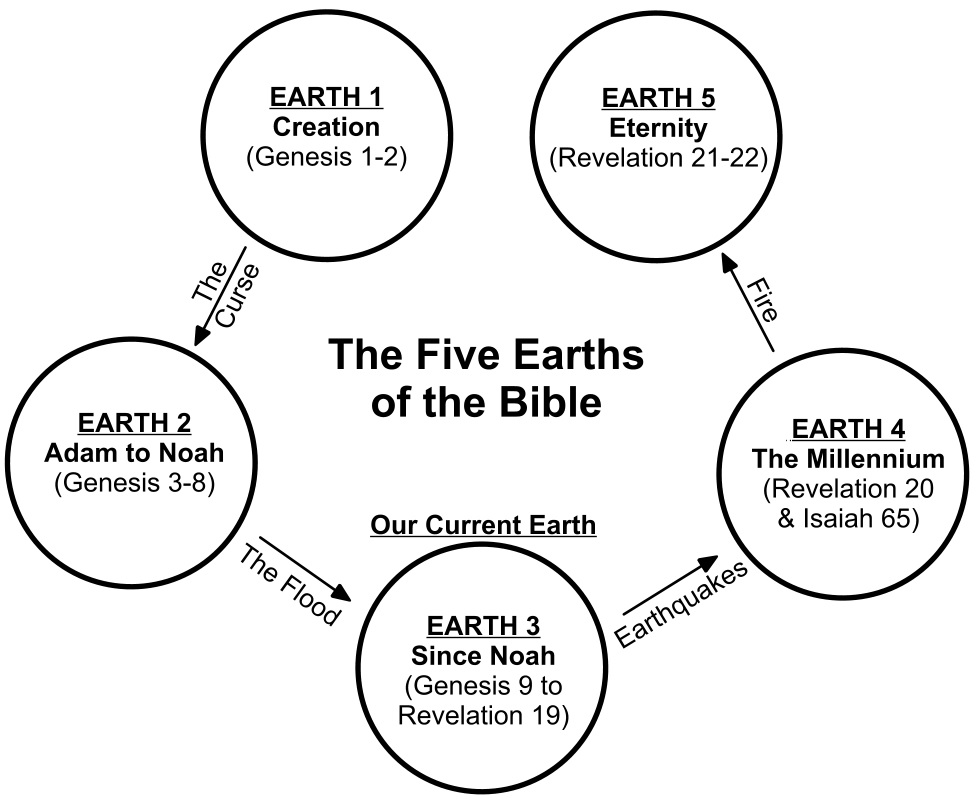
In the eternal age of the new heavens and new earth, God’s government will reign in the universe and we’ll be his citizens/children/servants and, like with any government, there will be holidays — special days to celebrate or commemorate this or that — including the “New moon” and “Sabbath.” Independence Day and Thanksgiving are good examples in America. But “context is king” and this passage is applicable to the eternal age to come and has nothing to do with our current age of grace. Remember what the WORD OF GOD says about this current age:
Therefore do not let anyone judge you by what you eat or drink, or with regard to a religious festival, a New Moon celebration or a Sabbath day. These are a shadow of the things that were to come; the reality, however, is found in Christ.
Colossians 2:16-17
But if you are led by the Spirit, you are not under the law.
Galatians 5:18
But now, by dying to what once bound us, we have been released from the law so that we serve in the new way of the Spirit, and not in the old way of the written code.
Romans 7:6
By calling this covenant “new,” he has made the first one obsolete; and what is obsolete and outdated will soon disappear.
Hebrews 8:13
Needless to say, taking a passage from Isaiah 66 which applies to the eternal age-to-come and applying it to a wholly different earth-reality and age is an example of unsound hermeneutics. The New Testament encourages those who teach God’s Word to “rightly divide” or “correctly handle” the Scriptures (2 Timothy 2:15). This of course involves applying the common sense rules of interpretation, like Context is king and Scripture interprets Scripture. When these rules are violated it always results in error.
Furthermore, the argument implies that the New Moon celebration and the Sabbath day Law were always in vogue, which simply isn’t the case. We see zero evidence of these holidays until Moses gave the Israelites the Law and established the Mosaic Covenant. Before that, Adam, Eve, Cain, Noah, Abraham, Isaac, Jacob and Joseph & his brothers didn’t practice these holidays, which means they weren’t in function during Earth 2 and the first part of Earth 3.
As for Earth 1, which involved the work of creation and the idyllic world of Adam & Eve until their fall, it is said that God rested on the seventh day after creating the earth, universe and all physical beings, but — other than this — we have no evidence that the Sabbath was practiced during Earth 1. Why? Because — as chapter 6 showed — Adam & Eve were in a perpetual state of paradisal Sabbath (rest) with the LORD. They didn’t have to practice the Sabbath because Earth 1 was the Sabbath — resting in blissful communion with the LORD — that is, once God’s work of creation had ceased.
Lastly, the eternal age of the new heavens and new earth will be a wholly different reality than what we understand today. For instance, there will be no more death or pain and the redeemed will have glorified, imperishable bodies (Revelation 21:4 & 1 Corinthians 15:42-44). Wouldn’t it be silly to argue that we should act now according to the way it will be in eternity? For instance, since we won’t be able to die in the new heavens and new earth, should we jump off a cliff or skyscraper without a parachute? Or, since we’ll be able to walk through walls like Jesus did after he received his glorified body (Luke 24:31,36-37), should we try to walk through solid objects?
The nature of reality will be completely different in eternity so it’s asinine to argue that we should do now what will be done then.
‘It appears that Old Testament rituals will be practiced during the Millennium, so shouldn’t we practice them now?’
This refers to Ezekiel 42-46, which shows that the offerings introduced in the Levitical system will be practiced during the Millennium, such as the burnt offering, the peace offering, the sin & trespass offerings and the drink offering. Many of the feasts will also be celebrated.
The obvious response is similar to the previous argument about eternity: The nature of reality in Earth 4 — the Millennium — will be quite different than what we experience now in Earth 3 (Revelation 20:1-10). For one, the quakes that will fashion Earth 4 will be so massive that every vale will be elevated, every peak will be depressed, and every isle will be relocated (Revelation 6:12-14 & 16:17-21). Jerusalem will be raised up, and Mt. Zion will be established as chief of the mounts (Zechariah 14:10 & Micah 4:1).
More importantly, Christ will reign from Jerusalem with the assistance of glorified, immortal believers while the devil & his filthy angels will be locked up in the Abyss, unable to deceive the nations until they’re released at the end. Meanwhile, mortals still alive at the end of the Tribulation and designated as “sheep” will be spiritually regenerated and allowed by Christ to enter the Millennium where they will propagate (Matthew 25:31-46). The Temple in Jerusalem will apparently be many times its current size with odd modifications.
Moreover, the laws of nature will be vastly different due to the Genesis curse being partially lifted. As such, animals will no longer eat other animals and so “the wolf will live with the lamb,” “the cow will feed with the bear,” “the infant will play near the hole of the cobra and the young child put his hand into the viper’s nest” and “the whole earth will be full of the knowledge of the LORD” (Isaiah 11:6-9).
Furthermore, Isaiah 65:20,22 shows lifespans returning to the exceptional lengths recorded after the fall of Adam & Eve in Earth 2. These extended lifespans were possible because Earth 2 had a thick vapor sunshade which safeguarded life from the sun’s ultraviolet radiation (Genesis 2:5-6 & Job 38:8-11). Our globe was like a greenhouse with dense flora growing everywhere, including the poles. The long lifespans of the Millennium in Earth 4 will likely be due to the vapor covering being restored. The planet will again have lush vegetation in great quantity (Isaiah 30:23-26 & Amos 9:13-14); even the Dead Sea will flourish (Ezekiel 47:1-9).
Getting back to the question, why does God allow sacrifices of the Levitical system during the Millennium since we know Christ’s sacrifice made them obsolete (Hebrew 9:23-10:12)? These sacrifices will likely be a worshipful memorial to Christ’s sacrifice, which will be in contrast to the way the Levitical system looked forward to the substitutionary death of the Messiah, a priest in the order of Melchizedek, not Aaron (Hebrews 7:11-12).
As with the previous argument, it’s silly to contend that, just because something will be done during the Millennium, we should be doing the same now. For instance, should you allow your child to put his/her hand into a viper’s next? Should ranchers allow wolves into their sheep corral? Should we trust our governments as if they were run by Jesus Christ? Obviously not.
I don’t really understand this argument anyway. Is it suggesting that we should be offering the Levitical sacrifices during our current Church Age just because some will apparently be doing so during the Millennium in a memorial sense? Imagine going to your local assembly and the ministers blowing valuable time slaughtering bulls, goats and pigeons. Yeah, that’ll compel the unsaved to receive the Lord (sarcasm). Think about it, not even orthodox ministers in Judaism practice the Levitical sacrifices, although they’ll start doing so once the Temple is rebuilt.
When will this be? All we know from the Scriptures is that The Third Temple will be in existence when the Antichrist is revealed (2 Thessalonians 2:3-4), which will be at the halfway point of the 7-year Tribulation (Daniel 9:27). Because this will be only 3½ years into the Tribulation, theologians have determined that the Temple will probably be restored just prior to the Tribulation. After all, how else could such a glorious edifice be erected in such a short span?
This leads to our next question…
‘Christ said that people alive when the Antichrist seizes power in Jerusalem should pray that their flight from Judea not take place on the Sabbath, which means the Sabbath will be observed’
This argument is based on the Messiah’s end-time prophecies in Matthew 24 where he reveals that the devil-possessed Antichrist will suddenly tramp into the reconstructed Temple in Jerusalem, halt the sacrifices, curse the LORD, and pronounce himself god (Daniel 9:27 & 2 Thessalonians 2:4). Of course the Jews will be outraged by such blasphemy and so the Antichrist will turn on them with the intention of wiping them off the face of the earth. This will be his obsession during the second half of the Tribulation and this explains why Christ said this event would usher in the period of the “great tribulation,” which concerns the second half of the Tribulation when excessive persecution breaks out against the Jews. Let’s read the passage:
15 “So when you see standing in the holy place ‘the abomination that causes desolation’ [aka the Antichrist], spoken of through the prophet Daniel—let the reader understand— 16 then let those who are in Judea flee to the mountains. 17 Let no one on the housetop go down to take anything out of the house. 18 Let no one in the field go back to get their cloak. 19 How dreadful it will be in those days for pregnant women and nursing mothers! 20 Pray that your flight will not take place in winter or on the Sabbath. 21 For then there will be great distress, unequaled from the beginning of the world until now—and never to be equaled again.
Matthew 24:15-21
Christ was The Prophet foretold in the Old Testament (Deuteronomy 18:18) and he’s informing us here what it will be like in Jerusalem & Judea when the Antichrist sets himself up as god in the Temple at the midway point of the Tribulation. Of course this event would not take place for another 2000 years so the Messiah’s warning is meant specifically for the corresponding Jews living in Jerusalem and surrounding Judea at that much later date. *
* Christ’s words could also be viewed as a double prophecy, which would mean that the prophecy had two applications — an immediate one and a far-flung one. In this case, the more immediate application would refer to the terrible suffering that occurred in 70 A.D. when Jerusalem was destroyed by Roman troops. Being only 37 years in the future, the (double) prophecy would therefore be relevant to Jesus’ listeners.
The persecution against Jews will be so great that Jesus is essentially saying “Drop everything and flee for your life!” Since leaving Jerusalem & Judea during the winter or on the Sabbath would be more difficult than other times, he’s advising Jews alive in central Israel at this future time to pray that this not be so. This has nothing to do with New Covenant believers observing the Sabbath or not observing it, it’s referring to the way it will be in Jerusalem & Judea during the mid-Tribulation when the Antichrist sets himself up as god and issues legal orders to apprehend and kill all Jews. If you find this incredulous, this very thing happened on a lesser scale in Nazi-controlled Europe during World War II, which wasn’t all that long ago.
As far as his reference to the Sabbath goes, even today it’s more difficult to travel in secularized Jerusalem on the Sabbath because of the lack of transportation — whether buses, trains, planes or taxi service — how much more so during the Tribulation when the Temple is rebuilt and there’s increased religious fervor with the Levitical sacrifices reinstituted? (We know they will be reinstituted because Daniel 9:27 says the Antichrist will immediately put a stop to the sacrifices & offerings when he seizes power in Jerusalem).
Honestly, this argument is tantamount to grasping for straws.
These are the best arguments advocates for being under the Law can come up with and — as you can see — they hold no water and are easily countered. Further objections are just variations on the same sincere-but-sincerely-wrong themes.
Conclusion
Believers in Christ are not under the Old Testament law, rather we fulfill the moral law by living out of our new nature, which was “created to by like God in true righteousness and holiness” with the help of the Holy Spirit. The Sabbath, the Jewish holidays and dietary laws have ceased because they were mere shadows pointing to the reality, which is Jesus Christ. And we are in Christ.
This article was edited from…
- Copies can be purchased here for just $6.99 (150 pages).
- Or get the eBook version here for only 99 cents!
Both links allow you to LOOK INSIDE the book.
Related Topics:
BIBLE — You Own One at a Huge Price!
Today, the Bible, the world’s most translated book, is accessible to virtually everyone, and its study is usually encouraged in Christian circles. Yet, in medieval times (circa 476-1500) the Bible was not available to the common person in Western Europe. The Old Testament was generally only available in Hebrew, Greek (the Septuagint) and Latin (the Vulgate). The New Testament was only available in Greek and Latin. Consequently, only scholars and educated clergy had direct access to God’s Word.
In time, Roman Church leaders adapted the absurd view that it was dangerous for ordinary people to read the Scriptures without benefit of clergy. They insisted that it was safer for people to rely on priests to tell them what the Bible said and meant.
These religious “leaders” well knew that it is knowledge and truth which give people power and freedom (Proverbs 24:5 & John 8:31-32), yet, in keeping with the character of lifeless religiosity, they wanted the common people to have neither (Luke 11:52). As such, those who dared to translate the Bible found themselves engaged in an increasingly dangerous business as the ban on vernacular Scriptures carried with it the death penalty in some countries.
John Wycliffe’s Translation
John Wycliffe was one of the first to make the Bible available to the average person. He argued that the Scriptures did little good locked away in Latin that few could understand. In 1382 he finished the first complete English translation based upon the Latin Vulgate. Hand-written copies were widely circulated and eagerly read.
In 1408, nearly a quarter century after Wycliffe’s death, Catholic leaders formally outlawed the reading of Wycliffe’s translation. So England had an English Bible but it was a forbidden one.
It gets worse: In 1415 the Council of Constance condemned Wycliffe, ordering his body exhumed and burned, along with his books. Fortunately, even the most energetic opposition could not wipe out this powerful new movement to translate the Bible into the languages of the common people.
William Tyndale’s Translation
In 1522 William Tyndale conceived the project of translating the New Testament directly from the Greek, bypassing the Latin Vulgate. To a critic of this plan he boldly declared: “If God spare my life, ere many years pass, I will cause a boy that driveth the plough shall know more of the Scriptures than thou dost.”
To carry out his noble project, Tyndale had to flee to Germany because of strong opposition from religious authorities in England. He was never to return to his home country.
After Tyndale finished his translation, copies were smuggled into England and widely distributed. But, when discovered, church leaders ordered the Bibles gathered up for burning!
In 1535 Tyndale was betrayed, kidnapped and imprisoned by papal agents near Brussels. He was tried for heresy and condemned to death. A decade earlier they had burned the translation; now they resolved to burn the translator!
Tyndale went boldly to the stake, still defending his belief that the English should have a Bible in their own language. He was strangled at the post before they burned his body. With his last breath he cried out, “LORD open the king of England’s eyes!”
Tyndale’s Prayer Answered
Following King Henry VIII’s break with the Roman Church he ordered that an English translation be made available to all. Consequently, in less than four years after Tyndale’s death four English translations were published in England, including the Great Bible, all based on Tyndale’s work.
In the ensuing years a flood of English translations and revisions swept the landscape as each translator sought to correct the errors and improve the language of the earlier ones.
The King James Bible
In the early 1600s King James appointed 54 scholars to carry out the work of translating an accurate “Authorized Version” for the nation with the number of translators increasing to 57. All were members of the Church of England and all but one were clergy. This version was, of course, the popular 1611 King James Bible (KJV). What distinguished this translation from all other versions was that it was produced by a committee of scholars, rather than by just one person.
It’s interesting to note that the King James New Testament was based largely on Tyndale’s work. In fact, it is estimated that 80 percent of Tyndale’s wording passed into the King James Version (about 76% of the Old Testament and 83% of the New Testament).
The original 1611 version of the KJV is virtually unreadable to modern English-speaking people; it was revised in the 1760s, culminating with the Oxford Standard Text of 1769, and this is the version people read today when they read the KJV. As such, the KJV is written in the English from 250-400 years ago and is understandably hard to understand for modern English readers. Yes, the Holy Spirit can certainly help them understand the archaic text, but how much more so if they read a translation written in the language they actually speak and understand?
This is why I utilize sound modern versions of the Bible in my teachings, like the New International Version (NIV), because what’s important is not allegiance to an archaic version of the Bible, but rather reading and understanding God’s Word and applying it to your life. As Jesus said, “If you continue in my word, then you are truly my disciples; and you will know the truth, and the truth will make you free” (John 8:31-32).
This isn’t to say, of course, that you shouldn’t read the KJV or use it in your studies. I own 4-5 editions of the KJV and sometimes quote it in my teachings. It’s a historically important version of the Bible and has aesthetic value to boot, but it would be a mistake to limit yourself to this version. If you haven’t done so already, please check out some of the sound modern versions of the Bible, like the NIV, the New King James Version, the English Standard Version, the New Revised Standard Version and many others. NIV, by the way, stands for “Nearly Infallible Version.” (Just joking, lol).
I encourage you to switch versions now and then and reference other translations in your studies besides the main version you prefer to read. It’ll bless your understanding and walk with the LORD.
Final Word
Realizing that the LORD inspired many dedicated Christians to great personal sacrifices in order to make His Word accessible to all people should motivate us to greater appreciate the Bible.
This once-forbidden book now lies open – to YOU.
Take advantage of it!
Related Topics:
Who Wrote the New Testament Books? Who Authorized them as Scripture Canon?
Hermeneutics — Proper Bible Interpretation
Bible—Is it Full of Contradictions? Does it Promote Slavery, Tyranny and Discrimination?
Berean Spirit — What is it? How Do You Cultivate It?
The NIV Bible — Answering the Critics
Sectarianism — What is It? What’s Wrong with It?
What is KJV ONLY? What’s Wrong with It?
WHY DIDN’T Catholics Want People Having Access to Scripture?
Your Thoughts RUN YOUR LIFE!

Proverbs 4:23 is such a powerful passage; it conveys a vital principle that’ll determine the very course of your life! It says: “Above all else guard your heart, for it is the wellspring of life.” The preface “above all else” indicates that guarding your heart is of the utmost importance and therefore you need to make it a top priority in your life. Your heart is the core of your mind and things get rooted in your heart based on your thought life and the ideas, desires or fears you choose to meditate on, that is, feed. This explains why the New Century Version of the Bible — a paraphrase — translates the verse like so:
Be careful what you think for your thoughts run your life.
Proverbs 4:23 (NCV)
Be careful what you choose to think about — impulses, inclinations, worries, desires, fears, etc. — because what you decide to dwell on in your mind will run your very life! Notice again how the NIV puts it: Guard your heart for it is the wellspring of life. The word “wellspring” in the Hebrew is totsa’ah (rhymes with matzah ball), which means “source” or “geographical boundaries.” In other words, whatever you allow to occupy your heart — your thought life — ends up being the source of your very life and determines your geographical boundaries; that is, how far you go or how far you don’t go. Put differently, what you allow to get rooted in your heart determines what you will be!
This corresponds to what Jesus said: “A good man brings good things out of the good stored up in his heart, and an evil man brings evil things out of the evil stored up in his heart” (Luke 6:45). People produce according to what’s in their heart. This is why the Bible likens the human heart to soil, as shown in the Parable of the Sower (Luke 8:1-15). Just as soil is neutral and grows whatever is planted in it — whether quality produce or weeds & thornbushes — so the heart is neutral and grows whatever you allow to get rooted in it, whether good or bad, productive or destruction, beautiful or hideous, pure or profane. This explains Paul’s instructions to meditate on positive things in Philippians 4:8 because whatever you meditate on inhabits your thought life and will get lodged in your heart. You thus produce accordingly.
This reminds me of a letter that a pedophile in prison wrote to Ann Landers years ago. He confessed that he was a pedophile and that his time in prison had not set him free — the walls could not change him. There was this monster in his heart, he said, and when he would be released in 7 months he was going to continue to do the very monstrous things that got him sent to prison in the first place. Why? Because he was in bondage to this evil desire that was lodged in his heart. In other words, this wicked desire that he allowed to get rooted in his heart by occupying his thought life was literally determining the course of his life! The good news is that there’s hope for people like this if they’re willing to humbly turn to the LORD in repentance & faith, receive spiritual rebirth and put into the practice the wisdom of God’s Word (e.g. Isaiah 55:6-9).
Needless to say: Be careful what you think for your thoughts run your life!
For details on this topic view the corresponding video…
Related Topics:
Heart – Is it “Desperately Wicked”? (It Depends)
Ezekiel and the VALLEY OF DRY BONES

If you’re familiar with the Bible you’re perhaps familiar with Ezekiel’s vision of the valley of dry bones from Ezekiel 37:1-10. The LORD instructed Ezekiel to prophesy to the dry bones and so the prophet spoke to them in place of the LORD: “I will make breath enter you, and you will come to life” (verse 5) and “I will attach tendons to you and make flesh come upon you and cover you with skin; I will put breath in you, and you will come to life. Then you will know that I am the LORD” (verse 6). Notice that he spoke “breath” into the bones twice. The bones came together with tendons, flesh and skin, but they still had no breath. So the LORD instructed Ezekiel further:
“Prophesy to the breath; prophesy, son of man, and say to it, ‘This is what the Sovereign LORD says: Come, breath, from the four winds and breathe into these slain, that they may live.’ ” 10 So I prophesied as he commanded me, and breath entered them; they came to life and stood up on their feet — a vast army.
Ezekiel 37:9-10
Two things stand out. First, although the LORD said he would make the bones come to life with tendons, flesh, skin and breath, it didn’t automatically happen. Ezekiel had to speak it into being. If Ezekiel hadn’t spoken the Word of God over the dry bones they would not have come to life. This testifies to the power of words. Proverbs 18:21 says that “the tongue has the power of life and death” and Christ also noted the incredible power of words spoken in faith (Mark 11:23). Furthermore, Hebrews 11:3 says that “the universe was formed at God’s command, so that what is seen was not made out of what was visible.” You see? Words have the power to create and resurrect when spoken in faith! This is how Dirk received his healing for his knee in 2013 (see the video Can I Recieve a Healing?).
Secondly, notice that Ezekiel only had to speak once for the tendons, flesh and skin to manifest but three times (altogether) for the breath to materialize. So if you’re speaking in faith for something that the LORD has put on your spirit, don’t give up if it doesn’t immediately manifest! Dirk had to repeatedly speak healing over his knee before it materialized. In fact, it took four months! The Bible repeatedly emphasizes that it’s not just through faith that we inherit what is promised, but through faith and patience, which is perseverance (Hebrews 6:12). So don’t give up!
In light of what the Bible blatantly says, I find it odd when believers say things like, “I don’t believe in that faith stuff!” They say they don’t believe? Like the Lord said, “Be it to them according to their faith.” Here are some passages for study & meditation.
– Carol Waren
Related Topics:
Faith — What Is It? Why Is It Important? How Does It Grow?
The Seven Keys to SPIRITUAL GROWTH
WORDS have the Power of Life and Death
What Is GREED? Why Is it Bad?

Greed is the love of money — the idolization of lucre, the obsession with wealth — and any corruption that goes with it. Please understand that it’s not money that’s bad, but rather the love of it. (People often misquote 1 Timothy 6:10).
Many righteous men and women in the Bible were wealthy or became wealthy or, at the very least, had ample money to live on, but that didn’t make them guilty of greed. Examples include Abraham, Job, David and Solomon. Speaking of Solomon, he fell away from God later in life, but it wasn’t due to his wealth, but rather his weakness for women (1 Kings 11:1-6).
Some people wrongly claim that Christ was poor, but he wasn’t. Yes, he was born in a stable because there were no inns available, but during his life he was a carpenter who made good money, much like quality carpenters today. When he became a traveling minister at the age of 30 he wasn’t poor either; one member of his ministry team was assigned the job of treasurer (John 12:6 & 13:29). Also, Jesus said, “The poor you will always have with you, but you will not always have me” (Matthew 26:11). Christ didn’t become poor until he was unjustly apprehended and crucified, as shown in 2 Corinthians 8:9. Poverty is a curse (Deuteronomy 28) and “cursed is everyone who is hung on a pole” (Galatians 3:13).
It’s significant to note that when Paul instructed the young pastor Timothy on rich people in the congregation he didn’t tell him to rebuke them for being wealthy, he simply told him to tell them not to be arrogant, to put their hope in God rather than their riches and “to be rich in good deeds and to be generous and willing to share” (1 Timothy 6:17-18). Why did Timothy have to tell them not to be arrogant? Because the attainment of wealth tends to feed the fleshly ego and tempts people to look down on those with less. This is a form of greed. So is putting on airs to impress others. Needless to say, if you’re wealthy don’t let it go to your head.
Why did Paul want Timothy to instruct the wealthy to be generous? Because giving is the proof you’ve conquered greed. You could say it’s the antidote.
It should be emphasized that you can be dirt poor and be guilty of the love of money. I was a supervisor at a company years ago and we hired a woman of modest means. She once took other peoples pay envelopes because she thought there was cash in them, like hers, but when she discovered they had checks in them she gave them back — ripped open, of course. Why did she do this? Because she loved money so much that she was willing to steal other people’s money if the opportunity presented itself. In essence, money had become the god whom she obeyed (at least on this occasion). As such, the love of money — greed — is a form of idolatry.
Another obvious example of greed is when an employer hoards profits for his or her luxuries, but fails to pay the workers on payday. This is being a rich oppressor and it’s condemned in the Law of Moses (Deuteronomy 24:14-15). It’s true that in that culture workers were paid at the end of each day yet the principle holds true today in that workers are to be paid on payday by employers. James 5:1-5 is a sobering passage warning employers who hoard profits while failing to pay their workers. If they refuse to repent they’ll reap judgment and destruction!
One of the best verses on greed is is this one where Jesus Christ said:
“Watch out! Be on your guard against all kinds of greed; a person’s life does not consist in the abundance of his possessions.”
This article is available in book form (with much more detail) in chapter 15 of…
- The print book is available here for only $12.50 (303 pages)
- The Kindle eBook is available here for just 99¢!
Both links allow you to “look inside” the book.
Related Topics:
Provision, Money and “Prosperity”
The Gist on Giving and “Tithing”
Giving and “Tithing” — What’s the Bible say?