
What Is the RESTORATION OF ALL THINGS?

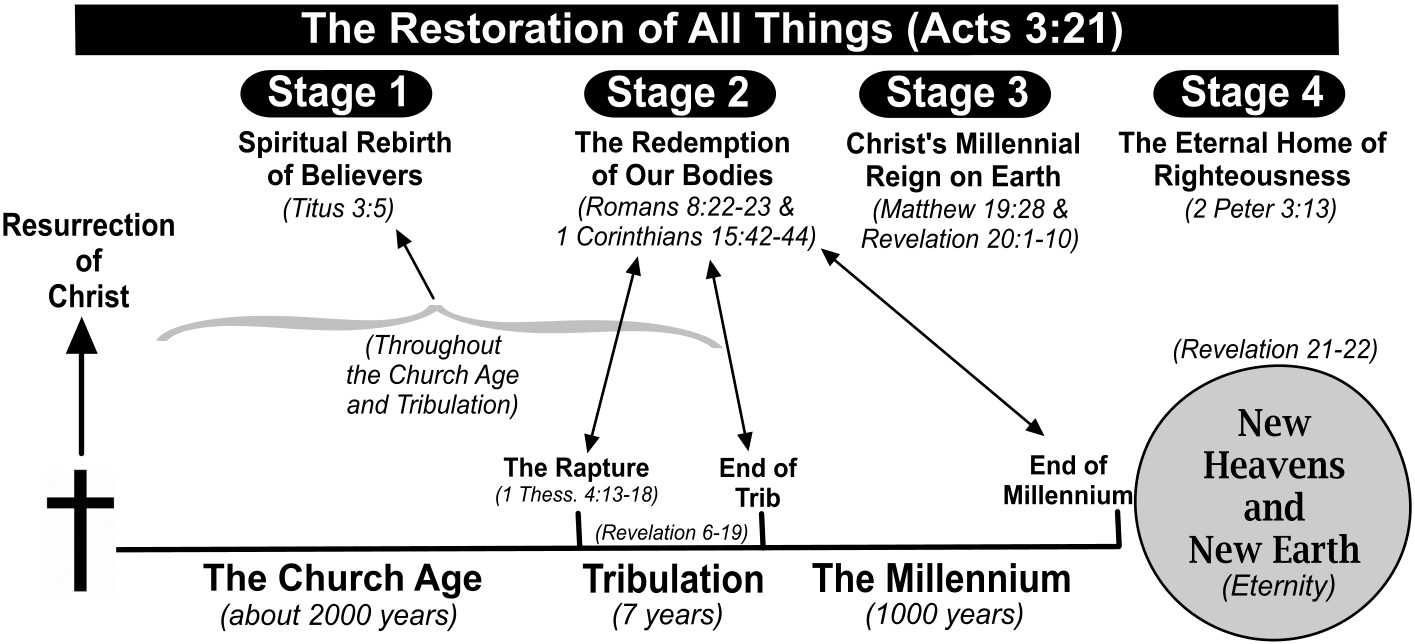
Peter spoke of “the period of restoration of all things” when preaching to a crowd after the miraculous healing of a lame beggar (Acts 3:21 NASB). God’s great restoration of creation takes place in four stages:
- Spiritual rebirth of people who accept the gospel.
- The redemption of our bodies, which is when we’ll receive glorified bodies and (primarily) takes place at the Rapture.
- Christ’s millennial reign on Earth after the seven-year Tribulation.
- The establishment of the new Heavens and new Earth, the eternal home of righteousness.
Let’s go over each stage and the scriptural support for each.
STAGE ONE: Spiritual Regeneration through the Gospel
The Messiah noted the restoration of all things here:
Jesus said to them, “Truly I tell you, at the renewal of all things, when the Son of Man sits on his glorious throne, you who have followed me will also sit on twelve thrones, judging the twelve tribes of Israel.”
Matthew 19:28
The Greek word for ‘renewal’ in this verse is paliggenesia (pal-ing-hen-es-EE-ah), which means “new birth, regeneration or renewal.” It’s only used twice in Scripture. The other occasion is Titus 3:5, where it refers to the regeneration of the human spirit. This occurs, of course, when a believer accepts the gospel through repentance and faith (John 3:3,6 & Acts 20:21).
Spiritual regeneration is the first stage of God’s “renewal of all things.” You see, the restoration of all things is jump-started in our current age through the spiritual rebirth of believers. When a person experiences spiritual regeneration they are transferred from the dominion of Satan to the kingdom of God (Acts 26:18). In terms of physical appearance it doesn’t look like anything has changed, although their new attitude about life undoubtedly changes their demeanor. This is because, spiritually, they’ve swapped kingdoms and are no longer slaves to Satan, which naturally has an impact on one’s disposition.
Think about it in terms of those sci-fi flicks based on Jack Finney’s book The Body Snatchers; the first two were called Invasion of the Body Snatchers. The same basic principle is at play except that the extraterrestrials are wholly good because they’re God—Father, Son & Holy Spirit—who want to snatch people from Satan’s dominion. The way they do this is through inward regeneration.
STAGE TWO: The Rapture
Spiritual rebirth culminates with Christ’s return for His Church, which is the second stage of the restoration of all things. All believers are promised this blessing providing they persevere in faith (Colossians 1:22-23 & 1 Corinthians 15:2).*
* This is just common sense; after all, if it takes faith to be saved, a person can no longer be saved if they give-up at some point and no longer believe.
This second stage concerns Jesus’ return for his Church where believers’ bodies are finally redeemed:
We know that the whole creation has been groaning as in the pains of childbirth right up to the present time. 23 Not only so, but we ourselves, who have the firstfruits of the Spirit, groan inwardly as we wait eagerly for our adoption to sonship, the redemption of our bodies.
Romans 8:22-23
The “redemption of our bodies” occurs when Christ snatches up His Church, as detailed in 1 Thessalonians 4:13-18. When this Rapture takes place, living believers will be translated to Heaven with new, glorified bodies while believers who physically died previously will be bodily resurrected with the same kinds of awesome bodies. How awesome will these bodies be? The Bible describes them as imperishable, glorified, powerful and spiritual in nature (1 Corinthians 15:42-44). Chew on that.
While some claim that the word ‘Rapture’ isn’t biblical, it is. It refers to a phrase used in the main passage that details this event:
After that, we who are still alive and are left will be caught up together with them in the clouds to meet the Lord in the air. And so we will be with the Lord forever.
1 Thessalonians 4:17
‘Caught up’ in the Greek is harpazó (har-PAD-zoh), which means to “snatch up” or “obtain by robbery.” It’s translated in Latin as “rapio” in the Vulgate, which is where we get the English “Rapture.” With this understanding, when the Bridegroom, Jesus, comes for His bride, the Church, He’s going to obtain us by robbing us off the Earth!
STAGE THREE: Christ’s Millennial Reign on Earth
The restoration of all things continues after the seven-year Tribulation when Christ returns to Earth and establishes his millennial kingdom, which is what Jesus was specifically referring to in Matthew 19:28 (quoted above). This is the third stage of the restoration of all things at which time Old Testament saints will be resurrected while Tribulation martyrs will be bodily resurrected. Both will receive their immortal bodies at this juncture. As for the mortal humans Christ allows to enter the Millennium after The Judgement of Living Nations (aka The Sheep and Goat Judgment—Matthew 25:31-46), their lifespans will return to the lengthy lifespans of people before the flood of Genesis 6.
Glorified believers will be priests of God and will reign with Christ during the Millennium. Such believers will not be able to propagate because, as Jesus taught, “they will neither marry nor be given in marriage… for they are like the angels” (Luke 20:34-36). This doesn’t mean, by the way, that we’ll be angels; simply that we’ll be like angels in the sense of not marrying and that we’ll attain intrinsic immortality, which we don’t currently possess (Romans 2:7 & 2 Timothy 1:10).
Isaiah 11:6-9 shows what life will be like during the Millennium: Carnivorous animals will become herbivorous and therefore wolves will live with lambs and leopards will lie together with goats; calves and lions will ‘hang out’ and be led by little children. Cows and bears will feed together and formerly carnivorous beasts, like the lion, will eat straw like an ox. Furthermore, children will play by the cobra’s den and the viper’s nest without fear because poisonous creatures will no longer be poisonous.
At the end of the Millennium Satan is released and immediately deceives the nations, inciting a mass attack on the righteous government of Christ in Jerusalem. This rebellion is easily defeated and the devil is cast into the lake of fire forever. Revelation 20:1-10 details these events.
God’s Purpose for the Millennium
The Millennium is basically a transitional phase between this present evil age (Galatians 1:4) and the eternal righteous age-to-come (Luke 18:29-30). But what exactly is God’s purpose for the Millennium? It’s simple when you think about it:
The Millennium is the LORD’s irrefutable proof to humanity that the religion of secular humanism is a lie. As you may or may not know, secular humanism is atheistic in nature and therefore anti-God. To those who embrace this godless religion there’s no sin problem because there’s no God for whom to sin against. To them, the problem of evil isn’t humanity’s sin nature and the corresponding alienation from our Creator, but rather a negative environment. As such, they believe evil, crime, poverty, war and other ailments will largely be eradicated when the right government is in place and every person is provided an education, a decent job, a nice living environment, protection from crime, and so on. While these things are good, they don’t actually remedy the sin problem or reconcile people to their Creator. They cannot set us free from Satan’s dominion and the slavery thereof. After all, a white collar man living in a rich suburb is still perfectly able to commit fraud due to a greedy heart, not to mention be a drunkard, drug addict, wife-beater, slanderer, hypocrite, adulterer, murderer, blowhard, oppressor, porn addict or practicing homosexual.
In the Millennium the LORD is going to provide the perfect government and environment for nations of mortals. It will be a veritable worldwide utopia. Since Jesus will be the King over all the Earth and his assistants will be glorified believers who don’t have a sin nature there will be zero corruption in the government (imagine that!). Yet, as the population increases over the course of the thousand years, many of the offspring of the original “sheep”—the mortals whom Christ allows to enter into the Millennium (Matthew 25:31-46)—will just go through the motions of being faithful to the Lord while their hearts aren’t in it. This is legalism—putting on the airs of godliness without the heart of godliness. Because legalism is an “outward job” it’s decidedly inauthentic. As such, when the devil is unleashed at the end of the thousand years these covert rebels will naturally embrace the lies of the kingdom of darkness and unite for war in a harebrained attempt to take over the completely righteous government of Christ! (This shows that Satan is thoroughly incorrigible; he never learns from his mistakes).
Of course the rebellion is quickly quelled and, after the Great White Throne Judgment, the eternal age of the new Heavens and new Earth will manifest (Revelation 20:9-15 & Revelation 21-22).
So the Millennium is the Most High’s eternal showcase in disproving the religion of secular humanism.
STAGE FOUR: The Eternal New Heavens and New Earth
As wonderful as the thousand-year reign of Christ will be, it’s just another stage in the “restoration of all things.” The fourth and final stage takes place when God wholly renovates the Earth & Universe and the heavenly city, the new Jerusalem, comes “down out of heaven from God” to rest on the new Earth (Revelation 21:1-4). Thus the renewal of all things climaxes with the renewing of the Earth & Universe. This is the new Heavens and new Earth, the eternal “home of righteousness” (2 Peter 3:13).
The Greek word for ‘restoration’ in the phrase “the final restoration of all things” is apokatastasis (ah-pok-ah-TAS-tah-sis), which appears only once in the Bible:
For he [Jesus] must remain in heaven until the time for the final restoration (apokatastasis) of all things, as God promised long ago through his holy prophets.
Acts 3:21
The root word for apokatastasis is apokathistémi (ah-pok-ath-IS-tay-mee), which means “to set up again” and “restore to its original position or condition.” That’s what the “restoration of all things” is about—restoring the Earth and Universe to its original condition before the fall, which is the way God originally intended it to be.
Creation Itself “Waits in Eager Expectation”
The Bible stresses that creation itself yearns for the redemption provided in the restoration of all things:
For the creation waits in eager expectation for the children of God to be revealed.
Romans 8:19
What does creation “wait in eager expectation” for? Answer: The children of God to be revealed, which is part of the restoration of all things, as detailed earlier.
What exactly is “the creation” in this verse? It refers to the Earth and Universe and all living things thereof, including the animal kingdom and even the plant kingdom. They will all be partakers in this redemption of the physical Universe. Why else would all creation “wait in eager expectation” for this great restoration if they were not included in it? Of course, animals and trees aren’t literally yearning for this renewal, but they yearn for it in a figurative sense because they’re included in it.
Consider something interesting, noted by David Reagan: When the high priest sprinkled animal blood on the cover of the Ark of the Covenant once a year to atone for the sins of the Hebrews, this blood covered God’s Law, which was represented in the Ark via the tablets of the Ten Commandments. This ritual resulted in God’s mercy year to year, covering the Israelites’ sins. But the blood of animals could only temporarily cover sin, not cleanse it away forever (Hebrews 10:1-4).
The good news is that Jesus Christ, who is the believer’s High Priest, offered his own blood when he went to the Most Holy Place in Heaven, not merely the blood of animals (Hebrews 9:23-28). Reagan points out that Leviticus 16:15 shows the high priest sprinkling blood on the ground in front of the Ark after sprinkling it on the cover. At the time, the Ark was housed in the tent Tabernacle and so the blood was literally poured on the ground. Why is this significant? Because the entire ceremony pointed to Christ’s blood atonement in Heaven and the high priest didn’t just sprinkle blood on the lid of the Ark for the redemption of humanity, but also on the ground for the restoration of all physical creation.
So “the final restoration of all things” (Acts 3:21) refers to the LORD restoring everything in creation to the condition it was originally intended. The Greek word for ‘all things’ is pas (pass), which means “all, the whole, every kind of.” So God is going to restore all creation to its initial condition, as He originally intended it to be before Satan duped Adam & Eve and usurped power-of-attorney over physical creation. Revelation 21:5 adds an interesting insight in that God will be “making everything new” and not making new things. There’s a difference.
Of course, the LORD won’t restore those condemned to the lake of fire. This includes damned human beings, the devil & his filthy angels or anything else cast into the lake of fire, such as death and Hades (Revelation 20:10-15 & Matthew 25:41). The lake of fire is basically God’s garbage dump. The good news of the gospel of Christ is all about escaping this eternal condemnation and partaking of “the restoration of all things.”
Needless to say, make sure YOU are a partaker and do everything in your power to get those linked to you to be partakers as well. As “Christ’s ambassador,” YOU are a “minister of reconciliation” called to share the “message of reconciliation” (2 Corinthians 5:18-20).
Here’s a diagram of the restoration of all things to help you visualize the four stages (click to enlarge):
This article was edited from chapter 13 of…

Both links allow you to LOOK INSIDE the book.
Related Topics:
REDEMPTION — God’s Plan of Liberation for Humanity & Creation
Second Coming of Christ — Rapture and Return to Earth
Millennial Reign of Christ — Why?
Eternal Life — What will it be Like?
What Are THE BASICS of Christianity?
REDEMPTION — God’s Plan of Liberation for Humanity & Creation

The Bible is all about 1. the LORD creating the Heavens & Earth and all living things, 2. the rebellion and expulsion from Heaven of Satan & his foul underlings, 3. humanity’s fall, 4. Satan’s usurpation of authority over creation and, most of all, 5. God’s brilliant, loving plan of redemption. In this article we’re going to focus on this fifth element—the LORD’s awesome plan of redemption.
If you want to “reign in life” (Romans 5:17) you’re going to have to thoroughly know your redemption.
“All the World’s a Stage”
The fascinating events of Genesis 3 are drama of the highest order and bring to mind Shakespeare’s famous verse:
All the world’s a stage,
And all the men and women merely players;
- The stage in Genesis 3 is a beautiful garden roughly the size of California or Iraq (according to dimensions specified in Genesis) on a planet called Earth in a solar system in one galaxy of an estimated 200 billion galaxies in the Universe (!).
- The players are: 1. The Almighty Creator, 2. His nemesis who was kicked out of Heaven and dwells in the dark spiritual dimension that parallels the Earth and Universe, 3. Adam & Eve (and the human race in their loins), the only beings created in the likeness of God and called to be co-heirs with Christ, and 4. a harmless, beautiful animal that Satan uses to dupe Adam & Eve and usurp their authority over the Earth and Universe.
- The prop is a tree with the forbidden fruit thereof.
- The suspense concerns whose word Adam & Eve will believe—God’s or Satan’s—which will determine their destiny and the destiny of the human race.
- The tragedy is their fall, the cursing of creation and the ensuing pathos of life in a fallen world.
- The challenge is how the Creator can possibly set things aright without compromising His perfect justice.
- The story contains elements of all great dramas—a noble hero, a wicked villain (or foil), protagonists, deceit, the testing of character, tragedy and potential redemption, which brings us to…
God’s Plan of Redemption for Humanity
To ‘redeem’ means “to liberate through payment of ransom” or “to clear of debt through proper payment.” In the 1st century nearly half the people on Earth were slaves in one form or another. The Greek word for ‘redeem’ was used back then in reference to purchasing freedom for a slave.
While slavery still exists today, it’s much less widespread. However, spiritual slavery is rampant because everyone born from Adam is a slave to sin and captive to the kingdom of darkness. The awesome news is that God has purchased our freedom from this spiritual slavery through the precious blood of Christ.
For you know that it was not with perishable things such as silver or gold that you were redeemed from the empty way of life handed down to you from your ancestors, 19 but with the precious blood of Christ, a lamb without blemish or defect.
1 Peter 1:18-19
We’ve been liberated through the death and resurrection of Christ, which is the gospel (1 Corinthians 15:1-4). Peter summarizes what we’ve been freed from as “the empty way of life” handed down to us from our ancestors. This refers to people’s empty existence separate from God as slaves to sin with Satan as slave master. Such bondage was handed down to us by our ancestors, Adam & Eve.
Some will understandably reason that it’s unfair for sin and spiritual slavery to be passed from our primordial parents to the rest of us. Answer: This is what theologians refer to as federal headship, which simply means that Adam was the human race’s spiritual, moral and physical fountainhead, our lone representative. The entire race was in his loins when he deliberately sinned and thus sin was passed on to all descendants (Romans 5:12). Think about it in terms of genetics: We naturally inherit characteristics of our fore-parents, such as facial features and skin color; the same principle is at play in a spiritual sense.
To be set free from this generational curse of sin we’d have to be born of a new Adam—a second Adam—one who doesn’t transfer sin and death, but rather life, because he was not born of the seed of Adam, but of the seed of God. Believe it or not, this is the core message of the gospel. Christ is the second Adam (1 Corinthians 15:45-49). Let me explain…
Our freedom was purchased through the precious blood of Yeshua:
For He has rescued us from the dominion of darkness and brought us into the kingdom of the Son he loves, 14 in whom we have redemption, the forgiveness of sins.
Colossians 1:13-14
God has rescued us—liberated us—from bondage to the kingdom of darkness through Christ. We’re no longer slaves to Satan, as long as you’ve accepted the awesome gospel.
This great salvation corresponds to the LORD’s prophecy after the fall of Adam & Eve:
“And I [God] will put enmity
between you [Satan] and the woman,
and between your offspring and hers [Christ];
he [Christ] will crush your head,
and you will strike his heel.”
Genesis 3:15
The offspring of the woman—Christ—would eventually deal Satan a fatal blow. The best the devil could do to circumvent this was to try to thwart the birth of the Messiah—which he repeatedly tried to do, but failed. The satanic attempt to pollute the bloodline through the “sons of God” copulating with women was one such attempt (Genesis 6:1-4), as covered here. Once Yeshua was born, the devil naturally manipulated his puppets in the Roman/Hebrew governments to have Jesus unjustly captured, tortured and executed, which amounted to “striking his heal.” Of course this played into God’s genius plan as the death and resurrection of Christ were key to our redemption.
The First Adam and the Great Wall
Adam’s sin and the passing of a sin nature to his descendants built an impenetrable wall between God and the human race. Yet, Hallelujah, the ministry of the second Adam—Jesus Christ—tore that wall down so that we can reconcile with our Creator.
This “great wall” is a barrier consisting of four figurative blocks:
- The holy character of God.
- The debt of sin.
- Slavery to Satan.
- Spiritual death.
Let’s look at all four:
The holy character of God. Have you ever known people who were so ‘good’ that you felt uncomfortable being around them, perhaps inferior? This is magnified when you know they’re aware of some of your more hideous “skeletons in the closet.” The reason you felt uncomfortable is because their moral standards were so high that you assumed they’d be judgmental of you, which created a sense of alienation.
Now relate this to the human race and God. All humanity is born of Adam’s seed and therefore has an inherent sin nature, which stands in stark contrast to the LORD’s flawlessness—His absolute purity, righteousness, justice, love, immutableness (unchangeableness), and veracity. Thus God’s holy character became a barrier after the fall. Is it any wonder that the Bible says “all our righteous acts are like filthy rags” (Isaiah 64:6)? Notice it doesn’t say that our bad deeds are like filthy rags, but rather our righteous acts! God is so holy—so absolutely perfect—that even what we would consider good works by human standards are offensive by comparison. In short, there’s an infinite gap between fallen humanity and the LORD due to God’s holy character.
The debt of sin. Back in the 1st century Roman Empire when criminals were judged they were given a Certificate of Debt, which was placed on the door of their cells. This document cited how they failed to live according to the law of Caesar and denoted the corresponding sentence. When the penalty was fulfilled their Certificate of Debt was stamped “Paid in Full” so that they would not be punished again for their crimes. Of course, if the penalty was death this was irrelevant, but if the consequence was time it was valuable: If someone tried to accuse them of a past offense all they had to do was show their canceled Certificate of Debt. Until that debt was paid, however, it stood between them and freedom.
Now let’s relate this to the human race and the perfect moral Law of God, summed up in the Ten Commandments and the Sermon on the Mount. All of us have sinned against God’s Law because the infection of sin passed from our Federal Headship to us. We’re all infected with a sinful nature and have missed it one way or another; actually we’ve transgressed innumerable ways, not just “one,” particularly when you consider the so-called “little sins,” like arrogance, envy, jealousy, rivalry, greed, carnal lust and the like. Since the “wages of sin is death” (Romans 6:23) we’ve all been assigned a Certificate of Debt, which cites the penalty of our offenses as death (Colossians 2:14). This is why the Bible says “whoever does not believe stands condemned already” (John 3:18).
Humanity’s debt of sin means that we’re in a state of criminality apart from Christ, the second Adam. We’re thus “objects of [God’s] wrath” (Ephesians 2:3). It’s an impassable barrier between us and God and can only be removed if a qualified individual paid the penalty of death in our place.
Slavery to Satan. This third block in the great wall that separates God and humanity refers to Satan apprehending power-of-attorney over physical creation and hence becoming the “god of this age” (2 Corinthians 4:4) or, as Christ called him, “the prince of this world” (John 12:31, John 14:30 & John 16:11). ‘Prince’ in the Greek is archon (AR-kohn), which means “ruler, governor, leader.” The devil is the spiritual ruler of this planet and thus the world is one big slave market where everyone born of the seed of Adam is legally a slave to Satan, whether they know it or not. This explains why the Messiah said the conservative religious leaders of Israel where children of the devil, to their astonishment (John 8:33-44). It’s why the New Testament proclaims in no uncertain terms that “the whole world is under the control of the evil one” “who leads the whole world astray” (1 John 5:19 & Revelation 12:9). It explains Christ’s commission to Paul to turn people “from the dominion of Satan to God” (Acts 26:18). It explains why Satan is referred to as “the ruler of the kingdom of the air, the spirit who is now at work in those who are disobedient” (Ephesians 2:2).
Unredeemed humanity may be God’s creation, but they’re not God’s children. They lawfully belong to their cruel slave master, the devil. The only person born into this world that was not born in subjugation to Satan is our Mighty Savior, Jesus Christ, because he was not born of the seed (sperm) of a human father and therefore was not tainted with Adam’s sin infection (Luke 1:34-35). To be set free of slavery to Satan a person has to be born of God’s seed and thus become a child of God (1 John 3:2,9 & 5:1).
Spiritual death. God warned Adam & Eve not to eat of the tree of the knowledge of good and evil because “in the day” that they did so they would “surely die” (Genesis 2:17). The Hebrew word for ‘death’—muwth (mooth)—is actually used twice in this statement and therefore could be rendered “in dying you will die.” In short, something died in Adam & Eve the moment they sinned, which led to their eventual physical decease. Theologians refer to this as spiritual death, which doesn’t mean that their spirit ceased to exist, but rather that their spirit became dead to God because Adam & Eve lost their spiritual life or eternal life. Their relationship with their Creator was thus short-circuited; it died. This condition was unfortunately passed on to everyone born into this world ever since.
Of course, God does not hold children accountable until they reach the “age of accountability,” which refers to the age that youths are held responsible for their sins. Theologians typically place this age at 13 based on the Jewish custom that a child becomes an adult at 13, but the Bible doesn’t actually say this. Interestingly, God only held Israelites 20 years-old and older accountable for serious sins of unbelief committed during the Hebrews’ desert journey to the Promised Land (Numbers 14:29-30). No doubt the age of accountability varies according to the maturity level of the individual and the severity of the sin in question. In any case, before the age of accountability children are spiritually alive; after the age of accountability they’re spiritually dead (Paul implied this in Romans 7:9). Yet all people inevitably sin—assuming they mature—and therefore they spiritually die due to the sin infection passed from Adam.
Because of this condition of spiritual death there’s a great wall between God and humanity. It’s impossible for unredeemed people to do anything to change this condition and reconcile to the LORD by their own efforts. As such, no human-made religion can reconcile people to their Creator and grant forgiveness of sins or eternal life. This explains a statement Jesus made to his disciples when they asked him who could be saved. He responded:
“With people it is impossible, but not with God; for all things are possible with God.”
Mark 10:27
Eternal salvation and everything that goes with it—reconciliation with the LORD, the forgiveness of sins and acquisition of eternal life—are only available through God and not human-made religion, including religious “Christianity,” which isn’t actual Christianity. These wonderful things are available exclusively from God through the gospel, which explains why ‘gospel’ literally means “good news.”
Paul said that God gives “all men life” (Acts 17:25). The word ‘life’ here is the Greek word zoe (ZOH-ay), which in this context refers to the temporal life (zoe) that God grants all people and is acquired simply by being born of the perishable seed of Adam. Consequently, everyone born into this world has temporal life (zoe). To receive eternal life (zoe) people must be born-again of the imperishable seed of Christ, the second Adam (see 1 John 3:9, 1 Peter 1:23, Romans 5:16-17 and 1 Corinthians 15:45). This is what the gospel of Christ is all about and it’s all summed up nicely in the Bible’s most famous passage:
“For God so loved the world that He gave His one and only Son that whoever believes in him shall not perish but have eternal life.”
John 3:16
This is the gospel in a nutshell. Speaking of which…
The Second Adam Demolishes the Great Wall
Summing up, the “great wall” that separates God and fallen humanity consists of four impenetrable blocks—1. God’s holy character, 2. our debt of sin, 3. slavery to Satan and 4. spiritual death—and no amount of human effort, religion or philosophy can bring it down. We can’t even get over the wall with God’s aid; the barrier must be destroyed.
This is precisely what Jesus Christ—the second Adam—did. To explain, consider this little parable: An entomologist lived by some woods where he studied the various insects. There was a huge ant hill of which he was particularly fond. When news came that the nearby road was going to be extended through the woods and it was on a collision course with the ant hill the entomologist longed to save his beloved ants, but it was impossible to communicate the dangers to them. The only way he could do so would be to become an ant!
I’m sure you see the parallel to God’s concern for the human race. Yet there’s one huge difference: God didn’t just become a human being to warn us to repent or perish (Luke 13:1-9), the Creator sacrificed himself for us by dying in our place.
Let’s look at the four works the Mighty Christ did that demolished the great wall between God and humanity:
Propitiation. This somewhat intimidating theological term simply means that Yeshua’s sacrifice turned away God’s wrath by satisfying violated justice. In other words, propitiation appeased the offense to God’s holy character and rendered us favorable to the LORD—reconciling the wrongdoer with the affronted. Thus the Messiah’s act of propitiation—his atoning sacrifice—demolished the block of God’s offended character. We observe this here:
He is the atoning sacrifice [aka propitiation] for our sins, and not only for ours but also for the sins of the whole world.
1 John 2:2
Christ is the “atoning sacrifice” for our transgressions. These two words are one word in the Greek: hilasmos (hil-as-MOSS), which means “a propitiation” or “atoning sacrifice.” You’ll usually see hilasmos translated as one or the other in English Bibles. To atone means to make amends or reparations for an offense or a crime. That’s what the Messiah did for us. Praise God!
Redemption. This is the work of Christ that 1. canceled our debt of sin and 2. freed us from slavery to Satan. In other words, redemption demolished the next two blocks of the great wall that separates God and humanity.
Concerning canceling our debt of sin, when Yeshua was nailed to the huge cross darkness fell upon the land for three hours whereupon Christ bore the sins of the world. It was at this time that the Son was utterly forsaken by the Father (Matthew 27:45-46). The Father perhaps allowed the pitch blackness so that no one could see the horror of what happened to the Son as he was engulfed by divine wrath when the sins of humanity were put on him.
For the first time Christ experienced the aloneness of being wholly separated from the Father & Holy Spirit with the corresponding sense of emptiness and meaninglessness.
Right before he died Jesus cried out a single, potent word, teleó (tel-AY-o), which means “It is finished” or “Paid in full” (Matthew 27:50 & John 19:30). This was the same Greek word stamped on a Roman prisoner’s Certificate of Debt when his or her sentence was completed. In other words, the price was paid for our sins and thus our Certificate of Debt was essentially stamped “Paid in Full.”
Concerning freeing us from satanic slavery, this passage best details our redemption through Christ’s sacrifice:
For there is one God and one mediator between God and mankind, the man Christ Jesus, 6 who gave himself as a ransom for all people.
1 Timothy 2:5-6
As noted earlier, to ‘redeem’ means “to liberate through payment of ransom; to clear of debt through proper payment.” We’ve been liberated from slavery to the kingdom of darkness through the sacrifice of the Creator. Jesus was qualified to do this because 1. He wasn’t himself a slave to Satan since he wasn’t born of Adam’s seed, but rather God’s seed (Luke 1:35); and 2. He was a willing redeemer. You see, a slave doesn’t have the clout to order someone to pay for his or her ransom. The liberator had to do so voluntarily, which explains why Christ emphasized this (John 10:17-18).
Yet what was his motivation? Love. Love sent the Lord to the cross to cancel our debt of sin and liberate us from slavery to the devil (John 3:16).
Substitutionary death. Whereas propitiation concerns God and appeasing his offended character; and redemption concerns sin and paying our debt of sin, as well as liberating us from Satan’s slave market; substitutionary death concerns the penalty of death, which is “the wages of sin” (Romans 6:23). All “substitutionary death” means is that Christ died in our place, the innocent for the guilty, which we observe in this potent verse:
But we do see Jesus, who was made lower than the angels for a little while, now crowned with glory and honor because he suffered death, so that by the grace of God he might taste death for everyone.
Hebrews 2:9
By dying in our place, Christ removed the barrier of spiritual death and all that goes with it—being dead to God, the loss of eternal life, physical death and, ultimately, the dreaded second death (Revelation 20:11-15).
Because death is the wages of sin, substitutionary animal sacrifice was implemented immediately by God to reestablish fellowship after Adam & Eve’s fall. Thus an innocent animal had to die when the LORD killed a mammal to cover their nakedness (Genesis 3:21). This established the principle that a guiltless substitute had to perish in order for sin to be forgiven or, at least, temporarily covered.
This blood sacrifice at the beginning of human history was prototypical and therefore cultures in ensuing generations utilized the concept, some staying close to the pattern and others devolving into perverse variations.
It’s interesting to observe in Scripture how substitutionary sacrifice applied to 1. one lamb for one person (Genesis 4:4 & Leviticus 4:32), 2. one lamb for one family (Exodus 12:3-14), 3. one lamb (or bull) for a nation (Leviticus 16) and 4. one “lamb” for the world, which refers to Christ and explains why John the Baptist exclaimed: “Look, the Lamb of God, who takes away the sin of the world!” (John 1:29). The Lord’s great sacrifice fulfilled the need for one lamb for one person, one lamb for one family and one lamb for one nation.
It was no coincidence, by the way, that Christ’s crucifixion took place on the Day of Passover because he was the world’s Passover lamb. Just as the blood of a lamb placed on the doorframes of the homes of the Hebrews would allow the death angel to “pass over” their abodes (Exodus 12:7,12-13), so the blood of Christ sprinkled on the doorposts of our hearts prompts God to “pass over” us, as far as the damning judgment of eternal death goes.
I want to stress again the Lord’s motivation for dying for us. Jesus said, “Greater love has no one than this: to lay down one’s life for one’s friends” (John 15:13). Christ died in our place because He loved us!
While the Messiah’s propitiation, redemption and substitutionary death demolished the four blocks of the great wall which alienated God from humanity, a final work was necessary to unite us by reestablishing relationship:
Reconciliation. To ‘reconcile’ means to change from a state of enmity to friendship. Reconciliation therefore neutralized hostility between God and humanity and this explains something Paul said:
Once you were alienated from God and were enemies in your minds because of your evil behavior. 22 But now he has reconciled you by Christ’s physical body through death to present you holy in his sight, without blemish and free from accusation— 23 if you continue in your faith, established and firm, and do not move from the hope held out in the gospel.
Colossians 1:21-23
At its core the gospel is about reconciling to our Creator, which is why the “good news” is also referred to as “the message of reconciliation”:
All this is from God, who reconciled us to himself through Christ and gave us the ministry of reconciliation: 19 that God was reconciling the world to himself in Christ, not counting people’s sins against them. And he has committed to us the message of reconciliation. 20 We are therefore Christ’s ambassadors, as though God were making his appeal through us. We implore you on Christ’s behalf: Be reconciled to God.
2 Corinthians 5:18-20
The conditions for reconciling with God are repentance and faith (Acts 20:21). Repentance seems to have a negative connotation today, but it simply means to change your mind for the positive, which therefore changes your direction. It means turning from rebellion to compliance, from dark to light, from destructivity to productivity. While it’s possible to repent and not believe, it’s not possible to truly believe and not repent.
A person’s embracing of the message of reconciliation is the first stage of what Christ called the “restoration of all things,” which refers to the liberation of the Earth and all creation from Satan’s dominion and the bondage to decay (i.e. entropy). You can read about the restoration of all things here.
This article was edited from chapter 12 of…
- The print book is available here for a special low price (345 pages)
- or get the Kindle eBook for just $2.99!
Both links allow you to LOOK INSIDE the book.
Related Topics:
Is Christ’s Body after Resurrection Physical or Spiritual (or Both)?
What Is the Significance of the NUMBER 40 in the Bible?

The number 40 is the biblical number of perfection in testing or judgment. Here are several examples:
- It rained on the Earth 40 days (Genesis 7:12).
- Moses fled to the desert to attend flocks for 40 years (Acts 7:30).
- Moses was on Mt. Sinai with God for 40 days (Exodus 24:18).
- Moses fasted & prayed for the Israelites for 40 days (Deuteronomy 9:18,25).
- The maximum lashes for a crime was 40 lashes (Deuteronomy 25:3).
- The 12 Hebrews reconnoitered the Promised Land for 40 days (Numbers 13:25).
- The Israelites wandered in the desert wilderness for 40 years (Deuteronomy 8:2-5).
- The Israelites suffered under the oppression of the Philistines for 40 years before God raised up Samson (Judges 13:1).
- Goliath balked at Saul’s army for 40 days before David miraculously slew him (1 Samuel 17:16).
- Elijah fled from Jezebel for 40 days to Mt. Horeb (1 Kings 19:8).
Here’s a recent personal example: My wife & I underwent a serious attack last Fall, but I had peace of mind about the trial and therefore had the grace to endure the ramifications of the assault. When it was finally over I was curious to see how long it lasted and so got out the calendar and discovered that it lasted exactly 40 days.
Related Topics:
What Is the SABBATH? Should Believers Observe It?

The first question we need to address here is: What is the Sabbath? Then we’ll consider if New Covenant believers are obligated to observe it. And, if so, how?
There are some misconceptions about the Sabbath, so let’s read God’s specific instructions to the Israelites on this issue:
“Remember the Sabbath day by keeping it holy. 9 Six days you shall labor and do all your work, 10 but the seventh day is a sabbath to the Lord your God. On it you shall not do any work, neither you, nor your son or daughter, nor your male or female servant, nor your animals, nor any foreigner residing in your towns. 11 For in six days the Lord made the heavens and the earth, the sea, and all that is in them, but he rested on the seventh day. Therefore the Lord blessed the Sabbath day and made it holy.”
Exodus 20:8-11
The root word for Sabbath is shabath (shaw-BATH), which means to “cease” or “desist from labor.” The Sabbath was a day of rest from one’s labor, that’s it. Although it’s presumed that a person celebrating the Sabbath will naturally worship the LORD there’s nothing in this ceremonial command that says people have to meet on that day to worship together. Yes, Hebrew people have traditionally met to worship on the Sabbath and that’s fitting, but — as you can see from this passage — meeting with other people and worshipping together is not the essence of the command, resting from one’s labors is.
The LORD commanded the Israelites to observe the Sabbath for all generations as a sign of the lasting covenant between God and them (Exodus 31:16-17). It was meant to be a blessing to the Israelites — a day to rest and refresh — but by the time of Christ sourpuss legalists had largely turned it into a burden. These religionists became so technical about defining what “work” was and wasn’t that they came up with myriad rules, like the “Sabbath Day’s journey,” which was less than half-a-mile, the distance Israelites were allowed to travel on the Sabbath without violating it (Acts 1:12).
The Pharisees are the quintessential example of legalism in the Bible and they objected to Jesus’ mere intention of healing a man’s deformed hand on the Sabbath, as shown here:
Another time Jesus went into the synagogue, and a man with a shriveled hand was there. 2 Some of them were looking for a reason to accuse Jesus, so they watched him closely to see if he would heal him on the Sabbath. 3 Jesus said to the man with the shriveled hand, “Stand up in front of everyone.”
4 Then Jesus asked them, “Which is lawful on the Sabbath: to do good or to do evil, to save life or to kill?” But they remained silent.
5 He looked around at them in anger and, deeply distressed at their stubborn hearts, said to the man, “Stretch out your hand.” He stretched it out, and his hand was completely restored. 6 Then the Pharisees went out and began to plot with the Herodians how they might kill Jesus.
Mark 3:1-6
The Pharisees were so ridiculously detailed and rigid with their rules concerning “working” on the Sabbath that they objected to Jesus doing any type of healing “work” on that day. Christ was so disgusted by their stubbornness that he shot them all a glance of anger, as shown in verse 5. This was righteous anger, of course, but anger nevertheless. He then proceeded to heal the man despite their legalistic objections. This was a wordless reprimand to the legalists; and they were so offended that they decided to murder him!
Can you imagine people being so blinded by legalistic zeal that they object to an incredible healing? Make no mistake, this is what the poison of legalism does when people are seriously infected. Those who are not contaminated, by contrast, are ever ready to praise God when people are miraculously healed and set free. Take, for instance, the occasion when blind Bartimaeus received his sight through faith and he immediately glorified God. The passage goes on to say, “And all the people, when they saw it, gave praise to God” (Luke 18:43 NKJV). This is how normal people react to incredible healings and life-changing miracles. Not so with legalists. They’re so corrupted by rule-ism they can’t see the forest for the trees!
On another occasion Jesus and his disciples were walking through the fields on the Sabbath and picked some heads of grain to quell their hunger. Since it was the Sabbath the Pharisees argued that the disciples were guilty of working because they plucked the grain and rubbed it in their hands before eating. To their legalistic way of thinking this was equal to reaping and threshing. God’s law did forbid working on the Sabbath but it was intended to be a blessing, not a burden. The Sabbath was supposed to be a welcomed rest and celebration of God after a 6-day work week, not a joyless ritual observing man-made technicalities. Jesus’ simple-yet-brilliant response says it all:
“The Sabbath was made for man, not man for the Sabbath.”
Mark 2:27
NOTE: You can compare the three accounts of this occasion as shown in Matthew 12:1-8, Mark 2:23-28 and Luke 6:1-5.
God’s Commands Are NOT Burdensome
God is always interested in blessing people by setting them free while religionists are intent on burdening others and putting them into spiritual bondage. Notice what Jesus said of the teachers of the law and the Pharisees: “They tie up heavy loads and put them on men’s shoulders, but they themselves are not willing to lift a finger to move them” (Matthew 23:4). By contrast, the Bible says:
This is love for God: to obey his commands. And his commands are not burdensome, for everyone born of God overcomes the world. This is the victory that has overcome the world, even our faith.
1 John 5:3-4
All of God’s moral laws in the Old Testament can be condensed into two basic commands with three applications: Love God and love people as you love yourself. That’s it. And these commands are not burdensome because believers are born of God and have the spiritual nature to fulfill them with joy. The only believers who can’t do this are those who fail to put off the flesh and are therefore flesh-ruled. As such, the “law of sin and death” is at work in their lives and this is no fun because sin’s reward is death. But those who walk in the Spirit are spirit-controlled and therefore the “law of the Spirit of life” is in motion, which is a higher law than the law of sin and death (Romans 8:2).
Did you ever marvel at how huge aircrafts are able to defy the law of gravity and soar above the landscape? How do they do this? It’s simple: They activate a higher law, the law of lift and propulsion, which neutralizes the law of gravity. As long as the higher law is in motion the lower law is rendered powerless. Just as the physical law of lift and propulsion enables people to conquer gravity and fly, so the law of the Spirit of life deactivates the law of sin and death when it is in motion. This is “walking in the spirit” or “participating in the divine nature.” Such a law is not burdensome, but man-made religion is. See the video How to Walk FREE of the Flesh for details.
Observe what Jesus said about God’s commands not being burdensome in the kingdom of God:
“Come to me, all you who are weary and burdened, and I will give you rest. Take my yoke upon you and learn from me, for I am gentle and humble in heart and you will find rest for your souls. For my yoke is easy and my burden is light.”
Matthew 11:28-30
Yes, there is a yoke and burden to serving the Lord, but unlike the yoke of the flesh or the burden of religion Jesus’ yoke is easy and his burden is light. How so? Because that’s the nature of the law of love, and love is the fulfillment of the law (Romans 13:8-10).
The Sabbath and the Believer’s Freedom
Getting back to the issue of the Sabbath, someone might argue, “If loving God is to obey God’s commands according to 1 John 5:3, then we should love God by obeying his Sabbath command.” Answer: The ten commandments were just ten of over 600 Old Testament laws and a lot of important moral commands are missing from the ten commandments, like do not fornicate, do not commit homosexuality, do not attempt to contact the dead, do not be a drunkard, do not engage in witchcraft, and so on. God’s instruction to rest on the seventh day wasn’t a moral command, but rather a ceremonial one, and believer’s are not required to follow the ceremonial & dietary laws of the Old Testament. Notice what the New Testament says about this:
Therefore do not let anyone judge you by what you eat or drink, or with regard to a religious festival, a New Moon celebration or a Sabbath day. 17 These are a shadow of the things that were to come; the reality, however, is found in Christ.
Colossians 2:16-17
The Sabbath was a shadow of what was to come — Jesus Christ! The dietary laws, feast days and holy days that God commanded in the Old Testament – including the Sabbath — pictured the person and work of the coming Messiah. Jesus carried out all these types through his ministry. Thus the need to observe them has ceased.
For the believer there is freedom on the issue, notice:
One person considers one day more sacred than another; another considers every day alike. Each of them should be fully convinced in their own mind. 6 Whoever regards one day as special does so to the Lord.
Romans 14:5-6
Paul goes on to say: “Therefore let us stop passing judgment on one another. Instead, make up your mind not to put any stumbling block or obstacle in the way of a brother or sister” (Romans 14:13) and earlier he said, “Who are you to judge someone else’s servant? To their own master, servants stand or fall” (Romans 14:4). As you can see, believers have freedom on the issue, but some are more conscious of their freedom than others and, as such, we need to be sensitive and respectful so as not to harm our brother and sister in the Lord.
In the early days of the church believers were predominantly Jewish. Antioch was nearly 500 miles north of Jerusalem (in what is now Turkey) and was the location of the first non-Jewish church, which included some Hebrew believers; there were more Gentile fellowships in Syria and Cilicia. The Jerusalem church faced a dilemma, what aspects of the Mosaic law would the Jewish believers impose on the Gentile believers? Notice what they decided:
“It is my judgment, therefore, that we should not make it difficult for the Gentiles who are turning to God. 20 Instead we should write to them, telling them to abstain from food polluted by idols, from sexual immorality, from the meat of strangled animals and from blood.”
Acts 15:19-20
Notice that there was no instruction for the Gentiles to keep the Sabbath or follow the Jewish festivals or celebrate the New Moon, nor to follow the Old Testament dietary laws. These Messianic Jewish leaders decided it wasn’t right to impose Old Testament ceremonial & dietary laws on Gentile believers.
It should be emphasized that this four-item list had nothing to do with God’s grace of salvation, which the council had already settled came through faith alone (Acts 15:6-11). However, the list had everything to do with how the Gentile believers could live and worship with Jewish believers who were particularly offended by these four types of behaviors and, as such, were intended to maintain peace and unity in the Gentile churches. Because the Greek and Roman world was filled with pagan religions the council’s instructions were focused on helping the Gentile believers to break from their pagan past and ease the consciences of sensitive Hebrew believers in their midst. Hence, the instructions were about the Gentiles cutting themselves off from anything related to pagan worship. They were therefore encouraged not to eat food sacrificed to idols or to participate in pagan festivals, which were marked by all-around sensual revelry, including sexual immorality. Antioch was located in a pagan nation where sexual immorality was rampant.
Several years after this occasion Paul declared eating meat sacrificed to idols acceptable for believers with strong consciences — i.e. mature believers — but he stressed that such believers should remain sensitive to their brothers and sisters with weak consciences who felt eating such meat was intrinsically wrong (1 Corinthians 8). This instruction revealed both the believer’s freedom and responsibility. Believers have the liberty to eat such meat but they were also responsible to make sure that the practice of their freedom didn’t harm someone with a weak conscience. This is true today with many issues, like drinking alcohol (which is different than being a drunkard) or watching movies. Paul stressed, “Be careful… that the exercise of your rights does not become a stumbling block to the weak” (1 Corinthians 8:9).
The point is that the Jerusalem council did not require Gentile churches to keep the Sabbath.
So when did early Christians meet and worship together? Read what the Bible says:
Every day they continued to meet together in the temple courts. They broke bread in their homes and ate together with glad and sincere hearts, 47 praising God and enjoying the favor of all the people. And the Lord added to their number daily those who were being saved.
Acts 2:46-47
They met together every day at the temple courts and in their homes. If there was a day that Christians met regularly it was the first day of the week, which is our Sunday (Acts 20:7 & 1 Corinthians 16:2). This was in honor of Christ’s resurrection on Sunday and should not be viewed as a “Christian Sabbath” but simply as a day to especially worship Jesus Christ. Notice what the Bible instructs about New Testament believers meeting together:
And let us consider how we may spur one another on toward love and good deeds, 25 not giving up meeting together, as some are in the habit of doing, but encouraging one another—and all the more as you see the Day approaching.
Hebrews 10:24-25
Notice that nothing is said about meeting and worshipping on a certain day. Why? Because it’s not important. What was important was that they met together. True worship is a lifestyle and a heart attitude; Jesus said we must worship “in spirit and truth” (John 4:24). As such, we should practice the presence of Christ 24 hours a day, seven days a week. Not only is there no correct day to worship the Lord, we should worship every day!
Again, Sabbath means “rest” or to “cease from labor.” In the New Testament age of grace we are to cease from working for righteousness. Jesus said that we are to come to him because he is our rest, our Sabbath (Matthew 11:28-30). Through Christ we are born righteous in our spirits and, as such, we are already righteous and in-right-standing with God. Of course genuine faith produces works (James 2:14-16), but these works are a result of being righteous and not an attempt to become righteous. Are you following?
The Church Is to Rest in Christ’s Already Accomplished Work of Salvation
Why did New Testament believers — the church (literally the “called-out ones”) — gather on the first day of the week as shown in Acts 20:7 and 1 Corinthians 16:2? Because the body of Christ is a new creation, and it’s very existence was birthed via resting in Christ’s already accomplished work of salvation:
for anyone who enters God’s rest also rests from their works, just as God did from his.
Hebrews 4:10
New Covenant believers cease performing our own works and the works of the Law, including the ten commandments (rather we fulfill the moral law by the spirit; more on this momentarily). Instead of working toward victory we work from Christ’s already accomplished victory. Let’s revisit a key passage with the addition of the preceding two verses:
14 having canceled the charge of our legal indebtedness, which stood against us and condemned us; he has taken it away, nailing it to the cross. 15 And having disarmed the powers and authorities, he made a public spectacle of them, triumphing over them by the cross.
16Therefore do not let anyone judge you by what you eat or drink, or with regard to a religious festival, a New Moon celebration or a Sabbath day. 17 These are a shadow of the things that were to come; the reality, however, is found in Christ.
Colossians 2:14-17
“A shadow” means a foreshadow, testifying to the reality to come. The real thing, however, is not the shadow. Notice what verse 18 goes on to say:
Do not let anyone who delights in false humility and the worship of angels disqualify you. Such a person also goes into great detail about what they have seen; they are puffed up with idle notions by their unspiritual mind.
Colossians 2:18
Those who walk in the shadow of things to come rather than the reality of Christ have an “unspiritual mind,” which means fleshly. This includes strict Sabbath-keepers. They’re still trying to serve God from the perspective of the flesh no matter what staunch religious airs they put on. Of course most of them do it out of ignorance, which is why this article exists.
The Physical Principle of the Sabbath
Although the Sabbath was a shadow that was fulfilled in Christ, the purely physical principle of the Sabbath — a day to cease from labor — remains true and applicable, but the believer has the freedom to pick that day or time slot. What I mean is that God set the example of working six days and resting one full day — completely taking a break from work, both mentally and naturally. This principle is necessary and healthy and is a wise principle to live by. For example, I’m one of those people Paul spoke of who “considers every day alike” (Romans 14:5) and am not moved by national or religious holidays, which doesn’t mean I won’t celebrate them to some degree. But, whether I do or not, I’m free. It’s the believer’s choice, as led of the Holy Spirit. In regards to the Sabbath — a day to cease from physical and mental toil — I celebrate Sabbaths once a week or as the need arises, as led of the Holy Spirit. For instance, just the other day I had finished a string of days of voluminous ministry work and I suddenly realized I was tired and needed a break. So I took a day off where I rested and didn’t think of ministry work — or any other type of work — at all. Once refreshed, I was inspired and psyched to finish the current project and tackle the next.
Are there examples of this in the New Testament? Yes. When Jesus sent out the twelve disciples to minister from village to village in Israel they drove out demons, cured diseases, preached the truths of God’s kingdom and healed the sick (wouldn’t it be awesome if more Christians did this today?). When they returned and gave a good report of their activities they all “withdrew by themselves” to the town of Bethsaida (Luke 9:10). Why is this significant? Because Jesus recognized the need for ministers to retreat for rest and refreshing after significant ministry endeavors, which naturally protects ministers from burnout.
This, of course applies to any type of work and not just ministry. It’s the principle of the Sabbath — to rest from one’s work and refresh. And this doesn’t have to be a full day either; you can (and should) have mini-Sabbaths every day. As Solomon said, there’s “a time to weep and a time to laugh, a time to mourn and a time to dance” (Ecclesiastes 3:4). Even work can become an idol — and unhealthy — if it’s done without moderation.
New Covenant Believers Are Free of the Ceremonial and Dietary Laws of the Old Covenant
I’d like to close by stressing that the New Testament believer is free of the ceremonial and dietary laws of the old covenant and are only obligated to fulfill the moral law, which they do by walking in the spirit — i.e. “participating in the divine nature” (2 Peter 1:4) — and not by putting themselves under the law. Believers are not under the Law:
But if you are led by the Spirit, you are not under the law.
Galatians 5:18
For sin shall not be your master, because you are not under law, but under grace.
Romans 6:14
…we have been released from the law so that we serve in the new way of the Spirit, and not in the old way of the written code.
Romans 7:6
That believers are required to fulfill the moral law but not the ceremonial & dietary laws can be observed by the fact that Old Testament moral laws are cited in the New Testament (e.g. Luke 4:8 & Acts 23:5), but never the ceremonial or dietary laws, including Sabbath-keeping. As a matter of fact, notice (again) what the Word of God blatantly says on the matter:
When you were dead in your sins and in the uncircumcision of your flesh, God made you alive with Christ. He forgave us all our sins, 14 having canceled the charge of our legal indebtedness, which stood against us and condemned us; he has taken it away, nailing it to the cross. 15 And having disarmed the powers and authorities, he made a public spectacle of them, triumphing over them by the cross.
16 Therefore do not let anyone judge you by what you eat or drink, or with regard to a religious festival, a New Moon celebration or a Sabbath day. 17 These are a shadow of the things that were to come; the reality, however, is found in Christ.
Colossians 2:13-17
Christ came to fulfill the righteous requirements of the Law on our behalf (Matthew 5:17) and, in fact, he is the “culmination of the law” — the “end of the law” – “so that there may be righteousness for everyone who believes” (Romans 10:4). “Everyone who believes” attain righteousness through spiritual rebirth (2 Corinthians 5:21) and learning to live out of his or her spirit with the help of the Holy Spirit. The reason this works is because the believer’s born-again spirit is the “new self,” which is “created to be like God in true righteousness and holiness” (Ephesians 4:22-24). As such, learning to put off the flesh — the sin nature — and put on the new self — our godly nature — is the key to fulfilling the moral law. Those who are led of the Spirit in this manner “are not under the law” (Galatians 5:18).
This material is mandatory for believers to walk in newness of life (Romans 6:4). Master this material and you will walk free of the flesh and legal-ism; you’ll soar in the spirit!
Notice again what God’s Word says:
Therefore do not let anyone judge you by what you eat or drink, or with regard to a religious festival, a New Moon celebration or a Sabbath day. 17 These are a shadow of the things that were to come; the reality, however, is found in Christ.
Colossians 2:16-17
The passage is addressing the dietary and ceremonial laws of the Old Testament: “what you eat or drink” refers to dietary laws and the others refer to ceremonial laws. We are not to allow legalists — like people from the Hebrew Roots Movement — to judge us negatively by these things. In fact, all of them — dietary laws, the Jewish festivals, the New Moon celebration and the Sabbath day — are a mere shadow of what was to come, meaning Jesus Christ, the Anointed One. “The reality is found in Christ” and if you’re a believer YOU are “in Christ.” Are you following? Everything in the law and prophets from Genesis to Malachi were types and shadows of the true reality, which is Christ and the spiritual rebirth (1 John 3:9) that comes through his seed (sperm) and the power of the Holy Spirit. More than 600 laws were given to the Hebrews in the Old Testament and Jesus fulfilled every one of them; he completed or stopped every one of them, including the Sabbath.
Answering Various Questions/Arguments on the Sabbath
Let’s wrap-up by considering various questions or arguments concerning the Sabbath…
‘Is Sunday the “Christian Sabbath”?’
No, the first day of the week — Sunday — was referred to by early Christians as “the Lord’s day” (Revelation 1:10) and they gathered, ate and worshipped together on Sunday for two scriptural reasons:
- Sunday was the day it was discovered that Christ’s tomb was empty and he had risen from the dead (Matthew 28:1-7, Mark 16:1-16 & Luke 24:1-7). All three of these passages plainly state that these events occurred on “the first day of the week.”
- There are seven references in Scripture of the Lord appearing to the disciples before his ascension and five of these times God’s Word indicates that Jesus met them on the first day of the week (e.g. John 20:19). The other two times the specific day is not noted. During these encounters Christ was honored and he taught from the Scriptures, ate with the disciples, breathed the Holy Spirit on them and commissioned them (see, for example, Luke 24:13-49 and John 20:19-29). These items sure sounds like a Christian service to me!
As far as extra-biblical testimony goes, Ignatius of Antioch (circa 35-107 AD) was a disciple of the apostle John and he referred to the “the Lord’s day” as the day that Jesus rose from the dead: “If, therefore, those who were brought up in the ancient order of things have come to the possession of a new hope, no longer observing the Sabbath, but living in the observance of the Lord’s Day, on which also our life has sprung up again by Him and by His death” (Magnesians 9:1).
‘Didn’t Roman Emperor Constantine the Great issue an edict in 321 AD making Sunday an official day of rest?’
Yes, he did, so what? What politicians did three centuries after Christ had no bearing on the scriptural facts or the beliefs/practices of the early believers, as detailed earlier.
For further proof, the 2nd century Christian apologist, Justin Martyr (100-165), said: “But Sunday is the day on which we all hold our common assembly, because it is the first day on which God, having wrought a change in the darkness and matter, made the world; and Jesus Christ our Savior on the same day rose from the dead.” * This was over 150 years before Constantine issued his edict.
* 1 Apol. LXVII in Ante-Nicene Fathers: The Apostolic Fathers with Justin Martyr and Irenaeus, Vol. 1, Ed. A. Cleveland Coxe (Grand Rapids, MI: Eerdmans, 2001), 186.
‘Isn’t meeting on Sunday pagan since the name “Sunday” stems from Hellenistic astrology?’
All seven of our days of the week were named after the planets of Hellenistic astrology, including Saturday, which was named after the Roman god Saturn. So, by this line of reasoning, worshipping on any of these days is “pagan.” Needless to say, this argument is silly.
‘The Old Testament says that the Sabbath is a “lasting covenant” and is a sign between God and the Israelites “forever”.’
This argument is based on what is said in Exodus 31:16-17. The root Hebrew word for “lasting” and “forever” in this passage is olam (oh-LAWM), which means “long duration” or “lasting,” but not necessarily never-ending in the absolute sense. So in the context of Exodus 31:16-17 (remember: “Context is king”) it means lasting as long as the Israelite’s covenant was in operation. This turned out to be about 1500 years, which is when Christ came.
In support of this conclusion, olam is also used in reference to circumcision, (Genesis 17:10-14), but physical circumcision is not relevant in the New Covenant; it was only relevant to the Abrahamic Covenant and the Mosaic Covenant (Galatians 5:2-6). Believers are circumcised inwardly through spiritual regeneration (Romans 2:29 & Titus 3:5). Numerous other New Testament passages teach against the practice of circumcision for believers in relation to the Mosaic Law, including: Acts 15, 1 Corinthians 7:17-20, Galatians 2:1-3, Galatians 6:12-16, Philippians 3:2-3, Colossians 2:11, 3:11 and Titus 1:10.
Olam is also used in reference to animal sacrifices (Leviticus 7:36-38) and yet the need to sacrifice animals ceased with the spilling of Christ’s blood (Hebrews 9:23-10:12).
Similarly, the Levitical priesthood was said to be a “lasting” (olam) ordinance in Exodus 29:7-9, but the New Testament clearly shows that it ended with the Mighty Christ, a priest in the order of Melchizedek, not Aaron (Hebrews 7:11-12).
I could go on and on here, but I think you can see that the Hebrew word olam used in reference to Sabbath-observance meant “lasting” only as long as the Mosaic covenant was in operation.
As for the phrase in Exodus 31:16: “The Israelites are to observe the Sabbath, celebrating it for the generations to come as a lasting (olam) covenant,” this simply means that Sabbath-observance was to be practiced for the many generations to come as long as their olam covenant was in effect. However, this long-lasting covenant is no longer in effect ever since Christ came.
‘Observing the Sabbath appears to be practiced during eternity, so why would it be removed during the Church Age?’
This question is addressed at the end of this article, along with a similar question about the Millennium.
For more details, pick up a copy of…
- The book is available here for only $6.99 (150 pages).
- Or you can get the eBook for a mere 99 cents!
Both links allow you to LOOK INSIDE the book.
Related Topics:
New Testament Believers are NOT UNDER THE LAW (Torah)
Nonkosher Foods — Are Believers Free to Eat Them?
Holidays—Which Ones Should Christians Observe or Not Observe?
Are Believers Free to Eat NONKOSHER FOODS?

It always surprises me — even shocks me — when I come across believers who staunchly advocate that Christians should obey the Old Testament dietary laws. Why does this shock me? Because it’s so absolutely clear in the Bible that believers are liberated from these laws in the New Testament era, the age of grace. Let’s start with what Jesus himself clearly taught on the issue:
“Are you so dull? Don’t you see that nothing that enters a person from the outside can defile them? 19 For it doesn’t go into their heart but into their stomach, and then out of the body.” (In saying this, Jesus declared all foods clean.)”
Mark 7:18-19
As you can see, no food that enters a person from the outside can defile them! (Please notice that Jesus was talking about legitimate food here). The passage goes on to matter-of-factly state that “Jesus declared all foods clean.” If language means anything we have to conclude that Jesus, in fact, declared all foods clean.
Is this backed-up by the rest of the New Testament? Absolutely. Let’s start with Peter’s vision of a sheet of unclean animals let down from heaven and a voice saying, “Get up, Peter. Kill and eat.”
“Surely not, Lord!” Peter replied. “I have never eaten anything impure or unclean.” The voice spoke to him a second time, “Do not call anything impure that God has made clean.”
This happened three times, and immediately the sheet was taken back to heaven.
Acts 10:14-16 & 11:8-10
As you can see, this passage appears twice in the New Testament verbatim and corresponds to what Jesus said above. Why does it appear twice verbatim? Because the LORD is trying to get something across to us and wants to make sure that we get it.
Now legalists will argue that the purpose of the vision had nothing to do with food and everything to do with God granting salvation to those considered unclean by Jews, the Gentiles, as shown in Acts 11:18. Actually, the vision applies to food literally and to the Gentiles figuratively. Why else would the Lord give Peter a vision of unclean animals and proceed to declare them clean three times and then have the account repeated verbatim twice in the book of Acts? If the Lord was only talking about Gentiles being declared clean in Christ then why use the vision of unclean animals at all? Why not just have a sheet of Gentile people appear to Peter to which the Lords says, “Do not call anything impure that God has made clean”? Obviously because the vision applies to both, especially when you consider what Jesus already said about all foods being declared clean (Mark 7:19) and what Paul’s epistles consistently teach about the believer’s dietary intake.
Let’s look at those particular passages:
I am convinced, being fully persuaded in the Lord Jesus, that nothing is unclean in itself. But if anyone regards something as unclean, then for that person it is unclean. 15 If your brother or sister is distressed because of what you eat, you are no longer acting in love. Do not by your eating destroy someone for whom Christ died.
Romans 14:14-15
For the kingdom of God is not a matter of eating and drinking, but of righteousness, peace and joy in the Holy Spirit.
Romans 14:17
Do not destroy the work of God for the sake of food. All food is clean, but it is wrong for a person to eat anything that causes someone else to stumble.
Romans 14:20
But food does not bring us near to God;we are no worse if we do not eat, and no better if we do.
1 Corinthians 8:8
Therefore do not let anyone judge you by what you eat or drink
Colossians 2:16
The Spirit clearly says that in later times some will abandon the faith and follow deceiving spirits and things taught by demons. 2 Such teachings come through hypocritical liars, whose consciences have been seared as with a hot iron. 3 They forbid people to marry and order them to abstain from certain foods, which God created to be received with thanksgiving by those who believe and who know the truth. 4 For everything God created is good, and nothing is to be rejected if it is received with thanksgiving, 5 because it is consecrated by the word of God and prayer.
1 Timothy 4:1-5
These passages couldn’t be anymore clear that all foods are declared clean in the New Testament period and that the kingdom of God is not about eating and drinking because, as Paul says, “food does not bring us near to God; we are no worse if we do not eat, and no better if we do.” In other words, whether a believer chooses to have shrimp for supper or some bacon for breakfast doesn’t mean anything in the kingdom of God, as long as we’re not gluttons — that is, make an idol of food — and we do all things in moderation (1 Corinthians 6:12 & 10:23).
Notice how the last passage shows that false teachers will rise up and follow deceiving spirits and one of their false doctrines will be instructing people to “abstain from certain foods, which God created to be received with thanksgiving for those who believe… For everything God created is good, and nothing is to be rejected if it is received with thanksgiving.” If words mean anything at all we have no recourse but to conclude that all foods are declared clean for the believer! Be on your guard against groups who insist on obedience to Old Testament dietary laws and abstaining from certain foods; those from the Hebrew Roots Movement are a good example. You can be sure that such people are following deceiving spirits who want to get believers back under the law where there’s no life. “For the letter kills, but the Spirit gives life” (2 Corinthians 3:6).
New Covenant Believers are Free of the Ceremonial and Dietary Laws of the Old Covenant
The New Testament believer is free of the ceremonial and dietary laws of the old covenant and are only obligated to fulfill the moral law, which they do by walking in the spirit — i.e. “participating in the divine nature” (2 Peter 1:4) — and not by putting themselves under the law. Believers are not under the Law:
But if you are led by the Spirit, you are not under the law.
Galatians 5:18
For sin shall not be your master, because you are not under law, but under grace.
Romans 6:14
…we have been released from the law so that we serve in the new way of the Spirit, and not in the old way of the written code.
Romans 7:6
That believers are required to fulfill the moral law but not the ceremonial & dietary laws can be observed by the fact that Old Testament moral laws are cited in the New Testament (e.g. Luke 4:8 & Acts 23:5), but never the ceremonial or dietary laws, including Sabbath-keeping. As a matter of fact, notice what the Word of God blatantly says on the matter:
When you were dead in your sins and in the uncircumcision of your flesh, God made you alive with Christ. He forgave us all our sins, 14 having canceled the charge of our legal indebtedness, which stood against us and condemned us; he has taken it away, nailing it to the cross. 15 And having disarmed the powers and authorities, he made a public spectacle of them, triumphing over them by the cross.
16 Therefore do not let anyone judge you by what you eat or drink, or with regard to a religious festival, a New Moon celebration or a Sabbath day. 17 These are a shadow of the things that were to come; the reality, however, is found in Christ.
Colossians 2:13-17
Christ came to fulfill the righteous requirements of the Law on our behalf (Matthew 5:17) and, in fact, he is the “culmination of the law” — the “end of the law” – “so that there may be righteousness for everyone who believes” (Romans 10:4). “Everyone who believes” attain righteousness through spiritual rebirth (2 Corinthians 5:21) and learning to live out of his or her spirit with the help of the Holy Spirit. The reason this works is because the believer’s born-again spirit is the “new self,” which is “created to be like God in true righteousness and holiness” (Ephesians 4:22-24). As such, learning to put off the flesh — the sin nature — and put on the new self — our godly nature — is the key to fulfilling the moral law. Those who are led of the Spirit in this manner “are not under the law” (Galatians 5:18).
This material is mandatory for believers to walk in newness of life (Romans 6:4). Master this material and you will walk free of the flesh and legal-ism; you’ll soar in the spirit!
Notice again what God’s Word says:
Therefore do not let anyone judge you by what you eat or drink, or with regard to a religious festival, a New Moon celebration or a Sabbath day. 17 These are a shadow of the things that were to come; the reality, however, is found in Christ.
Colossians 2:16-17
The passage is addressing the dietary and ceremonial laws of the Old Testament: “what you eat or drink” refers to dietary laws and the others refer to ceremonial laws. We are not to allow legalists — like people from the Hebrew Roots Movement — to judge us negatively by these things. In fact, all of them — dietary laws, the Jewish festivals, the New Moon celebration and the Sabbath day — are a mere shadow of what was to come, meaning Jesus Christ, the Anointed One. “The reality is found in Christ” and if you’re a believer YOU are “in Christ.” Are you following? Everything in the law and prophets from Genesis to Malachi were types and shadows of the true reality, which is Christ and the spiritual rebirth that comes through his seed (sperm) and the power of the Holy Spirit. More than 600 laws were given to the Hebrews in the Old Testament and Jesus fulfilled every one of them; he completed or stopped every one of them, including the Sabbath.
For more details see the article Law (Torah) and the Believer; or, for even more details, pick up a copy of…
Both links allow you to LOOK INSIDE the book.
Related Topics:
Holidays—Which Ones Should Christians Observe or Not Observe?
Were WOMEN Considered PROPERTY in Bible Times?

Someone wrote me with this dubious claim:
Judeo-Christian ethics as laid out in both Testaments is disgustingly patriarchal. Wives and children are considered no more than property.
This statement exposed the writer’s ignorance on the topic. Wives and children were much more than mere property (like a table or an ox) to Hebrew & Christian men in the Old and New Testaments, at least godly ones.
Regarding the latter, Christian men are instructed to “love your wives, just as Christ loved the church and gave himself up for her” (Ephesians 5:25), meaning they are to love their wives in a self-sacrificial manner. Does this remotely sound like women are to be considered mere property?
Also consider the proclamation of Galatians 3:28: “There is neither Jew nor Greek, there is neither slave nor free, there is no male and female, for you are all one in Christ Jesus.” Conclusion: Women were (and are) not to be viewed as mere property, even if that was the cultural norm in the Near East area at the time, and even around the world, generally speaking.
Concerning the Old Testament, Abraham was the progenitor of the Israelites and it was his wife, Sarah (originally called Sarai), who made the decision to give her servant, Hagar, to Abraham so he could have children through her since Sarah couldn’t bear offspring at the time (Genesis 16). It was also her decision to exile Hagar & Ishmael (Abraham & Hagar’s child) after she became jealous. Abraham complied with both decisions (Genesis 21). This clearly shows that he didn’t view Sarah as he would a table or an ox; she had the freedom to make life-changing decisions for their family and Abraham willingly abided by them.
Or take the account of Abigail and her oafish husband, Nabal: The latter’s idiotic actions almost caused their huge ranch to be raided by David & his warriors, which would’ve resulted in the deaths of all male adults on the property. Abigail took the initiative and made the wise decision without Nabal’s approval to assuage David’s anger in order to save the ranch and many lives (1 Samuel 25). Abigail was obviously much more than mere property.
Or consider the account of the divinely orchestrated marriage of Isaac & Rebecca: The latter was asked if she was willing to drop everything and immediately depart with Abraham’s servant to travel to Canaan, along with her personal assistant (Genesis 24:57-59).
Also observe the LORD’s command concerning newlyweds:
If a man has recently married, he must not be sent to war or have any other duty laid on him. For one year he is to be free to stay at home and bring happiness to the wife he has married.
Deuteronomy 24:5
God is so concerned about marriages being healthy and starting off on the right foot that newlywed husbands in Israel were not permitted to go to war for a full year, but rather to stay home and bring happiness to their wives! Does that remotely sound like women were mere property in Old Testament times, as LIE-berals claim?
It’s true that societies all over the world, including in the Near East, were male-dominated in biblical times and thus women played a smaller role than men; as such, this reality is observed in the Old and New Testaments. The majority of leaders on national, tribal and familial levels were men, which is why the number of important women chronicled in God’s Word is unusual for that time and place.
The inclusion of the stories of Deborah, Hannah, Ruth and Esther in the Old Testament, as well as Mary, Elizabeth and Priscilla in the New Testament, offers evidence that the LORD values women more than civilizations did as a whole. Consider Deborah whom the LORD raised up to lead Israel spiritually, legally, politically and militarily for 40 years (Judges 4:4-9 & 2:18). That sounds like a formidable national leader and not someone considered mere property.
Also consider when Christ’s disciples, all men, remained in concealment while Mary Magdalene, the mother of James and other women boldly ventured out to investigate Christ’s sepulcher, found his body missing, incredibly encountered the mighty living LORD, and then became the first evangelists of the Church (Matthew 28, Mark 16:1, 16:7 & Luke 24:10).
Despite all this clear evidence, someone might argue:
But I’ve seen certain devout Christian men and sects regard women in a demeaning manner, as if they were chattel.
While this may be true in some cases, it’s not God’s fault nor the fault of God’s instruction manual for humanity, the Bible. Consider, for example, a guy who decides to buy a chainsaw, but he’s inexperienced with the tool. Instead of reading the instruction manual or learning from a trained lumberjack he instead takes the example of Leatherface from that infamous horror flick and proceeds to misuse the chainsaw — harassing and killing people. Is it the instruction manual’s fault that he misused the chainsaw? Was it the chainsaw’s fault that he hurt numerous people with it? Of course not. It was his fault because he ignored the instructions of the manual and the wise examples of people all around him who knew how to properly use the tool; he did this to satisfy his fleshly idiosyncrasies.
It’s the same thing with “Christian” men or dubious sects that treat women in a demeaning or abusive manner. They’re ignoring the wise instructions of God’s manual for life, not to mention the instructions of the Holy Spirit, our Companion and Helper. Yet, make no mistake, they’ll have to stand before the LORD one day and give an account of their abusive actions, unless they wise up and repent (Matthew 12:36 & Romans 14:12).
For details on how the Bible in no way, shape or form supports misogyny, see these two articles by David Servant:
Related Topics:
Women of the Bible / Women in Ministry
Bible—Is it Full of Contradictions? Does it Promote Slavery, Tyranny and Discrimination?
Does God have a Feminine side?
Q&A on Solomon’s Song of Songs
Insights for Today From the Book of RUTH
ISLAMIC TERRORISTS — Why Do They Do It?

WHY do Islamists regularly terrorize people in peaceful Western countries? Two reasons:
- Their sacred text, the Quran, commands them to fight non-Muslims until they exterminate all other religions and ideologies, leaving Islam as the one and only belief system in the world (see Surah 2:193 and Surah 8:39).
- The Quran commands them to terrorize non-Muslims thusly:
Strike terror [into the hearts of] the enemies of Allah and your enemies
Surah 8:60
Their false god, Allah, assures his faithful followers that he will assist them in their diabolic endeavors:
I will instill terror into the hearts of unbelievers. Smite them above their necks and smite all their finger-tips off them. It is not you who slay them, it is Allah
Surah 8:12,17
As you can see, Islam is hardly a “religion of peace.”
Most Muslims, of course, don’t commit terrorist acts because they’re respectable citizens with common sense who naturally don’t want to commit heinous acts against humanity, whether the people are “infidels” or not. As such, they write-off these passages one way or another. But literalist Muslims who take their religion more seriously are essentially at war with non-Islamic cultures, they thus savagely act on these passages. To them, they’re just being faithful to their false Moon god, Allah.
This illustrates the power of false religion to brainwash people and manipulate them to perform horrific atrocities.
Related Topics:
Your Belief Window (13-minute video)
Islam and Christianity: A Side-by-Side Comparison
Is a Person’s HEART “Desperately Wicked”? (It Depends)

We’ve all heard ministers—or Christians in general—take Jeremiah 17:9 and go off on a tangent about how the human heart is inherently “desperately wicked.” And so we must never “follow the heart.” Is this true? It depends on the person and the condition of his or her particular heart. Let me explain by considering several Old and New Testament passages on the human heart, rather than just one. This is in line with the hermeneutical law that “Scripture interprets Scripture.” This interpretational guideline insures balance and keeps us from falling into error by going to one loony extreme or another.
“Above All Else, Guard Your Heart”
Proverbs 4:23 says “Above all else, guard your heart, for it is the wellspring of life.” Why is it so vital to protect your heart? Because whatever you allow rooted in your heart will determine what you will become; in other words, who you ARE. Proverbs 27:19 puts it like this: “As water reflects a face, so a man’s heart reflects the man.” Also consider what Jesus said:
“The good man brings good things out of the good stored up in his heart, and the evil man brings evil things out of the evil stored up in his heart. For out of the overflow of his heart his mouth speaks.”
Luke 6:45
You could also say: “For out of the overflow of the heart the person ACTS.” This is essentially what Jesus taught in Mark 7:20-23 where he pointed out that any carnal trait you can name stems from what we allow rooted in our hearts. Of course, all sin originates from one’s sinful nature, but you won’t habitually act on fleshly impulses until they get rooted in your heart.
How do various sins get lodged in the heart? Through:
- What you allow your eyes to see
- What you allow your ears to hear
- And the atmosphere you allow, which includes the company you keep (the people you typically “hang” around)
How does any sin grow in a person’s heart? By feeding a fleshly desire through thought, imagination and word. The more you feed it the more it grows; and when the desire grows big enough you’ll act on it (James 1:14-15). The more you act on it the deeper the sin gets rooted and the greater the bondage.
‘But the Bible Says “the Heart Is Desperately Wicked”’
Ministers and Christians who preach that the heart itself is “desperately wicked” base it on a passage from Jeremiah. Here’s the verse from both the New International Version and the King James Version:
The heart is deceitful above all things and beyond cure. Who can understand it?
Jeremiah 17:9 (NIV)
The heart is deceitful above all things, and desperately wicked: who can know it?
Jeremiah 17:9 (KJV)
What this verse says is absolutely true, but it’s referring specifically to the hardened hearts of the people of Judah of that era to whom Isaiah was prophesying. So to take this verse and apply it to all people throughout history is an example of taking a verse out of context, which violates the hermeneutical rule of “Context is King.”
Let’s first consider some other passages on the human heart and then we’ll come back to Jeremiah 17 and verify the context.
Christ Said “The Good Man Brings Good Things Out of the Good Stored Up in His Heart”
Jesus Christ himself disagreed with the idea that the heart is intrinsically wicked in Luke 6:45 above. He plainly said that a good person brings good things out of the good stored up in their heart. This disproves point plank that the heart is always desperately wicked and never able to store or produce anything good.
People who teach this simply aren’t being balanced with the Scriptures. They’re either (1.) failing to consider other integral passages on the topic or (2.) parroting what someone else said without investigating if it’s actually true or (3.) a combination of both. Whatever the case, it’s error.
The Heart Is Like SOIL
Actually, the human heart is neutral and akin to soil in the Bible (Luke 8:15). Just as soil grows whatever a planter decides to sow in it, so the human heart will produce whatever a person chooses to plant in it, whether spiritual or fleshly. This explains Jesus’ declaration that a good man brings good things out of the good stored in his heart and the evil man brings bad things out of the evil in his heart. If this is so, how do we explain Jeremiah 17:9? Simple. As noted above, this verse refers specifically to the stubborn hearts of the people of Judah of that time and place, not to every human heart throughout history. This is supported by Jeremiah 16:12, 17:1 and 18:12, all of which verify the context of 17:9 and, again, “Context is King.”
Besides, verse 10 says that the LORD examines the heart; this would make no sense if the heart is inherently wicked. After all, why search the heart if it’s ALWAYS and AUTOMATICALLY “desperately wicked”? No, God searches the heart of every human soul to see what’s planted there because whatever WE ALLOW in our hearts becomes who we are. Hence, although the heart certainly has the capacity to be desperately wicked, it could just as well be exceedingly good or somewhere in between. It’s contingent upon what each person allows sown in his/her heart.
Examples
Let’s consider a couple examples. Say a married man becomes infatuated with an alluring woman at work and starts to feed the initial desire with his thought life. Eventually this will grow in his heart into a monstrous desire to commit adultery. In this case, should he “follow his heart”? Absolutely not, because the thing he allowed to grow in his heart—the desire to commit adultery with this woman—is “desperately wicked.”
Now say there’s a single Christian man who spots a beautiful single woman and, as he gets to know her and seeks the LORD, he increasingly becomes convinced that she’s the one he should marry and start a beautiful family. Should he “follow his heart”? Absolutely, because there’s nothing wrong with this desire that he’s allowed to grow in his heart. It’s a good desire and not “desperately wicked.”
Now let’s consider a couple real-life examples. Remember the Charleston church massacre on June 15, 2015, when some young thug shot ten innocent people at Emanuel African Methodist Episcopal Church, killing 9? The evidence shows that the murderer was a racist, wanting to start a race war. He foolishly allowed his heart to be filled with hate to the point of wanting to murder innocent black people. I think we can all agree that “following his heart” was a bad decision (to say the least) because he allowed it to become “desperately wicked” with hate.
By contrast, I remember reading about this wealthy guy who said he wanted to make sure everyone in his city had a nice dinner for Thanksgiving. He cared about the poor and homeless in his midst and couldn’t genuinely enjoy the holiday while so many went without, not when he had the resources to make a difference. So he implemented his plan and thousands who would not have otherwise had a quality Thanksgiving meal were able to do so. This benevolent project sprang from his concern for the poor in his community; it sprang from love in his heart. Was it a good thing that he “followed his heart” and made sure the underprivileged had a quality dinner for the holiday? The answer is obvious.
Conclusion
The human heart is not always “desperately wicked,” as was the case with the Judeans of 6th century BC Israel (Jeremiah 17:9). Whether one’s heart is wicked or good — or somewhere in between — depends on what the individual allows to be planted & grow there over time. This explains why it’s so important that we guard our hearts as the wellspring of life “above all else” (Proverbs 4:23).
For more on this topic see our 10-minute video:
Related Topics:
Evil desires — What does the Bible Mean?
Human Nature — Spirit, Mind & Body
Spirituality — How to be Spirit-Controlled Rather than Flesh-Ruled
SANCTIFICATION: Spirit, Mind & Body
Libertinism — What’s Wrong with It and How to Walk FREE
HOMOSEXUALITY Is a Sin, BUT There’s Freedom Through Christ

In discussing a topic like this we have to distinguish between the practice of the thing in question—which includes indulging in it on a mental level (Matthew 5:27-28)—and the proclivity for it. We all have sinful proclivities—areas of the flesh for which we have a weakness. Anyone who says they don’t is a liar because everyone has a lower nature. Having such a fleshly proclivity is not a sin, but indulging that inclination by engaging in it in our hearts or in action is sin. I point this out so there’s no misunderstanding about what I mean when I use the term “homosexuality” in this article. I’m not talking about a carnal inclination for sex with people of the same gender, but rather the practice of it, whether in thought or physical action.
With this understanding, the Bible indeed teaches that engaging in homosexuality is a sin. Observe for yourself in Paul’s letter to the Corinthian believers:
Or do you not know that wrongdoers will not inherit the kingdom of God? Do not be deceived: Neither the sexually immoral nor idolaters nor adulterers nor men who have sex with men* 10 nor thieves nor the greedy nor drunkards nor slanderers nor swindlers will inherit the kingdom of God. 11 And that is what some of you were. But you were washed, you were sanctified, you were justified in the name of the Lord Jesus Christ and by the Spirit of our God.
* The words “men who have sex with men” are translated from two Greek words that refer to the active and passive participants in homosexual acts.
Paul was talking to believers here and he warns them not to be deceived regarding practicing sin with no care to repent; he plainly declares that such people will not inherit the kingdom of God. He doesn’t want this to happen to any of the Corinthians and that’s why he warns them.
To get his point across Paul lists numerous sins, including homosexuality, and then adds “And that is what some of you were. But you were washed, you were sanctified, you were justified in the name of the Lord Jesus Christ and by the Spirit of our God” (verse 11). There were many believers in Corinth who were once thieves, adulterers, drunkards, slanderers and homosexuals, but they had repented and were therefore cleansed of all unrighteousness (1 John 1:8-9). Those who proved themselves spiritually mature were involved in important ministry positions. The point is that they used to walk in these sins in their former lives, but they didn’t any longer. They had repented. They were washed and freed.
This passage shows that homosexuality is a sin, but so are the other carnal practices listed—sexual immorality (i.e. fornication), idolatry, adultery, stealing, greediness, drunkard-ness,* slander and swindling. Elsewhere the Bible lists numerous other sins, like arrogance, envy, jealousy, malice, hatred, strife, sectarianism (and the resulting carnal divisions), gossip, fits of fleshly rage and many more (e.g. Galatians 5:19-21 & Proverbs 6:16-19). The wages of all sin is death and God wants us to escape it through the gospel by reconciling with God via spiritual regeneration and apprehending eternal life (Romans 6:23, 2 Corinthians 5:18-19 & Titus 3:5). The message of Christ is called the “good news” because it’s the means to setting people free from slavery to fleshly bondages, reconciling to God and apprehending immortality (2 Timothy 1:10). Christianity’s all about true freedom. As the New Testament says: “It is for freedom that Christ has set you free” (Galatians 5:1).
* I should point out that, when the Bible uses the term “drunkard,” it isn’t referring to someone who drinks a sip of alcohol (see Deuteronomy 14:26), but rather to the alcoholic lifestyle, including binge drinking. Ephesians 5:18 instructs believers to “not get drunk on wine, which leads to debauchery” but “Instead, be filled with the Spirit.” This means that we should be seeking to get ‘drunk’ on the LORD and the things of God, not alcohol. Psalm 34:8 says “taste and see that the LORD is good.” When you truly “taste” of the Almighty nothing else satisfies!
I’m pointing this out so that no one thinks this article is disregarding other sins and picking on people who struggle with homosexuality. That’s not the case at all. While some sins are more damaging than others — to the individual and to society — all sin is sin, which means to “miss the mark.” The wages of any sin is death and the first thing it kills is relationship with God.
The Bible plainly teaches that “God so loved the world that he gave his one and only Son, that whoever believes in him shall not perish but have eternal life” (John 3:16). This includes homosexuals—people who indulge their fleshly same-gender attractions. Like all people, the LORD loves them and has provided a way for them to escape the wages of sin—death—and obtain eternal life.
The Modern Pro-“Gay” Culture
Up until 2003 homosexuality was still considered a crime in many states in the USA, which is when the so-called Supreme Court reversed their 1986 decision that upheld the constitutionality of sodomy Laws.
I distinctly remember working at a department store circa 1987 where a popular tabloid sold openly at the cashier had an overt cover story & corresponding pic of a gay pride parade with the title “SICK!” This wasn’t that long ago. Of course, you would never see such an article today, at least not in any conventional tabloid, magazine or newspaper offered to the general public. My point is that we as a society acknowledged the immorality of homosexuality just a short time ago. But that’s all changed with the propaganda of militant homosexuals over the last quarter century. Generally speaking, they’ve changed the public’s opinion of the practice to the point that it’s now severely looked down upon to criticize homosexual practices. In fact, homosexuality is now celebrated to the point that a professional athlete who comes out publicly about his/her homosexual lifestyle will be personally commended by the president.
Just a couple of generations ago the term ‘gay’ referred to a happy, good time, but somewhere along the line it became synonymous with homosexuals and their abnormal practices. This was no accident. It was/is a subconscious attempt to paint homosexuality as a good time.
Modern culture has embraced two lies: (1) If you disapprove of someone’s lifestyle it automatically means that you fear or hate them; and (2) to truly love someone you must agree with everything they believe and do. Needless to say, this is absurd. I don’t approve of drunkards and fornicators, but that doesn’t mean I fear or hate them. I actively walk in love toward arrogant people, liars, adulterers and slanderers, but that doesn’t mean I agree with their destructive behaviors. By the way, when I say that I “walk in love” I don’t just mean the gentle variety because sometimes “tough love” is in order.
Understanding “Evil Desires”
I quoted a passage above that shows that homosexuality is a sin. ‘Sin’ literally means to “miss the mark,” but you don’t have to know a single passage of Scripture to know that homosexuality is intrinsically wrong. It’s an “evil desire.” According to the Bible an “evil desire” is any desire that stems from the flesh, which is the sinful nature. The “sinful nature” refers to the negative side of human nature. It’s our lower nature, which Freud described as the “id” (not that I’m a follower of Freud). The Bible details three basic categories of the sinful nature: The lust of the flesh, the lust of the eyes and the pride of life (1 John 2:16). Any sin you can name stems from one of these three categories, including the traditional “seven deadly sins”—lust, wrath, pride, envy, gluttony, greed and sloth.
The problem with Western culture is that we’ve largely thrown out the notion of “evil desires” and therefore have lost our moral compass. Instead of shunning evil desires, like hatred, murder, perversion, greed & inebriation—we are encouraged to indulge them. The result is our hedonistic society.
Thankfully, the LORD has provided a Way to escape the evil desires of the sinful nature, which is one of the many reasons the message of Christ is called the Good News! So, if you are struggling with a certain sin, you can walk free!
Conscience, Nature and Common Sense Reveal the Perverseness of Homosexuality
All moral truth is obvious, particularly the more a person develops discernment or wisdom. Consider this moral conundrum: A married man meets a comely woman on the job who conveys interest. Should he commit adultery with her or not? You don’t have to be a Christian or know any passage in the Bible to know that it’s wrong. Why? Because it’s wrong to be unfaithful to one’s spouse. What about homosexuality, is it right or wrong? It’s a matter of being honest about the obvious facts of reality. It’s common sense and you don’t need the Bible to tell you one way or another. I don’t mean to be crude, but honestly consider the male and female sex organs. They’re simple to figure out: Tab ‘A’ fits into slot ‘B.’ Tab ‘A’ doesn’t fit with Tab ‘B’ nor does Slot ‘B’ fit with Slot ‘A.’ It’s common sense. Those who rebel against this axiom are rebelling against their Creator and nature itself. They’re embracing a lie.
This common sense is observed in nature. Have you ever seen or heard of two male gorillas trying to have intercourse or having “sex” in a 69 position? Of course not, it’s absurd.
Moral truth is obvious because we all instinctively know the difference between good and evil due to conscience (Romans 2:15). So why do people rebel against this inherent moral code? Paul explained it this way: “They are darkened in their understanding and separated from the life of God because of the ignorance that is in them due to the hardening of their hearts” (Ephesians 4:18). You see? They harden themselves to the voice of their conscience to the point that they no longer even realize moral common sense.
This is why the moral law, as detailed in the Scriptures, is necessary. It reveals right from wrong for us so that there’s no doubt. Say if a brother or sister in the Lord offends you or is walking in sin and you need to correct them. You can show them through God’s Word that their behavior or attitude is wrong and hopefully they’ll repent, that is, change for the positive. This is why we need the moral law, but it doesn’t change the fact that moral truth is obvious.
If moral truth is obvious to unbelievers, as long as they don’t harden their hearts, how much more so to the re-born believer who’s in spiritual union with his/her Creator? We just have to open our eyes and look beyond the false indoctrination of secular and religious culture, which is what being transformed by the renewing of the mind is all about (Romans 12:2).
Homosexuality Is a Sin, but Freedom Is Available!!!
As noted earlier, we have to distinguish between our flesh’s proclivity to sin and the actual practice of it. For instance, someone might have a fleshly penchant for alcohol, but they’ve learned to overcome the temptation through Christ and the support of others and therefore don’t indulge it. A married man might experience the carnal desire to commit adultery with a flirtatious sexpot at work, but he refuses to indulge the desire, which includes guarding his thought life* (Proverbs 4:23 & Matthew 5:27-29).
* see Thoughts RUN your Life!
So, yes, homosexuality is a sin (1 Corinthians 6:9 & Leviticus 18:22), but having a flesh proclivity for it isn’t, as long as you don’t indulge it mentally or physically. All Christians have carnal proclivities because of the sinful nature; and these inclinations are usually based on the sins we’ve tasted of in the past, although in some cases it’s a generational thing. For instance, I’ve never been tempted by cocaine because I’ve never “tasted” of it, but there are sins I have tasted of and therefore have a penchant for them. When I’m tempted I merely resist the temptation and it passes. This is overcoming the flesh (1 Corinthians 10:13). Temptation, by the way, is simply the enemy’s attempt to get the believer out of the realm of the spirit and into the realm of the flesh through the inclinations the sinful nature (James 1:13-15). The kingdom of darkness wants you flesh-ruled rather than spirit-controlled because when you’re flesh-ruled it’s impossible to truly be effective in God’s service. For key scriptural principles on walking free of any fleshly addiction or bondage see the article How to be Spirit-Controlled Rather than Flesh-Ruled.
Why Were Homosexuals Put to Death in Israel During the Old Testament?
Someone might understandably ask: Why were homosexuals put to death in the Israelite community under Old Testament law, as seen in Leviticus 20:13? Answer: The same reason adultery, incest, rape and bestiality were capital crimes for the Israelites, aka God’s consecrated nation: These particular sins threatened the very fabric of society—the family—and therefore immediate death was the penalty under Old Testament law in order to deter them.
You might say that this is rather stern and the Bible actually agrees with you:
Not that we are adequate in ourselves to consider anything as coming from ourselves, but our adequacy is from God, (6) who also made us adequate as servants of a new covenant, not of the letter but of the Spirit; for the letter kills, but the Spirit gives life.
2 Corinthians 3:5-6
The “letter” refers to being under the Old Testament law, which—as you can see—KILLS. The good news, however, is that “the Spirit gives LIFE.” Praise God!
While some sins were considered severe enough for the offender to be put to death under Old Testament law we have to understand that death is actually the penalty of all sin. The grave sins listed above—adultery, incest, rape, homosexuality and bestiality—resulted in premature physical death for the Israelites during the Old Covenant, but all sins result in eternal death if not repented of through the gospel of Christ. As it is written:
For the wages of sin is death, but the gift of God is eternal life in Christ Jesus our Lord.
Romans 6:23
Then, after desire has conceived, it gives birth to sin; and sin, when it is full-grown, gives birth to death.
James 1:15
Whoever sows to please their flesh, from the flesh will reap destruction; whoever sows to please the spirit, from the spirit will reap eternal life.
Galatians 6:8
The bad news is that death is the wages of sin, but the good news is that eternal life is God’s free gift to those who turn to him through the gospel in repentance and faith (Acts 20:21). This awesome salvation begins with spiritual regeneration (John 3:3,6 & Titus 3:5). From there deliverance from any sin problem is a process as the believer undergoes sanctification, which means being transformed by the renewing of your mind, learning to live out of your “new self” with the guidance of the Holy Spirit (Ephesians 4:22-24). The more a believer becomes spirit-controlled rather than flesh-ruled the more you will bear the fruit of the spirit, one of which is self-control or self-discipline (Galatians 5:22-23 & 2 Timothy 1:7). This naturally gives the believer the “edge to win” over any severe sin problem or addiction. In other words, the closer you get to the LORD the more self-control you’ll walk in and therefore the more freedom you’ll experience. This explains why David praised God like so:
I run in the path of your commandments, for you have set my heart free.
Psalm 119:32 (WEB)
(Keep in mind that David was a type of the New Covenant believer).
Homosexuality Is a Sexual Addiction “but the Spirit Gives LIFE”
How’s all this apply to homosexuality? The truth is that homosexuality is a severe sexual addiction, a life-dominating sin problem, which is why the kingdom of darkness does everything in its power to get a person to fall into its dark pit. For the Hebrews under Old Testament law there was no hope for those who fell into this pit. The “letter KILLS” and so the ‘best’ the Israelites could do was to put to death those infected by homosexuality, which stopped its spread in their communities.
But 2 Corinthians 3:5-6 doesn’t end with “The letter kills,” it goes on to say “but the Spirit gives LIFE.” In other words, while deliverance for the homosexual was unavailable under the inferior Old Covenant, total deliverance is available in the New Covenant. This is one of the many reasons why the New Covenant is a superior covenant (Hebrews 8:6,13).
The Bad News and the Good News
So the “bad news” is that the Bible teaches that homosexuality is a sin and those who choose to practice it with no care of repentance will be damned to everlasting destruction (Revelation 20:11-15 & 2 Corinthians 1:9). The good news, however, is that Christianity offers deliverance, freedom and LIFE for anyone who wants it (John 10:10). Praise God!
For those struggling with same-sex attraction or any other sin, freedom is a simple matter of mastering the 3-point plan of deliverance detailed in this article and the corresponding video. Be encouraged! Total freedom is there for you, but it’s going to take commitment and some effort on your part. The LORD is our helper, not a puppet master who makes us do things or does everything for us (Psalm 121). Get on God’s train and let him sort out the baggage.
But God can’t help people or “sort out their baggage” if they’re stubbornly convinced that a destructive behavior that they’re practicing is not wrong or, worse, they’re proud of it. The latter go so far as to identify with their sin and define their very life by it, like “gay American” or “gay Christian,” the latter of which is an oxymoron, akin to someone referring to himself or herself as a “fornicator Christian,” a “pathological liar Christian,” a “thieving Christian” or a “drug addict Christian.” Remember what the New Testament warns: “Do not be deceived” (1 Corinthians 6:9-11). God allows such deceived people go on in their stubborn self-deception to the sad inevitable end, which is death—eternal death (Proverbs 14:12 & 16:25).
So anyone who desires to walk free of homosexuality—or any “evil desire”—must be willing to turn away from the evil desire in question, meaning repent of it. This is what Christ was trying to get across with this passage:
If your hand causes you to fall into sin, cut it off. It is better for you to enter life crippled than to have two hands and go into hell, into the unquenchable fire. (45) If your foot causes you to fall into sin, cut it off. It is better for you to enter life lame than to have two feet and be thrown into hell. (47) And if your eye causes you to fall into sin, pluck it out. It is better for you to enter the kingdom of God with one eye than to have two eyes and be thrown into hell, (48) where ‘their worm never dies, and the fire is never quenched.’
Mark 9:43-48
No matter how you slice it, this is a sobering—even scary—passage. Jesus wasn’t talking about cutting off your literal hand or foot or plucking out your literal eye. This is an example of hyperbole, which is exaggeration for effect. The “hand,” “foot” and “eye” are figurative of any fleshly desire that causes us to sin. They figuratively refer to sins having to do with what you do (“hand”), the path you walk (“foot”) and what your “eye” sees, which includes your inner eye. Anyone who practices sin without care of repentance will reap the wages of sin, which is death. So in order to “enter life”—meaning acquire eternal life—we must be willing to cut off evil desires, which includes homosexuality.
This explains what the Messiah meant when he said, “Whoever wants to be my disciple must deny themselves and take up their cross and follow me” (Matthew 16:24 , Mark 8:34 & Luke 9:23). Jesus was talking about denying fleshly evil desires, not every desire. After all, some desires are righteous because they stem from your spirit—your godly nature or “good side”—and God even uses such desires via the Holy Spirit to motivate us to fulfill his will. See this article for details.
I stress the need to throw off evil desires, like homosexuality, because until you grasp that something is evil—intrinsically negative, destructive, anti-reality and anti-God—you won’t be motivated to turn from it. Any time you might relapse be sure to quickly ’fess up and the LORD will forgive you and cleanse you from all unrighteousness (1 John 1:8-9). Cultivate a relationship with your Heavenly Father and learn to identify with who you are in Christ, as detailed in the aforementioned teaching. As you regularly sow to the spirit and repent of the flesh as necessary you’ll walk FREE of any sin with which you struggle. While spiritual regeneration (justification) is an instantaneous experience, walking free of a deeply-rooted sin almost never is; it’s a process. But as you apply the scriptural principles disclosed in the article you WILL experience total freedom where you’ll one day look back at the sin in question and literally laugh at it. It’s true; believe it! Praise God!
Responding to “Gay” Advocates or Enablers
I’m going to close by responding to some arguments by a couple of “gay” advocates/enablers, one of whom hysterically objected to a simple 3-word post I made, which merely said “Arguments Against Homosexuality,” followed by a link to a short article. Here’s what the person wrote:
Every single person on this earth was created in His image. Every single person on this earth is loved by Him. Not one person in the whole world deserves to be treated as less than human, or killed because of their race, color, sexual inclinations, job, anything. My God loves everyone, forgives everyone, My God simply loves every soul he ever created, I try to also.
God indeed loves everyone and therefore wants them to reconcile with Him and receive the gift of eternal life (John 3:16), which is why the Lord warns them of the ultimate consequences of sin (i.e. an unrepentant sinful lifestyle): “For the wages of sin is death, but the gift of God is eternal life in Christ Jesus our Lord” (Romans 6:23).
As for God forgiving everyone, actually the LORD only forgives those who repent of sin, which means to turn away from it. See 1 John 1:8-9, Psalm 32:5 and Acts 20:21. For details see this article.
This is why the apostle Paul said to the Corinth believers: “Do not be deceived: Neither the sexually immoral nor idolaters nor adulterers nor men who have sex with men nor thieves nor the greedy nor drunkards nor slanderers nor swindlers will inherit the kingdom of God. And that is what some of you WERE. But you were washed, you were sanctified, you were justified in the name of the Lord Jesus Christ and by the Spirit of our God.” (1 Corinthians 6:9-11)
You’ll notice that homosexuality is listed as a sin that believers must repent of, along with other sins, like adultery, greed, slander, thievery and swindling. Anyone who practices these sins without care of repentance WILL NOT INHERIT THE KINGDOM OF GOD, meaning they will not inherit eternal life. As Paul said, “Do not be deceived.”
People like this person who wrote me are right to care about the homosexual, but they’re shortsighted in that their concern is focused on the short-term: They’re concerned about them having a satisfactory “sex” life on earth for a temporal period whereas we should be concerned about their long-term welfare—that they be reconciled with God and have eternal life.
Not one person in the whole world deserves to be treated as less than human, or killed because of their race, color, sexual inclinations, job, anything.
I never said otherwise. I simply posted a blurb with a link that details the destructiveness of homosexuality as an unrepentant lifestyle (anyone interested can read it here). For instance, the article says homosexuality is unhealthy and is not pro-life—it leads to various diseases, physical & psychological disorders and early death among those who practice homosexual behavior. Study after study reveals that homosexuality, whether male or female, can take anywhere from 10-30 years off of someone’s lifespan.
What happened in Orlando in June, 2016, was mass murder and thoroughly wrong. It’s not supported by Christianity whatsoever. (The Old Testament penalty of death for homosexuality applied specifically to God’s chosen nation of Israel during that specific era and is not relevant to the current age of grace). However, Christianity does teach—as noted above—that those who practice homosexuality or any other sin without care of repentance will be condemned to everlasting destruction (Matthew 10:28) because “the wages of sin is death” (Romans 6:23). This explains why Christ declared to all people: “unless you repent, you too will all perish” (Luke 13:3,5).
Another “gay” enabler argued:
Nobody should go through life living a lie
Embracing the perversion of homosexuality is itself a lie. The fact that the sex organs don’t line up testifies against the practice.
Just because someone has a certain thought or desire doesn’t make it good; it doesn’t mean they were “born that way” and therefore are obligated to fulfill that thought or desire. For instance, if the thought/desire strikes me to wring someone’s neck in frustration or have my way with a comely 16 year-old girl should I act on those desires? If I did, could I justify my actions on the grounds that I was “born that way”? Of course not. For a healthy, successful life, every person alive must reject destructive thoughts and desires practically every day.
Nobody should go through life… being lonely.
Engaging in unhealthy sexual perversion is not the answer to loneliness. How about simply developing close platonic relationships or friendships, including getting involved in a group, like a house church, cell group, AA, club, lodge, etc.? To presume that wicked sexual deviance is the prime answer to loneliness is absurd. How about taking the emptiness of loneliness and using it as a spur to seek and serve God? Or serve people? Wouldn’t that be a more positive way of dealing with something negative?
I also feel it’s not my business to judge others.
Amen. Keep in mind, however, that certain behaviors have ALREADY BEEN JUDGED to be damning sins by God IF the person stubbornly refuses to turn from them, like adultery, stealing, murder, drunkard-ness, slandering, etc. (see the aforementioned 1 Corinthians 6:9-11, for instance). Pointing out the ultimate destructiveness of a behavior and sharing the way to freedom is not judging, but rather love. Enabling people to continue to engage in negative practices, by contrast, isn’t love; at best it’s well-meaning but misguided love.
As far as judging goes, the Bible doesn’t teach that believers should never judge anyone, for anything, ever. That’s a popular myth. Christ condemned hypocritical judging — that is, judging someone for something that you yourself are guilty of practicing (Matthew 7:1-5) — but he didn’t condemn righteous judging. In fact, Jesus went on to instruct his disciples (learners, followers) to be sure to judge the “fruit” of those who say they speak for God in order to determine if they’re legitimate or not (Matthew 7:15-23). So, while we’re not to hypocritically judge others, we are called to wisely judge people’s “fruit,” particularly those who say they’re Christians.
Take, for instance, a young man who wants to date your daughter and says he’s a Christian. However, you wisely observe his “fruit” and discover that he’s involved in gangster activities, like selling meth and dealing in stolen goods. His “fruit” exposes him as false and so it’d be utter folly to allow such a man to have anything to do with your daughter.
A good biblical example is when the apostle Paul judged Peter’s bad “fruit” of legalism and rebuked him on the spot (Galatians 2:11-14).
For more on judging see this article.
For an excellent scriptural evaluation of Matthew Vines’ book God and the Gay Christian: The Biblical Case in Support of Same-Sex Relationship use the following links:
The New Gay Bible by David Servant
The New Gay Bible, Part 2 by David Servant
Related topics:
Hope for Homosexuals by Dennis Pollock
Responding to Homosexuality by Dennis Pollock
A Biblical View On Homosexuality by Lance VanTine
(Pseudo) Science is the “New God” and Dubious Scientists are the “New Gods”