
SANCTIFICATION: Spirit, Mind and Body

The word ‘sanctification’ is one of those big theological words whose definition eludes the average believer. The verb form is ‘sanctify.’ Both words are derived from the Greek hagios (HAG-ee-os), which means “holy,” “set apart” or, more specifically, “different from the world due to purification.” Observe how the apostle Paul uses the verb form:
Now may the God of peace Himself sanctify you entirely; and may your spirit and soul and body be preserved complete, without blame at the coming of our Lord Jesus Christ.
1 Thessalonians 5:23 (NASB)
This verse is a microcosm of God’s will for every human being—his plan of complete salvation that occurs in three phases, corresponding to the sanctification of each part of our being—spirit, mind & body, which can be explained as follows:
- Sanctification of Spirit: Justification, aka spiritual regeneration
- Sanctification of Mind: The process of renewing (purifying) the mind
- Sanctification of Body: The purification of our mortal bodies and eventual glorification, aka the bodily resurrection where believers receive imperishable glorified bodies
Since Paul used the word ‘sanctify’ in reference to all three of these life-changing transformations ‘sanctification’ technically refers to all of them. It refers to the purification of (1.) spirit, (2.) mind and (3.) body. However, when ministers use the word ‘sanctification’ they’re usually referring to the second one, the process of purification of the mind. Let’s go over all three:
SANCTIFICATION OF SPIRIT: Justification, aka Spiritual Regeneration
The Bible says that Christ “was delivered over to death for our sins and was raised to life for our justification” (Romans 4:25). ‘Justification’ here means divine approval via Christ’s full payment of our debt for sin, which liberates the believer from all divine condemnation. The Greek word for ‘justification’ is derived from the verb dikaioó (dik-ah-YOH-oh), which means to “make righteous” and therefore “acquit”—that is, release from the just charges and corresponding guilt. It’s translated as “justify” three times in this passage:
know that a person is not justified by the works of the law, but by faith in Jesus Christ. So we, too, have put our faith in Christ Jesus that we may be justified by faith in Christ and not by the works of the law, because by the works of the law no one will be justified.
Galatians 2:16
As you can see, justification comes through faith in Jesus Christ and, more specifically, his paying the penalty for sin in our place and being raised to life for our justification, i.e. our acquittal through being “made righteous” (Romans 10:9-10). This happens instantaneously the moment a person has faith for salvation. You could say that justification means “just-as-if-I-never-sinned”!
How exactly are we “made righteous” in this manner? It’s not just a declaration from God, but a reality through being spiritually regenerated via the seed of Christ by the power of the Holy Spirit. Titus 3:5 puts it like this: “he saved us, not because of righteous things we had done, but because of his mercy. He saved us through the washing of rebirth and renewal by the Holy Spirit.” This is talking about spiritual rebirth where the believer is born of the “seed” of Christ. ‘Seed’ is the Greek word for sperm, by the way (1 John 3:9 & 1 Peter 1:23). Spiritually speaking, believers are born of the sperm of Christ! Why is this important? Because the Messiah said that we need to be born-again to see the kingdom of God and explained what he meant by this rebirth, saying “flesh gives birth to flesh, but Spirit gives birth to spirit.”
In other words, your parents gave birth to you, but the Holy Spirit gives birth to a reborn spirit inside the believer when he or she has faith for justification. This reborn spirit is called the “new creation” (2 Corinthians 5:17) and a “treasure” in the jar of clay of your body (2 Corinthians 4:7). It’s the “new self, created to be like God in true righteousness” (Ephesians 4:22-24).
That needs to be empasized: If you’re a believer your spirit was “created to be like God in true righteousness”! When you were justified through faith you were spiritually born-anew of the sperm of Christ by the Holy Spirit and created to be like God in true righteousness in your spirit! It’s imperative that you grasp this because it’s vital for the next phase of sanctification—the purification of your mind.
I was justified, incidentally, in late March of 1984 as I was cleaning a women’s shower room well after midnight as a janitor at a fitness club. I was working and reflecting on things when—suddenly—everything clicked, obviously due to the sudden potent enlightenment of the Holy Spirit. One moment I was in darkness and the next moment I was in the light, spiritually speaking. One moment I was in one kingdom and the next moment I was in another. I instantaneously crossed from death to life (John 5:24 & 1 John 3:14). And it’s been a fascinating journey ever since. Speaking of which…
SANCTIFICATION OF MIND: Renewing (Purifying) the Mind
Purification of the mind is the next phase in the believer’s journey after justification. This is a process that takes place the rest of your life on this earth. It means “being made new in the attitude of your mind” (Ephesians 4:23) simply by purging erroneous concepts from your psyche with the truth—reality. The ministry of the Holy Spirit will aid you in this, which includes conviction and the believer’s corresponding repentance. Thus Romans 12:2 encourages us to “not conform to the pattern of this world, but be transformed by the renewing of your mind.”
But how exactly are we transformed in this manner? The following instruction is key:
You were taught, with regard to your former way of life, to put off your old self, which is being corrupted by its deceitful desires; 23 to be made new in the attitude of your minds; 24 and to put on the new self, created to be like God in true righteousness and holiness.
Ephesians 4:22-24
‘Attitude’ in verse 23 is the Greek word for spirit, pneuma (NOO-mah), but it doesn’t refer to the human spirit in this context. The “new self” in verse 24 refers to the believer’s regenerated spirit, but verse 23 uses spirit (pneuma) in connection with the mind, as in “spirit of the mind,” which means the character or perspective of your mind, which is why the New International Version translates pneuma as “attitude” above. The International Standard Version translates “attitude of your minds” as “mental attitude.” Once being justified through spiritual rebirth believers are to be made new in their mental attitudes—meaning the character, perspective and even desires of the mind.
You see, your mind is caught in a battle between two natures—flesh and spirit — the “old self” and the “new self” — which refer to your lower and higher natures respectively. They are the two conflicting proclivities that shoot thoughts/impulses/desires into your mind on a regular basis (Galatians 5:17). Your mind, by contrast, is the center of your being; it’s the part of you that possesses volition (will), intellect (reason) and emotion (feeling). Because your mind possesses volition—i.e. will—you have the power of decision and therefore the ability to DECIDE which nature you’re going to receive from and follow—your sinful nature (flesh) or your godly nature (spirit).
Keep in mind that the Holy Spirit gave birth to your new regenerated spirit (John 3:6), which was “created to be like God in true righteousness and holiness” (Ephesians 4:24). Moreover, you are a Temple of the Holy Spirit—a Temple of God—because the Spirit of God resides in you. Exactly what part of your being does the Holy Spirit inhabit? Your spirit, of course, since your spirit was made holy through regeneration (Ephesians 3:16). In fact, it’s only because your spirit has been reborn holy that the Holy Spirit is able to indwell you! With this understanding, your spirit—your “new self”—is indwelt and led by the Holy Spirit. So when you follow the impulses of your regenerated human spirit you are simultaneously following the leading of the Holy Spirit. Reflect on this and the Lord will give insight.
Managing the Soil of Your Heart
According to the Bible, what is the “heart” and how does it fit into the biblical model of human nature? The Greek word for “heart” is kardia (kar-DEE-ah), which is where we get the English ‘cardiac.’ Like the English word “heart,” kardia literally refers to the blood-pumping organ but figuratively to the core thoughts or feelings of a person’s being or mind (Strong 39). Greek scholar E.W. Bullinger describes the heart as “the seat and center of man’s personal life in which the distinctive character of the human manifests itself” (362). The heart could therefore be best described as the core of the mind. It is part of the mind, but specifically refers to the deepest, most central part, i.e. the core.
What’s in your heart is determined by whether you, in your mind, have decided to live by the flesh or by the spirit (Romans 8:5-6). Jesus said, “The good man brings good things out of the good stored up in his heart, and the evil man brings evil things out of the evil stored up in his heart” (Luke 6:45). If you, in your mind, decide to dwell on carnal thoughts, then carnal, negative, destructive things will naturally store up in your heart. If, on the other hand, you choose to focus on spiritual thoughts, then good, positive, productive things will store up in your heart. Whatever’s in your heart then determines your actions and therefore the course of your very life. The Bible puts it like this: “Be careful what you think for your thoughts run your life” (Proverbs 4:23 NCV). Take heed—truer words have never been spoken!
Consider the fact that the Bible likens your heart to soil (Luke 8:15). Soil in the natural is neutral and therefore grows whatever seed is planted in it. This is the way it is with the soil of your heart, except that it grows non-physical “seeds,” whether spiritual or unspiritual.
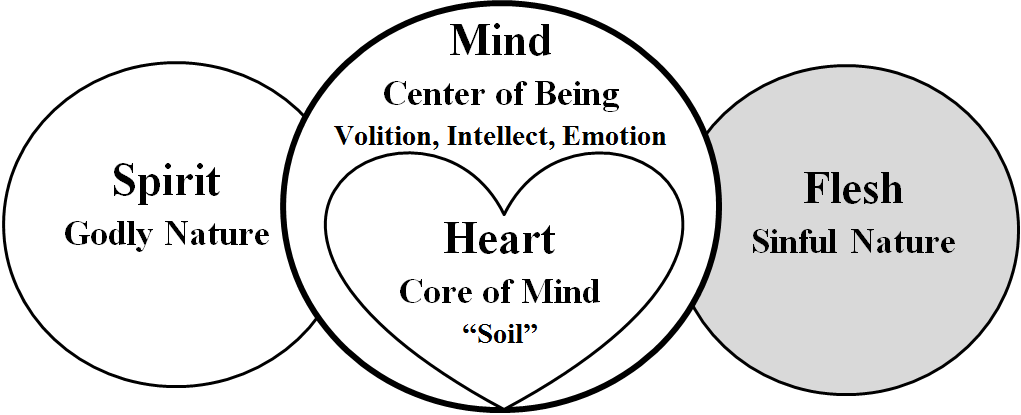
(Click to enlarge image)
Understanding Noémas
The Bible instructs us to “take captive every thought and make it obedient to Christ” (2 Corinthians 10:5). Christ is the living Word of God who is the truth (John 1:1 & 14:6). So we are to “take captive” thoughts and make sure that they comply with the truth. ‘Truth’ is alétheia (ah-LAY-thee-ah) in the Greek, which means “reality” or “the way it really is.” So we are to take “thoughts” and make sure they conform to reality. If they don’t comply with the truth then they are ‘weeds’ of unreality and must be purged from the soil of our hearts.
The word ‘thought’ in this passage is noéma (NOH-ay-mah) in the Greek. While noéma can refer to thoughts/impulses, good or bad, it can also refer to a perspective—a mindset or attitude—that’s the result of indoctrination, good or bad. Such a mindset typically formulates over the course of many years. The Greek for ‘take captive’ in the phrase “take captive every thought” literally means to “take captive as a prisoner and interrogate.” The Bible is saying that we should take any perspective we have and honestly & thoroughly examine it, making sure it conforms to reality (the way it really is) rather than unreality (the way it really isn’t). If we discover that the mindset doesn’t comply with reality then we need to throw it out.
This can apply to any doctrine—teaching—you were taught during your formative years as a believer. Just because you were indoctrinated by a particular teaching doesn’t make the doctrine true. So you need to “interrogate” it in light of reality. Does it comply with the rightly-divided Word of truth and the Spirit of truth (John 17:17 & 16:13)? If not, it needs to be thrown out in favor of whatever the truth is, which is reality.
Another example would be secular indoctrination. Take homosexuality, for example. While homosexuality was still a crime in the USA as of the new millennium (2003), that’s all changed. Now homosexuality is taught to be innate and healthy in our secular culture and people are encouraged to experiment with it and embrace it as a legitimate alternative lifestyle. Significant people who publicly “come out”—like professional athletes—might even receive a call of commendation from the President. Those who refuse to approve of homosexuality, by contrast, are considered evil bigots and punished severely, socially speaking. The truth about homosexuality, however, is that it’s a damning sin and those who unrepentantly practice it will not inherit the kingdom of God, period. “Do not be deceived,” the Bible warns (1 Corinthians 6:9-11).
A believer struggling with this kind of worldly indoctrination or same-sex attraction can take these noémas (mindsets/thoughts) captive and interrogate them in light of the truth of Scripture and the leading or conviction of the Spirit of truth. Since these noémas don’t comply with the truth they need to be thrown out in favor of reality.
As you do this with every thought/impulse/attitude/mindset you purge your heart of falsity and unreality. This is “being made new in the attitude of your mind.”
SANCTIFICATION OF BODY: Purification of the Mortal Body and Ultimate Glorification
Like justification, glorification takes place instantaneously when Christ returns for his called-out ones—the church—wherein believers will receive new imperishable, glorified, powerful, spiritual bodies (1 Cor- inthians 15:42-44, 50-55). This is mind-blowing and I encourage you to study it in more detail in this article Eternal Life—What will it be Like?
The truth of eventual glorification does not discount the importance of sanctifying our present mortal bodies. Notice what the New Testament says on this:
Therefore, since we have these promises, dear friends, let us purify ourselves from everything that contaminates body and spirit, perfecting holiness out of reverence for God.
2 Corinthians 7:1
The word for “body” in this verse is sarx, which is most frequently used in the Bible in reference to the literal body of a person (e.g. John 3:6), but is often figuratively used in reference to the sinful nature, aka “the flesh.” In case of the latter, the New International Version understandably translates sarx as “sinful nature” (e.g. Romans 7:18 & Galatians 5:19-21). In the context of the above passage—2 Corinthians 7:1—sarx obviously refers to your body and not the sinful nature.
Likewise “spirit” in this context is not referring to the human spirit, but rather to a person’s character, which is the result of what an individual allows to be rooted in the soil of his/her heart, as explained in the previous sections. A good example of “spirit” used in this manner is the reference to Caleb having a “different spirit” than the ten unbelieving Hebrews who spied out the promised land (Numbers 14:24,30). Keep in mind that a lot of illnesses are psychosomatic in nature; meaning, they start in the psyche—which is the result of what a person allows to be lodged in his/her heart—and this eventually has physical ramifications, such as work stress creating an ulcer or high blood pressure.
Let’s focus on purifying ourselves from everything that pollutes the body. I’ll leave it to you and the Holy Spirit to discern how this applies to you, but there are some obvious contaminants, like smoking, alcohol abuse, overeating and drugs, the latter of which includes overindulgence in “meds.” As far as “meds” go, keep in mind that the word for “witchcraft” or “sorcery” in the list of fleshly activities noted in Galatians 5:19-21 is pharmakeia (FAR-mah-KIH-ah), which is where we get the English words ‘pharmacy’ and ‘pharmaceuticals.’ It means “the [wrongful] administration or use of medicine, drugs or spells.”
May you be sanctified through and through; may your whole spirit, mind & body be purified. Amen.

Related Topics:
Spirituality — How to be Spirit-Controlled Rather than Flesh-Ruled
Human Nature — Spirit, Mind & Body
Demonic Spirits — How to Deflect Them
How to Renew Your Mind (video)
SLAIN IN THE SPIRIT — Is It Biblical?

Being “slain in the Spirit” is not a teaching in the sense of a biblical doctrine—like, say, the nature of eternal life—but rather a phenomenon that occurs when the natural meets the supernatural. As such, there are hints of this phenomenon in the Scriptures, but no detailed exposition.
Three passages in the Old Testament come to mind:
Then the cloud covered the tent of meeting, and the glory of the Lord filled the tabernacle. 35 Moses could not enter the tent of meeting because the cloud had settled on it, and the glory of the Lord filled the tabernacle.
Exodus 40:34-35
As you can see, Moses could not enter the Tent of Meeting because the glory of God had settled on it. The natural (Moses) met the supernatural (God) and so Moses was, in effect, “slain in the Spirit.”
Similarly, the following two passages show that the priests could not perform their service because the glory of God filled the Temple:
When the priests withdrew from the Holy Place, the cloud filled the temple of the Lord. 11 And the priests could not perform their service because of the cloud, for the glory of the Lord filled his temple.
1 Kings 8:10-11
The trumpeters and musicians joined in unison to give praise and thanks to the Lord. Accompanied by trumpets, cymbals and other instruments, the singers raised their voices in praise to the Lord and sang:
“He is good; his love endures forever.”
Then the temple of the Lord was filled with the cloud, 14 and the priests could not perform their service because of the cloud, for the glory of the Lord filled the temple of God.
2 Chronicles 5:13-14
As far as the New Testament goes, the guards at Jesus’ tomb seemed to have been ‘slain in the Spirit’ after encountering the angel of the Lord:
There was a violent earthquake, for an angel of the Lord came down from heaven and, going to the tomb, rolled back the stone and sat on it. 3 His appearance was like lightning, and his clothes were white as snow. 4 The guards were so afraid of him that they shook and became like dead men.
Matthew 28:2-4
In the Garden of Gethsemane some of the soldiers & officials who came to apprehend Christ “fell to the ground” when he simply said “I AM he,” which bespeaks of the slain in the Spirit phenomenon:
Jesus, knowing all that was going to happen to him, went out and asked them, “Who is it you want?”
5 “Jesus of Nazareth,” they replied.
“I am he,” Jesus said. (And Judas the traitor was standing there with them.) 6 When Jesus said, “I am he,” they drew back and fell to the ground.
John 18:4-6
Another applicable occasion is when John fell at the Lord’s feet “as though dead”:
When I saw him, I fell at his feet as though dead. Then he placed his right hand on me and said: “Do not be afraid. I am the First and the Last.
Revelation 1:17
In these three cases it’s not clear whether the people in question fell backwards or forwards, although the first two imply falling backwards. Does it really matter?
I’ve experienced the slain in the Spirit phenomenon a handful of times, maybe more; my wife too. Again, it’s just something that occurs when the natural meets the supernatural. It’s a phenomenon rather than an essential doctrine. As such, we shouldn’t dis-fellowship over the issue. To do so would be very immature. Remember the saying:
In essentials unity; in non-essentials liberty; in all things, charity.
I’ve encountered some fellowships where this slain in the Spirit phenomenon is overemphasized to the point that people are encouraged and expected to fall over when a minister lays hands on them. When this occurs people tend to fall over because they’re expected to—and want to—and hence it’s just a psychosomatic reaction. This, of course, isn’t being slain in the Spirit, which is different than saying that the Lord couldn’t minister to someone experiencing this.
One popular minister would go so far as to call people “dummy” if they failed to fall over when he laid hands on them, which is absurd and thoroughly unbiblical, not to mention arrogant and carnally offensive. Moreover, I’ve actually witnessed a pastor literally push someone over after praying. This is wrong. If people fall, they fall, but don’t push ’em over! Why would ministers behave this way? Because they’ve been taught that (1) someone hasn’t actually received unless he or she falls over and (2) they believe their ministry isn’t authentic unless the person falls over. Needless to say, you won’t find any biblical support for either.
Unless the assembly in question is overemphasizing this phenomenon to the point that its bugging you so much you can’t stand being there due to obvious error, as noted above, I wouldn’t let it bother you. As 1 Thessalonians 5:21 says: “Test all things; hold on to the good.” Or, as I like to say, “Eat the meat and spit out the bones.”
Lastly, Christ said “the truth will set you free” (John 8:31-32). This article offers some scriptural substantiation for the ‘slain in the Spirit’ phenomenon (which is different than saying that all cases are authentic). Every move of God has its lunatic fringe, which includes phonies who latch on to it; but don’t let this prevent you from being blessed by a minister or ministry due to fear or unbelief. It’s better to hang with those who eagerly desire spiritual gifts and function in them to some degree — flaws and all — than to hang with those who eagerly deny them with the corresponding sterile religious atmosphere (1 Corinthians 12:31 & 14:1).
Related Topics:
The Six Basic Doctrines of Christianity (the “Laying on of Hands” section)
Pool of Béthesda—What Was It All About?
Is the Holy Spirit God or a Divine Force?
What Are the Nine GIFTS OF THE SPIRIT?
What Is CESSATIONISM and Is It Biblical?
What Is the Doctrine THE LAYING ON OF HANDS?
MINISTERIAL ABUSE — The Diotrephes Spirit vs. the Davidic Spirit

I see too much rivalry in the church today, even in leadership. Of course, this is nothing new, as the apostle Paul had to deal with it in the early church, 2000 years ago (Philippians 1:15). Too many ministers view anyone who’s knowledgeable and gifted with an eye of evil suspicion. They don’t want anyone “stealing their thunder,” so they turn people against those they deem rivals, sometimes even resorting to slander, as unbelievable as that may seem. In fact, they’ll cite the gifts of the Spirit to back up their smear campaigns, e.g. “I discerned by the Spirit that he (or she) is here to provoke disunity and to do the devil’s work.” Of course there are people who cause serious problems and they need to be rebuked and driven out if necessary, but such people are proud mockers and will show clear signs of the flesh (Romans 16:17-18 & Titus 3:9-11). That’s not who I’m referring to here. I’m talking about solid, fruit-bearing Christians who are slandered and chased out of assemblies because pastors or elders feel threatened by them. Such rivalry is rooted in jealousy, insecurity and selfish ambition (Philippians 1:15-17). They’re weak “leaders,” pure and simple.
There’s a good example of this in the Bible:
9 I wrote to the church, but Diotrephes, who loves to be first, will not welcome us. 10 So when I come, I will call attention to what he is doing, spreading malicious nonsense about us. Not satisfied with that, he even refuses to welcome other believers. He also stops those who want to do so and puts them out of the church.
3 John 1:9-10
The apostle John cited a leader of one of the churches he oversaw – Diotrephes (dye-OT-rah-feez) – who refused to welcome John and other godly ministers in the assembly and even ran a smear campaign against them (!); those in the congregation who objected to Diotrephes’ fleshly tactics were swiftly excommunicated by the man! This indicates that Diotrephes was the head pastor. After all, who else but the pastor would have the authority to prevent an overseer of John’s stature from coming and ministering? Who else but the pastor has the power to excommunicate?
John readily understood Diotrephes’ root problem – he loved to be first (verse 9). In other words, Diotrephes was an arrogant control-freak who wasn’t interested in serving others, but rather desired others to serve him. Such an attitude is, of course, in direct opposition to Christ & Paul’s teaching and example of servant-leadership (Matthew 23:1-11, 2 Corinthians 10:8, 13:10; 1 Peter 5:2-3). John may have been renowned for his loving spirit, but he wasn’t about to overlook such heinous abuses in the name of peace and niceness; no, he was fully intent on exposing and correcting the man (verse 10). In fact, John’s third epistle was/is a public judgment and exposal of Diotrephes’ error to every person who has read it ever since! This includes you, right now. This is a form of tough love.
Sad to say, there are ungodly “ministers” in the Church today just like Diotrephes. Mature Christians need to boldly rise up and call attention to the abuses of these selfish control-freaks whenever such abuses occur, like John did, even at the threat of excommunication or losing one’s ministry gig. After all, evil thrives when good people do nothing! (Speaking of which, there’s nothing more pathetic than weak ‘yes men’ or ‘yes women’ who condone corruption in the name of meekness or due to idolization of a relationship or position).
Strong leaders, by contrast, are able to utilize strong people and properly integrate them in their work. Take the example of David, “a man after God’s own heart.” The Bible goes into quite a bit of detail about David’s “mighty men,” which were some 53 men who helped David become king of Israel (2 Samuel 23:8-39; 1 Chronicles 11:10-47). They formed David’s inner circle of leadership. These powerful men were more skilled than David in their areas of expertise (!). Yet David knew his calling and strengths, and was therefore secure and unthreatened. He also knew his limitations. He realized he wasn’t going to make it alone because no one makes it alone – no one. All great men and women embrace the help and skills of others. Consequently, David enlisted a formidable group to assist him in fulfilling God’s assignment. In short, David didn’t automatically view gifted people with an eye of evil suspicion and chase them away. No, he wisely recognized their uniqueness & greatness and released them to operate in their strengths on his team. Thus David became the greatest king of Israel. Oh, that there were more leaders like David in the Church today!
Needless to say, Go where you’re celebrated and encouraged to walk in your strengths and not where you’re tolerated, ignored, suppressed or slandered.
This article is also available in chapter 14 of…

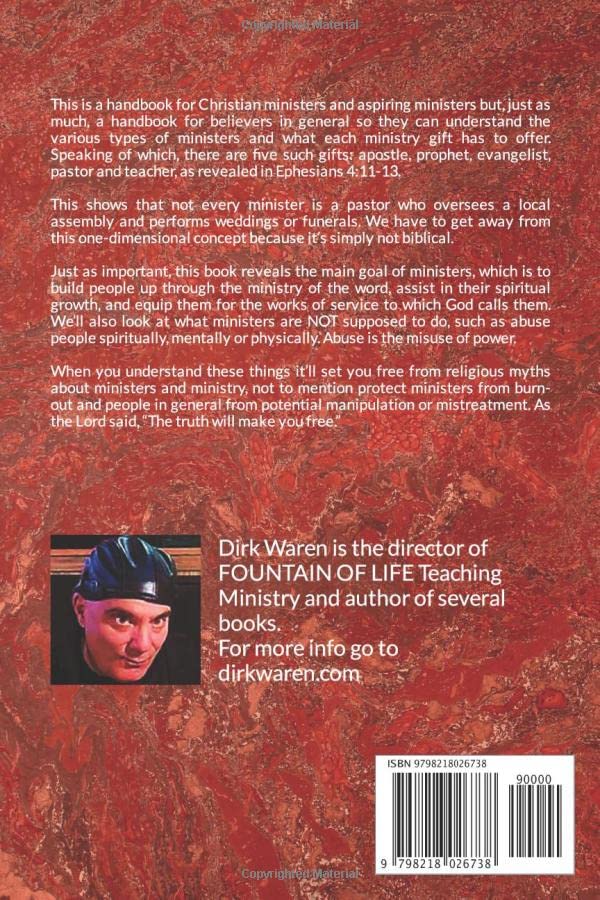
- You can purchase the print book here for only $7.38 (175 pages).
- Or get the Kindle eBook here for only 99¢
Related Topics:
The Fivefold Ministry Gifts — Apostle, Prophet, Evangelist, Pastor and Teacher
Ministerial Pitfalls and Abuses
Condemnation & Authoritarianism
Judging—When Should You Judge and When Shouldn’t You Judge?
What Are THE BASICS of Christianity?
DISASSOCIATE FROM TOXIC PEOPLE! (The “Turn Away Principle”)

There are numerous passages in the New Testament where we are instructed to disassociate from toxic people who are hostile, quarrelsome, lazy or carnal and refuse to accept or follow God’s Word. See, for example, 1 Corinthians 5:9-13, Romans 16:17-18, Titus 3:9-11, 2 Thessalonians 3:6, 2 Thessalonians 3:14-15, 2 Timothy 3:1-5 and 2 John 10-11 (for details see this article).
I call this the “turn away principle” based on a notable Old Testament passage. Chapter 17 of 1 Samuel details the famous account of David and Goliath. The 9’5″ Goliath was the Philistine champion who came down from his camp and challenged the Israelites every morning and evening for forty days. King Saul and his entire army reacted with great fear to the giant’s menacing threats, but when the shepherd boy David came to visit his brothers in Saul’s camp he expressed courageous interest in fighting Goliath for the considerable reward. Note the hostile reaction of David’s oldest brother:
When Eliab, David’s oldest brother, heard him speaking with the men, he burned with anger at him and asked, “Why have you come down here? And with whom did you leave those few sheep in the desert? I know how conceited you are and how wicked your heart is: you came down only to watch the battle.”
1 Samuel 17:28-29
Why was Eliab so angry with his youngest brother? Why did he insult David’s work (“those few sheep”)? Why did he call him conceited and wicked? Why did he make erroneous judgments concerning his intentions for visiting the army (which David actually did in obedience to their father, Jesse)? Eliab’s objections were all rooted in the flesh since David was clearly anointed of God to fight Goliath and deliver the Israelites from the Philistines. Eliab was jealous, pure and simple. Why was he jealous? Obviously because he was ashamed since, if anyone in his family was going to take on Goliath, it should’ve been him, the eldest brother with the most military experience. Simply put, David’s ultra-confidence in the LORD and his boldness at the prospect of fighting Goliath while the entire army shrunk back in terror seriously threatened Eliab’s sense of manhood and self-respect. In addition, Eliab was passed over a few years earlier when the prophet Samuel anointed David (1 Samuel 16:6-13). He was also likely jealous of the honor David received at such a young age in Saul’s court as a musician and armor-bearer (1 Samuel 16:21-23).
Notice David’s response to Eliab:
“Now what have I done?” said David. “Can’t I even speak?” (30) He then turned away to someone else and brought up the same matter, and the men answered him as before.
1 Samuel 17:29-30
David’s response – “Now what have I done?” – reveals that he was used to Eliab’s hollow accusations and insults. As the firstborn and eldest brother, Eliab had sibling authority and he obviously abused that authority via his constant unprovoked attacks on David, the gifted and anointed sibling who most threatened him. But this time David wasn’t going to take it; his adrenalin was pumping with righteous anger after hearing Goliath’s defiant challenge (verse 26) and he wasn’t about to let his brother’s discouraging words hinder him from fulfilling his divine commission. So what did David do? He “turned away” from his brother and inquired of someone else about the king’s reward for slaying the giant. Saul caught word of David’s bold interest and gave him his blessing to face Goliath. The rest is history – David slew Goliath with his slingshot and the Israelites had a great victory. He received a high rank in Saul’s service, fought many successful campaigns and ultimately became king of Israel.
This is important: In one day David graduated from a lowly shepherd boy to a mighty warrior and Eliab tried to stop this incredible promotion because of his pathetic rivalry. Since David’s promotion was clearly God-ordained, Eliab’s attempt to abort it was not only carnal, it was Satanic. But David was very close to God and therefore knew his divine calling; he wasn’t about to let Eliab’s false accusations and insults discourage him from fulfilling the LORD’s will and receiving the subsequent reward and promotion.
Yet notice what David did and didn’t do. He didn’t enter into some draining quarrel with his brother; he simply “turned away,” which means he disassociated from him.
At some point you too will have to “turn away” from some of your relatives, friends or colleagues if they’re treating you the way Eliab treated David. Don’t fight with them, as far as it is possible. Like David, refuse to enter into life-sapping conflicts of this sort because they’ll inevitably pull you into the realm of the flesh and break your focus. If you make a battle out of everything you won’t have enough energy left over for what’s important. Just turn away.
And always remember that spirit is thicker than blood. What’s this mean? On one occasion Jesus’ mother and brothers came to see him while he was ministering from town to town but they weren’t able to get inside the domicile where he was teaching due to the crowds. Someone announced that his mother & brothers were outside waiting to which Jesus responded, “My mother and brothers are those who hear God’s word and put it into practice” (Luke 8:19-21). Was Jesus disrespecting his blood relatives? No, he was simply making an important point: Your true relatives or friends are any who follow the ways of God and truth, which naturally includes those who recognize your worth and respect your divine assignment, not those who mock and discourage you because they’re arrogant, ignorant, insecure or jealous.
One last thing: Turning away from someone doesn’t have to be a lifelong affair; hopefully it’s temporary, depending on the person’s change of heart. David, for example, didn’t turn away from his oldest brother forever as Eliab later acknowledged David’s divine call and served as an officer under his kingship. This shows that, although Eliab really blew it on this occasion, he wasn’t a hopeless fool.
I’ve had to “turn away” from a few people over the years due to consistent bad fruit like arrogance, disrespect, strife and pure folly; one was even a best friend for about decade. They were stubborn and unrepentant, so I cut ties. But this doesn’t mean it has to last a lifetime. I’m more than willing to restore these relationships if any show genuine signs of repentance. They don’t even have to vocalize it to me; all they have to do is indicate that they’ve had a sincere change of heart. Heck, I’m open to being best buddies, as long as they’re penitent. Isn’t this exactly how God deals with humanity? He’s willing to be close with any of us as long as we come to him with humble, respectful, pliable, repentant hearts, but if we’re stubborn and disrespectful, forget it. I’m happy to report, by the way, that one of these relationships was restored recently – God is good!
New Testament Passages that Support the “Turn-away Principle”
Observe these instructions Paul gave to the Roman Christians:
I urge you, brothers, to watch out for those who cause divisions and put obstacles in your way that are contrary to the teaching you have learned. Keep away from them. (18) For such people are not serving our Lord Christ, but their own appetites. By smooth talk and flattery they deceive the minds of naïve people.
Romans 16:17-18
Paul tells the believers to watch out for those who have a penchant for causing strife and he instructs them to simply “keep away from them.” Notice he didn’t instruct them to confront and rebuke these divisive individuals; he simply told them to stay away from them. Were these divisive people Christians or unbelievers? It’s clear that Paul was referring to people within the community of Roman believers who at least proposed to be Christians. Regardless of whether or not they were legitimate Christians, Paul points out in verse 18 that they’re not serving the Lord but rather their own selfish desires.
He then shares telltale signs of such divisive persons: They’re known for smooth talking and deceiving naïve people, meaning individuals who are unable to discern their true ungodly character. What’s “smooth talk”? In modern vernacular, it’s bullcrap or another word that shares the initials of Barbara Streisand. Such people have a natural gift for storytelling and exaggeration. In other words, they have a social talent to dazzle others with bullcrap, yet not everyone, just those who are naïve and unable to recognize their smooth talk for what it is – bullcrap. They’re liars, exaggerators, boasters and flatterers who naturally provoke strife and disunity wherever they go because it’s their nature. In modern lingo, they’re narcissists.
Be on guard against such supposed Christians and keep away from them. Unless the Spirit moves you otherwise, don’t try to confront and correct them because they’ll hate you for it and turn the confrontation against you (Proverbs 9:7-9); they’ll do everything in their power to tear you to pieces like the savage wolves they are. They’ll draw you right into the realm of the flesh, which is the only plane they’re comfortable with, and bring out the worst in you. Don’t fall into their trap; don’t take the bait. Simply stay away from them, pray for them and protect the innocent lambs in your midst from their smooth-talking clutches.
This reminds me of an in-law who was so insulting and contentious that I simply stopped taking his calls. If he’d leave a message I’d automatically delete it without listening. Why? Because talking to him, or even listening to one of his messages, was like drinking spiritual poison; it would literally ruin my day – needlessly destroying my focus and sapping my positivity. I discovered that my godly sister Becky refused to take his calls as well. Trust me, neither of us came to this decision rashly; it took a full decade of loving patience, mercy and prayer. But life’s too precious to waste on people who have proven themselves to be disrespectful, arrogant ingrates, no matter how loudly they claim to be Christians. The only way I’d open my life or ears to such a proven divisive, aggravating person is if I hear from a respected source that he/she is willing to talk with a modicum of humility and respect. If so, I’m all ears.
Here’s another pertinent passage on the subject:
But mark this: There will be terrible times in the last days. (2) People will be lovers of themselves, lovers of money, boastful, proud, abusive, disobedient to their parents, ungrateful, unholy, (3) without love, unforgiving, slanderous, without self-control, brutal, not lovers of the good, (4) treacherous, rash, conceited, lovers of pleasure rather than lovers of God – (5) having a form of godliness but denying its power. Have nothing to do with them.
2 Timothy 3:1-5
These instructions were given to Paul’s young protégé, Timothy. Paul encouraged him to “have nothing to do with” these carnal individuals who had a form of godliness but denied its power (verse 5). This indicates that these were people who professed to know God but clearly lacked the power of a transformed life. Instead of “fruit” like love, joy, peace, kindness, humility and self-control (Galatians 5:22-23) they showed consistent evidence of selfishness, greed, boasting, pride, abuse, ungratefulness, profaneness, hostility, lying, slander, intemperance, rashness, conceit and hedonism (including drunkard-ness and drug-worship). As in the Romans passage above, Paul doesn’t even tell Timothy to confront and rebuke such people; he simply instructs him to have nothing to do with them.
Likewise, if the people who offend you share these consistent fleshly traits confronting them — as Christ elsewhere instructed (Matthew 18:15-17) — is useless because they lack godly character; the primary fruit being love. It’s simply impossible to correct arrogant, abusive, brutal, rash, hedonistic narcissists without being drawn into a big ugly quarrel. Again, it will inevitably draw you into the flesh and bring out the worst in you. Such people despise godliness and correction, regardless of whether or not they confess the Lord and go to church. “Have nothing to do with them.”
Related Topics:
Turning the Cheek — What it Means and Doesn’t Mean
Is Name-Calling Ever Appropriate?
Absolute Pacifism (Unbiblical) vs. Limited Pacifism (Biblical)
How to Confront & Correct (and How NOT to)
Handling Personal Offenses vs. Handling Criminal Acts
When Should You JUDGE and When Shouldn’t You JUDGE?

Judging is a generally misunderstood subject in Christendom. Numerous times I’ve heard people quote Jesus’ statement “Do not judge” insisting that Christians should never judge anyone for anything ever. This is no different than the topic of forgiveness where people take one or two passages, disregard the entire rest of the Bible, and “prove” that believers are required to automatically forgive everyone for everything all the time. It goes without saying that this is a very foolish and unbalanced approach to Bible interpretation. Don’t these people realize that anyone who conveys God’s Word in this unsound manner will ultimately have to answer to the LORD Himself? This is why James 3:1 dissuades believers from jumping the gun on teaching from the Bible, because those who minister the Word will be “judged more strictly.” Why will they be judged more strictly? Because they’re conveying to people the very Word of the Almighty. Consequently, those who teach the Bible are responsible for “correctly handling” the Scriptures, meaning they must strive to ‘get it right’ by being honest, unbiased, studious, thorough and balanced on every subject they teach. It’s a big responsibility.
With this understanding, let’s examine the topic of judging.
The Measure You Use Will Be Measured to You
Yes, Jesus said “Do not judge”, but we need to look at the full passage and then take into consideration other notable statements from the very same chapter:
“Do not judge, or you too will be judged. (2) For in the same way you judge others, you will be judged, and with the measure you use, it will be measured to you.
(3) “Why do you look at the speck of sawdust in your brother’s eye and pay no attention to the plank in your own eye? (4) How can you say to your brother, ‘Let me take the speck out of your eye,’ when all the time there is a plank in your own eye? (5) You hypocrite, first take the plank out of your own eye, and then you will see clearly to remove the speck from your brother’s eye.”
Matthew 7:1-5
Verses 1-2 illustrate the law of sowing and reaping—you reap what you plant or get what you give. Are you often strict, judgmental, suspicious and critical toward others? People will generally treat you in like manner. Are you merciful and graceful? People will largely regard you the same way. This brings to mind the “golden rule” cited by Jesus seven verses later:
“So, in everything, do to others what you would have them do to you, for this sums up the Law and Prophets.”
Matthew 7:12
Every social-moral law of the Old Testament is fulfilled by simply following this rule, called the “royal law” in Scripture (James 2:8). If you don’t like people stealing from you then don’t steal from others. If you don’t like someone messing with your spouse don’t mess with someone else’s mate. Etcetera.
In verses 3-5 Jesus shares the example of a person criticizing a speck of sawdust in someone else’s eye while that person has a plank sticking out of his or her own eye. It’s absurd, isn’t it? Jesus calls such a person a hypocrite—a clueless religious fake. He concludes by instructing what needs to be done in such a scene: The hypocritical judger needs to examine himself or herself, remove the plank, and then s/he can see clearly enough to help the other person remove the speck.
This is really just a matter of common sense, but I’m surprised at how often people refuse to see their “plank” while criticizing someone else’s “speck.” For instance, I was berated for 20 minutes by an in-law for canceling out of a one-night campfire with family, which was 3 hours away; I simply didn’t have it in me to drive that far after working hard all week. Even though I humbly apologized he still kept berating and antagonizing. It later dawned on me that this was the same person who had a record of canceling entire vacations with dubious excuses (e.g. “I went to the wrong airport”). Unbelievable.
Here’s another example: Many years ago I worked at a department store and there was this loss-prevention manager, a former Marine drill instructor, who would scream at meetings, “I don’t care if you steal a pack of gum or a candy bar; if I catch it you’re fired!!” He seemed hell-bent on saving the company money and time—monitoring the time clock, peering through security windows with binoculars, etc. Years later he was fired for stealing expensive items by hiding them behind the building to pick up later when he did his final security round. He had been doing this for years. Do you see the hypocrisy? He loudly condemned the possibility of an employee stealing a candy bar while he regularly stole expensive merchandise (?). You can’t make this stuff up.
I’m sure you see why Jesus said “Do not judge” in light of the context: The way we judge others generally determines how others will judge us. More importantly, it determines how God will judge us, and with the measure we use it will be measured to us. It’s an obvious and simple principle. Yet this is much different than saying we should never judge anyone ever, as some claim. Jesus never said this. In fact, later in the chapter he instructs believers to make judgments based on the fruitfulness of people who claim to speak for God. Let’s look at that…
The Importance of Judging Fruit
Notice what Jesus said in the very same chapter about those who falsely speak for God and the importance of judging a person’s “fruit”:
“Watch out for false prophets. They come to you in sheep’s clothing, but inwardly they are ferocious wolves. (16) By their fruit you will recognize them. Do people pick up grapes from thornbushes, or figs from thistles? (17) Likewise every good tree bears good fruit but a bad tree bears bad fruit. (18) A good tree cannot bear bad fruit, and a bad tree cannot bear good fruit. (19) Every tree that does not bear good fruit is cut down and thrown into the fire. (20) Thus, by their fruit you will recognize them.”
(21) “Not everyone who says to me, ‘Lord, Lord,’ will enter the kingdom of heaven, but only he who does the will of my Father who is in heaven. (22) Many will say to me on that day, ‘Lord, Lord, did we not prophesy in your name, and in your name drive out demons and perform many miracles?’ (23) Then I will tell them plainly, ‘I never knew you. Away from me, you evildoers!’ ”
Matthew 7:15-23
Jesus is warning people here about “false prophets.” ‘False prophets’ in the Greek is one compound word pseudoprohetes (soo-doh-prah-FAY-tus); pseudo of course means false and prophetes refers to inspired speakers or those who propose to speak for God. Hence, pseudoprophetes or “false prophets” refers to people who falsely speak for the LORD.
Jesus doesn’t want believers to be misled so he warned us about those who falsely speak for God and revealed how to recognize them. How do we recognize them? As you can see, Jesus twice said that they can be recognized by their fruit (verses 16 & 20).
“Fruit” in this context refers to the “fruit of the spirit” or lack thereof as detailed in this next passage (which is the same Greek word):
The acts of the sinful nature are obvious: sexual immorality, impurity and debauchery; (20) idolatry and witchcraft; hatred, discord, jealousy, fits of rage, selfish ambition, dissensions, factions (21) and envy; drunkenness, orgies, and the like. I warn you as I did before, that those who live like this will not inherit the kingdom of God.
(22) But the fruit of the spirit is love, joy, peace, patience, kindness, goodness, faithfulness, (23) gentleness and self-control.
Galatians 5:19-23
As you can see, this passage contrasts the works of the flesh and the fruit of the spirit.* How can you tell if people are living out of their flesh or out of their spirit? By the fruit they bear on a consistent basis: Are they sexually immoral? Hateful? Quarrelsome? Jealous? Have childish fits of rage? Selfish? Envious? Given to drunkard-ness**? If so, they’re obviously walking according to their flesh. We’re not talking about someone who stumbles or struggles, then humbly confesses and gets back up; we’re talking about people who regularly produce these types of fleshly acts with no concern to repent or change, even when corrected. It’s stubborn, selfish arrogance, pure and simple. People who live out of their flesh like this are fleshly and therefore carnal. A confessing believer who regularly manifests these traits without care of repentance is a carnal-Christian, a Christian ruled by his/her carnal nature. Of course, a “carnal Christian” is a total oxymoron and, if a lasting condition, would indicate that the person isn’t even saved. After all, didn’t Jesus say we could distinguish the true from the false by their fruit?
* Since there is no capitalization in the original Greek, translators have to discern whether “spirit” should be capitalized in reference to the Holy Spirit or not capitalized in reference to the human spirit (e.g. Matthew 26:41). I maintain that whenever a text contrasts flesh and spirit, like Matthew 26:41 or Mark 14:38, “spirit” obviously refers to the human spirit. It makes little difference, however, in light of the fact that the believer’s human spirit is indwelt and guided by the Holy Spirit; hence, if we’re living out of our human spirit (uncapitalized), we’re automatically following the Holy Spirit and therefore living by the Spirit (capitalized).
** I should point out that being a drunkard is not the same as drinking a sip of alcohol. See Deuteronomy 14:26.
The point is that we can determine if people are living out of their spirit simply by the evidence and quantity of fruit of the spirit. Do you see love? Joy? Peace? Patience? Kindness? Goodness? Faith? Meekness (not weakness)? Self-control? If you generally see these fruits in people’s lives, they’re obviously living out of their spirit, meaning they’re spiritual. The more fruit you see, the more spiritual they are. You could also describe them as godly.
Speaking of which, people often misunderstand the term “godly.” They think it means to be staunchly religious in a lifeless and posturing Pharisaical sense, but nothing could be further from the truth. To be godly simply means to be like God. Is the Creator of the wonders of the universe some lifeless, dull fuddy-duddy? Of course not. The Almighty overflows with life, joy, love, peace, goodness and vitality – he’s literally the Fountain of LIFE (Psalm 36:9)! The fruits of the Spirit are, in reality, the fruits of God’s character. Consequently, to be godly or like-God means to consistently bear the fruit of the spirit or “new self,” which is “created to be like God in true righteousness and holiness” (Ephesians 4:24, emphasis added). In other words, do you see a person consistently producing fruit of the spirit, the primary fruit being agape love as defined in 1 Corinthians 13:4-7? Such a person will be honest about his/her shortcomings and quick-to-repent. That person is godly. Do you see a person consistently producing works of the flesh and stubbornly unwilling to admit it or change when corrected? That person is ungodly. This isn’t deep; it’s simple as pie.
Keep in mind that this passage, Galatians 5:19-23, does not provide an exhaustive list of either works of the flesh or fruit of the spirit. For instance, arrogance, deceit and laziness are top works of the flesh but they’re not cited here, which explains why Paul added “and the like” to the end of the list. There are also more than just nine fruits of the spirit; for instance, righteousness and truth are also spiritual fruits according to Ephesians 5:9 and Philippians 1:11 (righteousness in this context would of course refer to practical righteousness, as shown in 1 John 2:29, rather than positional righteousness).
All this helps clarify what Jesus was talking about when he said “by their fruit you will recognize” those who falsely speak for God (Matthew 7:16,20). He then went on to explain this in verses 21-23, citing those who readily call him “Lord” but fail to walk according to God’s will. In fact, he ultimately calls them “evildoers” (verse 23). An evildoer is simply someone who chooses to live out of his or her flesh and, consequently, produces evil.
We must distinguish good fruit from good works because these people whom Jesus called “evildoers” clearly performed good works. When they stand before the Lord to give an account of their lives we see them boasting of many good works—prophesying, exorcizing demons and performing many miracles (verse 22). Such boasting indicates that they’re living out of their flesh because boasting stems from arrogance, which is in contrast to the fruit of meekness. It also signifies a strong works-orientation rather than relationship-orientation, a clear sign of legalism. In the passage Jesus does not deny that these people did these good works. Since there is no indication that they’re lying we must conclude that they did, in fact, do these good works. But Jesus plainly tells them, “I never knew you. Away from me, you evildoers!”
The obvious conclusion is that it’s possible to do good works and not produce fruit while doing them. This explains why Paul prayed this prayer for the Colossian believers:
And we pray this in order that you may live a life worthy of the Lord and may please him in every way: bearing fruit in every good work, growing in the knowledge of God.
Colossians 1:10
Notice Paul prayed that they bear fruit in every good work. Fruit is distinguished from good works. The reason Paul prayed this is because it’s possible to do a good work and not produce fruit of the spirit while doing it. You’ll see this all the time, just open your eyes. Have you ever seen someone doing a good work like “witnessing” in the flesh? I have. There’s no love, there’s no joy; they’re rude and arrogant. They may be doing a good work but they’re not bearing fruit of the spirit. Or how about a guy who gives $20 to a poor man—undoubtedly a good work—but he rudely adds, “Get a job ya worthless slob.” Or how about ministers who regularly give dull, lifeless, legalistic, rude or condemning sermons? Teaching the Word of God is definitely a good work, but they’re not bearing fruit doing it. (Don’t get me wrong here, there’s a time and place for open rebuke and righteous rudeness, like when Jesus called Peter “Satan” or rebuked the religionists as “blind fools” and “snakes”).
The problem with doing good works in the flesh like this is that they’re dead works; and the first basic doctrine of Christianity is repentance from dead works (Hebrews 6:1-2). This not only refers to repenting from sin but repenting from any good work done in the flesh to attain salvation or favor with God. This is the very definition of human religion. Christianity, by contrast, isn’t a mere religion; it’s rebirth, reconciliation, renewal and relationship with the Most High Creator of the universe! Genuine spiritual works spring forth naturally from this new nature and a loving, secure relationship with God.
Getting back to Matthew 7:15-23, according to Jesus the way we distinguish the true from the false, the genuine from the counterfeit, the sheep from the goats or wolves, is by fruit. Jesus backed this up elsewhere when he pointed out that “a tree is recognized by its fruit” (Matthew 12:33 & Luke 6:43-45). You can’t tell by good works, you can’t tell by personality/charisma and you can’t tell by gifts of the Spirit. Islamic terrorists perform good works. Hollywood celebrities have charisma to spare. The worldly Corinthian church had gifts of the Spirit because the gifts are given “without repentance” (Romans 11:29). I’m not saying these things are bad, just that they can’t be used as the primary gauge for distinguishing the genuine from the counterfeit. The way you distinguish the true from the false and the mature from the immature is by fruit of the spirit, the more consistency and greater quantity the better.
It’s true, of course, that we all miss it and fail from time to time as verified by 1 John 1:8, so if both true and false believers give in to the flesh what’s the difference? The obvious difference is that genuine believers produce the fruit of humility and are therefore open to correction and willing to repent, whereas counterfeits are proud, resistant to correction and stubbornly unwilling to repent. Not to mention that genuine believers consistently and increasingly produce fruit of the spirit, whereas the bogus do not.
By the way, when I say “correction” I don’t just mean face-to-face rebuke, which is what people automatically think of when they hear the term. Although open reproof is a legitimate means of correction, it’s probably the least common type. Correction can manifest in many ways—through the Word, through hearing a sermon, reading a book, by the Holy Spirit, during prayer or worship, while watching a movie, when alone and reflecting on things, etc. Learning, which is simply the act of acquiring accurate information, is the most common form of correction as the very process of learning corrects error and ignorance. Those with pliable, hungry hearts will receive correction in all these ways, making face-to-face rebuke either unnecessary or, at least, infrequent.
Summing this all up, in the very same chapter that Jesus said, “Do not judge, or you too will be judged,” he also instructed believers to judge people’s fruit so we’re not hoodwinked by those who falsely speak for God. So Jesus obviously didn’t mean that we should never judge anyone for anything ever.
Also, although Jesus was referring to judging the fruits of people who presume to be spiritually mature to some degree since he was talking about those who propose to speak for God, this principle works in distinguishing the authenticity and maturity level of any believer. After all, aren’t all believers ambassadors for the Kingdom of God? Don’t we all represent Christ and speak for him to some degree (1 Peter 2:9 & 2 Corinthians 5:20)? Aren’t we all living epistles (2 Corinthians 3:2-3)? Don’t get me wrong here, young Christians who have only been in the Lord a matter of months or a handful of years should be given more leeway than those who’ve been Christians for two or three decades but, regardless, the evidence of spiritual fruit—consistency and quantity—is how we’re to determine legitimacy and maturity. It’s really that simple.
“Are You Not to Judge Those Inside?”
Like Jesus, Paul also taught that we should judge fruit in the lives of fellow believers, including those who claim to be fellow believers but are not.
First Corinthians 5:1-5 details the account of the unrepentant fornicator whom Paul insisted must be expelled from the church at Corinth. The apostle went on to say this:
I have written you in my letter not to associate with sexually immoral people—(10) not at all meaning the people of this world who are immoral, or the greedy and swindlers, or idolaters. In that case you would have to leave the world. (11) But now I am writing you that you must not associate with anyone who calls himself a brother but is sexually immoral or greedy, an idolater or a slanderer, a drunkard or a swindler. With such a man do not even eat.
(12) What business is it of mine to judge those outside the church? Are you not to judge those inside? (13) God will judge those outside. “Expel the wicked man from among you.”
1 Corinthians 5:9-13
Paul points out that it’s none of his business—or our business—to judge those outside the church, referring to unbelievers; that’s God’s business. It’s also the business of the governing authorities who are ordained by God to “punish evildoers” (Romans 13:1-5). But it is our business to judge those inside the church, that is, fellow believers, as well as those who say they’re believers but aren’t. And notice what we’re supposed to judge—fruit. Are the people in question producing fruit of the spirit or bad fruit of the flesh? Paul points out in verse 11 that if a brother or sister in the Lord consistently produces works of the flesh with no concern of repentance we should cut associations with him or her. This doesn’t necessarily mean that we should never greet such a person or show kindness when the opportunity presents itself—situations vary and you have to be led of the Lord—but it is clear that we should have no close relations, which is indicated by the statement, “With such a man do not even eat.”
This type of “tough love” isn’t enacted for the purposes of being “holier than thou,” but rather to provoke the person to shame, self-examination and humble repentance. Keep in mind that ‘repentance’ means, “to change one’s mind or purpose for the better.” In other words, it’s a very positive thing. Once repentance is clear, whether verbally or non-verbally, the person should be received back into the fellowship with open arms and warm hearts. This is the Christian way—the way of love, humility, genuineness, hope, change and forgiveness.
What I want to stress here is that Paul clearly instructed the Corinthians to make judgments in certain situations. He asks in verse 12, “Are you not to judge those inside?” This is a rhetorical question; the obvious answer is ‘yes.’ Look what Paul goes on to say:
If any of you has a dispute with another, dare he take it before the ungodly for judgment instead of before the saints? (2) Do you not know that the saints will judge the world? And if you are to judge the world, are you not competent to judge trivial cases? (3) Do you not know that we will judge angels? How much more the things of this life! (4) Therefore, if you have disputes about such matters, appoint as judges even men of little account in the church! (5) I say this to shame you. Is it possible that there is nobody among you wise enough to judge a dispute between believers? (6) But instead, one brother goes to law against another – and this in front of unbelievers!
1 Corinthians 6:1-6
The church at Corinth was so immature and worldly that members were bringing lawsuits against one another. This is testimony to their carnal state of strife, an abysmal lack of peace and harmony. Paul contended that, instead of maligning Christianity by taking cases to secular court “in front of unbelievers,” wasn’t there someone in their midst wise enough to settle disputes? He argues in verses 2-3 that, since the saints (i.e. true believers) will judge the world and even angels to some degree, are we not competent enough to handle the trivial cases of this life?
How exactly will believers judge the world and angels? We will assist Christ to some measure in judging the world in the millennial kingdom (Revelation 2:26-27 & 3:21) and I’m sure there’s even more to it than this, but the Bible provides little detail. Such specifics will be made clear when the time comes and simply aren’t important now. As for judging angels, since ‘judge’ can mean “to rule or govern” it’s likely that this means we’ll govern angels in the eternal age of the new heavens and new earth. This seems reasonable since Hebrews 1:14 describes angels as “ministering spirits sent to serve those who will inherit salvation” (emphasis added); hence, it makes sense that angels will serve us in eternity as we govern them. Another possibility is that the reference is to judging fallen angels.
As you can plainly see, the notion that Christians are not to judge anyone for anything ever is a myth. Those who teach this are not balanced with the Scriptures; on the contrary, they’re improperly handling them and, consequently, spreading error.
Paul Judges and Corrects Peter
A good example of judging fruit can be found in Galatians 2:11-14 where Paul judged Peter and openly corrected him in front of other believers in Antioch. What did Peter do that was worthy of such a public rebuke? Peter was a “pillar” in the church with great influence, as shown in Galatians 2:9. He was the first to take the gospel to the gentiles after discovering the Mosaic command to disassociate from non-Jews was no longer relevant in the new covenant (Acts 10:9-48), yet in Antioch he withdrew from the gentile believers to side with the legalistic Judaizers who were espousing heresy. Peter’s actions started to negatively influence others, including Barnabas. This was a serious blow to the gospel of grace and Paul had no choice but to boldly address the matter. He was righteously angry and referred to Peter’s behavior as “hypocrisy,” which literally means putting on an act. How were Peter and those swayed by his example putting on an act? They were supposed to be committed to the gospel of grace but embraced Hebrew legalism because they were afraid of losing popularity with the Jewish religionists. You could also argue they were pretending to be committed to the gospel of grace while buddying up with the heretical Judaizers. Either way it’s hypocrisy.
Paul was acting according to godly wisdom. The book of Proverbs states, “Better is open rebuke than hidden love” (27:5). Paul observed Peter’s bad fruit, judged it, and corrected him accordingly. Since Peter’s error was in the open Christian community Paul reasoned that it called for a public reprimand. His motivation was love—love for God and love for people, which are the two greatest commands (Matthew 22:34-40). Paul loved the LORD and people too much to allow the gospel of grace to be poisoned by legalism. Had he not acted decisively and boldly at that moment the positive worldwide impact of Christianity would have suffered. Make no mistake, there was much at stake.
The good news is that Peter received the correction and reformed accordingly. This is testimony to his wise character as verified in Proverbs 9:7-9, which points out the differences of correcting a “mocker” and a godly man. If you rebuke a mocker, which is a proud man according to Proverbs 21:24, he’ll hate you and react with abuse, whereas if you correct a humble, righteous man he’ll appreciate it and add to his learning (Psalm 141:5). I’m only referring, of course, to legitimate corrections here; if someone attempts to correct you and it’s not legitimate don’t receive it. Correct him or her instead, particularly those who are overly gung-ho about correcting others, including pastors. Such people usually have an unhealthy need to be authoritative; in other words, they’re control freaks. This is a form of spiritual abuse, which is the misuse of power. They need taken down a peg or two. Do it.
Paul’s judgment and correction of Peter’s hypocrisy was legitimate, however, and Peter humbly received it.
Other Examples of Judging Fruit
There are numerous instances in the New Testament where believers are encouraged to judge fruit. In all the following examples we are instructed to judge unrepentant fleshliness in one form or another and cut associations just like in the aforementioned cases, unless of course the person repents. Nowhere are we directed to just automatically forgive these people by unconditionally pardoning carnality.
Let’s look at a couple of passages that instruct us how to handle divisive people who unnecessarily provoke strife:
I urge you, brothers, to watch out for those who cause divisions and put obstacles in your way that are contrary to the teaching you have learned. Keep away from them. (18) For such people are not serving our Lord Christ, but their own appetites. By smooth talk and flattery they deceive the minds of naïve people.
Romans 16:17-18
Paul tells the believers to watch out for those who have a penchant for causing strife and he instructs them to simply “keep away from them.” Notice he didn’t instruct them to confront and rebuke these divisive individuals; he simply told them to stay away from them. Were these divisive people Christians or unbelievers? It’s clear that Paul was referring to people within the community of Roman believers who at least proposed to be Christians. Regardless of whether or not they were legitimate Christians, Paul points out in verse 18 that they’re not serving the Lord but rather their own selfish desires. He then shares telltale signs of such divisive persons: They’re known for smooth talking and deceiving naïve people, meaning individuals who are unable to discern their true ungodly character. What’s “smooth talk”? In modern vernacular, it’s bullcrap or another word that shares the initials of Barbara Streisand, too crude to cite here. Such people have a natural gift for storytelling and exaggeration. In other words, they have a social talent to dazzle others with bullcrap, yet not everyone, just those who are naïve and unable to recognize their smooth talk for what it is—bullcrap. They’re liars, exaggerators, boasters and flatterers who naturally provoke strife and disunity wherever they go because it’s their nature. Be on guard against such supposed Christians and keep away from them. Don’t try to confront and correct them because they’ll hate you for it and turn the confrontation against you (Proverbs 9:7-9); they’ll do everything in their power to tear you to pieces like the savage wolves they are. They’ll draw you right into the realm of the flesh, which is the only plane they’re comfortable with, and bring out the worst in you. Don’t fall into their trap; don’t take the bait. Simply stay away from them, pray for them and protect the innocent lambs in your midst from their smooth-talking clutches.
This reminds me of an in-law who was so insulting and contentious that I simply stopped taking his calls. If he’d leave a message I’d automatically delete it without listening. Why? Because talking to him, or even listening to one of his messages, was like drinking spiritual poison; it would literally ruin my day—needlessly destroying my focus and sapping my positivity. I discovered that my godly sister Becky refused to take his calls as well. Trust me, neither of us came to this decision rashly; it took a full decade of loving patience, mercy and prayer. But life’s too precious to waste on people who have proven themselves to be disrespectful, arrogant ingrates, no matter how loudly they claim to be Christians. The only way I’d open my life or ears to such a proven divisive, aggravating person is if I hear from a respected source that he (or she) is willing to talk with a modicum of humility and respect. If so, I’m all ears.
Here’s a similar passage:
But avoid foolish controversies and genealogies and arguments and quarrels about the law, because these are unprofitable and useless. (10) Warn a divisive person once, and then warn him a second time. After that, have nothing to do with him. (11) You may be sure that such a man is warped and sinful; he is self-condemned.
Titus 3:9-11
Paul instructs his companion in ministry, Titus, to warn such people twice before disassociating with them. Why take such strict measures with people who needlessly cause division and strife? Because a quarrelsome spirit is rooted in fleshly traits like arrogance, malice, rivalry and selfish ambition. I don’t think we realize how severe and damaging these carnal fruits are. It’s not a small matter. Notice God’s list of the top seven sins:
There are six things the LORD hates, seven that are detestable to him: (17) haughty eyes, a lying tongue, hands that shed innocent blood, (18) a heart that devises wicked schemes, feet that are quick to rush into evil, (19) a false witness who pours out lies and a man who stirs up dissension among brothers.
Proverbs 6:16-19
As you can see, needlessly provoking strife and division is one of the worst sins a person can commit! And notice that a few of the others in the top seven feed discord—haughty eyes, which means an arrogant heart (Proverbs 21:4), a lying tongue, and a false witness who pours out lies, which is a slanderer – someone who concocts false accusations in order to discredit and hurt others. Make no mistake, people who spread slander and gossip hate those they malign, as Proverbs 26:28 points out: “A lying tongue hates those it hurts.” ‘Hate’ refers to hostility and hostility is the root of the slander, gossip and lies. But what is the cause of such hostility if the person lied about is innocent and has done nothing wrong? The motive is obviously traits like envy and jealousy, which are works of the flesh according to Galatians 5:19-21, cited earlier.
Look what the Bible says about those bent on provoking strife and dissension:
He who loves a quarrel loves sin;
Proverbs 17:19
This is a simple verse but it packs a wallop. It refers to those who habitually generate quarrels and division. We’re not talking about legitimate confrontations and corrections here, like when Paul corrected Peter. Such valid confrontations are necessary and have the capacity to get heated at times, but they’re positive because they spur spirituality since “iron sharpens iron.” No, we’re talking about people who customarily create an atmosphere of quarrels, insults and carnal criticism. Such people “love sin,” the text says. If the person is stubborn and unrepentant, is it any wonder the Bible encourages us to “have nothing to do with him”?
This next verse refers to lazy people who refuse to practice the Word of God:
In the name of the Lord Jesus Christ, we command you, brothers, to keep away from every brother who is idle and does not live according to the teaching you received from us.
2 Thessalonians 3:6
Here Paul literally commands the Thessalonians to “keep away from” Christians who are idle and refuse to live according to the teaching of the Word. Once again, we are instructed to disassociate from people based on judging fleshly characteristics. Idleness refers to habitual inactivity or laziness, which the King James Bible calls sloth and other versions refer to as being a sluggard. Such people are too lazy to apply the Word of God in their lives, not to mention they refuse to get a job and work for their keep, which is why Paul follows up with a rule in verse 10: “If a man will not work, he shall not eat.” Of course he’s not referring to people who are unable to work or are legitimately out of work and looking for a job, but rather to lazy moochers who try to get by without working for a living.
Paul goes on to say:
If anyone does not obey our instruction in this letter, take special note of him. Do not associate with him, in order that he may feel ashamed. (15) Yet do not regard him as an enemy, but warn him as a brother.
2 Thessalonians 3:14-15
Again, Paul is talking about sluggards who refuse to adhere to the Word of God. He encourages believers to cease associations with such people and also reveals the purpose for doing this: So they’ll experience shame, which of course inspires repentance. The intent of disassociating from people in such situations is twofold: First, to protect oneself from the sin in question since fleshliness is a spiritual disease that spreads socially (1 Corinthians 5:6 & Galatians 5:9); and, secondly, to provoke positive change through warning the brother or sister, whether verbally or simply through the act of disassociation. If the person shows signs of humble repentance it would indicate that he or she is willing to live according to the Word; such people should be warmly embraced and encouraged.
In this next passage Paul instructs his young protégé to “have nothing to do with” people who display all manner of fleshly qualities:
But mark this: There will be terrible times in the last days. (2) People will be lovers of themselves, lovers of money, boastful, proud, abusive, disobedient to their parents, ungrateful, unholy, (3) without love, unforgiving, slanderous, without self-control, brutal, not lovers of the good, (4) treacherous, rash, conceited, lovers of pleasure rather than lovers of God – (5) having a form of godliness but denying its power. Have nothing to do with them.
2 Timothy 3:1-5
Although this passage could certainly apply to unbelievers, it more specifically refers to counterfeit believers in light of verse 5, which describes them as “having a form of godliness but denying its power.” This would indicate legalists, modern-day Pharisees, who have the outward veneer of religiosity but lack the inward reality of true godliness. Such people may go to church, wear the ‘right’ clothes, say “Amen” at the proper time and give offerings, but they lack the power of a transformed life that comes only through spiritual rebirth and a growing relationship with the Almighty. Hence, instead of producing fruit of the spirit they naturally produce the various carnal works noted above. The text could just as easily refer to those who embrace libertinism, which is lawlessness. Either way, as Jesus said, “You’ll know them by their fruit.”
Note, again, what Paul’s instructions are when dealing with such people: We are to judge the bad fruit and consequently “Have nothing to do with them.”
This doesn’t mean there’s no hope for them; there’s hope for everyone, but whether or not they positively change is dependent on their will and choices. All people, after all, wield the power of decision. Pray for them. Share the Word with them as the Spirit directs. Do a good deed for them if the opportunity presents itself. But, other than that, disassociate from them. Don’t have close relations with them. Unless, of course, they show signs of humble repentance, in which case you should extend your hand of fellowship with open arms.
This reminds me of a work situation several years ago where I was on break with a handful of men. One of the guys, a professing Christian, started boasting of committing adultery. Provoked by the Spirit, I immediately turned and left the room. I wasn’t being “holier than thou,” his words simply hurt my ears so much I couldn’t possibly stay. What did the Holy Spirit lead me to do in this situation? To disassociate – leave, “have nothing to do with.” This is in accordance with what the Bible teaches. Such an action corrects and provokes shame without inciting strife, which is particularly important in the workplace. Apparently it worked since I never again heard the man boast of infidelity, at least not when I was present.
For more passages on this topic and important additional insights see the article Gentle Love and Tough Love.
Saying Something is a Sin with Proof from God’s Word isn’t Judging; It’s Merely Affirming What God has ALREADY DETERMINED
Occasionally when I say something is a sin with proof from the Bible I’ll get the knee-jerk response “Do not judge!” But this isn’t a case of judging at all; it’s merely affirming a fact from God’s Word. To illustrate, consider this New Testament passage:
9 Or do you not know that wrongdoers will not inherit the kingdom of God? Do not be deceived: Neither the sexually immoral nor idolaters nor adulterers nor men who have sex with men 10 nor thieves nor the greedy nor drunkards nor slanderers nor swindlers will inherit the kingdom of God. 11 And that is what some of you were. But you were washed, you were sanctified, you were justified in the name of the Lord Jesus Christ and by the Spirit of our God.
1 Corinthians 6:9-11
This passage proves beyond any shadow of doubt that practices like adultery, homosexuality, stealing, greediness, drunkard-ness, slander and swindling are damning sins. It’s stated as fact in God’s Word. As such, citing this passage to prove these behaviors are sins and practicing them without care of repentance will prevent people from inheriting eternal life is not judging; it’s simply affirming what the Creator has already determined. It’s stating fact for the purpose of helping people escape sin and the resulting eternal damnation. It’s tough love.
If you observe your pet or a neighbor’s pet walking toward a busy street would you not try to stop the animal? Of course you would. Why? Because the street’s a death trap where the pet will likely get hit and either suffer severe injuries or die. Obviously your motive is concern for the animal’s welfare. It’s the same principle with warning people of the damning nature of sin, as the apostle Paul does in the above passage. It’s not being a “judgmental bigot” or whatever. It’s caring enough to tell people the awful truth—the severe negative consequences of immoral behavior. Of course, if you tell unbelievers the “awful truth,” be sure to tell them the good news of the message of Christ through which they can escape sin, be reconciled to the Creator and receive eternal life. Encourage them to get on God’s train and let Him sort out the baggage. Amen.
Love “Always Protects”
In the definition of agape love from 1 Corinthians 4-7, verse 7 says love “always protects,” which explains why John instructed Christians to not welcome so-called believers into their homes who contradicted the essentials of Christianity (see 2 John 10-11). His purpose was to protect them from being tainted and misled by false doctrine. Parents adhere to this principle when they object to their children hanging around kids of questionable character. They object because they love their children and instinctively realize that “bad company corrupts good character.” Love protects. It’s a wise principle to live by.
Proverbs 4:23 says “Above all else, guard your heart, for it is the wellspring of life.” Why is it so vital to protect your heart? Because whatever you allow rooted in your heart will determine what you will become; in other words, who you are. Proverbs 27:19 puts it like this: “As water reflects a face, so a man’s heart reflects the man.” Also consider what Jesus said:
“The good man brings good things out of the good stored up in his heart, and the evil man brings evil things out of the evil stored up in his heart. For out of the overflow of his heart his mouth speaks.”
Luke 6:45
You could also say: “For out of the overflow of the heart the person acts.” This is essentially what Jesus taught in Mark 7:20-23 where he pointed out that any carnal trait you can name stems from what we allow rooted in our hearts. Of course, all sin originates from one’s sinful nature, but you won’t habitually act on fleshly impulses until they get rooted in your heart. How do they get lodged in the heart? Through your eyes, your ears and the atmosphere you allow, including the company you keep. How do they grow? By feeding a fleshly desire via thought, imagination and word. The more you feed it the more it grows; and when the desire grows big enough you’ll act on it (James 1:14-15). The more you act on it the deeper it gets rooted and the greater the bondage.
I occasionally hear preachers erroneously proclaim that the heart itself is “desperately wicked,” quoting Jeremiah 17:9, but this simply isn’t true and Jesus Christ himself disagreed with it, as shown in Luke 6:45 above. Actually, the human heart is neutral and akin to soil in the Bible (Luke 8:15). Just as soil grows whatever a planter decides to sow in it, so the human heart will produce whatever a person chooses to plant in it, whether spiritual or fleshly. This explains Jesus’ declaration that a good man brings good things out of the good stored in his heart and the evil man brings bad things out of the evil in his heart. If this is so, how do we explain Jeremiah 17:9? Simple. This verse refers specifically to the stubborn hearts of the people of Judah of that time and place, not to every human heart throughout history. This is supported by Jeremiah 16:12, 17:1 and 18:12, which verify the context of 17:9 and, as they say, “context is king.” Besides, verse 10 says that the LORD examines the heart, which would make no sense if the heart is inherently wicked. After all, why search the heart if it’s always “desperately wicked”? No, God searches the heart of every human soul to see what’s planted there because whatever we allow in our hearts becomes who we are. Hence, although the heart certainly has the capacity to be desperately wicked, it could just as well be exceedingly good or somewhere in between. It’s contingent upon what each person allows sown in the heart.
I trust you’re getting this: YOU decide what’s planted in your heart and therefore what it regularly produces. Is your heart producing negative things like worry, fear, folly, sexual immorality and fits of rage? Rip it out! Start planting and watering seeds of peace, faith, wisdom, virtue and self-control. Be patient. Although weeds sprout up overnight, it takes time and effort to produce a good crop. But the fruit will come and you’ll be blessed. Just stay on track and, if you miss it, be honest about it and quick-to-repent.
Needless to say, if you love yourself – and I hope you do, since it’s impossible to love others if you don’t love yourself (Matthew 22:39) – be diligent to protect your heart! Put it at the top of your list of priorities.
It’s important to point out, however, that this “love protects” principle can be abused and actually prevent believers from advancing spiritually. For instance, just because a certain denomination, camp or church labels something a “false doctrine” doesn’t necessarily mean it’s really an unbiblical teaching. It may simply be a Biblical teaching of which the sect is presently ignorant. In that case it’s a truth they actually need. We should keep in mind that Christendom went through a millennial “dark age” and didn’t start coming out of it until the Protestant Reformation, which involved masses of Christians objecting to all the unscriptural baggage that had accumulated over the centuries. Many of the great truths of the early church were foolishly discarded and laid dormant during this dark age. But since the Reformation the Holy Spirit has been restoring these truths one after another over the past five centuries. With each wave of restoration the Holy Spirit would raise up a person or people to proclaim a long-dormant truth and usually a denomination would result. Some camps or churches have kept up with these restorations and some haven’t, which is understandable in light of the fact that every legitimate restorative wave is accompanied by flakes and counterfeits. Regardless, it’s a mistake to have an arrogant “know-it-all” attitude that resists restorative moves of the Holy Spirit. This is a stubborn spirit that refuses to consider the possibility that one’s present understanding may be incomplete or even erroneous. This is all done under the guise of conservativism, of course – protecting the heart, protecting the faith, protecting the core doctrines of one’s sect – but that doesn’t make it right.
A good example would be the truths of the baptism and gifts of the Holy Spirit, which were restored to the church in the early 20th century. While this movement has had its share of flakes, untold millions from numerous camps have accepted these truths in the many decades since and have been immeasurably blessed. Yet, to this day, a large portion of the body of Christ refuses to embrace them, to their own limitation. This doesn’t mean, of course, that they’re inauthentic Christians. The bible teaches: “The man who eats everything must not look down on him who does not, and the man who does not eat everything must not condemn that man who does, for God has accepted him. Who are you to judge someone else’s servant?” (Romans 14:3-4). Those who reject the baptism and gifts of the Spirit should be embraced as fellow brothers and sisters in the Lord (and vice versa) but, the fact remains, they are limiting themselves by not eating everything the Word offers.
The bottom line is this: Be diligent to “guard your heart as the wellspring of life” but don’t be so stubbornly protective you resist legitimate truths that will keep you from spiritual stagnancy and dryness. Protect yourself but be wise and balanced; don’t be a stuffy “know it all” religionist. Flee rigid and stifling sectarianism like the plague (Luke 9:49-50, 1 Corinthians 1:11-13 & 3:3-9).
“Shake the Dust off Your Feet”
This next example of judging is in reference to Jesus’ instructions to his twelve disciples when he sent them out to various towns to minister:
“Whatever town or village you enter, search for some worthy person there and stay at his house until you leave. (12) As you enter the home, give it your greeting. (13) If the home is deserving, let your peace rest on it; if it is not, let your peace return to you. (14) If anyone will not welcome you or listen to your words, shake the dust off your feet when you leave that home or town. (15) I tell you the truth, it will be more bearable for Sodom and Gomorrah on the day of judgment than for that town. (16) I am sending you out like sheep among wolves. Therefore be as shrewd as snakes and as innocent as doves.”
Matthew 10:11-16
As you can see, this is the opposite situation to what John addressed in 2 John 10-11. John instructed believers to not welcome people into their homes who contradicted the essentials of Christianity, whereas in this passage Jesus instructed believers to disassociate from the people who refused to welcome them in their homes and towns. The same principle applies to both.
Before examining this text it’s important that we take into consideration the historical context of Jesus’ instructions, otherwise immature individuals may be tempted to go off half-cocked condemning anyone who merely disagrees with them. Jesus was sending his disciples out to the villages of “the lost sheep of Israel” (Matthew 15:24), which consisted of people already technically in covenant with the LORD and therefore generally familiar with the Scriptures and the things of God. Jesus’ “tough love” instructions were appropriate here since, after “400 silent years”*, these Israelites should have been receptive to an incredible move of God, to say the least. While this approach may be called for in similar situations today it’s obviously not appropriate in others. For instance, if you’re ministering to a culture that generally rejects the ideas of God and absolute truth (e.g. modern Western Civilization), you’ll have to be more patient, compassionate and gentle. As always, you have to be led of the Spirit, which means you must be tight with God.
* This refers to the absence of Divine revelation between the Old and New Testament eras.
With this understanding, let’s consider what Jesus said in the passage. In verse 14 he instructs his disciples to “shake the dust off” their feet when they leave a home or town that doesn’t welcome them. What’s the significance of this? When Hebrews would return to Israel from foreign lands they would shake the dust off their sandals and clothing to keep from defiling the Holy Land. Hence, shaking the dust off their feet delivered this warning: “If you reject the message of Christ you will face the same judgment as unbelieving foreigners.”
Jesus gave similar instructions to 72 other disciples when he sent them out:
“But when you enter a town and are not welcomed, go into its streets and say, (11) ‘Even the dust of your town that sticks to our feet we wipe off against you. Yet be sure of this: The kingdom of God is near.’ ”
Luke 10:10-11
Jesus encouraged his disciples in these cases to make a judgment concerning the fruit of the people to whom they were ministering. Fruit comes from the heart, whether good fruit or bad fruit. Jesus taught, “The good man brings good things out of the good stored up in his heart, and the evil man brings evil things out of the evil stored up in his heart.” The fact that some Israelites were going to reject the truth of the gospel revealed the condition of their hearts – they were stubborn, arrogant, resistant, selfish, and lacked hunger for God and truth. In such cases Jesus didn’t instruct his disciples to be non-judgmental and lovey-dovey but rather to judge the bad fruit and issue a proclamation of condemnation in no uncertain terms.
The “Turn Away Principle”
We’ve seen example after example where the New Testament instructs believers to disassociate from those who are hostile, quarrelsome, lazy or carnal and refuse to accept or follow God’s Word. I call this the “turn away principle” based on a notable Old Testament passage. Chapter 17 of 1 Samuel details the famous account of David and Goliath. The 9.5’ Goliath was the Philistine champion who came down from his camp and challenged the Israelites every morning and evening for forty days. King Saul and his entire army reacted with great fear to the giant’s menacing threats, but when the shepherd boy David came to visit his brothers in Saul’s camp he expressed courageous interest in fighting Goliath for the considerable reward. Note the hostile reaction of David’s oldest brother:
When Eliab, David’s oldest brother, heard him speaking with the men, he burned with anger at him and asked, “Why have you come down here? And with whom did you leave those few sheep in the desert? I know how conceited you are and how wicked your heart is: you came down only to watch the battle.”
1 Samuel 17:28-29
Why was Eliab so angry with his youngest brother? Why did he insult David’s work (“those few sheep”)? Why did he call him conceited and wicked? Why did he make erroneous judgments concerning his intentions for visiting the army (which David actually did in obedience to his father, Jesse)? Eliab’s objections were all rooted in the flesh since David was clearly anointed of God to fight Goliath and deliver the Israelites from the Philistines. Eliab was jealous, pure and simple. Why was he jealous? Obviously because he was ashamed since, if anyone in his family was going to take on Goliath, it should’ve been him, the eldest brother with the most military experience. Simply put, David’s ultra-confidence in the LORD and his boldness at the prospect of fighting Goliath while the entire army shrunk back in terror seriously threatened Eliab’s sense of manhood and self-respect. In addition, Eliab was passed over a few years earlier when the prophet Samuel anointed David (1 Samuel 16:6-13). He was also likely jealous of the honor David received at such a young age in Saul’s court as a musician and armor-bearer (1 Samuel 16:21-23). Notice David’s response to Eliab:
“Now what have I done?” said David. “Can’t I even speak?” (30) He then turned away to someone else and brought up the same matter, and the men answered him as before.
1 Samuel 17:29-30
David’s response – “Now what have I done?” – reveals that he was used to Eliab’s hollow accusations and insults. As the firstborn and eldest brother, Eliab had sibling authority and he obviously abused that authority via his constant unprovoked attacks on David, the gifted and anointed sibling who most threatened him. But this time David wasn’t going to take it; his adrenalin was pumping with righteous anger after hearing Goliath’s defiant challenge (verse 26) and he wasn’t about to let his brother’s discouraging words hinder him from fulfilling his divine commission. So what did David do? He “turned away” from his brother and inquired of someone else about the king’s reward for slaying the giant. Saul caught word of David’s bold interest and gave him his blessing to face Goliath. The rest is history – David slew Goliath with his slingshot and the Israelites had a great victory. He received a high rank in Saul’s service, fought many successful campaigns and ultimately became king of Israel.
This is important: In one day David graduated from a lowly shepherd boy to a mighty warrior and Eliab tried to stop this incredible promotion because of his pathetic rivalry. Since David’s promotion was clearly God-ordained, Eliab’s attempt to abort it was not only carnal, it was Satanic. But David was very close to God and therefore knew his divine calling; he wasn’t about to let Eliab’s false accusations and insults discourage him from fulfilling the LORD’s will and receiving the subsequent reward and promotion.
Yet, notice what David did and didn’t do. He didn’t enter into some draining quarrel with his brother; he simply “turned away,” which means he disassociated from him.
At some point you too will have to “turn away” from some of your relatives, friends or colleagues if they’re treating you the way Eliab treated David. Don’t fight with them, as far as it is possible. Like David, refuse to enter into life-sapping conflicts of this sort because they’ll inevitably pull you into the realm of the flesh and break your focus. If you make a battle out of everything you won’t have enough energy left over for what’s important. Just turn away.
And always remember that spirit is thicker than blood. What’s this mean? On one occasion Jesus’ mother and brothers came to see him while he was ministering from town to town but weren’t able to get inside the domicile where he was teaching due to the crowds. Someone announced that his mother and brothers were outside waiting and Jesus responded, “My mother and brothers are those who hear God’s word and put it into practice” (Luke 8:19-21). Was Jesus disrespecting his blood relatives? No, he was simply making an important point: Your true relatives or friends are any who follow the ways of God and truth, which naturally includes those who recognize your worth and respect your divine assignment, not those who mock and discourage you because they’re arrogant, ignorant, insecure or jealous.
One last thing: Turning away from someone doesn’t have to be a lifelong affair; hopefully it’s temporary, depending on the person’s change of heart. David, for example, didn’t turn away from his oldest brother forever as Eliab later acknowledged David’s divine call and served as an officer under his kingship. This shows that, although Eliab really blew it on this occasion, he wasn’t a hopeless fool.
I’ve had to “turn away” from a few people over the years due to consistent bad fruit like arrogance, disrespect, strife and pure folly; one was even a best friend for about decade. They were stubborn and unrepentant, so I cut ties. But this doesn’t mean it has to last a lifetime. I’m more than willing to restore these relationships if any show genuine signs of repentance. They don’t even have to vocalize it to me; all they have to do is indicate that they’ve had a sincere change of heart. Heck, I’m open to being best buddies, as long as they repent. Isn’t this exactly how God deals with humanity? He’s willing to be close with any of us as long as we come to him with humble, respectful, pliable, repentant hearts, but if we’re stubborn and disrespectful, forget it. I’m happy to report, by the way, that one of these relationships was restored recently – God is good!
Summing Up Judging
Let me share an encounter that nicely sums up the issue of judging.
A few years ago I respectfully corrected a man on the internet who left his wife and children to pursue adulterous relationships. He responded by pointing out that Jesus said we are not to judge and that “he who is without sin cast the first stone.” This quote is derived from John 8:1-11 where a woman was caught in adultery and the legalists insisted that she be stoned to death according to Old Testament law (Leviticus 20:10 & Deuteronomy 22:22). Jesus’ merciful response – “he who is without sin among you, let him throw a stone at her first” (NKJV) – reveals the vast difference between the old covenant and the new one, “for the letter kills, but the Spirit gives life” (2 Corinthians 3:6).
I responded, “Yes, but how does the story end?” The Biblical account shows that the condemning legalists all walked away because none of them were without sin. So Jesus asked, “Woman, where are they? Has no one condemned you?” “No one, sir,” she said. “Then neither do I condemn you. Go now and leave your life of sin” (emphasis added). My point was that, although Jesus mercifully pardoned the woman, he made a judgment concerning her immoral behavior and instructed her to stop doing it in no uncertain terms. Unsurprisingly, the man never wrote back, obviously because he was unable to refute the whole story. You see, he cut out a couple of snippets of Scripture, disregarded the surrounding passages, as well as the entire rest of the Bible, and used them to defend his foolish lifestyle choices. When faced with the truth – the full truth, not snippets taken out of context – he couldn’t handle it and therefore backed out of the discussion. It goes without saying that’s it’s important to be balanced and honest with the Scriptures and not cut out small bits, using them to support folly and sin.
Yes, Jesus said, “Do not judge, or you too will be judged. For in the same way you judge others, you will be judged.” This is an important principle to live by since we’re called to practice the golden rule – doing on to others as we would have done to ourselves. But in the very same chapter Jesus also taught that we should judge fruit in others, especially those who proclaim to speak for God. In addition to this, we examined example after example where the Bible instructs us to judge bad fruit of a wide variety and respond in a “tough love” fashion – warn them and/or disassociate if they refuse to humbly repent.
On top of all this, the New Testament plainly declares that “the spiritual man makes judgments about all things” (1 Corinthians 2:15), but notice the qualification for judging – the person must be “spiritual,” not carnal. This is just common sense. After all, is it even possible for an individual bound up by the flesh to make wise and proper judgments? Of course not. But the spiritual man or woman can make sound judgments about all things, naturally because they’re living out of their spirit, which is indwelt and guided by the Holy Spirit. Needless to say, if we want to make judgments, and make them wisely, we have to first make sure that we’re spirit-ruled rather than flesh-ruled.
“Mercy Triumphs over Judgment”
In light of all this Biblical support, we can soundly conclude it’s a colossal lie that we should never judge anyone for anything ever.
Even though this is so, it’s important to keep balanced on the matter. Let’s not go to the other extreme by being judge-mongers frothing at the mouth with criticisms, evil suspicions and premature conclusions. I think it’s obvious that people who function like this have bigger problems than the ones they judge. Not to mention this type of judgment smacks of a superiority complex, i.e. arrogance, which is sin numero uno in God’s eyes (Proverbs 6:16-19). This explains Paul’s condemnation of believers judging fellow believers in “disputable matters,” whether for lesser or greater understanding (Romans 14). Paul asks a humbling question, “Who are you to judge someone else’s servant? To his own master he stands or falls” (verse 4) and ultimately concludes, “So whatever you believe about these things keep between yourself and God” (verse 22).
So always strive for mercy and patience above judgment and criticism because, if you wrongly judge someone, any criticism or gossip based on your false conclusion is tantamount to slander or false witness, which is a heinous sin in God’s eyes (James 4:11-12 & Proverbs 6:16-19).
Some people have a weakness toward gossipy slander. One guy I know has a penchant for declaring ugly premature judgments about fellow believers, and then it inevitably turns out to be wrong. What’s this make his words? Not just gossip, which is bad enough, but vile false accusation. I’ve been earnestly praying for him to repent because such slanderous backbiting – even if it’s given under the guise of innocent talk – will draw God’s judgment, no doubt about it.
Similarly, another individual I know, a part-time preacher no less, has the tendency to label as “gay” practically any man he perceives as a rival, particularly fellow ministers (!). He does this because he knows calling a guy “gay” is the ultimate put-down for a man. What juvenile carnality!
Even if the slandered man in question struggled with homosexuality at some time in the past – or even if he stumbled in the present – how is smearing him behind his back and poisoning people’s minds against him going to help? It’s a malicious attack, pure and simple, and the motive is obviously envy and rivalry. If the man’s a believer and sincerely keeping in repentance then he’s a new creation in Christ. Woe to those who would smear what God Himself has declared to be a new creation!
This reminds me of an occasion years ago when I was getting counseling from a pastor who had a Master’s degree (and he made sure you knew it). A famous family-oriented minister came up in our discussion, a man of proven integrity, and the pastor bluntly informed me that he was gay. I was shocked and asked why he would say such a thing. Incredibly, he had zero evidence; he just came up with this slanderous conclusion on his own. His reasoning was that the minister habitually denounced homosexuality and so he confidently deduced that he had to be a homosexual. Do you smell arrogance?
According to this absurd line of reasoning a minister is guilty of every sin he or she denounces! If I preach against adultery, then I’m an adulterer; if I teach against alcohol idolatry, I’m a drunkard. Why sure! Although it’s true that a minister may at times preach against something for which he or she has a weakness, it’s certainly not usually the case. After all, Jesus spoke against all manner of sins and yet was sinless. The Holy Spirit later revealed to me the real reason why this pastor slandered the popular minister – he was jealous of his success! I earnestly pray for such people to wise-up and repent. I truly fear for them if they refuse. Don’t they realize that they’ll have to stand before the Lawgiver and Judge one day to give an account? And, yes, those are New Testament terms for God (James 4:11-12 & 5:9).
The Diotrephes Spirit vs. the Davidic Spirit
Needless to say, there’s simply too much rivalry in the church today, even in leadership. Too many ministers view anyone who’s knowledgeable and gifted with an eye of evil suspicion. They don’t want anyone “stealing their thunder,” so they turn people against those they deem rivals, sometimes even resorting to slander, as unbelievable as that may seem. In fact, they’ll cite the gifts of the Spirit to back up their smear campaigns, e.g. “I discerned by the Spirit that he’s here to provoke disunity and to do the devil’s work.” Of course there are people who cause serious problems and they need to be rebuked and driven out if necessary, but such people are proud mockers and will show clear signs of the flesh. That’s not who I’m referring to here. I’m talking about solid, fruit-bearing Christians who are slandered and chased out of churches because pastors or elders feel threatened by them. Such rivalry is rooted in insecurity and selfish ambition (Philippians 1:15-17). They’re weak leaders, pure and simple.
There’s a good example of this in the Bible: The apostle John cited a leader of one of the churches he oversaw – Diotrephes (dye OT rah feez) – who refused to welcome John and other godly ministers in the church and even ran a smear campaign against them (!); those in the congregation who objected to Diotrephes’ fleshly tactics were swiftly excommunicated by the man (3 John 9-10)! This indicates that Diotrephes was likely the head pastor. After all, who else but the pastor would have the authority to prevent leaders of John’s stature from coming and ministering? Who else but the pastor has the power to excommunicate?
John readily understood Diotrephes’ root problem – he loved to be first (verse 9). In other words, Diotrephes was an arrogant control-freak who wasn’t interested in serving others, but rather desired others to serve him. Such an attitude is, of course, in direct opposition to Jesus & Paul’s teaching and example of servant-leadership (Matthew 23:1-11, 2 Corinthians 10:8, 13:10 & 1 Peter 5:2-3). John may have been renowned for his loving spirit, but he wasn’t about to overlook such heinous abuses in the name of peace and niceness; no, he was fully intent on exposing and correcting the man (verse 10). In fact, John’s third epistle was/is a public judgment and exposal of Diotrephes’ error to every person who has read it ever since! This includes you, right now.
Sad to say, there are ungodly “ministers” in the church today just like Diotrephes. Mature Christians need to boldly rise up and call attention to the abuses of these selfish control-freaks whenever such abuses occur, like John did, even at the threat of excommunication or losing one’s ministry gig. After all, evil thrives when good people do nothing! (Speaking of which, there’s nothing more pathetic than weak ‘yes men’ or ‘yes women’ who condone corruption in the name of meekness or due to idolization of a relationship or position).
Strong leaders, by contrast, are able to utilize strong people and properly integrate them in their work. Take the example of David, “a man after God’s own heart.” The Bible goes into quite a bit of detail about David’s “mighty men,” which were some 53 men who helped David become king of Israel (2 Samuel 23:8-39 & 1 Chronicles 11:10-47). They formed David’s inner circle of leadership. These powerful men were more skilled than David in their areas of expertise (!). Yet David knew his calling and strengths, and was therefore secure and unthreatened. He also knew his limitations. He realized he wasn’t going to make it alone because no one makes it alone – no one. All great men and women embrace the help and skills of others. Consequently, David enlisted a formidable group to assist him in fulfilling God’s assignment. In short, David didn’t automatically view gifted people with an eye of evil suspicion and chase them away. No, he wisely recognized their uniqueness & greatness and released them to operate in their strengths on his team. Thus David became the greatest king of Israel. Oh, that there were more leaders like David in the church today!
Needless to say, go where you’re celebrated and encouraged to walk in your strengths and not where you’re tolerated, ignored, suppressed or slandered.
Closing Word
Here’s how the Bible sums up the matter of judging:
Speak and act as those who are going to be judged by the law that gives freedom, (13) because judgment without mercy will be shown to anyone who has not been merciful. Mercy triumphs over judgment.
James 2:12-13
It goes without saying that it’s better to err on the side of patient mercy than on the side of premature or harsh judgment.
Amen.
For further insights see our 14-minute video:
This article was edited from…

- You can pick up the eBook here.
For a limited time we’re offering this book FREE, just write us for a gift hardcover copy! (Those outside the USA must pay approximate shipping).
What Is the LAW OF CHRIST?

The Bible shows that New Testament believers are not under the Mosaic law, but rather under the law of Christ:
19 Though I am free and belong to no one, I have made myself a slave to everyone, to win as many as possible. 20 To the Jews I became like a Jew, to win the Jews. To those under the law I became like one under the law (though I myself am not under the law), so as to win those under the law. 21 To those not having the law I became like one not having the law (though I am not free from God’s law but am under Christ’s law), so as to win those not having the law.
1 Corinthians 9:19-21
As you can see, the apostle Paul was “under Christ’s law,” not under the Mosaic law. He only became “like one under the law” on certain occasions in order to “win those under the law,” meaning win Jews over to the superior New Covenant. We’ll look at what makes the New Covenant “superior” momentarily.
Other passages clearly show that Christians are not under the Mosaic law, such as:
But if you are led by the Spirit, you are not under the law.
Galatians 5:18
For sin shall not be your master, because you are not under law, but under grace.
Romans 6:14
…we have been released from the law so that we serve in the new way of the Spirit, and not in the old way of the written code.
Romans 7:6
So believers are not under the Old Testament law, but rather “under Christ’s law.” Here’s another passage that verifies this:
Carry each other’s burdens, and in this way you will fulfill the law of Christ.
Galatians 6:2
But what is the law of Christ? Neither of these verses that mention the law of Christ define what it is. Scripture interprets Scripture and the rest of the New Testament shows us what the law of Christ is. Notice how Jesus answers an expert in the law who sought to test him:
36 “Teacher, which is the greatest commandment in the Law?”
37 Jesus replied: “‘Love the Lord your God with all your heart and with all your soul and with all your mind.’ 38 This is the first and greatest commandment. 39 And the second is like it: ‘Love your neighbor as yourself.’ 40 All the Law and the Prophets hang on these two commandments.”
Matthew 22:35-40
“The law and the prophets” is a reference to Old Testament Scriptures; and, more specifically, to the moral law since the ceremonial laws of the Old Testament were foreshadows of Christ and were fulfilled in Christ:
16 Therefore do not let anyone judge you by what you eat or drink, or with regard to a religious festival, a New Moon celebration or a Sabbath day. 17 These are a shadow of the things that were to come; the reality, however, is found in Christ.
Colossians 2:16-17
The passage is addressing the dietary and ceremonial laws of the Old Testament: “what you eat or drink” refers to dietary laws and the others refer to ceremonial laws. We are not to allow legalists to judge us negatively by these things. In fact, all of them—dietary laws, the Jewish festivals, the New Moon celebration and the Sabbath day—were mere shadows of what was to come, meaning Jesus Christ, the Anointed One. “A shadow” means a foreshadow, testifying to the reality to come. The real thing, however, is not the shadow. “The reality is found in Christ” and if you’re a believer YOU are “in Christ.” Are you following?
Everything in the law and prophets from Genesis to Malachi were types and shadows of the true reality, which is Christ and the spiritual rebirth that comes through his seed (which is “sperm” in the Greek) and the power of the Holy Spirit (1 John 3:9; 1 Peter 1:23). More than 600 laws were given to the Hebrews in the Old Testament and Jesus fulfilled every one of them; he completed or stopped every one of them, including the Sabbath.
Upholding (Fulfilling) the Moral Law
So the dietary and ceremonial laws were fulfilled in Christ and thus we are “released from” them (Romans 7:6). Of course, we are released from the moral law as well since the Messiah also fulfilled the moral law. As such, we’re not under the moral law. Now, some dubious believers might think that this gives them a license to sin, but Paul faced this same question in the first century and notice his response:
What then? Shall we sin because we are not under the law but under grace? By no means!
Romans 6:15
So, while believers are not under the moral law, we uphold it:
Do we, then, nullify the law by this faith? Not at all! Rather, we uphold the law.
Romans 3:31
How exactly do uphold the moral law; that is, establish it and fulfill it?
so that the righteous standard of the Law might be fulfilled in us, who do not live according to the flesh but according to the Spirit.
Romans 8:4
The “righteous standard of the Law” refers to the moral law, which is fulfilled in believers “who do not live according to the flesh, but according to the spirit.” This means learning to live out of our new spiritual nature as led of the Holy Spirit:
So I say, walk by the Spirit, and you will not gratify the desires of the flesh.
Galatians 5:16
You see? Walking in the spirit is the key to fulfilling the moral law for the New Testament believer, which is one-in-the-same as “participating in the divine nature” (2 Peter 1:4). It means being spirit-controlled rather than flesh-ruled and is the automatic result of loving God, which is the primary part of the law of Christ and includes “coming near to God” (James 4:8). If you’re “near to God” that obviously means you have a close relationship with your Creator. You can read more about how to do this here.
The Law of Christ Is the Law of Love
Let’s get back to Jesus’ statement in Matthew 22:
Jesus replied: “‘Love the Lord your God with all your heart and with all your soul and with all your mind.’ 38 This is the first and greatest commandment. 39 And the second is like it: ‘Love your neighbor as yourself.’ 40 All the Law and the Prophets hang on these two commandments.”
Matthew 22:37-40
All the Old Testament moral laws can be condensed into two basic rules with three applications: LOVE GOD and LOVE PEOPLE as you LOVE YOURSELF. When you do this you automatically fulfill all the moral law of the Old Testament, which is verified by several passages:
“In everything, then, do to others as you would have them do to you. For this is the essence of the Law and the prophets.”
Matthew 7:12
8 Let no debt remain outstanding, except the continuing debt to love one another, for whoever loves others has fulfilled the law. 9 The commandments, “You shall not commit adultery,” “You shall not murder,” “You shall not steal,” “You shall not covet,” and whatever other command there may be, are summed up in this one command: “Love your neighbor as yourself.” 10 Love does no harm to a neighbor. Therefore love is the fulfillment of the law.
Romans 13:8-10
The entire Law is fulfilled in a single decree: “Love your neighbor as yourself.”
Galatians 5:14
The law of Christ or law of love is also referred to as “the royal law” in Scripture:
If you really keep the royal law found in Scripture, “Love your neighbor as yourself,” you are doing right.
James 2:8
Christ’s law — the law of love — is conveyed in various ways throughout the New Testament. For example:
Be imitators of God, therefore, as dearly loved children 2 and live a life of love, just as Christ loved us and gave himself up for us as a fragrant offering and sacrifice to God.
Ephesians 5:1-2
By the way, loving others means walking in tough love when necessary just as much as it means walking in gentle love. See this article for details.
The Superiority of the New Covenant, Which Is Based on “Faith Working Through Love”
As noted earlier, the New Covenant that believers have with God is superior to the Old Covenant that the Israelites had:
5 They serve at a sanctuary that is a copy and shadow of what is in heaven. This is why Moses was warned when he was about to build the tabernacle: “See to it that you make everything according to the pattern shown you on the mountain.” 6 But in fact the ministry Jesus has received is as superior to theirs as the covenant of which he is mediator is superior to the old one, since the new covenant is established on better promises…
13 By calling this covenant “new,” he has made the first one obsolete; and what is obsolete and outdated will soon disappear.
Hebrews 8:5-6,13
The New Covenant is “superior” because we’ve been released from the law—the Torah—as shown in Romans 7:6. We serve in the new way of the Spirit wherein we receive spiritual regeneration (Ephesians 4:22-24), not in the Old Covenant way of the written code, i.e. the law. This is great because “the letter [the law] kills, but the Spirit gives life” (2 Corinthians 3:6).
Repentance and faith are the conditions for entering into the New Covenant (Acts 20:21; Hebrews 6:1) and the terms are “faith working through love,” which means faith is activated by love (Galatians 5:6 Amplified). When we walk out of love (1 Corinthians 13:4-7) we walk out of faith and thus negate it, which isn’t good because faith is the foundation of our covenant. Why is love “faith working through love” so important? Because love is the fulfillment of the moral law. It’s the law of Christ, the law of love.
Related Topics:
Holidays—Which Ones Should Christians Observe or Not Observe?
Sabbath — What is it? Should Believers Observe It?
Nonkosher Foods — Are Believers Free to Eat Them?
What Are THE BASICS of Christianity?
HOLIDAYS—Which Ones Should Christians Observe or Not Observe?

Occasionally I come across believers—face to face or in print—who rant and rave over holidays. They insist that certain holidays shouldn’t be celebrated by genuine Christians and that certain others should be observed. For instance, they’ll decry the somewhat dubious origins of, say, Christmas and Easter and lambaste those who celebrate these holidays while insisting that the Jewish festivals and the Sabbath must be strictly observed in order to please God.
A good example of how annoying this can be took place last St. Patrick’s Day when my wife, Carol, had the audacity to wear a green jacket to work with a shamrock pin. A Christian coworker lambasted her for following a supposedly “pagan” holiday. Not being one to get into strife, particularly over minor issues, sweetie Carol informed the coworker that she was Irish. The woman responded, “Well, I’m German, should I celebrate Hitler?”
Irksome confrontations like this are unnecessary and irrelevant in light of what God’s Word says on the topic of holidays. Since Christians are under the New Testament — the New Covenant, which means new contract with God — I encourage believers to embrace what the New Testament teaches on holidays. Notice what it says:
Accept the one whose faith is weak, without quarreling over disputable matters. 2 One person’s faith allows them to eat anything, but another, whose faith is weak, eats only vegetables. 3 The one who eats everything must not treat with contempt the one who does not, and the one who does not eat everything must not judge the one who does, for God has accepted them. 4 Who are you to judge someone else’s servant? To their own master, servants stand or fall. And they will stand, for the Lord is able to make them stand.
5 One person considers one day more sacred than another; another considers every day alike. Each of them should be fully convinced in their own mind. 6 Whoever regards one day as special does so to the Lord. Whoever eats meat does so to the Lord, for they give thanks to God; and whoever abstains does so to the Lord and gives thanks to God.
Romans 14:1-6
The apostle Paul brings up two “disputable matters”: In verse 2 he mentions the issue of eating everything or being a vegetarian; in verse 5 he mentions how some consider certain days holy—i.e. “holidays”—while others consider every day the same. The person who has the fuller knowledge and understanding on the issue is “strong” while the person with lesser revelation is “weak” (see 15:1).
While the issue of holidays is not necessarily a matter of being “strong” or “weak” because it’s often simply an issue of preference, a person’s preference could be the result of fuller knowledge, which means that person is “strong.” The person who acts out of lesser knowledge or ignorance, by contrast, is “weak.”
Some believers celebrate Christmas and Easter because these days represent the birth and resurrection of Christ to them and I know others who don’t celebrate them for one reason or another or, at least, are indifferent. It’s a matter of preference or opinion, regardless of one’s reasons. As Paul taught, “Each one should be fully convinced in his own mind.”
“Accept One Another… in Order to Bring Praise to God”
Regardless, the one who has the fuller understanding is not to look down on the one with the lesser because it would be arrogant. Similarly, the one with the lesser revelation must not condemn the one with the fuller. You could insert any non-essential doctrine or issue into this scenario and it would apply.
Paul concluded the matter with these powerful words:
Accept one another, then, just as Christ accepted you, in order to bring praise to God.
Romans 15:7
Whether someone is “strong” with fuller revelation or “weak” with lesser, we are to accept one another just as Christ accepted us! Furthermore, doing this brings praise to God! Do you want to bring praise to God? Then be sure to warmly accept brothers and sisters in the Lord who disagree with you on non-essential matters.
Nowhere does the Bible say we are to cancel relationships due to non-essential doctrines or issues, like which holidays a believer observes or doesn’t observe. On the contrary, we’re to accept one another.
The only just reasons for breaking relations with other believers or so-called believers are:
- If the person advocates false teaching on essential matters, like the Lordship of Christ or the importance of keeping in repentance (2 John 1:9-11; Romans 16:17-18);
- if the individual refuses to repent of a legitimate transgression (Matthew 18:15-17; Luke 17:3); or…
- if the person is incorrigibly contentious or fleshly (Romans 16:17-18; 2 Timothy 3:1-5).
It’s important to keep in mind, however, that in all these cases the offending individual should be prayed for and should receive the warm hand of fellowship if s/he makes a 180 at some point, like the fornicator who repented and was welcomed back into the Corinth church (2 Corinthians 2:6-11).
In any event, when you see brothers or sisters in the Lord who are quick to cease fellowship over non-essential issues, including holidays, you can be sure they’re infected by rigid sectarianism. It’s a form of legalism. It’s sad because this needlessly separates Christians and, just as bad, limits the lives of those with lesser revelation.
What Is the “Fuller Knowledge” on Holidays?
To recap, the Bible says that the person who has the fuller knowledge and understanding on an issue is “strong” while the person with lesser revelation is “weak.” So, you might be wondering, what is the “fuller knowledge” on holidays for the New Testament believer? Verses 5-6 plainly show us:
5 One person considers one day more sacred than another; another considers every day alike. Each of them should be fully convinced in their own mind. 6 Whoever regards one day as special does so to the Lord. Whoever eats meat does so to the Lord, for they give thanks to God; and whoever abstains does so to the Lord and gives thanks to God.
Romans 14:5-6
This passage offers additional insight:
Therefore do not let anyone judge you by what you eat or drink, or with regard to a religious festival, a New Moon celebration or a Sabbath day. 17 These are a shadow of the things that were to come; the reality, however, is found in Christ.
Colossians 2:16-17
The Jewish festivals, the New Moon celebration and the Sabbath were mere shadows of what was to come—Jesus Christ! The dietary laws, feast days and holy days that God commanded in the Old Testament—including the Sabbath—pictured the person and work of the coming Messiah. Jesus carried out all these types through his ministry. Thus the need to observe them has ceased.
“A shadow” means a foreshadow, testifying to the reality to come. The real thing, however, is not the shadow. Notice what verse 18 goes on to say:
Do not let anyone who delights in false humility and the worship of angels disqualify you. Such a person also goes into great detail about what they have seen; they are puffed up with idle notions by their unspiritual mind.
Colossians 2:18
Those who walk in the shadow of things to come rather than the reality of Christ have an “unspiritual mind,” which means fleshly. This includes strict Sabbath-keepers. They’re still trying to serve God from the perspective of the flesh no matter what staunch religious airs they put on.
Simply put, the Jewish festivals, the New Moon celebration and the Sabbath belong to the Old Covenant that Israel had with the LORD and have been done away. Let’s consider a few relevant passages:
For when the priesthood is changed, the law must be changed also.
Hebrews 7:12
In our New Covenant Jesus Christ is our high priest (Hebrews 2:17 & 4:14). The priesthood has changed and thus the law must also be changed, which includes ceremonial laws like the Jewish festivals, the New Moon celebration and the Sabbath, which have been done away:
5 They serve at a sanctuary that is a copy and shadow of what is in heaven. This is why Moses was warned when he was about to build the tabernacle: “See to it that you make everything according to the pattern shown you on the mountain.” 6 But in fact the ministry Jesus has received is as superior to theirs as the covenant of which he is mediator is superior to the old one, since the new covenant is established on better promises…
13 By calling this covenant “new,” he has made the first one obsolete; and what is obsolete and outdated will soon disappear.
Hebrews 8:5-6,13
What about the moral law, how has it changed? As shown above, the New Covenant that believers have with God is superior to the Old Covenant that the Israelites had. The New Covenant is superior because we’ve been released from the law—the Torah—and serve in the new way of the Spirit wherein we receive spiritual regeneration (Ephesians 4:22-24), not in the Old Covenant way of the written code, i.e. the law. This is great because “the letter [the law] kills, but the Spirit gives life” (2 Corinthians 3:6).
Repentance and faith are the conditions for entering into the New Covenant (Acts 20:21; Hebrews 6:1) and the terms are “faith working through love,” which means faith is activated by love (Galatians 5:6 Amplified). When we walk out of love (1 Corinthians 13:4-7) we walk out of faith and thus our faith won’t work, which isn’t good because faith is the foundation of our covenant. Why is “faith working through love” so important? Because love is the fulfillment of the moral law, as Jesus points out here:
36 “Teacher, which is the greatest commandment in the Law?”
37 Jesus replied: “‘Love the Lord your God with all your heart and with all your soul and with all your mind.’ 38 This is the first and greatest commandment. 39 And the second is like it: ‘Love your neighbor as yourself.’ 40 All the Law and the Prophets hang on these two commandments.”
Matthew 22:35-40
All the Old Testament moral laws can be condensed into two basic rules with three applications: LOVE GOD & LOVE PEOPLE as you LOVE YOURSELF. When you do this you automatically fulfill all the moral law. By the way, loving others means walking in tough love when necessary just as much as it means walking in gentle love. This “law of love” automatically fulfills all the moral law of the Old Testament and is one-in-the-same as the “law of Christ” (Galatians 6:2; 1 Corinthians 9:21).
Closing Word
Now you know what the New Testament teaches about holidays and I hope it sets you free (John 8:31-32). If you come across legalists who rant and rave that “Christians can celebrate this and that holiday but not this or that holiday” you can disregard their words as the result of lesser knowledge or ignorance; or perhaps the infection of legalism. But continue to accept them, pray for them, walk in love with them and correct them through God’s Word when appropriate, which is a form of tough love.
Although some religious holidays have somewhat dubious origins, observing them or not is a matter that comes down to a person’s current perception and the preference thereof. For example, Christmas may be about materialism to one person — which isn’t good — and it may be about a celebration of Christ and the gift of giving to another — which is good; Easter may be about colored eggs and hedonistic spring vacation to one person — which isn’t good — and about the resurrection of Christ and spiritual regeneration to another — which is good. This is why Paul encouraged Christians to resist making judgments about fellow believers and the days they choose to celebrate as holidays (Romans 14:5-8; Colossians 2:16).
This article was edited from chapter 8 of…
- Copies can be purchased here for just $6.99 (150 pages).
- Or get the eBook version here for only 99 cents!
Both links allow you to LOOK INSIDE the book.
Related Topics:
Can Believers Celebrate CHRISTMAS or Is It Evil?
Legalism — Understanding its Many Forms
Sabbath — What is it? Should Believers Observe It?
The SHEPHERDS and Baby Jesus vs. the MAGI and Toddler Jesus
Can Believers Celebrate CHRISTMAS or Is It Evil?
POOL OF BÉTHESDA — What Was It All About?

The Pool of Béthesda (bay-thes-DAH) was a pool at the Sheep Gate in the northeastern section of Jerusalem. The pool was known for its curative powers via an intermittent spring or perhaps an angel supposedly stirring the waters. The healing quality would last only until the spring water became mingled with the surrounding water. As such, when the pool was “stirred” those needing healing would rush to the water to receive healing.
Christ visited this fascinating pool and ministered to a paralyzed man seeking healing there. Let’s read the passage:
Some time later, Jesus went up to Jerusalem for one of the Jewish festivals. 2 Now there is in Jerusalem near the Sheep Gate a pool, which in Aramaic is called Bethesda and which is surrounded by five covered colonnades. 3 Here a great number of disabled people used to lie—the blind, the lame, the paralyzed [—and they waited for the moving of the waters. 4From time to time an angel of the Lord would come down and stir up the waters. The first one into the pool after each such disturbance would be cured of whatever disease they had.] 5 One who was there had been an invalid for thirty-eight years. 6 When Jesus saw him lying there and learned that he had been in this condition for a long time, he asked him, “Do you want to get well?”
7 “Sir,” the invalid replied, “I have no one to help me into the pool when the water is stirred. While I am trying to get in, someone else goes down ahead of me.”
8 Then Jesus said to him, “Get up! Pick up your mat and walk.” 9 At once the man was cured; he picked up his mat and walked.
The day on which this took place was a Sabbath, 10 and so the Jewish leaders said to the man who had been healed, “It is the Sabbath; the law forbids you to carry your mat.”
11 But he replied, “The man who made me well said to me, ‘Pick up your mat and walk.’ ”
12 So they asked him, “Who is this fellow who told you to pick it up and walk?”
13 The man who was healed had no idea who it was, for Jesus had slipped away into the crowd that was there.
14 Later Jesus found him at the temple and said to him, “See, you are well again. Stop sinning or something worse may happen to you.” 15 The man went away and told the Jewish leaders that it was Jesus who had made him well.
John 5:1-15
Verses 3b and 4 are in brackets because they’re not original to the Gospel of John. The earliest and best Greek manuscripts exclude these words. Apparently an overzealous scribe felt that the nature of the Pool of Bethesda needed explained to the reader and so added these words centuries later. As you can see, these additional lines attribute the curative powers of the pool to an angel who occasionally stirred the waters. But the original account omits this explanation. So we don’t know if the pool’s healing powers were due to an intermittent spring or an angel stirring the water now and then. Whatever the case, people were healed in the Pool of Bethesda immediately following the stirring of the waters and this explains why a great number of disabled people would lie by the pool—the blind, the lame, the paralyzed—waiting for it to be stirred, as shown in verse 3.
“Do You Want to Get Well?”
When the Messiah saw the paralyzed man and learned that he had been an invalid for a long time he curiously asks him, “Do you want to get well?” (Verse 6). Why on earth would Jesus ask such a question? Would it not be obvious that the man wanted to get well? Why else would he be sitting beside a pool with healing powers? But this was actually an imperative question. Some ill people—whether physically or mentally—become so used to their malady that it becomes a crutch for them and a source of pity, which they learn to rely on. For all Christ knew, the man was just going through the motions lying at the pool. After all, there was no way the man in his condition could make it to the pool in time to receive a healing before others got there before him (verse 7).
However, the man’s response convinced the Lord that he really wanted to be healed and so Jesus exhorted him “Get up! Pick up your mat and walk” and the man was immediately healed, picking up his mat and walking!
Notice how the man received his healing—he responded in faith to the word of the Lord. He didn’t try to convince the Lord that there was no way he could get up and walk because he was paralyzed for many years now. No, he simply responded in faith to the word of the Lord and thus immediately received his healing.
The Pool of Bethesda is a Type of the Gifts of the Holy Spirit
This fascinating pool is a type of the gifts of the Holy Spirit, which are detailed in this passage:
4 There are different kinds of gifts, but the same Spirit distributes them. 5 There are different kinds of service, but the same Lord. 6 There are different kinds of working, but in all of them and in everyone it is the same God at work.
7 Now to each one the manifestation of the Spirit is given for the common good. 8 To one there is given through the Spirit a message of wisdom, to another a message of knowledge by means of the same Spirit, 9 to another faith by the same Spirit, to another gifts of healing by that one Spirit, 10 to another miraculous powers, to another prophecy, to another distinguishing between spirits, to another speaking in different kinds of tongues, and to still another the interpretation of tongues. 11 All these are the work of one and the same Spirit, and he distributes them to each one, just as he determines.
1 Corinthians 12:4-11
As you can see, there are nine gifts of the spirit, including gifts of healing, which is what Christ operated in on this occasion with the paralyzed man at the Pool of Bethesda. Verse 11 shows that these gifts are distributed to believers “individually as he [the Spirit] wills” (ESV).
I’m not going to go into detail about the gifts of the Spirit except to say that they are still in operation today and that they did not die out when the last of the first century apostles died, which is the false doctrine called Cessationism, i.e. the belief that the end of the ‘apostolic age’ brought about a cessation of the miraculous gifts associated with it. The Bible encourages us to “eagerly desire” spiritual gifts not eagerly deny them (1 Corinthians 12:1, 31, 14:1, 39). Those who eagerly deny them based upon their sectarian indoctrination are fools.
For those who genuinely believe in the gifts of the Spirit and desire to operate in them, they will manifest, but only “as the Spirit wills.”
NOTE: 1 Corinthians 12:31 instructs us to “eagerly desire the greater gifts.” Which of the nine gifts of the spirit is the “greater gift”? Simply the gift that’s needed at the time. For instance, when Jesus encountered the invalid at the Pool of Bethesda the gift of healing was needed, and arguably special faith (which would obviously be needed to suddenly order a paralyzed person to get up and walk!).
Doesn’t this remind you of the Pool of Bethesda, which only healed people when the waters were stirred, and then, only those who made it to the pool in time? I’ve been at services where there’d suddenly be an anointing for, say, back problems and thus the minister called people with back issues to come up for healing. Those who complied received their healing while those who refused didn’t. I’ve also heard ministers say, after a period of time functioning in one gift of the Spirit or another, “the anointing’s gone.” Like the curative waters of the Pool of Bethesda, the anointing of one gift of the Spirit or another would come and people could receive a healing for this or that, but they had to obediently come up and receive because the anointing would eventually depart.
You might say that this is sad for the person who, for whatever reason, fails to comply and receive their healing (or whatever the case) when the gifts of the Spirit are in motion. But here’s the message of Jesus’ encounter with the invalid at the Pool of Bethesda…
You Can Receive a Healing from the LORD Any Time You want!
That’s right, you don’t have to wait around for this or that gift of the Spirit to manifest at a Charismatic service. You can receive a healing from the Lord Himself any time you want! That’s what happened with this paralyzed man at the Pool of Bethesda. His excuse for not receiving a healing at the pool was that he couldn’t get there in time, and it’s a good excuse. But this didn’t prevent him from receiving the miracle he needed directly from the Lord. Moreover, it’s important to stress that the Lord clearly wanted him to be healed even though he couldn’t make it into the curative waters. So when the man took the Lord at his word and responded with faith instead of unbelief he immediately received his healing!
For more on receiving a healing directly from the LORD see this article or the corresponding video:
This article is also relevant: Should You Get the Surgery or BELIEVE FOR HEALING?
The Response of Legalists to the Paralyzed Man’s Amazing Healing
Notice how the religious hypocrites responded to the invalid’s incredible healing:
9 At once the man was cured; he picked up his mat and walked.
The day on which this took place was a Sabbath, 10 and so the Jewish leaders said to the man who had been healed, “It is the Sabbath; the law forbids you to carry your mat.”
John 5:9-10
Amazingly, instead of being thrilled and praising God for the man’s mind-blowing healing they were upset that he disobeyed one of their unbiblical religious rules concerning the Sabbath.
You see, the Pharisees were so ridiculously detailed and rigid with their rules concerning “working” on the Sabbath that they objected to this former-invalid carrying his mat! Can you imagine people being so blinded by legalistic zeal that they overlook an incredible healing to nitpick over what constitutes “work” on the Sabbath? This is what the poison of legalism does when people are seriously infected. Those who are not contaminated, by contrast, are ever ready to praise God when people are miraculously healed and set free. Take, for instance, the occasion when blind Bartimaeus received his sight through faith and he immediately glorified God. The passage goes on to say, “And all the people, when they saw it, gave praise to God” (Luke 18:43 NKJV). This is how normal people react to incredible healings and life-changing miracles. Not so with lifeless religionists. They’re so corrupted by rule-ism they can’t see the forest for the trees!
On another occasion Jesus and his disciples were walking through the fields on the Sabbath and picked some heads of grain to quell their hunger. Since it was the Sabbath the Pharisees argued that the disciples were guilty of working because they plucked the grain and rubbed it in their hands before eating. To their legalistic way of thinking this was equal to reaping and threshing. God’s law did forbid working on the Sabbath but it was intended to be a blessing, not a burden. The Sabbath was supposed to be a welcomed rest and celebration of God after a 6-day work week, not a joyless ritual observing man-made technicalities. Jesus’ simple-yet-brilliant response says it all:
“The Sabbath was made for man, not man for the Sabbath.”
Mark 2:27
For more on legalism see:
Law (Torah) — New Testament Believers are NOT Under the Law
Legalism — Understanding its Many Forms
WORDS Have the Power of Life and Death

Proverbs 4:24 instructs us to “keep corrupt talk far from your lips.” The root Hebrew word for ‘corrupt’ is luz (looz), which means “to turn aside or depart from what is right or good.” To practice this verse you must realize the power of your tongue:
The tongue has the power of life and death, and those who love it will eat its fruit.
Proverbs 18:21
The “fruit” of the tongue is good, but only “those who love it will eat its fruit.” This means only those who realize and value the tongue’s power — and utilize it accordingly — will partake of the tongue’s fruit.
You must get a hold of the fact that your tongue is a powerful gift from God, which has the potential to bless or destroy. Only those who realize the value of the tongue will experience the fruit it has to offer.
Exactly how powerful is the tongue? The Bible likens it to the small rudder of a large ship that steers the vessel wherever the pilot wants it to go (James 3:2-6). Think about it: The very course of your life is linked to what you do with your tongue; or what you don’t do. How so?
Your words are creative forces or destructive forces. Let’s look at examples of both.
Words Have THE POWER OF LIFE:
The earth & universe were created at God’s command (Hebrews 11:3). You were created in God’s likeness and therefore your words have creative power as well. Let’s consider a few examples:
God promised Abram countless offspring (Genesis 15:5), but Abram was still childless 24 years later at the age of 91. While people lived longer back then—Abraham lived to be 175 years-old—91 was still relatively mature and certainly uncommonly aged for having a first child. To bring this miracle to pass the LORD had to get Abram’s tongue into play:
- So God changed his name to Abraham, which means “father of a multitude” (17:3-5).
- Abraham and everyone else were in essence forced to speak of Abraham as “father of a multitude” every time they simply referred to him. And thus the promise came to pass (Romans 4:18).
Another example is the Old Covenant priestly blessing, which blessed people. The priests would bless people and God would in turn bless the people. Here’s how the blessing went:
22 The Lord said to Moses, 23 “Tell Aaron and his sons, ‘This is how you are to bless the Israelites. Say to them:
24 ‘“The Lord bless you
and keep you;
25 the Lord make his face shine on you
and be gracious to you;
26 the Lord turn his face toward you
and give you peace.”’
27 “So they will put my name on the Israelites, and I will bless them.”
Numbers 6:22-27
To ‘bless’ simply means “to speak positive words that have a productive impact.” This explains why Jesus blessed children on occasion (Mark 10:13,16).
Another example of the positive impact of words was covered earlier this chapter: Christ stressed that your words, combined with belief, can remove obstacles (Mark 11:22-23).
Words Have THE POWER OF DEATH:
To ‘curse’ means “to speak negative words that have a destructive impact.” The Bible likens the tongue to a sword that can harm people, including yourself (Proverbs 12:18 & Psalm 64:3). Consider these examples:
An influential person—such as a parent, relative, teacher or coach—tells a little girl she’s “fat,” which she then takes to heart and becomes anorexic.
Sadly, parents curse their very own children; the kids take the evil words to heart and the words essentially become a deadly prophecy in their lives.
- Thankfully, underserved curses have no power over you, unless you allow it: “an undeserved curse does not come to rest” (Proverbs 26:2).
- You can counteract curses by speaking blessings over yourself. For instance, you can take 1 Peter 2:9, personalize it, and say: “I am a part of a chosen people, a royal priesthood, a holy nation, God’s special possession, that I may declare the praises of Him who called me out of darkness into his wonderful light.” Speak such blessings with fervor!
Even worse, people speak curses over themselves: e.g. “I’m so clumsy,” “I always get sick during flu season,” “I can’t do it”—“I can’t,” “I can’t,” “I can’t,” “I can’t.” Because they speak it and start believing it the words come to pass.
- Never speak ill of yourself, your worth, your work or your goals. If you do, you’re cursing your own life, which could become a self-fulfilling prophecy.
- If you say anything enough you’ll eventually believe it; and as a person thinks or believes in their heart, so they are (Proverbs 23:7 KJV; Proverbs 27:19; Matthew 12:34-35).
- Your words advertise who you are and where you are going, like signposts.
- Reject the victim vocabulary—“I was abused” or “I don’t have an education.” Instead, seek the Lord for inner healing with the assistance of mature believers; and get educated in the areas that interest you, formally or informally. One of the most successful filmmakers of our time, James Cameron, didn’t go to film school. He studied filmmaking on his own while working odd jobs and got experience by getting gigs on sets, working his way up as he increased in knowledge & skill.
We are to bless others (Romans 12:14), but sometimes cursing may be in order, like when Jesus cursed the fig tree, as a lesson for the disciples (Mark 11:12-14, 20-21) or when Paul cursed Elymas (el-OO-mass) the sorcerer (Acts 13:8-12).
Closing Word
Here’s one last powerful passage on the subject to chew on:
From the fruit of their lips people are filled with good things, as surely as the works of their hands reward them.
Proverbs 12:14
This article was edited from chapter 7 of…
- You can pick up copies here (258 pages, $9.95).
- Or get the Kindle eBook for only $2.99!
This book will help you see where you are at spiritually and where you need to go. Just as important, it provides the spiritual tools you’ll need to get there!
Related Topics:
What did Christ mean by “Empty” / “Careless” / “Idle” words in Matthew 12:36?