
What Is the KEY OF KNOWLEDGE?

Christ noted the “key of knowledge” when addressing the legalistic Teachers of the Law:
46“And you experts in the law, woe to you because you load people down with burdens they can hardly carry, and you yourselves will not lift one finger to help them…
52 Woe to you experts in the law because you have taken away the key to knowledge. You yourselves have not entered, and you have hindered those who were entering.”
Luke 11:46,52
As you can see in verse 46, legalists lack the capacity or desire to set people free. On the contrary, they do the very opposite—they load people down with heavy and unnecessary burdens that they’re unwilling to help carry. This is what legalists do. (For details on the pharisaical spirit see this article).
Verse 52 goes on to show that legalists aren’t interested in giving anyone the “key of knowledge.” What is the “key of knowledge”? It refers to understanding what the Law is all about—it’s simply correct interpretation of the Scriptures. In short, it’s truth, which is the only thing that can set people free (John 8:31-32), the primary truth being Jesus Christ is Lord and Savior. After all, the Messiah is the main theme of Scripture (John 1:45 & 5:39-40). And the Living Word and the written Word are both truth (John 14:6 & 17:17). ‘Truth,’ by the way is alétheia (ah-LAY-thee-ah) in the Greek, which means “reality” or “the way it really is.”
The Mighty Christ is the “word of God” (John 1:1-4) and “truth” (John 14:6), not to mention the Creator of all things and the One who “holds all things together” in the Universe, including every molecule (Colossians 1:15-20). As such, Jesus Christ is the key of knowledge “in whom are hidden all the treasures of wisdom and knowledge”:
My goal is that they may be encouraged in heart and united in love, so that they may have the full riches of complete understanding, in order that they may know the mystery of God, namely, Christ, 3 in whom are hidden all the treasures of wisdom and knowledge.
Colossians 2:2-3
But Pharisaical religionists — i.e. legalists — aren’t interested in giving people this key because 1. they don’t really know the LORD and 2. they don’t really want people set free. In fact, they actually hinder others from discovering the truth and walking in freedom. They ironically offer the precise opposite to the services they’re supposed to provide. Is it any wonder that Christ called their converts “twice the sons of hell” as they were? (Matthew 23:15).
But why? Why don’t legalists want people set free? Why do they actually hinder others from finding the truth? Because of pride. It makes them feel needed and superior if people are weak, dependent and needy. If people are set free they’ll no longer have control over them. In fact, they’re intimidated by strong individuals who are free, which is why they wanted to kill Jesus Christ (Matthew 12:13-14 & John 8:40). As a matter of fact, legalists can’t set people free since they’re not free themselves and people can only give what they’ve got. If they don’t have freedom they can’t give freedom.
You’ll see this spirit seep into some churches or ministries. The pastor and staff will only go so far in helping others because they want to keep congregants weak and needy. It’s an issue of pride and even job security; it’s also totally absurd. It’s like guitar teachers holding back important theory and techniques because they don’t want their students to surpass them one day and steal their thunder. Ridiculous!
The true Christian spirit, by contrast, is intent on setting people free above all else. As a minister friend told me, “My job is to become unnecessary in the life of the believer.” As disciples get to know the LORD they’ll naturally become stronger and freer. In time, the minister’s services will no longer be needed.
This article was edited from…


- The print version is available here for a special low price (292 pages).
- Or you can get the eBook version for only $2.99!
Both links allow you to LOOK INSIDE the book!
Related Topics:
Legalism — Understanding its Many Forms
Ministerial Abuse — The Diotrephes Spirit vs. the Davidic Spirit
Ministerial Pitfalls and Abuses
Religion and Christianity — What’s the Difference?
Godliness and Religion—What’s the Difference?
Spiritual Growth — The Four Stages
Should You “Obey” Your Pastor?
Spiritual Growth is Like Climbing a Mountain
DENY Yourself or LOVE Yourself — Which Is It? (Both)

Christians are not under the Mosaic Law (Galatians 5:18; Romans 7:6), but under Christ’s law (1 Corinthians 9:19-21; Galatians 6:2), which is the law of love:
Jesus replied: “‘Love the Lord your God with all your heart and with all your soul and with all your mind.’ 38 This is the first and greatest commandment. 39 And the second is like it: ‘Love your neighbor as yourself.’ 40 All the Law and the Prophets hang on these two commandments.”
Matthew 22:37-40
There are only two laws in Christianity with three applications: Love God and love others as you love yourself. Christ Himself taught this by quoting the Old Testament. Anyone who walks according to this law of love automatically fulfills all the moral Law of the Old Covenant (Matthew 7:12; Romans 13:8-10), which is why Jesus said loving God and loving people — which includes loving yourself — are the greatest commands.
Yet Jesus also instructed that we are to deny ourselves:
Then Jesus said to his disciples, “Whoever wants to be my disciple must deny themselves and take up their cross and follow me.
Matthew 16:24
While this might seem like a contradiction, it is not.
The passages that say you are to love others as you love yourself are obviously referring to loving oneself in a wholistic, eternal sense whereas biblical instructions to deny yourself refer to denying the flesh, the sinful nature. For instance, the married believer who genuinely loves himself (and the Lord, his wife, and family) won’t entertain the adulterous attentions of a flirtatious “hottie” whereas the fool who doesn’t truly love himself will. Why? Because the fool stupidly favors indulging the deceitful desires of his flesh above his own long-term welfare.
It’s for this reason that a wise woman won’t consume a strawberry shortcake every day even though her flesh might crave it. She loves herself too much. Loving oneself in this manner is healthy and is not narcissistic whereas indulging the corrupt desires of the flesh is folly (Ephesians 4:22-24).
Related Topics:
Spirituality — How to be Spirit-Controlled Rather than Flesh-Ruled
The Four Types of LOVE in the Bible
What Are THE BASICS of Christianity
MILITARY SERVICE — Is it Okay for Believers to Serve in the Armed Forces?

Some hardcore pacifists are so unbalanced they argue that a true Christian should never participate in the military, even in cases where the God-ordained authorities require it. Just yesterday I ran into a couple of believers who adamantly advocated this position. The implication, of course, is that it’s inherently sinful to serve in the military and be willing to kill or die in obedience to the civil authorities of one’s country. War is indeed hell and should ideally be resorted to only when absolutely necessary. Yet those who believe serving in the armed forces is itself evil have to explain John the Baptist’s answer to some soldiers who asked him what they should do. Notice John’s response:
John replied, “Don’t extort money and don’t accuse people falsely – be content with your pay.”
Luke 3:14
Keep in mind that John was preparing the way for the ministry of Jesus Christ by calling people to repentance (Mark 1:4). If merely being a soldier is intrinsically evil John would have said something like, “It’s wicked and sinful to be a soldier; flee from the military or you will suffer God’s wrath!” You’ll find no such statement anywhere in the New Testament, whether from Jesus, Paul or anyone else. Simply put, governing authorities need police and military personnel to fulfill their God-ordained mandate to maintain societal order, which includes protecting the country (Romans 13:1-6).
This is not to say, of course, that individual Christians don’t have the right to object to military service due to personal conscience or what have you. In such cases the military is better off without them since their hearts wouldn’t be in it, so to speak (see Deuteronomy 20:8 & Judges 7:3).
Nor am I saying that corrupt governments shouldn’t be resisted or corrected, like the Nazi-led government in Germany during WWII or the Japanese “constitutional monarchy” of the same era (which was, in effect, a military junta). A good biblical example of resisting corrupt government can be observed when Nathan made a bold stand against the gross corruption in David’s monarchy (2 Samuel 12:1-10).
Related Topics:
Pacifism — Absolute Pacifism (Unbiblical) and Limited Pacifism (Biblical)
Should Christians RESIST Criminal Acts? (video)
Dealing with Personal Offenses vs. Criminal Acts
WHY DID GOD ALLOW Thousands of Years to Pass and False Religions to Emerge Before Revealing the Truth?

The full question we want to address is this:
I wanted to ask you about the period of history that predates any form of Judaism and Christianity. Other religious beliefs existed during this time, such as Hinduism. Why do you think God allowed thousands of years to pass and for false religions to inhabit the Earth before revealing himself in the ways that Christianity claims?
Genesis was written between 1445-1405 BC (about 3500 years ago) by Moses and it shows that the LORD was revealed to Adam & Eve — the first humans — as soon as they had consciousness and spiritual understanding. This documented event predates Hinduism and any other human religion.
All races stem from Adam & Eve. Genesis 2-10 show Yahweh working with humanity from Adam to Noah and the post-flood era. In Genesis 11 we observe people scattered all over the Earth after the Tower of Babel incident. This would include India where Hinduism originated.
Since the fall of humanity in Genesis 3 God could only work with peoples through covenants (contracts/agreements), which were necessary for the temporal covering of sin (Old Testament) and cleansing through Christ (New Testament) and thus protection from God’s wrath.
Before God’s establishment of Israel there were two covenants: The Adamic covenant and the Noahic covenant. The Adamic covenant had two parts: the Edenic covenant, which detailed humanity’s responsibilities and the prohibition to eat of the Tree of the Knowledge of Good and Evil (Genesis 1:26-30 & 2:16-17), and the Post-Fall covenant, which detailed God’s curse on physical creation for Adam & Eve’s transgression and his plan of redemption (Genesis 3:16-19).
Since the fall, the Almighty has always revealed truth to people all over the Earth through general revelation. This consists of 1.physical creation, which includes the starry panorama of the Universe (Romans 1:20; Psalm 19:1-4) and 2.conscience (Romans 1:19 & 2:14-15).
God also reveals himself through special revelation, like a visit from the Angel of the LORD, dreams/visions, the Urim & Thummim (pronounced yur-EEM and thuh-MEEM) and prophets. Of course, the Holy Scriptures are the most specific source of special revelation (2 Timothy 3:16; 2 Peter 1:20-21).
Religion is the human attempt to connect with God (as the culture comprehends the Divine or the spiritual realm), which always involves various rules/works/rituals. This is how all human religions begin. Notice what Christ said about human religion:
The disciples were even more amazed, and said to each other, “Who then can be saved?”
Jesus looked at them and said, “With man this is impossible [speaking of human religion], but not with God; all things are possible with God.”
Mark 10:26-27
True salvation comes via the Creator, not flawed human invention (religion).
People scattered across the planet have dreamed up all manner of religious belief systems, some sticking pretty close to the basic pattern of God’s revelation to Adam et al. while others deviating absurdly and even becoming horrific (e.g. Mesoamerican human sacrifice).
Even after the Mosaic covenant was established with the Israelites, they were surrounded by nations that worshiped myriad different false gods, like Asherah, Baal, Ashtoreth, Dagon and Molech, not to mention the false religions throughout the rest of the Earth.
The LORD revealed truth to humanity via his special revelation to Israel and, subsequently, Christ, the New Testament and genuine Christians.
Here’s a brief video that might be helpful. (The speaker appears to embrace the old Earth theory; for several theories on the age of the Earth — including the one I favor — go here).
As far as why did Yahweh wait until the time of Moses to reveal special revelation via Scripture, He likely had to wait for a culture with 1. an advanced written language and a suitable alphabet thereof and 2.the capabilities to preserve those Scriptures from generation to generation. (Romans 3:2, 9:4; Deuteronomy 4:8). Google how the Hebraic Scriptures were carefully copied/preserved by scribes from generation to generation; it’s fascinating stuff. God also had to wait for Israel to escape slavery to Egypt.
For why the LORD chose Israel to be His chosen people through which divine truth would be revealed to the world, including Jesus Christ, go here.
Follow-Up Questions & Answers
A reader asked some follow-up questions:
You state: “Genesis was written between 1445-1405 BC (almost 3500 years ago).” Could you please provide some reputable sources as to where you got this information?
The general time of when Genesis was written is common knowledge amongst the majority of biblical scholars (although I’m sure some people take issue with it as is typical with dates of any event from thousands of years ago). The date I provided comes from John MacArthur’s Study Bible. Here’s another good source.
You conclude: “This predates Hinduism and any other human religion.” I appreciate that Hinduism is a complicated religion and probably very difficult to “pin down,” but it would be really interesting to attempt to compile an approximate timeline of events. For example, if you are able to show that Genesis was written between 1445-1405 BC, are you able to provide some approximate dates (with sources) which help support your statement?
The Vedic period of Hinduism started around 1500 BC, which is about 55-95 years before Moses wrote Genesis. What I said was that the LORD’s revelation to Moses concerning the creation of the first humans – Adam & Eve – and the historical chronicling from that point on predates Hinduism. Hebraic oral tradition also precedes Hinduism. Abraham, for instance, was born somewhere in the range of 2170-1852 BC (depending on where one places the Hebrew exodus from Egypt), which of course predates Hinduism.
Please keep in mind that this article acknowledges there were myriad false religions throughout the Earth from the time of the Tower of Babel to when God gave Genesis through Moses, not just Hinduism.
People who claim that Hinduism pre-dates CHRISTianity are probably referring to the events concerning the resurrection of Jesus, rather than the date in which Genesis was written, so you could argue they are technically correct?
Since the New Testament was written in the 1st century it obviously could be said that Hinduism is older than Christianity since it originated well before Jesus Christ. But Christianity’s roots are decidedly in Judaism, which can be traced back to the first humans, as revealed in the book of Genesis. Everything comes down to whether or not you believe the Genesis account is a reliable source. I think it is (obviously).
The implication of some of these points seems to be that “because Hinduism is older than Judeo-Christianity, it is therefore more valid.” But this is a fallacious form of argumentation called argumentum ab annis – “argument because of age” – which is also known as “chronicle snobbery” (lol). Just because something can be proven to be older doesn’t make it truer. A lie 3500 years ago is still a lie today. For instance, religions in the land of Canaan before the Israelites conquered it practiced child sacrifice and shrine prostitution (wherein a female or a male prostitute would have sex with worshipers of a god/goddess in the corresponding temple). Just because these practices are ancient doesn’t make them proper.
Hinduism is an idolatrous religion with 330 million goddesses/gods. One of their absurd beliefs is that people can be reincarnated as animals, like rats and cockroaches, which naturally hinders many of them from exterminating vermin because one of them might be Uncle Raj or Aunt Priya. The negative repercussions of their belief system can be observed all over India. I’m not being mean or insensitive to Hindus or Hinduism; rather I’m just sharing the adverse effects of some of the dubious elements of this religion. For a notable example, see this article.
Lastly, please keep in mind that no article here at Fountain of Life is the all-and-end-all on a topic. If that were the case, the articles would be book-length long, at the very least. Readers are encouraged to study and reflect on the relevant biblical passages and gather info from other pertinent sources and draw their own conclusions with the help of the Holy Spirit (1 John 2:20). Amen.
Related Topics:
Religion and Christianity — What’s the Difference?
What Is God’s GRACE? How Do You Receive It? How Do You Grow In It?

You hear a lot about “grace” in Christian circles, but what exactly is it? In the Bible it’s translated from the Greek word charis (KAIR-iss), which means “graciousness, favor, kindness.” Consider a “teacher’s pet” in a positive way. Why is a certain student the “teacher’s pet”? Simply because that particular student has the teacher’s favor. Now let’s apply this to God’s favor or God’s grace. Just as the teacher’s pet has the teacher’s favor so you and I can have God’s favor.
But how do we obtain God’s grace/favor? It’s simple:
…Scripture says:
“God opposes the proud
but shows favor (charis) to the humble.”
James 4:6
“God opposes the proud
but shows favor (charis) to the humble.”
1 Peter 5:5
Both James and Peter are quoting Proverbs 3:34 (albeit in koine Greek). So this phrase is shared three times in God’s Word—once in the Old Testament and twice in the New Testament. Do ya think the LORD’s trying to get something important across to us? Obviously so: Don’t be proud because God opposes — resists — the proud; rather cultivate humility because God gives his grace/favor (charis) to the humble. Simply put, humility attracts the LORD. Now humility is not self-loathing; it simply means you don’t think you’re all that and a bag of chips. Those with a humble spirit are teachable. It’s a healthy, beautiful quality and we’ll look at why humility attracts God and his favor shortly.
In this article we’re going to explore two forms of God’s grace:
- God’s grace (favor) of eternal salvation. This, of course, includes all the benefits that come with salvation, like the forgiveness of sins (Ephesians 1:7), spiritual regeneration (Titus 3:5) and the apprehension of eternal life (John 3:36 & 1 John 5:11-12).
- God’s grace (favor) for you personally as you grow spiritually. If you find this incredulous, Jesus Christ—our example—grew in God’s grace (favor) when he was on Earth (Luke 2:52) and the epistles clearly exhort us to grow in God’s favor (2 Peter 3:18 & James 4:8).
We’re also going to look at humility because, as noted above, this is the quality that attracts God’s favor/grace. Along with humility, we’re going to examine two qualities that spring from humility—repentance and faith. We’re also going to consider two types of love in the Bible, which relate very differently to God’s grace.
The reason this article is important is because there’s a lot of error about God’s grace in the body of Christ today. This includes error concerning the linking topics above, especially repentance. A top example would be the erroneous idea that God’s grace is “unconditional.” Really? If this were so, then everyone would have it. It’s true that God’s favor is unmerited in the sense that you cannot work for it or purchase it, but there are conditions to receiving it… and growing in it. If this weren’t so, then everyone would have it—or will have it—and that’s Universalism, a blatantly unbiblical doctrine.
I should stress that this article is rooted in what God’s Word teaches about grace and not what this or that sect/camp/popular minister teaches. Thankfully, the Scriptures are simple and unmistakable on the topic.
Let’s start with:
1. God’s Grace (Favor) of Salvation
Notice how the awesome gift of eternal salvation is linked to God’s grace:
In him we have redemption through his blood, the forgiveness of sins, in accordance with the riches of God’s grace (charis),
Ephesians 1:7
and all are justified freely by his grace (charis) through the redemption that came by Christ Jesus.
Romans 3:24
For the grace (charis) of God has appeared that offers salvation to all people.
Titus 2:11
For it is by grace (charis) you have been saved, through faith—and this is not from yourselves, it is the gift of God— 9 not by works, so that no one can boast. 10 For we are God’s handiwork, created in Christ Jesus to do good works, which God prepared in advance for us to do.
Ephesians 2:8-10
Eternal redemption and all of its benefits are available to all people by God’s grace. In other words, God is extending his hand of favor—and the eternal salvation that goes with it—to all people as a gift. A gift—as Ephesians 2:8-9 above shows—is not something that comes from ourselves through performing religious works; it’s a gift from a giver and you cannot work for it. In this sense God’s grace of salvation is unmerited and this explains the definition of grace you’ll often here from Christian ministers as “unmerited favor.” But, technically speaking, the word ‘grace’—charis—doesn’t mean “unmerited favor,” it simply means “graciousness, favor, kindness.”
While God’s grace of salvation is an unmerited gift, the individual has to receive this gift; he/she has to accept it. In other words, although the gift of eternal salvation is unmerited and therefore you can’t work to get it or purchase it, this doesn’t discount the fact that it needs to be received.
There are two things necessary in order for people to receive a gift:
- They have to know there’s a giver with a gift for them to receive.
- They have to be willing to receive the gift, which is where humility comes into play.
Let’s say a rich distant relative leaves you $1 million when he dies. It’s in the bank for you to receive. But you can’t receive it if 1. you don’t know about the giver and his generous gift and 2. you don’t go to the bank and get it.
Concerning the second one, I remember an occasion in the 90s when a family I knew was financially struggling. So I went to their apartment and handed the wife a $100 bill, but she waved it off. She refused it. Why? I don’t know. Pride maybe, like perhaps she was too proud to take “handouts.” I don’t know, but she declined the gift. I walked away a little sad that she wouldn’t receive my gift. This shows that, just because someone offers a generous gift, it doesn’t mean that everyone will receive it.
It’s the same with God’s gracious gift of salvation and all that goes with it, like the forgiveness of sins and eternal life: Some people will choose to reject it. Why? I don’t know. Usually I suppose because they don’t think it’s legitimate; in other words they don’t believe. Perhaps they stubbornly adhere to secular humanism or this or that religion/ideology, which they feel is good enough for them and more valid than John 3:16 & Romans 6:23. Another possible reason is pride. Maybe they think they don’t need it for one reason or another, like they deem themselves good enough as is to merit God’s favor and eternal life.
This brings us back to that attractive characteristic which is key to receiving God’s grace/favor…
Humility, the Key (or Key Ring) to Receiving God’s Grace
Let’s return to our fundamental verse—James 4:6—but this time include the verses before and after:
Or do you think Scripture says without reason that he [God] jealously longs for the spirit he has caused to dwell in us? 6 But he gives us more grace (charis). That is why Scripture says:
“God opposes the proud
but shows favor (charis) to the humble.”
7 Submit yourselves, then, to God. Resist the devil, and he will flee from you. 8 Come near to God and he will come near to you. Wash your hands, you sinners, and purify your hearts, you double-minded. 9 Grieve, mourn and wail. Change your laughter to mourning and your joy to gloom. 10 Humble yourselves before the Lord, and he will lift you up.
James 4:6-10
Verse 6 stresses that God shows graciousness to the humble. As noted earlier, this is conveyed three times in the Bible. It reveals a vital truth about God’s favor and how to unlock it in your life. ‘Humility’ in the Greek is tapeinophrosune (tap-i-nof-ros-OO-nay), which means “inner lowliness” or “lowliness of mind.” It’s not self-loathing or self-belittlement, but rather a healthy sense of one’s littleness in the grand scheme of things regardless of position, possessions or talents. It’s a modest opinion of oneself and describes a person who depends on the LORD rather than self. A humble person is pliable and teachable whereas an arrogant person is obstinate and unteachable. You could explain humility as an inside-out virtue that is naturally produced when comparing oneself to the Almighty Creator rather than to other people, which of course helps keep one from being a self-exalting, self-inflated blowhard.
Have you ever met someone who regularly brags on himself or herself? It’s a huge turn-off, isn’t it? If it’s a turn-off to you, how do you think the LORD feels about it? This explains the words of wisdom: “Let someone else praise you, and not your own mouth; an outsider, and not your own lips” (Proverbs 27:2).
Two good examples of humility in the Bible are Moses (Numbers 12:3) and David (1 Samuel 18:23). It goes without saying that God used these men greatly, which is why 3000-3500 years after their passing people all over the world still talk about them and their exploits, like us right now. They were mighty men—very talented individuals—but they were also genuinely humble, which is what attracted God’s favor and explains why the LORD was able to use them so mightily.
God’s favor/graciousness/kindness is wonderful and he offers his grace to everyone, regardless of race, ethnicity or location. This shows that God has no favoritism. But the LORD does not give favor to the proud who are too proud or too stubborn (one way or another) to recognize it, let alone receive it.
Now someone might point out that Christ taught that God “is kind to the ungrateful and wicked” (Luke 6:35) and “He causes His sun to rise on the evil and the good, and sends rain on the righteous and the unrighteous” (Matthew 5:45). This shows the LORD’s general grace — kindness — toward fallen creation, which is intended to attract people to the Creator and his grace of salvation. Unfortunately, many proud souls disregard God’s general grace and scoff at the Almighty, even denying his existence; some palpably hate the LORD or any notion of an Almighty Creator (Psalm 14:1 & 53:1).
God is greatly patient with such people (2 Peter 3:9) and we’re called to pray for them (Matthew 5:44), but if they stubbornly continue in their arrogance, hatred and unbelief—disregarding God’s general grace, not to mention any additional grace offered to them through the intercession of the saints—they’re not going to receive God’s grace of salvation. And, if they’re too stubborn to recognize and receive the LORD’s grace of salvation they’re certainly not going to grow in personal grace, like Jesus did (Luke 2:52) and Peter instructed us to do (2 Peter 3:18). Why not? Because—again—God opposes the proud, but gives his grace to the humble!
And this reveals…
The Two Keys to Receiving God’s Grace of Salvation
While God’s grace of salvation is unmerited—meaning you cannot work for it or buy it—it still has to be received in order to possess it. If this weren’t so then everyone would be saved, which is Universalism, a false doctrine easily disproven in the Scriptures (click the link for details).
There are two keys to receiving God’s grace of salvation, both of which spring from genuine humility (as opposed to false humility). In light of this, you could say that humility is the key ring to God’s grace, which holds two keys, the first one of which is…
Faith
We observed earlier how faith is key to receiving God’s grace of salvation in this famous passage:
For it is by grace (charis) you have been saved, through faith—and this is not from yourselves, it is the gift of God— 9 not by works, so that no one can boast.
Ephesians 2:8-9
God’s grace of salvation is received through faith. Why? Christ implied the answer in these two statements: “I tell you the truth, anyone who will not receive the kingdom of God like a little child will never enter it” (Mark 10:14) and “the kingdom of God belongs to such as these [children]” (Matthew 19:14). Jesus wasn’t encouraging childish behavior, of course, but rather childlike trust—faith—and all that goes with it: humility, innocence, receptivity and lack of self-sufficiency in regard to the Creator and his kingdom. This is meekness or humility. It draws God’s grace, whereas arrogance repels him.
Faith is vital due to the fact that:
…without faith it is impossible to please God, because anyone who comes to him must believe that he exists and that he rewards those who earnestly seek him.
Hebrews 11:6
Without faith it’s impossible to please God. Reflect on that; it’s an axiom.
What exactly is faith? Faith is belief, but not in the sense of believing in fairy tales; nor is it casual mental assent. Faith is simply belief based on God’s revelation. Now, understand, God reveals truth—reality (including the Reality of Himself)—through various sources in addition to the written Word of God, although God’s Word is where we learn specific spiritual truths and develop genuine doctrine. For instance, the Creator reveals himself through everything that he has created (Romans 1:19-20). So faith is belief based on 1. what is intrinsically obvious, 2. accurate knowledge, whether scientific, spiritual or otherwise, 3. genuine revelation by the Holy Spirit, or 4. some combination of these three.
Let’s consider examples of the first three. Regarding #1, someone may say they believe in the concept of God as Creator because it’s obvious that the Earth, Universe and all living creatures were intelligently designed. Or someone may believe homosexuality is intrinsically wrong because the design and function of the sexual organs is obvious (tab ‘A’ fits into slot ‘B’). In both cases the person believes based on what is clearly palpable. Concerning #2, people may believe they have a brain even though they’ve never seen it because medical science has proven that it exists through dissecting human remains, not to mention brain surgery, etc. So the person believes based on sound data. Regarding #3, some may turn to God because the Holy Spirit revealed reality to them and they believed it. Their belief is based on revelation supplied by the Holy Spirit. Of course any revelation given by the Spirit of truth will correspond to the rightly divided written Word of truth, which explains Paul’s ministerial guideline: “Do not go beyond what is written” (1 Corinthians 4:6).
We observe further insights about faith in that the Scriptures describe it as the substance of things hoped for and being certain of what we do not see (Hebrews 11:1). The Amplified Bible augments the original Greek text like so:
Now faith is the assurance (the confirmation, the title deed) of the things [we] hope for, being the proof of things [we] do not see and the conviction of their reality [faith perceiving as real fact what is not revealed to the senses].
Hebrews 11:1 (Amplified)
Faith is the “title deed” of the things we hope for; that is, the things we righteously desire. In short, faith is the substance that brings the world of hope or desire into reality! In the Gospels, for instance, people would come to Jesus hoping for healing and after receiving it the Lord would say something like “Your faith has healed you” (see, for example, Mark 5:25-34). Faith was the substance that brought them what they hoped for, healing. They were certain—convinced—that Jesus would heal them even though they couldn’t yet see it physically.
I trust you’re seeing why faith is necessary to receive God’s gracious gift of reconciliation and eternal life. After all, how can you receive a gift from someone you don’t even believe exists? For example, if you said you had a gift for me and I responded by saying I can’t receive it because I don’t believe you exist, would you still force the present on me? Of course not. More likely, you’d be irked at my stupidity and arrogance. The same principle applies to those who reject the gospel. When you come across people who do this, be sure to pray that the LORD open their eyes to the truth, i.e. reality.
Did you ever wonder why faith is so important to receiving salvation? Because faith is nothing more or less than believing God. That’s precisely what Adam & Eve failed to do when they were tested in the Garden of Eden and that’s why they fell (see Genesis 2:15-3:24). In other words, the fall of humanity came about due to unbelief and therefore humanity’s restoration is dependent upon belief.
The fall of Adam & Eve in the Garden of Eden, by the way, is actually a showcase of God’s grace: The LORD could’ve justly wiped ’em off the face of the Earth for their sin (Romans 6:23), but instead he killed two animals as a substitutionary sacrifice, which provided the temporary covering of sin (Genesis 3:21). This, of course, prefigures the substitutionary death of Christ, which forever cleanses us of the guilt of sin (Hebrews 9:12-15 & 10:4).
I said that there are two keys to receiving God’s grace of salvation. Ephesians 2:8-9 (quoted above) only cites one—faith. The reason only faith is cited is because the other key goes hand-in-hand with faith. In short, they’re two sides of the same coin. This other key is…
Repentance
The word ‘repent’ simply means to change one’s mind for the positive, yet this does not refer to a hollow mental exercise, but a real change of mind with the corresponding actions, like the resolve to fulfill God’s will (Acts 26:20) and turn from that which is opposed to God’s will, i.e. sin (Acts 8:22, 2 Corinthians 12:21 & Revelation 2:21-22). Please look up those passages because they offer a balanced understanding of repentance.
We see a complete explanation of what it means to repent here:
You were taught, with regard to your former way of life, to put off your old self, which is being corrupted by its deceitful desires; 23 to be made new in the attitude of your minds; 24 and to put on the new self, created to be like God in true righteousness and holiness.
Ephesians 4:22-24
While this passage does not use the word ‘repentance,’ that’s precisely what it’s talking about and we see that repentance is a three-pronged practice. It’s not just putting off the flesh and the sin it produces, which is how repentance is often defined. This is an incomplete definition and therefore a shallow understanding of the subject.
Nor is repentance trying to put on the new self without putting off the old self and changing one’s thinking. Say you’re a parent and have a baby who soils her diaper. How do you resolve the mess? You (1) take the old diaper off, (2) clean her up, and then (3) put on the new diaper. Wouldn’t it be absurd to put the new diaper over the old diaper? Yet this is what many Christians do in effect when they refuse to put off the old self before putting on the new. They try to put the new man over the old man without changing their thinking and it doesn’t work. It’s a ticket to utter frustration.
To genuinely repent means to change one’s mind corresponding to a revelation from God, as noted earlir. It could be revelation based on 1. obvious reality (truth), 2. some element of creation, 3. God’s written Word, 4. spiritual conscience, 5. the moving of the Holy Spirit (the last two being arguably synonymous) or some combination of these.
Let’s say John Smith, a believer, is struggling with a particular form of sexual immorality and he learns from the Scriptures that he needs to “flee from sexual immorality” (1 Corinthians 6:18). For John to genuinely repent he’s going to have to put off the sin in question, which is the first prong of repentance. Then he needs to change his thinking — his mind — regarding that transgression, which is the second prong of repentance. The reason he’s been falling into this particular sin is because he thought it would be good for him to commit it, but if he changes his thinking to understand that sexual immorality is destructive to his life and his relationship with God (not to mention likely destructive to other people) he’ll be less prone to fall prey to it. Lastly, he needs to “walk in the spirit” so that he’ll be spirit-controlled rather than flesh-ruled, which is the third prong of repentance — putting on the new self. Those who are spirit-controlled bear forth the fruit of the spirit rather than the works of the flesh (Galatians 5:19-23). This is the key to walking free from any sin; the Bible calls it “walking in the spirit” (Galatians 5:16), “putting on the new self” (Colossians 3:9), “participating in the divine nature” (2 Peter 1:4) and “clothing yourself in Christ” (Romans 13:14). You can read more about how to walk in the spirit here.
If John wants true, lasting freedom from his sin he’s going to have to change his thinking regarding who he is in Christ. For instance, the Bible describes the believer as:
- dead to sin (Romans 6:11,14,18),
- a child of God (John 1:12-13)
- born righteous, spiritually speaking (2 Corinthians 5:21 & Titus 3:5).
These are positional truths as opposed to practical truths. They reveal who the believer is in Christ. The way you ‘practice’ positional truth is by simply lining up your thinking & confession accordingly, which is the second prong of repentance. For instance, John would think/say “I, John, am dead to sin; I’m a child of God born righteous; Praise God!” Changing your thinking to be in harmony with who the Word of God says you are in Christ is one way to sow to the spirit (Galatians 6:8); it’s part of “putting on the new self” — your new spiritual nature — which was “created to be like God in true righteousness” (Ephesians 4:22-24, quoted above). Simply put, if you change your thinking, you’ll naturally change your actions. To learn more about positional truths and how to practice them see this video.
Repentance and Faith
I pointed out that repentance and faith are two sides of the same coin, which we observe here:
I have declared to both Jews and Greeks that they must turn to God in repentance and have faith in our Lord Jesus.
Acts 20:21
For repentance to be effective it must be combined with faith — which comes through exposure to the LORD and His revelation; this includes God’s Word and genuine revelation of the Spirit. If repentance is not combined with faith — belief rooted in God’s revelation of reality — it’s just a dead exercise and will ultimately fail because true repentance is a genuine “change of mind” with the corresponding actions, as detailed above. This explains, by the way, why repentance and faith are the first two doctrines of the six basic doctrines of Christianity (Hebrews 6:1-2). It is vital to your spiritual health to grasp how repentance and faith work together.
Speaking of the six basic doctrines, they’re referred to as “elementary” Christian teachings in Hebrews 6:1 and yet there are whole sects and ministries in Christendom that cut out one or more of these foundational doctrines or, at least, cut out parts of them. For instance, “radical grace” (or “pure grace”) preachers will cut out repentance almost entirely and, if they do teach repentance, they emphasize that it’s a change of mind while deemphasizing the corresponding actions, which includes “putting off the old self,” meaning turning from the “deceitful desires” of the sinful nature (see Ephesians 4:22-24, quoted above).
Repentance reflects humility because it takes humility to admit you’re wrong about something and change your mind. The same goes with feeling remorse and admitting a mistake or transgression. By contrast, an arrogant person is too lofty, selfish, hardhearted and stubborn to change his/her mind with the corresponding actions or feel genuine guilt or confess error. Indeed, pride by its very nature refuses to show proper respect toward others, including—perhaps especially—those in legitimate authority, particularly the Ultimate Authority (God). This again brings to mind this passage:
“God opposes the proud
but gives grace to the humble.”
James 4:6 & 1 Peter 5:5 (see also Proverbs 3:34)
We must get a hold of this: God literally opposes the arrogant, that is, he resists them; Proverbs 16:5 even goes so far as to say “the LORD detests all the proud of heart” (emphasis added). Yet, thankfully, God gives his awesome grace to the humble, which means his favor. This explains why the LORD only offers the grace of his forgiveness to those who are humble enough to acknowledge and turn from their transgressions, as shown here:
If we claim to be without sin, we deceive ourselves and the truth is not in us. 9 If we confess our sins, he is faithful and just and will forgive us our sins and purify us from all unrighteousness.
1 John 1:8-9
Modern-day “radical grace” teachers hate this passage because they stress that all our sins are already forgiven—including our future sins—and thus there’s no need to confess them when we miss it. Confessing sin, by the way, is a synonym for repentance because ’fessing up would be useless if not accompanied by a change of mind and the corresponding actions.
One “radical grace” teacher had the audacity to quote 1 John 1:7 to support the idea that all of our future sins are already forgiven. Incredibly, he wasn’t aware of the following two verses (verses 8-9, quoted above), which show that believers are obligated to confess their sins as they commit them in order to receive forgiveness. Remember the hermeneutical rules: Context is King and Scripture interprets Scripture.
Of course, Christ died for all our sins (Colossians 2:13-14). This includes our future sins, and therefore forgiveness is available for them, BUT forgiveness of these future sins cannot be personally appropriated until AFTER we commit them and humbly confess, as shown above. After all, how can you repent of something you haven’t even done (yet)? Moreover, how can God forgive something that hasn’t even been committed? This explains the need for 1 John 1:8-9. This dynamic is what John the Baptist was referring to as “keeping with repentance” (Matthew & Luke 3:8). It’s in line with what Peter taught concerning born-again believers:
But whoever does not have them is nearsighted and blind, forgetting that they have been cleansed from their past sins.
2 Peter 1:9
Believers have only been forgiven and cleansed of their “past sins” (other translations say “former sins” or “old sins”). Thus when a person turns to the Lord in repentance and faith all their past sins are immediately forgiven, Praise God!
But future sins are a different matter because, again, you can’t confess something you haven’t even committed. Like I said, forgiveness is readily available for any future sins you might commit since Christ bought and paid for all our sins through His substitutionary death, but you have to confess future sins after you commit them—repent, change your mind with the corresponding action—in order to be forgiven of them. If you don’t do this these sins won’t be forgiven—dismissed—and you’ll hence have to answer for them at the Judgment Seat of Christ, which is the judgment believers must undergo wherein Paul said we’ll “receive what is due us for the things done while in the body, whether good or bad” (2 Corinthians 5:10-11). The “bad” isn’t referring to confessed sins because all confessed sins are forgiven—dismissed—and you’re “purified of all unrighteousness” (1 John 1:9). So the “bad” would include unconfessed sins, whether sins of commission or sins of omission.*
* A “sin of commission” is something you do, like steal, gossip/slander or commit adultery whereas a “sin of omission” is something you don’t do that you should’ve done.
Let me share an example of the repentance/forgiveness dynamic from everyday life that we can all relate to: Several years ago I was pulled over on a bypass for changing lanes without using my turn signal. I had just finished a sermon outline for the following Sunday morning and was going to a job; I had a million things going through my mind and didn’t have the time or desire to chat with a patrol officer. When he came to my window he noticed an attitude in my words & demeanor and responded, “Now, sir, did I approach you in a disrespectful manner? Why are you giving me an attitude?” In the flash of a second or two I searched my heart and received correction; I made a 180˚ attitude adjustment and replied, “I’m really sorry, sir; I’m on my way to work and have a lot of things on my mind.” I then explained that, even though I didn’t use my turn signal, I did look into the lane before changing and also pointed out that we were the only two vehicles on the highway at the time. Throughout the rest of our conversation I addressed him as “sir” and treated him with sincere respect. This changed the entire course of the incident. Instead of strife and a ticket, our conversation was pleasant and he ended up just giving me a verbal warning.
What saved me from a needless citation? The humility to receive correction, sincerely apologize and show respect. This works in every relationship, including your relationship with the Almighty. Humble repentance is the key that unlocks mercy and forgiveness in all relationships. This simple, powerful principle will bless your socks off if you wisely apply it when appropriate.
Humility—and the Corresponding Repentance & Faith—is What Makes People “Worthy of the Kingdom of God”
At the risk of sending “radical grace” preachers into cardiac arrest, the New Testament blatantly speaks of those “worthy” of the gift of eternal life. Notice for yourself from the very words of the Mighty Christ and apostle Paul:
Jesus replied, “The people of this age marry and are given in marriage. 35 But those who are considered worthy of taking part in the age to come and in the resurrection from the dead will neither marry nor be given in marriage, 36 and they can no longer die; for they are like the angels. They are God’s children, since they are children of the resurrection.
Luke 20:34-36
Therefore, among God’s churches we boast about your perseverance and faith in all the persecutions and trials you are enduring.
5 All this is evidence that God’s judgment is right, and as a result you will be counted worthy of the kingdom of God, for which you are suffering.
2 Thessalonians 1:4-5
As you can see, Christ spoke of those considered “worthy of taking part in the age to come and in the resurrection of the dead” while Paul spoke of those “worthy of the kingdom of God.” In both cases they were talking about genuine believers worthy of the kingdom of God and the resurrection unto eternal life (1 Corinthians 15:42-44). The Greek word for ‘worth’ in each passage is kataxioó (kat-ax-ee-OH-o), which simply means to “deem worthy.” The Scriptural data above shows that this does not refer to being deemed worthy of eternal salvation due to religious works or rituals, but rather being “deemed worthy” due to genuine humility characterized in repentance and faith (Acts 20:21).
In conclusion, anyone who wants God’s grace of salvation, it’s free and you don’t have to work for it or purchase it, but it can only be received through humility; and humility is reflected in the willingness to repent and believe in response to God’s revelation, in this case the message of Christ. This is how you “obey the gospel of our Lord Jesus” (2 Thessalonians 1:8) as opposed to disobeying the gospel of God (1 Peter 4:17). These are two other verses that send “radical grace” preachers into coronary because they hate the word ‘obey’ in conjunction with God’s grace of salvation. But obeying the message of Christ does not mean working for salvation or trying to buy it; however, it does mean responding with humility to God’s gracious offer of salvation—which is manifested in repentance and faith. Why? Because it’s humility that attracts God’s grace as opposed to pride which naturally repels His favor (James 4:6, 1 Peter 5:5 & Proverbs 3:34). Amen.
The New Testament Started with John the Baptist and his “Baptism of Repentance”
The New Testament started with John the Baptist, as plainly stated by Christ:
“The Law and the Prophets [i.e. the Old Covenant] were proclaimed until John. Since that time, the good news of the kingdom of God is being preached”
Luke 16:16
The Old Testament ended with John the Baptist who prepared the way for the Messiah via a baptism of repentance (Luke 3:2-4). With the ministries of John and Jesus the kingdom of God was preached, not the Law and the Prophets. From John forward “the good news of the kingdom of God is being preached.” The “Good News,” of course, refers to the awesome message of Christ—the gospel.
So the four Gospels are not Old Testament, but rather the “prologue” to the New Testament and therefore PART OF the New Testament, even though the Church didn’t technically start until the Day of Pentecost (see Acts 2:1-13 & 11:15-16). This explains why Christ spoke AS IF the Church was already in function in this passage where he addressed dealing with offending believers:
“If they [the offending believers] still refuse to listen, tell it to the church; and if they refuse to listen even to the church, treat them as you would a pagan or a tax collector.”
Matthew 18:17
As you can see, Jesus spoke as if the Church was already in existence even though he had yet to die for our sins and be raised to life for our justification. You could say that the Church was already alive but not birthed yet, like a baby in a mother’s womb.
With the understanding that John the Baptist and Jesus Christ preached “the good news of the kingdom of God,” notice what the first word of each of their first sermons was:
In those days John the Baptist came, preaching in the wilderness of Judea and saying, “Repent, for the kingdom of heaven is near.”
Matthew 3:1-2
From that time on Jesus began to preach, “Repent, for the kingdom of heaven is near.”
Matthew 4:17
Why did they preach repentance? Because the kingdom of Heaven was near. Similarly, the disciples proclaimed that “the kingdom of God is near” (Luke 10:8-9). Other translations say “the kingdom of God is at hand.” The words “near” and “at hand” are translated from the Greek eggizó (eng-ID-zoh), which means “extreme closeness, immediate imminence—even a presence.” Whether extremely close or even present to a degree, they preached the kingdom of God and not the Law and the Prophets, which agrees with Jesus’ plain declaration in Luke 16:16 above.
Keeping with the full definition of repentance (as detailed above), by saying “repent for the kingdom of God is near” John and Christ were essentially saying “change your minds, turn from sin and turn to the LORD for the kingdom of God is immediately imminent!” John’s “baptism of repentance” was given to “prepare the way for the Lord” (Luke 3:3-4). In other words, John wasn’t encouraging people to change their minds & turn from sin and that’s it; he was preparing them for the soon-to-come ministry of Jesus Christ, the Word of God, who had “the words of eternal life” (John 6:68). Notice that Jesus didn’t have the words of the Law, but the words of eternal life. This verse puts it well:
For the law was given through Moses; grace and truth came through Jesus Christ.
John 1:17
When Christ did teach on the Law, he focused on the moral Law* and the fact that believers achieve the moral Law simply by fulfilling the first and second greatest commands by the Spirit (Matthew 22:36-40). All of this shows that repentance & faith go hand-and-hand. They’re two sides of the same coin. Genuine repentance—that is, changing one’s mind plus the corresponding action—is based on faith in God’s revelation, whatever that revelation might be.
* Whilst Christ fulfilled the ceremonial and dietary laws, he didn’t teach that believers were obligated to obey them because these laws are done away with in the New Covenant (Colossians 2:16-17, Mark 7:19, etc.). For details see this article.
Why do I point out such obvious things? Because there are “radical grace” preachers who claim that John the Baptist was decidedly Old Testament and therefore he preached the Law in the manner of Old Testament prophets. Many “radical grace” teachers say the same about Christ, but the above proves otherwise.
For details on the Church and when it began, etc. go here.
2. God’s Grace (Favor) for You Personally as You Grow Spiritually
Once obtaining eternal salvation by God’s grace (favor), every believer can grow in the LORD’s favor on a personal level. We see this in the example of Jesus Christ:
And Jesus grew in wisdom and stature, and in favor (charis) with God and man.
Luke 2:52
God’s grace—His favor—was on Jesus (Luke 2:40) and he grew in it. He also grew in favor with people because the fruits of the spirit are attractive and work as people magnets (Galatians 5:22-23). This is stressed in the biblical book of wisdom:
3 Let love and faithfulness never leave you;
bind them around your neck,
write them on the tablet of your heart.
4 Then you will win favor and a good name
in the sight of God and man.
Proverbs 3:3-4
Both love and faithfulness are fruits of the spirit, which attract the favor—kindness, graciousness—of God and—generally speaking—people too. I say “generally speaking” because the fruits of the spirit can also attract enemies due to their envy, jealousy and rivalry, which incite them against the fruit-bearer. A good example of this is Christ, who walked in the spirit and thus won the hearts of the common Israelites, but he also incurred the ire of the Pharisees and Teachers of the Law.
The prophet Samuel is another good example of growing in favor with God and people (1 Samuel 2:26).
Concerning growing in God’s favor, observe how plainly Peter urged this:
But grow in the grace (charis) and knowledge of our Lord and Savior Jesus Christ. To him be glory both now and forever! Amen.
2 Peter 3:18
Just as important as it is to grow in the knowledge of the Lord—which is typically stressed in Christendom—it’s also vital to grow in his grace; that is, grow in his graciousness, his favor. How do you do this? We saw the answer earlier in this verse:
Come near to God and he will come near to you.
James 4:8
This is a universal law—an axiom: If you come near to the LORD he will come near to you. And when God comes near to you, you naturally have greater favor than if he was distant from you. It’s a simple principle verified in the Old Testament (Zechariah 1:3 & Malachi 3:7). It can even be observed in the priestly blessing of the Old Covenant:
“the Lord make his face shine on you
and be gracious to you;
the Lord turn his face toward you”
Numbers 6:25-26
Someone might protest: “This is favoritism!!” No, favoritism would be denying certain people from growing in God’s grace, but that’s not the case. Anyone—from any race, any ethnicity, any socio-economic class and any location—has the opportunity to grow in God’s favor. All they have to do is put into practice these simple principles and they’ll grow in God’s graciousness. Again: Come near to God and he’ll come near to you.
Two Types of Love and How They Relate to God’s Grace
The concept of having God’s grace and growing in it can be observed in the Greek terms translated as “love” in the New Testament, phileo love and agape love:
- Phileo love refers to friendship love or brotherly love, like the platonic affection of David and Jonathan (2 Samuel 1:25-26). Philadelphia, “the city of brotherly love,” was named after this type of love. There’s an element of tender affection to phileo love; it means there’s a bond with the corresponding respect and affection. The word phileo (fil-LAY-oh), a verb, can be found some 25 times in the original text of the New Testament whereas the noun form, philia (fil-EE-ah), appears only once. Jesus’ phileo love for Martha, Mary and Lazarus is a good example (John 11:5,35-36).
- Agape love refers to practical love or love-in-action and is therefore not dependent on affection, respect or closeness. This can be observed in the Scriptural definition of agape love found in 1 Corinthians 13:4-7, which says that agape (uh-GAHP-ay) love is patient, kind, does not envy, does not boast, is not proud, is not rude or selfish or easily angered, etc. The word ‘love’ for God’s love for the world in the most popular passage of the Bible is agape: “For God so loved the world that he gave his one and only Son, that whoever believes in him shall not perish but have eternal life” (John 3:16). The Creator was walking in love toward all humanity when the Father allowed the Son to die in our place as our substitutionary death; and the Son was willing to die. This was agape love, practical love, and not phileo love.
The Bible says that the Father phileo loved Jesus when Christ was on Earth (John 5:19-20). Why? Because Jesus imitated the Father, that is, he was godly—like God. As such, Jesus grew in God’s favor (Luke 2:52). We too can grow in God’s favor by coming near to Him (James 4:8, 2 Peter 3:18 & Ephesians 5:1).
God loves every person on Earth in a practical sense (John 3:16)—in other words he agape loves them—but he does not have phileo love for everyone on Earth, that is, affection and respect—a close bond. For instance, God had great phileo love for the apostles Paul, Peter and John, but not for arrogant, hateful people like Hitler. Sure, God agape loved Hitler—just like God has agape loved people all over the earth throughout history—but he didn’t have any affection or respect for Hitler; He wasn’t close to Hitler, but he agape loved him. Are you following?
Just the same, God is agape loving heinous criminals and sick deviants all over the world today—he’s walking in agape love toward them—but the LORD doesn’t have phileo love for cruel murderers, self-centered rapists and perverse pedophiles. The wonderful news for these types of people—and all sinners everywhere—is that when unbelievers respond positively to God’s agape love—humbly receiving his grace of salvation through repentance & faith—they automatically attract God’s phileo love; and this love can grow as their relationship develops.
Think about it in terms of a “teacher’s pet,” as noted earlier. I mean “teacher’s pet” in a positive sense, not negative. The pupil is the teacher’s pet because she’s humble; she honors the teacher and is compliant. She does her homework and strives to do well on tests. If she offends the teacher she readily apologizes. The teacher will naturally have phileo love for such a student—affection and respect—but he won’t have affection and respect for a student who’s aloof and shows contempt. Of course the teacher will care about the latter student because he’s a noble instructor who unbiasedly cares about all his students. He wants each one to learn, mature and be successful in life. But when a student is foolish and disrespectful there’s only so much the teacher can do. The teacher will walk in agape love toward such students—practical love—but he will not have phileo love for them. Why? Because they’re arrogant fools who regard the teacher with contempt. All the instructor can do is continue walking in agape love toward them—including praying for them and walking in tough love when required—in the hope that they’ll positively respond at some point and turn from their folly.
Now let’s relate this to you and God: YOU can grow in God’s phileo love just like the teacher’s pet! “Come near to God and he will draw near to YOU” (James 4:8). It’s an axiom—a universal law. Strive for a closer relationship with your Creator. Cultivate a more intimate prayer life, which is simply talking with the LORD. Paul instructed us to “pray without ceasing,” which indicates a 24/7 bond of communion (1 Thessalonians 5:17). Love God by obeying His instructions, both the general instructions from the written Word and the specific instructions of the living Word, the Spirit of Christ (1 John 5:3). As you do this, you’ll grow in God’s favor just as surely as Jesus Christ did when he was on Earth (Luke 2:52) and others as well, like Samuel (1 Samuel 2:26).
This is why Peter exhorted believers—you & me—to “grow in the grace and knowledge of our Lord and Savior Jesus Christ.” DO IT. This is adding godliness to your faith, as Peter instructed (2 Peter 1:5-9), which you can read about in detail here.
Just as God offers grace to his human enemies by walking in practical (agape) love toward them, which has the potential to morph into phileo love if they respond positively to his grace, so believers are instructed to agape love their enemies. This means to walk in practical love toward them (Luke 6:35 & Matthew 5:44). However, we are never commanded to phileo love our enemies. Why? Simply because you’re not going to have affection & respect for people who hate you without cause and therefore disrespect & abuse you. You’re not going to have a bond of friendship with them. You’re not going to be close to them. But this doesn’t prevent you from walking in practical (agape) love toward them—praying for them to come to their senses and receive Christ, returning blessing for cursing, doing good to them even though they don’t deserve it. God is only asking us—co-heirs in Christ—to do what he does for his human enemies. Are you following?
For details on the four types of love go here.
God’s Grace is the Foundation for Living a Godly (“Like-God”) Life
Here’s another wonderful thing about God’s grace:
For the grace (charis) of God has appeared that offers salvation to all people. 12 It teaches us to say “No” to ungodliness and worldly passions, and to live self-controlled, upright and godly lives in this present age,
Titus 2:11-12
It’s God’s favor that enables believers to say “No” to worldliness and the deceitful desires of the flesh, the sinful nature. It empowers us to live self-controlled, godly (“like-God”) lives in this present evil age (Galatians 1:4). How so exactly? It’s through God’s grace of salvation that we obtain spiritual regeneration (Titus 3:5) and are thus born righteous through the seed of Christ (Galatians 2:21) and, furthermore, are indwelt by the Holy Spirit, our Helper (1 Corinthians 6:19 & John 16:7,13). All this equips us to practice repentance in the genuine three-pronged sense, as covered above (Ephesians 4:22-24).
Speaking of repentance, it is God’s grace—God’s kindness—that leads us to repentance:
Or do you show contempt for the riches of his kindness, forbearance and patience, not realizing that God’s kindness is intended to lead you to repentance?
Romans 2:4
It’s the LORD’s grace that enables us to be born righteous, spiritually speaking, through the seed of Christ (2 Corinthians 5:21, Romans 1:17, 1 John 3:9 & 1 Peter 1:23):
I do not set aside the grace of God, for if righteousness could be gained through the law, Christ died for nothing!
Galatians 2:21
Needless to say, authentic repentance—that is, 1. changing one’s mind based on faith in God’s revelation with the corresponding 2. turning from sin and 3. living out of your new nature—does not come about through preaching the Law or simply urging people to “Turn from sin!” but rather through declaring God’s grace and the truths thereof, as covered in this article.
Responding to a “Radical Grace” Preacher
Switching gears, let’s now consider this unbalanced parable on repentance offered by a “radical grace” preacher:
Let me give you a picture to illustrate true repentance. Suppose a man calls a woman up and gives an invitation to come to his house. She’s never been there before so need directions. There are two ways the man could direct her: He could give her his address and provide an accurate picture of where he lives. Or he could say, “flee from your house—just drive from your house as fast as possible and don’t look back.” Do you see the difference? In both cases the woman’s going to leave her house. That’s guaranteed.
But only by trusting his directions will she arrive at his house. Repentance is just like that. It’s not fleeing from sin like a Pharisee. It’s turning to God in faith. In both cases you will leave your sin. But only by trusting God will you actually arrive someplace better than where you started.
On the surface this illustration sounds accurate and there are certainly truths contained therein, but the man’s perspective on repentance is unbalanced, as verified by a few statements:
Repentance is just like that. It’s not fleeing from sin like a Pharisee. It’s turning to God in faith.
Actually Pharisees didn’t flee from sin, generally speaking, although they of course gave the outward appearance of doing so, which is a form of legalism. Why else do you think Christ blatantly called them “hypocrites” (literally meaning “actors,” that is, fakes), as well as “sons of hell,” “blind guides,” “blind fools,” “whitewashed tombs,” “full of hypocrisy and wickedness,” “snakes” and “brood of vipers”? See Matthew 23:13-33.
More importantly, repentance is neither one nor the other; it’s both. The erroneous idea that it’s only turning to God in faith can be observed in another statement the preacher made:
Which of the following is the best definition of repentance: 1. Repentance means to turn from sin or 2. Repentance means to change your mind.
By slyly using the “which is the best definition” tactic, this minister was trying to get the reader to choose one or the other definition which, by default, rejects the other. I understand where he’s coming from because there are shallow ministers who preach repentance as “You must turn from your sin!” and pretty much leave it at that. These types fail to give people New Testament revelation, which would inspire faith and enable them to change their mind with the corresponding putting off of the flesh and living out of their new nature with the help of the Holy Spirit. That’s true repentance, not merely turning from sin.
The problem with defining repentance as changing one’s mind while disregarding putting off the old self—the proverbial “turn from sin”—opens the door to the mentality that believers can walk in faith, but they don’t necessarily have to put off the old self, that is, turn from sin. This unbalanced mentality explains how the Corinthian church had a man in their midst who was living in fornication with his father’s wife and was unwilling to repent; i.e. change his mind and put off the old self. The “old self” in this case was sexual immorality. Thus Paul instructed the assembly to expel the man from the assembly (1 Corinthians 5:1-5,12-13). Thankfully, the guy later repented and so Paul encouraged the believers to forgive him and warmly welcome him back into their fellowship (2 Corinthians 2:6-11). I should point out that Paul was following the instructions that Christ Himself gave on handling an unrepentant believer (Matthew 18:15-17).
This “radical grace” preacher happened to bring up this particular occasion at the Corinthian church and wondered why Paul didn’t expel numerous others from the fellowship since they were guilty of sins like jealousy, strife and divisive sectarianism (1 Corinthians 3:3-4). Here’s why: Paul’s very letter—the epistle of 1 Corinthians—was his initial confrontation concerning these types of offenses in the Corinth assembly and it remained to be seen if those guilty would repent, i.e. change their minds with the corresponding actions. The fornicator, by contrast, was obviously already confronted a few times (probably half-heartedly, knowing the Corinthians) and—since he stubbornly refused to change—Paul adamantly instructed the Corinthian elders to expel him, at least until he (hopefully) repented, which the man later did and was therefore welcomed back.
My point is that it was this unbalanced mentality that repentance is merely “changing one’s mind” without the corresponding turning from the flesh that enabled this man to continue practicing fornication with no qualms in the fellowship at Corinth.
It was this same unbalanced mentality that enabled a woman in the church of Thyatira in Asia Minor (modern-day Turkey) to mislead believers into sexual immorality, which compelled the Lord Christ to rebuke the believers as follows:
Nevertheless, I have this against you: You tolerate that woman Jezebel, who calls herself a prophet. By her teaching she misleads my servants into sexual immorality and the eating of food sacrificed to idols. 21 I have given her time to repent of her immorality, but she is unwilling. 22 So I will cast her on a bed of suffering, and I will make those who commit adultery with her suffer intensely, unless they repent of her ways. 23 I will strike her children dead. Then all the churches will know that I am he who searches hearts and minds, and I will repay each of you according to your deeds.
Revelation 2:20-23
“Jezebel” is likely a symbolic name for this false prophetess who was misleading believers at the Thyatiran fellowship into sexual immorality and other sins. The Mighty Christ points out that he had graciously “given her time to repent of her immorality” but she was unwilling to do so. This offers a fuller understanding of repentance as Jesus gave her time to repent—that is, change her mind—but notice it wasn’t a pointless changing of the mind as she was to “repent of her immorality,” i.e. change her mind about her immoral ways, which meant putting off the immorality. In other words, turning from it—stopping it.
The same can be observed in Christ’s statements about those who committed adultery with this libertine “prophetess” and followed her immoral example: He said he would make them “suffer intensely, unless they repent of her ways” (verse 22). You see? Repentance isn’t merely changing of one’s mind; it includes putting off the flesh and putting on the new self (Ephesians 4:22-24).
The Lord goes on to say that he would “strike her children dead,” obviously referring to Jezebel’s spiritual children who followed her example and stubbornly refused to repent. This is the divine judgment of premature death. Many modern Westernized believers find such a thought incredulous due to the unbalanced diet their pastors feed them, but in the Scriptures we observe this same thing happened in the Corinth church where unrepentant believers brought judgment upon themselves and thus some of them were wiped off the face of the Earth (1 Corinthians 11:27-32). This doesn’t mean they lost their eternal salvation, but they did incur the judgment of premature death, as did Ananias and Sapphira (Acts 5:1-11). The positive side to accounts like this is that they inspires the fear of the Lord (see verse 11), which promotes holiness—changing one’s mind in light of the revelation of God which motivates putting off the flesh and putting on “the new self, which is created to be like God in true righteousness and holiness” (again Ephesians 4:22-24).
Plain passages like these cause “radical grace” preachers to hyperventilate. They thus totally ignore them and hope that no one brings them up. But we have to be balanced with God’s word. When we draw conclusions on a topic, like grace, we cannot discard relevant “pieces of the puzzle”; rather, we must make sure that all the Scriptural “pieces” fit together. Our conclusions should be as “watertight” as possible. That’s what this teaching on grace is all about—putting all the pieces of the scriptural puzzle on grace together without unsoundly discarding relevant passages. If you’re not familiar with proper hermeneutics go here.
Now let’s get back to the man’s parable:
Suppose a man calls a woman up and gives an invitation to come to his house. She’s never been there before so need directions. There are two ways the man could direct her: He could give her his address and provide an accurate picture of where he lives. Or he could say, “flee from your house—just drive from your house as fast as possible and don’t look back.” Do you see the difference? In both cases the woman’s going to leave her house. That’s guaranteed.
Actually, it’s not guaranteed that the woman’s going to leave her house. What if she simply refuses the invitation? What if she’s not very smart and—even though the man provided directions to his house—she stubbornly refuses to leave her abode? Or what if she’s a homebody who prefers to stay home and “visit” the man’s house via Skype, phone or email? In such cases, it would be necessary for the man to not only provide his address, but also encourage the woman to leave her house.
But only by trusting the man’s directions will the invited woman arrive at his house.
No, only by 1. trusting the man’s directions and 2. willingly leaving her house will she arrive.
only by trusting God will you actually arrive someplace better than where you started.
Only by trusting God enough to obey the details of his instructions, which includes leaving where you are. Otherwise one’s trust—faith—is hollow.
Okay, that’s enough of this faulty parable. Let’s consider some of this man’s other “radical grace” statements:
If grace is the only thing that teaches us to say no to ungodliness, guess what you should preach. Grace!
True—as shown in Titus 2:11-12—but what is it that unlocks God’s grace in a person’s life? Humility (James 4:6 & 1 Peter 5:5). After all, God opposes the proud. Furthermore, humility is the root of both repentance and faith, as explained earlier, which open the door to eternal salvation (Acts 20:21).
Responding to the message of Christ with genuine humility and the corresponding repentance & faith is what it means to “obey the gospel of our Lord Jesus” (2 Thessalonians 1:8). It’s those who are arrogant who “do not obey the gospel of God,” which means they refuse to humbly repent and believe (1 Peter 4:17).
Of course, “radical grace” preachers loathe these verses because they hate the word “obey” in connection with salvation; and they hate the idea that people have a responsibility to humbly receive the message of Christ. The gift of salvation is not forced upon anyone.
The one message I hope people take away loud and clear from all this, is that it’s all about Jesus and what He has done. It’s not about me and what I do. See Him, know Him, fix your eyes on Him, marvel at Him and repentance will follow as naturally as breathing.
While I understand where this man is coming from and there’s certainly some good truth in this statement, God’s grace of salvation is dependent upon what the person does or doesn’t do, as plainly denoted above. The person is responsible for “obeying the gospel of our Lord Jesus.” This doesn’t mean the gift of salvation is worked for or purchased, but it does have to be received by those “worthy” candidates (Luke 20:34-36 & 2 Thessalonians 1:4-5) who respond to God’s grace with humility characterized in the willingness to repent and walk in faith.
Repentance literally means “change your mind” – nothing more, nothing less.
Wrong, it means changing one’s mind with the corresponding action, like the resolve to fulfill God’s will (Acts 26:20) and turn from that which is opposed to God’s will, i.e. sin (Acts 8:22, 2 Corinthians 12:21 & Revelation 2:20-23). Why do you think Christ urged the transgressing Thyatirans to “repent of [their] immorality”? (See Revelation 2:21-22).
Paul said we must rightly divide the word (i.e. emphasize certain scriptures over others). It follows that it must be possible to wrongly divide the word (emphasize the wrong scriptures over others).
But “rightly dividing the Word” (or “properly handling” it, as the NIV puts it) does not mean to discard relevant passages. As noted earlier, all the applicable pieces of the Scriptural puzzle must fit and one’s conclusions must be watertight or, at least, as watertight as possible. This is what this article does with the topic of grace whereas “radical grace” preachers regularly cut out pertinent passages to support their unbalanced take on the subject. For instance, you’ll rarely, if ever, hear them mention 2 Peter 3:18, Luke 20:34-36 & 2 Thessalonians 1:4-5 or Acts 8:22, 2 Corinthians 12:21 & Revelation 2:21-22. Passages like these send them into uncontrollable spasms of spiritual arrest.
How do you account for Luke 24:47 where Jesus says the forgiveness or remission of sins will be proclaimed in His name to all nations?
Let’s read the passage to see what Christ specifically said:
“This is what is written: The Messiah will suffer and rise from the dead on the third day, 47 and repentance for the forgiveness of sins will be preached in his name to all nations, beginning at Jerusalem.”
Luke 24:46-47
While Jesus died for everyone’s sins throughout history and therefore bought forgiveness for us (Colossians 2:13 & 1 Peter 3:18) notice that repentance is a condition for people to personally appropriate that forgiveness. This explains why the apostles preached repentance & faith (Acts 20:21) and why repentance & faith are the first two doctrines of the six basic doctrines of Christianity, which are “elementary” teachings, meaning they’re fundamental to Christianity and therefore those ministers who fail to teach them are askew and out-of-balance.
Have our sins been forgiven or haven’t they? Paul thought so (Colossians 2:13). Peter thought so (2 Peter 1:9). John thought so (1 John 1:7 & 2:12). I think so.
When a person humbly turns to the Lord in repentance & faith in response to the gospel all their past sins are forgiven, which explains Peter emphasizing “past sins” in 2 Peter 1:9, a verse this minister cites. Future sins, however, are a different story because—although Christ paid the penalty for them—a person cannot receive forgiveness for them until 1. they commit the sin and 2. confess to the LORD. After all, how can a person confess and receive forgiveness for something they haven’t even done yet? This is why 1 John 1:9 is sandwiched between the verses this man cites above. Speaking of which, why did he omit such a relevant passage on the topic contained in the very context of the verses he cites as proof texts? I’ll tell you why: It contradicts his unbalanced idea that all future sins are already forgiven and so there’s no need to confess them and receive forgiveness.
The point is not that the tax-collector “beat his breast” but that he asked. This is the sole condition for receiving grace and mercy – you have to ask for it. You can ask with weeping, like this man, or boldly, like the Canaanite woman (Matthew 15:21-28) – as long as you admit your need for grace you’ll get it.
Exactly: humility opens the door to God’s grace, as I’ve been stressing throughout this article. Let’s read that passage about the tax-collector who “beat his breast”:
To some who were confident of their own righteousness and looked down on everyone else, Jesus told this parable: 10 “Two men went up to the temple to pray, one a Pharisee and the other a tax collector. 11 The Pharisee stood by himself and prayed: ‘God, I thank you that I am not like other people—robbers, evildoers, adulterers—or even like this tax collector. 12 I fast twice a week and give a tenth of all I get.’
13 “But the tax collector stood at a distance. He would not even look up to heaven, but beat his breast and said, ‘God, have mercy on me, a sinner.’
14 “I tell you that this man, rather than the other, went home justified before God. For all those who exalt themselves will be humbled, and those who humble themselves will be exalted.”
Luke 18:9-14
The reviled tax collector “went home justified before God” because he humbled himself before the Almighty and asked for mercy. He was obviously willing to repent—change his mind with the corresponding action. The Pharisee, on the other hand, did not go home justified before God. Why? Because he was arrogant and absurdly boasted of all his “great” religious works when he stood before the LORD at the Temple. This parable effectively illustrates the fundamental truth emphasized throughout this article: “God opposes the proud but gives his grace to the humble.”
People need to hear how much God loves them.
Absolutely. They need to hear how far God has bent over backwards, so to speak, to reconcile lost, sinful humanity. This is the extremist example of loving one’s enemies — suffering horribly and dying for them; in this case, in the hope of reconciling with them and providing eternal life (2 Corinthians 5:18-20). And, yes, apart from redemption lost humanity are enemies of God (Romans 5:10), which isn’t to say that every unsaved soul is frothing at the mouth with malevolent evil.
As explained earlier, the LORD loves his human enemies in the sense of agape love, which is practical love; thus Christ died for us (John 3:16). The Almighty is hoping this gets their attention, that they “come to their senses” and transfer “from the dominion of Satan to God” (Acts 26:18 ). But God doesn’t have phileo love—affection, respect, closeness—for arrogant fools who spurn the Creator and his graciousness. He doesn’t have “warm fuzzies” for those who stubbornly and selfishly continue on in their sin. He’s not up their affectionately reflecting on sick pedophiles: “Oh, I just luvvy wuvvy these vile abusers of children.” NO! He opposes them—resists them.
We see this in the case of Saul, who was radically persecuting the early Church: The Lord appeared to him and asked why he was persecuting Him (his body, the Church) and proceeded to strike Saul with blindness (Acts 9:1-19). This is an example of tough love, which you can read about here. Saul was a tough nut to crack, but he wisely responded to the Lord’s tough love tactics by humbling himself and praying, to which the Lord sent Ananias, who laid hands on Saul and he was healed. Thus Saul became the apostle Paul, God’s mightiest human agent in the New Testament era.
But it could have gone the other way: Saul could’ve arrogantly spurned the Lord and suffered the inevitable consequences. A good example of this is King Herod Agrippa I, who reigned over Judea from 41-44 AD. Like Saul, Herod began severely persecuting the Church, even putting James, the brother of John, to the sword and imprisoning Peter (Acts 12:1-5). The Lord mercifully gave Herod much time to repent, but he refused and pompously continued on in his sin and thus an angel of the Lord wiped him off the face of the Earth (Acts 12:19-23). Truly, God opposes the proud, but gives grace to the humble!
They need to hear about his unconditional favor and grace.
Actually the Greek word for ‘favor’ or ‘grace’—charis—simply means “graciousness, favor, kindness.” Contrary to what this man heard in seminary it doesn’t mean “unconditional favor.” If God’s grace of salvation was truly “unconditional,” as this man & others claim, then everyone will be saved, whether they humbly turn to God in repentance & faith or not, which is not what the Scriptures teach. That is Universalism, a false doctrine easily negated by numerous plain passages, as shown here.
It is true that God’s grace of salvation is unmerited in the sense that it cannot be bought and you can’t work for it. Yet this doesn’t mean there aren’t conditions to receiving it. Humility is the necessary condition that unlocks God’s grace in a person’s life (James 4:6, 1 Peter 5:5 & Proverbs 3:34) and humility is the root of both repentance and faith, as explained earlier. In other words, the only ones who merit God’s grace are those humble souls who are willing to “obey the gospel” through repentance & faith. These are the ones who are “worthy of the kingdom of God” (2 Thessalonians 1:4-5).
When the Corinthian Christians fell into sin, Paul still didn’t preach “turn from sin.” Instead he reminded them of their identity in Christ. He understood that grace, not dead works, is the cure for sin.
Yes, some of the Corinthians fell into jealousy, strife and sectarianism, which is why Paul corrected them in his first letter (1 Corinthians 3:3). By “corrected them” he clearly encouraged them to put off such fleshly works. He even emphasized that they “flee from sexual immorality” “and stop sinning,” both of which certainly sound like “turn from sin” to me (1 Corinthians 6:18 & 15:34).
But, in keeping with the proper understanding of repentance, Paul didn’t just urge them to flee from sin, he also told them who they were in Christ to give them a revelation on which to base their faith. For instance, he stressed that they were a “temple” of God (1 Corinthians 6:19-20) and conveyed several other such truths in his subsequent letter (e.g. 2 Corinthians 5:17,21 & 8:9).
Regarding 2 Corinthians 7:8-11, Paul is saying, “I don’t regret what I did.”
What did Paul do and why didn’t he regret what he did? Let’s read the passage:
Even if I caused you sorrow by my letter, I do not regret it. Though I did regret it—I see that my letter hurt you, but only for a little while— 9 yet now I am happy, not because you were made sorry, but because your sorrow led you to repentance. For you became sorrowful as God intended and so were not harmed in any way by us. 10 Godly sorrow brings repentance that leads to salvation and leaves no regret, but worldly sorrow brings death. 11 See what this godly sorrow has produced in you: what earnestness, what eagerness to clear yourselves, what indignation, what alarm, what longing, what concern, what readiness to see justice done. At every point you have proved yourselves to be innocent in this matter.
2 Corinthians 7:8-11
Paul caused the Corinthian believers sorrow by his previous letter (that is, the epistle of 1 Corinthians). Why did his epistle cause them sorrow? Because it identified their sins and corrected them; he urged them to repent and even insisted that they expel an unrepentant fornicator. All this is detailed above. Paul didn’t regret what he said because it made them sorrowful and this led to their repentance. This shows, by the way, that the Corinthians repented in response to Paul’s confrontation in his first letter; and this is why none of them were expelled. Thankfully, even the man who was expelled repented and thus Paul urged them to allow him back into their fold (2 Corinthians 2:6-8).
You see, it was necessary for Paul to preach biblical repentance on this occasion and it bore good fruit at the Corinth church. Sometimes it will be necessary for you or me to preach repentance as well—which includes urging people to put off the flesh—as led of the Spirit. “Radical grace” preachers who hate the idea of preaching repentance—at least in the sense of turning from sin—need to get a hold of this.
I change my way of thinking so that my life lines up with what is true. I repent every day and it’s wonderful.
That’s great, Praise God! I encourage this man — and other “radical grace” preachers — to preach biblical repentance to their listeners, but repentance in its complete sense, not just useless mental assent. ‘Radical grace’ teachers tend to downplay “putting off the flesh,” one way or another.
The key to life is not in turning from sin but trusting in Jesus.
I don’t understand why this man insists that it’s one or the other. It’s both. If “the wages of sin is death” then it naturally follows that turning away from sin must be turning away from death (Romans 6:23). It’s why Christ admonished: “unless you repent, you too will all perish” (Luke 13:3,5). In other words, repentance is a step in the right direction, toward life. This is why the book of wisdom says that “correction and instruction are the way to life” (Proverbs 6:23). When a person is in error and receives correction or instruction and turns from his/her error, it’s the way to life.
Of course “trusting in Jesus” is the key to life because Christ is “the way and the truth and the life” (John 14:6) and thus has “the words of eternal life” (John 6:63,68).
Yet having faith in Christ and stubbornly refusing to turn from the deceitful desires of the flesh is not life. It’s this kind of libertine folly that enabled the unrepentant fornicator at the Corinth church and eventually caused him to get expelled (1 Corinthians 5:13); it’s what brought about the premature deaths of others in Corinth (1 Corinthians 11:29-32); it’s what caused Jezebel’s followers in Thyatira to suffer intensely, with the most stubbornly unrepentant ones prematurely dying (Revelation 2:20-23)!
So the key to life is 1. turning from sin and 2. turning toward the Lord in faith. That’s why Paul preached repentance and faith, not one or the other (Acts 20:21); it’s why repentance and faith are the first two of the six basic doctrines of Christianity (Hebrews 6:1-2). It’s why repentance & faith go hand-in-hand.
Needless to say, “radical grace” are really teaching unbalanced grace because they regularly discard relevant passages on the topic. And they’ll have to answer for it at the Judgment Seat of Christ (see James 3:1 & 2 Corinthians 5:10-11).
Let’s not be foolish like that; let’s be thorough in our studies — including on the topic of grace — and “watch our life and doctrine closely” (1 Timothy 4:16 ). Some unwise ministers, unfortunately, are not watching their doctrine.
This article is available in book form with additional material…

Both links allow you to LOOK INSIDE the book.
Related Topics:
False Grace — “Hyper-Grace Cotton Candy”
Libertinism — What’s Wrong with It and How to Walk FREE
Berean Spirit — What is it? How Do You Cultivate It?
Spirituality — How to be Spirit-Controlled Rather than Flesh-Ruled
What Is the CHURCH OF CHRIST?

The word ‘church’ in the Greek is ekklesia (ee-KLEE-see-ah), meaning “called out of ” or “the called-out ones.” It refers to people who have been called out of the darkness of this world and consecrated to the LORD via responding in faith & repentance to the good news of the message of Christ (Acts 20:21) and the ensuing spiritual rebirth (1 Peter 1:3,23 & James 1:18). The worldwide Church is synonymous with “the body of Christ” (Colossians 1:18) and is also called “God’s household” or “the household of God” in Scripture (1 Timothy 3:15). The Church includes every genuine believer who’s experienced spiritual regeneration regardless of what sectarian tag they favor (John 3:3,6 & Titus 3:5).*
* Always remember this about sectarian tags: Putting a label of ‘corn’ on a can of beans doesn’t make the can of beans a can of corn.
In its singular form ekklesia is always used to describe all people across the globe who know Christ and not to a specific sect—like, say, the Baptists, Nazarenes or Assemblies of God. When pluralized, the word ekklesia is used in reference to specific assemblies of believers who meet together. In the 1st century this was often at a person’s house (Acts 20:20 & Romans 16:3,5). It should be noted that the word ‘church’ is never used in the Scriptures to describe either a physical facility or a human-organized group—i.e. a sect or denomination—although the people of such an organization may, of course, be the Church (“called-out ones”); and usually are if it’s a legitimate (i.e. biblical) ministry organization.
No specific assembly or denomination is necessarily the “one true church” because the body of Christ is not a human-organized institution, but rather a spiritual entity comprised of those who have been reconciled to the LORD by grace through faith (Ephesians 2:8–9 & 2 Corinthians 5:18-20). Such people—no matter what structure they meet at, no matter which sect they’re a part of, and no matter what nation they happen to live in—are the true Church.
Any time you hear a minister or believer talk about his or her sect/assembly as the “one true church” it’s an indication of the infection of staunch sectarianism, which is a spiritually immature mindset, as witnessed in Jesus’s disciples in Luke 9:49-50. And, worse, it’s actually a work of the flesh, as shown in Galatians 5:19-21 where “factions” is listed as one of the works of the flesh, also translated as “sects” (and sometimes dubiously translated as “heresies”). “Factions” or “sects” is a translation of the Greek word hairesis (HAH-ee-res-is), which means “a religious or philosophical sect” and the resulting division, discord or contention in the body of Christ.
With the understanding of the above, I am the Church and you are the Church; that is, if you’re a genuinely born-anew believer.
For important related info see this article.
Related Topics:
GRACE — What Is God’s Grace? How Do You Receive It? How Do You Grow In It?
TRINITY — Father/Son/Holy Spirit — Yes or No?

“The Trinity” is a reference to God as Father/Son/Holy Spirit but, interestingly, the word “Trinity” does not appear in the Bible, which explains why I don’t use the term in my teachings. After all, if the LORD doesn’t use the term, why should I?
So is the doctrine of the Trinity true? And, if so, what is the biblical evidence to support it?
Let’s start with the very beginning of the Bible where the Creator refers to Himself in the plural:
Then God said, “Let us make mankind in our image, in our likeness…”
Genesis 1:26
And the LORD God said, “The man has now become like one of us, knowing good and evil. He must not be allowed to reach out his hand and take also from the tree of life and eat, and live forever.”
Genesis 3:22
The LORD’s plurality doesn’t indicate the false notion of polytheism, however, because the Bible emphasizes that God is one (Deuteronomy 6:4 & Isaiah 45:5,6,18). Rather, it’s an indication of one God in three persons: Father, Son and Holy Spirit. Here are ten plain passages to illustrate this:
Then Jesus came to them and said, “All authority in heaven and on earth has been given to me. 19 Therefore go and make disciples of all nations, baptizing them in the name of the Father and of the Son and of the Holy Spirit, 20 and teaching them to obey everything I have commanded you.”
Matthew 28:18-20
May the grace of the Lord Jesus Christ, and the love of God, and the fellowship of the Holy Spirit be with you all.
2 Corinthians 13:14
For through him [Christ] we both have access to the Father by one Spirit.
Ephesians 2:18
As soon as Jesus was baptized, he went up out of the water. At that moment heaven was opened, and he saw the Spirit of God descending like a dove and alighting on him. 17 And a voice from heaven said, “This is my Son, whom I love; with him I am well pleased.”
Matthew 3:16-17
There is one body and one Spirit, just as you were called to one hope when you were called; 5one Lord, one faith, one baptism; 6one God and Father of all, who is over all and through all and in all.
Ephesians 4:4-6
But when the kindness and love of God our Savior appeared, 5 he saved us, not because of righteous things we had done, but because of his mercy. He saved us through the washing of rebirth and renewal by the Holy Spirit, 6 whom he poured out on us generously through Jesus Christ our Savior
Titus 3:4-6
4 There are different kinds of gifts, but the same Spirit distributes them. 5 There are different kinds of service, but the same Lord. 6 There are different kinds of working, but in all of them and in everyone it is the same God at work.
1 Corinthians 12:4-6
25 “All this I have spoken while still with you. 26 But the Advocate, the Holy Spirit, whom the Father will send in my name, will teach you all things and will remind you of everything I have said to you.
John 14:25-26
Peter, an apostle of Jesus Christ,
To God’s elect, exiles scattered throughout the provinces of Pontus, Galatia, Cappadocia, Asia and Bithynia, 2 who have been chosen according to the foreknowledge of God the Father, through the sanctifying work of the Spirit, to be obedient to Jesus Christ and sprinkled with his blood:
Grace and peace be yours in abundance.
1 Peter 1:1-2
17 For the kingdom of God is not a matter of eating and drinking, but of righteousness, peace and joy in the Holy Spirit, 18 because anyone who serves Christ in this way is pleasing to God and receives human approval.
Romans 14:17-18
It might help you to grasp the concept of the tri-unity of God by considering that human beings are triune in nature — spirit, mind & flesh. If you think it’s wrong to relate human nature to God’s nature, the New Testament does this very thing here:
For who knows a person’s thoughts except their own spirit within them? In the same way no one knows the thoughts of God except the Spirit of God.
1 Corinthians 2:11
Also, there are items in nature that reflect the three-in-one principle, like the shamrock:
Or consider water, which is one element that can manifest as fluid, ice or vapor.
These clear passages and others prove the notion of God as Father, Son & Holy Spirit.
The Enemy hates any teaching that relays the truth of God as Father, Son & Holy Spirit because the kingdom of darkness desperately wants people — including believers — to think less of Christ and the Holy Spirit, rather than view them as equal to Yahweh (God). In other words, the devil wants to trick people into thinking Jesus Christ and the Holy Spirit are less important and have less power than God and therefore what they say or do is just not as important. This is a LIE of the Enemy to deceive people.
As the Messiah said, “The truth shall set you free” (John 8:31-32).
I should stress that sincere believers who don’t understand or accept the tri-unity of God are genuinely saved and therefore brother & sisters in the LORD. After all, you don’t have to properly understand someone’s nature in order to have a relationship with him/her. For instance, does a person have to properly grasp my physical/psychological/spiritual make-up to have close fellowship with me? Of course not. Just the same, you don’t have to have a perfect understanding of our Creator’s nature to have a genuine relationship.
Furthermore, no passage on salvation thru Christ, like John 3:16 or Romans 10:9-10, includes a clause about how the believer must embrace the tri-unity of God in order to be saved. In other words, while the nature of the LORD is an important topic in the Scriptures, it’s not essential to salvation. Put another way, to be a genuine Christian — a sincere learner of the Anointed One — you don’t have to have a perfect understanding of God’s nature.
Related Topics:
Seven Proofs that JESUS CHRIST IS GOD
Is the Holy Spirit God or a Divine Force?
THE Angel of the LORD — Mighty Angel or Pre-Incarnate Christ?
Does God have a Feminine side?
What is Oneness theology—aka “Jesus Only”—and is it Biblical?
Human Nature — Spirit, Mind & Body
How to DEFLECT Demonic Spirits

A basic understanding of human nature is necessary to grasp how evil spirits negatively influence people and destroy their lives. This will help you to understand the simple measures we need to take in order to prevent them from doing this. I want to stress that these are simple actions and they’re easy as pie to master.
So let’s first establish the essentials of human nature and then observe some key passages that show how malicious spirits negatively sway people.
Human Nature and Spiritual Influence
Human beings are made up of three basic parts: spirit, mind and flesh. Your mind is the center of your being and it’s flanked by two opposing natures—spirit and flesh. Your spirit is your higher nature whereas your flesh is your lower nature. Put another way, your spirit is your godly nature while your flesh is the sinful nature. Your spirit is the part of you that inclines toward what is positive, productive and godly whereas your flesh is the part of you that veers toward what is negative, destructive and ungodly.
These two natures regularly transmit impulses, images and desires to your mind. The mind is the center of your being; it’s the part of you that thinks (intellect), feels (emotion) and decides (volition). Your mind is caught between these opposing natures (Galatians 5:17). In other words, you regularly experience the conflict of these two natures in your mind. This diagram helps picture all this:
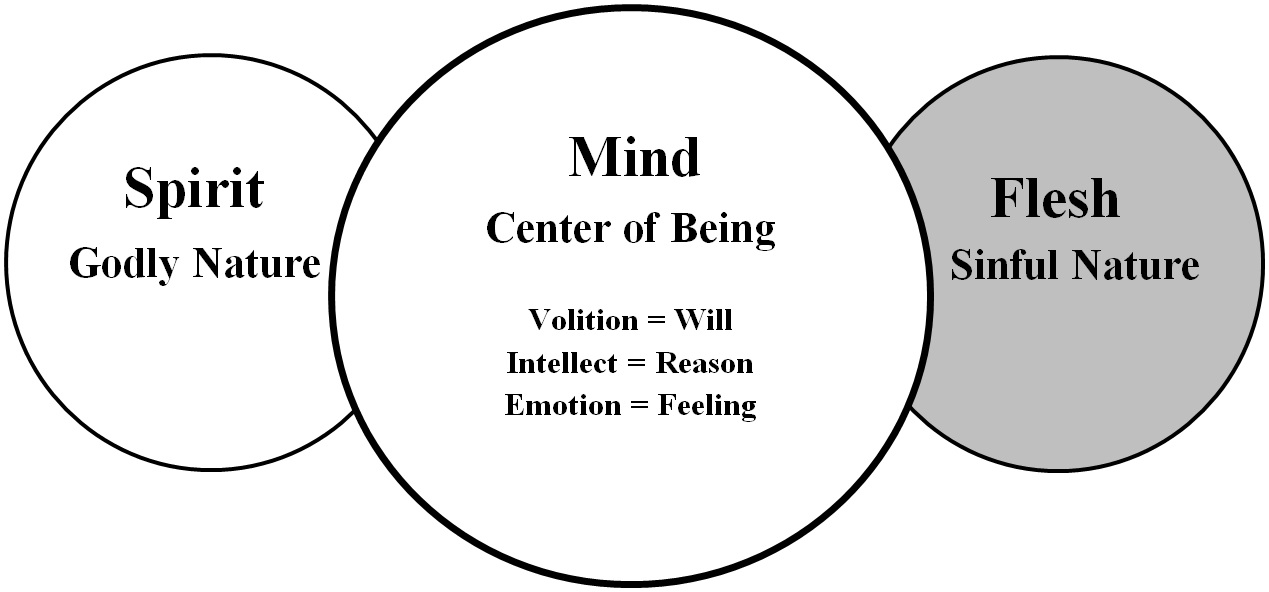
While it’s not fun being caught in a conflict between two opposing natures, there’s good news: Because your mind possesses volition—will—you have the God-given power of decision and therefore the ability to DECIDE which nature you’re going to receive from and follow—your godly nature (spirit) or your sinful nature (flesh).
Assuming you’re a believer, the Holy Spirit gave birth to your new regenerated spirit (John 3:6 & Titus 3:5), which was “created to be like God in true righteousness and holiness” (Ephesians 4:24). On top of this, you are a temple of the Holy Spirit—a temple of God—because the Spirit of God resides in you. Exactly what part of your being does the Holy Spirit inhabit? Your spirit, of course, since your spirit was made holy through regeneration (Ephesians 3:16). In fact, it’s only because your spirit has been reborn holy that the Holy Spirit is able to indwell you! With this understanding, your spirit—your “new self”—is indwelt and led by the Holy Spirit. So when you follow the impulses of your regenerated human spirit you are simultaneously following the leading of the Holy Spirit.
By contrast, if you follow the impulses of the flesh—the sinful nature—you are automatically following the leading of the devil and filthy spirits because the flesh is the sinful nature, which is the satanic nature. In other words, all a person has to do in order to fulfill the devil’s will in his or her life is to live according to his/her fleshly impulses.
What I’m getting to is this: The Holy Spirit (God) works with you through your spirit—your godly nature—while demonic spirits work with through your flesh—the sinful nature.
In light of this, it’s imperative that you learn to distinguish spiritual thoughts from fleshly ones. Both types of thoughts will be transmitted to your mind on a regular basis. Once you can distinguish these two kinds of thoughts you simply need to learn to discard the negatives impulses and feed positive proclivities.
Doing so naturally keeps demonic spirits from being attracted to you and setting up house, so to speak. How so? Because, remember, demons are impure spirits and are therefore attracted to what is morally filthy. So keeping moral filth far from your “house”—your mind & body—naturally keeps filthy spirits away.
How to Distinguish Spiritual Thoughts from Fleshly Thoughts
To accomplish this you’ll have to learn to differentiate thoughts that originate from your godly nature from impulses that proceed from your sinful nature. The former are positive and productive whereas the latter are negative and destructive. Distinguishing the two is easy.
The Bible offers fairly detailed descriptions of what these conflicting natures produce:
The acts of the flesh are obvious: sexual immorality, impurity and debauchery; 20 idolatry and witchcraft; hatred, discord, jealousy, fits of rage, selfish ambition, dissensions, factions 21 and envy; drunkenness, orgies, and the like. I warn you, as I did before, that those who live like this will not inherit the kingdom of God.
22 But the fruit of the spirit is love, joy, peace, forbearance, kindness, goodness, faith-fulness, 23 gentleness and self-control. Against such things there is no law.
Galatians 5:19-23
Every believer has to learn to recognize and throw off thoughts that stem from the flesh, like sexual immorality, hatred, discord, jealousy, rage, selfishness, envy and other obvious carnal traits, such as arrogance, deceit and slander (Proverbs 6:16-19). Don’t feed these types of thoughts. Instead feed thoughts that stem from your spirit, your higher nature, which is why Paul said:
Finally, brothers and sisters, whatever is true, whatever is noble, whatever is right, whatever is pure, whatever is lovely, whatever is admirable — if anything is excellent or praiseworthy — think about such things. 9 Whatever you have learned or received or heard from me, or seen in me — put it into practice. And the God of peace will be with you.
Philippians 4:8-9
The more you “feed” positive, productive thoughts like these, the more you’ll live out of your higher nature. It’s simple. The Bible puts it like this:
Those who live according to the flesh set their minds on the things of the flesh; but those who live according to the spirit * set their minds on the things of the spirit.
Romans 8:5
* Since there is no capitalization in the biblical Greek, translators must determine if “spirit” should be capitalized in reference to the Holy Spirit or not capitalized in reference to the human spirit. Many translations capitalize “spirit” in these passages and some do not (for example The New English Bible). I believe these passages (and other such passages) are plainly referring to the human spirit and therefore “spirit” should not be capitalized because the context is contrasting the conflicting parts of human nature (e.g. Matthew 26:41). In a way it makes no significant difference since our born-again human spirit is indwelt and led by the Holy Spirit (Ephesians 3:16).
So learning to set your mind on things of the spirit rather than things of the flesh is key to walking free of the satanic nature and the influence of evil spirits.
Also, as verse 9 of the previous passage instructs, get in the habit of observing genuinely spiritual believers (not religious people) and put into practice the positive things you observe. When you practice these two things, notice what results: “and the God of peace will be with you.” Needless to say, filthy spirits will not be attracted to you when you do this (which is not to say that they won’t attack you for righteousness’ sake when permitted, as explained in this article).
Managing the Soil of Your Heart
It helps to understand the biblical concept of the heart and how it fits into the model of human nature.
“Heart” is kardia (kar-DEE-ah) in the Greek, which is where we get the English ‘cardiac.’ Like the English word ‘heart,’ kardia literally refers to the blood-pumping organ but figuratively to the core thoughts or feelings of a person’s being or mind (Strong 39). Greek scholar E.W. Bullinger describes the heart as “the seat and center of man’s personal life in which the distinctive character of the human manifests itself” (362). The heart could therefore be described as the core of the mind. It is part of the mind, but specifically refers to the deepest, most central part; that is, the core.
What dwells in your heart is determined by which nature you have decided to live by, whether spirit or flesh (Romans 8:5-6). Jesus said, “The good man brings good things out of the good stored up in his heart, and the evil man brings evil things out of the evil stored up in his heart” (Luke 6:45). What’s this mean? Simple: If you, in your mind, decide to dwell on carnal thoughts, then carnal, negative, destructive things will naturally store up in your heart over time. If, on the other hand, you choose to focus on spiritual thoughts, then good, positive, productive things will store up in your heart. Whatever’s in your heart then determines your actions and therefore the course of your very life. This is why the book of wisdom says: “Be careful what you think for your thoughts run your life” (Proverbs 4:23 NCV). Take heed—truer words have never been spoken!
Here’s our diagram of human nature with the heart added:
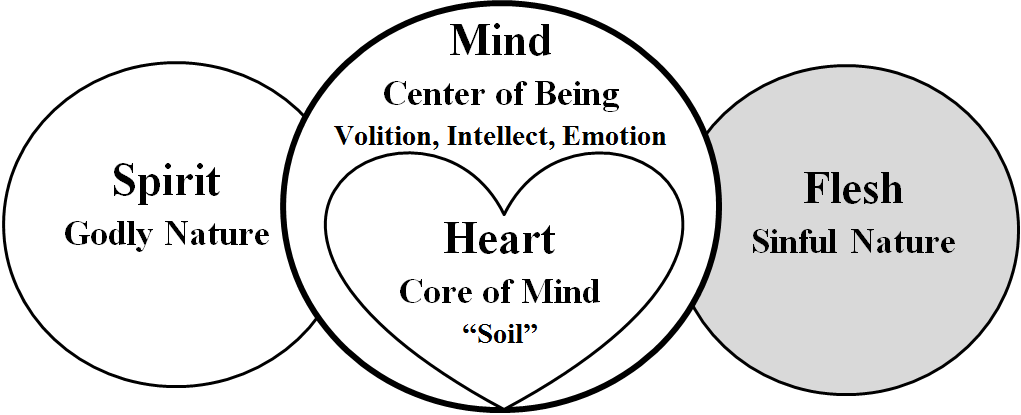
Notice that the heart is the core of your mind and is figuratively called “soil.” Why? Because the Bible likens the heart to soil (Luke 8:15). Soil in the natural is a neutral substance that grows whatever seed is planted in it. This is the way it is with the soil of your heart, except that it grows non-physical “seeds,” whether spiritual or unspiritual. By “seeds” I mean thoughts, impulses, desires, images or impressions. Dwelling on these “seeds” waters them, so to speak, and thus enables them to grow. In other words, your meditation feeds them; and that is how they grow. And whatever grows in your heart is what eventually fills your heart and produces the desires thereof. These desires of your heart then determine your actions, good or bad.
Has someone ever offended you and you dwelt on it so much that you made more of it than what it was? When the issue was finally resolved you realized you made a mountain out of a mole hill. How did this happen? Simple: You fed the offense with your thought life and thus it grew. As you kept thinking about it, the bigger it got. This principle goes into motion with any impulse you choose to focus on and give life to, whether of the spirit or the flesh.
In regards to fleshly impulses, the Bible details the scenario like so:
but each person is tempted when they are dragged away by their own evil desire and enticed. 15 Then, after desire has conceived, it gives birth to sin; and sin, when it is full-grown, gives birth to death.
James 1:14-15
People are tempted by evil desires that stem from their flesh, the sinful nature. Once they grab ahold of the bad impulse and feed it with their thought life, desire is conceived in the soil of their hearts, which eventually gives birth to the action, the sin itself.
Demons Work with People through their Flesh
The reason I’m going into detail about human nature is so you’ll grasp how the Holy Spirit (God) works with you through your spirit, your higher nature, whereas evil spirits work to destroy you (and those linked to you) through your flesh, the sinful nature.
Because the flesh is the satanic nature all a person has to do in order to be “of the devil” is to habitually live out of his/her sinful nature. For instance, envy, jealousy, rivalry, hatred and strife are works of the flesh. If a person regularly lives out of these fleshly impulses he or she will automatically carry out the Devil’s will in whatever environment s/he operates.
Take a woman at a church assembly who embraces thoughts of envy and jealousy. This naturally gives birth to rivalry and hostility toward the people with whom she’s envious and jealous. Hostility is hatred. There are degrees of hostility, of course, but—whatever the degree—hatred always eventually morphs into unjust attacks, starting with malevolent gossip, which is slander. This of course poisons people’s minds against their maligned brother or sister, which then produces discord in the assembly and robs the fellowship of peace and unity. Every Christian assembly on Earth has experienced this scenario and the root problem can always be traced to an individual who gave-in to the fleshly impulses of envy, jealousy & rivalry and then spread the resulting hostility to others.
Or consider the example of a married Christian man who meets an alluring woman on the job and it stirs up fleshly interest. The more he thinks about her the more desire grows in his heart until it manifests into adultery when the opportunity presents itself.
In both of these cases neither the woman who gossiped and created strife in her assembly nor the man who committed adultery were possessed by evil spirits. They simply ignored the leading of their higher nature (and the corresponding guidance of the Spirit) and surrendered to their fleshly desires by feeding them with their thought life, which made the corresponding desire grow in the soil of their hearts. And then they eventually acted on these desires.
Allow me to point out that the word ‘spirit’ does not always refer to a spiritual entity; it can simply refer to a person’s character, as in Joshua had “a different spirit” than other Hebrews and thus served the LORD wholeheartedly (Numbers 14:24). Neither the woman who engaged in hostile gossip and created strife in her fellowship nor the man who committed adultery was possessed by demons to do what they did. They simply gave their hearts over to the destructive impulses of their flesh, fed those desires, which then grew in their hearts, and ultimately acted on them. As such, the woman had a spirit of gossip and strife—a character of gossip and strife; and the man had a spirit of adultery—a character of adultery. But neither was possessed by a demon to do what they did. They have no one to blame but themselves for their foolish decisions. Remember, we all have the power of decision and therefore we decide which nature we’re going to live out of, whether flesh or spirit, sinful nature or godly nature. It’s our choice every day.
However, this is not to say that demonic spirits didn’t “whisper in their ears,” so to speak (which we’ll look at momentarily). Not to mention, once they started engaging in their particular sin it no doubt attracted evil spirits because filthy spirits are drawn to that which is morally impure, much like flies are attracted to dog excrement and rats to garbage.
An anointed minister testified to how he picked up a stench in the spirit when practicing homosexuals came up for prayer as he was ministering. I also shared how a boy, my nephew, smelled vomit when he was around a practicing witch who married into the family. People who take paths that are morally filthy like these—homosexuality and witchcraft—naturally attract filthy spirits. This results in demonic bondage to the sin, at best; and demonic possession, at worst. I’m not saying this with Pharisaical condescension or condemnation, but rather godly compassion and the desire to see people set free, whatever their transgression is, whether homosexuality, witchcraft, adultery, gossip/slander, religious legalism, drunkard-ness or what have you.
Needless to say, don’t entertain impulses of the flesh. Learn to put into motion the law of displacement by focusing on impulses of your higher nature (Ephesians 4:22-24). Concentrating on spiritual thoughts naturally displaces carnal desires. This keeps evils spirits at bay because they’re not attracted to that which is pure, godly and spiritual. And when they observe that a person is stubbornly single-minded they’ll give-up and seek easier prey. Remember: sloth is a trait of the satanic nature and so impure spirits are lazy by nature.
For quick insights on controlling your thoughts see this video; for insights on how to renew your mind see this video.
How Does Satan “fill a Person’s Heart”?
All of the above helps us to interpret a couple cases in the Bible where it says that Satan filled a person’s heart.
Let’s start with the case of Ananias from Acts 5:1-11. This was the era of the early church where believers were selling land and extra houses to provide money for the needy in the church (Acts 4:32-37). Ananias followed suit by selling a piece of property and giving the proceeds to the church, but he kept a good chunk for himself. There was nothing wrong with this and Peter even said so (Acts 5:4). It was Ananias’ property and his money; and he could do whatever he wanted with it, as led of the Spirit. The problem was that Ananias and his wife deceptively said they gave all the proceeds to the church, evidently to appear exceptionally generous and spiritual. Thus Peter asks: “Ananias, how is it that Satan has so filled your heart that you have lied to the Holy Spirit and have kept for yourself some of the money you received for the land?” (verse 3).
How did Satan fill Ananias’ heart? Did he literally possess him? No, he filled his heart in the sense that Ananias gave his mind over to the fleshly impulses of the sinful nature, which is the satanic nature. Ananias wanted to impress others by appearing more generous than he actually was, so he lied about giving all the profit of his sale when he only gave part.
This is the typical way the devil fills a person’s heart, which we observed in the examples from the previous section: Satan filled the heart of the woman who succumbed to envy and hostility, which resulted in gossip and produced strife in the assembly. The married man surrendered to his carnal lust for a flirtatious woman at work and allowed desire to build in his heart until it manifested in adultery. The devil “filled their hearts” in the sense that they gave themselves over to the cravings of the satanic nature, but they weren’t possessed by Satan or demons.
How did Satan fill Judas’ Heart?
The case of Judas Iscariot shows that Satan or demons can fill people’s hearts more literally. Judas, of course, was the fake disciple who betrayed Christ for 30 pieces of silver. This reveals that his main problem was greed (that is, his main problem beyond not actually knowing the Lord). The Bible blatantly describes him as a thief who regularly pilfered from the treasury of Jesus’ ministry (John 12:6). The Lord knew what was going on, of course, because he functioned in the gifts of the Spirit, one being the word of knowledge (1 Corinthians 12:4-11). Thus Jesus indirectly referred to Judas as “a devil” well before this incident (John 6:70-71). Why? Not because Judas was literally possessed by an evil spirit at the time, but because he walked in the flesh without repentance and therefore wasn’t a genuine follower of Christ. Anyone who chooses to live out of their flesh will automatically perform the will of the devil because the flesh is the sinful nature, the satanic nature. This is why Jesus called Judas “a devil”—his allegiance was clearly with the devil, even though he wasn’t likely aware of it.
Yet a couple other passages reveal that Satan literally possessed Judas on two separate occasions over a year later:
Then Satan entered Judas, called Iscariot, one of the Twelve.
Luke 22:3
As soon as Judas took the bread, Satan entered into him.
So Jesus told him, “What you are about to do, do quickly.”
John 13:27
The verse from Luke is talking about when Judas skulked away to the chief priests to agree to betray Jesus for a monetary reward. The verse from John takes place over a day later during the Last Supper, which is when Christ discharged Judas from the celebratory meal to betray him.
The texts do not contradict one another because John acknowledges the first occasion where Judas was possessed in verse 2 of the same chapter: “The evening meal was in progress, and the devil had already prompted Judas, the son of Simon Iscariot, to betray Jesus.” This refers to the events of the Luke passage.
We can glean a few important facts from both verses:
- Satan possessed Judas not once, but twice
- There was an interim period between the two possessions where Judas was not possessed. This indicates a partial possession, as detailed in this article (scroll down to the section Dealing with “Spirits of Infirmities”).
- Even though Judas’ will was not under the direct control of the devil during the interim he did not repent or seek to undo Christ’s unjust arrest which he had set in motion.
No doubt the Sovereign LORD insisted on the interim so that Iscariot had time to reflect on what he had done, graciously providing him the opportunity to repent.* Since Judas didn’t have a change of heart, however, he was without excuse. In other words, Judas couldn’t justify his actions on the grounds that “the devil made him do it.”
* God reigns supreme, which includes reigning over the devil who’s the temporary “god of this world” (2 Corinthians 4:4). Thus even Satan has to have permission to carry out his wicked attacks, as shown in Job 1:6-12 and 2:1-7. That said, this is a general truth and it’s uncertain how far and detailed it extends concerning any given satanic strategy and the target(s) thereof.
A fourth point is that his kind of demonic possession does not come out of nowhere. A person isn’t just morally heading one way one day and is suddenly possessed by a demon and proceeds to go in a totally different direction. No, possession of this nature occurs when a person has already given in to the sinful nature and is therefore already habitually fulfilling the devil’s will, which naturally attracts wicked spirits. If the person is eventually possessed by a demon or demons he or she simply goes deeper down the same fleshly path s/he was going.
We see this with Judas: He was already habitually stealing from the treasury because of his greed. Jesus knew this early on due to the word of knowledge and thus thoroughly interceded for the thief. Christ even made it known that he was on to him outright (John 6:70-71). Unfortunately, Judas remained unrepentant. His eventual succumbing to the temptation of blood money for Christ’s arrest & murder was simply deeper down the same dark road. It wasn’t until then that Satan possessed him.
Of course, Judas’ possession was a special case that warranted the devil’s direct involvement. When Satan possesses the Antichrist during the future Tribulation it’s likewise a special occasion (2 Thessalonians 2:9 & Revelation 13:2). In the vast majority of cases, however, Satan prefers to kick back and allow his filthy underlings to perform hands-on work like this (i.e. possess people).
It’s important to distinguish between demonic possession that occurs due to increasing immoral activity (as was the case with Judas) and demonic possession by a spirit of infirmity, which results in some kind of mental/physical malady. The latter type of possession may have nothing to do with a person participating in immorality. For instance, the boy who had a mute, deaf spirit (Mark 9:17-29) and the woman with the crippling demon (Luke 13:10-16), both addressed at the end of this article (scroll down to the section Dealing with “Spirits of Infirmities”). There is zero indication that either of them suffered possession and the corresponding maladies due to increasing, unrepentant immorality.
This shows that living a morally blameless life (which, of course, requires keeping in repentance*) is not enough to walk free of demonic possession as far as spirits of infirmities are concerned. Having a close relationship with God is not enough either. Why? Because these kinds of spirits prey upon the ignorant. The only antidote to ignorance is knowledge; and knowledge is power, assuming it is implemented (Proverbs 24:5). Any believer who knows and practices the Scriptural truths detailed in this article & the follow-up one will protect themselves from spirits of infirmities.
* Matthew & Luke 3:8. Keep in mind that blameless is not the same as sinless.
This illustrates the difference between:
- The Person of God.
- The wisdom principles of God’s kingdom.
It’s possible to genuinely know God, but be ignorant of the principles of His Kingdom, including spiritual warfare. Likewise, it’s possible to grasp principles of godly wisdom and yet not know the LORD whatsoever. For instance, an atheist doesn’t know God—and possibly hates God—but because he lives by the principle that “diligent hands will rule” (Proverbs 12:24) he prospers in his occupation.
The ideal, of course, is to walk in both: 1. Develop a relationship with the Person of God and 2. learn the wise principles of His kingdom.
Amen.
Can Believers be Possessed?
This brings up the question of whether or not genuine Christians can be possessed. The answer is no and yes. Let me explain…
True believers can never be totally possessed because they’re already indwelt by the Holy Spirit (Romans 8:9). Of course, evil spirits are assigned to believers to try to oppress them and ruin their lives—the very opposite of what heavenly angels are commissioned to do (which is to serve people). This shows why learning and mastering spiritual warfare is vital as we grow in Christ.
Genuine believers cannot drink of the cup of the Lord and the cup of demons as well (1 Corinthians 10:21). To be fully possessed of a demon or demons, a believer would have to first fall away by denying Christ, whether literally or through incorrigibly wicked actions. For proof that a Christian can indeed fall away, see Hebrews 6:4-9, 2 Peter 2:20-21, 2 Timothy 2:11-13 and Titus 1:16. I want to emphasize that God’s Word supports the doctrine of eternal security 100% and this is verified by Christ Himself in John 10:28-29. However, the Bible clearly does NOT support the doctrine of unconditional eternal security, as verified by these crystal clear passages and numerous others. *
* For details see the section of this article The Enemy WILL Attack these God-Given Blessings. Also see the article Once Saved Always Saved?
Although genuine believers cannot be fully possessed, they can fall prey to partial possession, which is touched on in this article (scroll down to the final section Dealing with “Spirits of Infirmities”). Here are two types of partial possession observed in the Scriptures:
- When a person suffers possession by a spirit of infirmity, which causes some type of ongoing physical disorder. In this scenario a spirit of infirmity induces a malady, but the person is otherwise uncontrolled by the spirit. The woman from Luke 13:10-16 whose crippling condition was caused by a demon and required exorcism is a good example. There’s no evidence that she wasn’t in control of her faculties. Thus the demon caused her crippling state, but it did not control her mind and will. It had power over her physically, but not mentally. It was thus a partial possession.
- Another kind of partial possession is when a spirit takes control of a person’s mental faculties one way or another, but the spirit comes and goes and thus it’s not a perpetual condition. This was the case with the woman I personally knew noted in this article. She was decidedly a Christian, but an evil spirit would come on her now and then, with two different manifestations—a depressed, worried state or a mean, stubborn state. Both of these manifestations were thoroughly demonic and she occasionally committed self-harm in one form or another. Yet she was her normal, pure, loving self about 50% of the time. Since the evil spirit came and went it wasn’t a total possession, but rather a partial one. This is evidence that a true believer can suffer partial possession where a demon comes on him or her from time to time and wreaks havoc. It’s not a total possession, but such people need exorcized nevertheless, like the boy in Mark 9:18 and Luke 9:39.
In cases where believers suffer partial possession the demon attacks their body or mind, but it cannot afflict their spirit because they are indwelt by the Holy Spirit (Ephesians 3:16).
Satanic Head Games
It was pointed out earlier that fallen angels are able to “whisper in a person’s ear,” that is, shoot thoughts into people’s minds, obviously corresponding to the desires and weaknesses of their flesh. Consider Christ’s temptation after the Spirit led him to fast in the wilderness for 40 days and nights:
Then Jesus was led by the Spirit into the wilderness to be tempted by the devil. 2 After fasting forty days and forty nights, he was hungry. 3 The tempter came to him and said, “If you are the Son of God, tell these stones to become bread.”
4 Jesus answered, “It is written: ‘Man shall not live on bread alone, but on every word that comes from the mouth of God.’ ”
5 Then the devil took him to the holy city and had him stand on the highest point of the temple. 6 “If you are the Son of God,” he said, “throw yourself down. For it is written:
‘He will command his angels concerning you,
and they will lift you up in their hands,
so that you will not strike your foot against a stone.’ ”
7 Jesus answered him, “It is also written: ‘Do not put the Lord your God to the test.’ ”
8 Again, the devil took him to a very high mountain and showed him all the kingdoms of the world and their splendor. 9 “All this I will give you,” he said, “if you will bow down and worship me.”
10 Jesus said to him, “Away from me, Satan! For it is written: ‘Worship the Lord your God, and serve him only.’ ”
11 Then the devil left him, and angels came and attended him.
Matthew 4:1-11
This occasion warranted Satan’s direct involvement. He knew that the Mighty Christ came to destroy his work* so he personally tried to stop the Messiah by tempting him to succumb to the weaknesses of his flesh and therefore sin. This, of course, would’ve made Jesus unacceptable as a substitutionary curse for humanity since the sacrifice had to be innocent.
* See Hebrews 2:14, 1 John 3:8 and Acts 10:38.
Notice that verse 3 says “The tempter came to him and said…”. Did the devil actually appear to Jesus or did he come to him and ‘whisper in his ear,’ so to speak? In other words, did he come to him invisibly and simply transmit the tempting words to his mind? The Greek word for “came to” doesn’t necessarily mean appear visibly, but simply ‘to come to, come near to, approach.’ Since Satan is a spiritual being, not physical, it’s more likely that he came to the Messiah spiritually and therefore invisibly, although Christ no doubt discerned his presence through the gift of discerning of spirits (1 Corinthians 12:4-11).
I’m not saying that Satan didn’t appear to Jesus in some physical form, just that it’s very possible they he simply came to him spiritually—invisibly—and spoke to him by shooting flesh-based suggestions into his head. This is how evil spirits try to negatively influence you and me, why wouldn’t it be the same in this situation?
Someone might understandably argue that verses 5 & 8 show the devil taking Christ to the highest point of the Temple in Jerusalem and then to a high mountain, but Satan could’ve taken him there in a mental sense, relaying his temptation in thought form or perhaps a vision. After all, have you ever been tempted where an evil spirit physically appeared to you or physically transported you to the applicable environment or did you simply experience the temptation through thoughts, impulses and the imagery thereof? The latter, of course.
The Sword of the Spirit and the Law of Displacement
Christ counteracted these temptations by simply speaking the truth. On all three occasions Jesus responded with a quote from the Scriptures. This is what we need to do when we encounter temptation: When you experience an inner carnal impulse, perhaps combined with the corresponding imagery, recognize it for what it is—a negative, destructive, ungodly temptation rooted in the flesh. Then boldly speak the counteractive truth. Repeat as necessary until the temptation lifts. This is one of our God-given spiritual weapons; it’s called the sword of the spirit (Ephesians 6:17). It’s simply speaking the Word of God in bold faith as a defensive or offensive tool. Use it! This “sword” does you no good if you don’t take advantage of it. It guarantees victory over temptation.
You’ll notice in the second temptation that the devil quoted a Scripture verse. Please understand that Satan & evil spirits know the Scriptures and will sometimes use them to tempt people to take a wrong path, just as the devil did with Jesus here. The Messiah recognized that Satan’s usage of this verse conflicted with other truths, of course, and so he cited another passage that gave balance to the matter, which is in line with the hermeneutical rule “Scripture interprets Scripture.”
You can only do this if you’re familiar with the Scriptures, so I encourage you to acquaint yourself with God’s Word more and more by developing a daily reading program. Try different reading plans until you find one that fits your lifestyle and schedule. Change your plan every now and then so it doesn’t get predictable and boring. Also switch translations from time to time; and consider reading plans based on topical studies. Always pray for knowledge, understanding and wisdom before you read and the LORD will bless you (Proverbs 2:1-7).
It’s important as well to understand that the Enemy can tempt you through a person or group who cite Scripture (2 Corinthians 11:13-15). The Jehovah’s False Witnesses are a good example. Yet such a temptation can very well come through people functioning under the tag of whatever camp you favor (Baptist, Evangelical, Charismatic, Reformed, Mainline, Pentecostal, Emergent, etc.). Thankfully, it’s easy to recognize these fakes, if you know for what to look. Speaking of which…
Christ said that false prophets can be recognized by their fruit (Matthew 7:15-23). A false prophet is simply a minister who falsely speaks for God and you can identify them by the fruit they bear. Do they produce fruit of the spirit on a regular basis or works of the flesh? See Galatians 5:19-23. No one is perfect, of course, but what do they habitually produce? And are they willing to humbly ’fess up and apologize when they miss it (1 John 1:8-9). Do they have a spirit of love or a spirit of abuse? Do they build up or tear down? Genuine ministers are called to build up, not tear down (2 Corinthians 10:8 & 13:10). After giving appropriate correction, they build-up and encourage, not condemn. Needless to say, if you observe consistent bad fruit and an unwillingness to keep with repentance in a “minister” then head for the hills (Matthew 15:14).
One last thing on this matter: When you ‘swing’ your sword of the spirit by speaking the truth in bold faith, it doesn’t have to be a word-for-word verse or even a Scripture text at all. It simply has to be truth, which is the way it really is. Say, for example, a wicked spirit whispers in your ear that you’re a no-good piece of excrement who can’t do anything right. You don’t have to quote an exact Scripture to counteract this lie, just speak the truth: “I’m a child of God born of the seed of Christ by the power of the Holy Spirit; I was born righteous and can do all things through Him who strengthens me!” Those of you who know the Bible know that this is a personalized paraphrase of several verses.
But, again, you don’t have to cite from Scripture at all to counteract a temptation—whether word-for-word or paraphrasing—as long as what you say is the truth. For instance, we earlier considered the example of a married man who was tempted by a coquettish “hottie” at work. All he has to say to thwart the temptation is the truth: “I am a married man of the Most High God! I love my wife and am faithful to her and God!”
When you do this you’re putting into motion the Law of Displacement, which means that two things cannot occupy the same space at the same time. In this particular case it applies to your thought life. When you experience a tempting thought you counteract it by simply speaking (and thinking) the counteractive truth, which displaces the negative thought. Repeat as necessary. When you do this you’re swinging your sword of the spirit and slicing down the lies of the Enemy.
Another thing you can do is sing praise & worship songs. Blast some music and have a praise & worship session; or, if you’re musically inclined, do it yourself, like David did in the Psalms (e.g. Psalm 8 and 65). Praise & worship is a powerful spiritual weapon because praise ushers in God’s manifest presence and there’s fullness of joy in the presence of the LORD (Psalm 100:4 & 16:11).
Examples of Demonic Head Games
The Bible repeatedly shows that the LORD knows our thoughts, which of course includes the Holy Spirit (1 Corinthians 2:11, Psalm 94:11 & Proverbs 20:27). But the devil and his loser minions have no such power. All they can do is determine your weaknesses by observing you and tempt you by shooting ideas into your mind corresponding to the weaknesses of the flesh, like lust, greed, pride, envy, jealousy, fear and doubt.
We know that angels are assigned to people to serve them. It’s the same thing in the kingdom of darkness, except that demons disservice people through misleading, hindering, oppression or possession. In short, they want to ruin people’s lives.
With this in mind, say a demon is assigned to a woman. This spirit cannot read her thoughts, but it can observe her actions and words day & night and so ascertain her fleshly weaknesses. The demon then transmits thoughts into her mind accordingly in the hope of ruining her one way or another. The spirit can also lure into her life the ‘right’ people to assist in the diabolic plot; that is, the wrong people. This is likely what happened with a teenage girl who embraced demonic thoughts and became convinced that she was going to be “taken” one day and her mother & sister would never see her again. She repeated shared this curious belief with her mother & sister. Once the (presumed) evil spirit got her to use the power of her mind in conjunction with the power of her tongue the next step was to inspire the right psychopath to meet her at the wrong time and place. Thus she was apprehended, raped and tragically wiped off the face of the planet.
Now consider the hypothetical woman we talked about earlier who caused strife in her fellowship due to her envies and jealousies. The demon (or demons) assigned to her would observe that she had issues with envy/jealousy/rivalry and so it would draw into her life the right person or persons who would stir up these fleshly impulses. Meeting these people would produce hostility in her—that is, hatred—and so she would start gossiping and slandering, which would in turn produce discord in the assembly, the precise opposite of what the Lord wants (Psalm 133).
It’s the same thing with that hypothetical married man who was enticed by an alluring woman at work. The wicked spirit (or spirits) assigned to him would notice his penchant for a certain type of female and then lure into his environment the perfect candidate. The man would experience unwholesome impulses from his flesh, particularly when the woman flirts with him. The demon might assist in the temptation by transmitting thoughts into his mind. In other words, this spirit “whispers into his ear” corresponding to the evil desires of his flesh. Once he grabs ahold of the idea and feeds it with his thought life, desire is conceived in his heart and keeps growing as he feeds it. He eventually falls into adultery when the opportunity presents itself.
This is how evil spirits work behind-the-scenes in regards to any type of sin.
Two Real-Life Stories
Let me share a couple real-life examples that I’ve unfortunately witnessed.
I was a teacher at an assembly a decade ago where there was this fatherless preadolescence girl who started calling me her “spiritual father.” She was a wonderful girl—bright, witty and fun. Carol & I never had a daughter so we enjoyed the honor of having a “spiritual daughter.” I’ll call her ‘Melanie.’
Melanie had a somewhat sad situation, but she never let it bring her down in the least: Her father evidently molested her in the form of inappropriate touching a few years earlier and he was essentially no longer in the picture. But she thankfully had a loving, if overly looming, mother.
When Melanie was 13 a new family joined the assembly. The couple had three daughters and one of them was also 13. The two girls started a friendship that soon became problematic. They would gaze into each other’s eyes in an unhealthy manner and walk together curiously close. It became so bad that visitors asked if they were “a couple.” During this time Melanie morphed from a bright, joyful girl into a brooding, lifeless early teen. The dramatic change occurred in a matter of just a few months.
That summer my sister, Jen, visited from California. She knew Melanie from past visits where we enjoyed outings together. I didn’t inform Jen about Melanie’s new friend, their questionable relationship or Melanie’s dark turn, but after sitting by Melanie during a service Jen asked me, “Who was that evil girl?” She was referring to Melanie’s new friend who was hovering behind her the whole time with a grim visage (evidently jealous of Jen sitting by her).
It was eventually discovered why the new family left their former assembly: The daughter had developed the same type of questionable relationships with a couple of girls there and the family was eventually asked to leave when the parents failed to properly control their daughter.
The situation got so bad at our fellowship it was decided that Melanie and her friend were no longer allowed to spend the night at each other’s houses; or even spend time alone together at all.
It goes without saying that any sense of closeness with our former “spiritual daughter” ceased as she fell under the spell of this girl. Shortly later the LORD called us out of this fellowship and four years passed before we received an email from Melanie. She was 18 by this point, on the verge of graduating high school and planning to go to art school. We met for coffee where she sadly confessed to being an atheist and explained away anything having to do with God or Christianity.
What went on “behind the scenes” in this sad situation? In light of the scriptural data we’ve covered, it’s not hard to come up with a probable answer: Melanie was a threat to the Enemy’s kingdom because she was genuinely fruit-bearing and on fire for the Lord. She spread joy to all the people she knew. She was overflowing with great potential. As such, the demonic spirit(s) assigned to her preyed upon her weaknesses. Her biological father had abused her and abandoned the family, but the LORD faithfully supplied my wife & me to help make up for it as her “spiritual parents.” She was home-schooled and the church assembly was small, so she was hungry for a friend her age. Hence evil spirits inspired this family who were in need of a new fellowship to come into the fold where Melanie would meet this girl her age and start a relationship. The demon would ‘whisper in Melanie’s ear’ according to her fleshly weaknesses. The friendship began and quickly descended into sullenness, unhealthy dependency, lesbianism and, ultimately, full-tilt atheism.
It’s a sad story and we continue to intercede for Melanie to come back to the Lord one day. But it shows that everyone will be tested by the enemy, as permitted by the Sovereign LORD, even bright church girls full of fruit of the spirit.
Here’s another real-life story: When I was a young man, shortly out of high school, I hooked up with this singer who was still in school for the purpose of starting a band. I’ll call her Laura. We attended the same mega-church.
While the band thing didn’t work out, I was impressed by Laura’s devotion to God and her genuine evangelistic spirit. She told me several stories about being a witness for Christ at her school and so forth. After graduating high school she quickly went off to college and I fell out of touch with her. Unfortunately, her rock-solid Christian family experienced several serious blows within the course of a year, starting with her father, who was a respected deacon at the fellowship. He committed adultery and the marriage eventually fell apart. Around the same time Laura’s younger sister, who was 17, died in a car wreck. On top of all this her first year at university didn’t go well, to put it mildly. She was assaulted by the wave of ungodly humanism that secular colleges are known for and was date raped. She dropped out of college and came home, but she didn’t return to her former assembly.
A close friend ran into Laura a couple years after these events and said she was palpably bitter. He brought up the Lord, but she didn’t want anything to do with God or Christianity. That was three decades ago and I’m unaware of what happened to her from there.
Both of these sad tales show that no one is exempt from satanic attack. If you’re a threat to the devil’s kingdom you will be attacked. If you fail to take advantage of the armor & weaponry that God has faithfully provided and “fight the good fight of faith” the enemy will take you out, just like these two young women.
Forgive my frankness, but you can’t half-buttocks it with the Lord. I’ve known several guys who got saved and went to church gatherings for a long season, but they never came to a point of taking the things of God seriously enough. They continued to flirt with the flesh and the world to some degree. I’m talking about things like boozing, porn, drugs, smoking, fornication and the like. They ended up losing their marriages, their jobs and basically becoming down-and-out. Three ended up in prison.
But—and this is an important “but”—I’m confident that this will not be the case with you. If you’ve come this far in this article then you obviously have a thirst for knowing the LORD and what God’s Word says about angelic spirits, good and evil, and your responsibility in spiritual warfare as a New Covenant believer.
As insinuated, one of the keys to overcoming the enemy’s attacks is to utilize God’s armor & weaponry, which is detailed in this article. Here we’re going to focus on a couple of other demonic strategies. The Bible instructs us to be aware of the devil’s schemes so that we’re not outwitted (2 Corinthians 2:11).
How the Enemy Blinds People’s Minds
The Scriptures show that the Enemy has the power to blind people’s minds:
And even if our gospel is veiled, it is veiled to those who are perishing. 4 The god of this age has blinded the minds of unbelievers, so that they cannot see the light of the gospel that displays the glory of Christ, who is the image of God.
2 Corinthians 4:3-4
The devil & his loser minions don’t want people to comprehend the awesome message of Christ because “it is the power of God that brings salvation” and sets them free (Romans 1:16). Evil spirits therefore veil it “to those who are perishing.”
“Veil” means to hide, conceal or keep secret. How exactly do wicked spirits conceal the gospel to unbelievers? Do they unleash a spiritual fog around their minds? Not literally, but in a sense, yes. They blind people’s minds by implanting an erroneous ideology, which is the result of embracing “deceiving spirits and things taught by demons” (1 Timothy 4:1). More traditional English versions refer to this as “doctrines of demons” or “doctrines of devils” (NASB & KJV). “Doctrines” is another word for teachings or instructions; so “doctrines of demons” simply means teachings or instructions of unclean spirits.
While these false teachings originate from a demon whispering error in someone’s ear, so to speak, they are passed to others through a human agent—someone who’s already blinded by the false indoctrination. The Bible describes such people as “hypocritical liars, whose consciences have been seared as with a hot iron” (1 Timothy 4:2). Although the context refers to false teachers in the Church, how much more so in the world? Libertine college professors are Exhibit A. As people give ear to these erroneous teachings they naturally develop an ideology; and this indoctrination—this perspective or mindset—blinds them to the good news of the gospel and the truths of the Word of God in general.
To understand how this works, let’s look at…
Noémas—Mindsets, Ideologies
Notice what the Bible exhorts us to do:
We demolish arguments and every pretension that sets itself up against the knowledge of God, and we take captive every thought to make it obedient to Christ.
2 Corinthians 10:5
Christ is the living Word of God who is the truth (John 1:1 & 14:6). So we are to “take captive” thoughts and make sure that they comply with the truth. ‘Truth’ is alétheia (ah-LAY-thee-ah) in the Greek, which means “reality” or “the way it really is.” So we are to take “thoughts” and make sure that they conform to reality. If they don’t comply with the truth then they are ‘weeds’ of unreality and should be purged from the soil of our hearts.
The word ‘thought’ in this passage is noéma in the Greek (NOH-ay-mah). While noéma can refer to thoughts, good or bad, it can also refer to a person’s perspective—mindset, attitude or ideology—which is the result of indoctrination, good or bad. Indoctrination is naturally determined by the doctrine—the teaching or instruction—to which you are regularly exposed. For instance, if you sit under a secular humanist professor long enough and don’t counteract what s/he teaches with the truth of the rightly-divided Word of God (or the truth period) you’ll naturally develop a secular humanist ideology. You’ll then start to live out of this mindset, to one degree or another. The doctrine or teaching you’re exposed to on a regular basis determines your indoctrination, which is your mindset, good or bad. Such a mindset is a noéma.
The Greek word for “doctrine” is didaskalia (did-as-kal-EE-ah). It means teaching or instruction and can be good or bad depending on how true it is or is not. The Bible speaks of sound doctrine (1 Timothy 4:6) and bad doctrine:
Now the Spirit expressly states that in later times some will abandon the faith to follow deceitful spirits and the teachings (didaskalia) of demons,
1 Timothy 4:1 (ESV)
Obviously the teachings of demons aren’t good because demons are evil spirits.
The point is that a person’s mindset or ideology—noéma—is determined by the teachings to which he or she is regularly exposed. Noémas formulate over the course of time as a person is fed information. The longer it takes for a noéma to develop the more imbedded it is in the individual’s psyche.
It is through negative noémas that the enemy “blinds the minds of unbelievers, so that they cannot see the light” (2 Corinthians 4:4). The devil has control of their minds—through demonic noémas—and the truth cannot penetrate the indoctrination. To help you visualize this, I went to the Facebook page of a Christian friend I hadn’t seen for 25 years and was surprised by his cover pic. It was a skull with a red dragon wrapped around its head. No doubt he chose this pic because he thought it looked ‘cool’ or whatever, but it’s actually an excellent illustration of how the enemy blinds people’s minds: The red dragon represents the devil and he has control of the person’s mind, which is depicted as a skull and symbolizing death, the natural result of Satan’s misleading.
Notice how 2 Corinthians 10:5 (quoted above) says we are to “take captive” thoughts and mindsets. The Greek for ‘take captive’ literally means to “take captive as a prisoner and interrogate.” The Bible is saying that we should take any perspective we have and honestly & thoroughly examine it, making sure it conforms to reality (the way it really is) rather than unreality (the way it really isn’t). If we discover that the mindset does not comply with reality then we need to throw it out.
This can apply to any doctrine—teaching—you were taught during your formative years as a believer. Just because you were indoctrinated by a particular teaching in a relatively sound sect by a respected pastor doesn’t make the doctrine true. So you need to “interrogate” it in light of reality. Does it comply with the rightly-divided Word of truth and the Spirit of truth (John 17:17 & 16:13)? If not, it needs to be thrown out in favor of whatever the truth is, which is reality.
As noted above, this applies to secular indoctrination as well, such as the godless humanism that’s commonly taught at our secular colleges and universities. Generally speaking, the professors thereof teach that the idea of an intelligent Creator is absurd and thus life is meaningless and you’re just an accident. There’s nothing special about human beings, they say, and we’re basically just animals. And, when ya die, that’s it. The consequences of this kind of brainwashing are devastating—it produces moral rot and an attitude of no respect for life, including one’s own; it encourages living with a temporal perspective (noéma) rather than an eternal one (noéma). Such a hedonistic philosophy can be summed up as: “Let us eat and drink, for tomorrow we die” (1 Corinthians 15:32).
One example of secular indoctrination is homosexuality. While homosexuality was still a crime in much of the USA as of the new millennium, that’s all changed. Now homosexuality is taught to be innate and healthy in our secular culture and people are encouraged to experiment with it and embrace it as a legitimate alternative lifestyle. Our secular mentors are increasingly active homosexuals, like Ellen DeGeneres, Rachel Maddow and Anderson Cooper. Take the first two, for instance: Parents allow their children to sit under them where they’re exposed to their smooth “gay” propaganda and then wonder why some of their offspring eventually embrace the homosexual lifestyle. Notable people who publicly “come out” are commended by celebrities and governing officials alike. Those who refuse to approve of homosexuality, by contrast, are considered evil bigots and punished severely, socially speaking. The truth about homosexuality, however, is that it’s a damning sin and those who unrepentantly practice it will not inherit the kingdom of God. “Do not be deceived,” the Bible warns (1 Corinthians 6:9-11).
A believer struggling with this kind of worldly indoctrination or same-sex attraction can take these noémas (mindsets) captive and interrogate them in light of the truth of Scripture and the leading of the Spirit of truth. Since these noémas don’t comply with the truth they need to be purged out of one’s mindset in favor of reality.
As you do this with every thought/impulse/attitude/mindset you purge your heart of falsity and unreality. This is “being made new in the attitude of your mind” (Ephesians 4:22-24).
How to Prevent Demonic Oppression and Possession
There are three effective ways to deflect evil spirits and they’re all taught in this passage:
Submit yourselves, then, to God. Resist the devil, and he will flee from you. 8 Come near to God and he will come near to you. Wash your hands, you sinners, and purify your hearts, you double-minded.
James 4:7-8
The three ways to keep evil spirits at bay are:
- Resist the devil and he will flee from you.
- Draw near to God.
- Purify your heart.
Let’s look at all three:
Resist the Devil and he will Flee from You
Resisting “the devil” doesn’t mean resisting Satan himself because the devil is, generally speaking, on his throne in the Underworld directing the activities of his dark kingdom. He only personally gets involved in matters that are of great magnitude to him, like tempting Christ to sin (Matthew 4:1-11) or moving Judas to betray Him (John 13:27). When James taught that we are to “resist the devil” he was speaking of the kingdom of darkness in terms of its leader much as historians speak of military aggression in relation to the aggressor nation’s leader, like “Hitler invaded France,” when, in fact, Hitler was nowhere near France. So resisting the devil means resisting the kingdom of darkness and, specifically, the evil spirits that are assigned to oppress you one way or another.
At the time that James wrote this passage he was addressing believers scattered across the nations, but his words apply to all believers scattered across the world throughout the Church Age. We’re called to “resist” evil spirits and their oppression. This means we are to conduct spiritual warfare—confront and overcome enemy attacks by utilizing the armor & arms that God has faithfully supplied us, which I’ll supply a link for momentarily.
Draw Near to God
This simply means to constantly make an effort to come closer to the LORD and corresponds to the first and greatest command: “love the Lord your God with all your heart and with all your soul and with all your mind and with all your strength” (Mark 12:30).
More than anything else, to draw near to God refers to cultivating a close relationship. The gospel of Christ is called “the message of reconciliation” because it’s all about reconciling to the Creator. To ‘reconcile’ means to turn from enmity to friendship. You must understand that God wants to be your friend (John 15:13-15). Of course, you can’t have friendship without relationship; and relationship demands communion, which is genuine communication. So cultivating a close relationship with God requires developing a prayer life. Prayer is simply communion with God—talking with your Creator—and the foremost form of prayer is simple communion. This is observed in Jesus’ outline for prayer:
9 “This, then, is how you should pray:
‘Our Father in heaven,
hallowed be your name,
10 your kingdom come, your will be done,
on earth as it is in heaven.
11 Give us today our daily bread.
12 And forgive us our debts,
as we also have forgiven our debtors.
13 And lead us not into temptation,
but deliver us from the evil one.’ ”
Matthew 6:9-13
This is typically referred to as “the Lord’s prayer” and people sometimes pray it word-for-word, particularly when the occasion calls for a brief scriptural prayer, like ceremonies. This is fine, but it’s really not a prayer to be spoken by rote. It’s actually an outline of different types of prayer. In other words, it’s a prayer skeleton that needs to be filled in with the “flesh” of our spontaneous prayers according to our unique expressions, communion, needs or desires and the specific people or situations touching us.
The outline can be broken down as such:
- Our Father in heaven = Communion or fellowship with God.
- Hallowed be your name = Praise & worship.
- Your kingdom come, your will be done on earth as it is in heaven = Binding & loosing or intercession, that is, releasing God’s will and kingdom into people’s lives and situations on Earth, including your own (as explained in this article; scroll down to the section Prayer “Releases” Angels to Serve You and Others).
- Give us today our daily bread = Petition, that is, praying for your needs and righteous desires.
- Forgive us our debts as we also have forgiven our debtors = Repentance, venting, and forgiveness where applicable.
- And lead us not into temptation, but deliver us from the evil one = Armoring up, protection, watchfulness, speaking in faith, and deliverance.
- For yours is the kingdom and the power and the glory forever. Amen = Return to praise and close.
As you can see, each part of “the Lord’s Prayer” refers to a specific type of prayer.
Let’s consider the first two types, as they apply to our topic:
Our Father in Heaven refers to communion with God since the believer is addressing God as his or her “Father.” ‘Father’ indicates familial relation and relationship requires communication, hence fellowship. Christianity at its core is a relationship with the Creator of the Universe, which is why the gospel is referred to as the message of reconciliation in 2 Corinthians 5:18-20. I encourage all believers to cultivate an intimate relationship with their heavenly Father where you’re in constant communion throughout the day, even when you’re in bed (Psalm 63:6). Paul referred to this as “praying without ceasing” (1 Thessalonians 5:17 KJV) and the “fellowship of the Holy Spirit” (2 Corinthians 13:14).
Please notice, by the way, that Jesus instructed us to pray to the Father, not to Him (Matthew 6:9). Praying to the Father in the name of Jesus is prayer protocol (John 16:23).
Hallowed be Your Name refers to praise & worship. To ‘hallow’ means to honor as holy and venerate, that is, treat with respect and reverence. God’s name—YaHWeH—represents the Creator Himself so we are to hallow the Great “I Am” (Exodus 3:13-14). The only way you can accomplish this in prayer is by telling him. Praise is celebration and includes thanksgiving, raving and boasting, whereas worship is adoration. Praise naturally attracts God’s presence and is in accordance with the law of respect: What you respect moves toward you while what you don’t respect moves away from you. Worship, on the other hand, is adoration or awe, and is the response to being in God’s presence. See Psalm 95:1-7 and Psalm 100 for verification.
We could further differentiate praise & worship as such: Praise celebrates God whereas worship humbly reveres Him; praise lifts God up while worship bows when He is lifted; praise dances before God whereas worship pulls off His shoes; praise extols God for what He’s done while worship adores Him for who He is; praise says “Praise the Lord” whereas worship demonstrates that He is Lord; praise is thanksgiving for being a co-heir in Christ while worship lays the crown at His feet.
Every believer is called to deeper praise & worship. It will literally revolutionize your life, as it has mine and continues to do so.
It’s no accident that communion with God and praise & worship are the first two kinds of prayer Jesus mentions in his outline (Matthew 6:9-13). They’re simply the most important. After all, what does the average father or mother want to hear from their children, particularly as the children grow and develop? Not, “Gimme, gimme,” but rather simple communion: “Hi Dad! How are you doing today? You’re awesome!” “Do you have time? I’d like to just hang out with you.” “Mother, I have something I’ve been thinking a lot about and I’d like to share it with you to see what you think.” “Mom, you’re so beautiful!” “Dad, tell me more about that project you’re working on; it’s lookin’ great so far.” Etcetera. If this is the kind of communion our earthly parents prefer, why would we think it’s any different with our heavenly Father?
You can have these types of conversations with God throughout the day, every day—when you wake up in bed, when you’re in the shower, when you’re driving, when you’re walking down the hall, in the evening, etc. As noted earlier, Paul referred to this as “praying without ceasing” and the “fellowship of the Holy Spirit.”
We have to get away from the idea that we only encounter God when we go to church gatherings once or twice a week. This is an Old Testament mentality in the sense that the Israelites had to go to the Temple in order to meet with the LORD, as far as His presence on Earth goes. And, even then, He was hidden in the Holy of Holies where the Ark of the Covenant was located (see this article for details).
Purify Your Heart
Demons are “unclean spirits” or “impure spirits,” which means filthy spirits. As such, they’re naturally attracted to that which is morally filthy. They are drawn to moral filth much as flies are attracted to excrement and rats to refuse. By contrast, the Holy Spirit and holy angels are attracted to that which is holy. “Holy” means purity, the natural result of being consecrated unto the absolutely pure Creator.*
* I was at a church Bible study once where the associate pastor insisted that ‘holy’ doesn’t refer to purity, but rather “consecrated unto God.” I understandably asked: So when God is worshipped by the seraphim and living creatures in Heaven as “Holy, holy holy is the LORD” (Isaiah 6:3 & Revelation 4:8) what these angels are really saying is “Consecrated unto God, Consecrated unto God, consecrated unto God is the LORD”? This of course is nonsensical and the pastor had no answer; moreover he was upset that his definition of ‘holy’ was shown to be dubious.
This shows why the Bible instructs us to “get rid of all moral filth and the evil that is so prevalent and humbly accept the word planted in you, which can save you” (James 1:21). Doing this repels evils spirits because they’re repelled by holiness and attracted to filthiness.
Yet notice that James didn’t just say to get rid of the moral filth and evil, he also said to “humbly accept the word planted in you, which can save you.” He was talking about the Word of God planted in believers through the teaching & preaching of Holy Scripture, which includes James’ very epistle. Remember, in the 1st century they didn’t have Bibles in book form available to every believer and so they relied on the teaching & preaching of the apostles, pastors and teachers who ministered to them. This included copies of epistles or gospels that might pass through their assemblies.
Why does James say “humbly accept” the Word planted in you? Because it “can save you.” ‘Save’ is the Greek word sozo (SOHD-zoh), which in this context means to rescue from the power of sin. James was teaching the “put off/put on” principle: Put off the moral filth and displace it with the truth. This corresponds to the law of displacement. As you do this you’ll be transformed as you’re “made new in the attitude of your mind”:
You were taught, with regard to your former way of life, to put off your old self, which is being corrupted by its deceitful desires; 23 to be made new in the attitude of your minds; 24 and to put on the new self, created to be like God in true righteousness and holiness.
Ephesians 4:22-24
To “put off your old self” means to put off the sinful nature. The works of the flesh are obvious (Galatians 5:19-23). When you miss it, be quick to humbly ’fess up and the LORD will forgive you and cleanse you from all unrighteousness (1 John 1:8-9). John the Baptist called this “keeping with repentance” (Matthew & Luke 3:8). The repentance/ forgiveness dynamic is fundamental to your walk with the Lord because it enables you to 1. get back up when you fall, 2. receive God’s forgiveness, 3. have your slate wiped clean, and 4. continue to progress forward.
However, James’ admonition to “get rid of all moral filth and the evil that is so prevalent” shows that putting off the old self is more than just repenting of sins committed, it’s also a matter of getting rid of anything that contributes to falling into sin, which includes anything that attracts filthy spirits.
For instance, I’ve thrown away entire secular album collections because I sensed some of their dubious lyrics and imagery were holding me back. I was being led by the Holy Spirit to consecrate myself to the LORD further than I already was at the time. I’ve likewise thrown away movies for this same reason. I encourage believers to regularly take inventory of their possessions—the items to which they expose their eyes and ears—and purge as directed.
When I was a young Christian I had several posters on the wall of my bedroom at my parents’ home that were ‘sword & sorcery’ in nature. I defended them on the grounds that the images were typically of warriors fighting demonic-type creatures. My brother-in-law, however, was visibly taken aback by them and argued that they could attract demonic spirits. While I didn’t necessarily believe this—since they depicted mighty warriors fighting evil beings—I decided to take the dubious art down in favor of more agreeable and Christian-oriented works. I didn’t regret the decision.
I know people who are essentially “stuck in a rut” of the past because they stubbornly refuse to move on from the art, music and accouterments with which they grew up. Please don’t misunderstand me here because God’s call on each person is different and the Lord often leads believers to stay within the culture or sub-culture with which they’re familiar (1 Corinthians 7:17-24). Why? Because the best way to reach people in a culture is through believers from that culture who are familiar with it. They speak the same language and therefore people can more readily relate to them and hence receive from them. Nevertheless, if there are certain things that you sense are bogging you down spiritually you need to either remove them from your life or, at least, limit your exposure to them. Of course, if something’s leading you into error or sin you need to get rid of it altogether.
In the early 2000s I read this book on ridding your home of spiritual darkness. The author argued that certain items can be cursed in the sense that impure spirits are attached to the articles and thus having such a cursed item in your house provides a door for that demon to oppress you one way or another. He didn’t give much scriptural support and so I was skeptical—and still am—but some of it made sense in light of what we’ve gone over in this article: Demons seek places that are dry of God and are attracted to that which is morally filthy, including occult-oriented objects or items that support the occult. They’re also attracted to objects of literal idolatry. In fact, the Bible says that demons are the entities behind the ‘gods’ that idols represent (1 Corinthians 10:19-22). Therefore those who worship idols are, in reality, worshipping demons! Needless to say, purge anything that has to do with idol worship from your household.
During the days of the early Church, articles that Paul touched, like handkerchiefs and aprons, “were taken to the sick, and their illnesses were cured and the evil spirits left them” (Acts 19:11-12). It was the same thing with Peter’s shadow (Acts 5:15-16). These things had the anointing of God on them and thus physically or mentally ill people exposed to them were healed and demons fled! A good example from the Old Testament would be Elisha’s bones (2 Kings 13:20-21). These various items were blessed as conduits of God’s power. Could the inverse also be true? Could certain items be cursed with a demonic non-anointing? If the former is true with the kingdom of light, isn’t it possible—even likely—that the reverse is also true with the kingdom of darkness? Passages like Deuteronomy 32:16-17 and 1 Corinthians 10:19-22 suggest that demons can associate themselves with certain objects, in this case idols. So don’t take chances with dubious items—purge yourself and your abode of anything questionable!
Let me share a couple of personal examples: In 2001 I purchased this wooden jungle mask while on vacation in Mexico and displayed it on our living room wall. Of course, I valued it as nothing more than an exotic piece of art, but I finally decided to discard it simply because I didn’t want anything in my house to attract evil spirits, not that there was any evidence of the mask doing this. I just felt that biblically-oriented art would be more appropriate for my dwelling.
It was the same thing with these little elephant figurines that my sister innocently sent me from one of her trips abroad. My stepson informed us that they were actually idols in India, so I promptly threw ’em out. I realize that things like this come down to a person’s heart and if the individual in question doesn’t perceive the object in an occultist or idolatrous manner there’s likely no problem. But, why even take the chance? As Paul said: “You cannot drink the cup of the Lord and the cup of demons too; you cannot have a part in both the Lord’s table and the table of demons” (1 Corinthians 10:21).
Consider how Solomon decorating the Holy Temple in Jerusalem with godly art, like cherubim, (1 Kings 6:23-29). Fill your dwelling place with items that attract the Holy Spirit & holy angels and repel filthy spirits. Get rid of anything morally dubious. Amen?
Now relate this principle to the abode of your body & mind. YOU are a temple of God — a living, breathing house of God (1 Corinthians 3:16). What’s ‘decorating’ the walls of your mind & heart? This offers additional insight to James’ admonition to purify our hearts.
‘You Kids Stay Off Drugs!’
Drugs played a vital role in ancient cults with their lifeless prayers to their gods—that is, demons—at pagan shrines and the magic empowered by these lying spirits. Sorcerers and witches used drugs in their spells, which explains something about the words “witchcraft” or “sorcery” used in Paul’s list of the works of the flesh in Galatians 5:19-21. The original Greek term is pharmakeia (far-mah-KIH-ah) and is where we get the words pharmacy and pharmaceutical. It literally means “drugs” or “medication” and only refers to magic by extension due to witches and magicians using drugs in their spells. As a work of the flesh, pharmakeia concerns any and all drug-related sins, which includes drug experimentation, drug abuse, drug trafficking, etc.
Needless to say, we should shun drugs if we want to avoid demonic influence, oppression and possession. This includes doctor-approved meds that you don’t really need, which doctors perpetually prescribe in order to keep the pharmaceutical biz thriving more than anything else.
The enemy uses witchcraft (including supposed “white” witchcraft), sorcery, séances, Ouija boards, and all occult-oriented activities to open a person up to demonic influence on a more personal basis, with partial or total possession being the goal.
Are there Spirits of Certain Sins, like Lust?
Christ said that some demons are more wicked than others (Matthew 12:45), but did he mean more wicked in general or more wicked in regard to a particular sin? I assume the former.
In any case, just as people are assigned heavenly angels (Matthew 18:10) so individuals are presumably assigned evils spirits on behalf of the kingdom of darkness. Just as angels are watchers, as detailed in this article, so demons are watchers. And it wouldn’t take long for an evil spirit assigned to a person to discern what his/her fleshly weaknesses are, whether envy, jealousy, hatred, arrogance, strife, greed, lust, perversion, alcohol, drugs, sloth, fear, doubt, depression, etc. Once a demon determines the carnal proclivity, it then “works with” the person to get him or her to live according to their carnal weakness, whatever that is.
It must be stressed, again, that devils never make a person sin except in cases where someone is wholly possessed, which—as covered earlier—is something that takes place down the road, after a person has already significantly conceded to the corrupt desires of the flesh. The Bible makes it clear that sin is the result of one’s “own evil desire” and so no one can claim ‘The devil made me do it’ (James 1:14-15). Consider, for example, when Satan tempted Christ: The Enemy knew Jesus was weak & hungry from fasting so he slyly proposed that he turn the rocks into bread and partake, but the devil couldn’t make Him do anything (Matthew 4:1-4). All evil spirits can do is tempt. The decision to commit evil or not comes down to the will of the individual.
If a demon successfully tempts a person and gets him/her into the habitual practice of sin it would eventually attract other evil spirits because filthy spirits are naturally drawn to that which is morally filthy. While these spirits may be attracted to the specific sin in question, they may just as well be attracted to sin in general. Whatever the case, a satanic bondage to the sin thus develops.
Thankfully, there’s freedom in Christ (John 8:31-32), but it doesn’t come through rebuking a demon of a particular sin, like a “spirit of alcohol” or a “spirit of gossip” or a “spirit of homosexuality.” Although there’s nothing wrong with authoritatively saying “Away from me, foul spirit” if you discern you’re under severe temptation; after all, Jesus did this (Matthew 4:10). Freedom from sin comes through 1. being spiritually regenerated (if the person isn’t saved) and 2. knowing and applying the relevant truths of God’s Word, as detailed above—putting off the evil desires of the flesh and learning to live out of your new nature by the Holy Spirit, which includes renewing the mind (Ephesians 4:22-24).
Notice how the Lord said freedom is attained:
Then Jesus said to those who had believed in him, “If you continue in my word, you are truly my disciples; 32 and you will know the truth, and the truth will make you free.”
John 8:31-32 (NRSV)
So acquiring the truth and putting it into practice is what sets people free, not verbally rebuking a demon of such-and-such sin. As the individual who is struggling with a particular sin acquires truth and puts it into practice any evil spirit oppressing him or her will eventually flee and seek easier game (James 4:7).* But the person has to be diligent with the things of the spirit because demons are going to fight tooth & nail to keep an individual in bondage to the sin in question. Life’s a fight, fight it.
* This brings up a question: If a demon is assigned to an individual, where would it flee to if it leaves that particular person? We can only theorize based on the biblical data: Obviously demons aren’t assigned to one individual and that’s it. For instance, people eventually die and new people are born. Evil spirits are assigned to human candidates within a territory and they naturally go where their efforts are proving fruitful. The demoniac from the Gerasenes, for instance, had hundreds or thousands of demons in him. Also keep in mind that only a third of the angels fell with Satan, so there’s a limit to their numbers.
Of course, in cases where a person is partially or fully possessed he/she would have to first be exorcized of the demon(s), followed by the applicable 2-step process above.
Earlier we saw that the word ‘spirit’ does not always mean a spiritual entity; it can simply refer to a person’s character, as in Joshua had “a different spirit” than the other Hebrews (Numbers 14:24). So whereas I think it’s unbiblical to say that a person has a spirit of a particular sin in reference to demonic spirits, you could say that s/he has a spirit of such-and such sin in regards to their developed character. For instance: “Mark has a spirit of lust,” “Carrie has a spirit of lying,” “Alex has a spirit of rage” or “Zach has a spirit of legalism.” This simply means that they’ve developed the character of the sin in question due to habitually giving-in to the flesh in that particular area. This is true in regards to noémas (mindsets/ideologies) as well. For instance, someone can have a spirit of liberalism.
It is biblical, however, to rebuke a “spirit of infirmity” if you genuinely discern that a person’s disability is induced by a demon or demons. Examples include a crippling problem (Luke 13:11,16), deafness and muteness (Mark 9:25) or mental illness (Mark 5:1-8). Of course, not all infirmities are directly caused by evil spirits, so you have to have spiritual discernment to effectively minister in these cases. And the only way you can do this is to have genuine spiritual sensitivity, which comes by drawing closer to the LORD, as well as eagerly desiring gifts of the Spirit rather than eagerly denying them (1 Corinthians 12:1,31 & 14:1,39). If you’re not sure if a spirit is behind the infirmity in question, simply rebuke the ailment itself, as Jesus did (Luke 4:39). As a believer and co-heir in Christ you have the authority to do the works the Messiah did (John 14:12). So get in the habit of boldly declaring your authority in Christ, take charge over any sickness and command it to leave.
For more details on dealing with spirits of infirmities see the final section of this article.
We’ve explored how to deflect evil spirits in this article, closing with the three simple yet effective ways to repel demons—1. resist their attacks, 2. draw near to God and 3. purify your heart. Actually, God has provided an easy, surefire means to achieve this. I’m talking about the Armor & Weaponry of God.
This article was edited from chapters 17 & 18 of…

- Copies are available for a special low price here (345 pages).
- Or pick up the Kindle eBook for only $2.99!
Both links allow you to LOOK INSIDE the book.
Related Topics:
Evil Spirits (Demons) — What Are They? What’s Their Purpose?
Your Thoughts Run Your Life! (video)
How to Renew Your Mind (video)
FALSE GRACE — “Hyper-Grace Cotton Candy”

NOTE: This article was written by guest minister Dennis Pollock of Spirit of Grace Ministries.
A friend recently pointed out a particular doctrine she is hearing taught on Christian television quite a bit these days. She was obviously troubled and concerned about this teaching, and wanted to know what I thought. I was intrigued enough to do a little research on the topic, and what I discovered blew me away.
The subject had to do with grace, or rather the exaggerated, inflated, twisted, and stretched-far-beyond-all-Biblical-limits version of it that a number of popular preachers are proclaiming today. It is grace on steroids, grace twisted beyond recognition, grace amplified to such a degree that it bears no resemblance to the grace declared by Jesus, and explained by Paul, Peter, and John.
Going Overboard
The hyper-grace doctrine that is popular today is often identified by the catch-phrase: “God forgave all of your sins when you came to Christ: past, present, and future.” Some may feel that this statement is accurate enough. After all, are we not justified through Christ, and regardless of any sins we may commit, don’t we still remain children of God? And if so, does that not imply that even our future sins are forgiven?
But the hyper-grace folks push this further — in fact a whole lot further. They suggest that it is never necessary for a Christian to confess their sins or ask forgiveness of God. After all, they say, God forgave us once and for all when we were saved, and never again will we need to ask forgiveness. If you blow it, and do something extraordinarily stupid or wicked, just go about your business and don’t trouble God about it. The matter is already settled in God’s eyes. The only Christians who ever ask forgiveness or bother to repent of sins are those who are carnal and ignorant of the grace of God. Real Christians never repent, or to paraphrase the theme of the movie Love Story: “Grace means never having to say you’re sorry.”
Twisting the Scriptures
In order to sustain a theory which is so blatantly contradictory of the Scriptures, the defenders of hyper-grace are forced to resort to all sorts of gyrations of logic, twisting and transforming the plain meaning of enormous chunks of the Bible. They also are forced to essentially throw out the majority of the Scriptures. The Old Testament, for example — the Old Testament is so forcefully anti-sin, with its thunderous demands for repentance, that the hyper-grace preachers are uncomfortable with it.
To solve this problem they simply insist that the Old Testament has virtually no relevance for us today. One of them has even written a book explaining why the God of the Old Testament is most definitely not the God of the New Testament. So if you really want to be one of their disciples, you can start with tearing the Old Testament out of your Bible, and paying no heed to it ever again. But they don’t stop there. They don’t really like the teachings of Jesus much either. Now I know that sounds hard to believe, and they certainly won’t put it in those terms, but it is the truth. They will insist that most of the teachings of Jesus you read in the gospel accounts were for the Jews of His day. They dismiss the entire Sermon on the Mount. In their minds the Sermon on the Mount was “law” and not grace, and therefore we have no obligation to keep any of those commands, and probably ought not to read it, lest we end up moving away from grace and back to the law.
Forget about turning the other cheek, pay no attention to doing your charitable deeds privately, erase from your memory Jesus’ insistence to love and forgive your enemies, to be a peacemaker, to avoid lusting after women, to pray secretly in our rooms, to lay up treasures in heaven, to trust our heavenly Father to provide for us, to seek first God’s kingdom, to enter by the narrow gate, or to do our Father’s will lest He tell us in the last day that He never knew us. All of these things were written for
Jesus’ generation only, according to this bizarre and absurd theory, and have no relation to the grace-Christian today.
Of all that Jesus said in the Sermon on the Mount, the thing that is most galling to the hyper-grace proclaimers is Jesus’ command for us to ask the Father to forgive our trespasses as we forgive those who trespass against us. In their minds this surely demonstrates that this sermon is not for us. There is no need for us to ask forgiveness for trespasses — in fact God never even sees our little moral boo-boos.
Of course the Sermon on the Mount is only the tip of the iceberg. As you read through the Gospels you find Jesus saying all sorts of things about sin and repentance and so forth. And so these well-meaning, deluded folks have decided that it is safer to simply say that nearly everything Jesus said before dying on the cross was for Jews and has nothing to do with the grace life. So, while you are tearing pages out of your Bible, you will need to go to the accounts of Jesus dying on the Cross — and everything to the left of that must go! It has nothing to do with you.
Invisible Sins?
The idea that when God looks at a Christian He only sees Jesus has been around for a long time, and there is some truth to that — in a legal sense. Legally we are indeed the righteousness of God in Christ. We have been given the gift of righteousness and God accepts us on that basis. If this is what is meant by “God only sees Jesus when He looks at me,” — well and good.
But if by that you mean that the Creator of Heaven and Earth is incapable of observing your sins, faults, and foolishness, and has no clue what you have been up to as you have engaged in all sorts of mischief — you are living in a dream world. The Bible tells us that “All things are naked and open to the eyes of Him to whom we must give account” (Hebrews 4:13). This warning is given in a letter clearly written to believers, not an evangelistic sermon presented to the ungodly. If God cannot see our sins, mistakes, and follies, how could He possibly discipline us? And yet the Bible unequivocally declares that “. . . whom the LORD loves He chastens, and scourges every son whom He receives.”
Any person who has been in Christ for some time and has never felt the chastening hand of God is suspect. In fact the Scriptures tell us, “But if you are without chastening, of which all have become partakers, then you are illegitimate and not sons” (Hebrews 12:8). Without question our holy God sees us, and hears our words, knows our thoughts, observes our actions, and finds some pleasing and others distinctly displeasing. The apostle Paul declared, “Therefore we make it our aim, whether present or absent, to be well pleasing to Him” (2 Corinthians 5:9). If Paul made it his aim to please God, he must have been convinced that it would be possible to live in such a way that you displeased God.
But according to the hyper-grace preachers, God is always well pleased with every Christian, whether they have recently been sharing Christ, or committing adultery with their best friend’s wife. After all, when He sees you He sees Jesus, so He is always well pleased with you, never upset, and really has no idea what you’ve been doing anyway!
Rejecting Repentance
Those espousing this teaching hate the idea of repentance. And if they mention it at all, they will suggest that repentance merely means changing your mind, but has nothing to do with feeling bad for your sins (something Christians should never do) and certainly never hints at changing your behavior. Repentance is for sinners (maybe — although some go so far as saying that even sinners have no need of repentance: only believe) but it is surely never for Christians.
It is astonishing to me that anyone could make and believe such a statement. In the second and third chapters of the Book of Revelation, Jesus addresses the churches — and He breaks nearly every rule and contradicts nearly every tenet of this monstrously anti-Biblical teaching. To one church He threatens to remove their lampstand unless they repent — but then I guess Jesus never read the hyper-grace manual. To another He threatens rebellious church members with sickness and death. And to the church at Laodicea He says:
. . . you say, “I am rich, and have become wealthy, and have need of nothing,” and you do not know that you are wretched and miserable and poor and blind and naked . . .
Revelation 3:17
And then He has the audacity to tell them “Therefore be zealous and repent.” Somehow Jesus missed the memo which instructs preachers to declare to Christians that God never sees their sins, that there is no need to ask forgiveness for sins, and that God is pleased with His children all the time! Not only do these preachers hate the idea of repentance; they even pronounce that God can never even get angry with the nations, as He did in those old law-based days. The preeminent hyper-grace TV preacher wrote:
I have also heard some believers pronouncing: “If God does not judge America for all its sins, God has to apologize to Sodom and Gomorrah.” Well, let me say this with honor and respect: If God judges America today, He has to apologize to Jesus and what He has accomplished on the cross!
So God has been so neutralized, made so morally feeble and blind, so “wimpified” that He is unable to discern the wickedness of the nations today, and if He does somehow observe a little bit of their wickedness, He would never dare punish them for it. This same preacher is unwilling to admit that we should ever confess our sins to God, despite the verse which states: “If we confess our sins God is faithful and just to forgive us our sins and to cleanse us from all unrighteousness” (1 John 1:9). To try to escape the obvious meaning of the verse, he insists that this was written to the Gnostics rather than believers! How strange that John used the pronoun “we!”
The Real Problem
This doctrine is so saturated with absurdity and the refutation of everything the apostles, the prophets, and the great reformers and revivalists of the church have always believed and preached, it would take a huge volume to cover it all. That there are preachers who have strayed from the truth is not all that surprising. There have always been strange and bizarre doctrines that surfaced in the church in every generation. The thing that is especially troublesome concerning this doctrine and our generation is the fact that so many Christians seem to be swallowing it, no questions asked or suspicions raised. How is it that millions can follow these teachers and believe every word that comes from their deluded hearts and deceitful mouths?
The only possible answer is that many Christians today are not Bible readers. With all our Christian bookstores and our multiple versions of Bibles available, with all our Bible software and scores of Bible commentaries, few Christians seem to have developed the habit of actually sitting down quietly for fifteen or more minutes a day and actually reading the Bible. We often would rather hear what someone has to say about the Bible than to read the Bible for ourselves.
May our gracious God and His Son, our Lord and Savior Jesus Christ, lead us back to the Scriptures where we may learn the ways of our God. For when God’s people are Biblically well-informed, heresies like this one will not thrive.
NOTE: You can visit Dennis’ ministry site here.
Related Topics:
GRACE—What Is It? How Do You Receive God’s Grace? How Do You Grow In It?