
THE THREE REALMS — Heaven, Earth and the Underworld

Scripture reveals that there are three basic realms or universes:
9Therefore God exalted him to the highest place
and gave him the name that is above every name,
10that at the name of Jesus every knee should bow,
in heaven and on earth and under the earth,
11and every tongue acknowledge that Jesus Christ is Lord,
to the glory of God the Father.
Philippians 2:9-11
2And I saw a mighty angel proclaiming in a loud voice, “Who is worthy to break the seals and open the scroll?” 3But no one in heaven or on earth or under the earth could open the scroll or even look inside it.
Revelation 5:2-3
As you can see, the three realms are:
- Heaven, the spiritual realm where God’s throne is located, also called the “third heaven” (2 Corinthians 12:2).
- The earth, which naturally includes the physical universe that encompasses it and, as such, refers to the entire physical realm.
- The underworld, which is the “dark heavenlies,” as described in this passage:
For our struggle is not against flesh and blood, but against the rulers, against the authorities, against the powers of this dark world and against the spiritual forces of evil in the heavenly realms.
Ephesians 6:12
Lending further support that there are three basic realms is the fact that God’s heaven is described as the “third heaven.” Since God’s heaven is the highest dimension where the LORD’s throne is located (Psalm 115:16) and is called the third heaven we must naturally conclude that there are two other heavens; that is, two other universes. These other realms are the earth/universe and the underworld, as shown in the above passages.
As far as the underworld goes, there was no such realm until Satan and his band of rogue angels started a war in heaven and were subsequently booted out and fell to the earth (Luke 10:18, Isaiah 14:12 & Revelation 12:9). The devil and his minions are spiritual beings and so they obviously didn’t enter into the physical earth & universe when they fell from heaven, but rather fell to the spiritual dimension that parallels or underpins the earth and universe. This is the underworld or dark heavenlies. We see evidence of this underpinning spiritual realm in the book of Job where Satan twice presents himself to the LORD in heaven to which God asks, “Where have you come from?” Both times the devil replies, “From roaming through the earth and going back and forth in it” (Job 1:6-7 & 2:1-2). Being a spiritual being, Satan wasn’t roaming around the physical earth, but rather throughout the dark heavenlies or underworld, which underpins the earth and universe.
The dark heavenlies exist between the earth/universe and the third heaven. This can be observed in Daniel 10:10-14 where an angel explains to Daniel that he was the messenger who came with a response from the Almighty to Daniel’s prayer, but he was hindered by a demonic entity in the dark heavenlies—”the prince of Persia”—and needed Michael the archangel’s help to get through to the physical realm. There’s more Scriptural evidence, but it’s scant and you have to read in between the lines. “For now we see through a glass, darkly; but then face to face: now I know in part; but then shall I know even as also I am known” (1 Corinthians 13:12 KJV).
In the above passage, Philippians 2:10, the Greek word translated as “under the earth” is one word—katachthonios (kat-akh-THON-ee-os), which means “subterranean” or “infernal.” This is the underworld—the dark spiritual dimension that underpins the earth & universe, which explains why it’s called the underworld. Notice that this passage doesn’t define the underworld as Hades. Why? Because Hades—that is, Sheol—is not the underworld; it’s merely a pit in the underworld where dead souls are kept.
This article was edited from chapter 10 of…

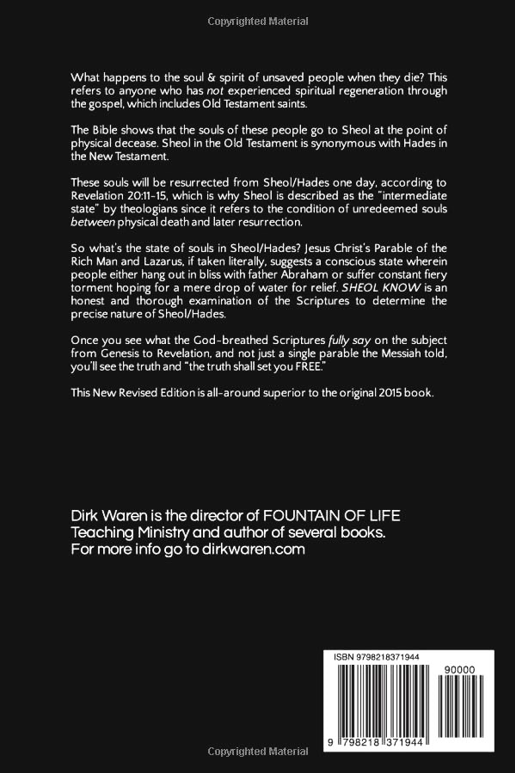
- You can purchase copies here for a low price (257 pages).
- Or you can get the Kindle eBook for just 99¢!
Both links allow you to LOOK INSIDE the book.
Insights on OFFENSE & FORGIVENESS from Joseph’s Story

A grossly false doctrine that’s prevalent in the body of Christ today is the teaching that believers are obligated to forgive everyone for everything all the time, no conditions whatsoever. (By ‘forgive’ I mean its literal definition—“to dismiss the offense” or “cancel the debt”). This erroneous teaching is so widespread that when the average Christian is exposed to the truth of what the balanced Scriptures actually teach on the topic they can scarcely believe it. If you haven’t already, I encourage you to read the prerequisite article for details (it’s not overly long).
No serious study on forgiveness can be complete without emphasizing the forgiveness Joseph offered his ten jealous brothers who were intent on murdering him, but settled for selling him into slavery at the young age of 17. These brothers covered up their wicked deeds by telling their father, Jacob, that Joseph was slain by a wild beast. They obviously never expected to see their younger sibling again but, in fact, they ran into him about 21 years later after a famine forced them to travel to Egypt in search of food. To their amazement, they ultimately discovered that Joseph ran the mighty nation and was second only to the Pharaoh. The story concludes with Joseph forgiving his brothers as shown in this powerful passage:
“You intended to harm me, but God intended it for good to accomplish what is now being done, the saving of many lives.”
Genesis 50:20
The opening words “You intended to harm me, but God intended it for good” are renowned as a biblical example of the grace to forgive. And it truly is an awesome example of forgiveness, isn’t it? Yet many preachers who quote this passage fail to point out why Joseph was willing to so graciously forgive his brothers. He didn’t just automatically forgive them; he forgave them only after they displayed sincere remorse and repentance.
In this article we’re going to focus on the important details of this story that are usually omitted when ministers sermonize from the passage. The full story is relayed in Genesis 37-50 so, if you’re not familiar with this amazing biography, I encourage you to read it for yourself firsthand (skip chapters 38 & 49 as they are not pertinent to the subject). I will reference and quote from this section of Scripture throughout this article.
Joseph was a Type of Christ
The foremost thing we need to understand about Joseph is that he was a type of Jesus Christ. A ‘type’ is simply an illustration of some future truth; hence, Joseph’s experiences foreshadowed the life of Jesus Christ in seven ways:
- Joseph was the beloved son of his father, Jacob.
- He was sent by his father to his brothers.
- He was hated and rejected by them and sold for pieces of silver.
- He was severely tempted and overcame.
- He was “killed” and “came back to life” as far as his father was concerned.
- He graciously forgave his offenders when they repented.
- He subsequently provided them a new home that was a paradise compared to where they had been living, at least as far as sustenance was concerned.
The fact that Joseph was a type of Christ makes his example of forgiveness all the more pertinent to Christians since ‘Christian’ literally means “follower of the Anointed One.” Needless to say, it’s to every believer’s benefit to pay close attention to Joseph’s example since he exemplifies the very life of Christ.
Joseph Didn’t Automatically Forgive His Brothers
The first thing we need to grasp about Joseph’s conflict with his brothers is that he didn’t just automatically forgive them. Most ministers who teach on the subject give the impression that Joseph immediately forgave his brothers upon their arrival in Egypt to acquire grain, which wasn’t the case at all. Notice what took place when Joseph and his brothers finally met:
Now Joseph was the governor of the land, the one who sold grain to all its people. So when Joseph’s brothers arrived, they bowed down to him with their faces to the ground. (7) As soon as Joseph saw his brothers, he recognized them, but he pretended to be a stranger and spoke harshly to them. “Where do you come from? He asked.
“From the land of Canaan,” they replied, “to buy food.”
(8) Although Joseph recognized his brothers, they did not recognize him. (9) Then he remembered his dreams about them and said to them, “You are spies! You have come to see where our land is unprotected.”
(10) “No, my lord,” they answered. “Your servants have come to buy food. (11) We are all the sons of one man. Your servants are honest men, not spies.”
Genesis 42:6-11
Verse 6 shows that when Joseph’s brothers came into his presence they bowed down to him. This was the fulfillment of the dreams Joseph foolishly shared with his brothers some 21 years prior, which made them hate him all the more, as detailed in Genesis 37:5-11.
Verse 7 shows that, although Joseph recognized his ten brothers, they didn’t recognize him. This was likely due to the fact that a person’s looks usually change quite a bit from their teens to their late 30s; but, more importantly, Joseph’s brothers never expected to see him again, let alone meet him as the governor of Egypt. They naturally imagined him to be an inconsequential slave somewhere performing menial tasks, if alive at all. Genesis 42:22 suggests the latter.
It’s important to note that even though Joseph recognized his brothers, even though they bowed down to him in submission and even though his dreams were finally fulfilled, Joseph still refused to automatically dismiss their great transgression of 21 years prior. Remember, Joseph is a type of Jesus Christ himself. How did he respond? He “spoke harshly” to them and accused them of being spies!
Joseph Didn’t Forgive, but He was NOT Bitter
This proves, incidentally, that Joseph didn’t forgive his brothers for their wicked actions over the course of the 13 or so years that he was a slave and prisoner in Egypt or the 8 years that he was governor. ‘Forgive’ means to dismiss the offense and it’s clear that Joseph hadn’t yet pardoned his brothers’ great offense. It’s also clear that, even though he refused to forgive his brothers up to this point, he didn’t allow their crime to ruin him in any way; he refused to allow their hateful actions to make him bitter.
How did he accomplish this? He continued his relationship with the LORD over the ensuing years despite the negative circumstances he experienced (slavery, false accusation and unjust imprisonment). This is supported by the fact that Joseph maintained God’s favor throughout these years, as indicated in Genesis 39:3,23 and 41:38. Hence, we can presume that he regularly prayed for his family, including the ten brothers who sold him into slavery. Any negative emotions he felt throughout these years—whether anger, frustration, injustice, depression or embarrassment—he wisely cast on the LORD (Psalm 55:22 & 1 Peter 5:7). No human can handle such negative emotional burdens, but God can because he’s our Creator and therefore the ultimate psychotherapist. Although the Genesis account doesn’t spell out these details we can soundly conclude as much since casting cares on God and praying for our transgressors are the two primary ways the Bible instructs us to keep severe offenses from making us bitter and destroying our relationship with God, not to mention our very lives. You can read more on this vital topic here.
The bottom line is that Joseph didn’t forgive his brothers and was under no obligation to do so, until or unless they repented. What he was required to do was maintain his relationship with the LORD no matter what (remember the first and greatest command?*); and not allow bitterness to take root in his heart, which would destroy him. We need to do the same when we face similar trials. And let’s not arrogantly think we’re above such hardships, because we’re not. Anyone who wants to be used mightily of God will have to face many challenging and humbling circumstances, like Joseph, Moses, David, Daniel, Jesus, Paul and numerous other Biblical characters.
* Matthew 22:34-40
Further Humbling was Necessary
Although it’s certain that Joseph’s brothers were humbled by their circumstances—a severe famine that forced them to go to Egypt where they had to bow to a foreign governor to acquire food—it’s also clear that they were in need of more humbling. This is seen in verse 11 of the text spotlighted above: They declared to Joseph (whom they didn’t recognize) that they were “honest men.” How do you think Joseph felt when he heard this? No doubt it stirred up his righteous anger. After all, these were the pathetically jealous siblings who plotted to murder him and only decided to sell him into slavery as an alternative because Reuben and Judah talked the gang into it (Genesis 37:21-27). They then lied to their father by saying that Joseph had been slain by a ferocious animal, hardly the actions of honest men.
Please notice that I said Joseph experienced righteous anger. Both the Old and New Testaments state, “In your anger do not sin” (Psalm 4:4 & Ephesians 4:26), which proves that a person can be angry and not in a state of sin. This was the type of anger Moses felt when he came down from Mt. Sinai and witnessed the Israelites worshiping a golden calf idol and engaging in sexual immorality, which prompted him to angrily throw down the stone tablets containing the Ten Commandments, breaking them to pieces (Exodus 32:19).
This was the type of anger Christ himself felt when—incredibly—the Pharisees objected to his mere intention of healing a man’s deformed hand on the Sabbath (Mark 3:1-6)! Can you imagine being so clueless and deceived to the point of opposing a miraculous healing of God? No wonder Jesus was angry. Such righteous anger is not sin but it must be handled and channeled properly or it can easily lead to sin because anger is such a powerful emotion.
What did Joseph do with his righteous anger? He productively channeled it in order to further humble his brothers and bring about their genuine repentance. This showed great wisdom on his part and befits his status as a type of Christ since Jesus is the wisdom of God (1 Corinthians 1:30 & Colossians 2:3).
“Be Shrewd as Snakes”
Remember when Jesus instructed his disciples, “I am sending you out like sheep among wolves. Therefore be as shrewd as snakes and as innocent as doves” (Matthew 10:16)? “Shrewd” refers to skill or sly cunning in practical matters, like when Paul mischievously implemented “divide and conquer” tactics when held before the two sects of the Sanhedrin (Acts 23:6-8). Christians today are often too nice, naïve and gullible yet Jesus said we need to be shrewd while maintaining our innocence. He even gave an entire parable commending the shrewdness of a wasteful manager who was about to lose his job (Luke 16:1-9). Why would Jesus encourage us to be skillfully cunning? He explained it himself: because we’re amongst wolves. By all means, walk innocently before your Creator but sweetness and naiveté won’t cut it when you’re dealing with arrogant, hostile, deceitful people like Joseph’s brothers. Such wolves will automatically regard niceness and gullibility as marks of weakness and take advantage. In short, they’ll chew you up and spit you out! This explains why Joseph pretended to be a stranger to his brothers, spoke harshly, and accused them of being spies—he was being shrewd. Shrewdness was the only way to break them.
Believe it or not, this is in keeping with the very character of God, as seen here:
With the merciful You will show Yourself merciful; With a blameless man You will show Yourself blameless;
(26) With the pure You will show Yourself pure; And with the devious You will show Yourself shrewd.
(27) For You will save the humble people, But will bring down haughty looks.
Psalm 18:25-27 (NKJV)
This passage shows that God deals with us according to the way we choose to live and treat others. Don’t take this in the wrong spirit because verse 27 plainly shows that the LORD saves the humble so, no matter how bad we might miss it, if we’re willing to humbly repent God will respond with gentle forgiveness and restoration.
Yet, notice how the Lord deals with devious people in verse 26: He shows himself shrewd. This reveals that being shrewd toward crooked, wolfish people is actually a godly characteristic! The Bible instructs us to “be imitators of God” (Ephesians 5:1). Consequently, if we’re dealing with devious people, like Joseph’s brothers, we need to imitate God by being shrewd, not nicey-wicey and lovey-dovey. How nice was Jesus with the Pharisees and other stuffy religionists? He openly rebuked them and called them “foolish people” who were “full of greed and wickedness” (Luke 11:39). Sometimes he would answer their devious questions in such a way that stunned them to silence (Luke 20:20-26) while others he’d refuse to answer their questions at all and asked them a question instead (Mark 11:27-33). You see, Jesus simply refused to be manipulated by these religious cons. Although this may not have been nice, it was certainly kind and good. After all, the kindest thing you can do for arrogant fakes like the Pharisees is openly rebuke them in the hope they’ll be shocked out of their deathly legalistic stupor. Although some devious people are incorrigible, like Judas Iscariot, shrewdness is the only way to break the ones who aren’t. This explains Jesus’ approach to the rigid religionists.
Joseph’s Shrewd Mind Games
With this understanding, Joseph employed a number of sly “mind games” on his brothers as follows:
- He didn’t reveal his true identity to his siblings (Genesis 42:7).
- He spoke harshly to them (42:7).
- He accused them of being spies even though he knew they weren’t (42:9).
- He put them in jail for three days (42:17).
- He made a threatening proposal: “Do this and you will live”; in other words, if they didn’t comply they’d be executed (42:18). Although it’s unlikely Joseph would have followed through with the threat, the proposal itself was indeed threatening.
- He tested the veracity of their words by insisting that one brother stay confined in Egypt until the others bring back their youngest sibling from Canaan, Benjamin, which was Joseph’s only full brother (42:19-20).
Joseph’s shrewd tactics worked as evidenced by his brothers’ reaction:
They said to one another, “Surely we are being punished because of our brother [Joseph]. We saw how distressed he was when he pleaded with us for his life, but we would not listen; that’s why this distress has come upon us.”
(22) Reuben replied, “Didn’t I tell you not to sin against the boy? But you wouldn’t listen! Now we must give an accounting for his blood.” (23) They did not realize that Joseph could understand them, since he was using an interpreter.
Genesis 42:21-23
Joseph could see that they were starting to break and turned away because he couldn’t control his emotions (verse 24). It would’ve been unwise to allow his wolfish brothers to see him weep since they’d interpret it as weakness.
Despite his sensitivity, Joseph realized that more cunning tactics were necessary for his siblings to come to a place of full remorse and repentance; hence, the mind games continued:
- Joseph ordered that Simeon stay behind in Egypt while the rest traveled back to Canaan; Simeon was consequently bound and humbled before his brothers’ eyes (Genesis 42:24).
- Why did Joseph single out Simeon? Likely because Simeon, the second oldest, was the ringleader of the plot to kill him.* This would surely convince the brothers more than ever that they were being punished for their wicked deeds some 21 years earlier.
- In what prison do you think Joseph confined Simeon? Surely the very same prison he himself was held for at least two years after Potiphar’s wife falsely accused him of attempted rape. Joseph sought to firmly impress upon Simeon the Biblical lesson: You reap what you sow.
- Joseph gave orders to fill their bags with grain to be taken back to their families in Canaan, which proved his compassion for them and their kin, but he also slyly ordered that the silver with which they paid for the grain be put in the bags as well (42:25-26).
* Reuben, the oldest brother, actually talked the bloodthirsty group out of murdering Joseph with the intent of ultimately saving him and bringing him back to their father (Genesis 37:21-22); Judah was the only other brother who pleaded for Joseph’s life, convincing them to sell him into slavery rather than murdering him (verses 26-27).
While camping that night one of the brothers discovered that his silver was in his bag and their hearts sank. Literally trembling they asked, “What is this that God has done to us?” (Genesis 42:27-28). After returning home they discovered that all their silver was in their bags and they were even more frightened (verse 35). Joseph’s tactics were clearly working. I’m sure he was having a good laugh back in Egypt imagining their responses when they discovered the money.
When their father, Jacob, learned that Simeon was imprisoned in Egypt and that the governor insisted that his beloved Benjamin be brought back to Egypt in order for Simeon to be released, he flat-out refused to do it, likely because Benjamin was the baby of the family and the favored son of his beloved wife Rachel (verses 36-38).
So they stayed in Canaan and lived off the Egyptian grain until the food ran out. Jacob was then forced to allow Benjamin to go to Egypt since the famine continued and they’d all perish if he didn’t (Genesis 43:1-14). It took at least a year for them to travel home, use up all the grain, and travel back to Egypt.
- Simeon, the evident ringleader of the plot to murder or enslave Joseph, was imprisoned in Egypt for over a year. This was fitting since Joseph was in prison for at least two years. Simeon was certainly reaping what he had sown, wasn’t he?
- When the brothers returned to Egypt with Benjamin, Joseph still refused to reveal his true identity (Genesis 43:15-16).
- He ordered that they be brought to his home for dinner. This concerned the brothers and made them suspicious that the dinner was a ruse to enslave them and take their donkeys as possible recompense for not paying for the grain on their first visit (verses 17-18). In modern vernacular, they were freaking out. The mind games were working well.
At Joseph’s house the brothers, including the just-released Simeon, bowed down to him in humility and honor (Genesis 43:26-28). It had now been well over two decades since Joseph’s brothers apprehended him with intentions of murder and sold him into slavery, yet Joseph still refused to dismiss their heinous actions; in other words, he still refused to forgive them. Although his cunning tactics were obviously breaking them, it wasn’t enough. There’s a difference between breaking and broken, and Joseph was intent on bringing them to full repentance. Hence, an important test was in order to see whether or not they still possessed the same jealous hatred they illustrated when they sought to murder him, a test involving the youngest sibling Benjamin, Joseph’s only full brother.
The sight of his beloved Benjamin, whom he hadn’t seen for over 22 years, moved Joseph to tears. Again, he wisely didn’t allow his brothers to see it, opting to cry in a private room and then return (verses 30-31).
- When they were seated to dine at Joseph’s house the eleven brothers were astonished to discover that they were seated in perfect order according to age (Genesis 43:33). They wondered how the Egyptians could possibly know their very age order and were freaking out more than ever.
- When they were served dinner, Benjamin received noticeably larger portions than the other ten brothers (verse 34). Joseph obviously wanted to test the siblings’ reaction to their younger brother’s special treatment. Would it stir up the same envious hostility they showed toward him over two decades earlier?
Although the ten brothers passed the test, Joseph still wasn’t satisfied. He had one final mind game in his arsenal, the coup de grace:
- Joseph had the brothers’ sacks filled with food to take back home but he also had his personal silver cup placed in the mouth of Benjamin’s bag. After the brothers left to travel home Joseph sent a detachment to catch up with them and accuse them of stealing the governor’s treasured chalice. After the cup was discovered in Benjamin’s sack they returned to Egypt and threw themselves at Joseph’s feet. Continuing his ruse, Joseph asked them why they stole his silver cup (Genesis 44:1-15). Notice Judah’s utterly broken response:
“What can we say to my lord?” Judah replied. “What can we say? How can we prove our innocence? God has uncovered your servants’ guilt. We are now my lord’s slaves—we ourselves and the one who was found to have the cup.”
Genesis 44:16
As you can see, the brothers were brought to a point of total brokenness. They admitted their guilt and saw God’s hand in the uncovering of their great transgression against Joseph over 22 years earlier. They even resolved themselves to slavery, the very fate they forced on their innocent brother. Joseph rejected this proposition, however, insisting that only the “guilty” Benjamin stay behind as his slave (verse 17).
Repentance Unlocks the Grace of Forgiveness
The rest of Genesis 44 shows Judah, in an extremely humble manner, explaining to the governor (Joseph) how beloved Benjamin was to his father and pleading that he himself remain in Egypt in place of Benjamin since he wouldn’t be able to bear Jacob’s misery if Benjamin failed to return (verses 33-34).
Judah was obviously the leader of the bunch and spoke for them all. What we see here is evidence of agape love, which is defined in 1 Corinthians 13:4-7. Agape love is not a feeling; it’s love in practice. It’s selfless in nature and protective. Consequently, Judah wanted to protect his father and Benjamin, and was willing to give up his very freedom to do so. Self-sacrifice is the supreme expression of agape love as illustrated in Jesus’ crucifixion for the salvation of humanity because “God so loved the world.” Whether Judah was motivated by love for his father or for Benjamin, or both, is unimportant; what matters is that Judah, speaking for all the brothers, displayed this change of heart via self-sacrificial love.
Joseph was finally satisfied. He saw enough evidence of his brothers’ humble brokenness and so revealed himself to them, wailing. The brothers were stunned to silence and terrified (Genesis 45:1-3).
Joseph’s grace flowed generously as he assured them that the LORD, in his amazing Sovereignty, used the brothers’ hateful jealousy and wicked deeds to accomplish his own good purposes:
And now, do not be distressed and do not be angry with yourselves for selling me here because it was to save lives that God sent me ahead of you. (6) For two years now there has been famine in the land, and for the next five years there will not be plowing and reaping. (7) But God sent me ahead of you to preserve for you a remnant on earth and to save your lives by a great deliverance.”
(8) “So then, it was not you who sent me here but God. He made me the father to Pharaoh, lord of his entire household and ruler of all Egypt.”
Genesis 45:5-8
Joseph was able to look beyond his brothers’ pathetic carnality and see the bigger picture: God reigns supreme even when it appears like wicked little fools get away with their devious, unjust deeds. This in no way excused the brothers’ transgressions, of course, as Joseph was led of the LORD to slyly break them and move them to genuine repentance. But it does show that God will accomplish his plans regardless of human transgression or interference. I find this very comforting. It also shows the radical forgiveness to which God calls us. Such forgiveness gushes life, mercy and pardon and will flow generously through anyone who’s experienced the Lord’s awesome favor. But this grace is not given unconditionally. There’s a condition, which is repentance. Some people seem to think that God’s forgiveness and grace flow unconditionally but this simply isn’t true. After all, why will all the stubborn fools who refuse to humbly repent be discarded in the lake of fire like garbage at the end of this present evil age? The only people who will escape this “second death” are those who humbly repent and receive God’s gracious forgiveness, reconciliation and eternal life (Revelation 2:11 & 20:11-15). Always remember: Humility unlocks God’s favor and confession stops prosecution (1 John 1:8-9 & James 4:6). These are powerful truths.
End of Story
Joseph’s father, Jacob, and all their kin then came to live with Joseph in Egypt where Jacob lived another 17 years (Genesis 46-50). After his death Joseph’s ten brothers were still concerned about Joseph holding a grudge for their great transgressions four decades prior. To ensure their pardoned status they fabricated a story:
So they sent word to Joseph, saying, “Your father left these instructions before he died: (17) ‘This is what you are to say to Joseph: I ask you to forgive your brothers the sins and the wrongs they committed in treating you so badly.’ Now please forgive the sins of the servants of the God of your father.” When their message came to Joseph he wept.
(18) His brothers then came and threw themselves down before him. “We are your slaves,” they said.
Genesis 50:16-18
Such deceit was unnecessary since Joseph forgave them 17 years earlier. It was a done deal. After all these years they still didn’t understand Joseph’s godly character or the grace of genuine forgiveness. They were unspiritual dullards, pure and simple. That’s when Joseph, at the age of 56, assured them:
You intended to harm me, but God intended it for good to accomplish what is now being done, the saving of many lives. (21) So then, don’t be afraid. I will provide for you and your children.” And he reassured them and spoke kindly to them.
Genesis 50:20-21
As you can see, Joseph didn’t just talk the talk, he walked the walk by following up his words with reassuring kindness and provision for his brothers and their kin.
I’m sure you now have a better understanding of Joseph’s profound words of forgiveness in this famous passage. Joseph didn’t offer this radical forgiveness to his devious brothers unconditionally; he only offered it after he shrewdly brought them to a place of brokenness and repentance. Just as important, before he forgave them he refused to allow their unjust actions to destroy him via bitterness, hatred and vengeance. He maintained his relationship with the LORD and overcame evil with good. Hence, the LORD continually blessed him regardless of the negative circumstances in which he found himself and ultimately promoted him beyond his wildest dreams. Or, should I say, according to his wildest dreams?
I encourage you to cultivate the same Christ-like spirit of Joseph. Increasingly implement the truths you’ve learned in this article and the prerequisite teaching in your life while being sensitive to the leading of Holy Spirit.
And, as my sister Jennifer once shared with me:
Never let the darkness in others take away your light.
The material from this article and much more is available in book form…

- You can purchase the print book here for only $5.76 (121 pages)
- Or get the Kindle eBook here for only 99¢
Both links allow you to LOOK INSIDE the book.
Related Topics:
Why You should always FORGIVE when the Offender is REPENTANT
Should You FORGIVE EVERYONE for EVERYTHING ALL of the Time?

There is gross error on the topic of forgiveness in the body of Christ, but it’s baffling because the truth about forgiveness is clearly taught in the Bible. What kind of “gross error”? The fallacy that Christians are obligated to forgive everyone for everything all of the time, no conditions whatsoever. This notion is completely unbiblical and is a widespread myth. Religionists may teach it, but the Bible does not.
To ‘forgive’ means to dismiss the offense in question, to the point of treating the guilty party as if he or she were innocent. This is the type of forgiveness God offers us when we repent, as shown here:
If we claim to be without sin, we deceive ourselves and the truth is not in us. 9 If we confess our sins, he is faithful and just and will forgive us our sins and purify us from all unrighteousness.
1 John 1:8-9
Notice that there are terms for receiving God’s forgiveness—we have to be willing to ’fess up. This means to humbly admit our mistake with the obvious resolve to not to do it again. This is repentance—making a 180 degree turnaround. God only forgives the repentant. This is a biblical axiom.
We Are to IMITATE GOD When It Comes to Offense and Potential Forgiveness
We see in the Scriptures that God’s children—i.e. believers—are called to imitate Him, as shown here:
Be imitators of God, therefore, as beloved children,
Ephesians 5:1
We’re instructed to imitate God and this includes dealing with people who offend us, particularly offending believers. Does the LORD forgive everyone for everything all the time, no conditions? Of course not. Neither should we. If we do then we’re not imitating God.
Jesus Instructions on Dealing With Offending Believers
This is in harmony with Jesus’ instructions for dealing with an offending believer:
“If your brother or sister sins against you, rebuke them; and if they repent, forgive them. 4 Even if they sin against you seven times in a day and seven times come back to you saying ‘I repent,’ you must forgive them.”
Luke 17:3-4
As you can see, Christ plainly taught that a fellow believer should be forgiven when they repent. Jesus also specified this condition here:
“If your brother or sister sins, go and point out their fault, just between the two of you. If they listen to you, you have won them over. 16 But if they will not listen, take one or two others along, so that ‘every matter may be established by the testimony of two or three witnesses.’ 17 If they still refuse to listen, tell it to the church; and if they refuse to listen even to the church, treat them as you would a pagan or a tax collector.”
Matthew 18:15-17
When a fellow believer sins against us we’re not to gossip about it to other believers, but rather go to the offending person in private and share with them what they did to offend us. As far as is possible, we should do this with a humble, compassionate spirit (sometimes it’s not possible because the offense in question is so offensive). If the offender refuses to repent then we are to get one or two mature believers as witnesses and confront the person again. If he or she is still not repentant then we’re to tell it to the church in general so that the person is socially pressured to ’fess up and make a turnaround. If the offender is still stubborn and unrepentant then we’re to regard him/her as a pagan or tax-collector. A pagan is an unbeliever, which means you stop treating the person as if they were a brother or sister in the Lord because his/her actions are proving otherwise.
As far as treating an unrepentant offender as a tax-collector goes, tax collectors (publicans) were viewed with disdain because they served the Roman government and customarily collected more than required to indulge their greed. They were placed in the same category as prostitutes (Matthew 21:32).
Please notice that Jesus Christ himself said that, if an offending brother or sister remains stubborn and unrepentant after being legitimately confronted, we are NOT to dismiss the charge—that is, forgive the person—but rather excommunicate him/her from the fellowship. If the offender doesn’t go to your assembly, which is often the case in our modern era, then you excommunicate him/her from your personal fellowship; meaning you cut relational ties. The offense in question is only to be dismissed—forgiven—if the offender REPENTS. Only then should he or she be forgiven and welcomed back into the church or personal fellowship.
Paul’s Instructions on Dealing With Offending Believers
The apostle Paul also taught this when there was an unrepentant fornicator in the Corinthian church; he instructed the believers in no uncertain terms to EXPEL HIM from the assembly (1 Corinthians 5:1-5,12-13). Thankfully, the guy later repented and Paul encouraged the Corinthians to forgive him and warmly welcome him back into the fellowship (2 Corinthians 2:6-11).
Please notice that the Corinthians only forgave this man when he was willing to humbly repent. Unfortunately, most Christian ministers and sects ignore these crystal-clear passages. Instead they insist that believers are obligated to forgive everyone for everything all the time, no conditions whatsoever, when the New Testament plainly teaches differently. This idea—that we are to constantly offer immediate and universal forgiveness, no conditions—is dangerous to believer’s spiritual health and can even cause people to reject Christianity altogether because this teaching is so absurd and totally misrepresents Christianity.
That said, we are obligated to forgive whenever the offender is humbly repentant. After all, this is how God mercifully treats us when we miss it and ‘fess up (1 John 1:8-9, Revelation 2:21-22, Proverbs 28:13; Psalm 32:5). We are to be “imitators of God” by treating penitent souls in the same merciful manner (Ephesians 5:1). If we refuse to forgive repentant people, the LORD will be angered and surely penalize us (Matthew 18:23-35). You can read details here.
What About Matthew 6:14-15 and Mark 11:25?
Ministers who teach that believers are obligated to forgive everyone for everything all the time usually focus on these two statements by Jesus:
“For if you forgive men when they sin against you, your heavenly Father will also forgive you. But if you do not forgive men their sins, your Father will not forgive your sins.”
Matthew 6:14-15
“And when you stand praying, if you hold anything against anyone, forgive him, so that your Father in heaven may forgive you your sins.”
Mark 11:25
From there they typically go on some rant about how Christians are obligated to forgive everyone for everything all of the time; and anyone who fails to do so is spiritually weak, carnal, rebellious, or damned. Consequently, because of these two brief texts and the fervent preaching of the minister, believers are misled on the subject and put into bondage. What kind of bondage exactly? This kind: It doesn’t matter what anyone does to you or your loved ones, you must forgive them, and forgive them completely, no conditions whatsoever. In fact, you must forgive them immediately, or at least as soon as possible. They can slander, steal, rape, maim, beat up, molest, torture or kill, but you are mandated to automatically forgive—dismiss all charges—no questions asked. This, after all, is the Christian way. Or so they say.
Actually, it’s not the Christian way; it’s universal forgiveness and wholly unbiblical, as shown above. Christ and Paul both taught that offending believers are to be held accountable for their offensive actions and confronted. If they repent, that’s awesome, but if they don’t repent we’re not to dismiss the offense, but rather hold it against them until they are willing to humbly repent. This holds believers accountable to their negative behavior and inspires repentance, i.e. positive change.
I’m not saying that these two quotes from Jesus—Matthew 6:14-15 and Mark 11:25—are false and shouldn’t be taught. They’re great passages with great truths — we must be willing to forgive on all occasions where we’re obligated to forgive, like when an offending believer readily repents (e.g. Luke 17:3-4 & 2 Corinthians 2:6-11). These two passages must be taught in a balanced manner, taking into consideration the numerous other clear texts on the subject, like the ones above. This is an interpretational law for properly handling the Word of God. When we fail to “rightly divide” the Scriptures by considering all relevant passages we inevitably fall into error; and error doesn’t set free. It can’t. It won’t. Only the truth sets free.
Confusing Forgiveness With Venting (Casting Cares)
This gross error on forgiveness can be attributed, in part, to people confusing forgiveness with venting or “casting cares.” The Bible does encourage us to cast our anxieties and burdens on the LORD so He can sustain us (Psalm 55:22 & 1 Peter 5:7). Venting in this sense should be done across the board, including situations where we are severely offended and the offender is unrepentant. Casting such burdens on the Lord keeps us free of bitterness and hatred. But venting is not forgiving. As noted earlier, ‘Forgive’ literally means to “cancel the debt” or “dismiss the offense” and the Bible gives us precise instructions on when to do this and when not to do it. To forgive someone of a severe offense prematurely is pure folly. However, we are instructed to cast (vent) all our cares unto the LORD, which includes the hurt, violation and frustration we experience due to various offenses. When we do this, the LORD bears our burdens and we free ourselves from bitterness or hatred taking root.
Praying for someone who has offended you goes hand-and-hand with venting. Jesus said that we are to pray for those who persecute us (Matthew 5:44 & Luke 6:28). This includes praying for fellow believers who mistreat you in one form or another, directly or indirectly. Yes, Christ and Paul taught that we’re to confront fellow Christians when they sin against us, but we should certainly bathe the offender & the situation in prayer before we confront them, which can pave the way for a profitable confrontation wherein the offender is more inclined to humbly repent.
Why pray for those who come against you? Obviously because—if they’re attacking you without cause—they desperately need prayer. How do you pray for them? Pray that the Holy Spirit show them their offense or sin and open their eyes, so to speak. Pray for them to have a teachable, compliant heart that responds in obedience to the Word of God. Pray that the LORD humble them one way or another because God will not bless them—show them His grace, His favor—if they’re proud and stubborn. As the Bible plainly says: “God opposes the proud but shows his favor to the humble” (James 4:6, 1 Peter 5:5 & Proverbs 3:34). When you pray like this you’re not cursing them, but rather blessing them because the LORD opposes—resists—the arrogant and only gives His graciousness to the humble.
Did Christ Forgive His Murderers On the Cross or Was He Simply Praying for Them?
Those who advocate the false doctrine that believers are obligated to forgiven everyone for everything all the time, no conditions, argue that Jesus forgave his murderers on the cross when he said “Father, forgive them for they do not know what they do” (Luke 23:34). But Christ wasn’t forgiving anyone on this occasion. Read the text closely: He was praying to the Father for HIM to forgive his murderers, which means he was praying for his murderers to come to repentance because THIS IS THE ONLY WAY GOD FORGIVES SIN (Acts 20:21). God doesn’t forgive the arrogant unrepentant; He only forgives the humbly repentant. It’s an axiom. So what Jesus was doing on the cross was precisely what he instructed believers to do when we are mistreated for his name: Pray for our persecutors!
What About Dealing With Offending Unbelievers and Severe Criminal Acts?
We are still left with some important questions, like how do you deal with offending non-believers? Obviously you should pray for them, as shown above, but should you confront them, like you would do when fellow believers sin against you?
And what about severe criminal acts; like sexual molestation, robbery or murder? How should you deal with these types of heinous offenses? And when should you forgive such crimes?
These questions, and more, are addressed in detail in my book…

- You can purchase the print book here for only $5.76 (121 pages).
- Or get the Kindle eBook here for only 99¢
Both links allow you to LOOK INSIDE the book.
Related Topics:
Joseph’s Story—Insights on Offense & Forgiveness
Why You should always Forgive when the Offender is Repentant
Dealing with Personal Offenses vs. Criminal Acts
Spiritual Warfare — the Basics
Should Christians RESIST Criminal Acts? (Video)
Pacifism — Absolute Pacifism (Unbiblical) and Limited Pacifism (Biblical)
SECTARIANISM — What Is It? What’s Wrong With It?

You don’t have to be a Christian for very long before you’ll notice some sincere believers who regard their sect or assembly as the “one true church” and all other believers are either false or, at least, somehow lesser Christians. Sectarianism is faction-ism wherein a believer’s loyalty is to his or her sect/church to the point that it overrides clear and balanced biblical teaching. It’s a myopic mentality that tends to hinder the apprehension of truth (and therefore freedom), but also fosters spiritual dependence & immaturity.
To be expected, believers who fall into sectarianism increasingly view “outsiders” with an eye of suspicion, condescension or contempt. By ‘outsider’ I mean anyone who is not part of their particular sect/church or anyone who has chosen to leave. Consider this scriptural example concerning Jesus’ disciples:
“Master,” said John, “we saw a man driving out demons in your name and we tried to stop him, because he is not one of us.”
(50) “Do not stop him,” Jesus said, “for whoever is not against you is for you.”
Luke 9:49-50
As you can see, John and the other disciples were upset that someone besides them was driving out demons in Jesus’ name and their knee-jerk response was to oppose him. This is sectarianism. Those who cop such an attitude view people outside their group with a suspicious, rivalrous eye. What’s absurd is that this man was doing an incredibly good work—driving out demons—but it didn’t matter to John and the other disciples because they were blinded by their factionalist spirit.
Christ put an immediate stop to this nonsense. His response was simple: “Do not stop him, for whoever is not against you is for you.” Obviously it didn’t bother the Lord that the man was operating outside their group. It didn’t irk him in the least that this guy didn’t go to Jesus’ “seminary.” The man was doing a good work and he was obviously on their side, so what was the problem? There wasn’t one, but those infected by sectarianism will always create a problem when it concerns someone who functions outside the box with which they’ve put themselves and God.
The Messiah didn’t come down too hard on his disciples here. He saw that they were developing a sectarian spirit and nipped it in the bud. Jesus’ general strategy on such occasions was to correct the negative behavior or attitude in a fairly mild manner and only take a sterner approach if the person or persons failed to respond positively. This should be our approach as well.
Sectarianism Is a Work of the Flesh
The reason Jesus corrected them was because sectarianism is of the flesh, which is why Paul listed it as one of the works of the flesh:
The acts of the flesh are obvious: sexual immorality, impurity and debauchery; (20) idolatry and witchcraft; hatred, discord, jealousy, fits of rage, selfish ambition, dissensions, factions (21) and envy; drunkenness, orgies, and the like. I warn you, as I did before, that those who live like this will not inherit the kingdom of God.
Galatians 5:19-21
The word ‘factions’ in the Greek is hairesis (HAH-ee-res-is), meaning “a religious or philosophical sect” and the resulting division it causes. As such, some translations render the word as “divisions,” like the English Standard Version. It’s a “self-chose opinion” rooted in sectarian loyalty—i.e. one’s favored sect—rather than a viewpoint rooted in the rightly-divided Word of God.
There’s nothing wrong with being part of a sect, of course, as long as it’s a healthy and legitimate group. In fact, to go through the foundational stage of spiritual growth it’s nigh necessary to hook up with a specific group; and every group has its governing structure and a list of official doctrines, written or unwritten. To function in this organization believers have to submit to the corresponding servant-leaders and assent to their major doctrines, which doesn’t mean they’ll agree 100% because young believers simply don’t know enough to agree with absolute certainty (and by ‘young’ I mean young-in-the-Lord, not young-in-physical-age; someone could be 75 years-old and be young-in-the-Lord). So there’s nothing wrong with being a part of a sect in this manner. It’s sectarianism that’s of the flesh, as observed with the disciples above. Staunch sectarianism is an arrogant and divisive attitude of superiority and condemnation toward anyone who’s not part of the group in question. This is what ‘factions’ refers to in the above passage.
Believers make a mistake when they join a church/camp/sect and then limit themselves to the official ministers and doctrines therein. By doing so they cut themselves off from any minister or teaching that doesn’t jibe with their group. Why is this a mistake? Because it will bar them from vital biblical information that can bless them and set them free in one area or another. I could list scores of examples off the top of my head. For example, if you join a camp that supports amillennialism and strictly embrace their theology you can pretty much kiss goodbye the awesome biblical truths that reveal the nature of eternal life and everything surrounding it—literal glorified bodies, the new Jerusalem, the new earth, the new heavens (universe), etc.*
*For insights on the nature of eternal life see this article.
When I first became a Christian I visited several local assemblies before finally settling down in a quality fellowship for a decade where I was fed the best spiritual diet you could imagine. Like most people in the beginning levels of spiritual growth (i.e. STAGE TWO*) I thought this assembly and its camp was the best on earth and in some ways it was; it was a top-of-the-line ministry. However, I didn’t make the mistake of only feeding from the teachings of this ministry/sect. At least half my spiritual diet was from my own studies in the Scriptures, which I supplemented with the teachings from quality ministers inside and outside this camp via books, tapes, radio programs and so on.
* See this article if you’re not familiar with the Four Stages of Spiritual Growth.
Somehow I instinctively knew that it was a mistake to limit myself to one general mindset in the body of Christ and I’ve been exponentially blessed because of it.
Sectarians would argue that doing this creates confusion in believers because they’ll expose themselves to conflicting beliefs. For instance, one camp will say that Jehovah is a healing God and it’s always His will to heal whereas another group will argue that the LORD sometimes heals, but it’s not always God’s will and so you can never be sure. Yes, facing such contradictions can cause some immature believers to throw the baby out with the bathwater, so to speak, and use it as an excuse to backtrack to darkness (STAGE ONE). Keep in mind, however, that people like this would’ve likely found another excuse to revert back to STAGE ONE. Let ’em go. Christ said it’s only those who “continue in his word” and don’t give up who find the truth and are set free (John 8:31-32). God is a rewarder of those who diligently seek Him, not of those who throw in the towel because one ministry teaches one thing and another contradicts it and it frustrates them (Hebrews 11:6).
Biblical Examples of Sectarianism
The aforementioned Greek word for sectarianism—hairesis (HAH-ee-res-is)—appears nine times in the New Testament and is used in reference to the two major factions of Judaism at the time of Christ, the Sadducees and Pharisees:
Then the high priest and all his associates, who were members of the party (hairesis) of the Sadducees, were filled with jealousy.
Acts 5:17
Then some of the believers who belonged to the party (hairesis) of the Pharisees stood up and said, “The Gentiles must be circumcised and required to keep the law of Moses.”
Acts 15:5
The Sudducees and Pharisees were two rigid sects of Judaism, both of which Christ charged with false teachings (Matthew 16:5-12). This doesn’t mean that all of their doctrines were false, of course, but some of them were and they were important matters, not insignificant. For instance, the Sadducees didn’t believe in a future resurrection, angels or demons (Acts 23:8).
In John 5:39-40 Christ told the Hebrews who rejected him: “You pore over the Scriptures because you presume that by them you possess eternal life. These are the very words that testify about Me, yet you refuse to come to Me to have life.” Why did they reject the Messiah? Because of their rigid sectarianism. While the common people of 1st Century Israel received the ministry of Jesus, the factionalists—the Pharisees and Sadducees—were too blinded and puffed up by their sectarian “orthodoxy” to receive and therefore considered Christ a rival and wanted to murder him!
Interestingly, Christianity itself was referred to as a “sect” by non-Christians during the early church. Notice what the apostle Paul says to the procurator of Judea:
“I do confess to you, however, that I worship the God of our fathers according to the Way [i.e. Christianity], which they call a sect (hairesis).”
Acts 24:14
While Christianity was thought of as just another “sect” by non-believers, it really wasn’t. It’s “the Way” of truth (reality).
Paul Condemned Sectarianism
Like Jesus, Paul also had to correct believers who were starting to fall prey to a sectarian spirit:
My brothers, some from Chloe’s household have informed me that there are quarrels among you. (12) What I mean is this: One of you says, “I follow Paul”; another, “I follow Apollos”; another, “I follow Cephas”; still another, “I follow Christ.”
(13) Is Christ divided? Was Paul crucified for you? Were you baptized into the name of Paul?
1 Corinthians 1:11-13
Believers at Corinth were starting to separate and look down on others based on their favorite teachers. This is bullheaded sectarianism. Paul corrected the problem by asking if Christ is divided because this is what the sectarian mindset does, it divides. Many believers in the body of Christ today won’t give heed to a word you have to say if you’re not part of their sect or camp. Some will even shun you, meaning they’ll refuse to associate with you or even give you the time of day.
Paul then addressed the fact that some Corinthians insisted that they followed Paul. In other words, they were “Paulites.” This didn’t stroke Paul’s ego, as it would many ministers today. Being a spiritual man, it offended him and he rebuked it by rhetorically asking if he was crucified for anyone or if anyone was baptized into his name. No human leader should be given the accolades and loyalty that belong to the Lord, not even someone as great as the apostle Paul.
Someone might understandably ask: “What’s wrong with the ones who claimed to ‘follow Christ,’ as shown in verse 12?” Nothing per se, as “following Christ” is the non-sectarian attitude all Christians should have, but we need to read between the lines here. The believers in Corinth who claimed to only “follow Christ” were actually saying that, since they followed Christ, they weren’t going to receive from (or submit to) the other genuine ministers in their midst, whether Paul, Apollos, Peter (aka Cephas) or otherwise. This was itself a sectarian spirit, which is why Paul rebuked it.
Paul addressed this problem again a little later in his letter:
You are still worldly. For since there is jealousy and quarreling among you, are you not worldly? Are you not acting like mere men? (4) For when one says, “I follow Paul,” and another, “I follow Apollos,” are you not mere men?
1 Corinthians 3:3-4
Copping a sectarian mentality is worldly! It provokes jealousy and strife. Those who succumb to it are not “participating in the divine nature,” as all Christians are called (2 Peter 1:4); on the contrary, they’re walking according to the flesh or, as Paul puts it here, behaving like “mere men.” For people in the world this is understandable, and this explains why you’ll see moronic partisans of every stripe on a regular basis, but for believers who are spiritually regenerated and able to walk in the spirit it’s totally unacceptable.
Sectarianism Comes to Antioch
The Bible offers an excellent example of how easy it is for sectarianism to slip into a church and infect the people, not only members of the congregation, but leaders as well.
The church at Jerusalem was established on the Day of Pentecost. It was the first Christian church and there’s evidence that it succumbed to some forms of legalism early on. Perhaps not wholly, but any amount of legalism is too much. After Stephen’s martyrdom, great persecution broke out against the church and the believers were scattered in every direction (Acts 7:54-8:1). Some of these Hebrew Christians went to Antioch, which was over 300 miles north, and shared the gospel with Gentiles (non-Jews). Antioch was in the Roman province of Syria, which is now southern Turkey. The Jerusalem church decided to send a minister up there to see what was going on and chose Barnabas, likely because he was from the same general region (Tarsus). Barnabas had nothing but good things to say about the awesome move of God in Antioch and enlisted the aid of Paul in teaching the “great numbers” of believers there for a whole year. Antioch wasn’t only the first non-Jewish church; it was the first one where believers were called “Christians.” These facts are relayed in Acts 11:19-26.
The church in Jerusalem was basically the headquarters of Christianity and, after some time, they sent Peter up to Antioch to check on the church there. Why? Likely for the sake of oversight since, in a sense, the Antioch church was a satellite fellowship. Perhaps they wanted to make sure it was orthodox.* Keep in mind that many in Jerusalem never met Paul and were understandably suspicious of him due to his infamous past. Another possibility is that some were jealous of this non-Jewish church’s success. Regardless of the reason, Peter visited the believers in Antioch and became so involved that he stayed quite some time, evidently longer than expected.
* By ‘orthodox’ I mean what the word literally means, “correct view,” and not what it has been corrupted into meaning over the centuries of church history.
It’s at this point that “certain men came from James” to the Antioch fellowship; James, by the way, was the Lord’s brother, the current pastor of the church at Jerusalem:
When Peter came to Antioch, I opposed him to his face, because he was clearly in the wrong. (12) Before certain men came from James, he used to eat with the Gentiles. But when they arrived, he began to draw back and separate himself from the Gentiles because he was afraid of those who belonged to the circumcision group. (13) The other Jews joined him in his hypocrisy, so that by their hypocrisy even Barnabas was led astray.
Galatians 2:11-13
There’s debate as to whether these men actually came with James’ blessing because the passage indicates that they were infected by legalism. What kind of legalism? The kind that insists on circumcision in order to be saved and encourages Jews to separate from Gentiles in accordance with Jewish tradition. Because of this, some commentators suggest that the men lied about having the support of the Jerusalem church, but the passage doesn’t state this. It literally says that they “came from James.” Besides, Peter was from the Jerusalem church and was, in fact, the previous pastor. Surely he would know if these men were lying about coming from the very church he was a leader!
The reason some commentators suggest that this group lied about coming “from James” is because they find it hard to believe that the Jerusalem church would send a team to Antioch who were infected by legalism, but that’s the insidious nature of this spiritual disease. It can infect anyone, any assembly, anywhere, anytime. In fact, it infected Peter in this very situation, a man who walked with the Lord for three years; a man who led the very first church fellowship on earth; a man who wrote two books of the New Testament inspired by the Holy Spirit. If Peter can fall prey to legalism anyone can!
NOTE: For a better understanding of Legalism see Legalism — Understanding its many forms.
Peter should have known better, of course, and this is why Paul boldly corrected him in public. Years prior, God gave Peter an amazing vision to show that non-Jews were granted the message of “repentance unto life” and, therefore, Jewish believers were no longer to disassociate from Gentile believers (Acts 10:9 – 11:18). This is why Paul said, “There is neither Jew nor Greek, slave nor free, male nor female, for you are all one in Christ Jesus” (Galatians 3:28).
Unfortunately, Peter succumbed to fear in this situation. He was “afraid of those who belonged to the circumcision group” and therefore “separated himself” from the Gentile believers. Peter’s sectarianism was so great that he stopped eating with the non-Jewish believers! How would you feel if you were one of the Gentile believers in Antioch? You’d feel like a lesser Christian than the Jewish ones. You’d feel unworthy, especially since Peter literally walked with the Lord for three years and was the former pastor of the first church on earth! Peter had so much influence that the other Jewish believers followed his example of separating from the Gentile believers, even Barnabas who was a leader at the Antioch church!
Is it any wonder that Paul couldn’t keep silent, that he was so incensed he openly rebuked Peter right then and there?
Make no mistake, although there are many different “camps” of believers in the body of Christ today, there is no place for the sectarianism that Peter temporarily fell prey to. And, please, don’t think you or your assembly leaders are immune to this arrogant spirit of exclusivity and divisiveness; if pillars like Peter and Barnabas can fall prey to it, any of us can if we’re not careful. Needless to say, be on your guard and, like Paul, refuse to tolerate it, in yourself or others.*
* It should be added that Paul had a somewhat different attitude when he was in Jerusalem at the time of Acts 21:17-26. In the center of Jewish culture Paul accommodated it. Why? Because he wanted to insure a peaceful atmosphere in Jerusalem since many Jewish believers were suspicious of him. This was in accordance with Paul’s attitude expressed in 1 Corinthians 9:19-23 where he said, “Though I am free and belong to no man, I make myself a slave to everyone, to win as many as possible. To the Jews I became like a Jew, to win the Jews. To those under the law I became like one under the law (though I myself am not under the law), so as to win those under the law. To the weak I became weak, to win the weak. I have become all things to all men so that by all possible means I might save some. I do all this for the sake of the gospel, that I may share in its blessings.”
Rigid Sectarianism Is Spiritual Immaturity
When Jesus’ disciples automatically condemned someone outside their group who was simply doing a good work they revealed their immaturity. They were young believers at this point—STAGE TWO. Jesus, on the other hand, was spiritually mature—STAGE FOUR*—and that’s why he didn’t mind one bit that this guy was driving out demons in His name. In fact, Jesus was no doubt elated that someone believed strongly enough to take the initiative and advance God’s kingdom in such an authoritative manner—and the man didn’t even have formal backing!
* If you’re not familiar with the Four Stages of Spiritual Growth see this article.
I see unhealthy sectarianism fairly regularly in the church and it always repels me. Here’s a good example: I worked with a guy for a number of years and, at first, he couldn’t say enough praise about the church he was attending. This is good to a degree. We should have a positive attitude toward the fellowship God calls us to serve; otherwise we should go somewhere else. Yet this guy’s attitude bordered on excessive. He kept trying to get me to come to his church for this or that function when I was perfectly happy at the fellowship I was serving. Then something went sour and he left his church. All his accolades suddenly vanished. Although he didn’t revert to overt backbiting, he now had nothing good to say about his former assembly. A year or so later he found another fellowship and, once again, it was the greatest church on earth and any person who wasn’t going there was somehow a lesser Christian and he looked down on them. He didn’t openly say this, of course, it was just the general vibe he gave. Frankly, this is arrogance—a superiority complex—which isn’t a good trait to develop because “God opposes the proud, but gives his grace to the humble” (James 4:6 & 1 Peter 5:5). A few years later he left that church. Apparently it wasn’t so great after all, huh?
I ran into this same guy recently and happened to mention a minister who functioned outside of the normal Christian circuit. Hostility suddenly flared on his face and it was clear that he couldn’t stand the man. Did this minister offend him in some personal way? Nope. He rejected him simply because he operated outside the typical church circles with which he was familiar. God forbid that the Lord would use someone outside conventional church circuits to serve people most believers would never likely reach!
Anytime you see professing Christians showing signs of staunch sectarianism like this, it signifies spiritual immaturity. It doesn’t matter if they’re elders, pastors, deacons, worship leaders or 80 years old. It’s a one-dimensional, puerile mindset. It’s spiritual tunnel vision. Yes, we all go through a period in our formative years thinking our church or camp is the best and most blessed on the planet, but then we hopefully grow up. Unfortunately, all believers grow older, but not all believers grow up. And that’s why I’m writing this article—to inspire people to grow out of myopic faction-ism and progress to spiritual maturity!
Sectarian Believers Argue Doctrine From a Sectarian Standpoint
You may have noticed that certain believers defend or denounce certain doctrines according to sectarian loyalties and boundaries. For instance, someone might denounce something you believe or teach because there’s a group he/she objects to that also teaches it, at least in some form. Or say you teach something that doesn’t gel with the religious tradition of another believer and s/he instantly writes it off as false doctrine without even studying the issue. Let me give you an example: In my book HELL KNOW I have a fairly long section on the Judgment Seat of Christ. A minister wrote me and lambasted me for deviating from Evangelical tradition. As I read his email it became clear that he didn’t even read the section of the book in question, at least not fully. Moreover his scriptural “evidence” was scant and he relied on quoting Evangelical slogans that aren’t actually in the Bible. I wrote him back the same day and explained the matter in detail. The only answer I got back was chirping crickets.
For the record, I’m an Evangelical believer, but I’m not sectarian about it, as was evidently the case with this minister who wrote me. If what Evangelicals teach is thoroughly biblical than I’ll embrace it; if not, I’ll reject it and expose it as unbiblical with clear scriptural support (if I didn’t have clear biblical support I wouldn’t reject it in the first place). The Bible teaches: “Do not go beyond what is written [in God’s Word]” (1 Corinthians 4:6), not “Do not go beyond what American Evangelicals say is truth.”
Here’s a truth that all spiritually mature believers embrace: It doesn’t matter what one group believes or another group believes on any issue; the only thing that matters is what the truth is. Why? Because truth in the Greek is alétheia (ah-LAY-thee-ah), which literally means “reality.” In other words, ‘truth’ simply means the way it really is. My point is that the truth is the truth regardless of what any person or group believes. So when you’re trying to discover the truth on a certain issue it’s irrelevant what this or that sect believes. All that matters is the truth and the truth is the clear revelation of the Word of God (John 17:17) as we continue in it, interpreting in context and in light of the greater context of the entire Bible (John 8:31-32). Here are the four common-sense rules of hermeneutics; that is, Bible interpretation:
- Context is king: Meaning the surrounding text reveals the obvious meaning of each passage
- Scripture interprets Scripture: Meaning every passage must be interpreted in light of the context of the entire Bible and that the Bible itself is its best interpreter. In other words, one’s interpretation of a passage must gel with what the rest of Scripture teaches; the more overt and detailed passages obviously expand our understanding of the more sketchy and ambiguous ones.
- Take the Bible literally unless it’s clear that figurative language is being used: In which case you look for the literal truth that the symbolism intends to convey.
- If the plain sense makes sense—and is in harmony with the rest of Scripture—don’t look for any other sense lest you end up with nonsense: This includes the “plain sense” of the whole of Scripture on any given topic. In other words, if an individual or group comes up with an interpretation that is opposed to the plain-sense meaning that all the passages in the Bible obviously point to on that subject, then it must be rejected. This fourth rule is essentially the other three combined.
These “rules” are really just common-sense guidelines for discovering truth and being set free from religious error. Although the Bible is simple enough that the simplest of persons can receive from it and be blessed, it’s also deep and complex, which means that as believers grow in the Lord they naturally grow in knowledge, understanding and wisdom. As such, one believer might have a grasp on a passage or topic and another might have a fuller understanding. A good example of this can be seen in Acts 18:24-26 where Apollos, a very learned man and powerful speaker, had a limited understanding of the gospel of Jesus Christ. What he knew was good and accurate, as far as he understood it, but it wasn’t a full or complete understanding. Aquila and Pricilla discerned this when they heard him speak; so they took Apollos aside, and “explained to him the way of God more adequately” (verse 26).
Staunch sectarians aren’t like this, however; they argue for or against a doctrine based purely on sectarianism. If what you teach doesn’t gel with their sect you’re automatically wrong; if what you teach is adhered to by a group they object to you’re wrong. What the Scriptures clearly and consistently teach on the topic is irrelevant to them (even though they claim otherwise). All that matters to them is strict adherence to their group’s official doctrines. It’s a spiritually immature mindset and decidedly STAGE TWO.
“You’re Not One of Us”
As noted at the beginning of this article, when you get around rigid sectarians the general vibe you’ll pick up is, “You’re not one of us.” This is precisely why Jesus’ disciples tried to stop the man who was exorcizing demons in Jesus’ name in Luke 9:49-50 – he wasn’t one of them. If you’re not officially part of their group sectarians will typically perceive you as an outsider and view you with a suspicious eye. You might even sense them looking down on you. It’s arrogance.
Back in the late 80s I stopped over my boss’ house for something work-related. It just so happened that his church was having a cell group meeting at the time. The lady who answered the door was an elder from the church and she gave me this overtly suspicious look, apparently because I wasn’t “one of them.” It was very odd and I didn’t feel welcome. Shortly later the head elder cornered me in the kitchen and kept robotically asking with strangely dead eyes, “Why don’t you come to our church sometime?” “Why don’t you come to our church sometime?” I’m not making this up.
In a less extreme sense Carol and I have experienced this “You’re not one of us” mentality at a couple of churches we’ve visited over the years. It’s sectarianism, which is a form of legalism, i.e. sterile religiosity or counterfeit non-Christianity.
Sectarians Think They Have a Patent on Truth
To be expected, rigid sectarians believe they have a monopoly on faith. In other words, they think their group is pure in doctrine and practice or, at least, vastly more accurate than other sects or ministries. For example, in 2001 Carol and I were attending a church where I taught adult Sunday school and a handful of sermons. I was considering getting credentials with this group. On one occasion the top elder and I had to travel by car for over an hour, which gave us the opportunity to really talk. Although we were from altogether different generations and sub-cultures we were both believers and that’s all that really mattered. At one point he made the statement, “Dirk I believe we have the truth,” referring to his denomination. You see, he was convinced that his denomination was the one true Christian sect, pure in doctrine and practice.
God bless this elderly brother. He was sincere, but sincerely wrong. Don’t misunderstand me, they were a legitimate Christian denomination, but they were hardly the most accurate sect in Christendom.
I observed this same mentality in a woman I was corresponding with last year where we discussed a theological issue in detail. Before the discussion got going I informed her that I was open to other viewpoints but wouldn’t embrace anything if it couldn’t be clearly proven from the Scriptures through multiple passages, which is in accordance with God’s Word (1 Corinthians 4:6). Proving something scripturally of course includes disproving arguments based on misunderstood texts that counter the position.*
*NOTE: See the article Berean Spirit — What is It? How Do You Cultivate It? for details.
She was courteous as we dialogued, but she kept insisting that her position was the right one despite clear evidence to the contrary. I cited this evidence and elaborated repeatedly, but it failed to persuade her. We kindly went back and forth as I gave her ample opportunity to prove her position and disprove the evidence that contradicted it, but she wasn’t able to do it. The plain-as-day passages I kept citing were unable to penetrate her indoctrination. Finally, she got upset and said she wasn’t going to write again. To her credit, she was willing to break away from erroneous tradition in certain areas, and I respected that, but one of the most important hermeneutical rules is “Scripture interprets Scripture” and she was unable to support her position in light of the several clear passages that proved it false.
Unsurprisingly, I discovered during the course of our discussion that she staunchly followed some peculiar teacher and the position she advocated was, of course, the official position of this man’s small group. In fact, she often parroted his words. You see? She was believing and arguing from the basis of sectarianism and not from the basis of Scripture alone. When people are like this you can dialogue with them until you’re blue in the face with as many clear Scriptures as you can muster but it’s not likely going to change anything. Why? Because they’ve developed a rigid sectarian spirit and are stubbornly intent on only believing what their preferred teacher or sect advocates, regardless of what God’s Word clearly and consistently teaches.
Rigid Sectarianism Limits and Confines Believers
This is actually one of the worst things about sectarianism in general and especially rigid sectarianism – it can limit and confine the believer and actually prevent him or her from healthy spiritual growth. How so? Practically every church assembly is part of a larger ministry or denomination. The pastor and associates of each fellowship are generally educated and trained at the schools of these sects and understandably espouse the same doctrines and doctrinal parameters. Here’s the problem: What if they’re wrong in certain areas? If they’re wrong that means what they believe is false or, at best, only partially true. The problem with this, of course, is that inaccurate beliefs are false and therefore cannot set the believer free since only the truth can set us free (John 8:31-32). Depending on how rigid the group is about their set of doctrines, the believers in the congregation are limited and confined by the beliefs of the group. Let me give an example.
I was communicating with a brother in the Lord from the other side of the country via email and we started to develop a good relationship over the course of a couple months. We compared insights from our studies and experiences and it was a blessing. One day he informed me that he didn’t believe in the devil or evil spirits, which is nothing new since the Sadducees didn’t believe in them either, as shown in the Gospels & Acts. As a non-sectarian Bible teacher, I know that no one would come to this conclusion by simply studying the Bible. In other words, I knew that this peculiar belief was likely an official doctrine of the assembly or sect he was hooked up with and, sure enough, that was the case.
The fact that he didn’t believe in the devil or demonic spirits didn’t make him an unbeliever because it’s not an essential doctrine to salvation, like the Lordship of Christ. But this belief would certainly limit his spiritual growth in some ways. For instance, it would negatively affect his understanding of spiritual warfare; as well as limit his appeal in the body of Christ, confining him to his peculiar group.
Another good example would be the untold millions of believers who reject the baptism and gifts of the Holy Spirit because their church or sect is either ignorant of them or, more likely, teaches that they’ve been “done away with” after the first century. Because of this demonic doctrine they eagerly deny spiritual gifts whereas the Bible encourages us to “eagerly desire” them! (See 1 Corinthians 12:1,31 & 14:1). You see? Because of sectarianism, believers in these assemblies are restricted from powerful truths of God’s Word. In other words, sectarianism prevents them from seeing and experiencing life-changing truths.
NOTE: If you’re not familiar with the baptism of the Holy Spirit see the article Baptism of the Holy Spirit.
The bottom line is this: Just because a certain denomination, camp or church labels something a “false doctrine” doesn’t necessarily mean it’s really an unbiblical teaching. It may simply be a biblical teaching of which they’re ignorant. If this is the case it’s a truth they actually need because it would bless them.
Untold thousands of believers limit their spiritual growth because of foolish sectarianism. It’s often a case of just not wanting to leave the comfort of what they know and currently believe. They refuse to change churches or denominations. They stay where they’re comfortable while others move up the mountain of spiritual growth because they’re willing to go through a little discomfort to reach new levels of glory in Christ.
Along the same lines is a group’s resistance to questions by members within their group. Say a member questions some of the sect’s doctrines or asks why God would do this or that and allow such and such. There’s nothing wrong with seeking answers to questions, of course, but in many sectarian groups questioning like this would mark the individual as a doubter and that’s a no-no.
Resistance to questions isn’t good because it assumes that the believer, or group/sect, has all the answers and that’s just not the case. Believing in God is merely the beginning of the journey, not the end (Proverbs 1:7, 9:10 & Psalm 111:10). Once a person finds the LORD he or she will have more questions than ever, not the reverse. Jesus said to believers “seek and you will find” not “if you seek answers to questions you’re an evil doubter and must be excommunicated!”
Every day I have questions swirling around in my mind that I seek answers to. Questioning is good because it inspires you to seek & find the truth and, once you discover it – even if it’s in partial form – the truth will set you free (and, by “truth,” I mean the way it really is).
It goes without saying, don’t allow your spiritual well-being and growth to be limited or confined by the rigid sectarianism of any pastor, group, church or ministry.
Rigid Sectarianism Needlessly Separates Believers
Another major problem with rigid sectarianism is that it unnecessarily separates Christians – genuine brothers and sisters in the Lord can’t have close fellowship because of some non-essential doctrine. I see this all the time. Take, for example, a believer from an Evangelical sect who doesn’t believe in faith-based healing and another from a Charismatic camp who does. The former might think the latter is loony or fanatical (even though faith and healing are huge topics of the Bible); whereas the latter might look down on the former for not adhering to what s/he considers the full gospel.
You can insert practically any non-essential doctrine into this scenario and it results in the same problem – genuine believers separated from close fellowship with other believers due to sectarianism. It’s both sad and unnecessary.
In the previous section, I spoke of a brother who told me he didn’t believe the devil was a literal spiritual being, nor did he believe in evil spirits in the obvious sense. Despite this, we were developing a good relationship when he abruptly stopped communicating after the topic came up where I maintained that there is indeed a literal devil and impure spirits and he obviously decided that it was too big of an issue to continue a relationship. Despite this difference, we were kindred spirits who could have had a rewarding friendship in the Lord. Our differences would have been addressed in future discussions when the topic in question came up, hopefully with an open mind, an open Bible and an honest attitude. At the end of the day, people have to be free to seek things out for themselves and draw their own conclusions on their spiritual journey, but this doesn’t mean that your relationship with them has to cease if your conclusions differ. Unfortunately, it did in this case. The brother decided to allow our differences to put an end to our developing friendship. But hopefully he’ll be open to a relationship some time down the line.
Believers cut themselves off from relationships all the time for sectarian differences. Take the lady in the previous section who disagreed with me on one very non-essential issue. When she saw that I wouldn’t embrace her position because she failed to prove it scripturally she got upset and ceased communicating.
It’s for this reason that I’m extremely careful about what I reveal when meeting new believers and trying to develop relationships. I know that if I share something that they staunchly disagree with due to their spiritual upbringing and indoctrination our fellowship will likely end right then and there. For example, if you speak in tongues (which is synonymous with praying in the spirit*) be careful who you share it with, when you share it and how you share it. If you come across a brother or sister who rigidly rejects this gift they’ll drop you like a hot potato, which explains why I almost didn’t include any mention of the baptism of the Holy Spirit in this article.
* Speaking in tongues and praying in the spirit are one and the same; see 1 Corinthians 14:14-15. This, by the way, is not the same as the public gift of tongues, which requires an interpreter.
Does the Bible teach that we should cancel relationships if we disagree on some non-essential doctrine? No. Here’s what Paul taught on the matter:
Accept him whose faith is weak, without passing judgment on disputable matters. (2) One man’s faith allows him to eat everything, but another man, whose faith is weak, eats only vegetables. (3) The man who eats everything must not look down on him who does not, and the man who does not eat everything must not condemn the man who does, for God has accepted him. (4) Who are you to judge someone else’s servant? To his own master he stands or falls. And he will stand, for the Lord is able to make him stand.
(5) One man considers one day more sacred than another, another man considers every day alike. Each one should be fully convinced in his own mind.
Romans 14:1-5
Paul brings up two “disputable matters” in this passage: In verse 2 he mentions the issue of eating everything or being a vegetarian; in verse 5 it mentions how some consider certain days holy – i.e. “holidays” – while others considers every day the same. The person who has the fuller knowledge and understanding on the issue is “strong” while the person with lesser revelation is “weak” (see 15:1).* Regardless, the one who has the fuller understand is not to look down on the one with the lesser because it would be arrogant. Similarly, the one with the lesser revelation must not condemn the one with the fuller. You could insert any non-essential doctrine or issue into this scenario and it would apply.
* Some issues are not a matter of being “strong” or “weak” because they’re issues of preference, like holidays. For instance, I know believers who celebrate Christmas and Easter because these days represent the birth and resurrection of Christ respectively and I know others who refuse to celebrate them for one reason or another. It’s a matter of preference or opinion, regardless of one’s reasons. As Paul taught, “Each one should be fully convinced in his own mind.” In cases like this it’s not a matter of one being stronger and another weaker.
Paul concluded the matter with these powerful words:
Accept one another, then, just as Christ accepted you, in order to bring praise to God.
Romans 15:7
Whether someone is “strong” with fuller revelation or “weak” with lesser, we are to accept one another just as Christ accepted us! Furthermore, doing this brings praise to God! Do you want to bring praise to God? Then be sure to warmly accept brothers and sisters in the Lord who disagree with you on non-essential matters.
Nowhere does the Bible say we are to cancel relationships due to non-essential doctrines or issues, like the brother and sister did with me in the above examples. On the contrary, we’re to accept one another.
The only just reasons for breaking relations with other believers (or so-called believers) are:
- If the person advocates false teaching on essential matters, like the Lordship of Christ or the importance of keeping in repentance.
- If the individual refuses to repent of a legitimate transgression (Matthew 18:15-17).
- If the person is incorrigibly contentious or fleshly (Romans 16:17-18 & 2 Timothy 3:1-5). It’s important to keep in mind, however, that in all these cases the offending individual should be prayed for and should receive the warm hand of fellowship if s/he makes a 180 at some point, like the fornicator who repented and was welcomed back into the Corinth church (2 Corinthians 2:6-11).
When you see brothers or sisters in the Lord who are quick to cease fellowship over non-essential issues you can be sure that they’re infected by rigid sectarianism. It’s a form of legalism. It’s sad because it needlessly separates Christians and, just as bad, limits the lives of those with lesser revelation.
What About Godly People Who Are Sectarian?
I said earlier that there’s nothing wrong with being part of a sect, as long as it’s healthy and legitimate, which means there’s also nothing wrong with being a fivefold minister within a sect, like being a pastor. In fact, it’s easier to minister and pioneer churches within an existing camp than to pioneer as a non-sectarian from scratch for obvious reasons. I knew a minister in the late 90s, for instance, who was pioneering a local assembly and had guaranteed financial support for five full years. That certainly makes it easier to start a church, to say the least.
However, the more spiritually mature a believer is the less sectarian he or she will be. Truly godly believers see the body of Christ with an increasingly universal eye rather than the limited lens of their relatively small group. You’ll come across such believers and ministers in every legitimate camp. While they belong to a sect and operate within its boundaries, they’re not sectarian. There’s nothing wrong with this and these believers are godly and mature, i.e. STAGE FOUR.
Unfortunately, there are some believers in ministry who are staunchly sectarian and they’re definitely not STAGE FOUR. They’re not even STAGE THREE. How do I know? Because to be STAGE THREE you have to be able to think and function independently of your sect/church and these people are unable to do this, which is why they’re so staunch about their sect. Even if someone who’s rigidly sectarian shows signs of genuine godliness—i.e. spiritual maturity—they’re still manacled to STAGE TWO. It may be high level STAGE TWO, but it’s STAGE TWO nevertheless. Such believers clearly have a hand or finger in the next two stages, but because of their blatant faction-ism they’re decidedly STAGE TWO and therefore still spiritually immature to some degree. Here’s how such a person would appear on the Four Stages diagram:

NOTE: If you’re not familiar with the Four Stages of Spiritual Growth see this article.
Understanding the “Communal Spirit”—Good and Bad
There’s a mindset that develops amongst the members of any group, which I call a communal spirit. Every organized group of people develops such a “spirit,” including marriages, families, close friends, clubs, companies, cities and nations. It’s the general social mindset of the people within the community in question and it can be good or bad or somewhere in between.
Church fellowships develop a communal spirit. Take, for instance, the seven churches of Asia Minor that Jesus evaluated in Revelation 2-3. Generally speaking, the Lord accessed these assemblies collectively and not as individuals, which shows that His descriptions were in reference to a communal spirit and not an individual one. The church in Philadelphia, for instance, was known for faithfulness and perseverance whereas the church in Laodicea was known for being lukewarm. Most of the other churches were known for both good and bad traits, like the Ephesians who were acknowledged for their good deeds, hard work and perseverance, but were corrected for losing their passion for the LORD on a relational level.
In the 1800s a white man was assimilated into a Native tribe for years, but later re-assimilated with his own people. He chronicled his experiences in a book where he described the communal spirit that he encountered in the tribe. I forget the name of the book, but he wrote of his experience in terms of being in a “fog.” When he eventually returned to American civilization he felt as if he had “woken up.”
The congregants of a fellowship whose pastor and staff are in STAGE TWO will experience a religious fog. This “fog” will likely increase the longer they stay at this assembly and, consequently, the longer they stay the more difficult it will be to break free of it. Let me give you an example.
There was a big church in my area in the late 80s where the pastor had an overtly authoritarian spirit. I know because I heard quite a few of his sermons on radio and cassette. He had an overwhelming air and it was easy to see why people would follow him, but I didn’t sense any love or joy in his words. I developed a friendship with someone who attended this church for a season. Some of his relatives and friends were members, but they were so wowed by the pastor’s natural leadership qualities that they failed to see his potentially harmful spirit. My friend, on the other hand, wasn’t so wowed. He said he visited the church many times before deciding not to stay. He told his relatives and friends, “He’s a charismatic speaker and all, but I just don’t see any love or joy there.” It wasn’t much later that the church had two mass exoduses over a period of about a year.* By this point the church had a bad reputation in the community and it never really recovered. The pastor died prematurely a dozen years later.
* Not splits, since a split is when those who leave a church start their own church. An exodus is when believers leave and disperse to other fellowships.
Before the breakdown and decline of this church there were red flags of authoritarianism everywhere: congregants had to get the pastor’s approval for large purchases, like a refrigerator; if someone left the church his or her relatives and friends were instructed to cut all ties; people were encouraged to quit their well-paying jobs and start their own businesses; men with longer hair were pressured to cut it and maintain shorter hair length; the entrance gates were closed and the doors locked during services; believers were discouraged from going to the restroom during the ridiculously long Sunday services; various individuals were literally screamed at in front of the congregation if the pastor thought they were going astray; etc. If you ever saw the excellent 1980 film Guyana Tragedy: The Story of Jim Jones, this church was verging on being that authoritarian.
Since the Bible plainly teaches that pastors are not to “lord it over” believers (1 Peter 5:1-4), they have no business telling congregants where to work, how to wear their hair, what kind of car to buy, what kind of clothes to wear, what style of music to listen to, what kind of movies to watch, etc. They’re not the final authority in believers’ lives, God is. Believers should simply be fed the Word of God and encouraged to develop a relationship with the Lord. This includes teaching them important principles, like how to guard their hearts as the wellspring of life (Proverbs 4:23), not to mention personal sanctification. As believers grow they’ll naturally make their own decisions about these types of things.
At any rate, before the decline of this church it had a communal spirit of arrogance. Why? Because the congregants took on the spirit of their authoritarian pastor. Waitresses at local restaurants would dread the groups of congregants that would come to eat after services because they behaved with a palpable air of pomposity.
My wife and I were part of a fellowship for about seven years. The church had numerous positive elements and I was ultimately accepted as a regular teacher, giving sermons roughly every other week. The longer we stayed, however, the more negatives we observed. For instance, there was toleration of a relative of the pastor who was a pathological liar and ran around the church slandering people, including elders, which naturally created strife and caused quality people to leave from time to time.
I call this the “Eli Syndrome” based on the biblical account of the priest of Shiloh, Eli, and his tolerance of his wicked sons. This is off-topic a bit, but it ties into the main point: Eli’s two sons were “in the ministry” but are described in the Bible as wicked men who had no regard for the LORD and even fornicated with the young women who served at the tabernacle (1 Samuel 2:12,17,22)! Although Eli rebuked his sons at one point it’s clear that his heart wasn’t in it, so to speak, and his sons continued in their wicked ways (verses 23-25). What was going on? Eli loved his sons, as any parent, but he foolishly only loved them with soft, feminine love. This was a huge mistake and ultimately resulted in God’s judgment, which entailed the premature death of both sons, as well as the capture of the Ark of the Covenant, Eli’s own death, the death of his daughter-in-law and the departure of God’s anointing from his direct bloodline (1 Samuel 4:11,18-22).
This could have all been avoided if only Eli would’ve been willing to love his sons with the necessary tough love, which would involve more than just a half-hearted verbal correction. It would mean a stern public rebuke and removal from the ministry altogether until they humbly repented and proved themselves. Loving his sons solely with gentle love resulted in their deaths whereas implementing tough love would have saved them. Are you getting this? Tough love would have literally saved their lives, not to mention Eli’s ministry. It goes without saying that tough love is sometimes necessary. It’s a good thing, not bad.*
* See Gentle Love and Tough Love for more details on this topic.
You’ll occasionally see evidence of this “Eli Syndrome” in today’s churches. A pastor will grant status to some undeserving kin, usually children, grandchildren or siblings, which doesn’t necessarily have to be an official position. The pastor will then tend to condone the relatives’ carnal antics, making excuses for them, etc. As long as you get along with these relatives you’ll have the pastor’s favor, but if you dare take a stand against any carnality you’ll be blacklisted one way or another and eventually forced to leave. Like Eli, the pastor may offer a weak verbal correction for appearances sake while the relatives continue to wreak havoc, overtly or covertly. There’s only one sad end to the Eli Syndrome: The corruption of the ministry as sin works like yeast through the dough of the fellowship and the inevitable departure of God’s presence and anointing. If only the pastor would implement tough love!
This is what was going on at the church Carol & I were attending. There were times when I instinctively had to take a break from attending services and I didn’t know why; I just knew I had to take a break and keep my head clear. Of course churches with a STAGE TWO mentality don’t take too kindly to those who take breaks from services, especially if you’re a teacher, and so the carnal tongues started wagging. Nevertheless, when I needed to take a break I took a break and I didn’t ask for the pastor’s permission. This had nothing to do with rebellion, but the simple fact that I needed to rest and get refreshed (I was working a full-time secular job at the time). Whether the pastor approved or not, I had to do what I had to do to stay healthy.
It wasn’t until a few years after leaving this assembly that I understood why I had to occasionally take breaks and refresh. I was instinctively preventing myself from getting sucked into the negative communal spirit of this fellowship. I was wisely keeping the religious fog of that assembly at bay—preventing it from getting its claws stuck in me. Consequently, when the LORD called us to leave after seven years it wasn’t difficult to depart because I never let its negative communal spirit get its clutches in me. If you’re serving at a fellowship and experience such a religious fog you’ll have to be careful to keep yourself from getting sucked into it. Seek the Lord about whether or not you should stay and certainly leave if (or when) the Holy Spirit gives you the go-ahead.
Thankfully, assemblies can have a good communal spirit, like the aforementioned church in Philadelphia, as well as the church in Smyrna (Revelation 3:7-13 & 2:8-11). The fellowship that I went to for a decade from 1986-1996 when I was a young developing believer (STAGE TWO) had a quality communal spirit. It wasn’t a perfect assembly—no fellowship is—but it had a healthy communal spirit and I was exponentially blessed. Ideally you’ll want to hook up with a ministry that has a healthy collective character, particularly if you’re in STAGE TWO. The exception would be if you’re spiritually mature—i.e. STAGE FOUR—and the Lord’s calling you to serve at an assembly and help set them free from a negative communal spirit. Chapter 9 of my book Legalism Unmasked shows how to do this; or scroll down to the section “How to Purge Legalism” in this article.
Rigid Sectarianism Is a Red Flag
As noted earlier, factionalism can easily be observed in pseudo-Christian sects and cults, like the Jehovah’s False Witnesses and Mormons. But – again – Mainstream and Evangelical groups can just as easily cop a sectarian spirit. For instance, the church that had the cell group at my boss’ house was of the Evangelical-Charismatic persuasion. Sectarianism is a form of legalism and, as we’ve seen, legalism is no respecter of persons or church/denomination boundaries; it can infiltrate any one, any church, any sect.
Needless to say, if you are part of a group or trying to be a part of a group that shows signs of rigid sectarianism, it’s a red flag. Pray about it and confront it wisely. If you ultimately see no positive change I’d seriously consider heading for the hills (Matthew 15:14).
Related Topics:
Kingdom of God — What Does it Mean?
Berean Spirit — What is it? How Do You Cultivate It?
Hermeneutics — Proper Bible Interpretation
The Seven Keys to SPIRITUAL GROWTH
Spiritual Growth — The Four Stages
Spiritual Growth is Like Climbing a Mountain
Roman Catholicism – Is it the “Original Church”? (No)
PRAYER IS Communing with God

Prayer simply means communion with God—it’s talking with your Creator. Jesus’ disciples asked him how to pray and this was his response:
“This then is how you should pray:
Our Father in heaven,
hallowed be your name,
your kingdom come,
your will be done on earth as it is in heaven.
Give us today our daily bread.
Forgive us our debts, as we also have forgiven our debtors.
And lead us not into temptation, but deliver us from the evil one.
For yours is the kingdom and the power and the glory forever. Amen”
Matthew 6:9-13
This is typically referred to as “the Lord’s prayer” and people sometimes pray it word-for-word, particularly when the occasion calls for a ritualistic or brief prayer to open or close ceremonies. This is fine, but it’s really not a prayer to be spoken by rote. “The Lord’s prayer” is actually an outline of different types of prayer. In other words, it’s a prayer skeleton that needs to be filled in with the “flesh” of our spontaneous prayers according to our unique expressions, communion, needs or desires and the specific people and situations touching us.
The outline can be broken down as such:
- “Our Father in heaven” = Communion or fellowship with God.
- “Hallowed be your name” = Praise & worship.
- “Your kingdom come, your will be done on earth as it is in heaven” = Binding & loosing or intercession, that is, releasing God’s will and kingdom into people’s lives and situations on earth, including your own.
- “Give us today our daily bread” = Petition, that is, praying for your needs and righteous desires.
- “Forgive us our debts as we also have forgiven our debtors” = Repentance, venting, and forgiveness where applicable.
- “And lead us not into temptation, but deliver us from the evil one” = Armoring up, protection, watchfulness, speaking in faith, and deliverance.
- “For yours is the kingdom and the power and the glory forever. Amen” = Return to praise and close.
As you can see, each part of “the Lord’s Prayer” refers to a specific type of prayer.
The First Two Types of Prayer
Let’s consider the first two types of prayer from Christ’s outline:
“Our Father in heaven” refers to communion with God since the believer is addressing God as his or her “Father.” ‘Father’ indicates familial relation and relationship requires communication, hence fellowship. Christianity at its core is a relationship with the Creator of the universe, which is why the gospel is referred to as the message of reconciliation in 2 Corinthians 5:18-20. I encourage all believers to cultivate an intimate relationship with their heavenly Father where you’re in constant communion throughout the day, even when you’re in bed (Psalm 63:6). Paul referred to this as “praying without ceasing” (1 Thessalonians 5:17 KJV) and the “fellowship of the Holy Spirit” (2 Corinthians 13:14).
Please notice, by the way, that Jesus instructed us to pray to the Father, not to him (Matthew 6:9). Praying to the Father in the name of Jesus is prayer protocol (John 16:23).
“Hallowed be your name” refers to praise & worship. To ‘hallow’ means to honor as holy and venerate, that is, treat with respect and reverence. God’s name—YaHWeH—represents the Creator Himself so we are to hallow the Great “I Am” (Exodus 3:13-14). The only way you can accomplish this in prayer is by telling him. Praise is celebration and includes thanksgiving, raving and boasting, whereas worship is adoration. Praise naturally attracts God’s presence and is in accordance with the law of respect: What you respect moves toward you while what you don’t respect moves away from you. Worship, on the other hand, is adoration or awe, and is the response to being in His presence. See Psalm 95:1-7 and Psalm 100 for verification.
We could further differentiate praise & worship as such: Praise celebrates God whereas worship humbly reveres Him; praise lifts God up while worship bows when He is lifted; praise dances before God whereas worship pulls off His shoes; praise extols God for what He’s done while worship adores Him for who He is; praise says “Praise the Lord” whereas worship demonstrates that He is Lord; praise is thanksgiving for being a co-heir in Christ while worship lays the crown at His feet.
Every believer is called to deeper praise & worship. It will literally revolutionize your life, as it has mine and continues to do so.

Communing with God
It’s no accident that (1.) communion with God and (2.) praise & worship are the first two kinds of prayer Jesus mentions in his outline (Matthew 6:9-13). They’re simply the most important. After all, what does the average father or mother want to hear from their children, particularly as the children grow and develop? Not, “Gimme, gimme,” but rather simple communion: “Hi Dad! How are you doing today? You’re awesome!” “Do you have time? I’d like to just hang out with you.” “Mother, I have something I’ve been thinking a lot about and I’d like to share it with you to see what you think.” “Mom, you’re so beautiful!” “Dad, tell me more about that project you’re working on in the yard; it’s lookin’ great so far.” Etcetera. If this is the kind of communion our earthly parents prefer why would we think it’s any different with our heavenly Father?
You can have these types of conversations with God throughout the day, every day—when you wake up in bed, when you’re in the shower, when you’re driving, when you’re walking down the hall, in the evening, etc. As noted earlier, Paul referred to this as “praying without ceasing” (1 Thessalonians 5:17 KJV) and the “fellowship of the Holy Spirit” (2 Corinthians 13:14). We have to get away from the idea that we only encounter God when we go to church gatherings once or twice a week. This is an Old Testament mentality.
Although the Holy Spirit was active among the Israelites in Old Testament times, it was much different than the way it is with believers in the New Testament. The Holy Spirit’s work in that earlier era was limited and selective because the Israelites were spiritually un-regenerated. However, they did have a covenant with God and there were glimmerings of what the Spirit’s function would be in the new covenant. David, for instance, was a type of the New Testament believer. Yet there was no spiritual rebirth, no indwelling and no baptism of the Spirit, at least not in the thorough scale we enjoy today.
Simply put, the Israelites were not temples of the Holy Spirit as believers are in the new covenant because they weren’t spiritually regenerated (Titus 3:5). The temple of God was a literal temple—a building—and before that, a tent tabernacle. Both the Tabernacle of Moses and the Temple of Solomon housed God’s presence via the Ark of the Covenant (Exodus 25:22). These structures were literally God’s house (although His presence was hidden in the Holy of Holies where the Ark was located, and the High Priest would only enter once a year). Unless they had an “altar experience,” for the Israelites to encounter God they literally had to go to the Tabernacle or Temple, but—Praise God—this isn’t the way it is in the New Testament period because believers are literally the temples of God through spiritual rebirth (1 Corinthians 3:16)!
So attending church gatherings at a church facility is not the primary way to connect with God in the New Testament era, although it is a way due to the corporate anointing, which Jesus spoke of in Matthew 18:20, not to mention the anointing of fivefold ministry gifts, detailed in Ephesians 4:11-13. Experiencing this “corporate anointing,” however, doesn’t require going to a specific building. It can take place wherever believers meet—a park, a street corner, the mall, someone’s house, a vehicle, the workplace, etc. Even better: Since every believer is the temple of God in this New Covenant period we can encounter the LORD every day. If you’re not doing it already, I encourage you to get in the habit of fellowshipping with the LORD on a continual basis, 24/7. It’ll revolutionize your walk.

Communing with God in Solitary Places
There’s a difference between the 24/7 fellowship noted above and personal prayer sessions. Regarding the latter, Jesus said “when you pray, go into your room, close the door and pray to your Father, who is unseen. Then your Father, who sees what is done in secret, will reward you” (Matthew 6:6). Jesus was simply talking about finding a solitary place for prayer sessions, known only to you and the LORD. This is in contrast to religious hypocrites who love to pray in front of others, which really isn’t communion with God, but rather putting on a show to impress people, which is fakeness, (Matthew 6:5). ‘Hypocrite’ literally means “actor.” This isn’t to say, by the way, that it’s wrong to pray with other believers, as is shown in the Bible (Acts 12:12), just that’ it’s wrong for believers to pray in front of others for the purpose of impressing them and proving how supposedly godly they are.
When Jesus said to “go into your room, close the door and pray” he was simply talking about finding a solitary place where it’s just you and the LORD. It’s interesting that Jesus “as was his habit” often went to solitary places in the wilderness to pray, as shown in Mark 1:35, Matthew 14:23 and Luke 22:39-41. How come? Because there’s something about nature that’s conducive to encountering the Creator.
I think this is why people are attracted to outdoor activities—like hunting, hiking, kayaking, fishing, etc.—because on some primal level they encounter God who is revealed in creation (Psalm 19:1-4, 97:6 & Romans 1:20). Paul & his ministry companions understood this:
On the Sabbath we went outside the city gate to the river, where we expected to find a place of prayer.
Acts 16:13
Let me bring something up that all hard-working ministers can relate to: Recently someone insinuated that it must be great to be a full-time minister because of all the supposed time off. I just smiled and allowed him to continue in his arrogant ignorance (although my wife humbly spoke of the constant work and devotion necessary for serving in full-time ministry). The guy simply wasn’t aware of what it takes to run a world outreach ministry, including the determination and focus it takes to write books that are often over 250 pages.

Later that night the Holy Spirit ministered to me and said that the man was ignorant of what it took to even start a world-reaching ministry let alone run one. Images flashed through my mind of literal years going out to pray in wilderness areas North, South, East and West of my home, seeking the LORD and interceding, etc. This was well before I even intended to start a ministry. Often I would drive an hour to get to a good spot, sometimes 90 minutes or more. Images of these prayer locations and the sweet communion I had with the Lord flashed through my mind. Of course, this man was completely unaware of all this because I never informed him. Jesus said to keep your prayer sessions to yourself and God. I’m only sharing it here as 1. an example to believers (1 Peter 5:1-4) and 2. to illustrate that those who seek the LORD will find Him (Jeremiah 29:13). As you make the LORD first priority—not your only priority, but the first priority (Matthew 6:33)—He’ll “direct your paths” (Proverbs 3:5-6).
For an easy-to-understand scriptural way to discern God’s will and fulfill it in any stage or level of spiritual growth see this article.
Friendship with God
The bottom line is that the LORD wants to be your friend, as observed in Exodus 33:11 and John 15:15. For insights on cultivating a friendship with your Creator that’s rooted in 24/7 fellowship and distinguished from working for God, give ear to this live sermon:
The bulk of this article was edited from…


- The book is available here for a low price (260 pages).
- Or get the Kindle eBook for only $2.99!
Related Topics:
Praise & Worship—What’s the Difference? Why are they Important?
Altars & Altar Calls and how they’re Relevant
Is Christianity a “Relationship with God”?
Support for PRAISE & WORSHIP in the Bible
What is Oneness theology—aka “Jesus Only”—and is it Biblical?
PRAISE & WORSHIP — What’s the Diff? Why Are They Important?

The Bible tells us to offer our bodies to God as “living sacrifices” and adds that “this is your spiritual act of worship” (Romans 12:1). ‘Worship’ means to “reverently honor or adore.” We can worship God in two ways:
- Through our actions
- Through our communion.
Actions have to do with practice. When we sincerely practice the truths of Holy Scripture we are also honoring the LORD, which is worship. It’s the same thing when we start lining up our lives with God’s assignment for us, big or small; we’re worshipping our Creator. Either way, our obedient actions give glory to God (1 John 5:3).
Communion, however, has to do with communication. Prayer is communion with God and we specifically honor our Creator through the type of prayer known as praise & worship.
What exactly are praise & worship? The two go hand and hand. Praise is celebration and includes thanksgiving, raving and boasting; whereas worship is adoration. Praise naturally attracts God’s presence and is in accordance with the law of respect: What you respect moves toward you while what you don’t respect moves away from you. Worship, on the other hand, is adoration or awe, and is the response to being in God’s presence. See Psalm 95:1-7 and Psalm 100 for verification.
You’ll see this principle at work in relationships all the time. Take, for instance, romantic relations. Say if a woman is interested in a man and she praises his work, how will this make him feel? He’ll feel important and respected. He’ll feel like the “king of the world” and will naturally be more inclined to the woman, even if she’s someone he might not have noticed otherwise. It’s the same principle with God. When you start praising the LORD and boasting of your awesome Creator, God will naturally be more inclined toward you. It’s a simple principle.

Distinguishing Praise & Worship
So praise is celebration and worship is adoration. They can be further differentiated accordingly:
- Praise celebrates God whereas worship humbly reveres the Lord.
- Praise lifts God up while worship bows when the Lord is lifted.
- Praise dances before God whereas worship pulls off the Lord’s shoes.
- Praise extols God for what He’s done while worship adores the Lord for who He is.
- Praise says “Praise the Lord” whereas worship demonstrates that Yahweh is Lord.
- Praise is thanksgiving for being a co-heir in Christ while worship lays the crown at the Lord’s feet.
Many believers are more comfortable with worshipping God through what they do rather than through communion, but I encourage you to excel in both. Remember, Christ commended Mary, who was simply enjoying his presence & receiving from him, above Martha who was involved in a whirlwind of activity trying to serve him (Luke 10:38-42). I run across a lot of wives who complain that their husbands rarely tell them that they love them, if ever. They hardly even compliment them. When confronted, the husband typically argues that he loves his wife by doing things for her, including working hard to bring home the bread. This is wonderful, of course, but the wife still wants to hear him communicate love to her. Do you think it’s any different with God?

Are Praise & Worship Unmanly?
Some men tend to veer away from praise & worship because they think it’s somehow girly. But, let me tell you something, David is one of the most passionate praise & worship warriors recorded in the Bible and he was wholly masculine. As a teenager he had the great faith and boldness to challenge the hulking Goliath with a slingshot when the entire army of Israel was shrinking back in terror (1 Samuel 17:24)! He went on to become one of the greatest kings of Israel, but God wouldn’t allow him to build the temple because he was a warrior king and had too much blood on his hands! (See 1 Chronicles 28:3). Does this sound like a girly man?
Or consider Moses’ aide, Joshua. After Moses spoke with God in the Tent of Meeting, Joshua would stay and linger in God’s presence (Exodus 33:11). Guess who God later chose to lead the Israelites in the conquest of Canaan? Joshua. There’s clearly a link between those who choose to be mighty praise & worship warriors for God and those who are mighty warriors in his service.
Those who are “ever praising” the LORD and who dwell in His presence “go from strength to strength” (Psalm 84:4-7). They are “transformed into his likeness with ever-increasing glory, which comes from the Lord, who is the Spirit” (2 Corinthians 3:18). In light of all this, anyone who claims that praise & worship is worthless or sissified is grossly ignorant.
Needless to say, every believer is called to deeper praise & worship. It will literally revolutionize your life, as it has mine and continues to do so.
For important details on Praise & Worship give ear to this live sermon:
This article was taken from parts of…


Print version eBook version
- You can purchase copies here for a low price (260 pages, $9.95).
- Or get the Kindle eBook for only $2.99!
Related Topics:
The FOUR STAGES of Spiritual Growth
Support for PRAISE & WORSHIP in the Bible
Godliness and Religion—What’s the Difference?
Altars & Altar Calls and how they’re Relevant
Is Christianity a “Relationship with God”?
GODLINESS and RELIGION — What’s the Diff?

The Greek word for “godliness” in the Bible is not the same as the Greek word for “religion.” The former is eusebeia (yoo-SEB-ee-ah) whereas the latter is thréskeia (thrays-KIH-ah). Notice how Greek scholar E.W. Bullinger distinguishes the two words:
Eusebeia [godliness] relates to a real, true, vital, and spiritual relation with God while thréskeia [religion] relates to the outward acts of religious observances or ceremonies, which can be done in the flesh. Our English word “religion” was never used in the sense of true godliness. It always meant the outward forms of worship. (335)
So godliness refers to genuine spiritual relationship with the LORD as opposed to religion, which refers to outward religious acts. Godliness cannot be performed by the flesh whereas religion can.
Godliness could simply be translated as “like-God-ness.” In other words, it’s behaving and speaking as the Lord would behave and speak. You could say it’s imitating God, which we are plainly instructed to do in the Bible
Be imitators of God, therefore, as beloved children,
Ephesians 5:1
If anyone speaks, they should do so as one who speaks the very words of God. If anyone serves, they should do so with the strength God provides, so that in all things God may be praised through Jesus Christ.
1 Peter 4:11
There are two ways we can imitate God. One is to find out what the Word of God instructs and simply put it into practice. The other is simply the result of loving the LORD in a relational sense. How would this make a person godly; that is, like-God? Simple: The more time you spend with a person, particularly someone you love and respect, the closer you’ll become and the more like him or her you’ll naturally be. It’s the same thing with your relationship with God. The more time you spend with your Creator, the closer you’ll become and the more like Him you’ll be. The LORD will “rub off” on you and you’ll thus be increasingly like-God or godly.
With the understanding of what godliness is, we are encouraged to pursue it in the Bible:
For the love of money is a root of all kinds of evil. Some people, eager for money, have wandered from the faith and pierced themselves with many griefs.
(11) But flee from these things, you man of God, and pursue righteousness, godliness, faith, love, perseverance [and] gentleness
1 Timothy 6:10-11
We are also encouraged to train ourselves to be godly:
Have nothing to do with godless myths and old wives’ tales; rather, train yourself to be godly. (8) For physical training is of some value, but godliness has value for all things, holding promise for both the present life and the life to come.
1 Timothy 4:7-8
NOTE: Both “godly” in verse 7 and “godliness” in verse 8 are the same Greek word, the aforementioned eusebeia.
I’m citing these two passages to stress that godliness—which is an active and increasingly intimate relationship with the LORD (or the natural result of such a relationship)—won’t automatically happen; it must be pursued and you have to “train yourself” to habitually walk in it. This is understandable when you consider that all good relationships take time, energy, attention and discipline. It’s no different with your relationship with God.
Godliness vs. Religion
So godliness and religion are altogether different. Godliness refers to an active relationship with God and the corresponding “rubbing off” effect where you become increasingly like-God whereas religion relates to outward acts of service and devotion. Religion in this sense is good as long as the person balances it out with godliness. However, religion without godliness devolves into sterile go-through-the-motions religiosity.
Godliness involves both simple communion with the Lord and praise & worship. This is understandable when you grasp that praise (celebration) & worship (adoration) are forms of communion. With this in mind, I have to be careful how I word the following because I don’t want to be taken the wrong way, so please read with discernment:
Of course it’s better to enter into praise & worship once or twice a week in the assembly of the saints than not at all, that’s a given. But celebration and adoration of God should become more of an everyday thing as the believer grows. Praise & worship should flow out of us as naturally as water from a spring (Hebrews 13:15). This is the way it should be for growing believers and more seasoned ones alike. But something’s seriously wrong if praising and worshipping God becomes mere outward antics at church services. When this happens, the believer is essentially just putting on an act because he or she is around other believers, but it’s not a reality in his/her personal life. Beware of falling into this mode because it’s a form of legalism—counterfeit “Christianity”—which Jesus denounced when he quoted Isaiah:
“These people honor me with their lips, but their hearts are far from me.”
Mark 7:6
It’s possible to praise & worship God with our mouths and yet not really mean it with our hearts. Please be careful to never slip into such a legalistic mode!
Believe it or not, churches sometimes unknowingly facilitate this problem. They put so much stress on coming to every church service and being involved in the assembly that believers end up running around like headless chickens doing this or that for the ministry, which leaves very little time for the most important thing, their relationship with God. This is especially so when you factor in other life essentials like work, kids, education, shopping, cooking, physical fitness, rest and recreation.* In other words, believers are so pressured to run around doing this or that so their pastors will deem them faithful and godly that they don’t have time and energy for the very things that create true godliness—personal time spent with the LORD and his Word.
* Yes, some measure of recreation is essential: “There’s a time to weep and a time to laugh, a time to mourn and a time to dance” (Ecclesiastes 3:4).
This could just as easily happen to pastors and worship leaders or musicians, even deacons (workers in the assembly). Such people become so involved in the work of the ministry that they forsake the core of all Christian service, the Lord himself. The story of Mary and Martha applies here:
As Jesus and the disciples were on their way, he came to a village where a woman named Martha opened her home to him. (39) She had a sister called Mary, who sat at the Lord’s feet listening to what he said. (40) But Martha was distracted by all the preparations that had to be made. She came to him and asked, “Lord, don’t you care that my sister has left me to do the work by myself? Tell her to help me!”
(41) “Martha, Martha,” the Lord answered, “you are worried and upset about many things, (42) but only one thing is needed, Mary has chosen what is better and it will not be taken away from her.”
Luke 10:38-42
Martha was so focused on the busy-ness of working for the Lord that she unintentionally forsook what was most important—spending time with him and “listening to what he said,” which is an obvious reference to spending quality time with the LORD, personally and His Word. In fact, Martha was so involved with the work of her service—her ministry—that she got mad at someone else who was free of such concerns and spending personal time with the Lord. So mad, in fact, that she started demanding things from the very One she was supposed to be serving! She TOLD the Lord, “Tell her to help me!” This is what religion without godliness does to people: It corrupts them to the point that they end up having the very opposite attitude they should have.
Serving God is a wonderful thing, but don’t be foolish like Martha and get your priorities out of whack. Think about it, the Living Lord was AT HER HOUSE—the amazing miracle-worker—and all she does is run around in a whirlwind of activity? Mary chose what was more important on this occasion and Jesus even commends her for it. There’s a time for doing works of service for the Lord, of course, but there’s also a time for your relationship. The latter’s more important because our service for the Lord must spring from our love for Him. Otherwise it’s just religious works or, worse, putting on a show.
In his aforementioned quote E.W. Bullinger noted that godliness in the sense of communion with the Lord and worship cannot be performed by the flesh, whereas religious acts can. The flesh gets uncomfortable during praise & worship or intimate prayer. Why? Because it can’t handle godliness. But it’s perfectly fine performing religious works, including going to church, taking notes, etc. Not that there’s anything wrong with these activities, as long as they’re balanced out by godliness. The flesh is comfortable working for the Lord or doing things in the name of being devotional rather than spending relational time with Him, which was the case with Martha.
Notes
Bullinger, Ethelbert W. A Critical Lexicon and Concordance to the English and Greek New Testament. Grand Rapids: Zondervan Publishing House, 1975
Related Topics:
Religion and Christianity — What’s the Difference?
Christ: THE ANOINTED ONE — What Does it Mean? What Does “Jesus” Mean?

“Christ” is not the last name of Jesus. “Christ” is translated from the Greek word Christos (khris-TOS), which means “anointed one” and comes from the Hebrew mashach (maw-SHAKH), meaning “anointed” or “chosen one.” A good example of this Hebrew word used in reference to Jesus in the Scriptures is Psalm 45:7.
As for “Jesus” (or “Yeshua”), this was simply the name the angel Gabriel gave to Mary, as shown in Luke 1:31. This name was specifically given because ‘Jesus’ is the transliteration of a Hebrew term meaning “Yahweh [God] saves” (or “Yahweh is salvation”). So ‘Jesus’ is the Lord’s God-given proper name while ‘Christ’ is his title, signifying that Jesus was sent from God as humanity’s King and Deliverer — our “salvation” and, hence, our Savior.
While the meaning of mashach—“anointed”—literally refers to the pouring of oil, it can also refer to one’s separation unto God, even if literal oil is not actually used (Hebrews 1:9). You see, when someone was promoted to a position of authority in the Old Testament, oil was smeared on the person’s head to signify being consecrated (separated) for God’s work. See 1 Samuel 10:1 for a good example. Anointing was a ritualistic act indicating God’s choosing (e.g., 1 Samuel 24:6). Kings, priests, and prophets were all set apart for the LORD’s ministry in this manner.
With this understanding, ‘Jesus Christ’ means “Jesus the Anointed One” and could be translated as “God saves through His Anointed One.” It’s “the name above all names,” as revealed in Scripture:
9Therefore God exalted him to the highest place
and gave him the name that is above every name,
10 that at the name of Jesus every knee should bow,
in heaven and on earth and under the earth,
11and every tongue acknowledge that Jesus Christ is Lord,
to the glory of God the Father.
Philippians 2:9-11
Related Topics:
Jesus Christ — Milksop or Mighty Lord?
Christianity — Does it Weaken People or Empower?
THE Angel of the LORD — Mighty Angel or Pre-Incarnate Christ?
Church of Christ — What Is It?
God’s Name — YHWH (Yahweh), the Tetragrammaton

In the Hebrew Scriptures God’s name is transliterated as YHWH. This is the Tetragrammaton (teh-truh-GRAM-uh-tawn), which is the actual name of God in the Bible. YHWH is typically rendered “LORD” in English versions of Holy Scripture (all capitals).
From the 2nd or 3rd century BC The Name was considered too holy to speak in Jewish culture and therefore substitute words for YHWH were used, like Adonai (ah-doh-NAHY) and Elohim (EL-oh-HEEM). Adonai is a title of reverence for God and elohim is a generic term for “god” or “gods.”
Since YHWH became ineffable, the actual pronunciation was lost over time, although YAH-way is the likely pronunciation (or YAH-hoo-way for devout Hebrews). “Jehovah” is merely the English form of the Tetragrammaton (JHVH) with the vowels of Adonai inserted.
Basically, when God told Moses “I AM WHO I AM,” he was giving the translation of what Yahweh means (Exodus 3:13-15). In other words, God’s proper name, Yahweh, was formed from “I AM WHO I AM.” God was saying in effect, “My name is the fact that I exist.”
Now, isn’t that a perfectly fitting name for the Almighty?
So What Name Do We Call On (Romans 10:13)?
In response to this fascinating information someone wrote me quoting Romans 10:13, which says “Everyone who calls on the name of the Lord will be saved.” She understandably asked:
So what name exactly? Since the one mentioned is too holy and we don’t really know the correct pronunciation (and probably for the best in light of the third commandment).
Let’s read this particular passage with the surrounding verses:
Moses writes this about the righteousness that is by the law: “The person who does these things will live by them.” 6 But the righteousness that is by faith says: “Do not say in your heart, ‘Who will ascend into heaven?’ ” (that is, to bring Christ down) 7 “or ‘Who will descend into the deep?’ ” (that is, to bring Christ up from the dead). 8 But what does it say? “The word is near you; it is in your mouth and in your heart,” that is, the message concerning faith that we proclaim: 9 If you declare with your mouth, “Jesus is Lord,” and believe in your heart that God raised him from the dead, you will be saved. 10 For it is with your heart that you believe and are justified, and it is with your mouth that you profess your faith and are saved. 11 As Scripture says, “Anyone who believes in him will never be put to shame.” 12 For there is no difference between Jew and Gentile—the same Lord is Lord of all and richly blesses all who call on him, 13 for, “Everyone who calls on the name of the Lord will be saved.”
14 How, then, can they call on the one they have not believed in? And how can they believe in the one of whom they have not heard? And how can they hear without someone preaching to them? 15 And how can anyone preach unless they are sent? As it is written: “How beautiful are the feet of those who bring good news!”
Romans 10:5-15
Paul was quoting the prophet Joel in verse 13 and the Hebrew word translated as “LORD” in that Old Testament passage is YHWH. Hence, we are to call upon the name of YHWH. But the verses before and after reveal that Paul was talking about calling upon the name of the Lord Jesus and believing in Him. “Jesus” is the Greek rendition of the Hebrew Yeshua (or Joshua), which means “Yahweh saves” or “Yahweh is salvation.”
Jesus Christ is the topic of this section of Scripture, as verified by verses 6, 7 and 9; and Jesus is even referred to as “Lord” in verse 9. This is the Greek word kurios, which is the very same word used to translate the Hebrew YHWH from Joel 2:32 in verse 13! In other words, the same Greek word for “Lord”—kurios—is used to translate the Hebrew YHWH and is used as a reference to Jesus Christ in the same context. Plus keep in mind what Christ said: “Anyone who has seen me has seen the Father” and “I and the Father are ONE” (John 14:9 & John 10:30).
Responding to Jehovah’s False Witnesses
I suggest keeping this data in mind for the next time a Jehovah’s False Witness tries to scam you about the Father and the Son who, as you can plainly see, are both YHWH. Romans 10:5-15 above is strategic in proving this.
Speaking of the Jehovah’s Witnesses, they make this big deal about referring to God by his proper name YaHWeH, which they pronounce as “Jehovah.” The problem with this is threefold:
- YHWH is actually pronounced Yahweh (YAH-way), not Jehovah, as explained above.
- The Tetragrammaton—YHWH—actually does not appear in the New Testament, at least not in any extant text. As noted above, the Greek word kurios is used to translate it (Joel 2:32 & Romans 10:13). Kurios, by the way, means “Lord, master, sir.”
- When Jesus Christ instructed us how to pray he said we are to address Yahweh as our “heavenly Father” or our “Father in heaven” (Matthew 6:9-13). This corresponds to familial relation where we’re Yahweh’s children through spiritual rebirth (1 John 3:9, 1 Peter 1:23 & Titus 3:5). As such, we are to naturally refer to Yahweh as “abba Father” (Romans 8:15 ). The Aramaic abba is a term of tender endearment by a beloved child for his/her father; it’s an affectionate, dependent word akin to “Daddy” or “Papa.” Think about your relationship with your earthly father. Do you call him by his proper name or do you use a term of endearment, like “Daddy,” “Dad,” “Pa,” “Pops” or “Father”? This is why Christ said we are to address YHWH as “Father” when we commune, which isn’t to say we can’t refer to him as Yahweh (more on this in a moment).
The Pronunciation of YHWH and Why it Became Ineffable
As to the pronunciation of YHWH, as noted above YAH–way (or YAH-hoo-way to devout Jews) is the accepted pronunciation, but proper pronunciation has nothing to do with the third Old Testament commandment—“You shall not misuse the name of the LORD your God” (Exodus 20:7)—especially in light of varying dialects. For instance, people of northern and southern Israel pronounced Adonai and Elohim differently, with the accent on different syllables. The idea that the LORD would reject someone merely because he or she put the accent on a different syllable than someone else is silly. God looks to the heart not to whether or not they pronounce a word perfectly (1 Samuel 16:7).
As far as YHWH becoming ineffable, that didn’t happen until the Hellenistic period which coincided with the inter-testamental period (i.e. “between testaments”—approximately 400 BC to the time of Christ). And it’s actually unbiblical in light of David—“a man after God’s own heart”—utilizing YHWH frequently in his prayer time, as seen throughout the Psalms, which shows that God approves of people using YHWH in our communion with Him. To exclusively use substitute names and titles on the grounds that we might severely offend God by mispronouncing YHWH is unbiblical.
Taking the LORD’s name in vain refers to the wrongful use of The Name, not mispronunciation based on one’s dialect or whatever; unless, of course, someone were to intentionally mispronounce it in a mocking sense. Check out this article for better understanding of taking the Lord’s name in vain: Thou shalt not take the name of the Lord thy God in vain.
Answering a Mocking Critic
An atheist wrote saying:
Yours is a mythical being. Specifically, the conflation of two Canaanite deities: their pantheon father Elo and Yahweh, a storm god. That’s why you do such silly things as ascribe to the Divinity human traits like gender. And particularism, hatred, violence, folly, jealousy, capriciousness, remorse — all quite absurd. A primitive god, suitable for the unwashed Chalcolithic goatherds who made him up as a way of explaining lightning strikes and to justify murdering their neighbors.
Answer: ELO is the name of a British band from the 1970s.
I suppose you may mean El or Elyon, the Canaanite and Hebrew name for God. The name Yahweh or Jehovah has a different origin but is also the Hebrew name for God that could have originated among the Jews in Egypt. Baal, of course, was the Canaanite storm God, not Yahweh .
I encourage you should do some research into the names of God and stop regurgitating the same boorish rhetoric from atheist sources, pretending to be smart. The history of the Canaanite pantheon, the names for God, are well known. Just Google it.
This article is also available in edited form as part of chapter 2 of…


- The print book is available here for only $11.99 (299 pages)
- The Kindle eBook is available here for just 99¢!
Both links allow you to LOOK INSIDE the book.
Related Topics:
Trinity — Father/Son/Holy Spirit — Yes or No?
Is Christianity a “Relationship with God”?