
Why Is THIS WORLD So Messed Up?
Everyone born into this world eventually discovers that we live in a really messed up reality, a world plagued by lies, pain, disease, aging, death, grief, immorality, perversion, confusion, corruption, injustice, abuse, hostility and war. I remember a song from the late 80s that honestly addressed the topic with the singer asking at the close: “Why is this world so (bleeped) up?!”
What is God’s answer in the Bible? How did humanity and the earth get to where we are?
First, the good news…
There’s a New World Coming!
Our Creator is well aware of how messed up life is in this current world. I say “current” because the LORD promises something very comforting – a perfect future world:
Then I saw “a new heaven and a new earth,” for the first heaven and the first earth had passed away, and there was no longer any sea. 2 I saw the Holy City, the new Jerusalem, coming down out of heaven from God, prepared as a bride beautifully dressed for her husband. 3 And I heard a loud voice from the throne saying, “Look! God’s dwelling place is now among the people, and he will dwell with them. They will be his people, and God himself will be with them and be their God. 4 ‘He will wipe every tear from their eyes. There will be no more death’ or mourning or crying or pain, for the old order of things has passed away.”
Revelation 21:1-4
This is a reference to the coming eternal age of the new heavens and new earth. God fully knows how hard it can be in this world and encourages us to look forward to this magnificent eternal age-to-come:
But in keeping with his promise we are looking forward to a new heaven and a new earth, the home of righteousness.
2 Peter 3:13
In this coming glorious universe everything that’s currently wrong with our world will be made right. Instead of aging, pain & death, we’ll have powerful, immortal bodies; instead of sinful natures we’ll have thoroughly spiritual natures; instead of shame, glory; instead of falsities, injustice, corruption, hate and war, there will be universal truth, justice, righteousness, love and peace. You can read more about it here.
I’m bringing this up to stress that God knows how bad it is on earth and promises a new heavens and new earth where all the problems of this one will be a distant memory. You must get ahold of this if you want to get through this current temporary life without pulling your hair out in fretfulness. I also want to point out that if this world was not severely messed up there wouldn’t be a need for a new one. In other words, this current world isn’t supposed to be perfect and blissful. If it were, there would be no need for a new one. Are you with me? The very fact that this world is so messed up verifies the truth of Scripture. The Bible point blank refers to the current state of our world as “the present evil age” (Galatians 1:4).
But how did this world get so messed up in the first place? What can explain the cosmic conflict between good and evil? A conflict so universal that every human being experiences this war in their very members practically every day! It’s in our governments, our families, our work places, our schools, our universities, our assemblies, our stories, our art, our music and our movies – it’s palpable everywhere!
The Great War of the Three Realms and How it Began
The three realms are Heaven, Earth and the Underworld (Philippians 2:9-11; Revelation 5:2-3). Heaven is God’s spiritual abode where his throne is located. The physical universe, which includes the earth, was created from the LORD’s invisible realm (Hebrews 11:3). After Satan & his corrupt angels rebelled and were kicked out of Heaven, the Underworld manifested. The Underworld is simply the dark heavenlies that parallel the Earth & Universe from which the devil & his demons operate (Ephesians 6:12).
Once satan fell, he focused on taking humanity down with him and he was successful in misleading the first man, Adam, by duping his wife, Eve (Genesis 3). Ever since, there has been a cosmic war between Heaven and the Underworld with humanity & this Earth caught in between these two forces of good and evil.
Before Satan’s fall & casting from Heaven along with a third of the angels, he was originally Lucifer — aka “Morning Star” or “Shining One” — the most attractive, talented and honored angel the LORD had created (Isaiah 14:12). Lucifer was a guardian cherub handpicked by God for the privilege of guarding — i.e. covering — God’s throne in Heaven, similar to the cherubim who were assigned to guard the Garden of Eden after Adam & Eve were banished (Genesis 3:24).
Ezekiel 28:12-19 shows that Lucifer had an intrinsic musical anointing and dwelt in the presence of the Almighty. When God created the Earth & Universe the angels “sang together” and “shouted for joy”. Satan’s rebellion occurred sometime after this because there had to be an Earth and the corresponding Underworld for him to fall to and inhabit (Luke 10:18). Again, the “underworld” is simply the spiritual dimension that undergirds the Earth & Universe. Not being physical beings, the devil and his fallen angels operate from this spiritual realm to negatively influence the physical world. See this article for insights.
Job 38:4-7 shows that “all the angels shouted for joy” when the Earth was created. The word ‘all’ is kol (kohl) in the Hebrew, meaning “the whole.” The Hebrew for ‘angels’ in this verse literally means “the sons of God,” a phrase used to describe angels elsewhere in Scripture, including the devil & his filthy angels (e.g. Genesis 6:2-4; Job 1:6, 2:1). The fact that angels are described as “the sons of God” in Scripture implies that they were created in the image of God, like human beings. You can read more about this here. My point is that all the angels rejoiced when God created the Heavens and the Earth (Genesis 1:1), which would include Lucifer and his subordinates before their rebellion and ouster from Heaven.
Yet in Genesis 3:1-15 we observe Satan, after his fall, possessing a serpent-with-legs in order to tempt the first woman. This shows that Lucifer and his cohorts rebelled and were cast from Heaven sometime after the creation of the Earth & Universe, but before the devil’s duping of Eve, which means sometime between Genesis 1:31 and Genesis 3:1.* We don’t know the exact expanse of time between these two events, but it could’ve been years. In any case, this shows that Satan’s rebellion occurred shortly after the creation of human beings.
* This is the young Earth perspective, which I believe is the most biblically faithful position on the age of the Earth/Universe. Gap theorists, who embrace the old Earth model, place the fall of Lucifer & his fallen spirits sometime between Genesis 1:1 and 1:2. For details, see this article.
We know that Lucifer’s insurgency was due to pride:
13 You said in your heart,
“I will ascend to the heavens;
I will raise my throne
above the stars of God;
I will sit enthroned on the mount of assembly,
on the utmost heights of Mount Zaphon.
14 I will ascend above the tops of the clouds;
I will make myself like the Most High.”
Isaiah 14:13-14
These five “I will” statements reveal Satan’s arrogance — he wanted to be God rather than be God’s servant. This was the first sin ever committed, the first sin to enter God’s creation. And notice that sin is traced to what’s going on in one’s heart, which is corroborated by Christ in the New Testament (Mark 7:20-23). No wonder Jesus emphasized this in the Sermon on the Mount (Matthew 5:21-22, 27-28).
Lucifer was not satisfied with his extraordinary blessings and privileges. Instead, he wanted to be God and so, after his defeat, he naturally tempted Adam & Eve with the same basic sin that led to his downfall (Genesis 3:1-5). But there’s more to this story, way more…
Lucifer was possibly having problems with the concept of serving before God created Adam & Eve, but once humans were created and he caught wind of the fact that angels were commissioned to serve people (Hebrews 1:14) his pride couldn’t handle it, particularly when he found out that human beings were created in the likeness of God, like the angels. And, worse, that they were expressly created to be co-heirs with Christ, seated with Him at the right hand of the Father, a privilege and position not granted to angels (Romans 8:17, Hebrews 1:13; Ephesians 2:6). Lucifer’s envy went into overdrive and thus he orchestrated his doomed revolt.
Lucifer thus became Satan, which means “Adversary” or “Enemy.” Knowing God’s character, the LORD gave Satan & his foul cronies time to repent, but they were incorrigible. Since angelic spirits possess intrinsic immortality (Luke 20:34-36), God couldn’t annihilate Satan & his fallen angels and so sentenced them to eternal separation from God’s kingdom and therefore created the lake of fire as their eternal habitation (Matthew 25:41).
This is when the devil – which means “slanderer” – accused the LORD of being unloving and unjust. God consequently allowed a universal demonstration to all the angels – faithful and fallen – to prove both his great love and perfect justice by allowing the Enemy to tempt human beings, which would result in humanity’s fall. This would pave the way for God to implement his wonderful plan of redemption through the suffering & sacrifice of Christ, which offered forgiveness, reconciliation & eternal life for any human being who humbly repented and received God’s graciousness (Acts 20:21), which was something the devil & his cronies were foolishly unwilling to do.
Hence, God’s sentence on the fallen angels was temporarily suspended until this universal demonstration was completed. This “demonstration” to spiritual powers can be observed in this passage:
8Although I am less than the least of all the Lord’s people, this grace was given me: to preach to the Gentiles the boundless riches of Christ, 9and to make plain to everyone the administration of this mystery, which for ages past was kept hidden in God, who created all things. 10His intent was that now, through the church, the manifold wisdom of God should be made known to the rulers and authorities in the heavenly realms, 11according to his eternal purpose that he accomplished in Christ Jesus our Lord. 12In him and through faith in him we may approach God with freedom and confidence.
Ephesians 3:8-12
“The rulers and authorities in the heavenly realms” refers to angelic authorities, which includes “the rulers… the authorities… the powers of this dark world and… the spiritual forces of evil in the heavenly realms” (Ephesians 6:12).
In the meantime the devil & his underlings are doing everything they can to thwart God’s demonstration. For anyone who might object to the idea of a dispute between God and the devil and the corresponding exhibition on Earth, the Bible details just such a scenario on a smaller scale in the book of Job (Job 1:8-12 & 2:3-7).
Satan’s top priority, of course, is to keep as many people from eternal salvation as possible (2 Corinthians 4:3-4). Apparently he thinks that if he can prevent enough people from acquiring redemption, the Creator will be forced to bend his justice, which would set a precedent and thus grant Satan & his demons a possible acquittal.
I know this is heavy, but it reveals the big picture of what’s going on behind the scenes and explains our messed up Universe and the ongoing war between good and evil. All the pieces the puzzle fit. Mull over the data and decide for yourself. Thankfully, this is a temporary war and God’s kingdom wins in the end. Thus all the humbly repentant are looking forward to the new heavens and new earth, the home of righteousness (2 Peter 3:13).
This article is also available in print form in chapter 3 of…

- The print book is available here for only $11.99 (299 pages)
- The Kindle eBook is available here for just 99¢!
Both links allow you to LOOK INSIDE the book.
Related Topics:
REDEMPTION — God’s Plan of Liberation for Humanity & Creation
Satan (the Devil) — Liar, Slanderer, Thief, Murderer
The Fall of Man (Humanity) and Slavery to Satan
IMMORTALITY — Only Available Through the Gospel
The Five Earths of the Bible (and the Eight Ages)
The SALVATION EQUATION: Faith = Salvation (+ Fruit + Works)

While genuine believers’ works will be evaluated at the Judgment Seat of Christ they’re not saved by their works. This is made clear in the New Testament when Paul declared:
at the present time there is a remnant chosen by grace. And if by grace, then it cannot be based on works; if it were, grace would no longer be grace.”
Romans 11:5-6
And, of course…
For it is by grace you have been saved, through faith—and this is not from yourselves, it is the gift of God— not by works, so that no one can boast.
Ephesians 2:8-9
So we are saved by God’s grace — His graciousness — through faith and not by works (deeds). This is a foundational truth and it’s imperative to grasp it.
Unfortunately, some people have gotten off-balanced and misinterpreted it to mean that works/deeds are next to meaningless when nothing could be further from the truth. True faith always automatically produces works and this can be observed in the very next verse of the popular passage:
10 For we are God’s workmanship, created in Christ Jesus to do good works, which God prepared in advance as our way of life.
Ephesians 2:10
So it is by God’s graciousness we’ve been saved, through the key of faith (Acts 20:21). It’s a gift from the LORD and not something we can gain by good works. However, we were “created in Christ Jesus to do good works.”
In other words, genuine faith results in eternal salvation and will also naturally produce good works as the believer grows spiritually. This is obviously what James meant in this passage in light of the clarity of the above texts:
You see that a person is considered righteous by what they do and not by faith alone… 26 As the body without the spirit is dead, so faith without deeds is dead.
James 2:24,26
With this data in mind, if we were to come up with a biblical equation to correspond to salvation in Christ — like 2 + 2 = 4 — how would we properly phrase it? Here it is:
True Faith = Salvation (+ Fruit + Works)
This equation simply means that genuine faith results in eternal salvation, but also fruit of the spirit and the inevitable good works that are a natural outflow of that fruit. You’re not saved by works; you’re saved by faith; and true faith produces fruit, which — in turn — produces works (deeds).
We already know by the cited texts above that faith naturally results in works or deeds. So let me explain why ‘fruit’ is included in the equation.
Genuine faith will naturally produce the fruit of the spirit (Galatians 5:19-23) as the believer learns to put off the old self and live according to his/her new nature with the help of the Holy Spirit (Ephesians 4:22-24). Such believers will automatically start to produce the various fruits of the spirit, including love, kindness and goodness. This, in turn, results in good works, which means deeds or actions, if you look up the Greek word.
Here are a couple examples: You love some brothers in the Lord who are in prison and so sacrifice the time in order to write, phone & visit them periodically; or you may buy a sister in Christ a new pair of glasses because she lacks the funds. These kinds of good works spring from the fruit you’re already bearing because you are spirit-controlled and not flesh-ruled. This explains Paul’s prayer for the Colossian believers:
…since the day we heard about you, we have not stopped praying for you and asking God to fill you with the knowledge of His will in all spiritual wisdom and understanding, 10so that you may walk in a manner worthy of the Lord and may please Him in every way: bearing fruit in every good work, growing in the knowledge of God
Colossians 1:9-10
The very fact that Paul prays for these believers to “bear fruit in every good work” shows that it’s possible to do a work without bearing fruit of the spirit. Meaning: We can do good works in the flesh; in other words, produce good works while controlled by the sinful nature. Quasi-Christian religionists (e.g. Mormons & Jehovah’s False Witnesses), Muslims and Sciencefictionologists do this all the time. This explains Paul’s observation in the love chapter: “If I give all I possess to the poor and give over my body to hardship that I may boast, but do not have love, I gain nothing” (1 Corinthians 13:3).
This all ties into something insightful that Christ taught:
15 “Watch out for false prophets. They come to you in sheep’s clothing, but inwardly they are ferocious wolves. 16 By their fruit you will recognize them. Do people pick grapes from thornbushes, or figs from thistles? 17 Likewise, every good tree bears good fruit, but a bad tree bears bad fruit. 18 A good tree cannot bear bad fruit, and a bad tree cannot bear good fruit. 19 Every tree that does not bear good fruit is cut down and thrown into the fire. 20 Thus, by their fruit you will recognize them.
21 “Not everyone who says to me, ‘Lord, Lord,’ will enter the kingdom of heaven, but only the one who does the will of my Father who is in heaven. 22 Many will say to me on that day, ‘Lord, Lord, did we not prophesy in your name and in your name drive out demons and in your name perform many miracles?’ 23 Then I will tell them plainly, ‘I never knew you. Away from me, you evildoers!’ ”
Matthew 7:15-23
As you can see, the Messiah said that we can recognize false ministers by their fruit or lack thereof. These religionists who come before Jesus to be judged are obviously proud of their good works and — incredibly — boast of them (it’s what proud religionists do). But the Lord says he never knew them because they were “evildoers” (i.e. “workers of iniquity”).
Since Christ does not dispute their good works — prophesying, exorcising demons and performing miracles — we can assume that they really performed these religious deeds to some degree. The problem is that they were “evildoers” who practiced iniquity, which shows that they were flesh-ruled with no care to “keep in repentance” (Matthew & Luke 3:8), as 1 John 1:8-9 instructs. In other words, their regular sinful actions (without care of repentance) testified against them despite their good works. We’re talking about people like the Pharisees who regularly performed good works — mostly as a show to convince themselves & others how “godly” they supposedly were — while unrepentantly living in the flesh in secret.
Let me close by driving home an important point…
Focus on Loving God (Relationship) and Works will follow
Walking in God’s rest and focusing on relationship is superior to trying to attain God’s salvation or favor through religious works because doing the latter simply doesn’t work, as the Old Testament testifies. Focusing on relationship is effective because works always follow genuine relationship with the LORD and the corresponding faith.
This brings to mind the story of Martha & her sister Mary when the Messiah visited their abode:
As Jesus and the disciples were on their way, he came to a village where a woman named Martha opened her home to him. 39 She had a sister called Mary, who sat at the Lord’s feet listening to what he said. 40 But Martha was distracted by all the preparations that had to be made. She came to him and asked, “Lord, don’t you care that my sister has left me to do the work by myself? Tell her to help me!”
41 “Martha, Martha,” the Lord answered, “you are worried and upset about many things, 42 but only one thing is needed, Mary has chosen what is better and it will not be taken away from her.”
Luke 10:38-42
Martha was so focused on the busy-ness of working for the Lord that she unintentionally forsook what was most important, 1. spending time with the Lord and 2. “listening to what he said,” which is a reference to listening to the leading of the Spirit or spending quality time in God’s Word. Martha was so involved with the work of her service — her ministry — that she got mad at someone else who was free of such concerns and spending quality time with the Lord. So mad, in fact, that she started demanding things from the very One she was supposed to be serving! She TOLD the Lord, “Tell her to help me!” This is what legalism does to people; it corrupts them to the point that they end up having the very opposite attitude they should have.
Serving God is a wonderful thing, but don’t be foolish like Martha and get your priorities out of whack. Think about it, the Living Lord was AT HER HOUSE — the amazing miracle-worker — and all she does is run around in a whirlwind of activity? Mary chose what was more important on this occasion. Yes, there’s a time for work, but relationship with your Creator comes first because it corresponds to the primary fruit of LOVE and the greatest commandment (Matthew 22:36-40). Work will naturally spring from this set-up. In other words, our service for the Lord must flow from our love for the Lord. Otherwise it’s just religious works or, worse, putting on a show.
When James said that faith by itself, if it is not accompanied by action, is dead (James 2:17,26) he was simply pointing out that genuine faith produces results because it’s more than just ineffectual mental assent. He certainly wasn’t saying that works produce salvation because it’s clearly established elsewhere in Scripture that we’re saved by God’s graciousness through faith “not by works so that no one can boast” (Ephesians 2:8-9). As noted above, this famous passage is followed up by something that wholly agrees with what James wrote: “For we are God’s workmanship, created in Christ Jesus to do good works” (Ephesians 2:10).
Again, genuine faith produces the corresponding fruit & works, but this is different than saying that works produce salvation, which is human religion. Let’s not get the cart before the horse!
This very article is a good example. I didn’t write it to acquire eternal salvation or gain God’s favor. It sprang from my relationship with the Lord and my run-ins with misguided religious people who put good works before faith and fruit of the spirit, such as love. So I wrote this piece out of my love for God and love for others. Love produced this work, not legalism. This is a New Covenant principle and explains Paul’s commendation of disciples for their “labor prompted by love” (1 Thessalonians 1:3).
All of this explains why the New Testament emphasizes knowing God, knowing Christ and the fellowship of the Holy Spirit (Ephesians 1:17, 2 Corinthians 13:14, 1 Thessalonians 4:5 & 2 Peter 3:18).
As you walk with the Lord, focusing on relationship, you’ll discern works that you’ll be inspired to do — small and great — and then you’ll carry them out, which produces satisfaction and joy (John 4:34). It could be buying a needy individual some new work boots, visiting someone in the hospital, starting a ministry, giving a sermon, performing a song, recording an album or writing an article/book but, whatever the case, these works will spring from walking in God’s rest and not working to acquire salvation or favor.
Related Topics:
Religion and Christianity — What’s the Difference?
GRACE — What Is God’s Grace? How Do You Receive It? How Do You Grow In It?
False Grace — “Hyper-Grace Cotton Candy”
Faith — What Is It? Why Is It Important? How Does It Grow?
What Makes a Believer a LEGITIMATE CHRISTIAN?
Did PAUL’S MESSAGE Contradict Jesus & James’ Gospel?
WHO WROTE the New Testament Books? WHO AUTHORIZED THEM as Scripture Canon?

All the Koine Greek Scriptures were written in the 1st century after the time of Christ. Here’s a list of the authors God used to write the New Testament Scriptures, followed by the texts they wrote, 27 books in total (the number following each book is the year it was written AD):
- Matthew: Matthew (67)
- Mark: Mark (66)
- Luke: Luke (63) and Acts (64)
- John: John (85), 1 John (90-95), 2 John (90-95), 3 John (90-95) and Revelation (94-96)
- James (this was likely Jesus’ brother; see Galatians 1:19): James (50)
- Peter: 1 Peter (67-68) and 2 Peter (68)
- Jude: Jude (68)
- Paul: Romans (57-58), 1 Corinthians (57), 2 Corinthians (57), Galatians (55), Ephesians (62-63),Philippians (62-63), Colossians (62-63), 1 Thessalonians (52-53), 2 Thessalonians (52-53), 1 Timothy (65), 2 Timothy (66), Titus (65), Philemon (62-63)
- The author of Hebrews (67) is undetermined, but Paul is the top candidate with Apollos, Barnabas and Luke being other possibilities.
As you can see, Paul was the vessel most used by God to write the New Testament Scriptures, at least as far as totality of books is concerned. He wrote 23% of the New Testament, but 28% if he was the writer of Hebrews. Either way, Paul wrote roughly ¼ of the New Testament. Luke only wrote two books, but they constitute 27% of the New Testament. John’s output came to 20%.
Who Authorized the New Testament Books as Scripture?
As far as who verified these books as Scripture, the immediate answer is God since the writers of these books “spoke from God as they were carried along by the Holy Spirit” (2 Peter 1:21). In regards to what human authorities confirmed these books as Scripture and when, here’s a list:
- Various New Testament texts were spread between the assemblies (Colossians 4:16, 1 Thessalonians 5:27 & 2 Thessalonians 3:14).
- Peter plainly referred to Paul’s epistles as Scripture, which basically confirms all of Paul’s letters to the churches as Scripture (2 Peter 3:15-16).
- Paul put some writings by Luke on the same level of Old Testament Scripture (1 Timothy 5:18, Deuteronomy 25:4 & Luke 10:7).
- In AD 95 Clement of Rome noted a minimum of 8 New Testament books.
- In 108 AD Polycarp, a student of the apostle John, recognized 15 books.
- In 115 AD Ignatius of Antioch recognized roughly 7.
- In 185 AD Irenaeus noted 21.
- Hippolytus (170-235 AD) acknowledged 22.
The Earliest Known Canon of New Testament Scripture
The word ‘canon’ comes from the Greek kanónas (can-ON-as), which means “rule” or “measuring stick” (literally “straight rod”). It refers to the set of texts that a group acknowledges as authoritative. ‘Canon’ isn’t just used in religious circles, of course; Star Trek novels, for instance, are considered non-canon in the fictional Star Trek universe.
After the Marcionite canon from 130-140 AD, which listed nine of Paul’s New Testament epistles, the Muratorian Canon circa 170 AD, aka the Muratorian Fragment, was the earliest known canon of New Testament Scripture. This catalog featured all of what became the New Testament except the epistles Hebrews, James, 1 Peter and 2 Peter while the mini-epistles 2 John and 3 John were considered possibilities. This indicates that the essential texts that would ultimately be accepted as New Testament canon were already acknowledged by early believers 143-146 years after Christ’s crucifixion. These scriptural writings offered a consistent statement on the nature of Christ, the Messiah’s substitutionary death and repentance/faith being the keys to spiritual rebirth, reconciliation with God and receiving eternal life. All of which embodied true Christian orthodoxy in the early decades of the Church.*
* ‘Orthodox,’ by the way, literally means “correct view” – aka the genuinely biblical view – and shouldn’t be confused with what some groups call “orthodox,” which to them is a code word for agreeing with their sect’s official doctrines, whether they’re biblical or not. For details see this article. For details on the inherent problems of sectarianism see this article.
For example, the books cited in the Muratorian Fragment establish fourteen fundamental truths of Christianity:
- Christ is Lord (Acts 2:36, 16:31, Romans 10:6-13, 1 Corinthians 9:1, 2 Corinthians 4:5, Ephesians 3:11, Philippians 2: 9-11, 3:8 & Jude 1:17). In the Romans passage the Lord Christ is paralleled with YHWH — the Tetragrammaton — used in the Old Testament Scriptures.
- Jesus is God (Matthew 1:23, 28:16-17, John 1:1–3, 8:58-59, 10:30-33, 14:9, 17:22, 20:27-29 & Philippians 2:6–8, Colossians 2:9 & Titus 2:13).
- God is Father/Son/Holy Spirit.
- The Lord was incarnated (John 1:14, 18:37, Galatians 4:4, Philippians 2:6–8 & Colossians 2:9).
- The Messiah perished in place of fallen humanity and was raised to life for our justification (Acts 2:22-24, Romans 4:25, 5:6, 5:8, 8:32, 1 Corinthians 15:3-4, 2 Corinthians 5:15, 5:21, Ephesians 5:2 & Titus 2:13-14).
- The Anointed One was bodily resurrected from the dead (Luke 24:36-43, Acts 1:3, 2:24-35 & 1 Corinthians 15:2-4).
- Spiritual regeneration is necessary for eternal salvation (John 3:3, 3:5-6, 2 Corinthians 5:17 & Titus 3:5).
- The message of Christ is about reconciling with God (John 14:6 & 2 Corinthians 5:17-21).
- Immortality and eternal life are only available through the gospel (John 3:16, 3:36, 6:47, Romans 2:7 & 2 Timothy 1:10).
- Salvation is by God’s graciousness thru faith, which naturally results in works (Ephesians 2:8-10, Acts 15:11, Romans 3:24, 9:16 & Ephesians 2:5
- Believers are not under the Law of Moses, but under God’s grace via the law of Christ, which is the law of love (Romans 6:14, 7:6, Galatians 5:18, 1 Corinthians 9:20-21, Galatians 6:2 & Matthew 22:36-40).
- The baptism of the Holy Spirit and the benefits that go with it (shhh, no one wants to talk about this today).
- The eternal habitation of the redeemed is the new heavens and new earth whereupon the New Jerusalem will “come down out of heaven from God” to be established in the physical realm (Revelation 3:12, 21:10 & Revelation 21-22; this is supported by 2 Peter 3:13 which wasn’t yet verified as Scripture in this particular catalog).
- Human damnation in Gehenna/the lake of fire results in literal everlasting destruction (Matthew 7:13-14, 10:28, 13:40, Luke 19:27, John 3:16, 3:36, 12:25, Romans 6:23, 8:13, Galatians 6:8, 2 Thessalonians 1:8-9, 2 Timothy 1:10 & Revelation 20:11-15).
All the texts verified by the Muratorian Canon support what the book of Hebrews calls the six basic doctrines of Christianity, which is essentially the biblical “statement of faith” of genuine Christianity.
This shows that well prior to the official recognition of the complete New Testament canon, the Muratorian Fragment established that believers in the early Church possessed copies of texts with apostolic verification. It was from these scriptural writings that Christians in the early years corroborated their core doctrines concerning the nature and work of the Mighty Christ, how to escape eternal death, how to reconcile and commune with God, how to apprehend eternal life and how to walk in newness of life, free of the flesh.
Later Canons of New Testament Scripture
The Council of Laodicea in 363 AD specified all the books of the New Testament as Scripture, except for Revelation. Two later Councils – the Council of Hippo (393 AD) and the Council of Carthage (397 AD) – also affirmed the same 26 books as authoritative along with the book of Revelation, for a total of 27 New Testament books. Revelation was, of course, already established as canon over 220 years earlier in the Muratorian Canon. You can compare the various canons here (scroll down to the colored diagram).
What questions did church leaders ask to verify which scrolls should be part of the New Testament canon? Obviously questions like: Can the cited author be verified? Was the author a Christ-ordained apostle or closely linked to them? Does the doctrinal content correspond to already-acknowledged Scripture? Does the ethical standards comply with established Judeo-Christian morality? Was the text accepted by the body of Christ at large?
Keep in mind that the LORD had already determined the books of the New Testament in the 1st century because the Holy Spirit moved upon the various authors to write them (2 Peter 1:21). It was simply a matter of Church leaders recognizing these God-breathed Scriptures and assembling them into a unit, which we know as the New Testament.
The New Testament Scriptures did Not come through the Catholic Church
Someone wrote me with this point:
You trust the New Testament canon to be the Word of God even though these Scriptures came through the hands of the Church Fathers of the Roman Catholic Church.
This argument is based on the erroneous premise of validation through physical lineage, which didn’t wash in the 1st century when the Pharisees & Sadducees relied on the same argument to support their authority (Matthew 3:7-10 & John 8:39-44). It’s spiritual lineage that counts (Galatians 5:6 & 6:15). And anyone spiritually regenerated by the Holy Spirit thru Jesus Christ can trace their lineal descent to the 1st century Church because those early believers were born-again of the same Spirit thru the same Lord (John 3:3,6 & Titus 3:5).
But, to answer the question, did the New Testament Scriptures come through the church fathers of Catholicism? Absolutely not because the Roman Catholic Church didn’t even exist yet since its origins were forged at the Council of Nicaea in Asia Minor (Turkey) in 325 AD. At this council the dubiously-converted Roman Emperor Constantine, who mixed Christianity with paganism, attempted to unite Christendom because he envisioned Christianity uniting the deteriorating Roman Empire. While some good things came out of this historic council, like upholding the doctrine of Christ’s divinity, it mixed Christianity with politics and the temptations of power and corruption thereof. Later in that century Christianity became the official state religion of the Roman Empire, which is essentially when Catholicism was born.
The Roman Church fell into increasing error. Christ & the apostles warned of this in the Scriptures (Matthew 7:15-23, Acts 20:28–32, 2 Corinthians 11:13, 2 Peter 2:1 & Jude 1:4). The acceptance of Augustine’s false doctrines in 431 AD at the Council of Ephesus was the prologue to a thousand year dark age where all kinds of absurd unbiblical doctrines & practices were embraced by the Roman Church and accumulated. These amassing corruptions are what prompted the great Protestant Reformation in the 1500s.
As noted above, the Muratorian Canon circa 170 AD already listed all the books of what is known as the New Testament except for Hebrews, James, 1 Peter and 2 Peter, plus the mini-epistles 2 John and 3 John. This was 155 years before the Council of Nicaea.
I realize that the Roman Catholic Church claims it began with Peter, whom they say was the first pope — that is, bishop of Rome — but the proof is in the pudding of Scripture, which is God’s established pattern for authentic Christianity. And nowhere in the God-breathed Scriptures will you find support for doctrines & practices like these:
- The papacy, a supreme human leader of Christianity on earth. Actually Christ is the head of the church (Colossians 1:18, 2:10 & 2:19) and fivefold ministers, e.g. pastors and teachers, are under-shepherds who lead in a servant-like fashion (Acts 15:1-23, Galatians 2:1-14, Ephesians 2:19-20, 4:11-13 & 1 Peter 5:1-5).
- Apostolic succession, the idea that the (supposed) supreme earthly authority of the papacy is transferred from pope to pope (ditto).
- Papal infallibility concerning declaration of dogmas (official teachings, aka doctrine), which is easily refuted. It’s the God-breathed Scriptures that are infallible, not a particular human leader in the Church (Isaiah 8:20 & 40:8, John 10:35, Acts 17:10-12, 20:32 & 2 Timothy 3:15-17).
- Equating extrabiblical traditions with the authority of Scripture (Mark 7:8).
- Mary veneration that smacks of worship, not to mention the mythology built around Mary centuries after the biblical canon was completed. Whilst Mary was highly favored of God and rightly considered blessed by all generations (Luke 1:28 & 1:48), she’s not to be worshiped, which both the apostles and holy angels utterly rejected (Acts 10:25–26, 14:13–15, Revelation 19:10 & 22:9). Worship is for God Alone. For details go here.
- Praying to dead saints or Mary (Matthew 6:9, Romans 8:26-27, 1 Timothy 2:5, Hebrews 4:16, 7:25). Nowhere in the Bible are we instructed to pray to someone who physically died; in fact, we are commanded not to do this (Leviticus 20:27 & Deuteronomy 18:10-13). Nowhere does the Bible suggest that believers who have passed away are praying for people on earth. This article details the believer’s intermediate state in heaven and the activities thereof. Only the omnipotent, omniscient LORD can hear all the millions of prayers on earth and address them accordingly and adequately.
- Obsession with religious statues in worship, which smacks of idolatry, even though the Bible forbids the use of images in worship (Exodus 20:4–5). Interestingly, the Catholic Church summarizes the second of the Ten Commandments as “you shall not have other gods beside me,” but they outrageously omit “you shall not make for yourself a carved image” and “you shall not bow down to them or serve them.” Why? Obviously because the Catholic Church has a long history of borderline idolatry with its use of statues and iconography in worship, so they just cut out the part of the Scripture passage they didn’t like!
- Confession to priests. Actually all believers are priests of God (1 Peter 2:5-9, Revelation 1:6 & 5:10) and we are to confess directly to the LORD (1 John 1:8-9 & Hebrews 4:16) and other believers in general as led of the Spirit (James 5:16). Of course you have to be wise in the latter because false believers or carnal believers will use negative data against you, e.g. gossip/slander.
- Infant baptism, which isn’t taught anywhere in the New Testament because a person has to willingly choose Christ (Romans 10:9-13) and of course infants are incapable of doing this.
- Celibacy mandated for Church leaders (1 Timothy 3:2).
- Transubstantiation, the curious claim that the bread & wine at the Lord’s Supper celebration literally morphs into the body and blood of Christ.
- The absurd granting of indulgences, which amounts to earned forgiveness. Indulgences were aggressively marketed & sold prior to the Reformation to fund the rebuilding of St. Peter’s Basilica in Vatican City, Rome. To Reformers, it smacked of the sale/purchase of salvation or the forgiveness of sins. Indulgences are still practiced to this day in various ways, e.g. plenary indulgences granted to Catholics who, say, watch a Christmas benediction on TV.
All of these extra-biblical errors were made up as they went along and became “tradition,” which Catholics consider equal with Scripture.
Christendom tends to give Catholicism a pass on these unbiblical items because the Roman Church is so huge and goes back to the approximate time of Augustine, but imagine if any non-Catholic group adopted these kinds of doctrines/practices today; it would be scandalous because they’re so outrageously unscriptural.
These blatant problems with Catholicism shouldn’t be interpreted to mean that someone who identifies as a Catholic cannot be a genuine believer. I’ve met several Catholics over the decades who struck me as sincere believers. God is not interested in the tag people go by, but with what’s going on in their hearts. For instance, if you put a label of corn on a can of beans, it wouldn’t make the beans a can of corn.
That said, the LORD is concerned about what people believe because belief corresponds to faith, which determines their salvation and quality of spiritual growth, depending on the specific data the person believes, whether it’s true or false, scriptural or unscriptural. Obviously if what a Christian believes is unbiblical, it will naturally have a negative impact on his/her relationship with God and spiritual growth. This is why the above twelve issues with Catholicism (and more) need to be exposed and purged from a Christian’s belief system, whatever tag s/he goes by. This is why I’m exposing them here, not to be mean to Catholics.
Getting back to the New Testament canon, the Church authorities noted above recognized which books from the 1st century belonged to New Testament Scripture. God bless ’em, but none of these leaders had to be spiritual Einsteins to do this. And it certainly doesn’t validate the gross errors of the Roman Catholic Church noted.
The Scriptures from the Early Church to the Present
In the early Church the apostles had actually walked with the Lord as his disciples while Paul later encountered the risen Lord on the road to Damascus (Acts 9). Their accounts of Christ & the early Church (i.e. the four Gospels and Acts) and letters (Epistles), not to mention John’s prophecy of the Apocalypse, were passed from assembly to assembly – usually houses – and copied and spread. Church leaders had access to copied scrolls of Scripture, but actual books of the Bible – as we know them – didn’t exist until after the invention of the printing press in the mid-15th century.
Here’s an interesting article on this point which you mind find of interest: Bible — You Own One at a Huge Price!
Meeting at the Blueprint for Christianity
All Christians — whatever sectarian tag they choose to go by — have to meet at the blueprint for Christianity, which is God’s Word (2 Timothy 3:16) and what it clearly & consistently teaches from a New Covenant perspective based on sound hermeneutics.
Anyone who is of God will love the Living Word – Jesus Christ – who came from the Father, as well as love the written Word because the Living Word and the written Word are in agreement. Both are “truth” (John 14:6 & 17:17). This explains a rule that Paul & Apollos had in their ministries: “Do not go beyond what is written” (1 Corinthians 4:6).
This wise principle corresponds to something Jesus stressed:
Then Jesus said to the Jews who had believed in him, “If you continue in my word, you are truly my disciples; 32 and you will know the truth, and the truth will make you free.”
John 8:31-32 (NRSV)
Knowing the truth – that is, reality, the way it really is – is dependent upon devotion to God’s Word and “continuing” in it (which means not giving up after a season and not settling into an arrogant know-it-all rut). This explains why the noble Bereans went directly to the Scriptures to verify if Paul’s message was true or not (Acts 17:10-12). They didn’t go to their sect’s doctrinal hand-scroll, but to the God-breathed Scriptures. They understood that the Scriptures are the LORD’s blueprint for authentic Christianity.*
* You can read more about the Berean spirit here.
By contrast, those who go beyond God’s Word will not know the truth and therefore will not be set free by it. Such people will find themselves in bondage in one form or another, including religious bondage. This is always the case with those who go beyond what is written and add this or that to the Holy Scriptures, which is blatantly denounced in God’s word (Deuteronomy 4:2, Proverbs 30:6 & Revelation 22:18-19). It’s something the Pharisees regularly did (Matthew 23:16-22, Mark 7:1–23, & Luke 11:42).
If you want clear proof that the Scriptures are God’s established pattern for authentic Christianity look no further than this passage where Paul instructs his protégé Timothy:
and how from infancy you have known the Holy Scriptures, which are able to make you wise for salvation through faith in Christ Jesus. 16 All Scripture is God-breathed and is useful for teaching, rebuking, correcting and training in righteousness, 17 so that the servant of God may be thoroughly equipped for every good work.
2 Timothy 3:15-17
According to this text, what is it that that’s going to make Timothy — and, by extension, any believer — wise? The Holy Scriptures! It goes on to explain why this is so: Because “all Scripture is God-breathed,” which simply means that the writers whom the LORD chose to chronicle Scripture “spoke from God as they were carried along by the Holy Spirit” (2 Peter 1:21). As such, Scripture is “useful” for several things: “teaching, rebuking, correcting and training in righteousness.” It’s through the rightly divided instruction of Scripture and the corrections & training thereof that we are “thoroughly equipped for every good work.”
Of course we understand that the Holy Spirit within the believer helps in accomplishing this (John 16:13 & 1 John 2:27). But notice that nothing is said about an infallible pope or an elaborate religious hierarchy being necessary to make you wise through teaching you, correcting you and training you. Yes, fivefold ministers (that is, apostles, prophets, evangelists, pastors & teachers) are instrumental in the healthy spiritual growth of disciples (Ephesians 4:11-13), but only according to their Spirit-led faithfulness to the God-breathed Scriptures in their loving teachings, exhortations, corrections and example!
Anyone who deviates from the God-breathed Scriptures by either adding unbiblical doctrines & practices or omitting vital material is not a genuine man or woman of God, no matter how authentic they claim to be. Whether or not their lineage can be traced back to the 1st century Church is irrelevant. This applies to groups as well. If a sect boasts of being the “one true Church,” but their doctrines & practices are grossly unbiblical, it tells you everything you need to know — head to the hills! Christ said: “LEAVE THEM; they are blind guides” (Matthew 15:14).
Related Topics:
Hermeneutics — Proper Bible Interpretation
Bible—Is it Full of Contradictions? Does it Promote Slavery, Tyranny and Discrimination?
Bible — You Own One at a Huge Price!
Berean Spirit — What is it? How Do You Cultivate It?
What Is KJV ONLY? What’s Wrong With It?
Sectarianism — What is It? What’s Wrong with It?
The Six Basic Doctrines of Christianity
Does Matthew 16:18-19 Support the Idea of a Pope?
Roman Catholicism – Is it the “Original Church”? (No)
Why DIDN’T Catholics Want People Having Access to Scripture?
The Jehovah’s (False) Witnesses — Why You Should HEAD FOR THE HILLS

Most of us have had (or will have) run-ins with members of the “Jehovah’s Witnesses” due to their dedicated practice of canvasing neighborhoods to acquire converts. They claim to staunchly adhere to what the Bible teaches, but do they really? Are they a legitimate Christian organization? Is it wise to meet with them and consider their doctrines? And maybe join them?
As a non-sectarian teacher of the Bible my main concern is “rightly dividing” the Scriptures and teaching others what God’s Word reveals on all relevant topics. This is important because Holy Scripture is the blueprint for genuine Christianity, which explains the New Testament rule for doctrine & practice “Do not go beyond what is written” (1 Corinthians 4:6). As such, I’m unbiased as far as the varying sects of Christendom are concerned. I personally don’t care who’s right or who’s wrong on any given issue — or partially right or partially wrong — all I care about is what God’s Word teaches through observing the common sense rules of interpretation:
- Scripture interprets Scripture.
- Context is King,
- Taking the Bible literally wherein possible and only figuratively when the text is clearly symbolic, in which case we should look for the obvious truth the symbolism intends to convey.
- If the plain sense makes sense — and is compatible with the rest of Scripture — we shouldn’t look for any other sense lest we end up with nonsense.
You can read more about these hermeneutical guidelines here.
With this understanding, my studies and experience compel me to inform you that the Jehovah’s Witnesses (JWs) are a wholly unhealthy group with which to get involved. Sure, they’re nice, moral people, generally speaking, obviously because they use the Bible’s moral code as a prototype, as should all believers. Yet this doesn’t negate several blatant problems inherent to the JWs, which is why I sometimes amusingly refer to them as the Jehovah’s FALSE Witnesses.
Let’s now rundown seven of the most important problems with this religious organization without going into too much detail (links are supplied for further information):
1. The JWs are staunchly sectarian in an unhealthy way.
The JWs claim that their governing organization, the Watchtower in New York, alone knows the true interpretation of the Scriptures on any given issue. This would be fine if several of their creative interpretations of Scripture (to be nice) weren’t wildly unbiblical, like the “other sheep” whom Christ spoke of (John 10:16) and all that goes with that bizarre teaching. Even young students of the Bible realize that the “other sheep” clearly refer to the Gentiles worldwide.
Because of the JW’s staunch sectarianism, members are not free to think & pursue the truth for themselves through study of the Scriptures with the help/leading of the Holy Spirit (1 John 2:27); on the contrary, they are obligated to believe & practice whatever the Watchtower says the Scriptures teach, whether it’s true or not. Genuine debate on any of their established doctrines is forbidden (of course they’re willing to talk about their peculiar beliefs, but members must agree or they’re removed).
For details on what’s wrong with sectarianism see this article.
2. The most important topic that the JWs are obviously erroneous about is the nature of Christ, whom they claim is not God, but rather a created angel whom the Almighty then used to create the Earth & Universe
For clear biblical proof that Christ is the LORD and not merely a powerful angel like Michael see this article and this one.
Actually, the JWs are off on the nature of God altogether, revealed in Scripture as Father/Son/Holy Spirit, which you can read about here with glaring proof from many clear passages.
3. The JWs are legalistic: Obsessed with eye-rolling rules that they’ve added to biblical Christianity, like how believers can’t celebrate holidays — including birthdays or Thanksgiving — can’t participate in politics, including voting, and can’t receive blood transfusions, etc.
The JW organization by its very nature puts people into religious bondage, which is the opposite of genuine Christianity (Galatians 5:1).
See this article for proof that celebrating holidays — or not — is not an issue for New Covenant believers.
For why legalism is wrong see this article and this one.
Now consider the curious JW rule against participating in the politics of one’s nation, such as voting or running for office. This is a recipe for disaster since — if every believer did this — it would guarantee a society governed by unbelievers. In other words, it takes power away from believers to determine how they should be governed. Imagine, today, giving all governmental control over to loony Leftwingers who believe there are hundreds of genders, that homosexuality is natural & healthy, that mentally ill men should be legally permitted to use the women’s restroom and that practicing the truths of the Bible is bigoted and hateful. Need I say more?
4. The JWs have a long, documented history of failed predictions and date-changing concerning the end of the world and Christ’s return, which the New Testament clearly says we can’t do anyway
All we can do is pinpoint the general time of Christ’s Second Coming, not the day or week or month; see Matthew 24:36.
Here is a documented list of false predictions by the JWs for your perusal.
5. Their founder, Charles Taze Russell, embraced the pyramidology theories of John Taylor and Charles Piazzi Smyth, studying the Great Pyramid of Giza in order to unlock eschatological truths
What’s curious about this is that the JWs are staunch about (supposedly) following the Bible as the basis of their teachings when nothing in the Holy Scriptures encourages us to study Egyptian pyramids to uncover eschatological truths. (Eschatology, by the way, refers to the study of end things).
In 1928 the Watch Tower Society rejected the idea that the Great Pyramid was a blueprint for biblical chronology. The group officially adopted the name “Jehovah’s Witnesses” in 1931.
6. Russell’s successor and president of the JWs, Joseph F. Rutherford, was guilty of an outrageous greedy scam; here’s the story:
In San Diego Rutherford acquired a stunning villa in 1929 less than a couple months after the Great Depression hit America. He used this extravagant bastion during the cold months wherein he lived like royalty while most folks were struggling thru the challenges of the economic collapse. He drove a Cadillac, imported luxury items and smoked expensive cigars.
Rutherford hoodwinked his Witness sheep into accepting the idea that the mansion was erected for Abraham & the faithful heroes noted in the Hall of Faith chapter, Hebrews 11. He christened the manor “Beth Sarim,” which was Hebrew for “House of Princes.” In a Time magazine interview from March, 1930, Rutherford maintained: “I have purposely landscaped the place with palm and olive trees so that these princes of the universe will feel at home.”
Rutherford stated when he built the manor that any minute the LORD would slay every human on the planet – male & female — except genuine JWs. The saints of the Hall of Faith chapter would then be resurrected and have their earthly homecoming and. With King David’s lead, they would use Rutherford’s lavish villa as their command center to govern the earth.
Of course, the majority of JWs today are unaware of this ridiculous con because Watchtower leaders have brushed it under the proverbial rug. The manor was retailed under the radar in 1942 and the doctrine that the resurrected patriarchs would soon arrive and reign was scrapped in 1950.
The deed of the estate stated that Rutherford was allowed to use the grounds as he determined until “the appearing of David or some of the other men mentioned in the Eleventh Chapter of Hebrews…” It went on to stipulate that when King David appeared it was necessary for him to prove his identity to the leaders of the Watchtower before he could take ownership of the estate!
You can read more about the Beth Sarim scam here.
7. The JWs are a works-based human religion with an emphasis on house-to-house evangelism
Not that a believer can’t participate in this kind of evangelism, but consider this: There’s not one instruction in the New Testament epistles for believers to ‘witness’ door-to-door. JWs might respond, “How else will people hear the good news?” Numerous ways: Natural contact, revivals, internet, tracts, books, radio, TV, inviting people to assembly services (whether conventional facilities or house churches), etc.
I’m not at all saying that believers shouldn’t go door-to-door, as Christ sent his disciples to do this on two occasions, but there’s no specific instruction or rule in the New Testament that believers must go door-to-door. Why? Because not all cultures or generations are conducive to the door-to-door approach, as 1st century Israel was, and believers need to adjust their evangelistic methods accordingly.
What God’s Word does say is that believers should “Always be prepared to give an answer to everyone who asks” us to give the reason for the hope that we have, “But do this with gentleness and respect” (1 Peter 3:15); and that we should “shine out like stars in the universe” as we “hold out the word of life” (Philippians 2:15-16).
You see? There’s no ironclad commandment that believers must go door-to-door, but rather general instructions to hold out the word of life in a respectful fashion as led of the Holy Spirit. Speaking of which, if the Holy Spirit guides a believer to go door-to-door in certain neighborhoods, he/she should by all means do so. But, be careful, because any evangelistic effort can become a works-oriented religious grind. Learn to be led of the Spirit. Amen.
Other Relevant Issues
Before closing, let’s consider four additional questions or points that are apropos to the discussion…
‘But why would God allow a counterfeit group to mislead me and trip-up my pursuit of truth?’
This is an understandable argument by anyone that might be sincerely looking into the JWs or whom the JWs are trying to convert.
But consider Satan’s second temptation of Christ:
Then the devil took him to the holy city and had him stand on the highest point of the temple. 6 “If you are the Son of God,” he said, “throw yourself down. For it is written:
“ ‘He will command his angels concerning you,
and they will lift you up in their hands,
so that you will not strike your foot against a stone.’”7 Jesus answered him, “It is also written: ‘Do not put the Lord your God to the test.’”
Matthew 4:5-7
As you can see, the devil quoted a Scripture passage in his temptation of Christ. This shows that Satan & evil spirits know the Scriptures well and will sometimes use them to tempt people to take a wrong path. The Messiah naturally recognized that Satan’s usage of this verse conflicted with other truths and so he cited another passage that gave balance to the matter, which is in line with the hermeneutical rule “Scripture interprets Scripture.”
Of course you can only do this if you’re familiar with the Scriptures, so I encourage you to acquaint yourself with God’s Word more and more by developing a daily reading program. Try different reading plans until you find one that fits your lifestyle and schedule. Consider changing your plan every now and then so it doesn’t get predictable and boring. Also switch translations from time to time; and consider reading plans based on topical studies, which is what I often do. Always pray for knowledge, understanding and wisdom before you read and the LORD will bless you (Proverbs 2:1-7).
Now here’s the point I want to drive home: The Enemy can and will tempt you through a person or group who cite Scripture (2 Corinthians 11:13-15). The Jehovah’s Witnesses are a good example. Yet such a temptation can very well come through people functioning under the tag of whatever camp you favor, e.g. Baptist, Evangelical, Charismatic, Reformed, Mainline, Pentecostal, Emergent, etc. Thankfully, it’s easy to recognize these fakes, if you know for what to look (Matthew 7:15-23).
The Communal Appeal of the JWs
I’ve never been involved with the JWs, but I generally enjoy chatting with them from time to time because they’re usually nice people and interesting to converse with, although some are so staunch they’re obnoxiously Pharisaical. I even worked with a JW years ago, but for only like 5-7 shifts altogether; he was a quality person and great worker.
Like with practically any group/club/organization — religious or secular — there’s a feeling of kinship when you meet together. Human beings naturally gravitate toward groups and the sense of belonging therein. We understandably look for a place to fit. So I fully understand every believer’s desire to find a Christian group where s/he gels.
But gelling with a certain group of people socially and finding them interesting to talk with isn’t grounds for the group’s correctness or healthiness. I’m sure hanging out with hedonistic Spring Breakers would be “fun” to a point, but is that grounds for doing so? If you meet a friendly coven of witches or satanists, should you join?
‘But the JWs are right about some things’
Practical every religious group on earth is right about some things. Does that mean you should join ’em? The above seven main problems of the JWs absolutely eliminate the group as a consideration for involvement.
I live not too far from where the JWs’ founder, Charles Taze Russell, started out — the Pittsburgh area — and so I’m familiar with his & the JWs’ questionable history. He was on the right track about some things — e.g. the nature of human damnation and the fact that immortality is only available through Christ and not something people intrinsically possess apart from the gospel (see Matthew 10:28 & 2 Timothy 1:10) — but wildly off on others, as noted above. Please notice that I said he was “on the right track” on some issues, which is different than saying he was wholly correct. The reason he was “on the right track” was because he stepped outside of the blinding influence of unbiblical religious tradition – e.g. the absurd doctrine of Amillennialism — and he simply knew how to read. Anyone who knows how to read will be blessed by the truths of the Scriptures if they apply them and change accordingly, regardless of their sectarian tag.
Being close to the truth or even correct on some important topics is good, but this doesn’t make the JWs “the one true church” or a healthy organization with which to get involved. It certainly doesn’t make their other creative (to be nice) doctrines true, like the idea that Christ is actually Michael the archangel, which is blatantly disproven by Scripture; or the laughable idea that the “other sheep” refer to spirit-believers who go to Heaven eternally rather than the new heavens and new earth; not to mention Russell’s documented devotion to pyramidology in interpreting biblical eschatology.
If You Join the JWs You Could End Up Losing Years of Your Life, Literally
Let’s say you hook up with the JWs despite the above warnings because you enjoy hanging with them and, besides, there’s an attractive girl/guy at the local “Kingdom Hall” that you’d like to know better. Say you marry and have children who naturally become part of this quasi-Christian sect. But, then, it dawns on you somewhere down the road that they’re a false cult and you want to leave. Many members of your family, however, stay and dis-fellowship you to prove their faithfulness. If this happens, not only did you waste valuable years of your life on this heretical group, but it also forced a split from beloved family members and friends.
Simply put, the JWs are experts at sucking people into their fold wherein the converts end up losing months or years of their lives. Why waste your time? Remember what Jesus said: “If the blind lead the blind they will both fall into a pit” (Matthew 15:14). Seek out legitimate believers & groups with which to fellowship; just remember: No group is perfect and they’ll be even less perfect if you join them.
If you don’t want to experience the tangled web described in this section, I urge you to…
Head for the Hills for Your Spiritual Welfare!
For all of these reasons and more I encourage you to head to the hills if you’re considering hooking up with the JWs or even meeting with them to discuss things. Since JWs are trained to answer certain arguments and know what passages to cite in order to (supposedly) back-up their dubious beliefs, the only believers who should meet with them are mature saints that know the LORD and know the God-breathed Scriptures. If you’re not in this category, flee for your spiritual welfare!
Related Topics:
Does Isaiah 19:19-20 Support Pyramidology?
Hell (Lake of Fire): Eternal Torment or Everlasting Destruction?
Sheol / Hades: The “Intermediate State” of the Unsaved Dead
Berean Spirit — What is it? How Do You Cultivate It?
Insights on Evangelism, aka WITNESSING
Military Service — Is it Okay for Believers to Serve in the Armed Forces?
Church of Christ — What Is It?
IMMORTALITY — Only Available Through the Gospel
God’s Name — YHWH (Yahweh), the Tetragrammaton
Trinity — Father/Son/Holy Spirit — Yes or No?
Religion and Christianity — What’s the Difference?
AMILLENNIALISM — What Is It? What’s Wrong With It?
The doctrine of Amillennialism was formulated by Augustine of Hippo (354-430) around 400 AD, four centuries after the birth of Jesus Christ. (Think about how long that it for a second. The USA hasn’t even been a country for 250 years!) ‘Amillennialism’ literally means “no millennium” and unsurprisingly maintains that there will be no literal thousand-year reign of Christ on earth before the eternal age of the new heavens and new earth, both of which are plainly detailed in Revelation 20-22.
Incredibly, this doctrine dares to suggest that we are already living in the Millennium; in fact, we’ve been supposedly living in it since the resurrection of Christ! Tell me, does it seem like Jesus has been reigning on earth for the last two thousand years? Does it appear like the devil has been bound up in the Abyss since Jesus’ resurrection in the 1st century? Of course not, the teaching is simply unbiblical and no sound student of the Scriptures would embrace the doctrine by simply reading the bible.
Even more incredible, Amillennialism teaches that we are simultaneously in both the Millennium and the 7-year Tribulation (!), the latter of which is chronicled in Revelation 6-19. Augustine’s reasoning was that the number 7 is symbolic and represents the period of time from the death/resurrection of Christ to his Second Coming. For those not in the know, the Tribulation is the 7-year period at the end of this age where God’s wrath will be poured out on the Earth wherein one quarter of the planet’s populace will perish followed by one-third of the rest (Revelation 6:8 & Revelation 9:18). Needless to say, no such calamity of this scope has happened since the ascension of Christ. Why? Simple: We’re not in the Tribulation as Amillennialism claims.
The only way Amillennialism can be accepted and perpetuated is by persuading Christian disciples through indoctrination in church or cemetery, I mean seminary. I repeat, believers would never see Amillennialism or accept it by merely reading/studying their Bibles. However, once disciples accept the idea that Amillennialism is unquestionable orthodoxy their studies of the scriptures will naturally be tainted and biased by their acceptance of this false doctrine; in other words, they’ll read the scriptures pre-supposing Amillennialism to be true, not freely or at face value, as is natural.
By contrast, when one studies the Bible free of such presuppositions, taking it simply for what it says, it isn’t difficult to see the error of Amillennialism.
The word ‘orthodox’ literally means “correct view.” What we determine to be orthodox Christian beliefs must be clearly and consistently taught in Scripture. In other words, if a doctrine is truly orthodox – that is, a “correct view” essential to Christian truth – it shouldn’t be necessary to engage in bizarre theological mumbo jumbo to prove its authenticity, like “spiritualizing” plain-as-day passages, which is what has to be done in order to “prove” Amillennialism.
The only way people who support Amillennialism can justify this doctrine is by convincing people that the Bible doesn’t really mean what it clearly says, which is that there will be a 7-year Tribulation period at the end of this age, then the devil will be bound up for a thousand years while Jesus Christ reigns on earth assisted by the resurrected saints (Revelation 20:1-6). To prove these plain truths one doesn’t have to resort to unjustified “spiritualizing” of the Scriptures, as is the case with Amillennialism. These truths can be discovered or proven simply by freely reading the Bible unhindered by foreign presuppositions.
How did a doctrine like Amillennialism come to be considered Christian orthodoxy when it’s so clearly unscriptural? The reason is that there’s another basis besides Holy Scripture used to determine the content of orthodoxy, and that is tradition. When people speak of Christian tradition they’re usually referring to religious literature, creeds and councils from the Patristic Age, or “late antiquity,” which extended from the 4th to the 8th centuries and includes Augustine’s advocacy of Amillennialism, as well as other errors. Augustine was the most prominent and influential “Church father” of this period. Christian tradition is also derived from other eras, including the later medieval, Reformation and post-Reformation eras. The very fact that Christian tradition is historically cumulative testifies that the worldwide invisible Church is in an ongoing state of reform; in other words, Christendom is not in bondage to historical tradition.
For important details on Amillennialism compared with the other views of the Millennium see this article by David Reagan, which features helpful diagrams. It contains vital information every believer should know about end-time events as prophesied in the Scriptures.
Why Am I Coming Down So Hard On Amillennialism?
Answer: Not just because Amillennialism is so grossly unscriptural, but because of the immense damage it has done to the body of Christ and our understanding of eschatology ever since it was concocted. (Eschatology, if you’re not aware, is the biblical study of end times events). For instance, to this day genuine believers all over the globe believe that when a person dies he/she either goes to Heaven to sit on a cloud playing a harp forever or goes to Hell to eternally roast in fiery torment. That’s it. If you think either of these is wholly true then Amillennialism has had a negative impact on YOU. Unfortunately, most unbelievers think this is what the Bible actually teaches; and most unseasoned believers as well. Why? Because of Augustine’s false doctrine of Amillennialism and the Roman Church’s official embracing of it in 431 AD at the Council of Ephesus.
Thankfully, as with any erroneous belief, the truth will set us free (John 8:31-32). Do you want to know what the Bible actually teaches on the most vital issues of eschatology. Here are some articles to start:
Second Coming of Christ — Rapture and Return to Earth
Millennial Reign of Christ (the Millennium) — Why?
RESURRECTIONS: Firstfruits, Harvest & Gleanings
Eternal Life (“Heaven”): Questions & Answers
Hell (Lake of Fire): Eternal Torment or Everlasting Destruction?
Related Topics:
The Five Earths of the Bible (and the Eight Ages)
Berean Spirit — What is it? How Do You Cultivate It?
Hermeneutics — Proper Bible Interpretation
The FIVE EARTHS of the Bible (and the Eight Ages)

The idea of the Bible delineating “five earths” does not mean five altogether different earths as in God annihilating one earth and creating an altogether new planet from scratch. After all, the Bible shows that the earth was created to exist forever:
You placed the world on its foundation so it would never be moved.
Psalm 104:5 (ESV)
Generations come and generations go, but the earth remains forever.
Ecclesiastes 1:4
Also see Psalm 119:90 and Psalm 125:1.
While God created the earth to be established forever, there are five different versions of this earth in the Bible with eight different ages fitting into these five earth-realities. The earth and the universe it inhabits – that is, “the heavens” — were originally created by the LORD (Genesis 1:1). The subsequent four versions of the earth were transformed by God through four different ways: (1.) The Genesis Curse, (2.) the Noahic Flood, (3.) massive earthquakes plus atmospheric modifications, and (4.) universal fire. Here’s a diagram to illustrate (click to enlarge):
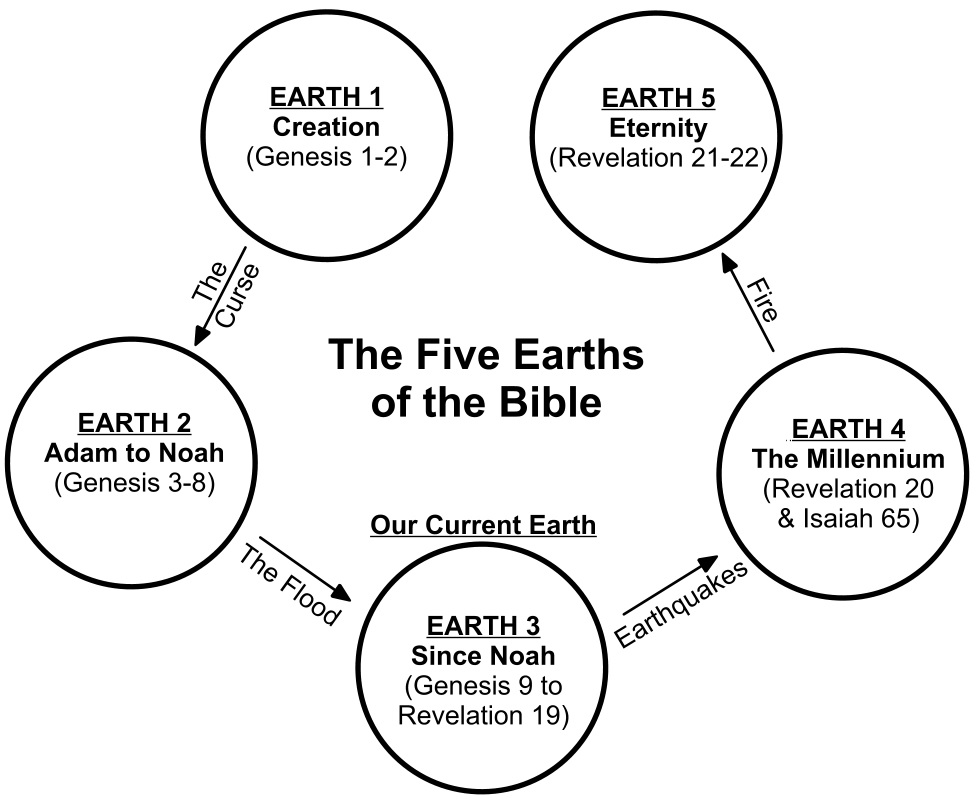
Let’s go over each of these five earths:
Earth 1: Creation to the Fall
The original earth – Earth 1 – was flawless and unspoiled (Genesis 1:31). This was the Age of Innocence. The Garden of Eden was about the size of California or Iraq according to the specifications shown in Genesis (2:8-15) and it was the only region on earth that was technically a paradise, which was the way God created it. However, the rest of the earth was not. The remainder of planet was untamed and uncultivated, which is why the LORD empowered humankind to subdue it and take dominion:
And God BLESSED them, and said unto them, “Be fruitful, and multiply, and replenish the earth, and subdue it: and have dominion over the fish of the sea, and over the fowl of the air, and over every living thing that moveth upon the earth.”
Genesis 1:28 (KJV)
In other words, God blessed humanity to make the planet the same paradise as that of the Garden of Eden, which is why this verse twice stresses replenishing and subduing “the earth” and not the Garden of Eden since it was already replenished and subdued.
The paradise of the Garden of Eden was God’s blueprint for humankind to expand on until the entire planet was a paradise. Once ‘Project Earth’ was complete they could go on to subdue and replenish every planet in the solar system, the galaxy, and ultimately the furthest reaches of the universe! Why do you think all those innumerable barren planets are there for? They’re there for us to reach and subdue, in love and faithfulness. This is supported by this passage:
For You (God) have put everything in subjection under his (humanity’s) feet. Now in putting everything in subjection to man, He left nothing outside [of man’s] control. But at present we do not yet see all things subjected to him [man].
Hebrews 2:8 (The Amplified Bible)
‘Everything’ can also be translated as “the universe,” which is how the Weymouth New Testament translates it. God put “everything” in the natural universe in subjection to humanity—“nothing” is outside of redeemed humanity’s control! In other words, nothing in the entire universe was to be outside of humanity’s control. We were created to explore, inhabit and rule the unfathomable reaches of the physical universe! You can read more about this in this article.
Unfortunately Adam & Eve sinned and so the LORD cursed the earth (Genesis 3:17-19). This is known as the Genesis Curse.
All living beings on the earth were herbivores before the fall of creation, including people, meaning their diet was strictly vegetarian.
Genesis 1:31 shows the Creator viewing all he had made and “it was very good.” There were no carnivores during Earth 1 because a carnivorous diet necessitates suffering and death of other living creatures and this wouldn’t be good. But Adam & Eve’s sin brought a curse on the physical universe and the sins of their descendants perpetuate it (Isaiah 24:5-6).
Earth 2: Adam to Noah
The Genesis Curse drastically changed the nature of physical creation. Rather than Humanity having power over Nature as it was supposed to be (Genesis 1:26,28), Nature now conflicted with Humanity: Growing foods from the soil became a chore, florae became toxic, animals became predatory, the planet manifested great quakes, as well as destructive volcanic activity, and there were now weather-based disasters, such as hurricanes and tornadoes.
Earth 2 corresponds to the Age of Conscience and began after Adam & Eve were banished from the paradisal Garden of Eden and God’s cursing of creation (Genesis 3:17-19). The Garden of Eden, which contained the tree of life (Genesis 3:22-24), was removed and taken to the New Jerusalem in Heaven (Revelation 2:7, 22:2, 14 & 19). At the beginning of the eternal age — Earth 5 — the New Jerusalem will “come down out of heaven from God” to rest on the new earth (Revelation 3:12 & 21:2). We’ll look at the New Jerusalem further when we get to Earth 5.
Lifespans were much longer during Earth 2 wherein people lived several hundred years (Genesis 5). Why was this so? Likely because there was a thick vapor sunshade that safeguarded life from the sun’s ultraviolet radiation (Genesis 2:5-6 & Job 38:8-11). Our globe was like a greenhouse with dense flora growing everywhere, including the poles. In short, the atmosphere prior to the worldwide flood was favorable to prolonging lifespans. These long lifespans will return during the Millennium in Earth 4, no doubt due to the vapor covering being restored.
As the population increased, humanity devolved to the point of being so wicked and perverse that the LORD was sorry for creating humanity. Consequently, God flooded the earth to wipe out the evil of humanity with the exception of Noah & his family – eight people – who escaped via a huge ocean liner-like vessel filled with all manner of animals (Genesis 6:5-7:24).
The change agent from Earth 2 to Earth 3 was water via global flooding. The LORD apparently caused the protective vapor sunshade to fold and allowed “springs of the great deep” to burst forth upon the planet’s surface (Genesis 7:11-12).
Earth 3: Our Current Earth
Our present earth is Earth 3, which has been in existence since the Genesis flood wiped out Earth 2. Earth 3 will continue to exist until the end of the future 7-year Tribulation and the Mighty Christ’s return to earth to set up his millennial kingdom (Revelation 6-19).
As with the Curse at the end of Earth 1, the Flood profoundly changed the environment of the Earth 2, resulting in Earth 3.
What changed? One theory is that the planet became skewed on its axis during this transition, which produced the polar ice caps. Another theory is that the single land mass – a supercontinent known as Gondwana (or Gondwanaland) – separated and drifted at this time, resulting in our current continents & islands (Genesis 10:25). Take a look at a world map and you’ll observe how they fit together like a jigsaw puzzle. If this theory isn’t true then the continents must have separated & drifted in an accelerated manner during God’s creation week (for a better understanding of what I mean by “accelerated manner” see this article).
Meanwhile the collapse of the atmospheric sunshade resulted in ultraviolet radiation reaching the globe in levels heretofore unknown, which minimized natural lifespans to 120 years with the average being more like 70-80 years (Genesis 6:3 & Psalm 90:10).
Unlike Earth 1 and Earth 2 (and Earth 4 and Earth 5) wherein each involves a single age, Earth 3 is comprised of four different ages:
- The Age of Human Government, which started after the Genesis flood and extended to the call of Abram/Abraham.
- The Age of Promise, which began with God’s call of Abraham and includes the time of the patriarchs, ending with the exodus of the Hebrew people from slavery in Egypt, a period of about 430 years. During this era God established a great nation that He had chosen (Genesis 12:1–Exodus 19:25).
- The Age of the Law corresponds to the LORD giving the Law (Torah) to the Hebrews and leading them into the land of Israel to conquer and inhabit.
- The Age of Grace began with the death & resurrection of Christ and the establishment of Christ’s body on earth thru spiritual rebirth, which is the Church worldwide regardless of sectarian tags.
The New Testament Scriptures plainly show that Earth 3 and the age of grace are a temporary phenomenon:
For this world in its present form is passing away.
1 Corinthians 7:31b
The world is passing away along with its desires, but whoever does the will of God remains forever.
1 John 2:17
Earth 3 will end with the cataclysmic earthquakes and atmospheric changes of the 7-year Tribulation and, ultimately, the return of the Christ detailed in Revelation 6-19. These alterations will so revise the planet & its heavens that Isaiah referred to the time of the thousand-year reign of the Lord as “the new heavens and the new earth” (Isaiah 65:17), which shouldn’t be confused with the Eternal Age of Earth 5 (Isaiah 66 & Revelation 21). This brings us to…
Earth 4: The Millennium
As with Earth 5, the nature of reality in Earth 4 — the Age of the Millennium — will be quite different from what we experience now in Earth 3. The Millennium is clearly detailed in Revelation 20:1-10. Earth 4 will be the result of earthquakes so massive that every vale will be elevated, every peak depressed, and every isle relocated (Revelation 6:12-14 & 16:17-21). Jerusalem will be raised up, and Mt. Zion will be established as chief of the mounts in some manner (Zechariah 14:10 & Micah 4:1).
More importantly, Christ will reign from Jerusalem with the assistance of glorified, immortal believers while the devil & his filthy angels will be locked up in the Abyss, unable to deceive the nations until they’re released at the end. Meanwhile, mortals still alive at the end of the Tribulation and designated as “sheep” will be spiritually regenerated and allowed by Christ to enter the Millennium where they will propagate (Matthew 25:31-46), which you can read more about here. The Temple in Jerusalem will apparently be many times its current size with odd modifications.
Moreover, the laws of nature will be vastly different due to the Genesis curse being partially lifted. As such, animals will no longer eat other animals and so “the wolf will live with the lamb,” “the cow will feed with the bear,” “the infant will play near the hole of the cobra and the young child put his hand into the viper’s nest” and “the whole earth will be full of the knowledge of the LORD” (Isaiah 11:6-9).
Furthermore, Isaiah 65:20,22 shows lifespans returning to the exceptional lengths recorded after the fall of Adam & Eve in Earth 2. As noted earlier, these extended lifespans were likely due to Earth 2 having a thick vapor sunshade which safeguarded life from the sun’s ultraviolet radiation (Genesis 2:5-6 & Job 38:8-11). Our globe during Earth 2 was like a greenhouse with dense flora growing everywhere, including the poles. The long lifespans of the Millennium in Earth 4 will likely be due to the vapor covering being restored. The planet will again have lush vegetation in great quantity (Isaiah 30:23-26 & Amos 9:13-14); even the Dead Sea will flourish (Ezekiel 47:1-9).
What is God’s purpose for the Millennium? See this article.
Earth 5: The Eternal Age of the New Heavens and New Earth
How is it that the earth during the future millennial reign of Christ – which is the Millennium or Earth 4 – morphs into Earth 5, the eternal new heavens and new earth? This passage shows:
10But the Day of the Lord will come like a thief. The heavens will disappear with a roar, the elements will be destroyed by fire, and the earth and its works will be laid bare…
13But in keeping with God’s promise, we are looking forward to a new heaven and a new earth, where righteousness dwells.
2 Peter 3:10,13
God will make vast changes to the earth & universe via purifying fire, both physical and spiritual.
Here’s a passage from Isaiah that concerns the Eternal Age of the new heavens and new earth:
“As the new heavens and the new earth that I make will endure before me,” declares the Lord, “so will your name and descendants endure. 23 From one New Moon to another and from one Sabbath to another, all mankind will come and bow down before me,” says the LORD.
Isaiah 66:22-23
This eternal age is also detailed in the book of Revelation:
Then I saw “a new heaven and a new earth,” for the first heaven and the first earth had passed away, and there was no longer any sea. 2 I saw the Holy City, the new Jerusalem, coming down out of heaven from God, prepared as a bride beautifully dressed for her husband.
3And I heard a loud voice from the throne saying:
“Behold, the dwelling place of God is with man,
and He will live with them.
They will be His people,
and God Himself will be with them as their God.
4He will wipe away every tear from their eyes,
and there will be no more death
or mourning or crying or pain,
for the former things have passed away.”
Revelation 21:1-4
As noted above, Peter instructed us to look forward to this eternal age:
But in keeping with his promise we are looking forward to a new heaven and a new earth, where righteousness dwells.
2 Peter 3:13
The eternal age of the new heavens and new earth is when the heavenly city, the new Jerusalem, will come down out of heaven from God to rest on the new earth where “God’s dwelling place is now among the people, and he will dwell with them” (verse 3). Notice how this is contrasted to the former ages saying, “for the first heaven and the first earth had passed away” (verse 1).
In the eternal age of the new heavens and new earth, God’s government will reign in the universe and we’ll be his citizens/children/servants. Many theologians refer to this eternal age as “heaven,” which can be confusing because the normal understanding of Heaven is the spiritual realm where the LORD’s throne is located and it was from this nonphysical realm that God created the physical realm, i.e. the earth and universe. In other words, it was through Heaven (the spiritual realm) that the Earth & Universe (the physical realm) came into being.
The new heavens and new earth concern the physical earth and universe made new for eternity with all former maladies forever removed, like pain, aging, death and grieving (Revelation 21:4). Interestingly, we see the Creator making his dwelling with humankind (verse 3), which suggests Heaven coming to Earth and a kind of merging of these two realms. This was the way it was during Earth 1: When Adam & Eve were in the Garden of Eden the LORD was in their midst (Genesis 3:8). This aspect of the new heavens and new earth shows that there’s some justification for referring to it as ‘heaven,’ even though it’s not technically the spiritual realm where God’s throne is located, which is how we normally perceive the idea of Heaven.
Obviously the eternal age of the new heavens and new earth will be a wholly different reality than what we understand today. For instance, there will be no more death or pain and the redeemed will have glorified, imperishable bodies (Revelation 21:4 & 1 Corinthians 15:42-44). Since we won’t be able to die in the new heavens and new earth, we’ll be able to jump off a cliff or skyscraper without a parachute. We’ll also be able to walk through walls like the Messiah did after he received his glorified body; we’ll even be able to teleport from place to place at will (Luke 24:31, 36-37). In short, the nature of reality will be vastly different during the Eternal Age of Earth 5.
For more on the nature of eternal life in the new heavens and earth go here.
The Five Earths, the Eight Ages, the Various Covenants and the Four Change Agents
Let’s outline the five earth-realities and how the eight ages fit, plus the four change agents from one earth-reality to the next. Included in the outline are the various covenants God has made with humanity through the ages:
Earth 1: From Creation to the Fall of Humanity
The Age of Innocence
The Edenic Covenant: Innocence (Genesis 1:26-30 & 2:16-17)
The Adamic Covenant: Grace (Genesis 3:16-19)
Change Agent: The Genesis Curse
Earth 2: From Adam & Eve to the Global Flood
The Age of Human Government
The Noahic Covenant (Genesis 9 & 2 Peter 2:5)
Change Agent: The Global Flood
Earth 3: From the flood to the Tribulation and Second Coming of Christ
The Age of Human Government: From the Genesis flood to the call of Abram/Abraham
The Age of Promise: From God’s call of Abraham to the Hebrew Exodus from Egypt
The Abrahamic Covenant (Genesis 12:2-3, 13:16, 17:4-5 & 22:18)
The Palestinian Covenant, aka the Land Covenant (Deuteronomy 30:1-10)
The Age of the Law: From the LORD giving the Law (Torah) to the time of John the Baptist & Jesus Christ (Luke 16:16)
The Mosaic Covenant, aka the Old Covenant (Deuteronomy 11 & Exodus 20)
The Davidic Covenant (Samuel 7:8-16)
The Age of Grace: From the establishment of the Church to the Second Coming of Christ
The New Covenant (Jeremiah 31:31-34 & Hebrews 8:6)
Change Agent: Massive Earthquakes and Atmospheric Phenomena
Earth 4: From the Return of Christ to the Satan’s Final Coup Attempt (Revelation 20)
The Age of the Millennium
Change Agent: Universal Fire, spiritual and physical
Earth 5: The New Heavens and New Earth
The Eternal Age
Ages or “Dispensations”?
The eight ages could be referred to as “dispensations” – divinely appointed ages noted in the Scriptures – even though dispensationalists usually (and curiously) omit the last age, the eternal age of the new heavens and new earth. (I suspect they do this to limit the ages to seven, which they deem a perfect number; or perhaps they separate the first seven ages from the age of the new heavens and new earth since the latter is the everlasting, permanent age, which itself will be split into ages — see Ephesians 2:7).
Yet I intentionally left out any references to ‘dispensations’ because dispensationalism is offensive to some camps in the body of Christ, particularly those who embrace Amillennialism, which is a grossly unbiblical doctrine. (You can read about Amillennialism and why it’s so unscriptural here). In other words, I left out the word “dispensation” to show readers how obvious the concept of five earth realities and eight different ages are in God’s Word without the risk of anyone stumbling over the word ‘dispensation.’
As it turned out, this happened anyway. After reading the article, someone wrote me with a smart aleck vibe saying:
You have spoken like a true Dispensationalist, Dirk. Are you aware that Dispensationalism is a heresy?
To these types of people ‘Dispensationalism’ is their spiritual boogeyman. They consider it a great evil in the body of Christ today even though it’s obvious that the Bible demarcates different ages in history, such as the Millennium (Revelation 20:1-10) and the eternal age of the new heavens and new earth (Revelation 21-22 & 2 Peter 3:13), not to mention the initial age of the Garden of Eden (Genesis 1-3) and the New Covenant Church age or age of grace (John 1:17 & Matthew 16:18). While anti-Dispensationalists are prone to reject the age of Christ’s millennial reign due to their stupefying adherence to Amillennialism, how can they possibly discount these other glaring ages in Scripture? How can they discount “the present evil age” noted in Galatians 1:4, which refers to all the ages of Earth 3 and arguably Earth 2? Even novice students of the Bible can discern these divinely appointed ages. In other words, if they acknowledge any of these various ages obvious in Scripture then they believe in ages; and believing in different ages in biblical history & prophecy is dispensationalism, at least a form of it.
Related Topics:
Eternal Life (“Heaven”): Questions & Answers
REDEMPTION — God’s Plan of Liberation for Humanity & Creation
Second Coming of Christ — Rapture and Return to Earth
Millennial Reign of Christ — Why?
HELL (LAKE OF FIRE): Eternal Torment or Everlasting Destruction?

Traditionally, the most prominent view on eternal damnation is that people cast into hell—the lake of fire—will suffer fiery conscious torment forever and ever. Depicting the horrors of this belief was a favorite subject with artists in medieval times, resulting in all manner of ghastly portraits of people suffering unending agony. Some have since tried to modify this position a bit, suggesting a more metaphorical view—that the unending pain refers to the mental anguish of eternal loss and “separation from God”—but it makes no appreciable difference as both views involve the notion of eternal torment.
This may be the traditionally prominent view of human damnation, but is it biblical? That is, do the Judeo-Christian Scriptures really teach it? Will the multitudes of people who reject God, and hence are rejected by God, really be subjected to never-ending torment—with no merciful pause to their misery?
One might contend that it is heretical to even question such a long-standing, widely-accepted teaching, but if this doctrine is truly scriptural then its proponents have no need to worry. Furthermore, all doctrines, no matter how traditional or popular, must be questioned in light of what the Bible clearly teaches; for it’s the God-breathed Scriptures alone that we must look to for truth, not popularity or religious tradition. This is the theological principle of sola scriptura, Latin for “by Scripture alone,” which maintains that the Bible is the final authority regarding all judgments of Christian doctrine and practice.
Due to this sound principle many traditional doctrines and practices have proven to be false over the years and have been corrected or discarded. It goes without saying that it’s a positive thing for Christians to periodically reevaluate their beliefs and practices because it helps prevent Christendom from straying from the biblical model. Since reevaluating official church teachings is very much a part of Christian heritage, and is indeed a healthy practice, there should be no problem here in entertaining the possibility that church tradition may be in error with this belief of perpetual roasting torment.
Eternal Torture: The Silent Subject of the Church
I read in a major news magazine that the teaching of hell as eternal torture has all but disappeared from the pulpit ministry in both mainline and evangelical churches. Why is this so? Why are Christians who are committed to this doctrine so reluctant to openly and honestly preach it? Why do they mask what they really believe by saying that the unredeemed will ultimately “perish” or be “destroyed” or suffer eternal “separation from God”? Yes, you’ll hear ‘hell’ thrown around now and then, but you’ll rarely, if ever, hear anyone explain what he or she really means by the term—suffering fiery conscious torment forever and ever with no merciful respite from the agony.
If this is true, why is everyone so timid about spelling it out loud and clear? The answer is obvious: They’re ashamed of it. They’re ashamed of it because, as Clark Pinnock aptly put it, the doctrine of eternal torture makes God out to be morally worse than Hitler “who maintains an everlasting Auschwitz for his enemies whom he does not even allow to die. How can one love a God like that? I suppose one might be afraid of Him, but could we love and respect Him? Would we want to strive to be like Him in His mercilessness?” (149). Let’s be honest here and tell it like it is: The doctrine of never-ending roasting torment makes God out to be a cruel, unjust, merciless monster. Who would possibly want to accept salvation from such a God?
Although there are many good reasons for questioning this teaching, the most important reason is the simple fact that the Bible does not teach it. Contrary to the loud claims of its staunch supporters, it is not a scriptural doctrine; and this is being realized by a growing number of biblically faithful Christians today. The Bible offers strong, irrefutable evidence to any unbiased reader that hell, the lake of fire, signifies literal everlasting destruction for ungodly people,* not eternal conscious torment.
* This view is often referred to as “conditional immortality” or “annihilationism,” but I prefer “everlasting destruction,” “literal destruction” or “destructionism” based on 2 Thessalonians 1:9 and numerous other passages. I consequently refer to it in these terms throughout this study.
This is the main reason why so many Christians of all persuasions are embracing the doctrine of everlasting destruction not because they’re “going liberal” as supporters of eternal torment claim. It’s a case of going biblical, not going liberal.
For clear proof that literal everlasting destruction is what the Bible really teaches, let us simply turn to the pages of Scripture; after all, a thorough, honest study of the Bible will always reveal the truth.
Life and Death: The Two Polar Opposites
The apostle Paul summed up the whole matter of people’s reward for sin when he wrote:
For the wages of sin is death, but the gift of God is eternal life through Christ Jesus our Lord.
Romans 6:23
Could it be stated any plainer? The wages for sin is shown to be death; and eternal life is a gift from God, not something people already have. This is consistently expressed from Genesis to Revelation, notice:
“Enter through the narrow gate, for wide is the gate and broad the road that leads to destruction and many enter through it. But small is the gate and narrow the road that leads to life, and only a few find it.”
Matthew 7:13-14
“For God so loved the world that he gave his one and only Son, that whoever believes in him shall not perish but have eternal life.”
John 3:16
For if you live according to the sinful nature, you will die; but if by the spirit you put to death the misdeeds of the body, you will live.
Romans 8:13
The one who sows to please the sinful nature from that nature will reap destruction; the one who sows to please the spirit, from the spirit will reap eternal life.
Galatians 6:8
The LORD preserves all who love Him,
but all the wicked He will destroy.
Psalm 145:20 (NKJV)
The truly righteous man attains life,
but he who pursues evil goes to his death.
Proverbs 11:19
All these passages clearly describe the two separate destinies of the righteous and the unrighteous. The “righteous” are people who are in right-standing with God because they’ve accepted his sacrifice for their sins while the “unrighteous” are those who are not in-right-standing with their Creator because they’ve rejected his offer of salvation.* The former will inherit eternal life whereas the latter will reap the wages of sin and be destroyed.
* Please don’t misinterpret this description of people as “righteous.” Our own righteousness apart from Christ is as “filthy rags” in God’s holy sight (Isaiah 64:6). To become in right-standing with God we must let go of our fleshly ‘righteousness’ in acceptance of God’s “gift of righteousness,” which comes via spiritual regeneration through Christ (see Romans 5:17 and 2 Corinthians 5:21). This is positional righteousness. Practical righteousness naturally occurs as the believer learns to put off the “old self”—the flesh—and live according to his or her new nature, which is “created to be like God in true righteousness and holiness” (Ephesians 4:22-24).
Yet those who adhere to the eternal torture doctrine mysteriously don’t accept this blatantly clear biblical truth. They don’t believe the two polar opposites are life and death; they believe the two polar opposites are eternal life in heavenly bliss and eternal life in burning torment. Sounds ridiculous, doesn’t it? They may not phrase it in such an honest manner, but this is what they actually believe when you spell it out.
Life and Immortality—Only Available through the Gospel
The offer to receive eternal life as opposed to suffering everlasting destruction is what the gospel of Christ is all about, as plainly expressed in this passage:
But it [God’s grace] has now been revealed through the appearing of our Savior, Christ Jesus, who has destroyed death and has brought life and immortality to light through the gospel.”
2 Timothy 1:10
Notice that life and immortality are only available for people through the gospel. What exactly is “the gospel?” The gospel literally means “good news.” Its main message is summed up in the famous passage John 3:16: “For God so loved the world that he gave his one and only Son that whoever believes in him shall not perish but have eternal life.” Note, again, what is clearly being contrasted in both of these passages: In John 3:16 perish is contrasted with the gift of eternal life; in 2 Timothy 1:10 death is contrasted with both immortality and life, which are said to be made available through the gospel. If the eternal torture doctrine were true, these verses would be contrasting eternal life and eternal life being tortured, or immortality and immortality in fiery torment. I realize this sounds absurd, but the Bible would certainly speak in such honest, blatant terms if this teaching were true. Does anyone seriously think that God would be misleading or ambiguous about such an important issue in his Holy Word—the everlasting fate of people who reject the gospel of reconciliation?
The reason the Bible doesn’t speak in such ludicrous terms is because the doctrine of eternal torment in not a biblical teaching. The above passage, 2 Timothy 1:10, makes it plain that until Christ was raised for our justification, the power of death was not destroyed and therefore immortality was not available to us—life was not available to us. This is because we are all sinners (see Romans 3:23 and Ecclesiastes 7:20) and consequently all deserve death, “for the wages of sin is death.” God cannot overlook this because he is perfectly just. One person cannot pay the penalty for another because both are sinful and deserve death. The only way we can escape this imminent death penalty is if a sinless person, who does not deserve death, dies in our place.
So what did God do? Because he so loved the world and didn’t want anyone to perish, he gave his Son as a sin sacrifice in order that we may have the gift of eternal life. The difference between wages and a gift is that wages are earned while a gift is free. Jesus paid the death penalty that we’ve all earned so that we can have the free gift of eternal life. The LORD did this so that we could fellowship with him forever instead of reaping the wages of sin, which is death.
This fact that God Himself wants to have a relationship with us explains why the gospel is also referred to as “the message of reconciliation” (2 Corinthians 5:17-21). ‘Reconciliation’ means to turn from enmity to friendship. The gospel is good news indeed because, not only does it grant eternal life to those who accept it, but, it simultaneously enables us to have a relationship with the Creator of the universe!
Notice what John the Baptist declared would happen to those who reject the gospel:
“Whoever believes in the Son has eternal life, but whoever rejects the Son will not see life, for God’s wrath remains on him.”
John 3:36
The passage could not be plainer: Those who reject the Son “will not see life.” God’s Word is absolute, and this is an absolute statement: Those who reject Jesus Christ will not see any life at all. This includes even a pathetic life in roasting agony for all eternity. Such people will be justly-but-mercifully put to death, absolute death, for this is the wages of their actions. But our loving Creator doesn’t want anyone to perish like this; He has provided a way to eternal life through his Son, Jesus Christ.
Do you see the simple, beautiful, clear message of the gospel here? God is just trying to save his beloved fallen creation, humanity, from sin and the wages thereof. Ezekiel 18:32 reveals the heart of God on this matter: “ ‘For I take no pleasure in the death of anyone,’ declares the Sovereign LORD, ‘Repent and live!’”
Jesus Taught Everlasting Destruction
Didn’t Jesus Christ preach that those who reject the gospel and refuse to repent will suffer never-ending torment in hell? Many ministers adamantly claim this, but what did the Messiah actually say as recorded in the Bible? Let’s observe what Jesus himself taught on the issue starting with a statement we’ve already looked at:
“Enter through the narrow gate. For wide and broad is the road that leads to destruction and many enter through it. But small is the gate and narrow the road that leads to life, and only a few find it.”
Matthew 7:13-14
Seriously, how much clearer could the Lord possibly be here? Destruction is the fate that awaits the “many” who will be thrown into the lake of fire, not perpetual undying agony in flames of torment. And notice, again, that this is in contrast to life that will be granted to the “few.”
Jesus repeatedly made this clear. Consider, for example, his simple statement, “Unless you repent, you will all likewise perish” (Luke 13:3,5 NASB). This mirrors Jesus’ statement in John 3:16 regarding the fact that those who believe in him “… shall not perish, but have eternal life.” “Perish” in both of these passages is not referring to the death we all must face at the end of this present earthly life. No, Jesus is obviously referring to a perishing that those who believe in him will not have to suffer—the second death, which takes place on the Day of Judgment when the damned are cast into the lake of fire. Revelation 20:11-15 verifies this; verses 14 and 15 state: “The lake of fire is the second death. If anyone’s name was not found written in the book of life, he was thrown into the lake of fire.”
What will happen to these people when they experience this “second death”? Jesus solemnly declared:
“Do not be afraid of those who kill the body but cannot kill the soul. Rather, be afraid of the One [God] who can destroy both soul and body in hell.” *
Matthew 10:28
* “Hell” in this verse is translated from the Greek word Gehenna, which is an illustrative reference to the lake of fire. We’ll examine Gehenna a little bit later.
Christ explicitly informs us what God will do to unrepentant sinful people on the Day of Judgment: He will destroy both soul and body in the lake of fire, his chosen instrument of destruction.
Jesus is dealing specifically here with the subject of the second death and yet he says absolutely nothing about spending eternity in undying roasting torment. If this were true Jesus would tell us to “fear the One who is able to preserve the soul in hell.” But this is not what he taught. Jesus didn’t teach it because it is not a biblical doctrine. Religion may teach it, but the Bible does not. God is going to unenthusiastically issue out the wages of sin and justly destroy the unrighteous, not sadistically torture them forever. Scripture clearly says:
There is only one lawgiver and judge, the One [God] who is able to save and destroy.
James 4:12
You see, God is going to do one of two things with people: He’s either going to save them, that is, grant eternal life to those who respond favorably to his love and gracious gift of life, or he’s going to justly but mercifully destroy them. He may or may not be the one who personally executes this sentence, but he’s certainly the One who authorizes it. In this sense, at least, it is indeed God Himself who destroys the ungodly.
This fact that God is either going to save or destroy people based upon their freewill decision to accept or reject the gospel is clearly conveyed in this verse from Hebrews:
But we are not of those who shrink back and are destroyed, but of those who believe and are saved.
Hebrews 10:39
“Those who believe” will be saved from the second death and granted eternal life whereas those who do not will be destroyed, both soul and body, in the lake of fire. Why do religionists insist on making such a simple truth so complicated and perverse?
“Destroy both Soul and Body” as in Complete Incineration
We’ve viewed some pretty clear biblical texts plainly stating that unrepentant sinners will ultimately perish and be destroyed. Let’s now dig a little deeper and trace these words to the original language in which they were written.
The words “perish” (from John 3:16 and Luke 13:3,5) and “destroy” (from Matthew 10:28 and James 4:12) are both English translations of the Greek word apollumi (ah-POHL-loo-mee),* which literally means “to destroy utterly” or “to perish” (Bulinger 220; Vine 164).
* Spellings and pronunciations of biblical Hebrew and Greek words are generally based on Strong’s Exhaustive Concordance.
Apollumi is used most often in the Bible simply in reference to the natural death we all must experience at the end of our present lives—the first death. Notice, for example, how apollumi is used by Jesus’ disciples when a squall threatened their lives as they crossed the Sea of Galilee:
Jesus was in the stern, sleeping on a cushion. The disciples woke him and said to him, “Teacher, don’t you care if we drown (apollumi)?”
Mark 4:38
As you can see, apollumi here simply refers to drowning. Apollumi is used 26 other times in the New Testament in reference to the first death. Likewise, Homer, in his epics of Greek antiquity, used apollumi chiefly of death in battle.
The apostles, like Jesus, used this same word, apollumi, in reference to the second death—the eternal fate of the ungodly:
For the message of the cross is foolishness to those who are perishing (apollumi); but to those who are being saved, it is the power of God.
1 Corinthians 1:18
They perish (apollumi) because they refuse to love the truth and be saved.
2 Thessalonians 2:10b
He is patient with you, not wanting anyone to perish (apollumi), but everyone to come to repentance.
2 Peter 3:9b
All these passages are indeed referring to what will happen at the second death and yet, again, there is mysteriously no mention of eternal roasting in conscious torment. In view of such blatantly clear biblical evidence, how can adherents of eternal torture possibly maintain their view? Their theory is that, in all these cases, the Greek word apollumi does not literally mean “to destroy utterly” or “to perish,” but that the idea is “not extinction, but ruin, loss, not of being, but of well-being” (Vine 164/Pearlman 387). This theory is a good example of trying to make the Scriptures line up with one’s favored doctrine rather than lining up one’s doctrine with what the Scriptures literally teach.
There are a number of reasons for rejecting this theory. For one, the Bible itself provides definitive proof of what apollumi means when used in reference to the second death: The word is used by Jesus in Luke 17:29* to describe the destruction of Sodom and Gomorrah: “ ‘But the day Lot left Sodom, fire and sulfur rained down from heaven and destroyed (apollumi) them all.’ ”
* Jesus no doubt spoke in Hebrew or Aramaic during his earthly ministry but Luke, inspired by the Holy Spirit, had his words recorded in Koine Greek.
Since apollumi is used to describe this destruction, the question must be asked: how were the cities of Sodom & Gomorrah and their inhabitants destroyed? Was the well-being of these cities merely ruined? No, Genesis 19:24-28 verifies that they were completely burned to ashes. This includes all the people in them, all the animals, and even the vegetation—in fact, all the land of the entire plain that these cities occupied! Peter also verifies this:
if he [God] condemned the cities of Sodom and Gomorrah by burning them to ashes…
2 Peter 2:6a
“Ashes” here is the Greek word tephroo (tef-ROH-oh), which means “to incinerate, i.e. consume” (Strong 71); and apollumi is the Greek word used to describe this absolute incineration as shown above in Luke 17:29. My point is that apollumi, in this case, refers to utter destruction and perishing in the sense of complete incineration. The idea “not extinction, but ruin, loss, not of being, but of well-being” does not fit at all because the well-being of Sodom and Gomorrah wasn’t merely ruined; these cities were completely and finally destroyed by incineration—forever obliterated!
But there’s more: Peter goes on to say that this utter incineration of Sodom and Gomorrah is an example of what will happen to the ungodly:
if he [God] condemned the cities of Sodom and Gomorrah by burning them to ashes and made them an example of what is going to happen to the ungodly;
2 Peter 2:6
We know that Peter is specifically referring to what will happen to the ungodly on Judgment Day when they’re thrown into the lake of fire—that is, the second death—because this will be the only time that all the ungodly will experience a fate comparable to the judgment of Sodom and Gomorrah.
If the incineration of Sodom and Gomorrah is a true and trustworthy example of what will happen to the ungodly when they suffer the second death, then we must conclude that the ungodly will, in fact, be incinerated; and if it is certain that the Greek word apollumi refers to absolute incineration in reference to the destruction of Sodom and Gomorrah, then it naturally follows that apollumi must also refer to absolute incineration when it is used in reference to the second death because the incineration of Sodom and Gomorrah is an example of the second death.
So, as you can see, by following the hermeneutical rule of allowing Scripture to interpret Scripture we have a clear understanding that the Greek word apollumi, when used in reference to the second death (e.g. Matthew 10:28), refers to nothing other than complete and final destruction. Hence the dubious theory of “not extinction, but ruin, loss, not of being, but of well-being” is proven false.
As if this weren’t enough, there’s much more scriptural proof that apollumi refers to literal destruction when applied to the second death. To start with, there are many other biblical words, besides apollumi, which describe the second death strictly in terms of complete and irreversible death and destruction. Let’s look at these words.
“ The Wages of Sin is Death,” Not Eternal Torment
Let’s begin with the Greek word thanatos (THAYN-ah-tohs). This word simply means “death” (Strong 35), the express opposite of life according to Romans 8:38, and therefore the cessation of conscious existence. Thanatos is most often used in the Bible simply in reference to the death that all human beings must one day experience—the first death (e.g. Acts 23:29). The first death therefore refers at least to the cessation of conscious existence in the physical realm.
Thanatos is also used in reference to the second death—the destruction of both soul and body in the lake of fire. In fact the Greek word translated as “death” in the phrase “the second death” is thanatos. For instance, “ ‘He who overcomes will not be hurt at all by the second death (thanatos)’ ” (Revelation 2:11). The verse refers to those who “overcome,” meaning all true believers (see 1 John 5:4). Genuine believers will not be hurt at all by the second death. The second death has no power over spiritually born-again believers because they’ve been saved from God’s wrath through Jesus’ death, burial and resurrection. That’s why Jesus said:
“I tell you the truth, if anyone keeps my word he will never see death (thanatos).”
John 8:51
This is obviously not referring to the first death; after all, Christians who have faithfully “kept his word” have been physically dying for two thousand years. No, this is a reference to the second death. Jesus’ promise is that true believers will never experience the destruction of the second death in the lake of fire. This coincides perfectly with what Christ said in John 3:16: that those who believe in him “shall not perish but have eternal life.”
As important as it is to point out what the Bible says, it’s sometimes important to point out what the Bible does not say as well. Notice that Jesus does not say, “if anyone keeps my word he will never see eternal life in conscious torment.” Jesus doesn’t say this, does he? No, he simply states that those who keep his word will never see death—the second death—the destruction of soul and body in the lake of fire.
The second death is the ultimate consequence of sin according to the Bible: “The wages of sin is death” (Romans 6:23), “sin… leads to death” (Romans 6:16), and sin will “result in death” (Romans 6:21). “Death” in all these verses is the Greek word thanatos, and they all refer to the ultimate penalty of sin—the second death.
James 1:14-15 clearly says that “sin, when it is full-grown, gives birth to death (thanatos).” Note that sin ultimately gives birth to death, not life in everlasting fiery torment. This is emphasized again later in James:
You should know that whoever brings back a sinner from wandering will save that sinner’s soul from death (thanatos).
James 5:20 (NRSV)
We observe here that if a person is not brought back from the error of a sinful lifestyle, their soul will die! When did Jesus say a soul would die and by whom? He said that God Himself would “destroy both soul and body in hell” (Matthew 10:28). So we know this verse is definitely a reference to the second death as well. Notice that a sinner’s soul is not saved from never-ending roasting torment, but from death. The Bible’s repeatedly clear on this matter.
“ Their Destiny is Destruction”
The Greek word apoleia (ah-POHL-lee-ah), which is the noun form of apollumi, refers to utter destruction and is often used in reference to the eternal fate of the ungodly, i.e. the second death. This is the case with the aforementioned Matthew 7:13-14 where Jesus said “wide is the gate and broad is the road that leads to destruction (apoleia) and many enter through it.” Jesus spoke of this destruction in direct contrast to the “life” that would be granted to the righteous “few;” so obviously apoleia is the direct opposite of life, namely death.
In 2 Peter 3:7 apoleia is used to describe the destruction of the second death:
By the same word the present heavens and earth are reserved for fire, being kept for the day of judgment and destruction (apoleia) of ungodly men.
2 Peter 3:7
The Day of Judgment is the day when ungodly people will suffer everlasting destruction. This is their “eternal punishment” as God destroys “both soul and body in hell” (please notice that I said “eternal punishment” and not “eternal punishing”; there’s a difference).
This is the ultimate destiny of God’s enemies as Paul verifies in Philippians 3:18-19: “For, as I have told you before and now say again even with tears, many live as enemies of the cross of Christ. Their destiny is destruction (apoleia).” As such, the Bible repeatedly refers to God’s enemies as “doomed to destruction (apoleia)” or “prepared for destruction (apoleia)” (see John 17:12, 2, Thessalonians 2:3 and Romans 9:22).
Apoleia is also translated as “destroyed” in reference to the eternal fate of God’s enemies: “…they will be destroyed (apoleia)” (Philippians 1:28), “we are not of those who shrink back and are destroyed (apoleia)” (Hebrews 10:39).
You see? The eternal destiny of ungodly people who reject God’s love in Christ is destruction. In other words, they will ultimately be destroyed. Seriously, how much plainer could the Bible be on the subject?
“ They will be Punished with Everlasting Destruction”
The Greek word olethros (OL-eth-ross), which means “destruction” (Vine 165), is used by Paul to describe the eternal punishment of the second death:
In flaming fire taking vengeance on them that know not God, and that obey not the gospel of the Lord Jesus Christ: 9 Who shall be punished with everlasting destruction (olethros) from the presence of the Lord, and from the glory of his power.
2 Thessalonians 1:8-9 (KJV)
The first part of this passage shows that God will punish those who reject the gospel and verse 9 reveals exactly what this punishment will be: everlasting destruction. This obviously refers to destruction that lasts forever and not to an endless process of destroying without ever quite destroying, as supporters of eternal torment weakly argue. After all, to perpetually destroy without ever destroying isn’t really destruction because the destruction never actually takes place. This would be everlasting torment but not everlasting destruction.
Adherents of eternal torture also argue that if, in fact, “destruction” refers to complete extinction it would not be necessary to describe it as “everlasting.” The reason the destruction is described as everlasting is obvious: “Everlasting destruction” is a reference to the second death. The second death is different from the first death in that everyone is resurrected from the first death to face judgment whereas no one is resurrected from the second death. It is a death that lasts forever—an “everlasting destruction”—destruction that lasts forever.
The passage goes on to reveal that this everlasting destruction shall proceed “from the presence of the Lord, and from the glory of his power.” This is further proof that it is God Himself, the supreme authority and judge, who will execute the everlasting destruction of the second death.
The New International Version translates verse 9 as “They will be punished with everlasting destruction and shut out from the presence of the Lord and from the majesty of his power.” This translation is acceptable as well, as both versions could be read together as such: God will punish the ungodly with everlasting destruction which proceeds from his presence and, consequently, removes and eradicates them from his presence forever (Fudge/Peterson 60).
To shed a bit more light on the meaning of olethros, the Greek word translated as “destruction” in this text, the verb form of this word, olothreuo (ol-oth-RYOO-oh), is used in Hebrews 11:28 in reference to the death angel—“the destroyer”—who slew all the firstborn of Egypt (see Exodus 12:29). So we’re talking about destruction in the sense of slaying here, which will be executed by God Himself on “the day of judgment and destruction of ungodly men” (2 Peter 3:7).
“If You Live according to the Sinful Nature you will Die”
Let’s examine yet another biblical word used to describe the second death, the Greek word apothnesko (ap-oth-NAYS-koh). Apothnesko simply means “to die off” (Strong 14)—to cease to live—and is exclusively translated as “die,” “died,” “dies,” “dead,” “dying” and “death” in the New International Version of the Bible. Unsurprisingly, apothnesko most often refers to the death all humans and animals must face at the end of their earthly sojourn. For instance, apothnesko is used in Matthew 8:32 in reference to pigs that “died in the water” and also in Revelation 8:9 and 16:3 in reference to millions of sea creatures that “died.” Apothnesko obviously refers to the utter cessation of life in these cases. The word is also used myriad of times in reference to the (first) death of human beings (e.g. Acts 9:37).
With this understanding, observe how apothnesko is used in reference to the second death in a passage already briefly viewed:
For if you live according to the sinful nature you will die (apothnesko); but if by the Spirit you put to death the misdeeds of the body, you will live.
Romans 8:13
Those who embrace sin and reject God will one day reap the wages of their actions; they will die. We know this isn’t a reference to the first death because even those who “by the Spirit… put to death the misdeeds of the body” will also one day die (unless they’re raptured). So this is a definite reference to the second death where God will “destroy both soul and body in hell.”
Here’s a case where Jesus used apothnesko in reference to both the first death and the second death:
“I am the bread of life. 49 Your forefathers ate manna in the desert, yet they died (apothnesko). 50 But here is the bread that comes down from heaven, which a man may eat and not die (apothnesko). 51 I am the living bread that came down from heaven. If anyone eats of this bread, he will live forever.”
John 6:48-51a
In this passage Christ is likening himself to the “bread of life… that comes down from heaven” in comparison to the earthly “bread,” manna, that God miraculously provided the Israelites when they were wandering in the desert (Exodus 16:15,31).
As you can see, apothnesko appears twice in this passage. The first time, in verse 49, it’s obviously used in reference to the death that all people must face at the end of their earthly lives, the first death. Jesus points out that the Israelite forefathers who partook of manna—the earthly “bread”—died. The second time apothnesko appears (verse 50) it is used in reference to the second death as Jesus declares that those who partake of him—the heavenly bread of life—will not die, but “will live forever” (verse 51).
We know for certain that Christ is not referring to the first death in verse 50 because even people who partake of the bread of heaven—that is, accept Christ as Lord—will one day die. No, Jesus is referring to another death—the second death.
We could sum up this passage as such: Those who partake of Jesus Christ, the heavenly bread of life, will not suffer the second death, but will live forever.
Observe a very similar statement by Jesus in which apothnesko is also used:
Jesus said to her, “I am the resurrection and the life, he who believes in me will live even though he dies (apothnesko); 26 and whoever lives and believes in me will never die (apothnesko). Do you believe this?”
John 11:25-26
Apothnesko appears twice in this passage as well; and, like the previous passage, the first time it is used in reference to the first death and the second time in reference to the second death.
For verification, note that Jesus says in verse 25 that those who believe in him will live even though they die. All Jesus is saying is that, because he is the resurrection and the life, those who believe in him, even though they will die (that is, suffer the first death), they’ll be resurrected unto eternal life. Jesus spoke of this resurrection when he declared:
“… a time is coming when all who are in their graves will hear his voice 29 and come out—those who have done good will rise to live, and those who have done evil will rise to be condemned.”
John 5:28-29
We see two classes of people referred to in this passage: “Those who have done good” will rise to live. This is referring to the resurrection unto eternal life spoken of in Daniel 12:2. Revelation 20:6 states that “the second death has no power over” the people who partake of this resurrection. This explains why Jesus says in John 11:26 (above) that believers in him “will never die”—they will not suffer the second death. By contrast, the other class of people—“those who have done evil”—will rise to be judged and condemned. Condemned to what? Condemned to the second death where Jesus said God will “destroy both soul and body.”
As we have observed from the passages examined in this section—Romans 8:13, John 6:50 and John 11:26—the Greek word apothnesko, meaning “to die,” is used to describe the second death. Why? Obviously because the people thrown into the lake of fire on Judgment Day will die. Certainly there will be a period of conscious suffering as with any execution—however long or brief—and no doubt this suffering will be meted out as divine justice requires for each individual, but the final, everlasting outcome for people thrown into the lake of fire is that they will die. If this were not the case the above passages wouldn’t use apothnesko to describe the second death.
The Language of Destruction
Up to this point we’ve plainly seen that the usual, basic meaning of the Greek word apollumi—“to perish” or “destroy utterly”—is backed up by many other biblical words that likewise describe the second death strictly in terms of literal death and complete destruction.
Let’s briefly review what Jesus and the apostles plainly taught would happen to ungodly people at the second death. They taught that:
- the ungodly would die (John 11:26 & Romans 8:13),
- that they would experience death (John 8:51, Romans 6:23 & James 5:20),
- that destruction would occur (Matthew 7:13 & 2 Peter 3:7),
- that both their souls and bodies would be destroyed (Matthew 10:28 & James 4:12),
- and that they would perish (John 3:16 & 2 Peter 3:9).
So there you have it in a nutshell—Jesus and the apostles’ description of the second death: die, death, destruction, destroy and perish. We could appropriately describe these terms as the “language of destruction.” This “language of destruction” is consistently used to describe the eternal fate of the ungodly in the Bible; not the language of eternal conscious torment, not the language of “eternal separation from God,” not the language of “ruin, loss, not of being, but of well-being,” but the language of destruction.
If the eternal fate of unrepentant sinners is to be some sort of perpetual life or existence in separation from God in utter roasting misery and torment, God would have said so. He could have used words that basically mean “separation from God,” “existence in torment,” or “life in misery.” But he didn’t do this. No, he consistently used words which have for their general, usual, or basic meaning “die,” “death,” “destruction,” “destroy,” and “perish.” If language means anything at all, we have no choice but to conclude that the second death will be a literal death—utter, awful, complete and final.
As if this consistent usage of “the language of destruction” in the Scriptures isn’t evidence enough, the Bible gives numerous easy-to-understand examples to back it up. Let’s look at these examples…
BIBLICAL EXAMPLES of Everlasting Destruction
Let’s now focus on biblical examples of literal everlasting destruction that back-up the numerous passages which blatantly state that unredeemed people will be destroyed in the lake of fire and not suffer never-ending roasting torment, such as Matthew 10:28, 2 Thessalonians 1:9 and 2 Peter 3:7.
The Example of Gehenna: “Hell”
We’ll begin with the very word “hell” itself. There is only one biblical word translated as “hell” that refers to the lake of fire and is therefore relevant to the final disposition of ungodly people: Gehenna (geh-HEN-nah). Gehenna is the Greek form of the Hebrew Ge-Hinnom, which literally means “the Valley of Hinnom” (HIN-uhm). The Hinnom Valley was also referred to as Topheth (TOH-feth), meaning “a place to be spat on or abhorred.” It borders Jerusalem to the south and can easily be located on close-up Bible maps of Jerusalem. This was the valley Jesus was referring to when he said, “…be afraid of the One who can destroy both soul and body in hell (Gehenna).” Why would Jesus use this ravine located outside the walls of Jerusalem as an example of the lake of fire and the destruction that will take place there on Judgment Day?
To answer, let me briefly inform you about Gehenna’s infamous history: The worst of Judah’s kings practiced pagan worship in the Hinnom Valley, with child sacrifice being a particularly offensive aspect of this “worship” (2 Kings 16:3 & 21:6). The valley apparently became a fiery disposal dump for 185,000 Assyrian warriors slain by the LORD (see 2 Kings 19:35, Isaiah 30:33 and 37:36), and, later, it would overflow with Israelite corpses as well when God judged Judah for its sins. Consequently Gehenna became known as “the Valley of Slaughter” (Jeremiah 7:30-34 & 19:2-13). Note incidentally that Gehenna was known as “the Valley of Slaughter” and not “the Valley of Eternal Torture,” an important difference. Needless to say, long before Jesus’ earthly ministry Gehenna had a negative image of sinful rebellion, fire and death.
After righteous King Josiah desecrated Gehenna as part of his godly reforms (2 King 23:10), the valley became the constantly smoking trash dump of Jerusalem, which is what it was at the time of Christ. As a hygienic incinerator, Gehenna’s fires were kept burning in order to burn up the refuse thrown in—trash, garbage, animal carcasses, corpses of despised criminals and vanquished enemies. As would be natural in such a climate, worms or maggots bred freely and preyed upon the filth. As such, whatever was not burned up in the fires would be devoured by maggots.
James Tabor, a professor of religious studies, commented about Gehenna on A&E’s Mysteries of the Bible segment “Heaven and Hell”:
“I’ve been to hell; many times I’ve been there and walked through it. It’s a valley on the south side of Jerusalem that anciently was a despicable place of child sacrifice; it’s mentioned in the Hebrew Bible a number of times. In Jesus’ day it was a garbage dump and so the fire was always burning and the maggots working and dead animals were thrown in there. Today you walk out the Dung Gate and look down in the Valley of Hinnom—that’s hell.”
Jesus used this smoking garbage dump as a figure for the lake of fire when he said God will “destroy both soul and body in hell (Gehenna)” in Matthew 10:28. The question must be asked: Why did Jesus feel Gehenna would be a good example of the second death? Because Gehenna was a certain symbol of destruction that all of his hearers readily understood. We saw earlier how supporters of eternal torture argue that “destroy” only refers to a ruined condition, but this does not fit Jesus’ usage of Gehenna as an example of the second death. Why? Because every cell of every body thrown into Gehenna was either burned up in fire or digested by worms; a body could not be destroyed anymore completely.
The implication of Gehenna is clear: Those who reject God’s love in Christ become God’s garbage and will consequently be disposed of in the LORD’s incinerating “garbage dump,” the lake of fire.
We cannot properly understand Christ’s teaching about the lake of fire and eternal punishment without keeping in mind this picture of Gehenna. Rubbish was thrown into Gehenna for the purpose of disposal and eradication and, as such, the infamous ravine was a fitting figure for the second death.
These facts show that it’s not really a good practice to translate Gehenna as “hell” in modern English Bibles. Why? Because the word ‘hell’ typically conjures up images based more on medieval mythology than on biblical fact (e.g. Dante’s Inferno). The common image ‘hell’ provokes is that of people eternally roasting in fire pits while devils poke them with pitchforks. It’s very comic booky. The biblical image of Gehenna is quite different in that the Valley of Hinnom elicits the image of ultimate disposal and eradication. It would therefore be more accurate and informative to translate Gehenna as “the Valley of Hinnom” in biblical texts, even though it’s a symbolic reference to the lake of fire and second death. For example, Matthew 10:28 should literally read: “‘Do not be afraid of those who kill the body but cannot kill the soul. Rather, be afraid of the One [God] who can destroy both soul and body in the Valley of Hinnom.’ ”
When this is done we get the proper impression of disposal and eradication rather than that of never-ending fiery torture in a devil-ruled nether realm. Disposal and eradication is the impression Jesus endeavored to give.
The Examples of Weeds, Trees, Branches and Chaff
Jesus also used many examples of literal everlasting destruction in his parables to back-up his words and to illustrate that God would destroy the ungodly in the lake of fire, not torture them forever.
The Bible says that Jesus spoke in parables to reveal “things hidden since the creation of the world” (Matthew 13:35). In other words, Jesus used figurative tales as a means to reveal scriptural truths to the common people. In many of these stories natural things are used symbolically in order to explain principles of truth. For instance, the “ground” in The Parable of the Sower (Luke 8:1-15) represents a person’s heart and “seed” represents the word of God. While these parables are easy-to-understand for those with spiritual discernment they simultaneously hide truth from arrogant fools, including sterile religionists, like the Pharisees (Matthew 13:10-15 & 1 Corinthians 2:14).
Let’s observe a clear example of everlasting destruction contained in The Parable of the Weeds (or “Tares” in the KJV):
Jesus told them another parable: “The kingdom of heaven is like a man who sowed seed in his field. 25 But while everyone was sleeping, his enemy came and sowed weeds among the wheat, and went away. 26 When the wheat sprouted and formed heads, then the weeds also appeared. 27 The owner’s servants came to him and said, ‘Sir, didn’t you sow good seed in your field? Where then did the weeds come from?’ 28 ‘An enemy did this,’ he replied. The servants asked him, ‘do you want us to go and pull them up?’ 29 ‘No,’ he answered, ‘because while you are pulling the weeds, you may root up the wheat with them. 30 Let both grow together until the harvest. At that time I will tell the harvesters: First collect the weeds and tie them in bundles to be burned; then gather the wheat and bring it into my barn.’”
Matthew 13:24-30
In verses 37-39 Jesus explains the symbolism of this parable: The owner of the field who sowed the good seed is Jesus, the “field” is the world, the “wheat” is the righteous, the “weeds” are ungodly people while the “enemy” who sowed them is the devil, the “harvest” is the end of the age, and the “harvesters” are angels. After explaining this symbolism, Jesus says:
“As the weeds are pulled up and burned in the fire, so will it be at the end of the age.”
Matthew 13:40
Christ is saying that just as weeds are burned in the fire in his story, so it will be with ungodly people—God’s enemies—at the end of this age on Judgment Day.
When literal weeds are burned, they are burned up. Was Jesus using a wrong example here or did he mean what he said? The obvious answer is that he meant exactly what he said. When the ungodly are thrown into the lake of fire, they—like the weeds—will be burned up.
The above example of weeds is backed up by three similar examples used in the gospels. In Matthew 7:19 Jesus likened the ungodly to trees: “Every tree that does not bear good fruit is cut down and thrown into the fire.” In John 15:6 he likened those who reject him to branches: “If anyone does not remain in me, he is like a branch that is thrown away and withers; such branches are picked up, thrown into the fire and burned.” Similarly, in Luke 3:17 John the Baptist likened evildoers to chaff: “His [Jesus’] winnowing fork is in his hand to clear his threshing floor and to gather the wheat into his barn, but he will BURN UP the chaff with unquenchable fire.”
In all these cases the “trees,” “branches” and “chaff” represent ungodly people—God’s enemies—and these combustible articles are to be “thrown [discarded] into the fire and burned.” Luke 3:17 even specifies that they will be burned up.
As with the Parable of the Weeds above, the “fire” in all these examples is, of course, a reference to the lake of fire. When the ungodly are thrown into the lake of fire, they—like the trees, branches and chaff—will be burned up.
As you can see, the Lord makes the issue of human damnation so simple and clear that even a child can understand it.
“Like Green Plants They Will Soon Die Away”
Let’s look at some similar examples of literal destruction used elsewhere in Scripture:
1 Do not fret because of evil men
or be envious of those who do wrong;
2 for like the grass they will soon wither,
like green plants they will soon die away.
Psalm 37:1-2
Notice how evil people are likened to grass that will soon wither and to green plants that will soon die away.
Adherents of eternal torment would contend that this passage is referring to physical death in the here in now (the first death) and not to eternal death (the second death), but verses 9-13 refute this argument:
9 For evil men will be cut off,
but those who hope in the LORD will inherit the
land.
10 A little while and the wicked will be no more;
though you look for them, they will not be found. 11 But the meek will inherit the land
and enjoy great peace.
12 The wicked plot against the righteous
and gnash their teeth at them;
13 but the LORD laughs at the wicked
for he knows their day is coming.
Psalm 37:9-13
These verses show that this is an eschatological passage—a text dealing with the ultimate fate of humankind and the world. Note how verse 9 refers to a time when evil people will ultimately be cut off, but “those who hope in the LORD” will inherit the land. Verse 11 further emphasizes that the meek will inherit the land and verse 29 adds an important detail, “the righteous will inherit the land and dwell in it forever.” These two verses coincide with Jesus’ statement in Matthew 5:5 that “the meek shall inherit the earth.” Christ was of course referring to the new earth detailed in Revelation 21:1-4.
Biblically, we know that all evil people will not be cut off until “the day of judgment and destruction of ungodly men” (2 Peter 3:7 & Revelation 20:11-15). We also know that the meek or righteous will not inherit the earth forever until the new earth—“the home of righteousness”—is revealed (2 Peter 3:13).
Furthermore, observe verses 10 and 13: “A little while and the wicked will be no more… but the LORD laughs at the wicked for he knows their day is coming.” Verse 10 refers to a time when all the wicked will be “no more” and the Bible clearly reveals that the only time this will become a reality is, again, “the day of judgment and destruction of ungodly men.” This is why, according to verse 13, the LORD laughs at the wicked because “he knows their day is coming.” What day? Why, the Day of Judgment, of course!
“ They Will Vanish—Vanish Like Smoke”
With the understanding that Psalm 37 contains eschatological references, let’s observe verse 20:
But the wicked will perish:
The LORD’s enemies will be like the beauty of the
fields,
they will vanish—vanish like smoke.
Psalm 37:20
Note the explicit proclamation that “the wicked will perish.” It doesn’t say the wicked will be consciously tormented in fire forever and ever, but that they will perish. The rest of the verse gives a natural illustration so that we’ll understand this perishment: It likens God’s enemies to “the beauty of the fields” that will be burned up. According to this unmistakable example, what will be the ultimate end of God’s enemies? It says “they will vanish—vanish like smoke.” I’m again compelled to ask, how much clearer could the Scriptures possibly be? The LORD’s enemies will not perpetually exist in fiery conscious torment, they’re going to be consumed by fire and go up in smoke.
A similar illustration is used in the New Testament:
Land that drinks in the rain often falling on it and that produces a crop useful to those for whom it is farmed receives the blessing of God. 8 But land that produces thorns and thistles is worthless and is in danger of being cursed. In the end it will be burned.
Hebrews 6:7-8
The worthless “land” in verse 8 produces nothing but thorns and thistles and, as such, is a figurative reference to worthless counterfeit Christians who profess to know Christ but bear no fruit (see verses 4-6 for verification). By contrast, the land that produces a useful crop in verse 7 refers to fruit-bearing, faithful Christians. The productive “land” will receive the blessings of God, but notice what happens to the worthless land that produces thorns and thistles: “In the end it will be burned.”
his example coincides with Jesus’ two examples above: Every tree that does not bear good fruit will be cut down and thrown into the fire; every branch that bears no fruit is cut off the vine and thrown into the fire. Likewise, the worthless land that produces thorns and thistles will be burned in the end. The purpose for burning such a field is to destroy that which is useless, not to preserve it. In the same way, ungodly people who fail to bear good fruit will be destroyed, not preserved for eternal roasting misery.
“Bring Them Here and Kill Them in Front of Me”
Continuing with the examples of literal everlasting destruction that Jesus used in his parables, let’s look at The Parable of the Ten Minas:
…he went on to tell them a parable, because he was near Jerusalem and the people thought that the kingdom of God was going to appear at once. 12 He said: “A man of noble birth went to a distant country to have himself appointed as king and then to return. 13 So he called ten of his servants and gave them ten minas.* ‘Put this money to work,’ he said, ‘until I come back.’ 14 But his subjects hated him and sent a delegation after him to say, ‘We don’t want this man to be our king,’ ”
Luke 19:11-14
* One mina was equal to about three months’ wages.
The symbolism is obvious: the “man of noble birth” refers to Jesus, the Son of God; the “distant country” where the man of noble birth goes to have himself appointed as king and then return is the world; the place he would return to is heaven; the subjects who hated this newly appointed king and rejected his kingship is referring to people in this world who love sin, hate the Messiah and reject his Lordship.
Now let’s skip down to verse 27 and observe what the king in the parable—symbolically referring to Jesus—said should be done to these subjects who hated him and rejected his kingship:
‘But those enemies of mine who did not want me to be king over them—bring them here and kill them in front of me.’
Luke 19:27
The king having the subjects who hated and rejected him brought before him is an obvious reference to The White Throne Judgment (Revelation 20:11-15), and possibly The Pre-Millennial Judgment of Christ as well (Matthew 25:31-46),* both cases in which those who reject Jesus as Lord will be thrown into the lake of fire to suffer the second death. Notice what the king in the parable ordered should be done with these subjects who rejected him—they were to be brought before him and killed in front of him!
* Also known as The Judgment of Living Nations or The Sheep and Goat Judgment.
If the destiny of people who reject Christ is eternal existence being tormented in the lake of fire, then Jesus would’ve certainly reflected it in this parable because the secondary purpose of this story is to reveal the eternal fate of those who reject the Lordship of Christ. Surely Jesus, the Son of God, could’ve easily come up with a clear way to reflect the doctrine of eternal torture in this parable (as well as his other parables). He could’ve said something like: “But those enemies of mine who did not want me to be king over them—bring them here and torture them in front of me, but be sure not to kill them, just torment them day and night, week after week, month after month, year after year, decade after decade. And all the while I’ll just kick back and pay no mind to it.” Yes, I realize how ridiculous this sounds, but I want to illustrate how absurd and unbiblical this doctrine is.
Let’s face it if a king or ruler were to do this in the real world, no one in their right mind would hesitate to declare him (or her) unjust, wicked and perverse, no matter how evil the subjects might be. By contrast, there’s nothing wrong with a king or ruler justly, but mercifully, executing such wicked rebels.
Summing up, let me emphasize that Jesus taught this parable in part to back-up and reveal the scriptural truth of what will happen to those who reject him as Lord. What will happen to them? According to Jesus in this parable, they will be brought before the King of Kings and killed in front of him. This will be accomplished by simply casting them into the lake of fire where raging fire will consume them (Hebrews 10:26-27). Could Jesus be any clearer? His words coincide with the numerous passages we’ve already looked at.
“ They Will Be Thrown into the Fiery Furnace”
Jesus also likened the lake of fire to a “fiery furnace” in Matthew 13:42 and 50. Like Gehenna, “fiery furnace” is an excellent example of the lake of fire because it clearly indicates nothing other than complete incineration—total destruction of soul and body—as Jesus earlier declared in Matthew 10:28.
The Messiah most likely got this apt figure from the Old Testament Scriptures since he studied and preached from them. In the Old Testament “furnace” or “fiery furnace” is used in reference to complete incineration or refinement (e.g. Psalm 12:6), but never to undying conscious torment. For instance, after the utter obliteration of Sodom and Gomorrah, which is a biblical example of the second death (2 Peter 2:6), Genesis 19:28 says that there was only “dense smoke rising from the land, like smoke from a furnace.”
Notice how the figure of “fiery furnace” is used in this Psalm:
At the time of your appearing
you will make them [God’s enemies] like a fiery
furnace.
In his wrath the LORD will swallow them up,
and his fire will consume them.
Psalm 21:9
There’s no mistaking here that “fiery furnace” refers to being utterly consumed by raging fire as God’s enemies are shown to be swallowed up and consumed by his fire, not existing in a perpetual state of conscious roasting.
In Daniel 3 the fiery furnace was so hot that it killed Nebuchadnezzar’s soldiers who simply went near it as they threw the three Hebrews into it (Daniel 3:22-23). The only reason Shadrach, Meshach and Abednego survived the fiery furnace was because of God’s supernatural protection (verse 27).
“Furnace” was also used by the prophet Malachi in the last chapter of the last book of the Old Testament to describe the day when God will judge evildoers: “That day will burn like a furnace” and “not a root or branch will be left to them” for “they will be ashes” (Malachi 4:1-3). We will examine this passage in more detail shortly.
As you can see, “furnace” in the Old Testament consistently signifies complete incineration, destruction and death, but never perpetual conscious torment.
We can confidently conclude that, if God does not miraculously intervene, as he did with Daniel’s three friends who were not harmed by the blazing furnace (Daniel 3:13-27), the ungodly who will be thrown into the fiery furnace of Gehenna will suffer the precise fate that the enemies of Shadrach, Meshach and Abednego hoped for them: death by incineration (Fudge 104-105).
Consuming Fire Will Consume the Enemies of God
This brings us to another proof text:
If we deliberately keep on sinning after we have received the knowledge of the truth, no sacrifice for sins is left, 27 but only a fearful expectation of judgment and of raging fire that will consume the enemies of God.
Hebrews 10:26-27
Notice clearly that raging fire will utterly consume God’s enemies on Judgment Day, not sadistically torture them without end. The Greek word translated as ‘consume’ here literally means “to eat” and is translated as “devour” in the King James Version. We can soundly conclude that raging fire will literally devour God’s enemies when they’re cast into the lake of fire—consuming them wholly.
This brings to mind James 5:1-5, which issues a warning to rich oppressors. Verse 3 states: “Your gold and silver are corroded. Their corrosion will testify against you and eat your flesh like fire.” The word “testify” indicates that James is referring to a time of judgment; this is made clearer in verse 5: “You have lived on earth in luxury and self-indulgence. You have fattened yourselves in the day of slaughter.” “The day of slaughter” is, of course, a reference to “the day of judgment and destruction of ungodly men” (2 Peter 3:7). Notice that the Day of Judgment is referred to as “the day of slaughter” and not “the day of the beginning of everlasting conscious torment” (sounds absurd, doesn’t it?). That’s because the Day of Judgment is a day of slaughter where the sins of God’s enemies will testify against them and “eat their flesh like fire”—raging fire will utterly consume them just as Paul taught in Hebrews 10:27 above.
It is fitting, incidentally, that James refers to the Day of Judgment as the day of slaughter since Gehenna, the biblical example of the lake of fire and often translated as “hell,” was otherwise known as “the Valley of Slaughter” (see Jeremiah 7:30-34 and 19:2-13).
Examples of God Consuming His Enemies throughout History
The New Testament declaration that God will ultimately destroy his human enemies—soul and body—by raging, consuming fire is in perfect harmony with the many historical cases of how God dealt with his enemies in the Old Testament. Here’s one example:
Aaron’s sons Nadab and Abihu took their censors, put fire in them and added incense; and they offered unauthorized fire before the LORD, contrary to his command. 2 So fire came out from the presence of the LORD and consumed them, and they died before the LORD.
Leviticus 10:1-2
Nadab and Abihu ignored God’s commands and attempted to approach Him on their own terms so “fire came out from the presence of the LORD and consumed them, and they died before the LORD.” Their disregard for the LORD’s will and attempt to approach Him on their own terms represents religion as opposed to Christianity. Religion is the human attempt to connect with God whereas Christianity is God connecting with humanity through Christ. We can either do it our way or God’s way; it’s our choice.
The fiery consumption of Nadab and Abihu is a biblical example of what will happen on Judgment Day to people who disregard God’s Word and live their lives with little or no concern of their Creator; such proud rebels are only willing to approach God on their own terms. On Judgment Day these fools can expect a fire to come out from the presence of the LORD and consume them. They will die before the LORD just as assuredly as Nadab and Abihu did.
Here are some more examples:
And fire came out from the LORD and consumed the 210 men [Korah’s followers] who were offering the incense.
Numbers 16:35
Elijah answered the captain, “If I am a man of God, may fire come down from heaven and consume you and your fifty men!” Then fire fell from heaven and consumed the captain and his men.*
2 Kings 1:10
* This exact same judgment came upon another captain and his fifty men, as detailed in verse 12.
…righteousness and justice are the
foundation of his throne.
3 Fire goes before him
and consumes his foes on every side.
Psalm 97:2-3
Fire blazed among their [Dathan’s] followers;
a flame consumed the wicked.
Psalm 106:18
“So I will pour out my wrath on them [the sinful people of Judah] and consume them with my fiery anger, bringing down on their own heads all they have done, declares the Sovereign LORD.”
Ezekiel 22:31
Just as God dealt with his enemies in the past, so he will deal with his enemies in the future at the Second Advent of Christ when God’s consuming fire will strike the whole earth and “Babylon”:
Neither their silver nor their gold
will be able to save them
on the day of the LORD’s wrath.
In the fire of his jealousy
the whole world will be consumed
for he will make a sudden end
of all who live on the earth.
Zephaniah 1:18
Therefore in one day her plagues will overtake her
[“Babylon”]:
death, mourning and famine.
She will be consumed by fire,
for mighty is the Lord God who judges her.
9 When the kings of the earth who committed adultery with her and shared her luxury see the smoke of her burning, they will weep and mourn over her.
Revelation 18:8-9
As you can plainly see, the fact that the LORD is going to destroy his human enemies by consuming fire at the second death perfectly coincides with how God has dealt with his human enemies throughout history. This is testimony to the unchanging, consistent character of God (see Psalm 102:26-27, James 1:17 and Hebrews 13:8). Wouldn’t it be strange and totally inconsistent with God’s just, merciful character as revealed throughout history if he sentenced his human enemies to never-ending roasting torment on Judgment Day—a sadistic, unjust, merciless sentence diametrically opposed to his consistent, unchanging character? Of course it would.
Notice in all the above passages that God does not wickedly torture these people with fire. No, the fire consumes them. No doubt there’s an amount of terror and conscious pain to this type of execution, but it’s not sadistically never-ending; it mercifully results in death.
Is this unjust on God’s part? Not at all. Notice Psalm 97:2-3 above: Before stating that God will judge and destroy his enemies with consuming fire, it assuredly states that “righteousness and justice are the foundation of his throne.” You see, we can always be confident of the fact that the LORD’s judgments are completely righteous and just; and God is not quick in making a judgment. He is “compassionate and gracious, slow to anger abounding in love” (Psalm 103:8); “He is patient… not wanting anyone to perish, but everyone to come to repentance” (2 Peter 3:9). Yet, there’s a limit to God’s patience and mercy if a stubborn person continually chooses to resist and rebel against Him; and when his patience and mercy end, his judgment begins. Yet even God’s judgments are balanced by his mercy and justice.
“ They Will Be Ashes under the Soles of Your Feet”
The very last chapter of the Old Testament also reveals how God’s enemies will be utterly consumed in a fiery “furnace:”
“Surely the day is coming; it will burn like a furnace. All the arrogant and every evildoer will be stubble, and that day that is coming will set them on fire,” says the LORD Almighty. “Not a root or branch will be left to them. 2 But for you who revere my name, the sun of righteousness will arise with healing in its wings. And you will go out and leap like calves released from the stall. 3 Then you will trample down the wicked; they will be ashes under the soles of your feet on the day when I do these things,” says the LORD Almighty…
5 “See, I will send you the prophet Elijah before the great and dreadful day of the LORD comes.”
Malachi 4:1-3,5
So ends the Old Testament, followed by a period of 400-years of silence between the testaments where God would not speak through Scripture prophecy. Like the final chapters of Revelation (the last book of the New Testament) the final chapter of Malachi (the last book of the Old Testament) contrasts the final destinies of both the righteous and the unrighteous: For those who revere God’s name, “the sun of righteousness will arise with healing in its wings.” They will experience warmth and healing in the light of His presence as He binds up their bruises, heals their wounds and wipes away every tear (see Isaiah 30:26 and Revelation 21:4).
The righteous will “go out and leap like calves released from the stall.” In other words, just as a calf leaps for sheer joy when finally turned loose into the sunlight after being confined to a stall for extended periods of time, so it will be with those who revere God’s name.
As for those who do not revere God’s name, “all the arrogant” and “every evildoer,” they will be like stubble set on fire; they will be burned up so completely that “not a root or branch will be left to them”; they will be like ashes under the soles of the feet of the righteous. These easy-to-understand figures eliminate any possibility of remnant or survivor. As Edward Fudge put it, a clearer example of literal destruction could hardly be given.
Thus ends the Old Testament with the righteous ultimately rejoicing in God’s salvation and eternal life while evildoers are utterly destroyed—gone forever with no remnant or possibility of restoration.
Once again, there is no mention whatsoever of people existing forever in a perpetual state of fiery conscious torment. All we see is a clear picture of “every evildoer” being utterly destroyed by raging, consuming fire.
Is Malachi 4:1-5 Applicable to Everlasting Destruction?
The above passage is such a stumbling block to the view of eternal torment that its advocates try to dismiss it altogether. They suggest that the text is referring to the battle of Armageddon on the day of Christ’s Second Advent and is therefore not applicable to the second death.
So let’s look at all the scriptural facts and draw a sound conclusion:
The passage is referring to “the day of the Lord” (verses 1, 3 and 5). What is “the day of the LORD”? This phrase appears 19 times in the Old Testament and 4 times in the New Testament to express the time of God’s extreme judgment and wrath.
These 23 passages do not all refer to the same specific judgment. For instance, in Ezekiel 30:3 “the day of the LORD” refers to a near future (now historical) judgment of Egypt; in Zechariah 14:1 and 2 Thessalonians 2:2 it refers to a far future judgment.
Two “day of the LORD” expressions yet remain to be fulfilled: 1. At the end of the 7-year Tribulation period or Daniel’s 70th week (see Joel 3:14), and 2. At the end of the Millennium (see 2 Peter 3:10). Both of these specific judgments result in condemned people being thrown into the lake of fire: The Pre-Millennial Judgment of Christ will take place at the end of the 7-year Tribulation period (see Matthew 25:31-46) otherwise known as The Judgment of Living Nations; and The Great White Throne Judgment will take place at the end of the Millennium (see Revelation 20:11-15).
Malachi 4:1-5 is applicable to either of these judgments. This is in line with the prophetic “law of double reference,” which is explained in Appendix A of HELL KNOW in the section “Those Who Forsake the LORD Will Perish… Like a Garden without Water”
Secondly, Malachi 4:1-5 coincides perfectly with a passage we’ve already examined, Matthew 13:40-43, which is an unquestionable reference to the second death. Observe how these texts parallel each other:
- “Surely the day is coming; it will burn like a furnace.”
Malachi 4:1a
- “They [the angels] will throw them into the fiery furnace,”
Matthew 13:42
- “All the arrogant and every evildoer will be stubble and that day that is coming will set them on fire.”
Malachi 4:1b
- “As weeds are pulled up and burned in the fire, so it will be at the end of the age.”
Matthew 13:40
- “But for you who revere my name, the sun of righteousness will arise with healing in its wings.”
Malachi 4:2
- “Then the righteous will shine like the sun in the kingdom of their Father.”
Matthew 13:43
As you can see, both passages liken the lake of fire to a blazing furnace; both liken “evildoers” to combustible matter that will be burned up (“stubble” and “weeds”); both reveal that, after every evildoer is destroyed, the righteous will shine like the sun; and both show that all that will be left of the ungodly will be ashes (Malachi 4 expressly states this in verse 3 whereas Matthew 13 implies it with the figure of “weeds… burned in the fire”).
Since these are clearly coinciding passages both refer to the ultimate end of the ungodly in the lake of fire, the second death.
Thirdly, notice that Malachi 4:1 refers to a time when “all the arrogant and every evildoer” will be destroyed. Biblically, we know that all evildoers will not be destroyed until “the day of judgment and destruction of ungodly men” (2 Peter 3:7) when all “the wicked will be no more” (Psalm 37:10).
Fourthly, notice that Malachi 4:1 says that “Not a root or branch will be left to them” and verse 3 says that all evildoers will be “ashes.” Both verses are figurative, but the picture they portray is clear: There will be nothing left of the ungodly but ashes when God’s raging fire consumes them. They will be totally destroyed—both soul and body—as Jesus solemnly declared.
No mention is made anywhere of their souls living forever in a state of fiery conscious torment. If this perverse religious belief were true, why would the LORD leave out something of such importance? This is way too significant of a “detail” to leave out.
Lastly, it just makes good sense that the Old Testament would sign off with a clear declaration of the final destiny of both the righteous and the unrighteous just as the New Testament does.
In light of all this, we can confidently conclude that Malachi 4:1-5 is indeed applicable to human damnation.
The Example of the Death of Jesus Christ
The very death of Jesus Christ on the cross is an example of literal everlasting destruction. Jesus suffered God’s wrath and died so that we don’t have to. Theologians refer to this as “substitutionary death.” All this means is that Christ suffered and died in our place; he was sacrificed for our sakes so that we don’t have to reap the wages of our sin. As the Bible states:
…he suffered death, so that by the grace of God he might taste death for everyone.
Hebrews 2:9b
Jesus suffered and tasted death for everyone. This is what God would have had to do to us on Judgment Day if Jesus hadn’t suffered and died in our place. In other words, Christ suffered the very penalty that we were to suffer, and that penalty is suffering that ends in death.
Jesus didn’t die for us so that we don’t have to experience earthly death, the first death; he died for us so that we don’t have to suffer the second death. So Christ’s death on the cross is a window for us of what the second death essentially is; and the only view we see through this window is suffering that ends in death, not never-ending conscious torture. Unlike the ungodly people cast into the lake of fire, who will suffer everlasting destruction, Jesus rose from the dead “because it was impossible for death to keep its hold on him” (Acts 2:24b) (Fudge/Peterson 204). God had to raise Christ from the dead otherwise we would not be justified and have the hope of eternal life (see 1 Corinthians 15:12-22 and Romans 10: 9-10).
The bottom line is that Jesus “tasted death for everyone,” he didn’t taste eternal roasting torture for us, he tasted death. If Christ’ substitutionary death had to consist of what supporters of eternal torture say the wages of sin is then Jesus would have to still be suffering never-ending torment. Are you with me?
Jesus’ suffering and death in our place on this earth is a picture of what the second death will be on Judgment Day in the spiritual realm. And the simple fact is that Christ suffered and died; this is what people witnessed when he was horribly crucified and this is what we see today when we picture it. Death is what we are saved from not eternal torture, for “the wages of sin is death.”
Examples of Literal Destruction—Not Eternal Torment
Let’s briefly review the many examples of literal everlasting destruction that we’ve covered. Observe how the eternal torture position doesn’t fit any of these examples:
- The very word “hell” itself is an unmistakable example of literal everlasting destruction as Gehenna, the biblical word translated as “hell” in reference to the lake of fire, was a very certain symbol of destruction which all of Jesus’ listeners readily understood.
- Jesus and John the Baptist proclaimed that “at the end of the age” (i.e. Judgment Day) the unrighteous will be like weeds, trees, branches and chaff thrown into fire. It goes without saying that combustible articles like these burn up in fire. We also viewed similar examples from the Old Testament and the book of Hebrews.
- In The Parable of the Ten Minas Jesus used the example of a king having his enemies brought before him and executed (Luke 19:27).
- Jesus twice spoke of the lake of fire as a “fiery furnace”—an unmistakable figure of complete incineration as revealed in the Old Testament. Articles thrown into a furnace are burned up, not perpetually preserved.
- We viewed many examples of how God consumed his human enemies by fire throughout history and saw that these examples perfectly coincide with the clear passages that state that God’s enemies will be consumed by raging fire at the second death (e.g. Hebrews 10:27 and Psalm 21:9).
- At the very end of the Old Testament we viewed an unmistakable example of ungodly people being likened to stubble set ablaze; “not a root or branch will be left to them” as they will be “ashes under the soles of [the righteous’] feet.”
- We discovered that the very crucifixion of Jesus Christ is an example of the second death. Jesus suffered God’s wrath and died on the cross. He was sacrificed in our place. This is a window for us to view the nature of the second death, and the picture we see through this window is that of suffering that ends in death, not never-ending fiery torture.
As you can see from all these illustrations, not only does the Bible repeatedly declare that people will be destroyed in the lake of fire, as shown earlier, it also backs up these plain declarations with numerous easy-to-understand examples of literal destruction.
2 Peter on Everlasting Destruction
Let’s observe what 2 Peter has to say about human damnation starting with a verse touched on earlier:
if he [God] condemned the cities of Sodom and Gomorrah by burning them to ashes and made them an example of what is going to happen to the ungodly…
2 Peter 2:6
The LORD tells us here precisely what the eternal fate of ungodly people will be: The utter destruction of Sodom and Gomorrah is His example of what will ultimately happen to them. How exactly did God destroy these cities as an example? Why, by burning them to ashes.
We know this passage is referring to the second death because it says that ungodly people will experience a judgment similar to the incineration of Sodom and Gomorrah and the only time all the ungodly will experience such a fate is at the time of the second death where God will “destroy both soul and body” in the lake of fire (Matthew 10:28).
Jude also speaks of this example:
Even as Sodom and Gomorrah, and the cities about them in like manner, giving themselves over to fornication, and going after strange flesh, are set forth for an example, suffering the vengeance of eternal fire.
Jude 1:7 (KJV)
As you can see, the Bible clearly says that Sodom and Gomorrah were destroyed by “eternal fire.” Yet, how could this be since the fiery destruction of these cities took place 4000 years ago? This shows that the phrase “eternal fire” refers to fiery destruction that lasts forever when applied to human beings and not to eternal torture since the fire that destroyed Sodom and Gomorrah has long since gone out, but their destruction remains. As always, the Bible is clear if we simply allow it to interpret itself and resist the temptation to attach our own biased meanings to words and phrases.
Continuing with the book of 2 Peter, 3:7 says, “By the same word the present heavens and earth are reserved for fire, being kept for the day of judgment and destruction of ungodly men.” Verse 9 continues, “The Lord is not slow in keeping his promise [of a new heavens and new earth—see verse 13], as some understand slowness. He is patient with you, not wanting anyone to perish, but everyone to come to repentance.”
We addressed verses 7 & 9 earlier, but here’s my point: 2:6 says that the ungodly will be burned “to ashes,” 3:7 that they will suffer “destruction,” and 3:9 that they will “perish.” Peter, who walked with Jesus Christ throughout his 3-year earthly ministry, keeps bringing up the issue of the second death yet only speaks of it in terms of incineration, destruction and perishment. He doesn’t say anything at all about suffering perpetually in varying degrees of conscious torture. If this perverse belief were true, wouldn’t this section of Scripture mention it somewhere since it’s specifically dealing with the subject of the second death, the eternal fate of ungodly people? I think being tormented forever and ever is much too important a detail to leave out, don’t you? The obvious reason Peter didn’t mention it is because this sadistic teaching is not a biblical doctrine. It’s a myth, a satanic lie (which will be proven momentarily) that has been perpetuated for centuries by the formidable force of religious tradition.
“Born Only to be Caught and Destroyed”
Let’s look at one other enlightening passage from the book of 2 Peter. This text refers to ungodly people “who follow the corrupt desires of the sinful nature” (as shown in verse 10):
They are like brute beasts, creatures of instinct, born only to be caught and destroyed, and like beasts they too will perish.
2 Peter 2:12b
Peter is speaking by the inspiration of the Holy Spirit here and what he’s saying is obvious: “Born” is referring to being born into this world; “caught” is referring to the soul being held in Hades, which takes place after physical decease, where it “awaits” resurrection*; and “destroyed” is referring to what will happen after the soul & body are resurrected whereupon the person is judged and cast into the lake of fire. For verification, Revelation 20:13** says that “death and Hades gave up the dead that were in them” to be judged and “If anyone’s name was not found written in the book of life, he was thrown into the lake of fire” (verse 15).
* Whether one regards the state of the soul in Hades as conscious or dead is not pertinent to the subject of eternal punishment, which is the subject of this book. This is obvious because Hades concerns the intermediate state of the soul between death and resurrection. Since this is a temporary condition it is not relevant to our study on the eternal destiny of ungodly people. See the article on Sheol/Hades for more biblical information on the nature of Sheol/Hades.
** Hades (HAY-deez) is the equivalent to the Hebrew Sheol (sheh-OHL) as a comparison of Acts 2:27 and Psalm 16:10 will verify; the former quotes the latter, supplanting the Hebrew Sheol with the Greek Hades.
What I want to emphasize is that 2 Peter 2:12 plainly teaches that ungodly people will be destroyed in the lake of fire, not preserved for roasting torture throughout all eternity. The Greek word translated as “destroyed” here is phthora (fthor-AH). Paul used this very same word to describe our present mortal, “perishable” bodies in contrast to the immortal, imperishable bodies that believers will receive at their resurrection (1 Corinthians 15:42). This is yet another word that we can add to the seemingly endless list of biblical words that refer to the second death strictly in terms of destruction and perishment.
“Like Beasts They Too Will Perish”
Also notice in the above verse that ungodly people are likened to “brute beasts, creatures of instinct.” The word ‘beasts’ here is translated from a Greek word which means “animals” (Strong 35). Now observe what the latter part of verse 12 says will happen to these ‘animals’: “and like beasts they too will perish.” So the Bible likens unrighteous people here to animals, creatures of instinct, and emphasizes that they will ultimately perish in the same manner as animals. The question is naturally raised: How do animals perish? Do they perish by being consciously tortured forever and ever? Do they perish by having their “well-being ruined?” Do they perish by spending eternity “separated from God?” No, because none of these mean perishing. Animals perish simply by ceasing to exist (though, of course, some amount of suffering is involved in their perishing).
This is not an isolated instance in Scripture. Psalm 49:20 says that “A man who has riches without understanding is like the beasts that perish.” The word ‘beasts’ in this verse likewise refers to “animals” (Strong 19). One might suggest that this passage is referring to the first death and not to the second death, but this can’t be so because rich men with understanding as well as rich men without understanding will both ultimately suffer the first death. Besides this, the writer of this psalm says in verse 15 that “God will redeem my life from the grave (Sheol); he will surely take me to him.” The psalmist confidently believed that God would redeem him from Sheol/Hades, whereas we can confidently deduce that “the man who has riches without understanding” will be resurrected from Sheol/Hades on the Day of Judgment to be judged and cast into the lake of fire, where like beasts he will perish.
Additional Points on Everlasting Destruction
Everlasting Destruction is Not a Denial of Hell
It’s important at this point to emphasize that the view of literal everlasting destruction does not in any way deny the existence of hell. Although this is obvious I’m compelled to bring it up because adherents of eternal torture often try to give this impression. Let me give an example: A popular fundamentalist heresy hunter* had one of his sermons aired on the radio to defend the doctrine of eternal torment in response to the view of everlasting destruction.
* Most such “heresy hunters” are not interested in biblical truth but rather in hunting down and discrediting anyone who deviates from their idea of proper Christian orthodoxy; in other words, truth is not the issue, but rather blind adherence to the established and accepted teachings of their religious tradition.
The title of his sermon was “Why I Believe in Hell.” There are two problems with this title. The first is that it gives the impression that adherents of literal destruction don’t believe in hell while supporters of eternal torture do, but this isn’t even remotely true. Adherents of both everlasting destruction and eternal torture believe that hell, the lake of fire, exists and that ungodly people will be cast into it on Judgment Day. The issue of contention is the nature of punishment people will experience in the lake of fire. The Bible calls it “the second death” (Revelation 20:14-15). Does this second death consist of eternal roasting torment or literal everlasting destruction? You see, the issue is not whether hell exists, but what happens there.
The obvious reason supporters of eternal torment resort to such tactics is because they don’t want people to be exposed to the monumental scriptural support for everlasting destruction. After all, if they can malign adherents of literal destruction as “heretics who don’t believe in hell,” most Christians won’t even consider the immense biblical support for everlasting destruction. In short, if they can keep people from studying destructionism they can keep them from believing it. They take this approach because they cannot disprove literal destruction scripturally; they therefore resort to misrepresenting it in order to keep people from considering it altogether.
Another common avoidance tactic they implement is to say that everlasting destruction is a cultic belief because a few cultic or borderline cultic organizations adhere to it in one form or another. Such an argument successfully diverts attention from the proof of Scripture, which is where any teaching ultimately stands or falls. Near the end of this article we’ll see why this argument holds no water in the section ‘Cults Teach Destructionism—It Doesn’t Look Good’.
The second problem with the sermon title “Why I Believe in Hell” is the vagueness of the word ‘hell.’ Although ‘hell’ usually conjures up ghastly medieval images of people suffering eternally in fire pits, the term means different things to different people. It can just as easily provoke cartoony images of The Far Side comic strip or, to people like me, biblical impressions of Gehenna, the Valley of Hinnom (see the earlier section on Gehenna). My point is that advocates of literal destruction could just as well title a sermon “Why I believe In Hell,” but refer to ultimate extinction of the ungodly with no hope of resurrection.
The reason supporters of eternal torment like to use the word ‘hell’ is because it’s a good cover-up term for eternal torture. What do I mean? When they speak of ‘hell’ they’re actually referring to never-ending fiery torment in separation from God with no merciful pause to the roasting misery. This, of course, is way too heinous of a concept to spell out in this manner, so they simply use ‘hell’ as a code word to covertly refer to it. A much more honest and accurate title of this man’s sermon would be “Why I Believe in Eternal Torture of the Damned.” Why are supporters of eternal torment so reluctant to honestly and accurately spell out what they really believe in this manner? Why do they hide behind code words and other misleading terms and phrases, like “perish,” “death” and “eternal separation from God”? Naturally because if they spell out what they really believe it would expose their belief as the sadistic sham it is.
The bottom line is that the view of everlasting destruction does not in any way, shape or form deny the reality of hell, the lake of fire; all it denies is the Roman church’s traditional teaching that people will suffer never-ending roasting torture there.
Suffering Meted Out as Divine Justice Requires
It’s also important to emphasize that the view of everlasting destruction allows for all the conscious pain that divine justice might require for any sinner to suffer according to his or her personal degree of guilt. In other words, the second death does not necessarily occur in an instant, but conscious life will be extinguished as any suffering experienced mercifully ends in death—eternal death—death that lasts forever.
This is a biblical principle regarding God’s judgment and justice. Consider, for instance, ‘Babylon’ in the book of Revelation, which will be judged and destroyed, but is given “as much torture and grief as the glory and luxury she gave herself” while being destroyed:
“for her [Babylon’s] sins are piled up to heaven
and God has remembered her crimes.
6 Give back to her as she has given;
pay her back double for what she has done.
Mix her a double portion from her own cup.
7 Give her as much torture and grief
as the glory and luxury she gave herself.”
Revelation 18:5-7
As you can see, according to God’s just judgment, conscious suffering will be meted out to “Babylon” in direct relation to the sinful excesses in which she indulged. She will receive punishment “as she has given,” and this will apparently be doubled. Doubling the payback is in keeping with God’s character as this is how He judged his own nation of Israel (see, for example, Isaiah 40:2 and Jeremiah 16:18). Revelation 18 goes on to inform us of the “torments” Babylon will suffer (verses 10 & 15). Yet this suffering will end in complete destruction as Babylon will be “consumed by fire” (verse 8), just as this entire present earth will ultimately be destroyed in preparation for the new earth (2 Peter 3:10-11).
Consider it this way, if you jumped into a bonfire, would you not experience conscious suffering for a brief period before losing consciousness and ultimately burning to death? Of course you would. It’s the same principle with the second death when God casts the damned into the lake of fire; the difference being that the period of suffering will be meted out to each individual according to their degree of sinful guilt as divine justice dictates. The period of conscious suffering may last a split second, a few seconds, one minute, an hour, a day, a week, or longer. It all depends on whom we’re talking about. Are we talking about the little old ungodly lady who lives down the street or Adolf Hitler? Hitler is responsible for the horrible suffering and deaths of millions upon millions of people. Perhaps God will determine that he deserves to experience the suffering and death of those millions before his ultimate extinction. We don’t know, of course; I’m just speculating. It’s up to the Supreme Judge to decide.
Understanding this helps explain a couple statements Jesus made. For instance:
“But I tell you that it will be more bearable for Sodom on the day of judgment than for you [referring to the people of the city of Capernaum].”
Matthew 11:24
Adherents of eternal torment have used this verse to support the idea that there will be varying degrees of ceaseless torture—as if never-ending torment isn’t bad enough (rolling my eyes). For example, in the case of Capernaum, eternal torturists argue that the people of this city will receive a harsher judgment and, consequently, a greater degree of perpetual roasting torment. Malarkey. The whole point Jesus is making in this section of Scripture (Matthew 11:20-24 & Luke 10:12-15) is that the unrepentant cities of Korazin, Bethsaida and Capernaum, where he preached and performed great miracles, are guilty of even greater sins than the infamous cities of Tyre, Sidon and Sodom. Because of this, Jesus says it’s going to be “more bearable… on the day of judgment” for Sodom than for these unrepentant cities. Please note that Christ said it would be more bearable on the Day of Judgment, not more bearable for all eternity experiencing fiery conscious torment in the lake of fire. Jesus is simply pointing out that, on Judgment Day, the second death will be more bearable for the people of Sodom than for the people of Capernaum according to divine justice. Why? Because the people of Capernaum are guilty of a greater degree of sin. That’s simple enough to understand, isn’t it? We should just allow Scripture to say what it literally says and not feel compelled to add to it or take away (Revelation 22:18-19). In this case, adherents of eternal torment read way too much into Jesus’ simple statement, no doubt because they’re desperate for biblical support of their position.
Jesus also implied that God’s enemies would experience varying degrees of conscious suffering at the second death when he said that corrupt religious teachers would “receive the greater condemnation” (NRSV) or “will be punished most severely” (Mark 12:40 & Luke 20:47). We’ve already determined from numerous passages that the unredeemed will suffer utter destruction of soul in body at the second death, but—obviously—some will justly experience a severer degree of suffering when this destruction occurs.
This aspect of the second death is actually comforting if you reflect on it. It suggests that everybody’s going to get exactly what he or she justly deserves on Judgment Day. All throughout human history evildoers have unfortunately “gotten away” with their wicked deeds—murderers, molesters, sadists, rapists, robbers, charlatans, oppressors, tyrants, slanderers, false testifiers, perverts, etc.; but we can take comfort in the fact that God’s justice will ultimately prevail and every unrepentant soul will justly “get what’s coming to him or her.”
Paul Relayed “ The Whole Will of God” and “Fully Proclaimed the Gospel”
At this time I’d like to point out an important statement made by the apostle Paul. Aside from Jesus Christ, Paul is by far the most important figure in the New Testament. Over half of the book of Acts, which is a biblical documentation of the early church, is devoted to Paul’s exploits in ministry. About one third of the entire New Testament and nearly two thirds of the epistles were actually written by Paul under the inspiration of the Holy Spirit (2 Peter 3:15-16).
With this understanding, consider a statement Paul made to a group of elders from Ephesus:
“Therefore, I declare to you today that I am innocent of the blood of all men. 27 For I have not hesitated to proclaim to you the whole will of God.”
Acts 20:26-27
Paul declares here that he is innocent of the blood of all people because he faithfully proclaimed “the whole will of God” or, according to the King James Version, he declared “all the counsel of God.” Paul backed this statement up in his letter to the Romans:
So from Jerusalem all the way around to Illyricum, I have fully proclaimed the gospel of Christ.
Romans 15:19b
Why was Paul “innocent of the blood of all men”? Simply because everywhere he went he fully proclaimed the gospel—the whole counsel of God. Paul didn’t hide anything that the Lord revealed to him; he didn’t hide any aspect of the gospel message. He shared it all. He was therefore innocent of “the blood” of all people.
My point is that if Paul fully proclaimed the whole counsel of God, as Scripture verifies, then he would have certainly mentioned something somewhere about unrepentant sinners suffering eternal conscious torment if this doctrine were true. After all, this is way too important of an issue to forget to mention, yet Paul says absolutely nothing about eternal fiery torture anywhere in his inspired writings or in his exploits as recorded in Acts.
Out of the fourteen biblical letters written by Paul (assuming he’s the writer of Hebrews) in all but six of them he repeatedly made very clear statements about the eternal fate of those who reject the gospel of reconciliation. Although we’ve already looked at many of these passages, let’s review them here. As you will see, viewing everything Paul consistently taught concerning the nature of the second death is illuminating and makes a powerful point.
Paul fully proclaimed the whole counsel of God by plainly declaring:
- That those who live a lifestyle of unrepentant sin “deserve death” – Romans 1:32
- That “all who sin apart from the law will also perish apart from the law” – Romans 2:12
- That sin “leads to death” – Romans 6:16
- That sin “results in death” – Romans 6:21
- That “the wages of sin is death” – Romans 6:23
- That those who live according to the sinful nature “will die” – Romans 8:13
- That the gospel is foolishness “to those who are perishing” – 1 Corinthians 1:18
- That “in Adam all die” – 1 Corinthians 15:22
- That those who preach the gospel are “the smell of death” “to those who are perishing” – 2 Corinthians 2:15-16
- That the Old Testament law “kills” and ultimately brings “death” – 2 Corinthians 3:6-7
- That the gospel is “veiled to those who are perishing” – 2 Corinthians 4:3
- That those who please the sinful nature “from that nature will reap destruction” – Galatians 6:8
- That “they will be destroyed” – Philippians 1:28
- That “their destiny is destruction” – Philippians 3:19
- That “they will be punished with everlasting destruction” – 2 Thessalonians 1:9
- That they “are perishing” – 2 Thessalonians 2:10
- That “they perish because they refused to love the truth and so be saved” – 2 Thessalonians 2:10
- That “Christ Jesus… has destroyed death” – 2 Timothy 1:10
We can add these next four if Paul was the writer of Hebrews:
- That they are like worthless land that will “in the end… be burned” – Hebrews 6:8
- That sins are “acts that lead to death” – Hebrews 9:14
- That raging fire “will consume the enemies of God” – Hebrews 10:27
- That those who “shrink back” in unbelief will be “destroyed” – Hebrews 10:39
In various ways with various words Paul was sure to repeatedly declare precisely what would happen to those who foolishly reject the gospel. He was sure to do this because God appointed him to fully proclaim the whole counsel of God. Paul didn’t hide any aspect of the truth—including the awful truth that those who reject Christ will be utterly destroyed by the raging, consuming fire of the Lord. If words have any meaning at all then this is what we must conclude.
Moreover, if Jesus supposedly preached eternal torture, as many contend, then Paul would have certainly reinforced it. Yet Paul taught no such thing because Jesus taught no such thing, not to mention the Bible they taught from—what we know as the Old Testament—teaches no such thing.
Lastly, in Acts 20:26-27, quoted above, Paul declared that he was “innocent of the blood of all men” because he didn’t hesitate to share the whole counsel of God, including the unfortunate news of what will ultimately happen to those who reject the gospel. The very fact that Paul said he was innocent of the blood of all people shows that people will actually die when they suffer the second death. Whether physical blood or spiritual blood, it doesn’t matter: People’s blood will spill on the Day of Judgment, which is called “the day of slaughter” in God’s Word (James 5:5). Gehenna, often translated as “hell” in English Bibles and used as a symbolic reference to the lake of fire, was also known as “The Valley of Slaughter.” “Slaughter” signifies that blood will be spilled, and the simple fact is this: When blood is spilled people die. Paul’s statement makes no sense whatsoever if people don’t really perish in the lake of fire. If people exist forever in conscious torment their blood would not be spilled at all—they’d still be alive, forever.
THE GREAT LIE: The “Immortal Soul” apart from Redemption in Christ
In light of the overwhelming scriptural evidence for everlasting destruction, how could anyone who knows how to read embrace the theory of eternal torment? What is it that prevents adherents of this position from accepting the monumental evidence for destructionism literally? After all, don’t they generally adhere to a literal view of the Bible?*
* Interestingly, those who advocate eternal torture often refer to their doctrine as “the literal view,” but it’s not really a literal view at all because, as we’ve seen, they fail to take the Bible literally on human damnation. Everlasting destruction is the true literal view.
Actually there are a number of reasons why they refuse to take the Bible literally on human damnation, such as the influence of religious tradition, denominational allegiance and the corresponding sectarian bias, as well as job security and pride. Perhaps the strongest reason is that they foundationally adhere to the doctrine of “the immortal soul,” the teaching that every human being once created can never cease to exist (a less common name is “the eternal spirit”). Supporters of eternal torture cannot very well take such words as “die,” “death,” “destruction,” “destroy” and “perish” literally if they believe that it’s impossible for people to cease living.
Anytime you hear or read of “the immortal soul” spoken of as an unquestionable truth it indicates that the person speaking is an adherent of eternal torment. For instance, simply scan the Statement of Faith of various Christian organizations—whether it’s for a church, denomination, magazine, college or website—and you’ll quickly be able to ascertain if they embrace the doctrine of eternal torture. If they believe in “the immortal soul” they consequently must believe in eternal torture as well. If this is the case, their Statement of Faith will read something like this: “We believe in the immortality of the soul; that the righteous shall receive eternal life in communion with God and that the ungodly shall suffer eternal separation.” Some may say “eternal punishment” rather than “eternal separation” but, regardless, what they really mean by these words is never-ending torment in the lake of fire. You see, because they believe human beings inherently possess undying souls they have no recourse but to conclude that every person will end up either living forever with God in eternal bliss or living apart from God in eternal torment. The fact that the Bible continually warns that ungodly people will die, be destroyed, suffer death and be consumed by raging fire like weeds cast into fire is rendered completely irrelevant because of the doctrine of the immortal soul.
It is this belief in unconditional human immortality that propels the religious view of hell as eternal torture and prevents people from taking the Bible literally on the subject.
The “Immortal Soul” (apart from Christ) is Not Taught in the Bible
What’s amazing is that the doctrine of the immortal soul cannot be found in Scripture. You can search in vain all you want, but you’ll find no passage in the Bible saying that human beings possess immortality apart from Christ. That’s because this belief did not originate from the Scriptures, but rather entered Judeo-Christian thought through contact with pagan Greek philosophy. The Bible teaches that God alone has immortality (1 Timothy 6:16) and he offers it to people only through the gospel: “… Christ Jesus, who has destroyed death and has brought life and immortality to light through the gospel” (2 Timothy 1:10).
The only support adherents of eternal torment can come up with for this immortal soul theory is to suggest that human beings are created “in the image of God” (Genesis 1:27) and therefore have an immortal soul and cannot die. Their reasoning is that God is immortal and therefore if human beings are created in His image then they must be immortal as well—that is, some core aspect of them, namely the soul (or mind or spirit), must be immortal. This argument assumes that being created “in the image of God” must refer to inheriting God’s quality of immortality. The obvious problem with this line of reasoning is that God has other characteristics such as omnipotence (all-powerful), omniscience (all-knowing) and omnipresence (present everywhere at the same time), yet human beings have never possessed any of these characteristics even though we’re created in the image of God.
Regardless, God did indeed bless the first man “Adam” * with the gift of eternal life when he created him; Adam had immortality.
* In the biblical Hebrew, adam (aw-DAWM) simply means “a human being (an individual or the species)” (Strong 8) or “the man” (see the NIV footnotes for Genesis 2:7 and 20).
There was, however, a condition to maintaining this immortality as God clearly instructed Adam that if he sinned he would “surely die”:
And the LORD God commanded the man, “You are free to eat from any tree in the garden; (17) but you must not eat from the tree of the knowledge of good and evil, for when you eat of it you will surely die.”
Genesis 2:16-17
The Hebrew word translated as “die” in this passage is muwth (mooth) which means “to die” or “kill” (Strong 63) and is repeatedly used in the Old Testament simply in reference to death, including the death of animals:
The fish in the Nile will die, and the river will stink;
Exodus 7:18a
They said to Moses, “Was it because there were no graves in Egypt that you brought us to the desert to die?”
Exodus 14:11a
If Adam never sinned he would’ve never died. Yet he did sin, and the instant that he did part of him died—his immortal nature. We know this because the aging process started that very day culminating in his death many years later (Genesis 5:5). God foretold Adam’s death immediately after Adam’s fall, “For dust you are and to dust you will return” (Genesis 3:19c). This helps us to understand why muwth—“die”—is actually used twice in Genesis 2:17 (two forms of the word). A more literal translation of the verse would read: “but you must not eat from the tree of the knowledge of good and evil, for when you eat of it, dying, you will die.” In other words, the very day Adam sinned part of his being died, leading to his eventual demise.
The Hebrew word muwth always indicates that something has died or will die. It does not mean “separation” as some claim. If God meant to warn Adam that he would “separate” He would have used the Hebrew word badal (baw-DAL). In Adam’s case the death of his immortal nature was merely the consequence of a much deeper death—spiritual death. Spiritual death simply means that the human spirit is dead to God. If the human spirit is dead to God it is impossible to have a relationship with Him because the human spirit is the facet of human nature that “connects” with the LORD. As Jesus said: “God is spirit, and his worshipers must worship in spirit and in truth” (John 4:24). If a person is spiritually dead it is impossible to know and worship God in spirit and truth. Why? Because they’re spiritually dead to Him. Because they’re spiritually dead to God they are separate from him, but ‘dead’ doesn’t mean “separation”; rather separation from the LORD is the result of being spiritually dead to God.
This raises a question: What about Old Testament saints, like Moses and David, who were technically spiritually dead, but obviously had a relationship with the LORD? How was this possible? The answer is that they had a covenant with God, which is a relational contract. But their covenant was an inferior covenant because it failed to provide spiritual rebirth wherein the person literally becomes the temple of God in which the Holy Spirit lives within him or her (which isn’t to say that the Holy Spirit didn’t come upon certain individuals in the old covenant and anoint them, etc.). This is one of the main reasons the new covenant is referred to as a “superior” covenant (Hebrews 8:6) and, furthermore, explains what Jesus meant when he said that there was no one greater than John the Baptist, but the least person in the kingdom of God is greater than him (Matthew 11:11). How could the least in the kingdom of heaven—the church—possibly be greater than John the Baptist? Because of spiritual rebirth and the fact that believers are the temple of God in the new covenant and not some structure as in the old covenant; that is, the Tabernacle and Temple.
The immediate spiritual death of Adam and Eve is evident by the fact that they hid from God and were afraid of Him (see Genesis 3:8-10). Their relationship with the LORD severely changed when they sinned as their pure communion died. Humanity has been hiding from God ever since. This is spiritual death—being dead to the Creator. Like Adam and Eve we’ve tried to cover up our sin with the fig leaves of religion, but religion can never solve the problem of spiritual death, including quasi-Christian religion. That’s why Jesus, the second Adam, taught that we need to be spiritually regenerated to have a relationship with God (see John 3:3-6).
So the LORD originally created human beings with immortality, but it was conditional immortality. Unfortunately our primeval parents failed to live by this condition and consequently passed the curse of sin and death on to us all.
The Soul Can Die
For further biblical support that the human soul is not inherently immortal apart from redemption in Christ and can indeed die or be destroyed, let’s go to “the creation text” which describes precisely how God created human beings:
And the LORD God formed the man from the dust of the ground and breathed into his nostrils the breath of life; and the man became a living soul.
Genesis 2:7 (KJV/NIV)
The word “soul” in this verse is the Hebrew word nephesh (neh-FESH) which is equivalent to the Greek word psuche (soo-KHAY) used in the New Testament. * Psuche is of course where we get the words “psyche” and “psychology.”
* When Old Testament passages are quoted in the New Testament, the Greek psuche is used for the Hebrew nephesh; for example, Acts 2:27, which quotes Psalm 16:10; and 1 Corinthians 15:45, which partially quotes Genesis 2:7.
There has been a lot of theological debate concerning the exact definition of a human being. Yet, if nothing else, we can all agree that this verse reveals that human beings are living souls. At their core, human beings are living souls. Isn’t this what the passage clearly says? God formed the human body from the basic chemical elements of the earth,* breathed into it the breath of life, and the man “became a living soul.”
* The notion that the human body is comprised of the basic chemical elements of the earth is a scientific fact not known until relatively recently, but our Creator revealed it here in Genesis 2:7 thousands of years ago.
Because humans are essentially souls, the Bible often simply refers to people as such. For example: “All the souls (nephesh) that came with Jacob into Egypt” (Genesis 46:26 KJV). “Souls” in this verse simply refers to the people that accompanied Jacob to Egypt. Another example would be Joshua 10:28 where it shows Joshua taking the city of Makkedah and killing “all the souls (nephesh) that were therein” (KJV). In the New Testament Peter spoke of the “eight souls (psuche)” that were saved in Noah’s ark (1 Peter 3:20 KJV); “souls” here obviously refers to the eight people that were saved in the ark. Most modern versions of the Bible would translate nephesh and psuche in the above three passages as “persons,” “everyone” or “people” (see, for example, the New International Version).
In light of this biblical information it’s obvious that “soul” (nephesh/psuche) in its broadest sense refers to the whole person, the whole human being—spirit, mind and body. In a narrower sense these Hebrew and Greek words for “soul” can refer to various facets of human nature. For instance nephesh specifically refers to a “dead body” in Leviticus 21:11 and Numbers 19:11; in Acts 14:2 psuche refers to the “mind”; and in Revelation 20:4 psuche refers to disembodied saints and thus to the entire immaterial facet of human nature—mind and spirit. (See this article for a more detailed study on the soul and human nature: spirit, mind and body).
Notice, incidentally, that the creation text also speaks of the “life” that God breathed into Adam. “Life” is translated from the Hebrew word chay (KHAH-ee) and is equivalent to the Greek zoe (zo-AAY), which is used in the phrase “eternal life” throughout the New Testament.*
* See, for example, 1 Peter 3:10, which quotes Psalm 34:12, or Acts 2:28, which quotes Psalm 16:11, both cases in which the Greek zoe supplants the Hebrew chay.
The kind of “life” (zoe) that God originally breathed into Adam was eternal life; but, as we’ve already seen, this God-given gift of eternal life was conditional. Adam sinned and therefore failed to live by this condition; consequently, he lost the gift of eternal life. It’s obvious that he still had life (zoe) after he sinned, as evidenced by the fact that he lived to be 930 years old, he just no longer had eternal life (zoe). All of Adam’s descendants—that is, everyone born into this world since Adam—have inherited Adam’s life (zoe) because we’ve all been born in his likeness and image (Genesis 5:3).*
* The entire human race was in Adam’s loins. He was thus humanity’s moral, spiritual and physical fountainhead and representative. When he sinned he did not act as an individual person but as an entire race.
Thus no one born into this world intrinsically possesses eternal life because we’ve been born of the perishable seed of Adam. The only life (zoe) that people born of the perishable seed of Adam possess is the temporal life (zoe) which God “gives all men” (Acts 17:25). To inherit eternal life (zoe) we must be born again of the imperishable seed of Christ, the second Adam. This is what the gospel of Christ is all about. As it is written:
For as in Adam all die, so in Christ all will be made alive.
1 Corinthians 15:22
For you have been born again, not of perishable seed, but of imperishable, through the living and enduring word of God.
1 Peter 1:23
This helps us to understand why Jesus said we must be “born again” to see the kingdom of God in John 3:3,6. Also, notice the two polar opposite fates cited in the first passage above: “in Adam all die” but “in Christ all will be made alive.” Enough said.
It’s interesting to note that the very same Hebrew word nephesh, translated as “soul” or “being” in the creation text, is used 29 times in the Old Testament in reference to animals, albeit most English translations do not render nephesh as “soul” when used in this manner. For instance: “let the water teem with living creatures (nephesh)” and “let the land produce living creatures (nephesh)” (Genesis 1:20,24). Psuche, the Greek equivalent to nephesh, is also used in reference to animals in the New Testament (for example, Revelation 8:9 and 16:3). As a matter of fact, “breath of life” is also used in reference to animals (e.g. Genesis 1:30). The question is automatically raised: If both humans and animals are “souls” animated or sustained by a “breath of life” from the Almighty, what’s the difference between humans and animals? The obvious difference is that human beings—unlike base, instinct-oriented animals—are created “in the image of God.” We thus have the capacity to know and worship God because we possess a higher spiritual dimension to our nature. Animals, of course, do not have a spirit as such. The spiritual dimension of human beings is contrasted by the sinful nature (“flesh”), which is the human proclivity to rebel against God and do evil. Animals likewise do not have a sin nature; since they are instinctual creatures their actions are neither good nor evil. See this article for more details.
The bottom line is that nowhere does the Bible state that the human soul, once created, is immortal and can never die. Nephesh, the Hebrew word for “soul,” appears over 750 times in the Old Testament and psuche, the Greek word for “soul,” appears over 100 times in the New Testament. These over 850 references should tell us all we need to know about the soul, yet none say anything about it being immortal by nature. If the immortal soul doctrine were true, why did God inspire hundreds of references to the soul without mentioning anything about it being inherently immortal? On the contrary, God plainly informed Adam, who was a “living soul,” that he would “surely die” if he sinned (Genesis 2:17). He also pointed out in Ezekiel 18:4,20 that “the soul (nephesh) who sins… will die.” And, of course, Jesus plainly declared that God would “destroy both soul (psuche) and body in hell” (Matthew 10:28). A usual knee-jerk, but hollow, response is to argue that these Scriptures “are taken out of context.” I would like to use this same argument by pointing out that biblical references to the immortal soul are taken out of context, but I can’t because no such passages exist.
Obviously this idea that an unredeemed human soul cannot die or be destroyed is alien to the God-breathed Scriptures.
The Great Lie and the Tree of Life
The Bible reveals where this immortal soul belief originated. Remember what God said to Adam and Eve would be the consequence of disobedience? He warned them that they would “surely die” (Genesis 2:17). You see, the LORD made it perfectly clear way back in the beginning that going the wrong way—the way of selfishness and rebellion—would lead to death. This is in harmony with the biblical fact that “the wages of sin is death” (Romans 6:23). Yet when satan, “the father of lies” (John 8:44), tempted Eve to sin in Genesis 3:4, he contradicted what God said by saying that she would “not surely die” if she sinned. This is the very first lie recorded in the Bible. The devil was saying in essence, “What God said is a lie, you will not surely die—you have an immortal soul.” Unfortunately people have been believing this lie about the so-called immortal soul ever since; this false doctrine infiltrated Christianity early on and has become the “orthodox” view even though the Bible does not teach it, thus proving the power of religious tradition and sectarian allegiance. This long-lasting mass deception explains why I refer to the doctrine of the immortal soul as The Great Lie.
After the unfortunate fall of Adam and Eve, notice what the LORD says to Himself:
And the LORD God said, “The man has now become like one of us, knowing good and evil. He must not be allowed to reach out his hand and take also from the tree of life and eat, and live forever.”
Genesis 3:22
God would not have said this if Adam already possessed an immortal soul (i.e. unconditional immortality). Secondly, this statement makes it clear that human beings can obtain unconditional immortality if they eat of the tree of life. The obvious reason God did not want Adam to eat of the tree of life is because he was unredeemed. If Adam ate of the tree of life in his unredeemed condition he would have attained unconditional immortality and thus would have condemned himself and his descendants to live forever in a fallen, ungodly state (like the devil and his angels, which we’ll look at shortly). The LORD is just, righteous and merciful and didn’t want such a horrible tragedy to befall humanity so he immediately banished Adam & Eve from the garden and was sure to guard the way to the tree of life (verses 23-24).
The LORD would have to redeem humankind before allowing us to eat “from the tree of life and live forever.” That’s what the gospel of Christ is all about. And this explains Jesus’ statement in Revelation 2:7, “To him who overcomes I will give the right to eat from the tree of life, which is in the paradise of God.” Notice clearly that only those who are born of God and overcome the world by faith (see 1 John 5:4) have the right to eat of the tree of life and live forever. That’s because, as we’ve already seen, eternal life and immortality are only available through the gospel (2 Timothy 1:10). God wisely doesn’t want sinful, unredeemed people to inherit unconditional immortality because then they’d have to live forever in a fallen state miserably separate from their Creator. In such a scenario they would indeed have the gift of immortality, but this “gift” would actually be a curse. After all, what good is living forever if you have to live it in utter misery separate from your Creator, the very Fountain of Life (Psalm 36:9)?
Resurrection unto Unconditional Immortality
Eating of the tree of life may simply refer to the resurrection of the dead unto eternal life. You see, Jesus spoke of two different kinds of resurrections:
“for a time is coming when all who are in their graves will hear His voice 29 and come out—those who have done good will rise to live, and those who have done evil will rise to be condemned.”
John 5:28-29
The two different kinds of resurrections are clear: the righteous (those in right-standing with God) will rise to live; the unrighteous (those not in right-standing with God) will rise to be judged and condemned if their names are not found in the book of life (Revelation 20:11-15). I add the “if” clause for reasons shared in Chapter Eight of HELL KNOW.
Notice clearly that only the righteous will “rise to live”—only the righteous will be granted “life and immortality” (2 Timothy 1:10). If only the righteous will rise to live, it naturally follows that the other group will rise to not live. That is, they will be judged and condemned to the second death, the lake of fire, where God will “destroy both soul and body.” We’ve already searched the Scriptures to see how plainly evident this is.
According to 1 Corinthians 15:42-54, the righteous who “will rise to live” will receive an imperishable, glorified, spiritual body at the time of their resurrection. Verse 54 speaks of this: “When the perishable has been clothed with the imperishable, and the mortal with immortality, then the saying that is written will come true: ‘Death has been swallowed up in victory.’ ” Incidentally, some adherents of eternal torment, apparently desperate for proof texts, will cite this passage to support their view that “every human being will have immortality” (Menzie 244), yet even a novice student of the Bible can see that the passage exclusively refers to born-again believers (for example, see verse 50, which plainly shows that the people addressed are to “inherit the kingdom of God”).
As you can see, this resurrection to eternal life is a resurrection to unconditional immortality. Those who “will rise to live” will never die—for “death has been swallowed up in victory.” Jesus made this clear:
“The people of this age marry and are given in marriage. 35 But those who are considered worthy of taking part in that age and in the resurrection from the dead will neither marry nor be given in marriage, 36 and they can no longer die; for they are like the angels. They are God’s children, since they are children of the resurrection.”
Luke 20:34-36
Firstly, notice that Jesus speaks of two ages here:
- “this age”—the present age in which we’re living.
- “that age”—the age to come, which is an eternal age.
Only those “who are considered worthy of taking part… in the resurrection of the dead” will experience the age to come. “The resurrection from the dead” in this passage only refers to the resurrection unto eternal life, which takes place in at least three stages, including the Rapture and Christ’s Second Coming to earth when he sets up his millennial reign (see 1 Thessalonians 4:13-17 and Revelation 20:4-6); it does not refer to the resurrection unto condemnation.*
* For details about the various resurrections see this article.
Secondly, notice what Jesus says about the righteous people who are worthy of partaking in this resurrection: He says that “they can no longer die; for they are like the angels.” This shows that the resurrection of the righteous is a resurrection unto unconditional immortality. We who partake in this resurrection “can no longer die”; that is, no matter what, death—the cessation of life—will never be a possibility for us throughout eternity. This is supported by Revelation 20:6, which says that the second death has no power over those who take part in this resurrection. Since believers will be immortal and can never die, the second death has no power over them.
Thirdly, notice that Jesus says the righteous “can no longer die; for they are like the angels.” Jesus doesn’t say these righteous people would become angels, but rather that they would be like angels in the sense that they “can no longer die.” This shows that angelic beings possess the God-given gift of intrinsic unconditional immortality. No matter what, angelic beings can never die—even if they choose to rebel against their Creator, like the devil and his loser demons, which we’ll look at in the next section.
This resurrection unto eternal life and immortality is a fundamental aspect of the gospel of Christ. Acts 17:18 says that Paul preached “the good news about Jesus and the resurrection” and “for his hope in the resurrection of the dead he was put on trial” (Acts 23:6). Unfortunately you won’t hear much emphasis on the resurrection of the dead unto eternal life in many churches today. It’s more likely you’ll hear about “going to heaven” when you die, as this belief seems to have supplanted the doctrine of the resurrection unto eternal life in importance. This was a byproduct of Augustine’s false doctrine amillennialism, which you can read about in this article. For a biblical look at the nature of eternal life see this article.
‘ What about the Devil and his Angels? ’
As noted above, Jesus said that angelic beings can never die; that is, they intrinsically possess unconditional immortality. Therefore even if some of them would choose to rebel against their Creator—like the devil and his angels (Isaiah 14:12-14)—they would still possess immortality and hence can never die. Why? Because their immortality is unconditional.
At the end of this age, what has God decided to ultimately do with the devil and his angels who have chosen to rebel against Him and who are, evidently, beyond redemption? The Bible teaches that the lake of fire is an “eternal fire prepared for the devil and his angels” (Matthew 25:41). This passage shows that God originally created the lake of fire as an eternal habitation for the fallen angels who chose to reject his Lordship. Revelation 20:10 reveals what will happen to the devil and his angels when they’re cast into the lake of fire at the end of this age: “And the devil, who deceived them, was thrown into the lake of burning sulfur, where the beast and the false prophet had been thrown. They will be tormented day and night forever and ever.”
As Christ plainly said in Matthew 25:41, the lake of fire was not prepared for human beings, but for the devil and his angels. Yes, God will use the lake of fire to execute “the second death” of human beings as we have clearly seen in this study, but the lake of fire was not originally created for people. Obviously the nature of the lake of fire is such that it will utterly extinguish any being that lacks immortality.
The devil and his angels, on the other hand, will not experience death in the lake of fire because they possess unconditional immortality; the very nature of Gehenna will torment them. This explains why the lake of fire is never referred to as “the second death” in reference to the fallen angels, but only in regard to human beings (e.g. Revelation 2:11, 20:6,14 & 21:8). Why? Obviously because people will be literally destroyed there, not preserved and endlessly tormented.
Adherents of eternal torture often cite the above verse, Revelation 20:10, to support their view by suggesting that “the beast and the false prophet” are human beings and this passage shows that they will be tormented day and night forever and ever. Their suggestion is that “the beast” refers to the antichrist and the false prophet is his prophetic cohort. Well, what does the rightly-divided Word of God teach on the matter? The antichrist is indeed a human being and is described in Scripture as “the man doomed to destruction” (2 Thessalonians 2:3). However, “the beast” from Revelation 19:20 and 20:10 is not referring to this man, but to the evil spirit that possessed him. This is clear because the Bible plainly says that the beast originated from the Abyss (Revelation 11:7 & 17:8). “The Abyss,” according to Scripture, is the furnace-like pit where evil spirits are imprisoned, not human beings (see Luke 8:31, Revelation 9:1-2 and 20:1-3). I can therefore assure you that “the man doomed to destruction” from 2 Thessalonians 2:3 did not originate from the Abyss, but from his mother’s womb! Likewise, the false prophet is referred to as “another beast” (13:11-17, 16:13 & 19:20). The Greek for “another” here is allos (AL-los), which means “another of the same kind.” Therefore the “false prophet” is an evil spirit that originated from the Abyss as well.
For further proof that the beast and the false prophet are evil spirits and not human beings, consider Revelation 16:13: “Then I saw three evil spirits that looked like frogs; they came out of the mouth of the dragon [satan]; out of the mouth of the beast; and out of the mouth of the false prophet.” Notice that the beast and the false prophet are spoken of on par with the devil himself; this signifies that they are evil spirits of the highest ranking, not human beings; in fact, they may be separate manifestations of satan.*
* If this is so, the dragon, the beast and the false prophet could be viewed as a sort of “unholy trinity,” a blasphemous perversion of the Father, Son and Holy Spirit.
Secondly, notice that evil spirits come out of the mouth of the beast and false prophet just as they come out of the mouth of the devil.
Lastly, the Bible shows both the human antichrist and his human prophetic partner performing spectacular miracles, such as “causing fire to come down from heaven” (e.g. Revelation 13:1-18 and 19:20). For unbelievers to do this they would have to be possessed by high-ranking demons or satan himself, as no unredeemed human could perform such miracles. Such miraculous phenomena always stem from a supernatural source. In this case, the source of these miracles is the beast and the second beast that will possess the antichrist and his partner.
Some might argue that I’m admitting that God will allow some of his created beings to suffer everlasting torment. In light of this, why do I have a problem if this applies to human beings? Mainly because I understand what God’s Word clearly teaches from Genesis to Revelation concerning the eternal fate of ungodly people, as revealed in this book. Secondly, because I am a human being and consequently have firsthand knowledge of the human experience and condition. I therefore have the capacity to make sound judgments on human affairs based on the universal moral and judicial instincts that God has granted all people created in His likeness. And my judgment of this doctrine of never-ending torture of human beings is that it is a heinous, revolting, perverse teaching—completely blasphemous to the just, moral, loving, merciful name of the Great I AM (God). Thirdly, because I’m not an angelic being, have no comprehension of the nature of their existence in the spiritual realm, and only know about these entities by faith through a smattering of non-detailed passages in the Scriptures; I therefore have no recourse but to trust that God’s eternal judgment of the fallen angels is just and righteous. Lastly, because the devil is directly responsible for the fall of humankind and, hence, all the horrible evil and suffering that’s ever been experienced on earth throughout history, I’m therefore not overly disturbed by the idea that he and his filthy minions have to suffer forever in a state of torment. The thought of any being suffering such a fate is tragic, but I think that the devil and his angels—who, unlike humans, have existed for millennia—were quite aware of the consequences of their foolish rebellion against the Almighty. As such, I can’t help but feel they perhaps deserve their fate.*
* The Bible says the devil “prowls around like a roaring lion looking for someone to devour” (1 Peter 5:8), but he’s a counterfeit “lion” whereas Jesus Christ is the genuine Lion of Judah. You could say that satan is a clawless, toothless, sinew-less, CLUELESS “lion.” He’s so clueless that he thought he could succeed in his original rebellion, which got him and his loser followers cast out of heaven (Luke 10:18). He’s so clueless that he’s going to deceive the nations for a doomed rebellion against the Lord in Jerusalem at the end of the Millennium, which God will easily dispel with fire from heaven (Revelation 20:7-10). Talk about Clueless.
Remember Jesus’ statement from Luke 20:35-36 that, when the righteous are resurrected, they “can never die; for they are like the angels”? The righteous will become like the angels in the sense that they will inherit unconditional immortality and thus will never again be able to die. The righteous will, in essence, become “immortal souls.” This is the only sense that the immortal soul doctrine is biblically valid. The downside to this is that if any partakers of this resurrection should choose to rebel against God at some point in the age to come they would have to suffer the same fate as the devil and his angels. Why? Naturally because they possess unconditional immortality and can never die.
This shows that the Almighty’s sentence of the devil and his loser demons to eternal torment in the lake of fire is both punitive and exemplary. Let me explain: Since these fallen angels possess unconditional immortality and cannot die the LORD created the lake of fire as their eternal prison, which is their eternal judgment & punishment. This, in turn, will serve as an example to all His creatures in the eternal age-to-come, including human beings. I seriously doubt that any of us will rebel in the age-to-come in light of the everlasting example of the devil & his foolish followers, but the possibility will exist since people will always possess free moral agency. After all, God would take little joy in creating robots programmed to love and obey him.
I should point out that there are many adherents of everlasting destruction who reject this idea that fallen angels will suffer never-ending torment in the lake of fire. They believe that they too will ultimately cease to exist, even if it takes eons of time. I have open-mindedly considered their position, but am persuaded by Scripture in maintaining the stance presented here. However, this is a detail matter and shouldn’t cause division. Who cares about them anyway?
God’s Gift of Eternal Life is the Answer to Humanity’s Quest for Immortality and ‘ the Fountain of Youth’
Think about it, what is humanity’s greatest desire—a greater desire than wealth, fame, true love or sexual gratification? From the ancient epic of Gilgamesh to Ponce De Leon’s obsessive search for the fountain of youth to our modern-day compulsion to be youthful-looking as long as possible, humanity is obsessed with the idea of immortality, the idea of living forever. Wise King Solomon reflected on this compulsion:
I have seen the burden God has laid on men. 11 He has made everything beautiful in its time. He has also set eternity in the hearts of men; yet they cannot fathom what God has done from beginning to end.
Ecclesiastes 3:10-11
Although everything in all creation, whether living or non-living, is beautiful in its prime—women, men, animals, trees, mountains, buildings—they all ultimately crumble into dust. Everything has its set time but ultimately dies or decays. The Bible refers to this as the creation’s “bondage to decay” (Romans 8:21). Despite this, there’s this yearning in our hearts to live forever, a yearning to never die, a yearning for immortality or “the fountain of youth.” We instinctively know we were created for immortality, but our immortality was somehow lost. Our fore-parents, Adam and Eve, possessed immortality but lost it due to sin. We therefore have this natural emptiness inside of us, an intense yearning for that which was lost—immortality and communion with God.
This deep yearning is what prompted a young rich man to approach Christ and ask: “Teacher, what good thing must I do to get eternal life?” (Matthew 19:16). The man was rich and had everything money could buy, but he lacked immortality. He knew he was inherently mortal and doomed to perish one day, despite his great wealth. And this explains why he asked Jesus how he could obtain eternal life. Christ answered, “If you want to enter life, obey the commandments” (verse 17). The Lord pointed the rich youth to the Old Testament law because the law is the schoolmaster that ultimately leads us to Christ through whom comes eternal life. Notice that Jesus didn’t contest the man’s question. He didn’t say, “Young man, you already possess immortality and thus have eternal life.” Jesus didn’t say this because it’s simply not true; instead he explained to him what he had to do to obtain eternal life.
On another occasion an expert in the law asked the Messiah a similar question: “What must I do to inherit eternal life?” (Luke 10:25). Like the rich man, the lawyer knew he was mortal and doomed to die one day. He didn’t believe he had some “immortal soul.” He thus asked Christ what he must do to inherit eternal life. And, once again, Jesus didn’t contest the man’s question. He didn’t assure him that he inherently possessed immortality. No, like the rich man, the Lord pointed the lawyer to the Law and said, “Do this and you will live” (verse 28).
My point is that Christianity at its core is the answer to humanity’s age-old quest for immortality. If you’re searching for the “fountain of youth,” the answer is revealed clearly in the Holy Scriptures, the revelation of Jesus Christ. Religionists may have obscured this truth over the centuries with their tangled web of life-stifling half-truths and lies, but the truth is still there, it cannot be quenched: “The wages of sin is death, but the gift of God is eternal life in Christ Jesus our Lord” (Romans 6:23).
Biblical Christianity is the true “fountain of youth” that humanity’s been seeking since time immemorial.
BIBLICAL ANALYSIS of Support Texts for Eternal Torture
Since the Bible doesn’t teach that unredeemed people possess immortality or that they will suffer eternal torment in the lake of fire, the only way adherents of these beliefs can defend their position is by milking a small number of passages for details that the entire rest of the Bible refutes. The ensuing sections are devoted to honestly examining these passages. Ironically, a close examination of these texts actually provides further support for literal everlasting destruction.
Daniel 12:2: “Shame and Everlasting Contempt”
Our first supposed proof text for eternal torture is this passage from Daniel:
Multitudes who sleep in the dust of the earth will awake: some to everlasting life, others to shame and everlasting contempt. 3 Those who are wise will shine like the brightness of the heavens, and those who lead many to righteousness, like the stars forever and ever.
Daniel 12:2-3
This passage speaks of two resurrections—the resurrection of the righteous to everlasting life, and the resurrection of the unrighteous to shame and everlasting contempt. Please notice that only the righteous will be resurrected to everlasting life. “Life” here is the Hebrew word chay (the equivalent of the Greek zoe, as shown in HELL KNOW), which simply means “living thing” or the state of being “alive” (Vine 138). This is the very same Hebrew word used to describe the “breath of life” that God breathed into Adam to animate him (Genesis 2:7) and the “breath of life” of animals as well (Genesis 6:17 & 7:15,22). This “life” is spoken of in the Bible as the express opposite of death (Deuteronomy 30:19 & 32:39). My point is that there’s nothing profound or mystical about the word “life” here. It simply refers to life, the state of being alive—the condition of existence. According to the above passage only one class of humanity—the righteous—will be resurrected unto everlasting life.
What about the class of humanity that is resurrected unto “shame and everlasting contempt?” One thing’s for sure, we know they won’t be resurrected for the purpose of being granted life since only the righteous will be resurrected for this purpose; the passage makes this clear. The resurrection of the unrighteous is a resurrection of shame because they are resurrected for the express purpose of judgment and condemnation.*
* What about the unrighteous who would repent and turn to the LORD if they had the opportunity? See the sections in Chapter Eight of HELL KNOW: Post-Mortem Evangelization: Salvation after Death?, Inclusivism and Restrictivism and Speculation—A ‘Simulation Test.’
As Jesus declared:
“Do not be amazed at this, for a time is coming when all who are in their graves will hear his voice, 29 and come out—those who have done good will rise to live, and those who have done evil will rise to be condemned.”
John 5:28-29
As in the passage from Daniel, Jesus stresses that only the righteous will be resurrected to live. “Those who have done evil” will be resurrected for the purpose of judgment and condemnation. Condemnation to what? Condemnation to the lake of fire where they will suffer “the second death” (Revelation 20:11-15), which consists of God destroying “both soul and body,” as Jesus plainly declared in Matthew 10:28. Isaiah 41:11-12 explains that the ungodly will be “shamed and dishonored” in the sense that they “will perish,” “be as nothing, and non-existent” (NASB). This is the ultimate shame—to have one’s life judged so defiled and worthless that it must be blotted out of existence and memory.
What about the “contempt” that the unrighteous will suffer, which is said to be everlasting? The Hebrew for “contempt” is deraown (day-raw-OHN). It’s enlightening to view this Hebrew word in another Old Testament passage, which also pertains to the eternal fate of the unrighteous. Here deraown is translated as “loathsome:”
“As the new heavens and new earth that I make will endure before me,” declares the LORD, “so will your name and descendants endure. 23 From one new moon to another, all mankind will come and bow down before me,” says the LORD. 24 “And they will go out and look upon the dead bodies of those who rebelled against me; their worm will not die, nor will their fire be quenched, and they will be loathsome (deraown) to all mankind.”
Isaiah 66:22-24
According to this passage, what will be “loathsome to all mankind?” The dead bodies of those who rebelled against the LORD! Notice that these people are dead—all that remains of them are their lifeless “carcasses” (as the KJV states). Just as a grotesque, rotting corpse would be loathsome to you or me, so the proud and wicked people who dared to rebel against the Almighty will be loathed and abhorred by the LORD and the righteous.
We observe further reinforcement that these rebels are dead eight verses earlier:
For with fire and with his sword
the LORD will execute judgment upon all men,
and many will be those slain by the LORD.
Isaiah 66:16
The verse speaks for itself: On Judgment Day there will be many “slain by the LORD.” The ungodly will be slain, not kept alive and sadistically tormented forever. Their carcasses will be loathsome to all humanity blessed with everlasting life.
(We’ll examine the phrase “their worm will not die, nor will their fire be quenched” in the forthcoming section on Mark 9:43-48).
Lastly, immediately after informing us of the two classes of resurrections, Daniel 12:3 denotes how the righteous will “shine like the brightness of the heavens… like the stars forever and ever.” Notice that the passage fails to share anything about the state of existence of those who are resurrected “to shame and everlasting contempt.” Why? Naturally because they’ll be “slain by the LORD.” In other words, since they aren’t granted everlasting life, they’ll have no existence of which to speak. They’ll be dead—revolting carcasses, condemned to death for all eternity.
“ There will be Weeping and Gnashing of Teeth”
Let’s now examine a phrase Jesus used that adherents of eternal torture often cite to support their view:
“As the weeds are pulled up and burned in the fire, so it will be at the end of the age. 41 The Son of Man will send out his angels, and they will weed out of his kingdom everything that causes sin and all who do evil. 42 They will throw them into the fiery furnace, where there will be weeping and gnashing of teeth…
49 “This is how it will be at the end of the age. The angels will come and separate the wicked from the righteous 50 and throw them into the fiery furnace where there will be weeping and gnashing of teeth.”
Matthew 13:40-42, 49-50
The key phrase here that eternal torturists use to support their position is, of course, “there will be weeping and gnashing of teeth.” The Bible shows Jesus using this phrase four other times in Matthew (8:12, 22:13, 24:51 & 25:30) and once in Luke (13:28).
Devotees of never-ending misery claim that Jesus was saying, “They will endlessly weep and gnash their teeth in roasting torment forever and ever.” But this is not what Jesus said. We need to be careful to let a biblical passage speak for itself and resist the temptation to read more into it based on our sectarian biases. When we read more into a simple statement like this we become guilty of adding to the Word of God, which is squarely condemned in Scripture (Proverbs 30:6, Revelation 22:18 & Deuteronomy 4:2, 12:32).
“Weeping and gnashing of teeth” is simply a solemn reminder that “It is a dreadful thing to fall into the hands of the living God” (Hebrews 10:31) for God’s enemies will experience “a fearful expectation of judgment and of raging fire that will consume the enemies of God” (Hebrews 10:27).
Regarding the “weeping,” if you were an unrepentant rebel against God, would you not be weeping the day you finally fell into His hands for judgment? And would you not be wailing as you are judged unworthy of living and subsequently cast into a vast fiery furnace? And would you not wail the entire time it takes the fire to consume you—however long that would justly be? Of course you would. That’s why James warned rich oppressors to weep and wail for fear of God’s coming judgment, referred to as “the day of slaughter,” when fire will “devour” them (James 5:1-5).
As for “gnashing of teeth,” most of us might think that this is a reference to the experience of pain, but Edward Fudge interestingly points out that “gnashing of teeth” in the Bible describes the wrath of an adversary about to kill his victim. In other words, the teeth belong to the tormentor, not the tormented (see Job 16:9, Psalm 35:16, 37:12, Lamentations 2:16 and Acts 7:54). Psalm 112 is the only exception. The psalm starts by stating “Blessed is the man who fears the LORD” and goes on to describe such a person in verses 2-9. The final verse mentions the wicked person by contrast:
The wicked man will see and be vexed,
he will gnash his teeth and waste away;
the longings of the wicked will come to nothing.
Psalm 112:10
As in the other passages that use the phrase “gnashing of teeth,” the wicked man’s gnashing of teeth is evidently an expression of fury against the righteous. Yet even while he grinds his teeth in ineffective rage, he wastes away and comes to nothing. The phrase could, in this one instance, be interpreted as a reference to pain, but the pain clearly does not last forever; the gnashing of teeth ends and the person is ultimately extinguished.
Edward Fudge’s conclusion on “weeping and gnashing of teeth” is well expressed:
In scriptural usage the expression ‘weeping and gnashing of teeth’ seems to indicate two separate activities. The ‘weeping’ reflects the terror of the doomed as they begin to realize that God has rejected them and as they anticipate the execution of his sentence. ‘Gnashing of teeth’ seems to express their bitter rage and enmity toward God, who has sentenced them, and toward the redeemed, who will forever be blessed. The common assumption that ‘weeping and gnashing of teeth’ describes the everlasting agony of souls in conscious torment is the interpretation of a later age and lacks any clear biblical support (The Fire that Consumes, 104-105).
Mr. Fudge does a fine job of wrapping up the matter, but let me add this: The reason I quoted the “weeping and gnashing of teeth” passage from Matthew chapter 13 above is because, unlike the other five times the phrase appears in the New Testament, Matthew 13 provides additional information to draw a sound conclusion. In verse 42 Jesus is still explaining The Parable of the Weeds, and therefore what he says must be interpreted in light of what he has already said. What did he already say? In verse 40 Jesus says, “As the weeds are pulled up and burned in the fire, so it will be at the end of the age.” Do weeds burn forever without ever quite burning up? No, they burn for a period of time until they burn up. It will be the same way with ungodly people on Judgment Day.
In addition to this, Jesus describes the lake of fire in verses 42 and 50 as “the fiery furnace.” As determined earlier, “fiery furnace” is an unmistakable example of complete incineration. This is indisputable. By adding that “there will be weeping and gnashing of teeth” Jesus is simply describing the miserable way it will be on Judgment Day. Can you imagine the horrible scene it will be? The weeping, the wailing, the gnashing of teeth as God’s enemies are cast into the lake of fire and consumed by raging fire? This is the only sound way we can interpret this phrase. After all, if Jesus meant to say that these sinners would perpetually weep and gnash their teeth throughout all eternity, don’t you think he would mention it somewhere? Yet he mentions no such thing. Instead he continually warned against the utter death and destruction of the second death, and backed it up with multiple easy-to-understand examples.
‘What about “Outer Darkness” and “Blackest Darkness”?’
In three of the “weeping and gnashing of teeth” texts—Matthew 8:12, 22:13 and 25:30—Jesus refers to the lake of fire as “outer darkness” or, as the NIV puts it, “outside, into the darkness.” Revelation 22:15 also refers to it as “outside.” “Outer darkness” is merely one of many names the Bible uses for the lake of fire. Other names include Gehenna, burning sulfur, eternal fire and the second death. “Outer darkness” is a fit name for the lake of fire since it is the eternal spiritual realm prepared for the devil and his angels where the light of God’s presence does not shine. When people are damned to “outer darkness” to suffer the second death, there will be weeping and gnashing of teeth, but God will ultimately utterly destroy both soul and body. That’s why the lake of fire is referred to as “the second death” for unredeemed human beings, but not the devil and his angels who possess intrinsic immortality. The nature of the lake of fire is such that it exterminates those who are mortal and torments those that are immortal.
Jude spoke of wicked, godless people as “wandering stars, for whom blackest darkness has been reserved forever” (Jude 13). How do we harmonize this statement with the many passages that portray the lake of fire as a gigantic garbage dump where God’s raging fire utterly consumes his human enemies? Obviously “blackest darkness” refers to the state of total oblivion. This is the blackest, most extreme darkness imaginable to the human mind—complete obliteration of conscious being in which there is no hope of resurrection or recovery. There is no blacker darkness than this. They “will be as nothing and non-existent” (Isaiah 41:12 NASB) or as Obadiah put it:
…they shall be as though they had not been.
Obadiah 1:16b (KJV)
“ They Will Go Away to Eternal Punishment”
Let’s consider one of the most frequently cited passages used to support eternal torment:
41 “ ‘Depart from me, you who are cursed, into the eternal fire prepared for the devil and his angels.’”…
46 “Then they will go away to eternal punishment, but the righteous to eternal life.”
Matthew 25:41, 46
Once again, the passage plainly declares that only the righteous will be granted eternal life. “Eternal life” (aionios zoe) literally refers the perpetual life of the age to come. If only the righteous will be granted eternal life in the age to come, then the unrighteous will obviously not be granted eternal life in the age to come. The Bible is clear about this:
Whoever believes in the Son has eternal life, but whoever rejects the Son will not see life, for God’s wrath remains on him.
John 3:36
So what does Jesus say will be done with the unrighteous in Matthew 25:41 and 46 above? One thing’s for certain, he says nothing about eternal life roasting in utter misery. What he does say is that they will be cast “into the eternal fire,” which is the lake of fire (verse 41), and that this is their “eternal punishment” (verse 46). Please note that Jesus said “eternal punishment” and not “eternal punishing.” There’s a difference.
The word “punishment” is translated from the Greek word kolasis (KOL-as-is) which refers to a “penal infliction” (Strong 43) and is therefore a judicial sentence. Christ does not say in this passage what the penal infliction will be, only that it will take place in the lake of fire (“the eternal fire”) and that this infliction will last forever (that is, take place in the age to come, which lasts forever). Since Jesus doesn’t specify here what exactly the penal sentence is, we must therefore turn to the rest of Scripture for answers. “Scripture interprets Scripture” is an interpretational rule. And we know elsewhere in Scripture that Christ plainly said God would “destroy both soul and body” in the lake of fire (Matthew 10:28) and Paul taught that the ungodly would suffer “everlasting destruction” (2 Thessalonians 1:9). Add to this the numerous biblical examples of literal destruction covered earlier and it is clear that the eternal punishment or penal sentence that the unrighteous will be condemned to in the lake of fire is everlasting destruction of soul and body—destruction of the whole person which lasts forever—and not eternal punishing.
Let’s also consider the fact that the Bible uses the word “eternal” to describe the results of an act even when it is clear that the act itself is not of endless duration. For instance, Hebrews 9:12 speaks of the “eternal redemption” that Christ obtained for us; yet no one absurdly supposes that this redemption will be an endless process that goes on through all eternity “because by one sacrifice he has made perfect forever those who are being made holy” (Hebrews 10:14). Also, Hebrews 6:2 speaks of “eternal judgment,” yet no one ludicrously claims that the work of judging goes on forever and ever without end. In the same way the act of punishment need not go on endlessly for the punishment to be eternal. Like eternal redemption and eternal judgment, eternal punishment is eternal in the sense that its results are eternal.
Some contend that Jesus was teaching eternal torment by describing the lake of fire as “the eternal fire.” Yet this is simply a name for—and description of—the lake of fire which was “prepared for the devil and his angels” as their eternal habitation (verse 41). As pointed out earlier, these wicked, rebellious angels possess unconditional immortality and therefore must be exiled to exist somewhere for all eternity. What else can God possibly do with such evil, irredeemable creatures that can never die?
Furthermore, as covered previously, Jude 1:7 plainly states that Sodom and Gomorrah were overthrown by “eternal fire.” Since these cities have long since been completely incinerated, “eternal fire” in this context must refer to total destruction which lasts forever and not never-ending conscious torment. As detailed elsewhere, this complete and permanent destruction of Sodom & Gomorrah is a biblical example of what will happen to the ungodly when they suffer the second death (2 Peter 2:6). So, technically, the phrase “eternal fire” refers to destruction that lasts forever when applied to human beings. As always, we must resist the temptation to add our own biased interpretation to various biblical phrases and simply let Scripture interpret Scripture.
Mark 9:43-48
Let’s turn to another passage often cited to support eternal torment:
“If your hand causes you to sin, cut it off. It is better for you to enter life maimed than with two hands to go into hell (Gehenna) where the fire never goes out. 45 And if your foot causes you to sin, cut it off. It is better for you to enter life crippled than to have two feet and be thrown into hell (Gehenna). 47 And if your eye causes you to sin, pluck it out. It is better for you to enter the kingdom of God with one eye than to have two eyes and be thrown into hell (Gehenna), 48 where ‘their worm does not die, and the fire is not quenched.’ ” *
Mark 9:43-48
* Verses 44 and 46, which are identical to verse 48, are not found in the best ancient scriptural manuscripts. This explains why modern translations—NIV, NASB, NRSV, etc.—do not include these verses in the main text. Apparently an overzealous scribe intentionally or accidentally repeated these two verses on a later manuscript.
The best way to handle this long passage is to examine it piece by piece and then take it as a whole; but let’s first consider three things:
Plainly observe that verses 43 and 45 say that it is better to enter life maimed or crippled than to be thrown into “hell,” which is Gehenna in the Greek. Verse 47 enlightens us that those who “enter life” will “enter the kingdom of God.” This is in harmony with what we’ve repeatedly witnessed in the Scriptures throughout this study: Only the righteous will be granted eternal life and partake of the kingdom of God in the age to come (i.e. the new Jerusalem and “new heaven and new earth,” as shown in Revelation 21).
If only the righteous will “enter life” in the age to come, then the unrighteous, who will be “thrown into Gehenna” (the lake of fire), will not enter any kind of life at all. On the contrary, they will suffer the second death—everlasting destruction of both soul and body—as we have repeatedly observed.
Secondly, notice that all three times Christ refers to the lake of fire in this passage he uses the example of Gehenna. As covered in earlier, Gehenna was the local trash dump & incinerator located right outside the city walls of Jerusalem to the south. Trash, garbage and carcasses of animals, despised criminals & vanquished enemies were thrown into Gehenna for the express purpose of disposal and eradication. Why would Jesus continually use this local trash incinerator as an illustration of the lake of fire? Because Gehenna was a certain symbol of disposal and eradication that all of his hearers readily understood. We need to keep this in mind whenever viewing biblical passages that speak of Gehenna. Sadly, many readers will miss out on this important fact because 1. the English word “hell” disguises the Greek Gehenna, and 2. they lack any historical knowledge of what Gehenna was at the time of Christ’ earthly ministry. As such, the myth of hell as never-ending roasting torment is perpetuated.
Thirdly, with the above two points in mind, let’s observe Jesus’ statement in verse 43: “Hell (Gehenna), where the fire never goes out.” This was actually true of Gehenna—the Valley of Hinnom—as the fires of this city dump were kept constantly burning for the purpose of burning up the refuse that was regularly thrown into it. But this is even more so with the lake of fire of which Gehenna is an example. As already covered, Christ spoke of the lake of fire as “the eternal fire prepared for the devil and his angels” (Matthew 25:41). The LORD had no choice but to prepare such a place after the devil and his filthy minions rebelled against him. Since the devil and his demons apparently possess unconditional immortality and can never die, the lake of fire will be their eternal habitation; but for mortal human beings, the lake of fire will be used as God’s chosen instrument to execute “the second death.” The fire never went out in the constantly smoking Valley of Hinnom, but the refuse thrown into it was eradicated. The rubbish didn’t ludicrously burn forever. In the same way, the fire in the lake of fire will evidently never go out, but the people cast in it will be completely eradicated.
Gehenna: Where “ Their Worm Does Not Die”
Let’s now examine Jesus’ statement in verse 48: “Hell (Gehenna), where ‘their worm does not die, and the fire is not quenched.’ ” Despite the obvious ambiguity of this statement, this is one of the major texts cited by adherents of eternal torment to support their view. But, let’s be honest here: Does Jesus say anything in this verse about people being in a state of perpetual, undying torment? No. In fact, if we were to take the verse literally Jesus is evidently teaching on the immortality of worms! The case for the eternal torment theory is pretty sad indeed if its adherents must resort to this verse as one of their major proof texts. If the ultimate consequence of sin is as harsh and cruel as everlasting fiery conscious torture, would Jesus Christ, the living Word of God, piddle around making such ambiguous statements? No, he would clearly spell out the truth regarding such an important subject. That’s why he plainly referred to the lake of fire as Gehenna three times in this very passage, because Gehenna was an unmistakable symbol of destruction that backed up his many clear and solemn statements regarding the second death.
You’ll notice that verse 48 is in quotation marks. That’s because Jesus is quoting the very last passage of the book of Isaiah. Although we addressed this verse earlier in the section on Daniel 12:2, let’s look at it again (from a different translation) as this is the only way we can properly interpret Jesus’ words:
“They [the righteous] shall go forth and look on the corpses of the men who have transgressed against me. For their worm shall not die, and their fire shall not be quenched; and they shall be an abhorrence to all mankind.”
Isaiah 66:24 (NASB)
The “corpses” refer to the people who have transgressed against the LORD and will be thrown into the lake of fire. Please notice that they are no longer alive. They are dead. They have been destroyed. They are loathsome, ashen, worm-chewed corpses. They will be “an abhorrence to all mankind” just as an ashen, worm-chewed corpse of a despised criminal would be abhorrent to you or me.
The fact that these transgressors are, in fact, lifeless corpses is backed up by verse 16 of the same chapter, which says that they will be “slain by the LORD;” and verse 17, which says that “they will meet their end.” The second death is when the ungodly will meet their end, not when they’ll meet the beginning of life in never-ending roasting agony.
The Hebrew for “worm” in this verse refers to maggots (Strong 123). The unmistakable fact is that the bodies affected by these maggots are dead. This is fitting since maggots exclusively devour dead flesh, not living creatures. And, it should be added, maggots don’t die, they pupate and morph into flies.
Being that Gehenna was a garbage dump, maggots bred freely and preyed upon the filth. When corpses of animals or executed criminals were thrown in, they would be destroyed by maggots or by the fires that were kept constantly burning there, or a combination of both.
Understanding the unmistakable context of Christ’s quote from Isaiah, as well as the historical facts concerning Gehenna, helps us to properly interpret Jesus’ words in Mark 9:43-48.
Unfortunately, many misguided preachers who advocate eternal roasting have had a field day with Mark 9:48, conjuring up all kinds of bizarre interpretations, including how immortal worms will forever chew on the undying souls of the damned in the lake of fire. They do this by not rightly-dividing the Word of God—ignoring the historical facts about Gehenna and the context of Jesus’ quote from Isaiah. They’re obviously biased on the subject and, sadly, superficial in their studies. In effect, they’re pathetic “yes men” or “yes women” in bondage to the doctrines of their sect regardless of what the Bible actually teaches.
I have a much less ambiguous “worm verse” that I’d like to share, which is also from the book of Isaiah:
“For the moth will eat them up like a garment;
the worm will devour them like wool.
But my righteousness will last forever,
my salvation through all generations.”
Isaiah 51:8
Just as moths eat or destroy garments, so the ungodly will be destroyed in the lake of fire. Like Mark 9:48, this is undoubtedly a figurative example of everlasting destruction. It is meant to be taken seriously, but not necessarily literally. I doubt, after all, that there will be literal moths or worms in the lake of fire devouring those thrown in. We’ve already deduced from Scripture that, literally, the ungodly will be consumed—both soul and body—by (something akin to) raging fire when cast into the lake of fire. This will result in the blackest darkness of all—absolute obliteration and extinction of being.
Notice how the everlasting destruction of the ungodly is contrasted with the LORD’s righteousness and salvation which will last forever. Those who accept God’s gracious gift of salvation—eternal life—will experience this salvation forever. Those who reject it have no “forever” to look forward to because they will be destroyed like garments devoured by moths or worms. Verses 3, 6-8 & 11 also confirm that this is an eschatological passage and therefore relevant to the eternal fate of ungodly people. Why is it that eternal torturists fail to ever mention this “worm verse”? I’ll tell you why—it contradicts their religious (but not biblical) position.
Gehenna: Where “ the Fire is Not Quenched”
Let’s now examine the latter part of verse 48 where Christ says, “hell (Gehenna)… where the fire is not quenched.” Adherents of eternal torture often attach their own meaning to this statement and suggest that it is supportive of everlasting roasting. However, there are multiple references to unquenchable fire in the Scriptures and none of these passages refer to eternal torment, but rather to fire that cannot be extinguished or resisted and consumes until nothing is left. See for yourself:
Therefore this is what the Sovereign LORD says: “My anger and my wrath will be poured out on this place [Judah], on man and beast, on the trees of the field, and on the fruit of the ground, and it will burn and not be quenched.”
Jeremiah 7:20
“Burn and not be quenched” here could not possibly refer to burning forever without end. After all, will the trees of the field and the fruit of the ground, as well as the men and beasts of Judah, burn forever? Obviously not. Here’s another example from Jeremiah:
“…my wrath will break out and burn like fire because of the evil you have done—
burn with no one to quench it…
14 I will punish you as your deeds deserve,”
declares the LORD.
“I will kindle a fire in your forests that will consume everything around you.”
Jeremiah 21:12b, 14
We clearly see here that God’s wrath will break out and “burn with no one to quench it” in the sense that it will “consume everything.”
These and many other passages that mention unquenchable fire prove that such phrases simply refer to the irrevocability of God’s judgment and wrath—for when the LORD’s judgment is pronounced and the fire is set to destroy, He will allow nothing to quench it until the consumption is complete (see, for example, Isaiah 34:9-11, Ezekiel 20:47-48, Amos 5:6, Matthew 3:12 and Luke 3:17).
Finally, let’s consider Mark 9:43-48 as a whole. Christ made similar comments in Matthew 5:29-30 and 18:8-9. The point Jesus is making in these passages is clear: If we want to enter eternal life we must be careful to cut off things in our lives that cause us to sin. Why? Because the wages of sin is death and this wage will be meted out in Gehenna, the lake of fire, God’s disposal dump & incinerator. In other words, Jesus is encouraging us to flee from sin because unrepentant sin—that is, sin as a lifestyle—will prevent us from entering life, and will, in fact, lead to ultimate extinction. This is a crucial matter that people must grasp. Paul, under the inspiration of the Holy Spirit, made the same point more succinctly when he said, “For the wages of sin is death, but the gift of God is eternal life in Christ Jesus our Lord” (Romans 6:23).
“ There Will Be Wrath and Anger… Trouble and Distress”
This next passage is not often cited to support eternal torment, but it has been thrown at me at least once. We need an excuse to look at it anyway as it’s actually a good proof text for everlasting destruction:
God “will give to each person according to what he has done.” 7 To those who by persistence in doing good, seek glory, honor and immortality, he will give eternal life. 8 But for those who are self-seeking and who reject the truth and follow evil, there will be wrath and anger. 9 There will be trouble and distress for every human being who does evil: first for the Jew, then for the gentile; 10 but glory, honor and peace for everyone who does good: first for the Jew, then for the gentile…
12 All who sin apart from the law will also perish apart from the law,
Romans 2:6-10, 12
Paul starts out this passage by quoting Psalm 62:12 and Proverbs 24:12: When people are judged, God will give to each according to what he or she has done. To those who persistently do good and seek immortality, he will grant eternal life. Notice clearly that immortality is not something that people intrinsically possess; no, it’s something that must be sought. Those who seek it will find it, as Jesus himself said, “seek and you will find” (Matthew 7:7). We again see that only one class of people will be granted immortality and eternal life—those who seek immortality and actively practice their faith, that is, the righteous.*
* Remember, the “righteous” are simply those people who are in-right-standing with God because they’ve let go of their fleshly ‘righteousness’ in acceptance of God’s “gift of righteousness” through Christ. See Romans 5:17 and 2 Corinthians 5:21.
If only one of the two classes of people will be granted life and immortality, then we know that the other class will not be granted life and immortality. If these people are not granted life and immortality, it naturally follows that they will be condemned to death. That’s why Paul goes on to say in verse 12 that all who sin apart from the law will also perish apart from the law. As a matter of fact, right before saying this Paul said that, according to God’s righteous decree, those who unrepentantly practice sin deserve death (Romans 1:32).
Paul describes the class of people who will not be granted eternal life and immortality, as “self-seeking and who reject the truth and follow evil.” He goes on to declare in verses 8 and 9 what this class of people can expect on Judgment Day: “…there will be wrath and anger. There will be trouble and distress.” “Wrath and anger” describe the scene from God’s perspective while “trouble and distress” portray it from the perspective of those who will suffer His wrath and anger.
Naturally, adherents of eternal torture would have us believe that God’s “wrath and anger” entails never-ending conscious agony. And this is strengthened, they claim, by the proclamation that the recipients will experience “trouble and distress.”
There are two obvious problems with this: The first is that it is hermeneutically unsound to take a phrase like “wrath and anger” and add to it our own personal interpretation, which just so happens to coincide with our pet beliefs. Secondly, Scripture must always be interpreted by Scripture; this is an interpretational rule because God, the author of Holy Scripture, is of one mind.
So what does God’s “wrath and anger” mean according to the Bible? Notice for yourself what results when God’s wrath and anger are poured out:
“So I will pour out my wrath on them [the sinful people of Judah] and consume them with my fiery anger, bringing down on their own heads all they have done, declares the Sovereign LORD.”
Ezekiel 22:31
8 Your hand will lay hold on all your enemies;
your right hand will seize your foes.
9 At the time of your appearing
you will make them like a fiery furnace.
In his wrath the LORD will swallow them up,
and his fire will consume them.
Psalm 21:8-9
As you can see, when God’s wrath and anger are finally poured out—after much patience and mercy, I might add—people are utterly consumed and destroyed, not tortured endlessly.
Zephaniah 1:14-2:3 informs us about the future “great day of the LORD” and describes this day as “a day of wrath” (1:15,18 & 2:2) and “the day of the LORD’s anger” (2:2-3). Notice what will result from God’s wrath and anger:
“Neither their silver nor their gold
will be able to save them
on the day of the LORD’s wrath.
In the fire of his jealousy
the whole world will be consumed,
for he will make a sudden end
of all who live on the earth.”
Zephaniah 1:18
Verse 15 describes this day of God’s wrath and anger as “a day of distress” and “a day of trouble” for the recipients of His wrath. Of course they’ll experience “trouble and distress,” but they won’t experience “trouble and distress” continuously forever and ever, as the passage clearly shows that God’s wrath and anger will result in the whole world being consumed—bringing “a sudden end to all who live on the earth.”
Because Scripture must always be interpreted in light of what the rest of Scripture teaches, these passages reveal what Paul was talking about in Romans 2:8-9 when he said there will be wrath and anger, trouble and distress for all those who reject the truth and follow evil.
The second reason we cannot take the phrase “there will be wrath and anger… trouble and distress” as a reference to eternal torment is because, as already pointed out, this passage is sandwiched between two crystal clear statements that 1. according to God’s righteous decree, sinners “deserve death” (1:32), and 2. “all who sin apart from the law will also perish apart from the law” (2:12). Keep in mind that originally there were no chapter divisions or verse numberings in the epistles; these were added much later for the sake of convenience.
We could sum up Romans 2:6-12 as follows: Only those who “do good” and seek immortality will be granted eternal life. Those who reject the truth and follow evil deserve death and therefore will experience God’s wrath and anger, which always results in consumptive perishment—“for all who sin apart from the law will also perish apart from the law.”
Revelation 22:14-15
The original publication of HELL KNOW didn’t address this passage because I didn’t view it as a support text for eternal roasting, but a couple of people have written me about this statement Christ makes in the last chapter of the Bible because it sounds as if there will be wicked people right outside the gates of the new Jerusalem in the eternal age of the new heavens and new earth.*
* Be sure to see the this article for a fascinating biblical exploration of the nature of eternal life in the new heavens and new earth.
Let’s read the passage:
“Blessed are those who wash their robes, that they may have the right to the tree of life and may go through the gates into the city. 15 Outside are the dogs, those who practice magic arts, the sexually immoral, the murderers, the idolaters and everyone who loves and practices falsehood.”
Revelation 22:14-15
Obviously there won’t be wicked people just outside the gates of the new Jerusalem because the new heavens and new earth are the “home of righteousness” (2 Peter 3:13). It’s the place “where righteousness dwells,” not the place “where righteousness dwells in the city while wickedness dwells without.” If damned human beings will be hanging right outside the city gates then that would mean the lake of fire is also right outside the gates, which obviously isn’t true. The “new heaven and new earth” refer to the coming eternal age where “There will be no more death or mourning or crying or pain, for the old order of things has passed away”; it’s where the LORD makes everything new (Revelation 21:5).
The problem lies with the dubious rendering of the Greek text by English translators. The linking verb “are” in the phrase “Outside are the dogs” is not in the original text. This is significant because, by adding ‘are’ to this rendition of the text, it gives the impression that these people will still be alive in the era of the new heavens and new earth. And coupled with the word “outside” it seems like they’ll be dwelling right outside the gates of the new Jerusalem.
The Greek for “outside” is exó, which means “out, outside, (going) forth or (thrown) away.” Adhering to the hermeneutical rule that Scripture interprets Scripture, let’s look at a couple of other passages relevant to damnation that also use this word:
“Once again, the kingdom of heaven is like a net that was let down into the lake and caught all kinds of fish. 48 When it was full, the fishermen pulled it up on the shore. Then they sat down and collected the good fish in baskets, but threw the bad away (exó). 49 This is how it will be at the end of the age.”
Matthew 13:47-49
Christ gave this natural example to illustrate the way it will be with people at the end of this age. What happens to bad fish that are thrown away? Do they exist forever in a state of constant torment or do they suffer for a bit and then perish? Jesus follows up with verses 49-50 where he says that angels will separate the wicked from the righteous at the end of the age and throw the wicked into a “blazing furnace.” Being cast into such a furnace indicates nothing other than horrible and total incineration.
This is further emphasized by Jesus’ explanation of The Parable of the Weeds in verse 40 of the same chapter: “As the weeds are pulled up and burned in the fire, so it will be at the end of the age.” What happens to weeds cast into fire? Obviously they burn for a little bit, but ultimately burn up. Why did Jesus use unmistakable illustrations like these? Because they’re unmistakable. Only a stuffy theologian blinded by sectarianism and tradition could miss their obvious meaning.
Here’s a similar passage where exó is used in reference to human damnation:
“If anyone does not abide in Me, he is thrown away (exó) as a branch and dries up; and they gather them, and cast them into the fire and they are burned.”
John 15:6 (NASB)
Once again, the point cannot be mistaken: The branches are thrown away into the fire where they are burned. Just like the weeds, the branches burn up in the fire; they don’t burn forever and ever without quite burning up.
Being “thrown away (exo)” in these passages is a reference to Gehenna—the Valley of Hinnom—which Christ used as an example of the lake of fire or second death (Matthew 10:28). The figurative “fire” is also an obvious reference to the lake of fire. At that time Gehenna was a perpetually smoking trash dump where all manner of refuse was cast for the purpose of disposal and incineration. It’s not a pretty picture, but it drives home a powerful point: Those who choose to be God’s enemies become God’s garbage and will thus be thrown away—exó—and exterminated, like garbage. This was covered in more detail earlier.
The comparative Greek word exóteros (ex-OT-er-us) is also used by Christ in reference to the lake of fire when he said that the damned would be “thrown outside, into the darkness” (Matthew 8:12), covered earlier. So when the Lord says “Outside (exo) are the dogs” in Revelation 22:14-15 he was saying that they were condemned to the lake of fire, the “second death.”
Lastly, the Greek for “practices” in Revelation 22:15 is the verb poieó (poy-EH-oh), which can be past tense, present tense or future tense depending on the context.
All this info helps us translate the original text of Revelation 22:14-15 as such:
“Blessed are those who wash their robes, that they may have the right to the tree of life and may go through the gates into the city. 15 Thrown away (in the lake of fire) are the dogs, those who practiced magic arts, the sexually immoral, the murderers, the idolaters and everyone who loved and practiced falsehood.”
Also keep in mind the sequence of events of Revelation chapters 20-22. In 20:11-15 the unrepentant wicked are cast into the lake of fire to suffer the second death. Then chapters 21-22 detail the establishment of the new heavens and new earth, the “home of righteousness.” The wicked have already been taken care of by this point—cast into God’s garbage dump and destroyed. Revelation 22:12-21 is the epilogue of Revelation—and the Bible itself—with Christ speaking in verses 12-16 & 20.
“ The Smoke of their Torment Rises Forever”
We are left with one last supposed proof text for eternal torture to scrutinize:
“If anyone worships the beast and his image and receives his mark on the forehead or on the hand, 10 he, too, will drink of the wine of God’s fury, which has been poured out full strength into the cup of his wrath. He will be tormented with burning sulfur in the presence of the holy angels and of the lamb [Jesus]. 11 And the smoke of their torment rises forever and ever. There is no rest day or night for those who worship the beast or his image, or anyone who receives the mark of his name.”
Revelation 14:9-ll
As you can see, this passage describes the harsh divine judgment that will befall people who choose to worship the beast and receive his mark during the Tribulation period. I admit that a casual reading of this passage gives the impression that these people will suffer eternal roasting torment, but such a conclusion does not stand up to biblical analysis. There are four solid reasons why we cannot interpret this passage as a reference to eternal torture:
First of all, although this passage gives the impression that God will sadistically torment people in his presence forever and ever, it does not say that. All it states is that these rebellious people will be tormented with burning sulfur and that “the smoke of their torment rises forever and ever.” “Smoke” indicates that they will be burned up and “torment” would refer to the anguish experienced while being burned up. This coincides with what the Holy Spirit inspired David to write in Psalm 37:20: “But the wicked shall perish… Into smoke they shall vanish away” (NKJV).
Earlier we covered the fact that, when people suffer the second death, conscious suffering will be meted out to each individual as divine justice dictates. This makes sense when comparing, say, Jack the Ripper and the friendly pagan guy at work who simply wants nothing to do with the Lord because he loves his pet sin too much. The pagan guy might experience a split second of pain when raging fire consumes him, but doesn’t a fiend like Jack the Ripper justly deserve a bit more conscious suffering before eternal oblivion? Of course he does. That’s why Christ said Judgment Day would be more bearable for some than for others and that some would be punished more severely even though they all suffer the same ultimate fate—literal everlasting destruction. This is actually a comforting aspect of Judgment Day as every evildoer throughout history who has “gotten away” with wicked deeds will have to stand before the true Supreme Court and answer for his or her crimes. As Erwin Lutzer aptly put it: “Every court case ever tried on earth will be reopened; every action and motive will be meticulously inspected and just retribution meted out. In the presence of an all-knowing God there will be no unsolved murders, no unknown child abductor, and no hidden bribe” (107).
In the case of Revelation 14:9-11, this passage is solely referring to those who have chosen to worship the beast and receive his mark during the Tribulation. This is apparently a heinous sin to God and these people will be punished accordingly.
The second reason we can’t take Revelation 14:9-11 as a reference to never-ending torment is because this passage has a “sister text” which uses the very same terminology where the meaning can’t possibly be mistaken. This sister text is from the Old Testament and is therefore the foundation upon which Revelation 14:9-11 rests:
Edom’s streams will be turned into pitch,
her dust into burning sulfur;
her land will become blazing pitch!
It will not be quenched night and day;
its smoke will rise forever.
Isaiah 34:9-10a
Reading this passage we get the impression that the kingdom of Edom will burn forever and ever without end, but the entire rest of the chapter renders this interpretation impossible. The rest of the chapter shows that Edom would become a desolate desert inhabited by owls, jackals and hyenas. Verses 5-6 state that the people of Edom will be “totally destroyed” and slaughtered, and Obadiah 10 & 18 back this up, stating that Edom will “be destroyed forever”—consumed by the fire of God’s judgment and wrath. Therefore the statement “it will not be quenched night and day; its smoke will rise forever” cannot be taken to mean what it might casually appear to mean.
Observe how Isaiah 34:9-10 and Revelation 14:10-11 use the same terminology:
her dust [will be turned] into burning sulfur
He will be tormented with burning sulfur
its smoke will rise forever
the smoke of their torment rises forever
It will not be quenched night and day
There is no rest day or night
This shows that the terminology used in Revelation 14:10-11 cannot refer to eternal conscious torment because, just as the entire rest of Isaiah 34 renders this interpretation impossible for Isaiah 34:9-10a, so the entire rest of the Bible renders this interpretation impossible for Revelation 14:10-11.
Please notice that Isaiah 34:10 plainly declares that Edom will burn and “not be quenched night and day.” This shows that the phrase “night and day” or “day or night” does not refer to an unending amount of time. The burning sulfur that destroyed Edom was not quenched “night and day” until the entire kingdom was destroyed. Likewise, the wicked people spoken of in Revelation 14:10-11 will have no rest from their torment “day or night” until the burning sulfur totally destroys them. “Burning sulfur” is simply another name for the lake of fire (see Revelation 21:8); so being “tormented with burning sulfur” is a reference to the second death. For further proof, Paul said that he worked and prayed “night and day” (1 Thessalonians 2:9; 3:10), but he did neither non-stop; and working ceased when he died. Acts 9:24 and Revelation 12:10 give additional support that this phrase refers to a temporary period of time.
The third reason we can’t regard Revelation 14:10-11 as a reference to eternal fiery torment is because there are other passages in the book of Revelation that also use the terminology used in Revelation 14:10-11, but like Isaiah 34:9-10, these passages distinctly refer to complete destruction by fire: Chapter 18 of Revelation deals with the fall of Babylon, which is the result of God’s judgment. “Babylon” here prophetically refers to a city that will be the governmental center of the antichrist’s kingdom on earth, likely in Europe and representing a modern version of the old Roman Empire; this is what some scholars maintain. Whatever the case, chapter 18 speaks of “the smoke of her burning” (verses 9 & 18) and of “her torment” (verses 10 & 15), and 19:3 says, “The smoke from her goes up forever and ever.” This terminology gives the impression that “Babylon” will be eternally tormented and burn forever and ever, but Revelation 18:8 makes it clear that “She will be consumed by fire”—completely destroyed—just as this entire present earth will also be destroyed (see 2 Peter 3:10-11). Thus, the statement “the smoke from her goes up forever and ever” can only refer to complete and final destruction.
These passages, which use the terminology of smoke rising forever, coincide with God’s total destruction of Sodom & Gomorrah, which is a biblical “example of what is going to happen to the ungodly” at the second death (2 Peter 2:6). In the Genesis account of Sodom & Gomorrah’s destruction, Abraham saw “dense smoke rising from the land, like smoke from a furnace” (19:28).
Fourthly, there’s even further reason why we can’t take Revelation 14:10-11 as a reference to never-ending roasting torture. Notice clearly from this passage where the tormenting is taking place: “He will be tormented with burning sulfur in the presence of the holy angels and of the lamb. And the smoke of their torment rises forever and ever.” Being tormented with burning sulfur is referring to suffering the second death (again, Revelation 21:8); according to this passage this “death” will take place in the presence of God and his holy angels. So whether we view “tormented with burning sulfur” as a reference to eternal torture or as a reference to the anguish of being completely burned up, it is certain that it will take place in the very presence of God. This presents a problem for the view of eternal torment as it shows a God who sadistically tortures his human enemies in his presence forever and ever. Yet it presents no such problem for the view of everlasting destruction as it shows the LORD present at the second death to judge his human enemies and execute their sentence of total, everlasting extermination by his chosen instrument—the lake of fire. As already covered, 2 Thessalonians 1:9 says that ungodly people “shall be punished with everlasting destruction from the presence of the Lord, and from the glory of his power” (KJV) “and shut out from the presence of the Lord and from the majesty of his power” (NIV), not tortured in the presence of the Lord forever and ever.
In addition, consider the numerous Scriptures that plainly show how there shall be no memory of the ungodly because the Lord will so thoroughly blot out their names forever and ever (see, for example, Psalm 9:5-7, Isaiah 65:16-17 and Obadiah 16). Needless to say, it would be rather hard to forget about the ungodly if they’re being tormented in the Lord’s presence throughout all eternity. As already examined, Isaiah 66:24 states that the righteous shall “go out and look upon” the carcasses of the damned as worms and fire devour their remains. The faithful will obviously not be able to forget about them until they are totally destroyed, so both Isaiah 66:24 and Revelation 14:9-11 cannot be references to never-ending roasting torment.
As you can see, the claim that Revelation 14:10-11 supports the eternal torment theory does not stand up to a thorough biblical analysis. This shows that it is a mistake to take one or two passages in which we read our own biased meaning into the terminology, disregard the entire rest of the Bible, and try to prove something. It’s unsound to do this because Scripture must always interpret Scripture; it’s a hermeneutical law. After all, I could easily take one or two scriptural texts and “prove” just about anything; that is, as long as I disregard the entire rest of the Bible. For example, I could “prove” that women must remain absolutely silent in the church (1 Corinthians 14:33-38 & 1 Timothy 2:11-14) or that the homosexual lifestyle is okay (2 Samuel 1:26). In both of these cases I was able to come up with what appears to be clear scriptural support to prove my point, yet despite how clear these Scriptures are by themselves, in both cases the entire rest of the Bible renders my casual interpretation false. Such is the case with Revelation 14:10-11. The terminology used in this passage is used elsewhere in the Bible where it refers to literal everlasting destruction, not eternal torment.
‘ What about the Rich Man & Lazarus? ’
In the previous section I said that Revelation 14:9-11 was the last proof text for eternal torment that was necessary to examine. Some readers might object by pointing out that I failed to address the rich man and Lazarus, an oft-cited support for eternal torture.
This objection refers to Luke 16:19-31 where Christ tells the story of a rich man and beggar named Lazarus who die and go to “hell” (verse 23). “Hell” in this passage is translated from the Greek word Hades (HAY-deez). Although both the rich man and Lazarus go to Hades in the story, they experience diametrical conditions—the rich man is shown to be in a horrible state of torment whereas the poor man is comforted in “Abraham’s bosom.” Jesus’ ‘punchline’ for the tale is that some people will not repent and believe even if someone rises from the dead.
It’s easy to see why casual Bible readers and non-advanced students might suggest that this passage supports eternal roasting torment. After all, the text portrays the rich man in hell after death and in an obvious state of torment, but let me explain why this story is not relevant to the subject of eternal punishment:
As pointed out above, the word “hell” in this passage is the Greek word hades (verse 23). Hades is equivalent to the Hebrew sheol (sheh-OHL). Sheol/Hades refers to the intermediate state of the soul between decease and resurrection and is therefore a temporary condition (Vine 286).
Since Sheol/Hades does not refer to the lake of fire, it’s obviously not relevant to the subject of eternal punishment in the lake of fire, which is the subject of this article and my book HELL KNOW.
There are differing views concerning the nature of Sheol/Hades. For instance, is it a place where souls exist in conscious torment (or comfort, as was the case with Lazarus)? Or is it a well of “sleeping” (i.e. dead) souls awaiting resurrection? In other words, is it simply the condition of death itself—“the graveyard of souls”—where souls are extinct as far as conscious life goes; and their remains are “awaiting” resurrection? Sheol appears 66 times in the Old Testament and Hades appears 10 times in the New Testament. There are numerous other scriptural references to Sheol/Hades as well (like “pit” and “the land of silence”). A prayerful, thorough and unbiased examination of these numerous passages will clearly reveal the truth and I encourage you to do such a study. In fact, this is the very purpose of this article and my book SHEOL KNOW.
Regardless of what view one accepts concerning this “intermediate state” of the unsaved, the fact of the matter is that biblical passages referring to Sheol/Hades are not relevant to the subject of eternal punishment—i.e. the everlasting fate of ungodly people. Needless to say, it is absolutely erroneous to take passages that refer to Sheol/Hades—like Luke 16:19-31—and teach on eternal punishment. Unfortunately, but to be expected, many adherents of eternal torment habitually use Luke 16:19-31 for this very purpose, no doubt due to the lack of legitimate texts to support their position. Those who make a practice of this—such as Norman Geisler and Robert Peterson—do so to their own shame.
The bottom line is this: Whether you regard the story of the rich man and Lazarus as a literal historical account or as a symbolic parable, it is not pertinent to the subject of this study. See this article and my book SHEOL KNOW for details.
“Rightly Dividing the Word of Truth”
Taking the story of the rich man and Lazarus and using it as a proof text for never-ending torment is a good example of “unrightly dividing” the Scriptures. To explain, let’s view a verse that instructs us on proper scriptural study and interpretation:
Study to show thyself approved unto God, a workman that needeth not to be ashamed, rightly dividing the word of truth.
2 Timothy 2:15 (KJV)
Notice that we are encouraged to “study.” This means that our interpretation of the Scriptures should not be based on superficial observation, but upon a thorough examination where we interpret Scripture with Scripture, which is precisely what we’ve been doing in this study. As long as we do this and we’re honest with the Scriptures—letting go of all biases—the truth should be plain to see on any given subject. This is called “rightly dividing the word of truth,” which simply means to handle it correctly (see the NIV translation of the passage).
If it is possible to “rightly divide” the Scriptures it is also unfortunately possible to “unrightly divide” them. We’ve seen in this study that a thorough examination of the Word of God strongly supports the view of everlasting destruction; but a person could very easily “unrightly divide” the Scriptures and “prove” that the Bible supports eternal torture. All they have to do is take a handful of passages where they add their own biased meaning instead of properly allowing Scripture to interpret Scripture. We observed examples of this above. Another example would be to take a passage and misapply it, as would be the case with the parable of the rich man and Lazarus. Even if we were to take this story literally it would still only refer to the temporary state between physical decease and resurrection; it therefore cannot be applied as a reference to the second death, which concerns the eternal fate of the ungodly.
Needless to say, watch out for those who unrightly divide the Scriptures!
Conclusion on Claimed Support Texts for Eternal Fiery Torture
This ends our examination of the handful of passages that eternal torturists cite to validate their doctrine. A careful biblical examination has shown that none of these passages actually support this false teaching; as a matter of fact, they actually provide further evidence for literal everlasting destruction. Revelation 14:9-11 is their most promising text but, as we have seen, the terminology contained in this passage is used elsewhere in Scripture where it clearly refers to literal destruction that lasts forever and not never-ending roasting torment.
EXTRA-BIBLICAL Arguments for Eternal Torture
In light of the overwhelming biblical support for literal everlasting destruction and the lack thereof for eternal torment, adherents of the latter position have resorted to all manner of bizarre religious theories and objections. The rest of this article will examine the most popular extra-biblical arguments from adherents of never-ending roasting torment.
Their two favorite arguments — ‘Death means “separation” ’ and ‘Death refers to spiritual death’ — are covered here.
‘ When you Burn Something, It Simply Changes Form ’
H. Buis pointed out that adherents of everlasting destruction place great emphasis on the fact that the figure of “fire” is used in the Bible to describe the second death, “and fire, they point out, always destroys… But the fact is that when you burn something it is not annihilated, it simply changes form” (Buis 125). I guess what Mr. Buis is trying to say is that when, say, a log is burned up, it technically isn’t wiped out from existence; it turns to smoke vapors and ashes. While this is true, the simple fact is that the log itself is destroyed—it no longer exists. The smoke vapors and ashes are merely the remains of the log.
The same is true when God “destroys both soul and body in hell (Gehenna).” Regarding the body, when it is destroyed the remains will simply return to the dust from which it came (Genesis 3:19 & Psalm 146:4). As for the soul, no one knows what spiritual materials God creates a soul from but, whatever they are, when the soul is destroyed it will return to such. The simple fact is that the soul is destroyed, just like the log, regardless of what materials it reverts to after its destruction.
Incidentally, in light of the creation text, Genesis 2:7, which says that the soul and body are animated by a “breath of life” from God, some might wonder what happens to this “breath of life” when the soul is destroyed. Well, according to this creation text, it is the breath of life from God that makes the soul “a living soul.” When the soul is destroyed, the breath of life simply returns to God who gave it (see Ecclesiastes 12:7, Psalm 146:4, Job 34:14-15 and 1 Maccabees 2:62-63). Naturally, a soul without God’s animating breath of life is a dead soul. See this article for details.
Throughout this study we’ve seen that the only words used to describe the destruction of soul and body in hell (Gehenna) are “die,” “death,” “destruction,” “destroy,” “perish,” “consume,” and “burn up.” The meaning of these terms can be comprehended by children; we don’t need to become advanced physicists to understand their obvious meaning.
I should add that literal destructionism is not the belief that the remains of the body and soul cease to exist when people suffer the second death; it is the contention that their conscious life expires. In other words, it’s the conscious life of their being that is annihilated not whatever substances God used to create their being.
The simple fact is that God is the Creator of all things, including human beings; and whatever he creates he can just as easily de-create, that is, destroy.* Why do eternal torturists find this so difficult to grasp?
* The only exception to this, as pointed out earlier, would be beings that willingly accept God’s gift of intrinsic immortality, such as all angelic beings. This will include redeemed human beings after their resurrection unto eternal life; see Luke 20:34-36.
‘ Torment is Not Torture ’
You may have noticed that I regularly refer to the view of eternal torment as eternal torture. Both apply to the same position—never-ending conscious suffering.
Norman Geisler, a staunch adherent of eternal torment, objects to using torment and torture interchangeably. His contention is that hell, the lake of fire, is indeed a place of torment, but it is not a torture chamber for “unlike torture, which is inflicted from without against one’s will, torment is self-inflicted”. * Mr. Geisler is a great man of God and I highly recommend his works — I want to stress this — but this argument is both nonsensical and unbiblical.
* From Everything You Wanted to Know about Hell, 34.
I have no idea where Geisler got this definition for torment—that it is always self-inflicted—but it certainly wasn’t the Bible. For example, Revelation 11:10 details how two prophets will “torment those who live on the earth” during the Tribulation. This torment is not self-inflicted at all as it obviously comes from an outside source. Also, consider the fact that the King James Version and the New International Version both use “torment” and “torture” interchangeably. See for yourself by looking up these passages in both versions: Matthew 8:29, Mark 5:7 and Revelation 9:5.
Obviously Geisler has a problem with the word “torture” being used to describe his belief in the never-ending conscious misery of unredeemed people. The reason I use the word “torture” to describe this belief is to expose the doctrine for what it really is. Let’s be honest enough to call a spade a spade!
Consider this illustration: If I tied a man to a chair and tormented him for five minutes with a lighter, would this not be torture? Of course it would. Subjecting a person to torment is torture. How much more so the prospect of subjecting a person to everlasting fiery torment?
But Geisler argues that eternal torment in the lake of fire is self-inflicted—living with the consequences of one’s bad choices—and therefore it’s not torture. This is more unbiblical mumbo jumbo. God Himself is going to forever destroy people who choose sin and reject his gift of salvation (Matthew 10:28, Hebrews 10:26-27,31 & James 4:12). Regardless of what “destroy” really means—whether literal destruction or eternal torment—the fact is that it is God Himself who is doing the destroying or, at least, doing it in the sense of authorizing it. Therefore everlasting destruction is not self-inflicted at all; it is executed by the LORD as the just consequences of a person’s bad choices.
This is actually a merciful action on God’s part. How so? If a person unrepentantly rebels against the LORD and makes himself or herself miserable through sin—usually spreading misery to others as well—the kindest, most merciful thing God can do is to let such a person die. Then this stubborn, foolish person will be unable to bring further misery to himself/herself or others.
Why does Geisler have such a problem with the word “torture” as a descriptive term for his belief in never-ending conscious torment? What has compelled him to create his own personal and unbiblical definition for “torment” (i.e. that it is only self-inflicted)? The answer is obvious and offers proof that the idea of eternal torment is indeed a profoundly disturbing concept that naturally offends our God-given moral and judicial instincts: The only way Geisler and like-minded people can accept this idea and live with themselves is by convincing themselves that their good, loving God is not the one carrying out (or authorizing) this sadistic sentence.
Is Endless Torture Better than Merciful Death?
Let’s observe another one of Mr. Geisler’s arguments in defense of eternal torture:
Annihilation would demean both the love of God and the nature of human beings as free moral creatures. It would be as if God said to them, “I will allow you to be free only if you do what I say. If you don’t, then I will snuff out your very freedom and existence!” This would be like a father telling his son he wanted him to be a doctor, but when the son chose to be a park ranger the father shot him. Eternal suffering is eternal testimony to the freedom and dignity of humans, even unrepentant humans (from Christian Apologetics, 22).
There are a number of problems with Mr. Geisler’s argument. For one, he says that the view of literal destruction (which he calls “annihilation”) snuffs out the very freedom of people. Is he ludicrously trying to convince us that locking people in a colossal chamber of endless torments is freedom? Need I say more?
Secondly, Geisler’s parable of the son who goes against his father’s wishes by choosing to be a ranger instead of a doctor is completely unfitting. The son is supposed to represent a rebellious sinner worthy of the judgment of eternal damnation. Since when is simply deciding on an occupation an evil thing? How can this be comparable to a person whom the Almighty justly deems worthy of eternal death? Rejecting God’s gift of reconciliation and eternal life in favor of sin bears absolutely no resemblance to merely choosing an occupation. Also, the symbolism of God as a father who damns his son simply because the son chooses an occupation against his wishes is wholly inappropriate. For one thing, our heavenly Father is an absolute authority whereas earthly fathers have very limited authority. They have the right to advise and influence their children on occupational options but they certainly don’t have the authority to assign them an occupation and kill them if they refuse. I could elaborate but it’s not worth it.
Thirdly, notice that Geisler fails to apply his little parable to the religious notion of eternal torture. Disregarding the inappropriate symbolism of his tale, let’s go ahead and do this for him:
If the doctrine of eternal roasting torment were true it would be like a father telling his son he wanted him to be a doctor, but when the son chooses to be a park ranger the father locks him in a large oven and subjects him to ceaseless torture day and night. The father is sure to never allow his son to sleep or mercifully die; he makes sure to keep him alive and awake enough to always feel the painful torment and cry out in agony, year after year, decade after decade, on and on and on and on.
Why did Geisler fail to share his parable in this manner? After all, if he can apply the story to the view of literal destruction it’s only right that he should apply it to eternal torture as well. The obvious reason he failed to do this is because it exposes his belief as the sham that it is.
Now, again, I completely reject the symbolism of this story; our Creator should not be compared to a father who savagely punishes his son because he merely chooses an occupation with which he disagrees. But, supposing the symbolism is valid and just, which scenario is more sadistic—to mercifully execute or to torment endlessly? Which scenario is the depth of human perversion? Executing a person is a severe enough punishment, but to ceaselessly torture a person is horribly twisted and repulsive—moral degeneracy of the lowest depth. This is regardless of how guilty the individual is.
Lastly, Geisler is attempting to prove that subjecting people to never-ending conscious torment is more just and moral than putting them to death. Eternal torture is better than merciful death? I find it hard to believe that anyone would even attempt to convince people of this.
‘ Hell is Where You Can Do Your Own Thing—Forever ’
Let’s examine Mr. Geisler’s weakest argument in defense of never-ending torment, albeit you’ll be hard-pressed to find any torment or suffering in this description of damnation:
One of the reasons there’s a hell [i.e. eternal torment] is because God is so loving that He won’t force people to do anything against their will… He loves people so much that He will say to them, “You don’t want to worship me? You don’t want to praise me? You don’t want to come to my place? Do your own thing.” In other words, hell is a place where people can do their own thing forever.
How’s this for a completely watered-down version of the traditional concept of damnation? If people are truly free to “do their own thing” in the lake of fire, as Geisler suggests, then they’d at least have to have as much freedom as they have here on earth. So basically we’re talking about a life very similar to the life we know on earth with the exceptions that God and death will be of no concern. So hell, according to Geisler, is doing whatever you want forever without ever having to worry about God, judgment, aging or dying. Frankly, this sounds like a pagan paradise more than anything else. If Christians described damnation to people like this do you think they’d ever care to get saved? No, they’d more likely get excited about going to hell and having a never-ending party with their buddies (which, of course, is how many unbelievers make light of the notion of eternal damnation). By contrast, Christ solemnly declared that hell is a terrifying reality and that we should fear God who has the authority to cast us there:
“I tell you, my friends, do not be afraid of those who kill the body and after that can do no more. 5 But I will show you whom you should fear: Fear Him who, after the killing of the body, has power to throw you into hell (Gehenna). Yes, I tell you, fear Him.”
Luke 12:4-5
Geisler’s idea that hell is a place where people can do their own thing forever doesn’t remotely fit the solemn biblical warnings of the second death; in fact, his belief makes an utter absurdity of it. To illustrate, let’s interpret Jesus’ statement in verse 5 according to Geisler’s view:
“Fear Him who, after the killing of the body, has power to throw you into hell where you’ll be free to do whatever you want for all eternity without any moral responsibility to your Creator. Yes, I tell you, fear Him.”
It simply makes no sense to fear God if his ultimate punishment for sinners is to merely allow them to do their own thing forever. Do you see how ridiculously off-track people can get when they veer from the plain truth of God’s Word? It’s so unscriptural it’s utterly heretical.
One might argue that I’m taking Geisler too literally here, but if he doesn’t really believe this is an accurate description of damnation then why would he teach it? This is especially so considering he made the statement on a television program that would reach millions of people—A&E’s Mysteries of the Bible segment “Heaven and Hell.” Watch the episode yourself and you’ll see that he’s absolutely serious. Geisler does go on to briefly mention the torment that people will endure while “doing their own thing forever” but, as previously pointed out, his idea of torment is merely living with the consequences of one’s bad choices.
Geisler is naturally forced to come up with unbiblical nonsense like this because the traditional concept of never-ending conscious torment is so monstrously evil and unscriptural that he has no other choice. When theologians have to resort to such ridiculous and unbiblical arguments as this it’s a sure sign that a doctrine is in its death throes. Our study on the nature of the second death has clearly shown that this fantastical image of damnation is wholly foreign to the Scriptures.
‘ A Spirit, by Definition, Cannot Die ’
Some oppose literal destruction on the grounds that people are spiritual beings, and “By definition, a spirit cannot die. A spirit is an immortal being” (Robertson 72).
You’ll notice that anyone who makes such an argument will fail to quote any biblical passages to support this definition. That’s because there are none. Nor does a standard English dictionary support it. The Funk and Wagnall’s dictionary defines ‘spirit’ as “A supernatural and immaterial being.” A spirit is an immaterial being, that’s all. This doesn’t mean an immaterial being is unable to die.
It’s as simple as this: Whatever creature God gives life to he can bring death to. Whatever he creates he can also de-create. The human mind or disembodied soul did not always exist; it was created by God out of immaterial substances and given consciousness by God’s “breath of life.” And the simple fact is that whatever is created can be de-created, that is, destroyed. If the LORD justly decides that a human being is worthy of death—soul and body—he certainly has the power to do it; after all, he’s the One who created human beings. Jesus Christ Himself declared that this is exactly what God will do to people on Judgment Day when they’re cast into the lake of fire (Matthew 10:28).
The exception would be creatures who possess God’s gift of unconditional immortality, specifically the devil and his angels. God will one day grant unconditional immortality to people as well, but only those who have been redeemed through spiritual rebirth in Christ. Such people will have “the right to the tree of life” and live forever (see Revelation 22:14,19 and 2:7). As for unredeemed human beings, the LORD refuses to grant such people this right because they’d have to exist forever in a miserable fallen state, like the fallen angels. Needless to say, unconditional immortality as such would be a curse. This is why, after Adam sinned and spiritually died, God said: “He must not be allowed to reach out his hand and take also from the tree of life and eat, and live forever” (Genesis 3:22). The LORD therefore denied Adam access to the tree of life (verses 23-24). This was covered earlier.
Human beings presently have yet to attain unconditional immortality and therefore are mercifully subject to literal death and destruction as justly deemed by the Almighty.
‘ You are Confusing “Eternal Life” with “Eternal Existence” ’
An adherent of eternal torture presented this argument in response to literal destructionism on the internet:
You are confusing “eternal life” with “eternal existence.” The orthodox view is that we all have eternal existence, but only in Christ do believers receive eternal life. All others are left in their natural state of eternal death.
The problem with this argument is that there’s no biblical Greek or Hebrew word for “existence” beyond the words for “life” detailed in this book—zoe and chay—and their derivatives. This explains why the man didn’t cite any such Hebrew or Greek word in his blurb.
Secondly, you’ll notice that he fails to cite any passages to support his position. That’s because there aren’t any. The Bible point blank says that eternal life and immortality are only available to people through the message of Christ:
…our Savior, Christ Jesus, who has destroyed death and has brought life and immortality to light through the gospel.
2 Timothy 1:10
The only life (zoe) that unredeemed people possess is the temporal life (zoe) inherited from Adam, which God “gives all men” (Acts 17:25). To inherit eternal life (zoe) we must be born again of the imperishable seed of Christ, the second Adam. This is what the gospel of Christ is all about. As it is written:
For as in Adam all die, so in Christ all will be made alive.
1 Corinthians 15:22
For you have been born again, not of perishable seed, but of imperishable, through the living and enduring word of God.
1 Peter 1:23
This helps us to understand why Jesus said we must be “born again” to see the kingdom of God in John 3:3,6. Christ goes on to say: “For God so loved the world that he gave his one and only Son, that whoever believes in him shall not perish but have eternal life.” Please notice that Jesus doesn’t say “whoever believes in him shall not have eternal existence but have eternal life.” This renders the text baffling, to say the least. Furthermore, John 3 goes on to say: “Whoever believes in the Son has eternal life, but whoever rejects the Son will not see life, for God’s wrath remains on them” (verse 36). Observe that it doesn’t say: “Whoever believes in the Son has eternal life, but whoever rejects the Son will have eternal existence.” Needless to say, the eternal torturist position makes an absurdity of the God-breathed Scriptures.
By the way, did you notice the two polar opposite fates noted in the first passage above: “in Adam all die” but “in Christ all will be made alive”?
The third problem with this man’s argument is that he appeals to “the orthodox view” rather than Scripture itself. Why? Because his position isn’t supported by God’s Word. As such, he has no other recourse but to appeal to man-made orthodoxy.
While ‘orthodox’ literally means “correct view,” not all so-called orthodox views are biblical, which means they’re not correct. Besides, appealing to “orthodoxy” raises the obvious question: Orthodox to whom? Does he mean the Catholic Church? If so, since when were they a sterling example of doctrinal correctness? If they were, there would’ve never been a Protestant Reformation. A true orthodox view is simply a thoroughly biblical view whereas an unorthodox view is unbiblical.
For more on orthodoxy see this article.
‘ Cults Teach Destructionism—it doesn’t Look Good ’
Some have opposed the view of everlasting destruction on the grounds that it is adhered to (in one form or another) by various cultic or borderline cultic groups like the Jehovah’s False Witnesses, the Seventh-Day Adventists,* Christadelphians and the Armstrongite sects. **
* Although the Seventh-Day Adventists are an evangelical sect, many consider them a “borderline cult” or even cultic because of their legalistic views regarding the Saturday Sabbath and Old Testament dietary laws, as well as their rigid allegiance to their prophetess, Ellen White, and their “all or nothing” mentality.
** Herbert W. Armstrong founded the Worldwide Church of God, a sect that was legalistic, exclusive and adhered to various strange doctrines (like Anglo-Israelism). In the mid-90s, a decade after Armstrong’s death, this sect reformed to a more orthodox perspective, but there are numerous groups that splintered off—some adhering to Armstrong’s teachings (e.g. the Philadelphia Church of God) and some not (e.g. the United Church of God). The main reformed group decided not to officially adopt the eternal torture doctrine; they instead left the issue open, urging Christians to seek the matter out for themselves in the Scriptures and draw their own conclusions.
Some Christians I know—who openly admit that literal destructionism seems to be biblical—have pointed out that “it just doesn’t look good” that cultic groups or borderline-cultic groups adhere to it in a flawed form.
I would counter that everlasting destruction is so blatantly obvious in Scripture that anyone who has high regard for God’s Word and is not blinded by religious tradition is able to plainly see it. In short, these groups adhere to literal destruction simply because they know how to read.
We must understand that God is not prejudiced with knowledge and truth. Whoever humbly, honestly and diligently seeks knowledge and truth will find it, regardless of what sectarian tag they currently go by. Such groups as these have been able to see the biblical validity of destructionism because they stepped outside the blinding influence of religious tradition. Once this is done, the truth is clear for anyone who is literate.
Moreover, it is not a fair or valid argument to oppose a view simply because it is adhered to by a group with whom one objects. The groups mentioned above, and similar sects, have a high regard for Scripture (which is different than saying their theology is wholly sound); consequently, Evangelical Christians naturally agree with them on many things (e.g. adultery is a sin, prayer is important, etc.). Are we wrong on these issues simply because these objectionable groups adhere to them too? Should we reject what the Bible clearly teaches on these issues merely because these objectionable groups agree? Of course not. The argument holds no water.
Adherents of never-ending roasting resort to hollow arguments like this because of the abysmal lack of biblical support for their position. They’re basically just diverting attention from the scriptural facts. It’s nothing more than an avoidance tactic with the implication that people who adhere to literal destruction are “guilty by association.” This is fine as long as we understand that guilt by association works both ways. For instance, we could ludicrously argue that, since adherents of eternal torture believe in the immortality of human souls, and pagan religions and philosophies believe the same thing, then supporters of eternal torture are pagans. Or we could argue that, since false religions like Islam believe in eternal torture, then Christians who believe in eternal torture are false religionists as well. Need I go on?
Furthermore, we lose credibility with members of cultic organizations like the Jehovah’s Witnesses and Christadelphians because of our official adherence to such doctrines as the immortality of the soul apart from Christ and eternal torture. Since members of such groups often know the Bible fairly well, it’s impossible to ever convince them of these doctrines because they’re not taught in the Bible. They reason that if we’re wrong on these important issues, we’re likely wrong on other doctrinal matters as well. We consequently close the door on rescuing them from the cults (or borderline cults) they’re trapped in.
It goes without saying that members of cultic or borderline cultic organizations will be more open to more authentic forms of Christianity if we humbly admit that Church tradition has grievously erred in regards to the immortality of the soul apart from Christ and eternal torture.
Conclusion: Everlasting Destruction, not Eternal Torment
This study concludes that the doctrine of eternal torture is a sadistic teaching foreign to the Bible. It was birthed from a satanic lie, is founded on a pagan view of human nature—that people possess immortality apart from Christ—and is perpetuated by sectarian allegiance to religious tradition rather than biblical truth. It is a stain on Christianity and a blasphemy to the just, merciful name of the LORD.
The doctrine of eternal torment is simply a gross mistake in Christian history. It’s an error that can no longer be ignored or tolerated. We need to quit mindlessly believing unbiblical doctrines that misguided ministers peddle generation after generation and let the scriptural facts speak for themselves. It’s time for Christians of all persuasions across the planet to rise up and boldly proclaim the biblical truth of everlasting destruction. Yes, this must be done in a spirit of love and compassion, with much patience in face of the closed-mindedness or stubbornness of religious traditionalists. And, no, it’s not an issue to break fellowship over (even though staunch advocates of eternal torment typically do this).
As we faithfully proclaim what the Judeo-Christian Scriptures plainly teach on human damnation (and human nature) the truth will expose the lie that the Church has wrongly embraced for so long. The doctrine of eternal torment needs to be put to rest in favor of what the Bible has always clearly taught on human damnation—everlasting literal destruction with no hope of restoration or resurrection.
This article was edited from the first six chapters of…
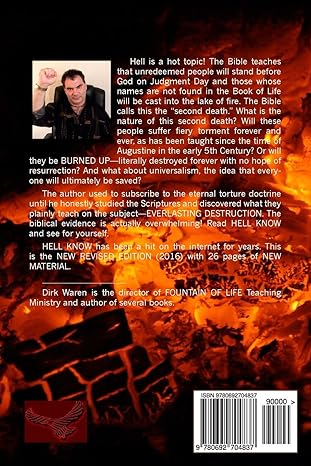
- You can purchase the book here for a low price (350 pages).
- Or get the Kindle eBook for only $2.99!
The more affordable Condensed Version is available here for only $6.72 (153 pages); or get the eBook for just 99 cents. This version is good for people who aren’t interested in excessive details and just want the main scriptural facts. It makes a perfect gift to introduce people to the topic.
Related Topics:
Sheol / Hades: The “Intermediate State” of the Unsaved Dead
RICH MAN & LAZARUS: Fantastical Parable or Literal Account?
Hell (Human Damnation) — Questions and Answers
Eternal Life (“Heaven”): Questions & Answers
Human Nature — Spirit, Mind & Body
The Believer’s “Intermediate State” (between Physical Death and Bodily resurrection)
Death — Does it Mean “Separation” as Religionists Claim? (No)
SHEOL / HADES: The “Intermediate State” of the Unsaved Dead
The Great White Throne Judgment is when God will resurrect every un-regenerated soul from Hades (HAY-deez) to be judged as shown in this passage:
The sea gave up the dead that were in it, and death and Hades gave up the dead that were in them, and each person was judged according to what he had done. Then death and Hades were thrown into the lake of fire. The lake of fire is the second death. If anyone’s name was not found written in the book of life, he was thrown into the lake of fire.
Revelation 20:13-15
We see plain evidence here that unredeemed people are held in a place called Hades after their physical death. Hades is called Sheol (she-OHL) in the original Hebrew of the Old Testament. These disembodied souls are kept in Hades until Judgment Day when, as you can see, they are resurrected for the purpose of divine judgment.
What is the precise nature of these people’s condition in Hades during this period between physical death and resurrection on Judgment Day? The traditional religious view is that they will be in a state of conscious torment the entire span or, if they’re righteous, they’ll hang out in bliss with father Abraham. Although this has been the common evangelical position of the “intermediate state,” it’s rarely mentioned or elaborated on in Christian circles.
Is this what the Bible really teaches? That people who are spiritually dead will suffer hundreds or thousands of years of torment in captivity immediately after they die merely waiting for God to judge them? (The people who believe this also believe the damned will then spend all eternity in roasting torture in the lake of fire after they’re judged).
Our purpose in this study is to thoroughly search the Holy Scriptures to find out the truth about Sheol/Hades, the intermediate state of the unsaved dead. If Sheol/Hades is indeed a place and condition of conscious torment, then God’s Word will clearly support it from Genesis to Revelation. However, if the Scriptures don’t reinforce this then we need to expose it as a false doctrine, eliminate it from our belief system and proclaim what the Bible actually teaches on the subject. This is the only way “the truth will set us free.”
Before starting our study, it needs to be established that…
Sheol and Hades are Synonymous Terms
Sheol and Hades are one-and-the-same; that is, they refer to the same condition or place. Sheol is the Hebrew term and Hades is the Greek. For proof of this, note the following Psalm passage, which speaks of Sheol, then observe how the Hebrew sheol is supplanted by the Greek hades when the text is quoted in the New Testament:
For Thou wilt not abandon my soul to Sheol; neither wilt Thou allow Thy Holy One to undergo decay.
Psalm 16:10 (NASB)
“Because Thou wilt not abandon my soul to Hades, nor allow Thy Holy One to undergo decay.”
Acts 2:27 (NASB)
As you can see, Sheol and Hades are synonymous terms in the Bible.
Since using both words could be overly wordy and confusing we will simply use the term Sheol throughout this article. The main reason for this decision is that the Hebrew sheol appears much more often in the Scriptures than the Greek hades; the former appears 66 times in the Old Testament and the latter 10 times in the New Testament. A secondary reason is that the word Hades is apt to conjure fantastical images of Greek mythology rather than biblical truth; the Hebrew Sheol, by contrast, offers no such misleading images.
Sheol/Hades Only Concerns the Spiritually Un-Regenerated
One other vital point needs to be established before we start our study and that is: Only unredeemed souls go to Sheol/Hades, which would include Old Testament saints because redemption and spiritual rebirth were not available until the death & resurrection of Christ.
New Covenant believers, by contrast, are reborn inwardly of the imperishable seed of Christ and thus possess immortality and eternal life (1 Peter 1:23, Titus 3:5 & 2 Timothy 1:10). Hence death & Sheol have no power over the blood-bought, spiritually regenerated believer in Christ!
For clear scriptural support of this see this article.
Jacob, Job and Solomon’s View of Sheol
We’ll begin our scriptural study by observing how Jacob, Job and Solomon viewed Sheol. All three were godly men of the Old Testament era. Jacob was the grandson of Abraham, the father of faith, and the patriarch of the twelve tribes of Israel. In fact, his name was changed to “Israel.” Job was regarded so highly by God that He boasted there was no one on earth as great as him (Job 1:8). As for Solomon, the Bible says “King Solomon was greater in riches and wisdom than all the other kings of the earth. The whole world sought audience with Solomon to hear the wisdom that God had put in his heart” (1 Kings 10:23-24).
These scriptural facts reveal that, although far from perfect, Jacob, Job and Solomon were great and mighty men of the Old Testament period. Hence, there’s no reason not to assume that their recorded statements about Sheol are sound and particularly so if they’re in harmony with what the rest of the Bible teaches.
With this understanding, let’s consider the very first passage in the Bible where the Hebrew word sheol appears…
What Jacob Said
Sheol first appears in Genesis 37:35. This was the occasion where Jacob’s sons treacherously sold their brother Joseph into slavery and then lied to their father by telling him that Joseph was slain by a wild beast. Jacob believed the lie and was understandably heartbroken:
All his sons and daughters sought to comfort him [Jacob]; but he refused to be comforted, and said, “No, I shall go down to Sheol to my son [Joseph], mourning.” Thus his father bewailed him.
Genesis 37:35 (NRSV)
Two simple facts can be derived from Jacob’s brief expression of grief in this passage: 1. Jacob very much expected to go to Sheol when he died, and 2. Jacob believed that Joseph was already in Sheol, that he would remain there, and that he would himself join him when he eventually died.
The King James Version translates sheol in this passage as “the grave.” Why? Obviously because the verse refers to Jacob and Joseph, both righteous men of God (righteous, that is, in the sense that they were in-right-standing with God via their covenant, not that they were unflawed individuals). This is in harmony with the King James translators’ policy of rendering sheol as “hell” when it applied to unrighteous people and as “the grave” when it applied to the righteous. There’s absolutely no justification for this practice; the meaning of the word sheol does not change depending on the character of the person going there.
We thus find evidence in the very first appearance of sheol in the Bible that religious people have tried to mislead the populace about its nature and who exactly went there.
As for the KJV and other translations rendering sheol as “the grave,” Sheol never denotes the physical grave or tomb where bodies are laid to rest; there’s a separate Hebrew word for this. Sheol should only be understood as “the grave” in the sense that it is the graveyard of souls in the spiritual realm, where dead souls are held and “awaiting” resurrection to be judged by God. This will become more evident as our study progresses.
Another important point concerning Jacob’s view of Sheol: Although Jacob doesn’t state anything about the nature of Sheol, it’s obvious that he didn’t regard it as some sort of nether paradise where his son was hanging out with father Abraham, which is what many ministers today advocate. If this were the case, would Jacob be “mourning” and “bewailing” Joseph so grievously? Of course not. It might be argued that Jacob was grieving over his own personal loss and not the destination of his son’s disembodied soul. If this were so, wouldn’t Jacob likely exclaim something to the effect of, “Praise you LORD that my son is now in the blissful presence of father Abraham, and I will one day go down to this same paradise rejoicing.” Yet Jacob says nothing of the kind; in fact, his reaction is completely opposite to this.
“So that We May Live and Not Die”
Further insight concerning Jacob’s view of Sheol can be derived from what he later exclaimed to his sons during a widespread famine:
“I have heard that there is grain in Egypt. Go down there and buy some for us, so that we may live and not die.”
Genesis 42:2
Jacob’s son, Judah, made a similar statement in the following chapter of Genesis:
Then Judah said to Israel his father, “Send the boy along with me and we will go [to Egypt] at once, so that we and you and our children may live and not die.
Genesis 43:8
Both quotes are in reference to Jacob’s sons traveling to Egypt to apprehend food so that their clan “may live and not die.” Obviously Jacob and his family were in no hurry to go to Sheol to commune with father Abraham in some nether-paradise. Please notice that there’s mysteriously no accompanying statement like, “…but—thankfully—if we die we’ll be in bliss with our forefathers in Sheol.” Why? Because this is an unbiblical doctrine.
This same point can be made from similar passages all over the Bible. Notice what the Israelites say to Moses when the army of Pharaoh was threatening them:
They said to Moses, “Was it because there were no graves in Egypt that you brought us to the desert to die? What have you done to us by bringing us out of Egypt? 12 Didn’t we say to you in Egypt, ‘Leave us alone; let us serve the Egyptians’? It would have been better for us to serve the Egyptians than to die in the desert!”
Exodus 14:11-12
Just as with Jacob and Judah in the two verses above, the Israelites were obviously in no hurry to die and go to a paradise in the heart of the earth to party with their forefathers. That’s because this supposed paradise in Sheol never existed. It’s a false doctrine and I find it puzzling that ministers have gotten away with peddling such blatant error for so long, not that they talk about it much, of course.
In all three of these passages the Hebrew word for “die” is muwth (mooth), which simply means “to die” and is used in reference to the death of animals as well as humans (Exodus 7:18). It does not mean “to separate” or, more specifically, “to separate and go to either bliss or torment in Sheol.” The Hebrew for ‘separate’ is badal (baw-DAL), which is used in Genesis 1:4: “God saw that the light was good, and he separated the light from the darkness.”
Needless to say, statements like “so we may live and not die” and “It would have been better for us to serve the Egyptians than to die in the desert” only make sense if Sheol is the graveyard of dead souls in the underworld where souls ‘rest’ in death until their resurrection.
Job’s View of Sheol
Let us now consider Job’s view of the intermediate state. Job was the greatest man of his time and God bragged of his integrity, godliness and hatred of evil (Job 1:1,3,8). Furthermore, in the book of Ezekiel God spoke of Job in the same breath as Noah and Daniel, two other great men of God (Ezekiel 14:14-20). The LORD obviously has a very high opinion of Job. We can therefore regard Job’s views on Sheol as very reliable. *
* Some may understandably argue that, since the LORD later accused Job of speaking “words without knowledge” (Job 38:2), his statements concerning the nature of Sheol are unreliable. But which of Job’s words did God mean were “without knowledge”? Obviously his erroneous belief that it was God Himself who was afflicting him, not the devil; which naturally provoked Job to rail against the LORD throughout the book, e.g. Job 10:1-3. This is what God understandably took issue with, not his theological insights concerning the intermediate state.
As we shall see, Job goes into quite a bit of detail on the nature of Sheol. Did he just dream up all this information or did he have divine revelation on the subject? No doubt God revealed these truths to him. We can confidently draw this conclusion because what Job says about Sheol is in complete agreement with what the rest of the Bible teaches on the subject; only if Job’s position contradicted the rest of Scripture should we question its validity.
For those unfamiliar with the book of Job, let me briefly explain its contents: Satan argues to God that Job is devoted to Him merely because the LORD blessed him so greatly and contends that Job will curse Him to His face if his blessings were removed. God therefore permits Satan to attack Job to find out. As a result of Satan’s attacks, Job loses his ten children, hundreds of his employees (with only four survivors), all his great wealth and even his health as he is afflicted with painful sores from head to toe.
After many months of suffering, three of Job’s friends go to “comfort” him, but end up judging & accusing him of some great hidden sin, which they presume brought about all his horrible suffering. Most of the book consists of Job, in great anguish, profoundly debating with these “friends.” It should be noted, however, that much of what Job says is directed at God Himself. Such is the case with this passage:
“But mortals die, and are laid low;
humans expire and where are they?
11 As waters fail from a lake,
and a river wastes away and dries up,
12 so mortals lie down and do not rise again;
until the heavens are no more, they will not
awake
or be aroused out of their sleep.
13 Oh that you [God] would hide me in Sheol,
that you would conceal me until your wrath is
past,
that you would appoint me a set time,
and remember me!
14 If mortals die, will they live again?
All of the days of my service
I would wait until my release should come.
15 You would call, and I would answer you;
you would long for the works of your hands.”
Job 14:10-15 (NRSV)
Much is said in this passage so let’s take it point by point.
Firstly, in verse 10 Job declares that “mortals die” and then asks “where are they?” He partially answers his own question in verse 12 by likening death to “sleep” which humans will not “awake” from until “the heavens are no more,” or, we could say, a very long time. What needs to be emphasized from these words is that Job describes the condition of death as “sleep” from which all human beings will one day “awake” or be resurrected.
Yet he still hasn’t really answered the question of where people go after they die. The very next verse answers this (verse 13): In his great anguish he cries out to God to hide him in Sheol. Why does Job pray this? Because his suffering was so great he wanted to escape it through death; and obviously when a person died—Job believed—his or her soul would go to Sheol.
One may argue that, in verse 12, Job is perhaps referring to the body “sleeping” in the grave, but the obvious focus of his words is the death condition of the soul in Sheol because in the very same breath he prays to God to go specifically there: “Oh that you would hide me in Sheol, that you would conceal me until your wrath is past, that you would appoint a set time and remember me!” (Verse 13).
Job erroneously believed that God Himself was causing his great afflictions because he was unaware of the devil’s hand in the situation. In truth, God only permitted Job’s afflictions by allowing Satan to attack him. Nevertheless, the fact is that Job believed that by dying and going to Sheol he would escape his intense suffering.
Yes, as amazing as it may seem, Job was actually hoping and praying to die and go to Sheol, a place traditionally considered “hell” and viewed as a horrible, devil-ruled torture chamber! Obviously Job’s view of Sheol was quite different from what religious tradition has taught us. He prayed to go to Sheol because, being one of God’s inspired servants, he knew that Sheol was a condition of unconsciousness, which he described as sleep. Job was understandably weary of his intense suffering and wanted it to end. He knew that in death, in Sheol, he would find relief from his misery, not an increase of it.
A vital fact that needs to be stressed from the above passage is that, regardless of the nature of Sheol, Job definitely believed that everyone would ultimately be resurrected from there. In verse 12 he makes it clear that all mortals who lie down in the sleep of death will one day awaken, that is, be resurrected when “the heavens are no more.” And, while Job prayed to go to Sheol in verse 13, it was not with the expectation that he would remain there forever. Job obviously believed that if God “hid” him in Sheol He would “appoint a set time and remember” him, which is when his “release” would come (verse 14). Release from what? Obviously his release from captivity to Sheol, “the world of the dead” as scholar James Strong defined it. So God “remembering” him and “releasing” him are references to a future resurrection from Sheol, which is in harmony with what the rest of the Bible teaches.
“There the Wicked Cease from Turmoil, and the Weary are at Rest”
Job elaborates greatly on the nature of Sheol in an earlier chapter. In Job 3 he curses the day of his birth because his suffering was so great. In essence, Job was wishing that he were never born because then he would never have had to experience such incredible agony. He then details what it would’ve been like for him if this were so:
“Why did I not perish at birth
and die as I came from the womb?
12 Why were there knees to receive me
and breasts that I might be nursed?
13 For now I would be lying down in peace;
I would be asleep and at rest
14 with kings and counselors of the earth
who built for themselves places now lying in
ruins,
15 with rulers who had gold,
who filled their houses with silver.
16 Or why was I not hidden in the ground like a
stillborn child,
like an infant who never saw the light of day?
17 There the wicked cease from turmoil,
and there the weary are at rest.
18 Captives also enjoy their ease;
they no longer hear the slave driver’s shout.
19 The small and great are there,
and the slave is freed from his master.”
Job 3:11-19
Job starts off this passage by asking why he didn’t die as an infant. He says that, in that event, he would not be enduring all the great suffering that he was experiencing. He explains in verse 13 that, had he died in infancy he would be peacefully “lying down… asleep and at rest.”
Job then further explains that he would have shared this condition of sleep and rest with kings and counselors of the earth, with the small and the great, with rulers and slaves, with captives and weary people and, yes, even with the wicked! In this state of death, Job declares in verse 17 that “there the wicked cease from turmoil, and there the weary are at rest,” and in verse 18 he makes it plain that there’s no “slave driver’s shout” as well.
This coincides with what Job later says concerning the wicked:
“They [the wicked] spend their days in prosperity
and in peace they go down to Sheol.”
Job 21:13 (NRSV)
Notice that Job doesn’t say the wicked go down to Sheol in torment; no, they go down to Sheol in peace. This completely contradicts the religious traditional belief that the unredeemed go to some horrible devil-ruled nether realm immediately after physical death to suffer torments as they are goaded on by slave-driving demons in fiery pits with not a single drop of water for relief. Instead Job makes it clear that there is no turmoil or torment for the wicked in Sheol.
If Job’s view of Sheol is divinely inspired and therefore coincides with the rest of the God-breathed Scriptures, these are potent facts indeed! They reveal that at death kings, counselors, rulers, infants, the wicked, the weary, captives, the small, the great and slaves all share the same condition, a condition of peaceful “sleep” and “rest,” which are obvious references to unconsciousness. No wonder Job, stripped of all his possessions, forsaken by his wife and friends, tortured by painful sores from head to toe, mocked and made a byword by everyone and mourning for his ten children & hundreds of servants, prayed to go to such a place. Needless to say, Job’s understanding of Sheol was quite different from that held by so many misguided religious people today.
Some may wonder if perhaps Job was referring to the literal grave or tomb where the body is laid to rest since there is no specific mention of Sheol in chapter 3. This idea is ruled out because Job makes it clear in verses 13-15 that, if he died, he’d be lying down asleep with kings, counselors and rulers. So Job is plainly referring to a common place or condition that all people shared together. Biblically speaking, this would be Sheol, the realm of dead souls, as verified in Ecclesiastes 9:10, a passage we will examine momentarily. In addition, Job would not be referring to the literal grave or tomb for the body because it is not acceptable or usual practice to bury people together in mass graves or tombs, then or now.
Before we continue let’s remember that this was well before the death and resurrection of Christ, hence spiritual rebirth and the consequent attainment of eternal life were yet to be manifested. For this reason, the souls of Old Testament saints could not be ushered into God’s presence when they physically died; the souls of both the righteous and unrighteous went to Sheol at this time because redemption was not yet available.
Amazingly, some righteous captives to Sheol—death—were set free when Jesus was resurrected:
And when Jesus had cried out again in a loud voice, he gave up his spirit.
51 At that moment the curtain of the temple was torn in two from top to bottom. The earth shook, the rocks split 52 and the tombs broke open. The bodies of many holy people who had died were raised to life. 53 They came out of the tombs after Jesus’ resurrection and went into the holy city and appeared to many people.
Matthew 27:50-53
Notice how verse 52 says that these “holy people who had died were raised to life” and not these “holy people who had died physically, but were still very much alive in the paradise section of Sheol fellowshipping with father Abraham, were raised to life physically.” With passages like this it’s important to note what the Bible actually says and also what it doesn’t say. Interestingly, there’s no account of these resurrected people lamenting that they had to leave paradise with Abraham to come back to this lost world. Why not? Because it’s a false doctrine.
What about the rest of the Old Testament saints? They were possibly released from Sheol when Jesus ascended (Ephesians 4:7-10); if not, we can be sure that they’ll be resurrected at the time of their bodily resurrection when Jesus Christ returns to the earth, which takes place at the end of the Tribulation period and before Jesus’ millennial reign (Daniel 12:1-2 & Matthew 19:28-30). This is addressed here.
Solomon’s View of Sheol
Solomon was the wisest man on earth in his time (1 Kings 4:29-34) and this explains why God utilized his great knowledge and wisdom in three books of the God-breathed Scriptures. Notice what it says about Solomon when the Queen of Sheba came to visit him:
Now when the queen of Sheba heard about the fame of Solomon concerning the name of the LORD, she came to test him with difficult questions… 3 Solomon answered all her questions; nothing was hidden from the king which he did not explain to her.
1 Kings 10:1,3
The king’s wisdom was renowned and so the Queen came to test him with hard questions and verse 3 shows that “nothing was hidden from the king which he did not explain to her.” Do you think that one of the questions she asked was what happens to people when the die? That is, where they go and what will it be like? Of course she did; after all, it’s one of the most common “difficult questions” people ask in life. With this in mind, it says that “Solomon answered all her questions” and that there was literally “nothing” he did not explain to her.
Furthermore, we know that Solomon had divine revelation on Sheol, the realm of the dead, because he commented on it quite a bit in the book of Proverbs, as we’ll see later. He also elaborates on it in Ecclesiastes, witness:
Whatever your hand finds to do, do with your might; for there is no work or thought or knowledge or wisdom in Sheol, to which you are going.
Ecclesiastes 9:10 (NRSV)
The language in this passage describes beyond any question of doubt that Sheol is a condition of unconsciousness. Notice that, in Sheol, there’s neither good work nor bad work; there’s neither positive, hopeful thoughts nor anguished, hopeless thoughts; there’s neither knowledge of what’s good and holy nor knowledge of what’s evil and impure.
This is further verified in verse 5:
The living know that they will die, but the dead know nothing.
Ecclesiastes 9:5 (NRSV)
The obvious reason the dead “know nothing” is because they’re no longer alive and conscious—they’re dead. This coincides with this passage from the Psalms:
His breath goeth forth, he [his body] returneth to his
earth;
in that very day his thoughts perish.
Psalm 146:4 (KJV)
The Psalmist makes it clear that when a person physically dies his or her thoughts perish. Note that there is no mention whatsoever of a person’s thoughts continuing to live on in some devil-ruled chamber of horrors. This is obviously because a dead person is no longer conscious of anything.
Take another look at Ecclesiastes 9:10 above and notice that Solomon doesn’t make a distinction between righteous or unrighteous people. Like Job, he plainly says that everyone would go to Sheol during this period of time, whether righteous or wicked, rich or poor, small or great. In fact, Solomon’s major point in Ecclesiastes 9 is that death or Sheol is the common destiny of all people before redemption was made available through Christ’s death and resurrection. He plainly states in verse 3 that “the same destiny overtakes all.” What destiny? The destiny of Sheol, the state of death, where—he goes on to say—there is neither work nor thought nor knowledge nor wisdom.
Summary
Jacob, Job and Solomon’s views of Sheol can be summarized as follows:
- Sheol is a condition that every spiritually un-regenerated person will experience immediately following physical decease, which includes godly men and women in Old Testament periods preceding the ascension of Christ. It includes the rich and the poor, the small and the great, the pure and the profane. In other words, Sheol is the common destiny of anyone who is spiritually dead to God and therefore unredeemed.
- Sheol is a condition of unconsciousness, likened unto sleep, where there is no work, thought or knowledge of any kind. It is not a place or state of conscious suffering and misery.
- Sheol is a temporary condition and all consigned to Sheol will ultimately be resurrected.
SHEOL IN THE PSALMS
The book of Psalms consists of 150 songs called psalms. Half of the psalms were written by Solomon’s father, King David, and some anonymous ones were likely written by him as well. Other psalmists include Moses, Solomon, Asaph, Ethan and Heman. Regardless of who wrote each psalm, one fact is certain: All the psalms are “God-breathed” (2 Timothy 3:16) since all the psalmists “spoke from God as they were carried along by the Holy Spirit” (2 Peter 1:21). For more proof of this, notice what Jesus said about David in a discussion with the Pharisees:
[Jesus] said to them, “How is it then that David, speaking by the Spirit, calls him ‘Lord’? For he says,
44 “ ‘The Lord said to my Lord: “Sit at my right hand
until I put your enemies under your feet.” ’
Matthew 22:43-44
Verse 44 is a quote of Psalm 110:1, written by David. Notice how Jesus emphasizes that David was “speaking by the Spirit” when he wrote this verse, which implies all the psalms he wrote. In other words, David’s statements in the Psalms were given by the inspiration of the Holy Spirit and the Holy Spirit is God. As such, David’s exposition on the nature of Sheol contained in the Psalms, as well as commentary by other psalmists, shouldn’t be considered just “their view” of Sheol. No, it’s God’s view too because they were “speaking by the Spirit,” as Jesus put it.
The book of Psalms contains a wealth of information on the nature of Sheol. Despite the fact that there were several authors, the psalmists are in complete agreement. This is unsurprising since they all “spoke from God… by the Holy Spirit.” Their many revealing statements about Sheol are also in harmony with the views of Jacob, Job and Solomon, covered above.
Sheol: Where You Cannot Remember or Praise God
Let’s examine the very first text in the Psalms where the Hebrew word sheol appears:
For in death there is no remembrance of you [God];
in Sheol who can give you praise?
Psalm 6:5 (NRSV)
In this verse David is praying for God to save his life because his enemies were trying to kill him (as indicated in verse 10). Despite his anguish David didn’t want to die; he was “a man after God’s own heart” (1 Samuel 13:14 & Acts 13:22) and thus wanted to live, serve God and worship Him. He knew that if he died and went to Sheol he wouldn’t be able to do this.
This simple passage completely contradicts the prominent religious position on Sheol, which suggests that when Old Testament saints died their souls would go to a supposed “paradise” section of Sheol. They would be conscious there and supremely comforted as they fellowshipped with father Abraham. If this were so, wouldn’t they be able to remember God? Would they not be praising Him and thanking Him as the righteous are always ever ready to do, that is, as long as it were possible?
However, David makes it clear in this passage that souls in Sheol do not and cannot remember God and consequently cannot praise Him either. This suggests that those in Sheol are unconscious—“asleep” in death until their resurrection.
The notion that Sheol is a condition where a person cannot remember or praise God is corroborated by other biblical texts. For instance:
The dead do not praise the LORD,
nor do any that go down into silence,
but we [the living] will bless the LORD
Psalm 115:17-18 (NRSV)
This passage shows that those who die “go down into silence.” Sheol is a place of silence because those who go there are unconscious, that is, dead. There’s no praising and worshipping of God there nor are there horrible screams of torment. It is a condition of silence. It is the living who bless the Lord, the psalmist plainly states, not the dead.
Righteous King Hezekiah’s prayer from the book of Isaiah also coincides:
“For Sheol cannot thank you,
death cannot praise you;
those who go down to the Pit
cannot hope for your faithfulness.
19 The living, the living, they thank you
as I do this day.”
Isaiah 38:18-19 (NRSV)
First, notice in this passage, as well as Psalm 6:5 above, that Sheol and death are spoken of synonymously (we’ll look at this in more detail shortly). Secondly, witness how Hezekiah makes it clear that those in Sheol are unable to thank or praise God, just as David and the other psalmist did.
The obvious conclusion we must draw is that, if the righteous are unable to remember God and cannot praise or thank Him, then they must be unable to do so; that is, they must be either unconscious or dead—no longer alive. This is supported by Hezekiah’s statement in verse 19 where he stresses that only “the living, the living” can thank and praise God, not those who go to Sheol, the world of the dead.
Let’s examine one other passage that corresponds to the three just looked at:
3 For my soul is full of trouble
and my life draws near the grave (sheol)…
10 Do you show your wonders to the dead?
Do those who are dead rise up and praise you?
11 Is your love declared in the grave (qeber),
your faithfulness in destruction.
12 Are your wonders known in the place of darkness,
or your righteous deeds in the land of oblivion?
Psalm 88:3,10-12
Here is further proof that those in Sheol are dead and therefore unable to rise up and praise God. Moreover, Sheol is likened to the literal grave (qeber) and destruction, and is also spoken of as “the place of darkness” and “land of oblivion.” The psalmist makes it clear that God does not show His wonders to the dead in Sheol; that the dead cannot praise Him there and that God’s love, faithfulness and righteous deeds are all unknown there. What unmistakable proof that souls in Sheol are dead and conscious of nothing!
This Psalm, written by Heman the Ezrahite when his life was in mortal danger, is a prayer to God for deliverance from death. Note in verse 3 that Heman clearly expected to go to Sheol when he died just as Jacob, Job, Solomon, David and Hezekiah did. In the King James Version this is kept from the general reader by the use of the word “grave” as a translation of sheol, which is likewise the case with the NIV rendering, as shown above, although there’s a footnote indicating that the verse is referring to Sheol. Because of this mistranslation the average reader is misled into believing that the psalmist is talking about the condition of the literal grave where the body is buried and not to Sheol where the soul goes. The problem with this is that it obscures the truth about the nature of Sheol to the common person and consequently perpetuates false religious ideas.
Let’s recap: The writers of the four passages examined in this section—David, Hezekiah, Heman and the anonymous psalmist—are in perfect agreement that Sheol is not a place of consciousness. According to these inspired biblical writers, Sheol is synonymous with death and is thus a condition of silence where it is impossible to even remember God, let alone praise and thank Him.
Sheol: “The Land of Silence”
Let’s examine another enlightening Psalm text by David from both the New International Version and the King James:
…let the wicked be put to shame
and lie silent in the grave (sheol).
18 Let their lying lips be silenced,
Psalm 31:17-18
…let the wicked be ashamed,
and let them be silent in the grave (sheol).
18 Let their lying lips be put to silence;
Psalm 31:17-18 (KJV)
Notice that this passage is solely referring to “the wicked”—people who are in outright rebellion against God, living after the desires of the sin nature. These are David’s enemies; they have rejected his God-appointed kingship and are trying to kill him. David is actually praying for their death for that is the only way their lying lips will be silenced.
With this understanding, observe how David describes the condition these wicked souls will experience if they die: He plainly says that they will lie silent in Sheol.
According to David—the godly king, biblical writer and “man after God’s own heart”—the wicked do not constantly scream in torment in Sheol, but rather lie silent! This description is in perfect harmony with the view that Sheol is a condition of unconsciousness where souls lie “asleep” in death “awaiting” their resurrection.
This is not the only biblical text that shows that souls lie silent in Sheol. This same thought is expressed in Psalm 115:17, as seen in the previous section. Here’s another coinciding verse from the Psalms:
If the LORD had not been my help,
my soul would soon have lived in the land of silence.
Psalm 94:17 (NRSV)
The psalmist is simply testifying that, if the Lord had not delivered him from his wicked enemies (referred to in verse 16), they would have killed him and his soul would have gone to “the land of silence.” What is “the land of silence”? Since he’s addressing the place his soul would go to after death we know he’s referring to Sheol.
With this in mind, notice that the psalmist does not describe Sheol as “the land of shrieking in torment” or as “the land of comforts with father Abraham” (religionists would have us believe Sheol is one or the other, depending on whether the soul is wicked or righteous respectively). That’s because neither of these descriptions is true; Sheol is, in reality, the land of dead souls where there’s no consciousness of anything and thus only silence.
Take another look at the King James rendition of Psalm 31:17-18 above and notice that the passage deviates from the King James standard practice of rendering sheol as “hell” whenever the text referred to the wicked (and as “the grave” when it referred to righteous people). Why did the translators fail to render sheol as “hell” in this particular case since it clearly refers to “the wicked”? Obviously because the passage portrays the wicked in Sheol as lying in silence and this contradicted their belief that wicked souls in Sheol suffer a constant state of screeching torment. What hypocrisy!
This reveals the dishonest extents religious people will go to cover up the scriptural truth and perpetuate their false religious beliefs.
Sheol: “The Pit” or “Well of Souls”
The fact that Sheol is a condition of silence is also pointed out in Psalm 30. This psalm shows David expressing thanks because God delivered him from death. He knew that, if he died, his soul would go to Sheol, as indicated in verse 3:
O LORD, you brought up my soul from Sheol,
restored me to life from among those gone down to
the Pit.
Psalm 30:3 (NRSV)
The text showcases a form of Hebrew poetry called synonymous parallelism where the second part of the verse simply repeats and reinforces the thought of the first, but in
different words. We’ve already seen examples of this type of poetry (Psalm 6:5 & Isaiah 38:18) and will continue.
With this understanding, notice that Sheol is spoken of as synonymous with “the Pit.” Since Sheol is described as “the Pit” we will gain better insight into Sheol by deciphering what “the Pit” means.
The Hebrew word for “the Pit” is bowr (borr) which literally refers to a hole or pit in the ground and is used 71 times in the Bible. The setting in which bowr is used determines what specific type of hole or pit and, consequently, which English word is used to translate it. For instance, bowr is used 26 times in reference to a ‘cistern’ (e.g. Genesis 37:22,24,28,29), nine times in reference to a ‘well’ (e.g. 1 Chronicles 11:17-18), five times in reference to a ‘dungeon’ (e.g. Genesis 40:15; 41:14), once to a ‘quarry’ (Isaiah 51:1) and once it’s even translated as ‘death’ (Proverbs 28:17). *
* These figures are from the New International Version.
Why “death”? No doubt because bowr, a hole in the ground, is what a grave actually is; and grave, of course, signifies death—the utter absence of life.
What is God trying to tell us in His Word by likening Sheol to bowr, a pit? Obviously that Sheol is like a vast common pit or grave where unregenerated souls are held after physical death and before resurrection.
Interestingly, since one of the definitions of bowr is ‘well,’ Sheol could be described as “the well of souls.”
Most of us have probably heard this phrase. “The Well of Souls” is an actual subterranean chamber beneath the Dome of the Rock in the Temple Mount in Jerusalem. Jews believe it is where Abraham almost sacrificed Isaac. The popular 1981 film Raiders of the Lost Ark depicts the Well of Souls as the hiding spot of the Ark of the Covenant, but placed it in a lost chamber in Tanis, Egypt, rather than in a cave in the Temple Mount.
From a purely biblical standpoint, however, the Well of Souls is Sheol, the pit where unregenerated souls are held between physical death and resurrection. Like the subterranean chamber beneath the Dome of the Rock, Sheol is a dungeon—a dungeon where souls are held captive to death after physical decease. This explains why bowr is translated as “dungeon” in reference to Sheol in this passage from Isaiah:
21 So it will happen in that day, that the LORD will
punish
the host of heaven, on high,
and the kings of the earth, on earth.
22 And they will be gathered together
like prisoners in the dungeon (bowr),
and will be confined in prison;
and after many days they will be punished.
Isaiah 24:21-22 (NASB)
The passage is referring to the day when God’s cataclysmic wrath will be poured out upon the whole earth; this occurs right before the establishment of the millennial reign of Christ. Because of God’s judgments billions of people will die and every unsaved soul will be confined to Sheol “like prisoners in the dungeon.” Only “after many days,” that is, after the thousand-year reign of Christ, will these souls be resurrected to face judgment and suffer the eternal punishment of the second death (see Revelation 20:5,13-15).
Incidentally, observe how verse 22 makes it clear that these unsaved souls will not be punished until after they are resurrected from Sheol and judged; this is further evidence disproving the view that unsaved souls are punished with conscious torment while captive in Sheol. The only punishment experienced in Sheol is death itself, the utter absence of life or being. This stands to reason since it is in harmony with the biblical axiom that death is the wages of sin.
The point I want to stress from this passage is that verse 22 likens Sheol to a gloomy dungeon or prison where souls are confined. No wonder David praised and thanked God for delivering him from this death condition. Obviously David didn’t share the view of some people today that righteous souls in Sheol are (or were) in some type of “paradise” chummin’ around with father Abraham. No, this is a religious myth! Sheol is a dungeon, a prison, a common pit of death where unregenerated souls are confined until their appointed resurrection.
The only soul who can escape this dungeon-like pit of death is the soul that is born-again and thus possesses eternal life (John 3:36, 5:24 & 1 John 3:14). This is only possible because “Christ Jesus… has destroyed death and has brought life and immortality to light through the gospel” (2 Timothy 1:10). The gospel or “good news” refers to all the benefits available to humankind as a result of Jesus’ sacrificial death, burial and resurrection (1 Corinthians 15:1-4). Aside from reconciliation with God, the main benefit of this gospel is, of course, eternal life. Until Jesus’ death, burial and resurrection, eternal life or immortality was not available and that’s why in Old Testament times, before the ascension of Christ, both righteous and unrighteous souls had to go to Sheol after physical decease.
It was necessary to go into detail here about bowr—“the Pit”—so now whenever it pops up in our study we’ll understand what it means.
Incidentally, I find it interesting that the original definition of the English word ‘hell’—“to conceal or cover”—is in harmony with the biblical description of Sheol as “the Pit.” This is evidence that the Old English ‘hell’ was originally used as a translation of Sheol because it properly gave the image of souls consigned and concealed in a pit in the netherworld until their resurrection on judgment day. Unfortunately, the definition of ‘hell’ has taken on a completely different meaning since that time, i.e. perpetually writhing in roasting torment in some devil-ruled torture chamber.
Let’s now return our attention to Psalm 30: At the end of this psalm David plainly reveals the state that his soul would have been in if God had not delivered him from death:
11 You have turned my mourning into dancing;
you have taken off my sackcloth and clothed me
with joy,
12 so that my soul may praise you and not be silent.
Psalm 30:11-12 (NRSV)
David is just praising God here because he knew that, had he died, his soul would have been silent in Sheol. He well knew that a person cannot praise God or tell of His faithfulness in Sheol, as indicated in verse 9, because Sheol is a “land of silence.”
Sheol: A Condition of the Soul (Mind)
Let’s return to Psalm 30:3 to observe another important fact about Sheol:
O LORD, you brought up my soul from Sheol,
restored me to life from among those gone down to
the Pit.
Psalm 30:3 (NRSV)
David was so close to death that God figuratively “restored” him to life by saving him from Sheol, which is where his soul would have gone had he physically died.
“Soul” in this context refers to his very being or mind, the actual essence or qualities that mark him as an individual human creation of God. This is supported by the second part of the verse, which speaks of “those” who actually died and consequently went to Sheol, the Pit. Notice that he doesn’t say “those whose bodies have gone down to the Pit” or “those whose breath of life has gone down to the Pit.” That’s because a person’s body does not go to Sheol when s/he dies; a lifeless body is placed in a grave or tomb. Neither does the breath of life, the spirit, go to Sheol when a person dies; this animating life-force simply returns to God from whence it came, as detailed in this article. No, Sheol is the holding place of a person’s very life essence or being, the part of human nature that possesses volition, emotion and intellect. In other words, Sheol is the condition to which the human soul or mind (not brain) enters after physical death.
This is supported by a verse examined earlier:
Whatever your hand finds to do, do with your might; for there is no work or thought or knowledge in Sheol, to which you are going.
Ecclesiastes 9:10 (NRSV)
Notice how the text plainly states that “you” are going to Sheol; that is, anyone who has not been spiritually regenerated through Christ, which included everyone in Old Testament times when Ecclesiastes was written. Sheol is the housing place of people’s very being after physical death, the part that marks them as an individual creation of God, the part of them that thinks, reasons, chooses and feels. Hence, Sheol is the condition that the mind enters when the body dies. As shown in the Appendix, “mind” is the Greek word nous (noos) and refers to that central part of human nature that decides, thinks and feels. We could put it this way: Your mind is you and you are your mind.
The human body separate from mind and spirit is just a slab of flesh that goes to the grave at death. The human spirit separate from mind and body is simply a breath of life, an animating life-force, not a personality. This breath of life comes from the Creator and gives life to our very being, our soul, our mind—our personhood. When a person dies this breath of life, or spirit, merely returns to God who gave it. (I’m not talking about believers who have spiritual regeneration through Christ here, but rather un-regenerated people, which includes Old Testament saints). The unredeemed soul separate from body and spirit goes to Sheol.
Simply put, Sheol is a condition of the unregenerate human soul, the disembodied mind.
If any of this is difficult to understand, please see the aforementioned article, which addresses the subject in detail
Sheol: A Place Where Sheep Go?
Let’s now turn to another very enlightening passage from the Psalms written by the sons of Korah:
13 Such is the fate of the foolhardy,
the end of those who are pleased with their lot.
14 Like sheep they are appointed for Sheol;
death shall be their shepherd;
straight to the grave they descend,
and their form shall waste away;
Sheol shall be their home.
15 But God will ransom my soul from the power of
Sheol,
for he will receive me.
Psalm 49:13-15 (NRSV)
The text refers to those who trust in themselves rather than God; verse 13 describes them as the “foolhardy.” A ‘fool’ in the Bible is synonymous with a wicked person since “fool” denotes someone who is morally deficient; that is, someone who rejects God’s existence, authority, wisdom & discipline and embraces evil desires (see Proverbs 1:7, 5:22-23 and Psalm 14:1).
Since this passage is definitely referring to ungodly people you would think that the King James translators would have translated sheol as “hell,” which would be in line with their policy of translating the word as “hell” when the passage referred to wicked people, and as “grave” when it referred to righteous people. Yet, notice how the King James Bible renders verse 14:
Like sheep they are laid in the grave (sheol);
death shall feed on them;
and the upright shall have dominion over them in the
morning;
and their beauty shall consume in the grave
from their dwelling.
Psalm 49:14 (KJV)
The passage is contextually referring to ungodly people yet the King James translators mysteriously chose not to render sheol as “hell,” which was their usual practice. Why? Obviously because the verse plainly says that wicked people are appointed for Sheol LIKE SHEEP! And everyone knows that sheep don’t go to a place of conscious torture when they die; the very idea is absurd. You don’t have to be a scholar to realize this. Hence, despite their desire to render sheol as “hell” in line with their standard practice they had no choice but to translate it as “the grave” in this case.
This passage coincides with Jeremiah 12:3, which also likens ungodly people to sheep that are to be slaughtered: “Drag them off like sheep to be butchered! Set them apart for the day of slaughter.” Note clearly that it says they are to be butchered and slaughtered (which is in harmony with the biblical axiom that “the wages of sin is death”), not tortured in some fiery nether realm until their resurrection thousands of years hence, as some ludicrously teach.
At this point, two questions crop up: Do sheep really go to Sheol as Psalm 49:14 implies? And, if so, does this mean they have souls since, biblically speaking, Sheol is the “world of the dead” where dead souls are specifically laid to rest after physical death?
“God Will Ransom My Soul from the Power of Sheol”
Let’s look again at a verse from Psalm 49:
But God will ransom my soul from the power of
Sheol,
for he will receive me.”
Psalm 49:15 (NRSV)
Firstly, notice that Sheol is spoken of as a condition of the soul, which was emphasized earlier. A person’s body doesn’t go to Sheol when s/he dies, nor does the breath of life (spirit), which simply returns to God who gave it; no, Sheol refers exclusively to the condition of unregenerated souls after physical death.
Secondly, like Job, the psalmist believed that his non-physical essence would go to Sheol when he died, but, also like Job, he believed God would ultimately ransom his soul from there. ‘Ransom’ literally means “the redeeming of a captive.” When did God eventually redeem the souls of righteous Old Testament saints, including the writer of this psalm, from captivity to Sheol? And with what did He redeem them? The answer to the second question is obvious: God redeemed them by the blood of Jesus Christ when he was crucified for the sins of humanity. The answer to the first question is: Old Testament saints will be resurrected at the time of Jesus’ second advent, as shown in Matthew 19:28-30 (although, again, some maintain that captive righteous souls were resurrected when Jesus ascended to heaven, citing Ephesians 4:8). This is when they will be “received” by the Father, as Psalm 49:15 puts it. See this article for details.
Did David Pray for His Ex-Friend to Go to a Hellish Torture Chamber?
Notice David’s statement in this passage:
Let death seize upon them,
and let them go down quick into hell (sheol):
for wickedness is in their dwellings, and among
them.
Psalm 55:15 (KJV)
David is obviously referring to his enemies in this verse, yet one of these enemies was once a close friend. This is revealed in the preceding lines, verses 12-14 (as well as verses 20-21). At one time David shared “sweet fellowship” with this person, but by the time of this writing his friend had turned against him.
As you can see, sheol is translated as “hell” in the King James Version and most English readers automatically picture “hell” as a devil-ruled torture chamber for wicked human beings. This presents a problem for these readers: How could David, “a man after God’s own heart,” pray for his enemies—including a former close friend—to go to such a place? The problem is resolved when we realize that Sheol refers to the graveyard of dead souls and, hence, the state of death itself. As such, David’s prayer is in harmony with the law of God, which plainly states that the “wages of sin is death” (Romans 6:23).
As a godly king of Judah, David knew that God’s Word promised his enemies would be defeated and destroyed (Leviticus 26:8 & Deuteronomy 28:7) and he was merely praying in accordance with these promises. True, he was obviously torn-up inside because one of these enemies was once a dear friend, but this ex-friend and his colleagues were trying to assassinate him, the righteous king of Judah. David felt he had no other recourse.
This verse illustrates that a proper, biblical understanding of Sheol clears up passages that present serious problems for those who view Sheol as a nether torture chamber.
“My Life Draws Near to Sheol”
Heman the Ezrahite was facing a grave situation with the possibility of death in this psalm:
3 For my soul is full of troubles,
and my life draws near to Sheol.
4 I am counted among those who go down to the Pit;
I am like those who have no help,
Psalm 88:3-4 (NRSV)
While this passage isn’t that notable it conveys several things detailed in other areas of this article: 1. Heman links the destiny of his soul to Sheol, which verifies that (1.) Sheol is a condition of the soul and (2.) that the righteous as well as the unrighteous went there during Old Testament times (because Jesus hadn’t yet paid for human redemption and therefore spiritual regeneration wasn’t available). 2. Sheol and “the Pit” are synonymous. 3. Heman describes the location of Sheol in terms of “going down to the pit,” which coincides with other passages that show that Sheol is located in the “heart of the earth,” not in the physical realm, but in the spiritual realm. We’ll address this later. 4. Heman says that his life was drawing near to Sheol, the Pit; and since Sheol is essentially synonymous with death (as shown in the next section) his life was drawing near to death.
“Who Can Live and Never See Death? Who Can Escape the Power of Sheol?”
Let’s observe what Ethan the Ezrahite had to say about Sheol:
Who can live and never see death?
Who can escape the power of Sheol?
Psalm 89:48 (NRSV)
Here it is as plain as language can convey that death and Sheol are essentially synonymous terms; in other words, the only thing souls going to Sheol will experience is death itself, the utter absence of conscious existence. The obvious implication of both rhetorical questions is that, apart from Christ’s redemption, everyone who lives will ultimately die and go to Sheol, the death state of the soul. Solomon also declared this:
…for death is the destiny of everyman;
the living should take this to heart.
Ecclesiastes 7:2b
Both of these verses were written during the Old Testament era before Jesus’ sacrifice for humanity was made; hence, no one living at this time had redemption from sin, regardless of whether or not they had a covenant with God, like the Israelites. Before Christ’s death and resurrection no one could escape the power of Sheol, whether moral, immoral or anywhere in between.
The good news is that this is no longer the case ever since Christ died for our sins and was raised to life for our justification (Romans 4:25). Jesus “poured out his soul unto death” (Isaiah 53:12 KJV) so that we don’t have to. As it is written: “For God so loved the world that he gave his only Son, so that everyone who believes in him may not perish but may have eternal life” (John 3:16 NRSV). You see, in order for the world—that is, all humankind—to be set free from death, someone innocent of sin and thus not worthy of death had to die in our place. This is exactly what Jesus Christ did. So now when a born-again believer in Christ physically dies, his or her soul does not die, that is, go to Sheol, but rather goes straight to heaven. As it is written: “…to be absent from the body [is] to be present with the Lord” (2 Corinthians 5:8 KJV). Of course, this is only the intermediate state of the Christian soul; ultimately, the believer will receive a new glorified, spiritual, imperishable body at the bodily resurrection of the saints, called the first resurrection (1 Corinthians 15:42-43 & Revelation 20:4-6).
We’ve already gone over much of this information so why am I re-emphasizing it here? Simply to answer Ethan’s question: “Who can live and not see death? Who can escape the power of Sheol?” The answer is the believer who has accepted God’s sacrifice for humanity’s sins, Jesus Christ. Genuine Christians literally possess eternal life in their spirits through spiritual rebirth (John 3:3,6,36), so even when they physically die Sheol has no power over them—Hallelujah!
“If I Make My Bed in Sheol, You Are There”
Let’s examine another Psalm passage by David that comments on Sheol:
7 Where can I go from your Spirit?
Or where can I flee from your presence?
8 If I ascend to heaven, you are there;
if I make my bed in Sheol, you are there.
Psalm 139:7-8 (NRSV)
To properly understand what David is saying here we must consider the gist of the entire psalm (remember, “context is king”). In Psalm 139 David is completely awestruck as he contemplates God’s omnipresence and omniscience; that is, God being everywhere at the same time and knowing everything. David humbly realizes that he himself is finite while God, the Almighty Creator, is infinite. This awareness overwhelms him so much that he states, “Such knowledge is too wonderful for me, too lofty for me to attain” (verse 6).
With this understanding, David’s words in verses 7-8 above are simply a poetic way of describing God’s omnipresence. Where can David go that God isn’t? The obvious answer is nowhere. Note how the New International Version renders this passage:
7 Where can I go from your Spirit?
Where can I flee from your presence?
8 If I go up to the heavens, you are there;
if I make my bed in the depths (sheol), you are
there.
Psalm 139:7-8
The NIV is a thought-for-thought translation and, as you can see, Sheol is rendered as “depths.” According to the NIV translators the thought of the passage is that, whether David goes far out into the universe or to the lowest depths of the earth, God is there. The translators evidently didn’t believe David was being very literal about the usage of sheol here; he was just making a point about God’s omnipresence in a poetic manner.
However, I don’t believe there’s any reason we shouldn’t take Sheol literally in this passage. God is everywhere. If David goes to heaven or to “the heavens”—the furthest reaches of the universe—God is there. If he makes his bed in Sheol, the LORD is there as well. God’s central presence isn’t in Sheol, of course (He’s on his throne in heaven), but He is completely aware at all times of Sheol and of every dead soul housed there. If you think that might be too difficult for the Almighty, consider that Psalm 147:4 says God “determines the number of the stars and calls them each by name,” which is mind blowing when you consider there are roughly 70 billion trillion stars according to current estimates!
David’s wording—“make my bed in Sheol”—is important to understanding the nature of the intermediate state for the unredeemed soul. David obviously believed that if he were to go to Sheol he’d essentially be in bed there or, we could say, asleep. This is in harmony with the repeated descriptions of souls in Sheol as “sleeping;” for example, Job’s exposition covered earlier.
Of course, souls in Sheol are not literally slumbering there, they’re dead. The only “sleep” they experience is the sleep of death.
This explains why David said in Psalm 6:5 that souls in Sheol cannot remember or praise the LORD even though God is present there (due to His omnipresent nature):
For in death there is no remembrance of you;
In Sheol who can give you praise?
Psalm 6:5 (NRSV)
This is a rhetorical question, meaning the answer is obvious within the question itself. If God is present is Sheol, why are souls held there unable to either remember or praise Him? Obviously because they are unable to do so because they’re dead and lack conscious existence. In short, they’re “asleep” in death. This is in complete harmony with the idea that Sheol is “the world of the dead.” It’s not the world of the living, it’s the world of the dead.
“Sleeping” in Sheol
As seen earlier, Job described the intermediate state in terms of sleep:
“Why did I not perish at birth
and die as I came from the womb?
12 Why were there knees to receive me
and breasts that I might be nursed?
13 For now I would be lying down in peace;
I would be asleep and at rest
14 with kings and counselors of the earth
who built for themselves places now lying in
ruins,”
Job 3:11-14
Let’s keep in mind that this passage pertains to the time before redemption was provided for humanity through Jesus Christ’s death and resurrection; hence, everyone shared the same fate when they physically died. No one could escape the power of Sheol back then. With this in mind, note how Job describes the condition he would experience if he had died at birth: He says he would be “lying down in peace… asleep and at rest” with other people that died long before him.
Those who advocate that Sheol is a place of conscious existence would argue that Job is referring to his body sleeping in the literal grave and not to the soul sleeping in Sheol. Yet, notice that Job does not say his body would be asleep; he plainly states “I would be lying down in peace; I would be asleep and at rest.” Let’s remember that, from a purely biblical standpoint, the Judeo-Christian perspective is focused on the inner man, not the body. The apostle Paul even stated that an improper focus on outward appearance rather than the heart is “worldly” (2 Corinthians 5:12-17); in other words, doing such is the carnal perspective or “human point of view” (NRSV), not the godly or divine point of view. Also, consider Jesus’ statement that we are not to fear people who can only kill the body, but not the soul; rather, we are to fear God Himself who is able to utterly destroy both body and soul in the lake of fire (Matthew 10:28). You see, a true man or woman of God’s outlook is geared toward the inward person, not the body; and, remember, Job was the most righteous man of God on the face of the earth at his time (Job 1: 1,3,8).
But, for the sake of argument, let’s consider the possibility that Job was, in fact, referring to his body when he stated that he’d be asleep if he died at birth; and, by contrast, his soul would be fully conscious in Sheol. Let’s read the passage as if this were so:
“Why did I not perish at birth and die as I came from the womb? Why were there knees to receive me and breasts that I might be nursed? For now I would be lying down in peace; I would be asleep and at rest with kings and counselors of the earth who built for themselves places now lying in ruins. [I’m, of course, referring to my body here. My soul—my real self—would be fully conscious in Sheol joyously hanging out with father Abraham].”
Job 3:11-14
Is this what Job really meant to say? Of course not. As you can see, altering the passage to fit the beliefs of those who insist that Sheol is a place of conscious existence renders it absurd.
Let’s observe a Psalm passage that describes the intermediate state of unredeemed souls in terms of sleeping:
Consider and answer me, O LORD, my God!
Give light to my eyes, or I will sleep the sleep of
death.
Psalm 13:3 (NRSV)
David’s life was in mortal danger here; if God didn’t save him he was going to die. Notice plainly how he describes the death condition he would experience if the LORD didn’t deliver him: “I will sleep the sleep of death.” Like Job, above, he wasn’t absurdly referring to his body here; he says “I will sleep the sleep of death” not “my body will sleep the sleep of death while I go to Sheol and enjoy fellowship with our holy patriarchs.”
Let’s observe two cases where Jesus Christ himself described the intermediate state in terms of “sleep:”
…a ruler came and knelt before him [Jesus] and said, “My daughter has just died. But come and put your hand on her, and she will live.” 19 Jesus got up and went with him, and so did his disciples…
23 When Jesus entered the ruler’s house and saw the flute players and noisy crowd, 24 he said, “Go away. The girl is not dead but asleep.” But they laughed at him. 25 After the crowd had been put outside, he went in and took the girl by the hand, and she got up. 26 News of this spread through all that region.
Matthew 9:18-19; 23-26
Why did the people laugh when Jesus said the girl was “asleep”? Obviously because she was literally dead. She was indeed dead but Christ described her condition as sleeping. Why? Because her soul was in Sheol sleeping the sleep of death and he came to “awaken” her back to life.
This next passage involves the case of Lazarus’ death and subsequent resurrection by Jesus. The Lord is speaking:
“Our friend Lazarus has fallen asleep; but I am going there to wake him up.”
12 His disciples replied, “Lord, if he sleeps, he will get better.” 13 Jesus had been speaking of his death, but his disciples thought he meant natural sleep.
14 So then he told them plainly, “Lazarus is dead, 15 and for your sake I am glad I was not there, so that you may believe. Let us go to him.”
John 11:11-15
As you can see, Jesus says that Lazarus had “fallen asleep” and that he needs to go to him in order to “wake him up,” meaning resurrect him. But his disciples mistook him and thought he was talking about natural sleep. That’s when Jesus plainly tells them that Lazarus had actually died. Verse 13 reveals that the Messiah was speaking of Lazarus’ death when he said he had “fallen asleep” in verse 11.
What I want to drive home in this section is that the Bible repeatedly describes the intermediate state of the spiritually dead soul in terms of “sleeping.” Both the Old and New Testaments do this. Even Jesus Christ himself, the living Word of God, did this.
What can we deduce from this? That when an unredeemed person dies, according to the Bible, his/her soul enters into the sleep of death. Again, this is not literal sleeping; it’s “the sleep of death” as David described it above in Psalm 13:3.
Most of us have heard the evangelistic declaration: “If you die today you will wake up in either heaven or hell!” Yet, if unredeemed souls are asleep in death in Sheol until their resurrection to face God’s judgment (Revelation 20:11-15), this slogan is only right on the first count. After all, souls can’t very well “wake up” in hell (i.e. Sheol) if they’re sleeping the ‘sleep’ of death. Jesus and the apostles never used inaccurate pronouncements like this in their evangelistic efforts, why should we? If you’re a Christian, let’s strive to be faithful to biblical truth!
Why are Souls in Sheol Referred to as “Sleeping”?
If souls in Sheol are dead, why are they repeatedly described as “sleeping” in the Bible? All who go to Sheol are, in fact, dead and have ceased to exist in the sense of conscious existence, but the Bible refers to them as “sleeping” because they will all be awakened or resurrected from death one day. As briefly noted earlier, this is what differentiates Sheol, the first death, from the lake of fire (Gehenna), which is the second death (Revelation 20:6,14, 21:8 & 2:11). Everyone will be resurrected from the first death, but no one will be resurrected from the second death. This is why the second death is described as an “eternal punishment” (Matthew 25:46) or “everlasting destruction” (2 Thessalonians 1:9) because there is no hope of recovery or resurrection from it—it’s a fatal destruction of such complete and final magnitude that it lasts forever.
‘Soul Sleep’?
Many of you have no doubt heard of “soul sleep” and may be wondering if that’s what I’m talking about here. Yes and no. ‘Yes’ because advocates of soul sleep believe, as noted above, that the soul is simply “sleeping” the sleep of death during the intermediate state between death and resurrection; they don’t believe the soul is literally slumbering while awaiting resurrection. ‘No’ because most adherents of soul sleep believe that the souls of spiritually regenerated people will also experience this condition of soul sleep during the intermediate state. As pointed out repeatedly in our study, this is simply not biblical. If people are born-again of the imperishable seed of Christ and, hence, possess eternal life in their spirits, why would they have to suffer death when their bodies perish? This explains why the apostle Paul wrote to the Corinthian believers that being absent from the body is to be present with the Lord (2 Corinthians 5:8). This is fully addressed here.
The doctrinal label “soul sleep” is a good, brief and accurate description of the intermediate state of unregenerated souls but I never use it for two reasons:
- It gives the impression to the average person that the soul is still alive and merely dozing during the intermediate state.
- The label is too closely related with cultic or marginally cultic groups with which I don’t want to be associated, and understandably so.
Some will inevitably argue: “If cultic or near-cultic organizations adhere in some form to the view that souls in Sheol are asleep in death and therefore not conscious, does this not automatically make it false or, at least, questionable? If nothing else, it doesn’t look good.”
This argument is addressed in HELL KNOW, but allow me to briefly address it here: Christians do not determine the veracity of a doctrine by whether or not an objectionable group adheres to it in one form or another; they determine what is true and not true simply by finding out what the God-breathed Scriptures clearly and consistently teach. If a doctrine is not clearly and consistently taught in the Bible, it’s a false doctrine, regardless of what respectable person or group claims otherwise. Likewise, if a doctrine is clearly and consistently taught in the Bible then it’s a true doctrine, regardless of what questionable person or group agrees with it. This is in accordance with the theological principle of sola scripture, meaning “by Scripture alone,” which maintains that the God-breathed Holy Scriptures are the first and final authority regarding every judgment of Christian doctrine and practice. This explains Paul’s word of advice to the believers at Corinth: “Do not go beyond what is written” (1 Corinthians 4:6).
Let’s face it, we all agree with cultic groups on some things; for instance, many cultic or borderline cultic organizations believe that the Bible is the inerrant Word of God. All authentic Christians, of course, believe this as well. Wouldn’t it be ludicrous to reject this belief simply because questionable groups agree with it?
Think about it like this: any person or group that steps outside of the blinding influence of erroneous religious tradition will easily be able to determine what the Bible clearly and consistently teaches on Sheol and the condition of souls held there during the intermediate state, as this study shows. This explains how various cultic or borderline cultic groups are able to discern the truth about the nature of Sheol, at least partially—they weren’t blinded by human-made religious tradition.
SHEOL IN PROVERBS,The book of Wisdom
Of the 31 chapters of the book of Proverbs, the first 29 were written by Solomon, the wisest person who’s ever lived outside of Jesus Christ (1 Kings 3:12). Earlier we saw how Solomon described the nature of Sheol in very clear language. He said that those who die “know nothing” (Ecclesiastes 9:5) because they’ve gone to Sheol, where “there is no work, or thought, or knowledge or wisdom” (Ecclesiastes 9:10).
Everything Solomon says about Sheol in the book of Proverbs is in harmony with this unmistakable description.
Sheol and Death: Synonymous
The following texts, for instance, reveal that Sheol is essentially synonymous with death because they go hand-in-hand. These first two verses poetically reference the wicked adulteress:
Her feet go down to death;
her steps follow the path of Sheol.
Proverbs 5:5 (NRSV)
Her house is the way to Sheol,
going down to the chambers of death.
Proverbs 7:27 (NRSV)
These passages apply to those in covenant with God under Old Testament law. They declare a sobering fact: Those who choose to commit sexual immorality with an adulteress “follow the path of Sheol” or are on “the way to Sheol.” Proverbs 2:18 teaches the same thing. This is not to suggest that godly people during the Old Testament period didn’t go to Sheol when they eventually died because we know from numerous passages that they did; these verses simply reveal that adulterers will prematurely die. This was the penalty for adultery and other critical sexual sins under the law of Moses (Leviticus 20:10-16).
Even today, despite the fact that we’re living during the New Testament era of grace, those who choose to live sexually immoral lifestyles often suffer serious consequences for their actions, including premature death from AIDS. Other consequences critically hamper the quality of one’s life—teenage pregnancy, illegitimate children, abortion, broken relationships, divorce, psychological problems, a multitude of sexual diseases—many of which are incurable—and other negatives, like the wrath of the mate of the person with whom one’s cheating. Truly, sexual immorality brings death. Even if it doesn’t literally kill you, it will certainly kill the quality of your life.
This next passage personalizes folly as a wicked woman and is referring to the foolish people who choose to follow “her”:
But they do not know that the dead are there,
that her guests are in the depths of Sheol.
Proverbs 9:18 (NRSV)
The 9th chapter of Proverbs showcases the personal invitations of Wisdom and Folly. Those who prudently enter the house of Wisdom will be rewarded with long lives, as verified by verses 11-12, while those who choose Folly will prematurely die.
Premature death is, of course, the gravest consequence of following folly with wild abandon. The graveyard is full of such people, so are our prisons and mental institutions. Those who merely dabble in folly here and there will suffer as well, just not as severely. This is the case even today in the age of grace.
Notice plainly in the verse that souls in Sheol are described as “dead,” not roasting alive in torment desperate for less than a drop of water for relief. Their sinful lifestyles resulted in their deaths because “the wages of sin is death” (Romans 6:23).
These next two passages equate Sheol with abaddon, which is the Hebrew word for destruction:
Sheol and abaddon [destruction] lie open before the LORD,
how much more human hearts!
Proverbs 15:11 (NRSV)
Sheol and abaddon [destruction] are never satisfied,
and human eyes are never satisfied.
Proverbs 27:20 (NRSV)
What I want to emphasize from the five proverbial texts in this section is that Solomon repeatedly brings up Sheol and repeatedly associates it with death or destruction. This is not unique to Solomon or the book of Proverbs; here are some passages from earlier sections that also equate Sheol with death:
For in death there is no remembrance of you;
in Sheol who can give you praise?
Psalm 6:5 (NRSV)
“For Sheol cannot thank you,
death cannot praise you;
those who go down to the Pit
cannot hope for your faithfulness.
19 The living, the living, they thank you
as I do this day.”
Isaiah 38:18-19 (NRSV)
Who can live and never see death?
Who can escape the power of Sheol?
Psalm 89:48 (NRSV)
There are other biblical passages that identify Sheol with death and destruction as well, such as Job 26:6, Psalm 49:14, Hosea 13:14, Habakkuk 2:5, Revelation 6:8 and 20:14. Most of these passages are cases of synonymous parallelism where the second part of the verse simply repeats and enforces the thought of the first in different words.
As you can plainly see, the God-breathed scriptures repeatedly equate Sheol with death and destruction, not conscious torture. These passages were written by a variety of godly men separated by many centuries—Job, David, the Korahites, Ethan, Solomon, Hezekiah, Habakuk and John; they all spoke in harmony concerning Sheol because they all “spoke from God as they were carried along by the Holy Spirit” (2 Peter 1:20-21). Do you think the LORD is trying to reveal something to us about the nature of Sheol in these many clear passages? Of course He is! Those who go to Sheol suffer death; their lives are destroyed. Death simply refers to the absence of life because it is, in fact, the opposite of life—the state of non-being or non-existence; it does not refer to a low-quality life separate from God as proven in Chapter Six of HELL KNOW. Living a life of misery in a subterranean torture chamber is still life, after all, but that’s not what Sheol is. Biblically speaking, Sheol is the “world of the dead” where lifeless souls are housed until their resurrection. They are dead and lack consciousness; they can therefore neither remember nor praise God. How much clearer could the LORD possibly be in his awesome Word?
“To Avoid Sheol Below”
Let’s look at another proverbial passage that mentions Sheol:
For the wise the path of life leads upward
in order to avoid Sheol below.
Proverbs 15:24 (NRSV)
This verse isn’t saying that wise people in Old Testament times (before the ascension of Christ) would go to heaven when they died. We must interpret Scripture in light of Scripture—a hermeneutical rule—and we know that during the Old Testament period both the wise and foolish alike went to Sheol when they died.
The text is simply declaring that, under the law of Moses, living a wise, godly life would guarantee a person a long, blessed life in the “land of the living” and avoid a premature trip to Sheol. As Proverbs 4:18 puts it, “The path of the righteous is like the first gleam of dawn, shining ever brighter till the full light of day.” Although death or Sheol was indeed “the destiny of every man” during the Old Testament period (Ecclesiastes 7:2 & Psalm 89:48), those who were wise by living according to godly wisdom would avoid Sheol as long as possible, enjoying a full, productive life.
Observe how the passage makes it clear that Sheol was something to be avoided as long as possible. This doesn’t jell with the belief that Sheol had a separate compartment called “paradise” where Old Testament saints enjoyed sweet fellowship with father Abraham far removed from their earthly troubles. If this were so, why would any godly person want to avoid it? Any righteous individual would want to get there as soon as possible if it were true, right? This shows that this belief is unscriptural. Sheol is, in fact, the state of death. Those who go there are dead and therefore no longer exist. Their soulish remains are held there but their conscious life has expired because the animating breath of life has returned to God. Hence, Sheol is to be avoided, not looked forward to.
Sheol: “The Assembly of the Dead”
As noted at the beginning of this article, Greek & Hebrew scholar James Strong defined Sheol as “the world of the dead.” This corresponds to the biblical description as seen in this passage:
Whoever wanders from the way of understanding
will rest in the assembly of the dead.
Proverbs 21:16 (NRSV)
A man who wanders from the way of understanding
will rest in the assembly of the dead.
Proverbs 21:16 (NASB)
The International Standard Version translates this passage like so: “Whoever wanders from the path of understanding will end up where the dead are gathered.” Where are the dead gathered? In Sheol, “the assembly of the dead.”
Someone might argue that “the assembly of the dead” might refer to the physical grave or tomb where bodies are laid to rest, but there are a number of problems with this view: corpses are laid to rest in cemeteries all over the earth and some bodies aren’t buried at all, while others are lost at sea or blown to bits, etc. This could hardly be “the assembly of the dead.” The phrase, however, perfectly fits the biblical concept of Sheol, which is the graveyard of dead souls in the heart of the earth, truly the “assembly of the dead.” And please notice that the souls gathered together in Sheol are dead. They’re not living souls or half-living souls. They’re dead because Sheol is the realm of the dead.
“Deliver His Soul from Sheol”
The fact that Sheol is the “assembly of the dead” and, as such, should be avoided as long as possible makes sense of this proverb:
Do not hold back discipline from the child,
although you beat him with the rod, he will not die.
You shall beat him with the rod
and deliver his soul from Sheol,
Proverbs 23:13-14 (NASB)
The passage is simply stressing the importance of godly, loving discipline. It is by no means advocating child abuse; only a wicked heart would entertain such a perverse interpretation. In Old Testament times everyone ultimately went to Sheol when they died, but by properly training a child to live in harmony with the laws of God, and hence acquiring godly wisdom, it would guarantee the child a long, blessed life and keep him or her from the curse of premature death.
Let me use my own life as an example: I grew up in a home where there was almost zero proper parental discipline. I was consequently full of folly as I entered my teenage years because my parents failed to discipline it out of me, that is, beat it out of me. *
* Proverbs 20:30 includes proper parental discipline when it states: “Blows and wounds cleanse away evil, and beatings purge the inmost being.”
This folly naturally resulted in a string of critical mishaps throughout my adolescence and young adult years. Some of these misfortunes included overdosing and almost dying on drugs, getting hit by a car and landing on my head resulting in a near-fatal head injury, getting expelled from school for drugs, falling off a 37’ cliff during a “party” at a fair and ending up in a body cast for months, not to mention almost committing suicide. The fact that I survived those years is a miracle!
My point is that the folly I walked in was due to lack of parental discipline and it almost resulted in my death on several occasions. So I know from experience how true this proverb is—if parents fail to drive-out folly in their children through proper discipline, folly will either severely hamper their lives or kill them.
By the age of 20 I was understandably starved for godly wisdom, discipline and truth! The LORD revealed Himself to me and I turned to Him in repentance through Christ. I slowly started to acquire wisdom through the study & application of His Word and the relational discipline of my Heavenly Father by the Holy Spirit. Here’s a fact: True love disciplines. Parents who fail to discipline their children are showing that they don’t really care nor have the time for them. The truth is, I longed for true, loving discipline throughout my teenage years but never received it. Thankfully my Heavenly Father lovingly gave me the discipline I needed when I finally turned to Him.
Observe, incidentally, how the above proverb says that a child’s soul is saved from Sheol. This is further evidence that Sheol concerns the state of the human soul after physical death. It is not the housing abode of the spirit—i.e. the breath of life—or the physical body. The spirit of life returns to God who gave it and the body simply returns to the dust. This article elaborates on this.
THE PROPHETS and the Intermediate State
Let’s now observe what the Old Testament prophets had to say about the nature of Sheol. Since this article is an abridged examination we’re going to limit our study to a few of the more important passages (if you’d like a more thorough examination on this topic please pick up my book SHEOL KNOW).
The Longest and Most Detailed Passage on Sheol
Ezekiel 32 features the longest passage on Sheol in the Bible. Chapters 31-32 of Ezekiel address God’s judgment on the nation of Egypt where Egypt is likened to a great cedar of Lebanon that is about to be felled by the nation of Babylon and, consequently, descend into Sheol where other nations condemned by God had descended, like Assyria, Elam and Edom. This passage powerfully drives home the image of Sheol as the common soulish grave of humankind where dead souls are housed until their resurrection on judgment day. God Himself is speaking in this passage from verse 18 onward:
17 In the twelfth year, in the first month, on the fifteenth day of the month, the word of the LORD came to me:
18 “Mortal, wail over the hordes of Egypt,
and send them down,
with Egypt and the daughters of majestic nations
to the world below,
with those who go down to the Pit,
19 “Whom do you surpass in beauty?
Go down! Be laid to rest with the
uncircumcised!”
20 They shall fall among those who are killed by the sword. Egypt has been handed over to the sword; carry away both it and its hordes. 21 The mighty chiefs shall speak of them, with their helpers, out of the midst of Sheol: They have come down, they lie still, the uncircumcised killed by the sword.”
22 Assyria is there, and all its company, their graves all around it, all of them killed, fallen by the sword. 23 Their graves are set in the uttermost parts of the Pit. Its company is all around its grave, all of them killed, fallen by the sword, who spread terror in the land of the living.
24 Elam is there, and all its hordes around its grave; all of them killed, fallen by the sword, who went down uncircumcised into the world below who spread terror in the land of the living. They bear their shame with those who go down to the Pit. 25 They have made Elam a bed among the slain with all its hordes, their graves all around it, all of them uncircumcised killed by the sword; for terror of them was spread in the land of the living, and they bear their shame with those who go down to the Pit; they are placed among the slain.
26 Meshech and Tubal are there, and all their multitude, their graves all around them, all of them uncircumcised, killed by the sword; for they spread terror in the land of the living. 27 And they do not lie with the fallen warriors of long ago who went down to Sheol with their weapons of war, whose swords were laid under their heads, and whose shields are upon their bones; for the terror of the warriors was in the land of the living. 28 So you shall be broken and lie among the uncircumcised, with those who are killed by the sword.
29 Edom is there, its kings and all its princes, who for all their might are laid with those who are killed by the sword; they lie with the uncircumcised, with those who go down to the Pit.
30 The princes of the north are there, all of them, and the Sidonians, who have gone down in shame with the slain, for all the terror that they caused by their might; they lie uncircumcised with those who are killed by the sword and bear their shame with those who go down to the Pit.
31 When Pharaoh sees them, he will be consoled for all his horde—Pharaoh and all his army killed by the sword, says the Lord GOD. 32 For he spread terror in the land of the living; therefore he shall be laid to rest among the uncircumcised, with those who are slain by the sword—Pharaoh and all his multitude, says the Lord GOD.
Ezekiel 32:17-32 (NRSV)
As you can see, the Pharaoh of Egypt and his army have been judged and condemned by God. What is the LORD’s sentence? God states in verse 20 that “Egypt has been handed over to the sword” and, in verse 31, “Pharaoh and all his army killed by the sword.” So God’s sentence is death. Is this a just sentence? Absolutely. It’s in line with the biblical axiom “the wages of sin is death.”
Since Egypt’s sentence is death, verse 18 says that the Egyptians shall be sent down “to the world below, with those who go down to the Pit.” “The Pit” is bowr in the Hebrew and is another term for Sheol, as detailed earlier; this synonym for Sheol appears 4 more times in the passage (verses 24, 25, 29 & 30) while Sheol itself appears twice (verses 21 & 27). As such, there’s no doubt that this section of Scripture is addressing the subject of Sheol, the intermediate state of un-regenerated souls between physical decease and resurrection.
With this understanding, let’s work our way through the long passage point by point.
Verse 18 describes Sheol as “the world below.” Sheol is described this way because it is part of the underworld. We’ll look at this in detail later but, briefly put, the Bible speaks of three realms or universes: 1. heaven, which is described as “the third heaven” in Scripture and is where God’s throne is located, 2. the earth & physical universe, and 3. the underworld (see Philippians 2:10 for verification). You’ll note that verse 18 above describes this “world below” as “the Pit.” Why? Because Sheol is a pit or dungeon in the underworld where dead souls are housed until their resurrection. Sheol has levels and chambers where dead souls are “laid to rest” in an orderly fashion according to nation and so on.
We know souls housed in Sheol are dead because the Bible repeatedly says so in numerous ways as detailed throughout this study. For instance, Ecclesiastes 9:5 & 10 explicitly state that “there is no work or thought or knowledge or wisdom in Sheol” and that the people housed there are “dead” and “know nothing.”
The fact that souls in Sheol are dead is verified in verse 19 where it says that the Egyptians will be “laid to rest with the uncircumcised.” Notice they will be “laid to rest,” not writhe in screaming torment for over a thousand years without a break, as some ludicrously teach. No, they are simply laid to rest; this phrase is repeated in verse 32 in reference to the Pharaoh being “laid to rest” in Sheol. The two words “laid” and “rest” used in conjunction evoke the image of sleep. In addition, verse 21 says that people in Sheol “lie still,” verse 25 that Elam will be in “bed,” and verses 27, 28 and 30 that those in Sheol “lie” there. All these images clearly suggest sleep, not conscious suffering in fiery torment. Of course, these descriptions aren’t suggesting literal physical sleep, but rather the ‘sleep’ of death itself, from which all unrighteous souls will be “awakened” to undergo the Great White Throne Judgment (Revelation 20:11-15).
Verse 25 flat out states that souls in Sheol are dead: “they bear their shame with those who go down to the Pit; they are placed among the slain.” In other words, the newest group of souls entering Sheol will be “placed among the slain.” You see? Souls in Sheol are dead; they are not alive and are therefore conscious of nothing. How much clearer could God be?
Note also how verse 19 says that the Egyptians will be laid to rest “with the uncircumcised.” Who are the “uncircumcised”? In the Bible circumcision was a sign that a person was in covenant with God under the law of Moses. The Scriptures always distinguish between those who are in right-standing with God and those who are not. The “uncircumcised” in this text did not have a contract with God and therefore were not right with Him. This would include the numerous peoples cited throughout the passage—the Assyrians, Edomites, Sidonians, etc. In other words, verse 19 is simply pointing out that the Egyptians will be laid to rest in the very same section of Sheol that housed other uncircumcised godless people from that era.
As noted throughout our study, souls in right-standing with God also went to Sheol at the time of death during the Old Testament period but were not laid to rest with the uncircumcised. There was obviously a separate section in Sheol for those in covenant with God. If this sounds strange to you, consider the fact that bodies are buried in earthly graveyards in an orderly fashion according to family, purchaser and sometimes even religious faith (for instance, there are Catholic cemeteries and church cemeteries where only those of that specific faith can be buried), why would we think it would be any different for dead souls in Sheol? These righteous souls will be resurrected at the time of their bodily resurrection when the Lord returns to earth to establish his millennial reign (Daniel 12:1-2 & Matthew 19:28-30), although I leave room for the possibility that their souls were raised to life when Jesus ascended to heaven (Ephesians 4:7-10). In any case, righteous souls no longer go to Sheol when believers die because they possess eternal life through spiritual regeneration via the imperishable seed of Christ (1 Peter 1:23).
Verse 20 states that those in Sheol have been “killed by the sword” and that the Egyptians will suffer this same fate. This phrase (or similar phrasing) is used for every group mentioned in the passage. In other words, the text repeatedly emphasizes that these people are dead. Also notice that it says they were killed “by the sword.” If taken in a strictly literal sense we would have to conclude that each of these thousands upon thousands of people from varying nations perished by the stroke of a sword. Is this what happened? Of course not. Many obviously died from other methods—arrow, spear, club, fire, etc. “The sword” simply refers to the God-ordained right of a government to inflict the penalty of death on those who have committed capital crimes or those judged and condemned by God (see Romans 13:4). For instance, Ezekiel 31-32 show that Egypt had been judged and condemned to death. Whom does God commission to carry out this sentence? Babylon, as verified in Ezekiel 32:11: “ ‘For this is what the Sovereign LORD says: ‘The sword of the king of Babylon will come against you [Pharaoh and his army]’.” It’s unlikely that the Pharaoh carried a sword and, even if he did, it was merely for show; so “the sword” that the king of Babylon carried was actually the authority from God to carry out His just sentence of death.
Verses 22-23 introduce a revealing concept:
Assyria is there, and all its company, their graves all around it, all of them killed, fallen by the sword. 23 Their graves are set in the uttermost parts of the Pit. Its company is all around its grave, all of them killed, fallen by the sword, who spread terror in the land of the living.
Ezekiel 32:22-23 (NRSV)
These verses reveal that the Assyrians are in Sheol and that they are killed, fallen by “the sword” of the LORD’s judgment. In addition, three times the passage emphasizes that the graves of the Assyrians are in Sheol. The words “graves” and “grave” are respectively translated from the Hebrew words qibrah (kib-RAW) and qeburwrah (keb-oo-RAW), which refer to literal graves or tombs. What’s this mean? Simply what we’ve been discovering throughout this study—Sheol is a graveyard in the underworld where dead souls are laid to rest until their resurrection. Just as dead bodies are laid to rest in grave plots on earth, so dead souls are laid in grave plots in Sheol.
Is a grave ever intended for anything other than that which is dead? Of course not. This is further proof that souls in Sheol are dead and that Sheol itself is a soulish graveyard in the underworld, not a diabolical torture chamber.
Verses 24-26 likewise point out that there are “graves” in Sheol for the people of Elam, Meshech and Tubal. Tell me: Are people placed in graves for the purpose of conscious torture or simply to lie in the ‘sleep’ of death?
Notice in verse 23 that the Assyrians’ graves are set “in the uttermost parts of the Pit.” This is evidence that there are levels in Sheol and distinct sections. The dead souls of the Assyrians were, evidently, placed in one of the lowest levels.
Verse 23 ends by pointing out that the Assyrians once “spread terror in the land of the living.” The “land of the living” obviously refers to life on earth where the Assyrians warred, conquered and ruled. This is in contrast to Sheol, the land of the dead, where they would spread terror no more. How is it that they won’t spread terror anymore? Because they’re dead. Sheol is the land of the dead where “there is no work or thought or knowledge or wisdom.”
The very same point is made in reference to Elam, Meshech, Tubal and Egypt in verses 24, 25, 26, 27 and 32. We look at this further in SHEOL KNOW.
As you can see, throughout this long passage God repeatedly uses unmistakable and vivid language to show that souls in Sheol are dead. God is without doubt a master communicator. With this understanding, verse 31 must be taken in a non-literal sense because it states that, after Pharaoh dies, he will “see” the other groups laid to rest in Sheol and be “consoled.” This is obviously not to be taken literally. Pharaoh and his men will be dead at this point and will not be able to see anyone or anything; they’ll be laid to rest in the sleep of death just like the other groups in Sheol. In fact, the very next verse—verse 32—emphasizes that Pharaoh is “laid to rest” in Sheol, not alive and making observations; and please notice that he’s “laid to rest” not suffering in fiery torture. However, even if we were to view verse 31 literally it still wouldn’t support the religious view that pagan souls are in a state of constant torment until the Day of Judgment. After all, how would Pharaoh possibly be consoled by the fact that he and his army are going to join thousands upon thousands of writhing, screaming souls in roasting agony? Do you see how unscriptural this mythical belief is?
“Progressive Revelation” on the Nature of Sheol?
The above passage from Ezekiel 32 and other texts disprove the theory that humanity had a “progressive revelation” concerning the nature of Sheol. This theory suggests that the Hebrew understanding of Sheol evolved over time and, of course, is embraced by those who advocate that Sheol is a place of conscious torture. The reason they are forced to adopt this odd theory is obvious: The many Old Testament passages on Sheol that we’ve examined in this study clearly reveal that Sheol is a “Pit” in the underworld where dead souls are laid to rest in the sleep of death—a vast soulish graveyard where there is consciousness of nothing. Since they are unable to reconcile these numerous passages with their belief that Sheol is a place of constant conscious torment they have no recourse but to completely ‘write them off ’ with this theory. This is a blatant case of “taking away” from God’s Word, a practice severely condemned in Scripture (see Deuteronomy 4:2, Proverbs 30:5-6 and Revelation 22:18-19).
The reason these people are compelled to such error is because they’ve been indoctrinated that Jesus’ story of the Rich Man and Lazarus from Luke 16:19-31 is a literal account of life after death for un-regenerated souls. Yet, if we take this tale literally the entire rest of the Bible is in error on the nature of Sheol. Hence, they had no recourse but to concoct the idea of “progressive revelation.” Aside from the obvious fact that this reasoning conflicts with the weight of scriptural testimony, there are two problems with this position: 1. Jesus’ story of the Rich Man and Lazarus is clearly a fantastical story that was never meant to be taken literally. This article shows that it’s absurd to take it literally. And 2. the idea of “progressive revelation” suggests that humanity’s awareness of the nature of Sheol slowly evolved over time. The problem with this is that there is clearly no progressive revelation on Sheol in the Bible. The testimony of Scripture goes from the concept of Sheol as a nether graveyard where dead souls are conscious of nothing as they “sleep” in death, to the abrupt and completely opposite notion (based solely on a literal interpretation of Jesus’ parable) that Sheol is a nether realm where souls are fully alive and conscious, either in a state of constant fiery torment or hanging out with Abraham in communal bliss, depending upon whether the soul is wicked or righteous.
So how does Ezekiel 32:18-32 disprove this theory of “progressive revelation”? Simply because God Himself is speaking throughout this long passage. Throughout this study we’ve examined numerous passages on Sheol that reflect what various Old Testament characters believed about the nature of the intermediate state. We’ve looked at Job’s view, Solomon’s view, David’s view, Hezekiah’s view and many others. All of their views coincide that Sheol is a “Pit” in the underworld where dead souls are laid to rest in the unconscious sleep of death ‘awaiting’ their resurrection. One may argue that their views are the result of a limited understanding of the subject and are therefore inaccurate. Yet, one cannot make this argument concerning Ezekiel 32:18-32 because God himself is speaking. It’s the same thing with Ezekiel 18:4,20 and 28:7-8,19, not to mention Ezekiel 26:19-21, all of which are examined in SHEOL KNOW. The LORD Himself is speaking in all these passages. Does anyone ludicrously think that God had a “limited understanding” of the nature of Sheol? Does anyone absurdly think that the LORD had to have “progressive revelation” on Sheol? Or has He always known precisely and completely everything there is to know about it? The answers are obvious.
The vast majority of people who believe that Sheol is a place of conscious torment (or bliss for Old Testament saints) have never researched the subject of Sheol beyond Jesus’ story of The Rich Man and Lazarus. I know because I was once one of them. As such, I understand their reasoning: The story of the Rich Man and Lazarus, if taken literally, reveals that people are in a conscious state in Sheol; and since Jesus Christ himself is speaking it’s not necessary to look into the subject any further. In other words, Jesus’ tale tells us everything we need to know about Sheol; after all, who would know more about Sheol than Jesus Christ himself?
Well, according to the Bible there’s only one higher than the Son, and that’s God the Father, and He is the One speaking in Ezekiel 32:18-32 wherein He repeatedly and explicitly reveals that souls in Sheol are “slain,” “laid to rest,” “lie still,” in “bed” in “graves,” etc. There’s mysteriously no hint of souls suffering in roasting anguish crying out for less than a drop of water that won’t be given. Why is it that advocates of conscious torture fail to bring up this long commentary on Sheol by God the Father Himself in Ezekiel 32? Because it contradicts their false religious belief, that’s why.
Am I suggesting that the Father and Son contradict each other? Absolutely not; that’s an impossibility. What I am saying is that the Scriptures very clearly show that the Father is the head over the Son and this is explicitly stated (1 Corinthians 11:3 & 15:27-28). (We could say that the Father and Son are equal in being, but the Son is subordinate to the Father in function or relationship). Hence, Jesus would never contradict the Father; in fact, he can’t contradict the Father because, as he said, “I and the Father are one” (John 10:30). Consequently, Jesus’ story of the Rich Man and Lazarus must be interpreted in light of what the entire rest of the Bible teaches on the subject of Sheol, including what the Father, who is the head, plainly taught, not to mention the Spirit, which brings us to one more crushing point…
Another reason this “progressive revelation of Sheol” argument holds no water is because the psalms are “God-breathed” (2 Timothy 3:16) and, as such, all the psalmists “spoke from God as they were carried along by the Holy Spirit” (2 Peter 1:21). This is why Jesus said David was “speaking by the Spirit” when he quoted Psalm 110:1 (Matthew 22:43-44). This, of course, implies that David was “speaking by the Spirit” in all his psalms (and he wrote at least half of them). In other words, David’s statements in the Psalms were spoken by the inspiration of the Holy Spirit and the Holy Spirit is God. In light of this, David’s exposition on Sheol contained in the psalms, as well as statements by other psalmists, shouldn’t be considered just “their view” of Sheol. No, it’s God’s view too because they were “speaking by the Spirit,” as Jesus put it, and the Holy Spirit is God; and God had no “progressive revelation of Sheol.” He’s always known the truth about its nature.
“Where, O Sheol, Is Your Destruction?”
The Hebrew word Sheol appears twice in the book of Hosea, both in the same verse:
“I will ransom them from the power of the grave
(sheol);
I will redeem them from death.
Where, O death, are your plagues?
Where, O grave (sheol) is your destruction?”
Hosea 13:14
This passage is simply God’s promise that all his children shall be ransomed from Sheol and redeemed from death. This was accomplished, of course, through the death and resurrection of Jesus Christ “who became a ransom for all men” (1 Timothy 2:6). Jesus took our place and died for our sins so we don’t have to. Christians who are spiritually born-again of the imperishable seed of Christ have eternal life in their spirits. Consequently, the only death they’ll undergo is physical death. The simple reason for this is that “flesh and blood cannot inherit the kingdom of God” (1 Corinthians 15:50). Which is fine because those redeemed through Christ are going to ultimately receive a much better body—an imperishable, glorified, powerful, spiritual body (see 1 Corinthians 15:42-44)! The awesome thing about this new body, unlike the old one, is that it can inherit the kingdom of God!
You’ll observe that Sheol is mentioned synonymously with death and destruction in Hosea 13:14. In other words, Sheol is death and death is Sheol. The condition of souls in Sheol is destruction, not flaming torture. That’s why the LORD raises the question: “Where, O Sheol, is your destruction?” and not, “Where, O Sheol, is your continuous fiery torment?” The Bible is so easy to understand once you’re freed up from erroneous religious indoctrination!
Samuel, Saul & the Witch of Endor (and Elijah & Enoch)
Let’s now venture back to the Old Testament historical books and observe a fascinating incident that concerns Sheol. Samuel was the last of the judges and the first of the major prophets (1 Samuel 3:19-21). After Samuel died, ungodly King Saul was desperate for counsel and so went to a medium to get word from the dead prophet, which was a wicked act strictly forbidden by the LORD (Deuteronomy 18:10-13). The appearance of the dead prophet to the witch of Endor provokes questions on the nature of Sheol because Samuel went to Sheol when he died.
Let’s read the passage in question:
3 Now Samuel was dead, and all Israel had mourned for him and buried him in his own town of Ramah. Saul had expelled the mediums and spiritists from the land.
4 The Philistines assembled and came and set up camp at Shunem, while Saul gathered all Israel and set up camp at Gilboa. 5 When Saul saw the Philistine army, he was afraid; terror filled his heart. 6 He inquired of the Lord, but the Lord did not answer him by dreams or Urim or prophets. 7 Saul then said to his attendants, “Find me a woman who is a medium, so I may go and inquire of her.”
“There is one in Endor,” they said.
8 So Saul disguised himself, putting on other clothes, and at night he and two men went to the woman. “Consult a spirit for me,” he said, “and bring up for me the one I name.”
9 But the woman said to him, “Surely you know what Saul has done. He has cut off the mediums and spiritists from the land. Why have you set a trap for my life to bring about my death?”
10 Saul swore to her by the Lord, “As surely as the Lord lives, you will not be punished for this.”
11 Then the woman asked, “Whom shall I bring up for you?”
“Bring up Samuel,” he said.
12 When the woman saw Samuel, she cried out at the top of her voice and said to Saul, “Why have you deceived me? You are Saul!”
13 The king said to her, “Don’t be afraid. What do you see?”
The woman said, “I see a ghostly figure [a “spirit” or “god” in the Hebrew] coming up out of the earth.”
14 “What does he look like?” he asked.
“An old man wearing a robe is coming up,” she said.
Then Saul knew it was Samuel, and he bowed down and prostrated himself with his face to the ground.
15 Samuel said to Saul, “Why have you disturbed me by bringing me up?”
“I am in great distress,” Saul said. “The Philistines are fighting against me, and God has departed from me. He no longer answers me, either by prophets or by dreams. So I have called on you to tell me what to do.”
16 Samuel said, “Why do you consult me, now that the Lord has departed from you and become your enemy? 17 The Lord has done what he predicted through me. The Lord has torn the kingdom out of your hands and given it to one of your neighbors—to David. 18 Because you did not obey the Lord or carry out his fierce wrath against the Amalekites, the Lord has done this to you today. 19 The Lord will deliver both Israel and you into the hands of the Philistines, and tomorrow you and your sons will be with me. The Lord will also give the army of Israel into the hands of the Philistines.”
20 Immediately Saul fell full length on the ground, filled with fear because of Samuel’s words. His strength was gone, for he had eaten nothing all that day and all that night.
1 Samuel 28:3-20
Was Samuel’s appearance after his death an illusion, an evil spirit masquerading as Samuel or Samuel himself coming back from the dead; that is, coming back from Sheol? Scholars may be divided on the issue, but the evidence shows that it was indeed Samuel in disembodied form. Verses 12, 14, 15, 16, 17 and 20 prove this and a couple verses state point blank that it was Samuel; for example, verse 15 says “Samuel said to Saul” and verse 16 that “Samuel said.” Notice that these verses don’t say “A spirit masquerading as Samuel said.” No, “Samuel said.”
As we’ve seen in this study, souls in Sheol are dead because the spiritual breath of God that animates them—that is, gives them life—has returned to the Creator. People become living souls when God animates them with a breath of life, as the ‘creation text’ shows (Genesis 2:7). Just as a physical breath of life is required for a body to live, so a spiritual breath of life is necessary for a soul to exist in a conscious sense. In the Old Testament period people’s souls went to Sheol at the point of physical death and the breath of life returned to the Almighty; this included both the righteous and the unrighteous. Elijah and (apparently) Enoch were exceptions (2 Kings 2:11 & Genesis 5:24). They bypassed death—Sheol—and went straight to heaven. God is the all-knowing, all-powerful Sovereign Creator of the universe and he occasionally chooses to treat some differently for his own purposes. God chose to spare them from death—Sheol—as examples of future resurrections, as detailed in this article. Again, these are exceptions.
The case of Samuel is a temporary exception where God, in His divine wisdom, chose to allow Samuel to be resurrected to ‘witness’ to the witch and prophesy to King Saul. Further proof that this was actually Samuel can be observed in that the witch cries out in fear when she sees the prophet coming up out of the earth; in other words, she wasn’t used to such real manifestations! Secondly, notice that what Samuel says is in line with God’s Word, and what he predicted came to pass—Saul and his sons were dead the next day (1 Samuel 31).
The passage says nothing about the nature of Sheol so we must turn to the rest of Scripture for answers on that question, but it fits the Sheol-as-the-sleep-of-death model in that Samuel says, “Why have you disturbed me by bringing me up?” This implies, of course, that he was disturbed from his ‘rest’ in Sheol. Numerous other Scriptures reveal what this ‘rest’ is—the ‘sleep’ of death where the soul is not conscious of anything because it’s dead.
How did God work this miraculous temporary resurrection? He simply breathed a spiritual breath of life into Samuel’s dead soul, which was housed in Sheol, and Samuel became conscious—i.e. a living soul—and came up. Speaking of coming up, note that Samuel came up from down in the earth, which is where Sheol—the world of the dead—is located: in the heart of the earth, albeit in the spiritual realm, not the physical, since Sheol and disembodied souls are not physical in nature (Matthew 12:40). Also, Samuel states that when Saul and his sons perish the next day they “will be with him.” My point? Both the righteous and wicked went to Sheol upon physical death in the Old Testament era. In our era, however, death has no power over those of us who’ve been born again of the imperishable seed of Christ, the second Adam—Praise God!
If my comments on human nature seem hard to understand (e.g. “spiritual breath of life”, etc.) please see this article.
Let’s now look at various biblical descriptions and insights about Sheol not yet addressed or, at least, not addressed in detail.
VARIOUS DESCRIPTIONS of Sheol in the Bible
Let’s now look at various biblical descriptions and insights about Sheol not yet addressed or, at least, not addressed in detail.
Sheol is Contrasted with “the Land of the Living”
The reality that Sheol is the realm where dead souls are held ‘awaiting’ their resurrection can be derived from the fact that Sheol is often spoken of in contrast to “the land of the living.” We witness evidence of this in Hezekiah’s statements from Isaiah 38:9-12. Let’s look at some other biblical examples:
8 For thou hast rescued my soul from death,
my eyes from tears, my feet from stumbling.
9 I shall walk before the LORD
in the land of the living.
Psalm 116:8-9 (NASB)
We see here that the LORD delivered the psalmist from a life-threatening situation. Verse 3 reveals that the psalmist was distressed and sorrowful because, as he puts it, “The cords of death encompassed me and the terrors of Sheol came upon me.” (Notice, once again, that death and Sheol are essentially synonymous terms in the Bible). The psalmist was seriously concerned that he’d lose his life in this situation, but the LORD ultimately delivered him and that’s why he exclaims in verse 8: “thou hast rescued my soul from death.” The psalmist knew that, if he died, his soul would go to Sheol, the world of the dead where lifeless souls experience only death (naturally). Note that God saved his soul from death. He did not save him from fellowship with father Abraham in the paradise compartment of Sheol; he saved him from death. Because the LORD delivered him, he states in verse 9: “I shall walk before the LORD in the land of the living.” Why does he say this? Obviously because you can’t walk before the LORD in Sheol.
If life in this world is “the land of the living” then it follows that Sheol is the land of the dead or “the world of the dead,” as James Strong and Proverbs 21:16 define it, where souls suffer death itself—the state of non-existence.
David speaks of “the land of the living” in these two passages:
I would have despaired unless I had believed
that I would see the goodness of the LORD
in the land of the living.
Psalm 27:13 (NASB)
I cried out to Thee, O LORD;
I said, “Thou art my refuge.
My portion in the land of the living.”
Psalm 142:5 (NASB)
In each case David was in a life-threatening situation. If the LORD failed to come through he would have died and gone to Sheol. As you can see, David speaks of life in this world as “the land of the living” as opposed to the alternative—dying and going to Sheol. Allow me to repeat: If life in this world is “the land of the living” then Sheol is obviously the land of not-living—the land of the dead, the realm of non-existence.
When his life was in danger, Jeremiah likewise used the phrase “land of the living” in this prayer:
Because the LORD revealed their plot to me, I knew it, for at the time he showed me what they were doing. 19 I had been like a gentle lamb led to the slaughter; I did not realize that they had plotted against me, saying,
“Let us destroy the tree and its fruit;
let us cut him off from the land of the living,
that his name be remembered no more.”
20 But, O LORD Almighty, you who judge righteously
and test the heart and mind,
let me see your vengeance upon them,
for to you I have committed my cause.
Jeremiah 11:18-20
There were people out to kill Jeremiah; their intent was to “slaughter” him and “destroy” his very life, thus cutting him off from “the land of the living.” These evil plotters rightly knew that if they successfully murdered Jeremiah his soul would go to Sheol. Since souls in Sheol are literally dead, Jeremiah would be completely cut off from those who are alive in “the land of the living.”
But let’s suppose for a moment that Sheol is a place where souls are alive and conscious as religionists contend—the wicked suffer continuous torment without a drop of water for relief while the righteous blissfully enjoy paradise. Let’s reword the evil plotters’ words in verse 19 as if this belief were true:
“Let us physically destroy Jeremiah and cut him off from the land of the living on earth. Unfortunately his soul will immediately go to the paradise compartment of Sheol where he’ll enjoy blissful communion with father Abraham and other righteous saints who have passed on.”
Once again, we see that adjusting the Scriptures to fit the religious belief that souls are alive in Sheol, whether tormented or comforted, makes an absurdity of God’s Word. If souls in Sheol are alive and conscious then Sheol is just as much “the land of the living” as life on earth is “the land of the living.” Yet, this would make nonsense of the Scriptures.
If life on earth is “the land of the living” then we naturally conclude that Sheol must be the land of not-living, the land of the dead.
Sheol: The Soulish Grave of “All the Living”
Notice what David exclaims to God after having been rescued from a life-threatening situation:
For you have delivered my soul from death
and my feet from falling
so that I may walk before God in the light of life.
Psalm 56:13 (NRSV)
Obviously David knew that Sheol was the state of death where “the dead know nothing” and where “there’s no work or thought or knowledge or wisdom” (Ecclesiastes 9:5,10). The only reason he could “walk before God in the light of life” was because God rescued his “soul from death.” He knew, as we’ve looked at before, that Sheol is a state where you cannot remember or praise God (Psalm 6:5). God used David himself to reveal this in Scripture. Thus, if the LORD hadn’t delivered him on this occasion, his soul would have dwelt in the silent darkness of non-existence.
This is the common spiritual grave of all humankind where the souls of non-born-again people go at physical death. No one had the opportunity to be reborn spiritually and receive immortality until Jesus died and was raised. Before that, all humanity went to Sheol, the soulish grave. This is why, when Joshua was nearing his time of death, he said he was “about to go the way of all the earth” (Joshua 23:14). What is “the way of all the earth”? Sheol, the graveyard of souls.
In complete agreement with Joshua, Job made the statement:
“I know that you [God] will bring me to death,
and to the house appointed for all the living”
Job 30:23 (NRSV)
What is “the house appointed for all the living”? Sheol, of course. Notice that Job makes it very clear that “all the living” would go there. That’s why Ethan the psalmist asked the rhetorical question: “Who can live and never see death? Who can escape the power of Sheol?” (Psalm 89:48 NRSV).
Thus Sheol can be described as the common grave of humankind. People’s bodies may, in fact, be housed in separate, individual graves, tombs, mausoleums or whatever all over the earth, but throughout history all people’s souls have shared the common spiritual grave, Sheol. We see this evident in Job 3:13-19 where Job says that, if he died, he would experience the sleep of death “with kings and counselors of the earth… with princes… There the wicked cease from troubling and there the weary are at rest. There the prisoners are at ease together… The small and great are there and the slaves are free from their master” (NRSV).
Job makes it clear that kings, counselors, princes, wicked people, weary people, prisoners, people of small and great social stature, and slaves will all be housed in the same condition together. Indeed, Sheol is the common grave of every soul throughout human history, “the house appointed for all the living,” as Job describes it above. The only people who can escape the power of Sheol are those who have obtained immortality by being spiritually reborn of the imperishable seed of Christ (1 Peter 1:23 & 1 John 3:9).
W.E. Vine, the Hebrew and Greek scholar, points out in his lexicon that Sheol/Hades “never denotes the grave” (286) and he’s technically right if, in fact, “grave” is referring to the physical hole, tomb or mausoleum where corpses are housed. As pointed out earlier in our study, the Hebrew word qeber (KEH-ber) is the biblical word used to specify this. However, although Sheol doesn’t refer to the literal physical grave where the body is buried, it can accurately be described as the grave of the soul—the common spiritual graveyard where all dead souls are housed.
We see this in Ezekiel 31:14-18 where it says that whole nations (which are likened to trees, e.g. “trees of Eden,” “cedars of Lebanon”) will go to “Sheol, to those slain by the sword… to the earth beneath; you will lie in the midst of the uncircumcised with those who were slain by the sword” (verses 17-18 NASB). Sheol is specifically mentioned three times in this passage (verses 15, 16 & 17) and the context clearly states that Sheol is death: “For they have all been given over to death, to the earth beneath” (verse 14 NASB). “The earth beneath” or “world below” (NRSV) is a descriptive phrase for Sheol, which we’ll analyze later. Note, incidentally that this passage describes souls as lying in Sheol with other dead people (verse 18). “Lie” is shakab (shaw-KAB) in the Hebrew, meaning “to lie down” or “sleep,” which indicates being in a horizontal or prostrate position as on a bed or the ground. The image is that of resting or sleeping, not writhing and wailing in constant roasting torment begging for less than a drop of water. The latter notion simply isn’t biblical. A belief that’s not biblical is false and, as such, is a false doctrine. It may be religious, it may be traditional in the sense that it goes back to the time of Augustine and the Pharisees, but it’s false nevertheless. A lie 1600-2000 years ago is still a lie today; the mere passage of time does not give credence to error.
My main point here is that, because of God’s judgment, whole nations of people will go to Sheol and lie together “in the midst of the uncircumcised.” This clearly shows that Sheol is indeed the common grave of all spiritually un-regenerated souls.
In the New International Version, which is the most popular modern translation of the Bible, Sheol is consistently translated as “the grave” in the Old Testament. At first, I considered this an improper translation of the word since Sheol does not technically refer to the physical grave where bodies are housed. However, as I studied the subject and discovered that Sheol clearly refers to the common graveyard of unregenerated souls, I’ve concluded that “the grave” is indeed a sound translation. (Unfortunately, some modern translations sometimes translate Hades as “hell,” which is erroneous because it gives the impression that Hades and the lake of fire—hell—are one-and-the-same, which they’re not, as seen in Revelation 20:11-15).
Lastly, by describing Sheol as the “common grave” of dead souls I don’t want to give the impression that the remains of souls are thrown into Sheol and placed haphazardly like a mass grave during wartime or what have you. In the section on Ezekiel 32:17-32 in SHEOL KNOW it is established that there are compartments and levels to Sheol. Whole nations of dead souls are kept in one section on a certain level and others elsewhere. Solomon mentioned the “chambers” of Sheol in Proverbs 7:27. Bodies are buried in earthly graveyards in an orderly fashion according to family, purchaser and sometimes even religious faith; for instance, there are Catholic cemeteries and church cemeteries where only those of that specific faith can be buried. Why would we think it would be any different for dead souls in Sheol?
Sheol and the Physical Grave: Distinct Yet Parallel
Although the physical grave (qeber) and the soulish grave (Sheol) are indeed separate terms in the Bible they are often mentioned in the same breath. Why? Obviously because the two go hand in hand—if an unredeemed person physically dies his or her soul goes to Sheol; if his/her soul is in Sheol it’s because s/he physically died. Simple, right? Let’s look at a few examples:
In Psalm 30:3 David says, “O LORD, you brought up my soul from Sheol, restored me to life from among those gone down to the Pit” (NRSV). Here, again, David is praising God for deliverance from a life-threatening situation. On this occasion David was so close to death that he considered himself as good as dead; that’s why he symbolically exclaims, “you brought up my soul from Sheol [and] restored me to life.” David obviously didn’t literally die, but he came so close that he spoke as if he did. Also notice that David makes it clear that Sheol is the condition and place that souls specifically go to upon physical death; this is, of course, in contrast to the physical grave where bodies are housed. Take note as well that David describes Sheol as “the Pit,” a synonym for Sheol.
With this understanding, consider what David goes on to say in verse 9: “What profit is there in my death, if I go down to the Pit? Will the dust praise you? Will it tell of your faithfulness?” (NRSV). Observe how David mentions “the Pit,” which is a reference to Sheol, and then in the very next breath asks, “Will the dust praise you?” “Dust” is definitely a reference to the physical grave (qeber) or tomb (qeburah) where the body is housed because dust is what (unpreserved) bodies revert to after death. The reason David refers to Sheol and the physical grave interchangeably is simply because the two, although distinct, go together.
We also see this in Psalm 88 where Heman prays for deliverance from a serious life-threatening situation. Starting with verse 3 Heman says, “For my soul is full of troubles and my life draws near to Sheol. 4 I am counted among those who go down to the Pit; I am like those who have no help, 5 like those forsaken among the dead like the slain that lie in the grave (qeber)” (NRSV). By saying his “life draws near to Sheol,” Heman is simply expressing how close he was to losing his life in this situation. Now observe what Heman declares in verses 10-12:
“Do you [God] work wonders for the dead?
Do the shades rise up to praise you?
11 Is your steadfast love declared in the grave (qeber),
or your faithfulness in abaddon [destruction]?
12 Are your wonders known in darkness,
or your saving help in the land of forgetfulness?”
Psalm 88:10-12 (NRSV)
Heman specifically mentions Sheol in verse 3 and refers to it as “the Pit” in verse 4. His reference to “darkness” and “the land of forgetfulness” in verse 12 are also references to Sheol, although they could arguably apply to the physical grave as well. In addition, he refers to Sheol as “regions dark and deep” in verse 6. He also mentions the literal grave, qeber, in verses 5 and 11.
Why is this important to our subject? I just want to show how Sheol and the physical grave are sometimes noted in the very same breath. Although Sheol refers to the soulish grave—“gravedom”—where un-regenerated souls go and qeber refers to the physical grave where bodies are laid to rest, both terms are parallel and signify the same condition: DEATH, the cessation of life. Qeber signifies the utter absence of life in the physical realm and Sheol denotes the utter absence of conscious life period.
Because Sheol and qeber are sometimes spoken of in the same breath some theologians have mistakenly theorized that Sheol refers to the physical grave, at least in the context in question. Yet, Sheol is repeatedly described in the Scriptures as a place and condition where immaterial souls go, not bodies. This has been firmly established in our study. As such, the idea that Sheol refers to the physical grave must be rejected.
Our conclusion is that Sheol and qeber are distinct yet parallel terms in the Bible; they have separate definitions but naturally go together. Being parallel terms, they signify the same thing—death, the absence of life. Is there any life in a physical grave? No. Neither is there life in Sheol, the soulish grave. Is a grave meant for anything other than that which is dead? No. The same goes for Sheol. Both terms, though distinct, denote the utter absence of life.
This presents a problem for the religious view which teaches that Sheol/Hades is a nether realm where unrighteous souls exist in a state of conscious torment desperately hoping for less than a drop of water for relief while Old Testament saints hang out in paradise with father Abraham. If this were so, Sheol and qeber couldn’t possibly be sister terms. Why? Because qeber would signify the utter absence of life whereas Sheol would refer to the express opposite—conscious life in a spiritual dimension, whether in misery or bliss. They wouldn’t be parallel terms at all if they represent two opposite conditions.
Job Spoke of “Sheol” and “Dust” in a Parallel Sense
The above explains why Job spoke of Sheol and “the dust” as parallel concepts:
“If I look for Sheol as my home,
I make my bed in the darkness;
14 If I call to the pit, ‘You are my father’;
To the worm, ‘my mother and my sister’;
15 Where now is my hope?
And who regards my hope?
16 Will it go down with me to Sheol?
Shall we together go down into the dust?”
Job 17:13-16 (NASB)
Job’s suffering was so great that he considered himself on the verge of death, which is why he says he’s looking for Sheol as his home in verse 13 and equates it with making his “bed in the darkness.”
This is synthetic parallelism where related thoughts are brought together to show similarities or some other correlation, including contrast. In this case, Job says that if he makes Sheol his home he will “make his bed in darkness.” Does this sound like Job will be conscious and active in Sheol, chummin’ around with father Abraham in some nether-paradise? No, he’ll “make his bed in darkness,” which perfectly coincides with his earlier statement that, if he died and went to Sheol, he’d be “lying down… asleep and at rest.” (Job 3:13). He’d be ‘sleeping’ the ‘sleep’ of death in his “bed in darkness.”
Verse 16 is another example of parallelism where the second part of the verse essentially restates the first part in different words: “Will it [hope] go down with me to Sheol? Shall we together go down into the dust?”
Job is obviously likening the soulish grave—Sheol—to the physical grave or tomb where the body returns to dust. Why? Because, as noted in the previous section, Sheol and the physical grave/tomb are distinct yet parallel concepts; they are different but go together. Being parallel, they signify the same thing—death, the absence of life. Is there any life in a physical grave? Neither is there life in Sheol, the soulish grave. The physical grave or tomb isn’t meant for anything other than that which is dead. The same goes for Sheol. Both terms, although distinct, denote the absence of life.
People Who Go to Sheol are “No More”
David says something interesting in Psalm 39 while lamenting about God’s severe discipline and the brevity of life:
Look away from me, that I may enjoy life again
before I depart and am no more.”
Psalm 39:13
We don’t know what David’s sin was or the nature of God’s discipline, but the psalm shows David’s suffering and his forlorn reflections on the transient nature of life. God’s hand of discipline was so heavy that David no longer even enjoyed living and was concerned for his very life, which is why he asks the LORD to look away from him before he departs—dies—and is “no more.”
Please notice what David does not say. He doesn’t say, “Look away from me… before I depart and share fellowship with Abraham in the paradise compartment of Sheol.” This belief makes utter nonsense of the passage because it’s not true. David knew that if he died he’d go to Sheol and be “no more,” meaning he’d be dead—his conscious life would expire as the breath of life returned to the LORD and his soulish remains would go to Sheol to ‘rest’ in death.
This is not an isolated example as there are many other passages revealing that those who die and go to Sheol are “no more.” This can be observed with the king of Tyre in Ezekiel 28:7-8,18-19. Another example is Psalm 59 where David prays that the LORD would hold his adversaries accountable for their sins:
12 For the sins of their mouths,
for the words of their lips,
let them be caught in their pride.
For the curses and lies they utter
13 consume them in your wrath,
consume them till they are no more.
Then it will be known to the ends of the earth
that God rules over Jacob.
Psalm 59:12-13
Notice that David doesn’t say, “Consume them until they physically die and their souls go to Sheol where they’ll suffer constant fiery torment.” Why doesn’t he phrase it like this? Because—again—it’s simply not true. It’s a false doctrine; a religious myth. When God’s wrath fell, David’s enemies would die and be “no more” because their soul would go to Sheol, which is the “world of the dead,” not the world of fiery conscious torture or the world of chummin’ with father Abraham in bliss.
Here’s an example from the LORD Himself against the city of Tyre:
“This is what the Sovereign LORD says: ‘When I make you a desolate city, like cities no longer inhabited, and when I bring the ocean depths over you and its vast waters cover you, 20 then I will bring you down with those who go down to the pit, to the people of long ago. I will make you dwell in the earth below, as in ancient ruins, with those who go down to the pit, and you will not return or take your place in the land of the living. 21 I will bring you to a horrible end and you will be no more. You will be sought, but you will never again be found, declares the Sovereign LORD’.”
Ezekiel 26:19-21
When God’s judgment falls on Tyre it will become a desolate city as the inhabitants will be wiped off the face of this earth. Verse 20 shows that they will go to the “the pit” and “the earth below,” which are synonyms for Sheol; verse 21 elaborates that this is a “horrible end” where they will be “no more.” Please notice that going to Sheol is spoken by God as a horrible END and not the beginning of a life of roasting torture until their resurrection on judgment day. When these people go to Sheol they will be “no more” because Sheol is the “world of the dead,” which is in contrast to life on earth, the “land of the living” (verse 20). In other words, if life on earth is the “land of the living” then Sheol must be the land of the dead where souls rest in the ‘sleep’ of death until their resurrection. Take note: God Himself describes their condition in Sheol as being “no more,” which mirrors His description in Ezekiel 28:7-8,18-19.
For more examples see Genesis 42:13,32,36, Job 7:21, Psalm 104:35 and Isaiah 26:14.
The Fire of God’s Wrath “Burns Down to Sheol Below”
Sheol and death are synonymous terms in the sense that unredeemed people who die go to Sheol and are “no more.”
As such, they only ‘experience’ the condition of death, which makes sense of something the LORD says in the Song of Moses:
21 “They made me jealous by what is no god
and angered me with their worthless idols.
I will make them envious by those who are not a people;
I will make them angry by a nation that has no understanding.
22 For a fire will be kindled by my wrath,
one that burns down to the realm of the dead
(sheol) below.
It will devour the earth and its harvests
and set afire the foundations of the mountains.
23 I will heap calamities on them
and spend my arrows against them.
24 I will send wasting famine against them,
consuming pestilence and deadly plague;
I will send against them the fangs of wild beasts,
the venom of vipers that glide in the dust.
25 In the street the sword will make them childless;
in their homes terror will reign.
The young men and young women will perish,
the infants and those with gray hair.”
Deuteronomy 32:21-25
Those who claim that Sheol is a torture chamber in the heart of the earth where unrighteous souls suffer constant roasting torment until their resurrection on Judgment Day sometimes cite verse 22 to support their view, but they’re not too enthusiastic about it because it lacks the diabolical details inherent to their position. Thankfully, the meaning of the verse is clear within the context.
The LORD Himself is speaking and His verbiage shows Him to be quite angry. Verse 21 reveals why: the Israelites engaged in unrepentant idolatry and therefore a “fire” was kindled by God’s wrath that “burns down to the realm of the dead below” (verse 22). The “realm of the dead below” refers to Sheol while the “fire” is figurative of the punishment that will be inflicted on the unrepentant due to God’s wrath, provoked by their stubborn idolatrous spirit. Their precise punishment is detailed in the rest of the passage:
- The Israelites’ crops will fail (verse 22).
- The LORD will “heap calamities” on them and many will perish as God spends his “arrows against them” (verse 23).
- The failure of their crops will result in famine (verse 24).
- God will send a “deadly plague” (verse 24).
- They will be struck down by the “fangs of wild beasts” and the “venom of vipers” (verse 24).
- On the streets and in their homes “the sword” will take them out, which is figurative of any deadly weapon of evildoers or foreign invaders (verse 25).
- God’s sentence for the community of idolaters—young and old—is death, for that is the wages of sin (verse 25).
While this might seem like a harsh punishment it’s in line with the terms of the Old Covenant that the LORD had with the Hebrews. The terms were simple: blessings for obedience to God’s law and curses for disobedience (see Deuteronomy 28). If the Israelites were willing to humbly repent of their idolatry it would’ve resulted in God’s mercy and forgiveness, but this obviously wasn’t the case. They were obstinate about their sin.
As you can see from the passage itself, the LORD’s wrath against the idolatrous Israelites would result in the sentence of death through various means. This explains why verse 22 says that the fire of God’s wrath burns down to the realm of the dead below—because the outcome of God’s wrath is death for “the wages of sin is death” (Romans 6:23). The souls of those who die would be housed in the realm of the dead in the heart of the earth below, i.e. Sheol.
You see? The passage is simple to understand when you grasp both the nature of Sheol and the biblical penalty for sin—death, not constant fiery torture.
With this understanding, notice that absolutely nothing is said about souls in Sheol suffering roasting torment without a tiny bit of water for relief; neither is anything said about a “paradise” compartment that also supposedly exists in Sheol. Why not? Because they’re false doctrines foreign to the Scriptures.
“Gathered to His People”
Let’s now consider an interesting phrase that is often used in the Old Testament to describe the perishing of an Israelite. Notice what the LORD tells Moses at the end of his life:
“There on the mountain that you have climbed you will die and be gathered to your people, just as your brother Aaron died on Mount Hor and was gathered to his people.”
Deuteronomy 32:50
What does “gathered to your people” mean? We know it’s linked to the death of a person, but does it refer to the body being placed in a tomb amongst others from one’s people? No, this phrase refers to the soul going to Sheol. For proof consider a similar statement in the previous chapter of Deuteronomy:
The LORD said to Moses, “Soon you will lie down with your ancestors. Then this people will begin to prostitute themselves to the foreign gods in their midst, the gods of the land into which they are going; they will forsake me, breaking my covenant that I have made with them.”
Deuteronomy 31:16 (NRSV)
God informs Moses that he was soon going to die and describes it in terms of “lying down with his ancestors,” which—like “gathered to his people”—refers to his soul going to Sheol, the graveyard of dead souls. We know that God wasn’t referring to Moses’ body “lying down with his ancestors” because Moses’ body was not buried with his forefathers, but in an unknown grave in Moab, as shown in Deuteronomy 34:6. With this understanding, notice that God Himself describes the condition of the soul in Sheol in terms of lying down, which corresponds to Sheol as the condition of death where dead souls ‘sleep’ in death until their resurrection.
Let’s observe further proof that being “gathered to his people” refers to the soul “lying down” in Sheol and not to the dead body resting in a tomb:
When Jacob had finished giving instructions to his sons, he drew his feet up into the bed, breathed his last and was gathered to his people.
Genesis 49:33
And the following verses of the next chapter:
Joseph threw himself on his father and wept over him and kissed him. 2 Then Joseph directed the physicians in his service to embalm his father Israel. So the physicians embalmed him,
Genesis 50:1-2
The instant Jacob breathed his last breath he was “gathered to his people.” He of course left behind his physical shell and that’s what Joseph throws himself on in grief.
Additional proof can be observed in an earlier statement that Jacob made to Joseph:
When the time drew near for Israel [Jacob] to die, he called for his son Joseph and said to him, “If I have found favor in your eyes, put your hand under my thigh and promise that you will show me kindness and faithfulness. Do not bury me in Egypt, (30) but when I rest with my fathers, carry me out of Egypt and bury me where they are buried.”
Genesis 47:29-30
Whether Jacob’s body was buried in Canaan or not he acknowledged that he would “rest with his fathers.” Where? In Sheol, the graveyard of dead souls.
These verses show that being “gathered to his people” is not a reference to the body, but rather to the soul going to Sheol and being laid to rest with the deceased’s countrymen: Jacob died and his soul—his immaterial being—was “gathered to his people” and Joseph subsequently gave directions about the embalming of Jacob’s body.
We discovered in a previous section that dead souls in Sheol are laid to rest according to nation, family and so on (see The Longest and Most Detailed Passage on Sheol). Earlier in this study we saw that the Hebrew word bowr (borr) is used as a synonym for Sheol, meaning “pit,” “well” or “dungeon.” Moreover, Proverbs 7:27 suggests that there are “chambers” or orderly sections to Sheol. As such, Sheol is a colossal pit or dungeon in the underworld where dead souls are housed until their resurrection. Sheol has levels and chambers where dead souls are “laid to rest” in an orderly fashion, according to nation, clan and family, much the way that bodies are buried in earthly graveyards or put in tombs or mausoleums in an orderly fashion according to citizenship, family, purchaser and sometimes even religious faith.
So when the Bible talks about Aaron, Moses, Jacob and others dying and being “gathered to their people” it means that their dead souls went to Sheol—the graveyard of souls—where they were laid to rest with their countrymen, tribe and family in an orderly fashion, just as the warriors of Egypt and other pagan nations were laid to rest with their countrymen, as seen in Ezekiel 32:17-32. It doesn’t mean that they went to Sheol and consciously hanged out with their dead loved ones and enjoyed sweet communion in a supposed paradise compartment of Sheol, as some teach. This is a false doctrine that’s incompatible with the Scriptures. After all, when the phrase “gathered to his people” is used, as well as any reference to a person dying and going to Sheol, does the passage say anything anywhere about them being conscious and buddying around with their countrymen in Sheol? No. On the contrary, the language is always that of lying down, “sleeping” in death, being silent, not being able to remember or praise God, resting, being “no more,” and so on. It’s the language of the condition of death, the state of utter non-being, which means the absence of consciousness.
In Genesis 50:1 above we observe Joseph mourning greatly for his father, as does the entire family and others nine verses later:
When they reached the threshing floor of Atad, near the Jordan, they lamented loudly and bitterly; and there Joseph observed a seven-day period of mourning for his father.
Genesis 50:10
Why all the loud, bitter lamentations if Jacob went down to a nether-paradise to fellowship with father Abraham? Jacob reacted the same way when he was informed that Joseph was dead, as shown near the beginning of this article (Genesis 37:34-35). Such a reaction makes no sense if Old Testament saints went to a conscious life of bliss where they communed with their countrymen. If this were the case, would he be “mourning” and “bewailing” him so grievously? Of course not. Someone might argue that Joseph and the other family members were grieving over their own personal loss and not the destination of Jacob’s disembodied soul. If this were so, wouldn’t they likely exclaim something to the effect of, “Praise you LORD that our father is now in the comforting presence of Abraham, and we will one day go to this same paradise to reunite with them.” Yet they say nothing of the kind; in fact, their reaction is completely opposite to this. Why? Because the idea that Sheol is a place where souls are conscious and holy people of the Old Testament went to paradise with father Abraham is a false doctrine.
Wicked Kings “Rested with their Fathers”
As noted in Genesis 47:30 above, Jacob spoke of dying in terms of “resting with his fathers.” Interestingly, this same phrase is used in reference to wicked kings in the Old Testament. For instance, these first two references refer to two of the worst kings of Judah:
So Joram [aka Jehoram] rested with his fathers, and was buried with his fathers in the City of David.
2 Kings 8:24 (NKJV)
So Ahaz rested with his fathers, and was buried with his fathers in the City of David.
2 Kings 16:20 (NKJV)
Please notice that, in both cases, “rested with his fathers” is differentiated from their bodies being buried. In other words, “resting with their fathers” is a reference to their souls going to Sheol where they were “gathered to their people,” as detailed in the previous section.
These next two verses refer to the wickedest kings of the northern kingdom of Israel:
So Omri rested with his fathers and was buried in Samaria. Then Ahab his son reigned in his place.
1 Kings 16:28 (NKJV)
So Ahab rested with his fathers. Then Ahaziah his son reigned in his place.
1 Kings 22:40 (NKJV)
Like righteous Jacob, these wicked kings and many others are said to have “rested with their fathers” when they physically perished. The Hebrew for “rested” is shakab (shaw-KAB), which literally means “to lie down,” “sleep” or “slept.” They obviously “lied down” or “slept” in the figurative sense of ‘sleeping’ in death in Sheol, the graveyard of dead souls, until their resurrection to be judged.
While these kings were all Israelites they were wicked leaders who turned the Hebrews away from the LORD. In fact, Ahaz was the worst king of Judah; and Omri and Ahab were the evilest kings of the northern kingdom. If the doctrine that Sheol is a place of conscious existence where wicked souls suffer constant fiery torment and righteous souls are comforted in paradise, then these four kings would’ve certainly gone to the torments section, right? Yet there’s no indication of this in these passages because it’s a false doctrine. These evil kings died and they “rested with their fathers” in Sheol. That’s what the Bible plainly teaches.
THE NEW TESTAMENT and Sheol (Hades)
Now we’re going to examine references to Sheol (Hades) in the New Testament other than Jesus’ Parable of The Rich Man and Lazarus. We’ll look at direct and indirect references to Hades, as well as every passage that people cite to argue that Sheol is a state of conscious existence for human souls.
“The Gates of Hades will Not Overcome It”
Let’s start with an interesting statement Jesus made in response to Peter’s confession that Jesus was “the Christ, the Son of the living God”:
Jesus replied, “Blessed are you, Simon son of Jonah, for this was not revealed to you by man, but by my Father in heaven. 18 And I tell you that you are Peter, and on this rock I will build my church, and the gates of Hades will not overcome it.
Matthew 16:17-18
What is the “rock” on which Jesus said he would build his church in verse 18? It’s not Peter whose name in Greek, petros, means “stone.” The “rock” on which Jesus would build his church is petra, meaning “large rock” or “bedrock.” When you’re driving on an interstate highway and pass through a section with sheer rock cliffs on either side it’s obvious that the road workers blasted through a big hill or mountain. When I see this I can’t help but marvel at the solid mass of rock underlying the topsoil. This is petra or bedrock. Figuratively speaking, Jesus said his church would be built on such bedrock—an incredible mass of solid rock. What is this “rock”? It’s the revelation—the fact—that Jesus is the Christ or Messiah, the Son of the Living God, who died for humanity’s sins and was raised to life for our justification, disarming all diabolical powers and authorities. This is the gospel or “good news.” Jesus’ church is built on this incredibly good news. It is through this gospel that people escape bondage to the kingdom of darkness and become part of God’s kingdom (Colossians 1:13).
Why did Jesus emphasize Peter’s name, petros? Because, although Peter was just a little “stone,” he would become a part of the bedrock of the church of Jesus Christ, as are all believers. We’re all little “stones” that together make up the bedrock of the church, Christ’s body on earth!
Jesus adds in verse 18 that the “gates of Hades” would not overcome his church. The “gates of Hades” was a colloquial Jewish phrase for death, which makes sense since Hades (or Sheol in Hebrew) is the realm of the dead and consequently a person would have to physically die to go there. In other words, physical death was the “gate” to enter Hades. With the understanding that the “gates of Hades” refers to death, Jesus was saying that even death, Satan’s ultimate weapon (Hebrews 2:14-15), couldn’t stop the Messiah from birthing and unleashing his church. And it didn’t. He was raised to life and the rest is history. Furthermore, death has no power to destroy the church, period. Every Satanic attempt to wipe out believers and stop the church’s spread has failed. In fact, the blood of genuine martyrs has always served to advance God’s kingdom rather than diminish it; for example, Stephan from Acts 7:59-8:4.
Peter’s Reaction to the Prospect of Jesus Dying and Going to Sheol
An interesting insight on the nature of Sheol can be observed from Peter’s response to Jesus’ declaration that he was going to be crucified and rise again three days later:
From that time on Jesus began to explain to his disciples that he must go to Jerusalem and suffer many things at the hands of the elders, the chief priests and the teachers of the law, and that he must be killed and on the third day be raised to life.
22 Peter took him aside and began to rebuke him. “Never, Lord!” he said. “This shall never happen to you!”
23 Jesus turned and said to Peter, “Get behind me, Satan! You are a stumbling block to me; you do not have in mind the concerns of God, but merely human concerns.”
Matthew 16:21-23
Notice that Jesus doesn’t tell his disciples that he will be physically killed and live in a conscious state in Sheol for three days and then be raised to physical life. No, he plainly informs them that he will be killed and only raised to life three days later. This is in harmony with the notion that Sheol is the graveyard of souls where dead souls are housed until their resurrection. It doesn’t support the idea that souls are conscious and either fellowshipping with father Abraham in paradise or suffering constant roasting torment.
This, in turn, is verified by Peter’s response where he literally rebukes the Messiah: “Never, Lord!” Why would Peter have such a negative reaction to Jesus’ crucifixion if it resulted in him going to paradise for three days to chum with Abraham? This is just further testimony to the fact that Jesus’ Parable of the Rich Man and Lazarus is a fantastical tale given to rebuke the Pharisees and proclaim the main theme of the New Testament and not a literal accounting of the nature of Sheol.
Jesus’ Transfiguration and the Appearance of Moses & Elijah
The “transfiguration” refers to the occasion where Jesus took Peter, James and John up a high mountain whereupon the Lord was gloriously transfigured before them. Moses and Elijah then appeared and talked to Jesus. Let’s read the passage:
Six days later Jesus took with Him Peter and James and John his brother, and led them up on a high mountain by themselves. 2 And He was transfigured before them; and His face shone like the sun, and His garments became as white as light. 3 And behold, Moses and Elijah appeared to them, talking with Him. 4 Peter said to Jesus, “Lord, it is good for us to be here; if You wish, I will make three tabernacles here, one for You, and one for Moses, and one for Elijah.” 5 While he was still speaking, a bright cloud overshadowed them, and behold, a voice out of the cloud said, “This is My beloved Son, with whom I am well-pleased; listen to Him!” 6 When the disciples heard this, they fell face down to the ground and were terrified. 7 And Jesus came to them and touched them and said, “Get up, and do not be afraid.” 8 And lifting up their eyes, they saw no one except Jesus Himself alone.
9 As they were coming down from the mountain, Jesus commanded them, saying, “Tell the vision to no one until the Son of Man has risen from the dead.”
Matthew 17:1-9 (NRSV)
Did Moses and Elijah actually appear to Jesus on the mountain and talk to him? If so, how was this possible? There are two general explanations:
1. After his spectacular transfiguration, Jesus said to his disciples, “Tell the vision to no man” (Matthew 17:9). The Lord referred to what they saw as a vision. A vision is not a material reality, but a supernatural picture seen in the mind or eyes. This same Greek word for “vision” was used in reference to Peter’s vision of the unclean beasts being made clean (Acts 10:3,17,19 &11:5). This leads to the possibility that Elijah and Moses were not real but a supernatural picture. If this was the case, the transfiguration was perhaps a prophetic vision of that which would take place in the distant future. Peter, James and John saw the Son of Man glorified in the Kingdom and communing with Moses & Elijah in this vision.
Although this seems like a plausible explanation since Jesus himself specifically called it a vision, it’s weak in that Jesus was seen talking to Moses and Elijah. If these two figures were, in fact, a vision why would Jesus—who is real in this situation, not a vision—talk with “them”? It makes no sense.
There’s a better explanation:
2. Elijah & Moses literally came “down” from heaven and visited Jesus on the mountain. The evidence for this position is that Elijah escaped death and Sheol altogether and was spectacularly translated to heaven (2 Kings 2:11). This is apparently what happened to Enoch as well (Genesis 5:24). As for Moses, we know he wasn’t translated to heaven like Elijah because the Bible shows that he died and the LORD kept his gravesite hidden, but there’s evidence that he was resurrected from Sheol and went to heaven.
To explain, consider something discussed in the earlier section Samuel, Saul & the Witch of Endor (and Elijah & Moses):
In the Old Testament period people’s souls went to Sheol at the point of physical death and the animating breath of life returned to the Almighty. They subsequently ‘sleep’ in death until their resurrection; this included both the righteous and the unrighteous in periods preceding the ascension of Christ. Elijah and Enoch were exceptions. They bypassed death—Sheol—and were supernaturally translated to heaven in the same manner that believers will be during the Rapture of the church. God is the all-knowing, all-powerful Sovereign Creator of the universe who occasionally chooses to treat some differently; and he chose to spare these two from death—Sheol—for His own purposes. What was God’s purpose in making these exceptions? To offer Old Testament examples of the resurrection of New Testament believers, specifically translation to heaven, which is what will happen when the Rapture occurs. Believers who die before the Rapture are translated as well, it’s just that their souls are translated to heaven first—when they physically die—and subsequently experience a bodily resurrection at the time of the Rapture where they receive new glorified bodies.
Since Elijah was already alive in heaven it wouldn’t be a problem for him to appear to Jesus on the Mountain and speak with him. The Scriptures also offer evidence that Moses was in heaven, along with Elijah and Enoch; in other words, although Moses certainly died and his body was buried, he too was resurrected to heaven after a brief time in Sheol. What proof is there of this?
Deuteronomy 34:5-6 shows that Moses physically died and his body was buried in Moab, but no one knows exactly where because the LORD—who buried him—intentionally wanted it kept hidden, likely to keep his gravesite from becoming an idolatrous shrine, which would’ve been a stumbling block to the Israelites. With this understanding, there’s a curious passage about Moses’ body in the New Testament:
But even the archangel Michael, when he was disputing with the devil about the body of Moses, did not himself dare to condemn him for slander but said, “The Lord rebuke you!”
Jude 1:9
This passage leaves you scratching your head. Why would Michael be arguing with Satan over Moses’ body after his death? Obviously the LORD did something extraordinary with Moses.
As you can see in the verse, Michael is described as an “archangel,” literally meaning an angel of the highest ranking. The Greek word for “archangel” is only used twice in the New Testament—here and 1 Thessalonians 4:16—the latter addressing the bodily resurrection of believers. Michael is also associated with the resurrection of the dead in Daniel 12:1-2. This offers evidence that Michael is God’s chief servant in the process of the resurrection of the dead. With this in mind, Jude 9 shows Michael arguing with the devil about Moses’ body, which suggests that Moses was resurrected from the dead at some point after his death.
The Scriptures are like a puzzle when it comes to topics like this and we have to put the pieces together based on the evidence God provides in his Word. From this evidence—even if it’s scant—we can draw possible conclusions; and the evidence at hand points to Moses being bodily resurrected sometime after his death and going to heaven. Before this resurrection his soul was dead in Sheol for a time, as shown in the earlier section “Gathered to His People”.
After the transfiguration, Christ instructed His three closest disciples not to mention this supernatural event to anyone else until He was resurrected from the dead (Matthew 17:9 & Mark 9:9). Why? Because they didn’t yet understand the resurrection unto eternal life, which includes three general types:
- Believers going straight to Heaven when they physically die and their later bodily resurrection at the time of the Rapture of the Church (1 Thessalonians 4:13-18). This type of resurrection also includes people who become believers during the Tribulation and physically die (Revelation 20:4-6), as well as mortal believers who perish during the Millennium. These latter cases will be similar to the time of the Rapture: Born-again believers who had physically perished and gone to Heaven will later be bodily resurrected.
- The translation of physically living believers at the Rapture, which includes the miraculous transformation of their bodies from mortal to immortal (1 Corinthians 15:51-54 & 1 Thessalonians 4:13-18). This will take place at the end of the Millennium as well.
- The resurrection of those in-right-standing with God from periods preceding the resurrection of Christ, which will take place at the time of Christ’s Second Coming after the Tribulation and before the millennial reign (Daniel 12:1-2 & Matthew 19:28-30).
What Peter, James and John saw on the mountain when Christ was transfigured were examples of these three types of resurrections. Think about it: Elijah was supernaturally translated to Heaven while Moses and Jesus were resurrected sometime after their physical decease. As such, Elijah represents the “type 2” resurrection specifically and “type 1” generally (as does Enoch); and Moses and Jesus represent “type 3.”
Another reason Moses & Elijah appeared to Jesus is that they represent the law and prophets respectively. Jesus was The Prophet who fulfilled the law and implemented a superior covenant (Hebrews 8:6). Again, Enoch, Moses and Elijah were types of the first resurrection, which is the resurrection of the righteous (covered here). Perhaps the LORD wanted types from each era of history: Enoch represented the righteous populace before the flood; Moses the deliverance of the Hebrews from Egypt and establishment of the theocracy of Israel; and Elijah the kingdom of Israel.
An Objection to Elijah & Moses Going to Heaven
Some object to the idea that Elijah & Moses (and Enoch) went to heaven based on a statement Jesus made:
No one has ever gone into heaven except the one who came from heaven—the Son of Man.
John 3:13
This statement seems to contradict the scriptural evidence above, that Elijah and Moses ascended to heaven as examples of the forthcoming resurrections of the righteous. But since God’s Word is truth and cannot contradict itself we must apply the hermeneutical rules: 1. Scripture interprets Scripture and 2. context is king. When we do this all will make sense and the passages will harmonize with each other.
Let’s first establish what the Bible clearly says about Elijah’s last moments on earth:
As they were walking along and talking together, suddenly a chariot of fire and horses of fire appeared and separated the two of them, and Elijah went up to heaven in a whirlwind.
2 Kings 2:11
As you can see, there’s no getting around the fact that Elijah was supernaturally translated to heaven at the end of his earthly life because it’s what God’s Word explicitly says. This explains how he was available to talk to Jesus at the Transfiguration and also how he was one of the two prophets from Revelation 11:1-14, the other being Moses, which is clear in the passage (and we’ll address it in the next section).
As detailed in the previous section, Elijah and Moses went to heaven as respective types of the resurrections of New Testament believers and Old Testament saints.
Since we know for a fact that Elijah did ascend to heaven as a type of raptured believers, how are we to interpret John 3:13? Again, Scripture interprets Scripture and context is king. Let’s read the passage with the surrounding verses, which is the context:
I have spoken to you of earthly things and you do not believe; how then will you believe if I speak of heavenly things? 13 No one has ever gone into heaven except the one who came from heaven—the Son of Man. 14 Just as Moses lifted up the snake in the wilderness, so the Son of Man must be lifted up, 15 that everyone who believes may have eternal life in him.”
John 3:12-15
The Messiah was contextually talking to Nicodemus, a leading Bible scholar of his day, and Jesus was answering the question of Proverbs 30:4: “Who has gone up to heaven and come down?” The answer, of course, is Jesus himself—he both came down from heaven to become a man and later ascended to heaven 40 days after his resurrection. Jesus then presents the gospel message to Nicodemus in verses 14-15 and the Bible implies that he later embraced it (see John 7:50-51 & 19:38-42). As you can see, the gospel message is rooted in believing in the One the Father lifted up—Jesus Christ who ascended to heaven.
So the context of John 3:13 is that of a person who both came from heaven and ascended to heaven and only one person fits that description, Jesus Christ. Elijah didn’t come from heaven; he was only translated to heaven as an Old Testament example of the raptured believer in the New Testament, as well as believers in general. Neither did Moses come from heaven; he died and went to Sheol but was later resurrected as an example of the resurrection of Old Testament saints.
People have to be careful not to take one passage out of its context, like John 3:13, and disregard clear scriptural evidence stated elsewhere, like the fact that Elijah was indeed translated to heaven (Enoch too); as well as the less overt evidence that Moses was resurrected and went to heaven.
“To Him (God) all are Alive”
Let’s now examine a passage of Scripture sometimes cited to argue that souls in Sheol are alive and conscious:
Some of the Sadducees, who say there is no resurrection, came to Jesus with a question. 28 “Teacher,” they said, “Moses wrote for us that if a man’s brother dies and leaves a wife but no children, the man must marry the widow and raise up offspring for his brother. 29 Now there were seven brothers. The first one married a woman and died childless. 30 The second 31 and then the third married her, and in the same way the seven died, leaving no children. 32 Finally, the woman died too. 33 Now then, at the resurrection whose wife will she be, since the seven were married to her?”
34 Jesus replied, “The people of this age marry and are given in marriage. 35 But those who are considered worthy of taking part in the age to come and in the resurrection from the dead will neither marry nor be given in marriage, 36 and they can no longer die; for they are like the angels. They are God’s children, since they are children of the resurrection. 37 But in the account of the burning bush, even Moses showed that the dead rise, for he calls the Lord ‘the God of Abraham, and the God of Isaac, and the God of Jacob.’ 38 He is not the God of the dead, but of the living, for to him all [of these] are alive.”
Luke 20:27-38
The topic here is the resurrection of the dead, not whether or not souls are conscious in Sheol awaiting their resurrection. Any unbiased reader who has read up to this point in this article realizes that God’s Word makes it clear that souls in Sheol are unconscious because they’re dead and know nothing. The remains of their souls in Sheol await resurrection. In this passage and the parallel passages (Matthew 22:23-33 & Mark 12:18-27) the resurrection of the dead is the subject, which the Sadducees didn’t believe in. So Jesus was not arguing for the immortality of the soul apart from Christ, but rather that the righteous dead would be resurrected to eternal life and attain a full state of immortality. This is why Jesus said “and they can no longer die” in verse 36, which of course indicates that they could die previously.
Let’s now consider verse 37. Christ said that Moses showed at the burning bush that “the dead rise…”. Again we observe that the topic is the resurrection of the dead, not whether or not people are conscious in Sheol. Secondly, notice that the Lord plainly describes souls in Sheol as “the dead.” These people are dead, not alive, conscious and buddying around with Abraham!
The Messiah goes on to point out that Moses referred to the LORD at the burning bush as “the God of Abraham, and the God of Isaac, and the God of Jacob.” To which Jesus points out: “He is not the God of the dead, but of the living, for to him all [of these] are alive.” The meaning is obvious within the context of the resurrection of the dead, which the Sadducees didn’t believe in: As far as God is concerned, Abraham, Isaac and Jacob were all alive because they were to be resurrected from the dead, as covered in the previous section. Just the same, the New Testament refers to unbelievers as “dead in their transgressions” even while they’re fully alive at present (Ephesians 2:5). In other words, they’re alive now, but God sees them as dead because he views reality from an eternal perspective and not a temporal one.
As you can see, Jesus’ statement was a correction to the Sadducees who didn’t believe in the resurrection of the dead.
“You’ll be with Me in Paradise”
Some claim that righteous people of the Old Testament era experienced “paradise” in the compartment of Sheol they call “Abraham’s Bosom” based on a literal reading of Jesus’ Parable of the Rich Man and Lazarus. They cite Jesus’ statement to the repentant thief on the cross as proof of this:
One of the criminals who hung there hurled insults at him: “Aren’t you the Messiah? Save yourself and us!”
40 But the other criminal rebuked him. “Don’t you fear God,” he said, “since you are under the same sentence? 41 We are punished justly, for we are getting what our deeds deserve. But this man has done nothing wrong.”
42 Then he said, “Jesus, remember me when you come into your kingdom.”
43 Jesus answered him, “Truly I tell you, today you will be with me in paradise.”
Luke 23:39-43
Jesus obviously discerned a repentant spirit in this thief and faith for salvation (Acts 20:21). As such, he was promising the former criminal paradise when he was resurrected, possibly when Jesus later ascended (Ephesians 4:8); if not, at his Second Coming (Daniel 12:1-2 & Matthew 19:28-30). Some argue that Jesus told the man he’d be with him in paradise that very day. We know, of course, that the Lord said no such thing because Christ didn’t go to “paradise” the day he died; he literally died and his dead soul laid in Sheol for three days until he was resurrected. This obviously was not “paradise,” but rather the penalty of sin—death—which Jesus experienced in our place as our substitutionary death.
So what “paradise” was Jesus referring to and when would he and this repentant thief experience it? The Greek word is only used three times in Scripture. Other than Jesus’ statement in Luke 23:43, Paul referred to “paradise” as currently being in heaven in 2 Corinthians 12:4, which is substantiated by Revelation 2:7. Since the latter verse states that the tree of life is in this paradise, it’s likely a reference to the Garden of Eden (see Genesis 2:9 and 3:22-24), which was evidently removed from this fallen earth after Adam’s banishment, to be replaced one day when God makes the earth and universe new—new in the sense of removing the stain of evil and death, as well as other changes, like making worthless desert landscapes blossom and bloom (Revelation 21:1-4). Again, we know Jesus didn’t go to paradise that day, but to Sheol. He was dead and resurrected three days later. Forty days after that Jesus ascended to heaven where this paradise is located.
As already noted, Jesus may have resurrected Old Testament saints from Sheol at this time—including this ex-thief who was crucified with him. If so, this passage seems to support this possibility:
“When he [Jesus] ascended on high,
he led captives in his train and gave gifts to men.”
Ephesians 4:8
When Jesus was crucified & resurrected he triumphed over the powers of darkness (Colossians 2:15). Paul said of this, “he was delivered over to death for our sins and was raised to life for our justification” (Romans 4:25). The apostle was referring to the justification of all those who believe according to the new covenant, of course, but also to the holy people of the Old Testament period who had already passed away. In our new covenant believers don’t go to Sheol when they die because they’ve been born-again of the imperishable seed of Christ (1 Peter 1:3,23); as such, they bypass Sheol and go straight to heaven to await their forthcoming bodily resurrection (Philippians 1:21-24 & 2 Corinthians 5:8). Death—Sheol—has no power over believers who are reborn of the seed of Christ by the Holy Spirit (1 Corinthians 15:55-57). Old Testament saints, on the other hand, had to go to Sheol when they physically died because Jesus hadn’t yet died for their sins or been raised to life for their justification. This includes the repentant thief whom Jesus informed would be with him in paradise, which—as we’ve seen—is located in heaven, not Sheol. As covered earlier, Enoch, Elijah and Moses were the only exceptions in the Old Testament period because they were types and shadows of the resurrection of the redeemed. After Jesus was resurrected, righteous souls no longer had to go to Sheol because justification was made available.
All this renders Luke 23:43 nonsensical because Jesus said to the ex-thief, “Truly I tell you, today you will be with me in paradise.” The idea that Jesus went straight to paradise when he died—whether in heaven or anywhere else—simply isn’t supported by the rest of Scripture. This violates the hermeneutical law “Scripture interprets Scripture.” The contradiction is easily solved, however, by simply placing a comma in the appropriate spot in the text. Keep in mind that there was no punctuation in the original Greek text; consequently, translators have to determine where punctuation marks go, like commas and so on. Also bear in mind that the Greek word for “today” literally means ‘this day’ or ‘now.’ With these facts in mind, the passage makes perfect sense simply by changing the placement of one comma in the English text like so: “Assuredly, I tell you this day, you will be with me in paradise.”
So Christ wasn’t telling the ex-thief that he’d be with him in paradise that very day; no, he was telling him that day he’d be with him in paradise, meaning the ex-thief would be with Jesus in paradise in heaven when his soul was resurrected from Sheol, whether that occurred 43 days later when Jesus ascended or much later at Christ’s Second Coming is regardless. Keep in mind that time is of no significance when you’re dead in Sheol.
Those who disagree have to find scriptural support that Jesus went straight to some paradise upon physical death, which they can’t do; so this is the appropriate way to read the verse. Of course, some cite Jesus’ parable of the rich man and beggar, suggesting that “Abraham’s bosom” was a paradise, but the overwhelming evidence supplied throughout this book disproves that theory.
“You will Go Down to Hades”
Jesus condemned three villages of northern Israel on the grounds that the wicked pagan cities of Tyre, Sidon and Sodom would have all repented if they experienced his miraculous ministry:
Then Jesus began to denounce the towns in which most of his miracles had been performed, because they did not repent. 21 “Woe to you, Chorazin! Woe to you, Bethsaida! For if the miracles that were performed in you had been performed in Tyre and Sidon, they would have repented long ago in sackcloth and ashes. 22 But I tell you, it will be more bearable for Tyre and Sidon on the day of judgment than for you. 23 And you, Capernaum, will you be lifted to the heavens? No, you will go down to Hades. For if the miracles that were performed in you had been performed in Sodom, it would have remained to this day. 24 But I tell you that it will be more bearable for Sodom on the day of judgment than for you.”
Matthew11:20-24
Jesus says that it will be “more bearable… on the day of judgment” for the wicked cities of Tyre, Sidon and Sodom than for these three Israelite towns. He was talking about the Great White Throne Judgment where people will be resurrected from Sheol (Hades), nation by nation, and judged, as shown here:
Then I saw a great white throne and him who was seated on it. The earth and the heavens fled from his presence, and there was no place for them. 12 And I saw the dead, great and small, standing before the throne, and books were opened. Another book was opened, which is the book of life. The dead were judged according to what they had done as recorded in the books. 13 The sea gave up the dead that were in it, and death and Hades gave up the dead that were in them, and each person was judged according to what they had done. 14 Then death and Hades were thrown into the lake of fire. The lake of fire is the second death. 15 Anyone whose name was not found written in the book of life was thrown into the lake of fire.
Revelation 20:11-15
Notice the sequence of events: Unredeemed souls are resurrected from Hades (Sheol) and judged according to what they had done; then death and Hades (Sheol) are cast into the lake of fire, which is defined as the “second death.” Then anyone whose name is not found written in the book of life will be thrown into the lake of fire.
This massive judgment takes place right before the establishment of the “new heaven and new earth,” the eternal home of righteousness where “there will be no more death” (Revelation 21:1-5 & 2 Peter 3:13). How is it that there will be no more death? Because, as you can see above, Revelation 20:14 says that death and Hades (Sheol) will be thrown into the lake of fire. As we’ve seen throughout this study, death and Sheol go hand in hand because when an unredeemed person dies their body goes to the grave (“death”) and their soul to Sheol (“Hades”). Both are cast into the lake of fire—probably symbolically—and so “there will be no more death” in the eternal age of the new heaven and new earth.
It’s important to understand this so that we understand Christ’s condemnation of Chorazin, Bethsaida and Capernaum in Matthew 11:20-24 (and Luke 10:12-15). Notice again what Jesus says to Capernaum:
And you, Capernaum, will you be lifted to the heavens? No, you will go down to Hades. For if the miracles that were performed in you had been performed in Sodom, it would have remained to this day.
Matthew 11:23
The phrase “will you be lifted up to the heavens?” is figurative since this judgment takes place in God’s throne room in heaven and immediately after this judgment the heavenly city of the new Jerusalem will come “down out of heaven from God” to rest on the new earth (see Revelation 21:2,10 & 3:12) and thus the eternal age of the new heavens and new earth will begin. Just the same, the phrase “you will go down to Hades” is also figurative because Hades (Sheol) will no longer exist at this time. The dead souls of Hades will have been resurrected to face this judgment and then Hades itself is cast into the lake of fire. It would have been more accurate if Jesus said, “you will go down to the lake of fire (or Gehenna),” so why didn’t he? Because both Hades and the Lake of Fire (Gehenna) refer to the condition of death for human beings, the state of utter non-being. They’re one and the same in this sense; the difference being that Hades is the first death and the lake of fire is the second death. Everyone will be resurrected from Hades, the first death, but no one will be resurrected from the lake of fire, the second death. In other words, those unredeemed souls who are resurrected from Hades to face judgment will be thrown into the lake of fire to suffer death forever and ever (that is, if their names are not written in the book of life). As the Bible says, “the wages of sin is death” (Romans 6:23). In short, for human beings Hades and the lake of fire are one in the same in that they both involve the condition of death.
Now what about Christ’s statement that it would be “more bearable” on the day of judgment for some towns than others? The whole point the Messiah is making in this section of Scripture (Matthew 11:20-24 & Luke 10:12-15) is that the unrepentant cities of Chorazin, Bethsaida and Capernaum, where he preached and performed great miracles, were guilty of even greater sins than the infamous cities of Tyre, Sidon and Sodom. Because of this, Jesus says that it’s going to be “more bearable… on the day of judgment” for Sodom than those unrepentant cities. Please note that the Lord said it would be more bearable on the day of judgment and not more bearable for all eternity experiencing fiery conscious torment in the lake of fire. Jesus was simply pointing out that, on the day of judgment, the second death will be more bearable for the people of Sodom than for the people of Capernaum according to divine justice. Why? Because the people of Capernaum are guilty of a greater degree of sin. That’s simple enough to understand. We should just allow Scripture to say what it literally says and not feel compelled to add to it or take away (Revelation 22:18-19). In this case, adherents of eternal torment read way too much into this simple statement, no doubt because they’re desperate for biblical support of their position. For more details on this issue see Suffering Meted Out as Divine Justice Requires in this article.
“You will Die in Your Sins”
This is a minor point, but notice what the Lord said to the Pharisees, the fake religious leaders of 1st century Israel:
Once more Jesus said to them, “I am going away, and you will look for me, and you will die in your sin. Where I go, you cannot come.”
22 This made the Jews ask, “Will he kill himself? Is that why he says, ‘Where I go, you cannot come’?”
23 But he continued, “You are from below; I am from above. You are of this world; I am not of this world. 24 I told you that you would die in your sins; if you do not believe that I am he, you will indeed die in your sins.”
John 8:21-24
The Pharisees (verse 13) were wicked religionists whom Jesus bluntly said were children of the devil (verse 44). Three times in this passage Christ plainly informs them of the dismal prospects of their afterlife: “you will die in your sins.”
Sometimes it’s just as important to point out what the Bible doesn’t say as it is to point out what it does say. In this case the Messiah doesn’t say “you will die in your sins and suffer roasting torment in Hades for a few thousand years without a drop of water for relief and then be resurrected to face judgment and condemned to fiery torture forever and ever in the lake of fire.” No, he simply declares—three times—that, if they didn’t believe, they would die in their sins. Why? Because that’s what the wages of sin is—death.
I realize that Jesus wasn’t obligated to tell them every single detail of their eternal fate on this public occasion, but—as “The Truth” (John 14:6)—he was certainly obliged to tell them the gist. For instance, he doesn’t say anything about the resurrection of the unrighteous, the Great White Throne Judgment and being cast into the lake of fire to suffer the second death (Revelation 20:11-15), but he certainly summarizes their eternal fate if they refused to believe (three times): “You will indeed die in your sins.”
Christ Spoke of “Sleeping” in Death, Not Enjoying Paradise with Abraham
We addressed this point earlier but let’s look at it again from a slightly different angle: Jesus got word that his friend Lazarus was deathly ill and, later, discerned that he had died. Notice what the Messiah says to his disciples:
…“Our friend Lazarus has fallen asleep; but I am going there to wake him up.”
12 His disciples replied, “Lord, if he sleeps, he will get better.” 13 Jesus had been speaking of his death, but his disciples thought he meant natural sleep.
14 So then he told them plainly, “Lazarus is dead, 15 and for your sake I am glad I was not there, so that you may believe. But let us go to him.”
John 11:11-15
Lazarus died and Jesus describes it as falling “asleep,” which his disciples mistook as natural sleep. So the Lord plainly informs them that Lazarus was dead.
Unlike the Parable of the Rich Man and Lazarus, which is figurative like all parables, this occasion is a historical chronicling and Jesus says nothing whatsoever about the real Lazarus (as opposed to the fictitious Lazarus in the parable) going to paradise to hang out with father Abraham, which would be the case if his parable was a literal account of the nature of Sheol. How does Jesus describe the real Lazarus’ condition after physically dying? He describes it in explicit terms of ‘sleeping’ in death. This doesn’t refer to literal snoozing, of course, but to the condition of non-existence in Sheol where dead souls are housed. The Lord describes it in terms of ‘sleeping’ simply because every soul in Sheol will be ‘awoken’ one day; that is, resurrected. This is in contrast to the “second death,” which refers to being cast into the lake of fire (Revelation 20:13-15). Those who suffer the second death are never said to be ‘sleeping’ because they will never be ‘awoken’ from eternal death, which is why the Bible calls it an “everlasting destruction”—destruction that lasts forever with no hope of resurrection (2 Thessalonians 1:9).
I want to emphasize that Lazarus’ death would’ve been the ideal occasion for Jesus to elaborate on Sheol having a paradisal compartment for righteous souls of the Old Testament period, but the Lord says nothing of the kind. Nor does the Bible mention anything at all about Lazarus being in bliss with Abraham and lamenting his return to our fallen earth after Jesus miraculously resurrects him. Why? Because it’s a false doctrine based on mistaking a fantastical parable for a literal account.
Christ also described a dead girl as being “asleep” in three accounts of the same story, as seen in Matthew 9:24, Mark 5:39: and Luke 8:52. As with the case of Lazarus, this would’ve been the perfect occasion for the Lord to elaborate on how the girl was in paradise in Sheol with Abraham, but—again—Jesus says no such thing. Instead, he likewise describes her condition in terms of ‘sleeping’ in death.
On top of this is the astounding event of “many holy people” who were raised to life when Christ was resurrected, as shown in Matthew 27:50-53. They came out of their tombs and went into Jerusalem and were seen by many. Again, absolutely nothing is said about these righteous people being resurrected from a supposed blissful section of Sheol where living souls commune with Abraham. Instead, the passage simply says this:
The tombs were opened, and many bodies of the saints who had fallen asleep were raised;
Matthew 27:52 (NASB)
As you can see, the Bible repeatedly describes the intermediate state of unregenerated souls in Sheol in terms of ‘sleeping’ in death, not being comforted in paradise or suffering constant fiery torment. It’s as if God is flashing the truth about Sheol in bright neon lights in His Word, but many Christians are too indoctrinated, sectarian, proud or dull to see it. WAKE UP, CHURCH!
Jesus’ Disciples Did Not Believe He went to Paradise (or Torments)
This is another minor point, but there’s no evidence in the New Testament that Christ’s followers believed he went to some nether-paradise to commune with father Abraham when he died. If this were so, wouldn’t they celebrate his going to this supposed paradise, even while they would grieve their loss? Yet there’s zero indication of this—none. Take, for instance, Mary Magdalene’s mournful disposition in this passage:
Now Mary stood outside the tomb crying. As she wept, she bent over to look into the tomb
John 20:11
After Mary saw the resurrected Messiah she reported it to the other disciples who were also terribly grieving:
She went and told those who had been with him and who were mourning and weeping.
Mark 16:10
There’s mysteriously no mention anywhere of the disciples celebrating Jesus going to the paradise compartment of Sheol to fellowship with Abraham and other Old Testament holy people. For those who believe that Christ went to Sheol to suffer constant torment for three days without a drop of water for relief, there’s curiously no mention of this either. Why not? Because the idea that Sheol is a place of constant torments for wicked souls and blissful comfort for righteous souls is a false doctrine; a religious myth that’s utterly foreign to the Scriptures. This unbiblical doctrine is spread by people who are simply ignorant of the colossal biblical data on Sheol. Their understanding on the subject is limited to Jesus’ tale of the rich man and Lazarus, which they regard as a literal accounting of the nature of Sheol. Of course this is contradicted by the entire rest of Scripture, but they don’t realize this, which is why this article exists.
Understanding the Three Realms—Heaven, Earth and the Underworld
Scripture reveals that there are three basic realms or universes:
9 Therefore God exalted him [Jesus] to the highest
place
and gave him the name that is above every name,
10 that at the name of Jesus every knee should bow,
in heaven and on earth and under the earth,
11 and every tongue acknowledge that Jesus Christ is
Lord, to the glory of God the Father.
Philippians 2:9-11
And I saw a mighty angel proclaiming in a loud voice, “Who is worthy to break the seals and open the scroll?” 3 But no one in heaven or on earth or under the earth could open the scroll or even look inside it.
Revelation 5:2-3
As you can see, the three realms are:
- Heaven, the spiritual realm where God’s throne is located, also called the “third heaven” (2 Corinthians 12:2).
- The earth, which naturally includes the physical universe that encompasses it and, as such, refers to the entire physical realm.
- The underworld, which is the “dark heavenlies,” as described in this passage:
For our struggle is not against flesh and blood, but against the rulers, against the authorities, against the powers of this dark world and against the spiritual forces of evil in the heavenly realms.
Ephesians 6:12
Lending further support that there are three basic realms is the fact that God’s heaven is described as the “third heaven.” Since God’s heaven is the highest dimension where the LORD’s throne is located (Psalm 115:16) and is called the third heaven we must naturally conclude that there are two other heavens; that is, two other universes. These other realms are the earth/universe and the underworld, as shown in the above passages.
As far as the underworld goes, there was no such realm until Satan and his band of rogue angels started a war in heaven and were subsequently booted out and fell to the earth (Luke 10:18, Isaiah 14:12 & Revelation 12:9). The devil and his minions are spiritual beings and so they obviously didn’t enter into the physical earth & universe when they fell from heaven, but rather fell to the spiritual dimension that parallels or underpins the earth and universe. This is the underworld or dark heavenlies. We see evidence of this underpinning spiritual realm in the book of Job where Satan twice presents himself to the LORD in heaven to which God asks, “Where have you come from?” Both times the devil replies, “From roaming through the earth and going back and forth in it” (Job 1:6-7 & 2:1-2). Being a spiritual being, Satan wasn’t roaming around the physical earth, but rather throughout the dark heavenlies or underworld, which underpins the earth and universe.
The dark heavenlies exist between the earth/universe and the third heaven. This can be observed in Daniel 10:10-14 where an angel explains to Daniel that he was the messenger who came with a response from the Almighty to Daniel’s prayer, but he was hindered by a demonic entity in the dark heavenlies—“the prince of Persia”—and needed Michael the archangel’s help to get through to the physical realm. There’s more Scriptural evidence, but it’s scant and you have to read in between the lines. “For now we see through a glass, darkly; but then face to face: now I know in part; but then shall I know even as also I am known” (1 Corinthians 13:12 KJV).
In the above passage, Philippians 2:10, the Greek word translated as “under the earth” is one word—katachthonios (kat-akh-THON-ee-os), which means “subterranean” or “infernal.” This is the underworld—the dark spiritual dimension that underpins the earth & universe, which explains why it’s called the underworld. Notice that this passage doesn’t define the underworld as Hades. Why? Because Hades—that is, Sheol—is not the underworld; it’s merely a pit in the underworld where dead souls are kept.
Sheol: “ The Heart of the Earth” and “the Earth Below”
The fact that Sheol is a “pit” in the underworld and is not the underworld can be seen in its biblical description as “the heart of the earth” and “the earth below”:
“For as Jonah was three days and three nights in the belly of a huge fish, so the Son of Man will be three days and three nights in the heart of the earth.”
Matthew 12:40
“Son of man, wail for the hordes of Egypt and consign to the earth below both her and the daughters of mighty nations, along with those who go down to the pit.”
Ezekiel 32:18
Since we know that Jesus’ soul went to Sheol for three days and nights when he died we know that “the heart of the earth” is a description of Sheol. “The earth below” in the second passage is also a reference to Sheol since “the pit” is a biblical synonym for Sheol, in the earlier section Sheol: “The Pit” or “Well of Souls”, not to mention “the earth below” is referred to as Sheol in verses 21 and 27.
These descriptions of Sheol tell us where Sheol is located—in the nether regions of the earth, not in the physical realm, but the spiritual. The Hebrew word translated as “the pit” is bowr (borr), which means “pit,” “well” or “dungeon;” and Proverbs 7:27 suggests that there are “chambers” or orderly sections to Sheol. As such, Sheol is a pit or dungeon in the underworld where dead souls are housed until their resurrection. Sheol has levels and chambers where dead souls are “laid to rest” in an orderly fashion, according to nation, clan and family, much the way that bodies are buried in earthly graveyards in an orderly fashion according to citizenship, family, purchaser and sometimes religious faith (for instance, there are Catholic cemeteries and church cemeteries where only those of that specific faith can be buried). Why would we think it would be any different for dead souls in Sheol? For more info see the previous section The Longest and Most Detailed Passage on Sheol.
So Sheol is not the underworld or dark heavenlies, it’s a colossal dungeon in the underworld located in the nether regions of the earth. This is where Christ’s dead soul was housed for three days until his mighty resurrection.
With the understanding that Sheol is the graveyard of dead souls in the core of the earth, let’s examine an Old Testament passage that also shows Sheol as being located in the heart of the earth. This text has to do with God’s astonishing judgment on rebellious Korah and his followers:
Then Moses said, “This is how you will know that the Lord has sent me to do all these things and that it was not my idea: 29 If these men die a natural death and suffer the fate of all mankind, then the Lord has not sent me. 30 But if the Lord brings about something totally new, and the earth opens its mouth and swallows them, with everything that belongs to them, and they go down alive into the realm of the dead (sheol), then you will know that these men have treated the Lord with contempt.”
31 As soon as he finished saying all this, the ground under them split apart 32 and the earth opened its mouth and swallowed them and their households, and all those associated with Korah, together with their possessions. 33 They went down alive into the realm of the dead (sheol), with everything they owned; the earth closed over them, and they perished and were gone from the community. 34 At their cries, all the Israelites around them fled, shouting, “The earth is going to swallow us too!”
Numbers 16:28-34
As you can see, the earth literally opened up and swallowed Korah and his followers and “they went down alive into the realm of the dead,” i.e. Sheol. This doesn’t mean that they stayed alive for long because the latter part of verse 33 clearly says that “the earth closed over them, and they perished.” Physical bodies can’t go to Sheol anyway since it exists in the spiritual realm—the dark heavenlies—and not the physical realm. Please notice that nothing is said about them suffering roasting conscious torment in Sheol for thousands of years until their resurrection on Judgment Day. It simply says “they perished.”
“The Spirits in Prison”
First Peter 3:18-20 is a particularly weak “proof text” for those who say that Sheol is a place of consciousness because anyone making this argument didn’t bother to really read the passage:
For Christ also suffered once for sins, the righteous for the unrighteous, to bring you to God. He was put to death in the body but made alive by the Spirit. 19 After being made alive, he went and made proclamation to the imprisoned spirits—20 to those who were disobedient long ago when God waited patiently in the days of Noah while the ark was being built. In it only a few people, eight in all, were saved through water,
1 Peter 3:18-20
Verse 18 says that Christ “was put to death in the body but made alive by the Spirit.” Of course, we know that Jesus wasn’t “made alive by the Spirit”—that is, resurrected—until three days after his crucifixion. In the original New International Version, verses 19-20 read like so: “through whom also he [Jesus] went and preached to the spirits in prison who disobeyed long ago when God waited patiently in the days of Noah while the ark was being built…” As you can see above, the newer edition of the NIV cites these verses as such: “After being made alive, he went and made proclamation to the imprisoned spirits—to those who were disobedient long ago when God waited patiently in the days of Noah while the ark was being built.” With this in mind, let me stress five things about this passage:
- Clearly, Christ didn’t preach to these “spirits in prison” until after his resurrection and likely before his appearance to his disciples, but certainly before his ascension.
- The “imprisoned spirits” spoken of in the passage refer to fallen angels or demons that were permanently bound due to their extraordinarily vile nature. Elsewhere in the Scriptures we see that unclean spirits resist such an imprisonment (Luke 8:31). Ultimately, they will be cast into the lake of fire as their eternal abode and punishment (Matthew 25:41 & Revelation 20:10).
- What is this “prison”? Most likely what the New Testament describes as “the Abyss,” the furnace-like pit where evil spirits are imprisoned, not human beings. See Luke 8:31, Revelation 9:1-2 and 20:1-3 for verification. As noted in the previous point, the mass of unclean spirits known as Legion begged Jesus not to sentence them to the abyss (Luke 8:31). Jude 6 also refers to this prison for fallen angels.
- What did the Lord preach to these spirits in prison after his resurrection? Jesus’ resurrection was an incredible moment of victory wherein the mighty Messiah “made a public spectacle of” the powers of darkness, which is illustrative of a Roman general parading his enemies through the streets of Rome (Colossians 2:15 & Ephesians 1:19-22). The Lord no doubt proclaimed this crushing victory to these filthy losers and reminded them of their impending judgment and condemnation to the lake of fire. Think of a football player making an incredible touchdown in a championship game and the ensuing victory celebration, but times it to the nth degree for Jesus Christ’s triumphant resurrection.
- Verse 20 shows that these impure spirits have been captive to the Abyss since the time of Noah and therefore applies to the “sons of God” from Genesis 6:1-4, which coincides with 2 Peter 2:4 and Jude 1:6. These evil spirits were sentenced to this prison because their wickedness overstepped the parameters of the Sovereign LORD’s tolerance, which helps explain why, after 120 years of Noah’s preaching while building the ark, only seven of his family members believed in the LORD. No one else in the human race could be convinced because of the vile anti-God activity of these spirits (not that this discounts human will, of course). God bound these wicked spirits in the Abyss until their final judgment. *
* See this article or the corresponding chapter in my book ANGELS for details.
As you can see, 1 Peter 3:18-20 in no way supports the idea that people are conscious in Sheol, including Jesus Christ who spent three days there—dead—until his awesome resurrection and victory over the kingdom of darkness.
1 Peter 4:6
This verse has been known to befuddle people because it causes them to wonder if it’s talking about the gospel being preached to souls in Sheol, which of course implies that souls in Sheol are alive and conscious. Thankfully, the context of the passage clears it up:
Therefore, since Christ suffered in his body, arm yourselves also with the same attitude, because whoever suffers in the body is done with sin. 2 As a result, they do not live the rest of their earthly lives for evil human desires, but rather for the will of God. 3 For you have spent enough time in the past doing what pagans choose to do—living in debauchery, lust, drunkenness, orgies, carousing and detestable idolatry. 4 They are surprised that you do not join them in their reckless, wild living, and they heap abuse on you. 5 But they will have to give account to him who is ready to judge the living and the dead. 6 For this is the reason the gospel was preached even to those who are now dead, so that they might be judged according to human standards in regard to the body, but live according to God in regard to the spirit.
1 Peter 4:1-6
As you can see, the context of the paragraph is the believer being “done with sin” in order to live the rest of his or her earthly life “for the will of God” (verses 1-2). This is the topic of the passage. Verses 3-4 go on to show how unbelievers—“pagans”—are in bondage to the flesh and live in sin as a lifestyle, for which they’ll be judged by God when they stand before the Almighty to give an account of their lives on Judgment Day (verse 5).
This is the context of verse 6, which is obviously talking about the gospel being preached to those who were now dead and not to preaching the gospel to dead souls in Sheol. In other words, the gospel was preached to these people before they died, which enabled them to “not live the rest of their earthly lives for evil human desires, but rather for the will of God” (verse 2). This is, after all, the main purpose of preaching the gospel to people beyond acquiring immortality (2 Timothy 1:10)—the power of the gospel sets them free of the flesh and enables them to “participate in the divine nature” (2 Peter 1:4) via “walking in the spirit.” When believers learn to be spirit-controlled rather than flesh-ruled they are free to “live according to God in regard to the spirit” (verse 6). We see this in passages like Ephesians 4:22-24. This is the thrust of the paragraph—the context—and “Context is King.”
It is presumed by the wording that the people whom Peter was referring to in verse 6 “who are now dead” accepted the gospel and—as spiritually regenerated children of God—were in heaven with the Lord, a topic covered (and proven) here.
How Can Sheol Be a State of Torment if Men Seek it During the Tribulation?
Let’s look at an indirect reference to Sheol in Revelation 9. The first part of this chapter has to do with the fifth trumpet judgment during the Tribulation. “Locusts” are released from the Abyss to torment people on the earth who don’t have the seal of God. As noted in a previous section, the “Abyss” is the furnace-like pit where particularly malevolent evil spirits are imprisoned (see Luke 8:31, Revelation 9:1-2 and 20:1-3). As such, we can confidently conclude that the “locusts” are wicked spirits who are given the power to torture people for five months, but not to kill:
[The locusts] were not allowed to kill them but only to torture them for five months. And the agony they suffered was like that of the sting of a scorpion when it strikes. 6 During those days people will seek death but will not find it; they will long to die, but death will elude them.
Revelation 9:5-6
As you can see, the agony of these stubborn, unrepentant people will be so great that they’ll seek death but it will elude them.
This passage indirectly addresses the nature of Sheol in two ways: 1. These unbelievers are seeking death and, if they die, they automatically go to Sheol; and 2. death and Hades (Sheol) are spoken of in the same breath in Scripture; for instance:
“I am the Living One; I was dead, and now look, I am alive for ever and ever! And I hold the keys of death and Hades.”
Revelation 1:18
…and there before me was a pale horse! Its rider was named Death, and Hades was following close behind him. They were given power over a fourth of the earth to kill by sword, famine and plague, and by the wild beasts of the earth.
Revelation 6:8
The sea gave up the dead that were in it, and death and Hades gave up the dead that were in them, and each person was judged according to what they had done. 14 Then death and Hades were thrown into the lake of fire. The lake of fire is the second death.
Revelation 20:13-14
Why is it significant that these horribly tormented people will literally seek death? Because such a statement only makes sense if Sheol is the graveyard of souls where dead souls ‘sleep’ in death. In other words, Revelation 9:6 makes no sense if Sheol were a torture chamber in the heart of the earth where unredeemed souls suffer constant fiery torment until their resurrection. Let’s go ahead and read this verse as if this doctrine were true:
During those days people will seek death [and go to Sheol to suffer constant roasting torment where they will not receive even a drop of water for relief] but will not find it; they will long to die [and be tortured in flames in Sheol], but death will elude them.
As you can see, the idea that Sheol is a condition of constant fiery torment for unredeemed souls doesn’t fit this passage or any other passage in Scripture. It’s a false doctrine that makes utter nonsense of God’s Word. However, when we have a biblical understanding of the nature of Sheol—that it’s the soulish graveyard in the underworld where dead souls “rest” in death—then the passage makes perfect sense. No wonder these people wanted to die.
Now someone might argue that it’s not necessary for these people to know what death actually entails—i.e. suffering constant roasting torture in Sheol. In other words, they’re deceived in thinking that death will offer them relief from the torture of the “locusts” when it will actually bring them worse agony. Supposing this is true, let’s read the passage according to this line of reasoning:
During those days people will seek death but will not find it; they will long to die, but death will elude them [little knowing that death will not bring them the non-existence they crave as they will suffer perpetual flaming torment in Hades only to be resurrected on the day of judgment and cast into the lake of fire where they will suffer never-ending roasting torture forever and ever].
Again, the eternal torture belief makes utter nonsense of the Scriptures.
One last point about this passage: If Sheol is a place of constant fiery torment for the unrighteous, why were the locusts not allowed to kill the people, as detailed in verse 5? After all, if they killed them the people would automatically go to Sheol where they’d undergo unceasing torture there until their resurrection on judgment day, right? Again, this view makes nonsense of the Scriptures.
For further commentary on this topic see Job’s View of Sheol near the beginning of this article.
Jesus Christ DIED
A central doctrine of Christianity is that Jesus died for our sins and was raised to life for our justification:
He was delivered over to death for our sins and was raised to life for our justification.
Romans 4:25
Moreover, the Bible explicitly says that Father God did not spare the Son but delivered him over to death for our sakes:
He who did not spare his own Son, but gave him up for us all—how will he not also, along with him, graciously give us all things?
Romans 8:32
Jesus himself plainly declared that he was going to be killed:
From that time on Jesus began to explain to his disciples that he must go to Jerusalem and suffer many things at the hands of the elders, the chief priests and the teachers of the law, and that he must be killed and on the third day be raised to life.
Matthew 16:21
Jesus took the Twelve aside and told them, “We are going up to Jerusalem, and everything that is written by the prophets about the Son of Man will be fulfilled. 32 He will be delivered over to the Gentiles. They will mock him, insult him and spit on him; 33 they will flog him and kill him. On the third day he will rise again.”
Luke 18:31-33
My point is that all four passages literally say in one way or another that Christ died for our sins and three of them that he was raised to life. How can someone be “raised to life” if he didn’t actually die? Stop for a moment and consider that question again: How can someone be “raised to life” if he didn’t actually die? It’s a simple question with a simple and obvious answer.
Amazingly, whole segments of Christendom don’t believe that Jesus really died. They only believe he died physically and then went to Sheol to either roast in torment for three days or hang out with Abraham in some paradise compartment; he perhaps ministered to imprisoned spirits in his spare time. Whatever the case, they don’t really believe he died, nor do they believe he was raised to life since he was already very much alive in Sheol. They only believe he was raised to life bodily.
The Bible, however, refutes this point blank. Both the Old and New Testaments plainly show that Jesus Christ died soulishly as well as physically:
Because He [Jesus] poured out His soul (nephesh) unto death,
And He was numbered with the transgressors,
And He bore the sin of many,
And made intercession for the transgressors.
Isaiah 53:12 (NKJV)
Then he said to them, “My soul (psuche) is overwhelmed with sorrow to the point of death. Stay here and keep watch with me.”
Matthew 26:38
As you can see, the Hebrew and Greek words for “soul” are used in these passages. Jesus “poured out His soul unto death,” not just his body.
To reinforce this, the Bible over and over stresses that Jesus Christ died as our substitutionary death. In fact, it’s often hard to get through one chapter of the New Testament without reading some reference to Jesus dying for our sins, as well as being raised to life. Let’s look at a smattering of examples from the epistle of Romans:
and who through the Spirit of holiness was appointed the Son of God in power by his resurrection from the dead: Jesus Christ our Lord
Romans 1:4
But God demonstrates his own love for us in this: While we were still sinners, Christ died for us.
Romans 5:8
For if, while we were God’s enemies, we were reconciled to him through the death of his Son, how much more, having been reconciled, shall we be saved through his life!
Romans 5:10
Or don’t you know that all of us who were baptized into Christ Jesus were baptized into his death? 4 We were therefore buried with him through baptism into death in order that, just as Christ was raised from the dead through the glory of the Father, we too may live a new life.
5 For if we have been united with him in a death like his, we will certainly also be united with him in a resurrection like his. 6 For we know that our old self was crucified with him so that the body ruled by sin might be done away with, that we should no longer be slaves to sin—7 because anyone who has died has been set free from sin.
8 Now if we died with Christ, we believe that we will also live with him. 9 For we know that since Christ was raised from the dead, he cannot die again; death no longer has mastery over him. 10 The death he died, he died to sin once for all; but the life he lives, he lives to God.
Romans 6:3-10
And if the Spirit of him who raised Jesus from the dead is living in you, he who raised Christ from the dead will also give life to your mortal bodies because of his Spirit who lives in you.
Romans 8:11
Who then is the one who condemns? No one. Christ Jesus who died—more than that, who was raised to life—is at the right hand of God and is also interceding for us.
Romans 8:34
For this very reason, Christ died and returned to life so that he might be the Lord of both the dead and the living.
Romans 14:9
If your brother or sister is distressed because of what you eat, you are no longer acting in love. Do not by your eating destroy someone for whom Christ died.
Romans 14:15
This is just one book of the New Testament and I’m skipping examples.
Here are more examples from other New Testament books:
As they were coming down the mountain, Jesus instructed them, “Don’t tell anyone what you have seen, until the Son of Man has been raised from the dead.”
Matthew 17:9
When they came together in Galilee, he said to them, “The Son of Man is going to be delivered into the hands of men. 23 They will kill him, and on the third day he will be raised to life.” And the disciples were filled with grief.
Matthew 17:22-23
“We are going up to Jerusalem, and the Son of Man will be delivered over to the chief priests and the teachers of the law. They will condemn him to death 19 and will hand him over to the Gentiles to be mocked and flogged and crucified. On the third day he will be raised to life!”
Matthew 20:18-19
As they were coming down the mountain, Jesus gave them orders not to tell anyone what they had seen until the Son of Man had risen from the dead.
Mark 9:9
“We are going up to Jerusalem,” he said, “and the Son of Man will be delivered over to the chief priests and the teachers of the law. They will condemn him to death and will hand him over to the Gentiles, 34 who will mock him and spit on him, flog him and kill him. Three days later he will rise.”
Mark 10:33-34
“For even the Son of Man did not come to be served, but to serve, and to give his life as a ransom for many.”
Mark 10:45
In their fright the women bowed down with their faces to the ground, but the men [angels] said to them, “Why do you look for the living among the dead? 6 He is not here; he has risen! Remember how he [Jesus] told you, while he was still with you in Galilee: 7 ‘The Son of Man must be delivered over to the hands of sinners, be crucified and on the third day be raised again.’ ”
Luke 24:5-7
“We are witnesses of everything he did in the country of the Jews and in Jerusalem. They killed him by hanging him on a cross, 40 but God raised him from the dead on the third day and caused him to be seen.
Acts 10:39-40
Now may the God of peace, who through the blood of the eternal covenant brought back from the dead our Lord Jesus, that great Shepherd of the sheep,
Hebrews 13:20
Praise be to the God and Father of our Lord Jesus Christ! In his great mercy he has given us new birth into a living hope through the resurrection of Jesus Christ from the dead,
1 Peter 1:3
Through him you believe in God, who raised him from the dead and glorified him, and so your faith and hope are in God.
1 Peter 1:21
“I am the Living One; I was dead, and now look, I am alive for ever and ever! And I hold the keys of death and Hades.”
Revelation 1:18
“To the angel of the church in Smyrna write:
These are the words of him who is the First and the Last, who died and came to life again.”
Revelation 2:8
The person speaking in these last two verses is Jesus Christ Himself—“The Truth” (John 14:6). Notice that he plainly testifies that he died, but is now alive forever. No where does he say that he only physically died, but was fully conscious in either bliss or torments in Sheol. No, he plainly declares that he died and came to life again!
This is just a quick smattering of these types of passages. You’ll find such statements in most of the books of the New Testament and, again, often every chapter. If words mean anything at all we have to conclude that Jesus Christ literally died for our sins and was raised to life for our justification. This is a central truth of Christianity.
Yet adherents of eternal torture don’t believe this; they only believe Christ died physically and then ministered to spirits in subterranean prisons for three days or hanged out with father Abraham or was tortured in flames. Whatever the case, they don’t believe he really died; and they don’t believe he was raised to life either, except physically, because they don’t actually believe he died.
True Christianity, however, is rooted in the fact that Jesus Christ, the Son of God, gave up his deity to become a human being and became “obedient to death”:
In your relationships with one another, have the same mindset as Christ Jesus:
6 Who, being in very nature God,
did not consider equality with God something to
be used to his own advantage;
7 rather, he made himself nothing
by taking the very nature of a servant,
being made in human likeness.
8 And being found in appearance as a man,
he humbled himself
by becoming obedient to death—
even death on a cross!
Philippians 2:5-8
Jesus Christ literally died for our sins and was raised to life for our justification. When he was crucified he “gave up his spirit” (John 19:30) and the breath of life returned to the Father in heaven while Christ’s dead soul was laid to rest in Sheol—the “the assembly of the dead,” as Proverbs 21:16 defines it—the graveyard of souls in the heart of the earth.
Think about that for a moment because it’s a mind-blowing statement: One part of the Godhead (Father, Son & Holy Spirit) DIED for you and me so that we may be reconciled to the Creator and have eternal life—God DIED. How could God possibly die, that is, cease to exist for three days? I don’t know, but that’s precisely what happened: The Alpha and Omega, the Beginning and the End, became “obedient to death” and ceased to exist for three days; and was raised to life so that we may be justified and inherit eternal life.
What an incredible price to pay; it’s awe-inspiring!
Pat Robertson (whom I love) objected to the idea that the Messiah died completely by adamantly insisting that Jesus was God and if Christ wholly died—not just his body—the universe would fall apart (Robertson 72). While it’s true that if the Creator died—that is, Father, Son and Holy Spirit—the universe would certainly perish with its Creator, Jesus is one part of the Godhead, not all three (Matthew 28:19). So, whereas Jesus is God and Jesus died completely for three days, as Isaiah 53:12 shows, the Father and Holy Spirit did not. As such, the Father and Holy Spirit naturally made up for the loss of the Son for three days. To illustrate, consider my wife, Carol, going on a trip for three days. I’d have to cover for her in the home and the ministry. If I can cover for my wife for three days why wouldn’t the Father and Holy Spirit be able to do the same for the Son? This in no way diminishes the worth of my wife or the Messiah. I consider my wife invaluable, how much more so the King of kings?
One last point before moving on: We’ve gone over numerous passages in this section that show how Christ died for our sins and was resurrected three days later. Isn’t it interesting that there’s absolutely no mention of Jesus being alive & conscious in Sheol, whether in blissful comfort with Abraham or in roasting agony? If either were true, don’t you think God would mention it somewhere in his Word—our blueprint for authentic Christianity—particularly in these passages that address the issue? It’s not like it’s an insignificant detail! And yet there’s mysteriously no mention of either in any of these passages. Why not? Because Jesus’ soul was literally dead in Sheol for three days. There’s no getting around it, the idea that Sheol is a place of conscious existence is a false doctrine that’s utterly foreign to the Scriptures.
Hades in the Book of Revelation
The Greek word for Sheol—hades—appears four times in the book of Revelation. Here’s the first time:
When I saw him [Jesus Christ], I fell at his feet as though dead. Then he placed his right hand on me and said: “Do not be afraid. I am the First and the Last. 18 I am the Living One; I was dead, and now look, I am alive for ever and ever! And I hold the keys of death and Hades.”
Revelation 1:17-18
The context of this passage is the vision John received as a prisoner on the island of Patmos when he was about 95 years old (!). In this vision John sees Jesus Christ and falls “at his feet as though dead,” which might be a reference to the “slain in the Spirit” phenomenon. The Lord proceeds to comfort him by touching him and encouraging him not to be afraid because Christ is the beginning and the ending of history and, in fact, the meaning of history (it is, after all, His-story).
Jesus goes on to point out that he died, but now he is alive forever and ever. This corroborates what was established in the previous section: Jesus Christ literally died for humanity; he suffered the wages of sin—DEATH—so that we don’t have to. Religion has been lying about this for centuries, saying that he only died physically. Who are you going to believe, religion or Jesus Christ?
The Messiah then goes on to say that he holds the keys to death and Hades. What does this mean? Keys signify control or authority. If you own the keys to a facility you control who comes in or leaves. Jesus holds the keys to death and Hades. As we’ve seen over and over in this study, death and Hades go hand-in-hand because when un-regenerated people physically die and their bodies go to the grave or tomb their dead souls automatically go to Sheol, which is Hades. Death and Hades go hand-in-hand, which explains the next appearance of Hades in Revelation:
And behold, a pale horse, and he who sat on it, his name was Death. Hades followed with him. Authority over one fourth of the earth, to kill with the sword, with famine, with death, and by the wild animals of the earth was given to him.
Revelation 6:8
The passage refers to the fourth seal judgment, which involves the fourth horseman of the apocalypse, which is death. Why is this fourth horseman death itself? Because, as you can see, this massive judgment entails the death of one quarter of the population on earth (!). This is why Hades follows after death because those who die go to Hades to “rest” in death until their resurrection, which takes place on judgment day, as shown here:
Then I saw a great white throne and him who was seated on it. The earth and the heavens fled from his presence, and there was no place for them. 12 And I saw the dead, great and small, standing before the throne, and books were opened. Another book was opened, which is the book of life. The dead were judged according to what they had done as recorded in the books. 13 The sea gave up the dead that were in it, and death and Hades gave up the dead that were in them, and each person was judged according to what they had done. 14 Then death and Hades were thrown into the lake of fire. The lake of fire is the second death. 15 Anyone whose name was not found written in the book of life was thrown into the lake of fire.
Revelation 20:11-15
As you can see, dead souls in Sheol are resurrected, as are their dead bodies from the earth and sea, and they are judged according to what they had done; if their names are not found written in the book of life they will be cast into the lake of fire, which is called “the second death” where Christ said God would “destroy both soul and body” (Matthew 10:28).
With this in mind, let’s go back to Jesus’ statement in the first chapter of Revelation:
“I am the Living One; I was dead, and now look, I am alive for ever and ever! And I hold the keys of death and Hades.”
Revelation 1:18
Because of Christ’s miraculous triumph over death he holds the keys to death and Hades (Sheol) and therefore is in control of the eternal destiny of the bodies (death) and souls (Hades) of every unredeemed person who has ever existed.
Now let’s revisit the final two verses of chapter 20:
Then death and Hades were thrown into the lake of fire. The lake of fire is the second death. 15 Anyone whose name was not found written in the book of life was thrown into the lake of fire.
Revelation 20:14-15
What does it mean that death and Hades are to be thrown into the lake of fire, which is the second death? It refers to one of two things or, more likely, both: 1. Since Jesus holds the keys to death and Hades he therefore has control over the bodies and souls of the un-regenerated. Those whose names are not found in the book of life will be cast into the lake of fire to suffer the second death; as such, death and Hades being cast into the lake of fire refers to the bodies (death) and souls (Hades) of the unredeemed who will suffer literal “everlasting destruction,” as Paul described it in 2 Thessalonians 1:9. 2. It also refers to the fact that “there will be no more death” in the eternal age of the new heavens and new earth as stated five verses later in Revelation 21:4. Since there will be no more death in the coming eternal age, death itself is cast into the lake of fire as is its counterpart Hades (Sheol). After all, if there’s no death there’s no need for Sheol either. In other words, they both cease to exist, just like the bodies and souls of the unrighteous who are cast into the lake of fire; that is, after a period of conscious suffering as divine justice dictates, which is covered in this article.
“The Rest of the Dead Did Not Come to Life until the Thousand Years were Ended”
Let’s look at one more passage from Revelation that reveals the nature of Sheol:
I saw thrones on which were seated those who had been given authority to judge. And I saw the souls of those who had been beheaded because of their testimony about Jesus and because of the word of God. They had not worshiped the beast or its image and had not received its mark on their foreheads or their hands. They came to life and reigned with Christ a thousand years. 5 (The rest of the dead did not come to life until the thousand years were ended.) This is the first resurrection. 6 Blessed and holy are those who share in the first resurrection. The second death has no power over them, but they will be priests of God and of Christ and will reign with him for a thousand years.
Revelation 20:4-6
In his vision, John describes what he sees in Heaven and says he “saw the souls of those who had been beheaded because of their testimony” during the Tribulation. These righteous souls are in heaven and the latter part of verse 4 says “they came to life and reigned with Christ a thousand years,” referring to the Millennium, the thousand-year reign of Christ. This resurrection is referred to as the “first resurrection” in verses 5-6. Some argue that the phrase “they came to life and reigned with Christ a thousand years” suggests that these righteous souls were fully dead—that is, in Sheol—but this can’t be since, again, the first part of verse 4 plainly shows these souls in heaven after being martyred during the Tribulation on earth, just like the martyrs in Revelation 7:9-17 and Revelation 6:9-11. Remember the hermeneutical rules: “Context is king” and “Scripture interprets Scripture.” With this understanding, here’s what verse 4 is saying: “they came to life [physically] and reigned with Christ a thousand years.” You see? The addition of one simple word clarifies the statement and settles the matter.
So this passage is addressing the “first resurrection,” which in this case is the third stage of the resurrection of the righteous (the first stage took place when Jesus was resurrected as the firstfruits and the second stage takes place at the time of the Rapture, as shown in 1 Thessalonians 4:13-18; see this article for more details). But notice the parenthetical reference to unredeemed souls in Sheol at the beginning of verse 5:
(The rest of the dead did not come to life until the thousand years were ended.)
Revelation 20:5
“The rest of the dead” is referring to all unredeemed souls laid to rest in Sheol throughout the course of human history. They “did not come to life” until after the Millennium, which is when the Great White Throne Judgment takes place, which we addressed in the previous section. If they “did not come to life” until their Judgment Day then this obviously means that they will be dead until then. In other words, they are in Sheol—the world of the dead—where dead souls ‘sleep’ in death until their resurrection.
Now, someone might argue that the reference to righteous martyrs coming to life at the end of verse 4 refers specifically to a bodily resurrection since the first part of the verse shows their souls alive in heaven; therefore, they argue, the reference to unredeemed people coming to life on Judgment Day would also refer only to a bodily resurrection. This argument must be rejected on the grounds that, although this passage reveals redeemed souls in heaven before their bodily resurrection, it doesn’t show anything about the nature of unredeemed souls in Sheol before their resurrection on Judgment Day. In fact, all it says is that they “did not come to life until the thousand years were ended,” which shows that they were dead until then, dead in Sheol. Since this passage says nothing more on the nature of Sheol beyond what is implied by this statement we have to look to the rest of Scripture to ascertain what it’s like for souls in Sheol; and the rest of this study plainly shows that souls in Sheol are dead, ‘resting’ in death until their resurrection.
The the believer’s intermediate state between death and resurrection is covered in this article.
What about People who Claim to have Visited Sheol Literally or in a Vision?
This question applies to books like Bill Wiese’ 23 Minutes in Hell (2006) and Mary K. Baxter’s A Divine Revelation of Hell (1993), both claiming to have gone to Sheol (Hades) in visions. I’ve read another minister’s testimony that he went to Sheol in a vision as well. I’m sure there are others with similar assertions.
The claim of these people is that they were given these visions in order to be used of God to evangelize the lost by utilizing the horrors of a torture chamber in the heart of the earth as a big club to convince people to repent. In other words, they believe they’re end-time agents of God on an evangelizing mission.
While evangelization and genuine repentance are always good, these people’s supernatural experiences beg the question: Why did the LORD wait almost 2000 years after the biblical canon was completed to reveal these insanely horrifying details about Sheol? If their visions (or experiences) are to be believed, why aren’t there similar such descriptions of Sheol in the Bible, the Word of God?
I’ve never read Wiese’s book and don’t need to because a thorough study of God’s Word informs us everything we need to know about the nature of Sheol, as this book testifies.
I did, however, read Baxter’s book back in the 90s and was sickened by its unscriptural portrayal of the topic. Ms. Baxter cites a number of passages at the end of her book to support her hideous visions, including Matthew 10:28. There are two problems with this: 1. Jesus was referring to Gehenna in this passage, which is the Greek word often translated as “hell” in English Bibles, and Gehenna literally refers to the Valley of Hinnom, a trash dump/incinerator located outside the southwest walls of Jerusalem (this is covered in this article; see the section The Example of Gehenna: “Hell”). Why would Jesus use this perpetually smoking trash dump to illustrate the lake of fire or second death? Because it was something all his listeners knew about and his message was therefore clear: Those who are God’s enemies will be discarded like trash and eradicated just like garbage cast into Gehenna, the Valley of Hinnom. 2. Gehenna (the lake of fire) and Sheol (Hades) are two completely separate places. In fact, souls in Hades will be resurrected from Hades and—if their names aren’t found in the book of life—will be cast into the lake of fire, as will Hades itself, as shown in Revelation 20:11-15.
Both of these points reveal the obvious problem with Baxter citing Matthew 10:28 to support her creative vision: The passage applies to the lake of fire and not to Sheol and, furthermore, refers to literal destruction of soul and body and not never-ending roasting torment. Evidently Ms. Baxter doesn’t even realize that there’s a difference between Sheol (Hades) and Gehenna, the lake of fire. Do you think it’s wise to give credence to the visions of a person who doesn’t even understand the fundamental aspects of her topic?
The bottom line is that we don’t need the visions or testimonies of these types of people to understand the nature of Sheol because everything God wants us to know about Sheol has already been revealed in his Word. This is in line with a rule that Paul gave believers: “Do not go beyond what is written” (1 Corinthians 4:6), which explains why SHEOL KNOW (from which this article has been taken) focuses exclusively on what God’s Word says on the subject from Genesis to Revelation and not the dubious testimonies of people who claim to have visions or experiences that just so happen to wholly disagree with what God’s Word teaches.
Enough said.
Near Death Experiences and Ghostly Phenomena
What about “near-death experiences”—NDEs—where people who claim to have died either “see the light” of heaven or suffer torments in some hellish torture chamber or some variation of either?
NDEs can be chalked up to one of four things:
- Activity of the mind after temporarily dying, i.e. dreams, imaginations.
- The person had a real after-death experience. This could be a child or spiritually regenerated person, like the kid in the book Heaven is Real, or an unbeliever whose soul and breath of life haven’t separated yet (I’m not saying that this actually happens; I’m just listing it as a possibility).
- We cannot discount what the Bible calls deceiving spirits.
- Another possibility is that the person is lying.
As for apparitions/ghosts, they could be one of four things:
- Flashes from the past, i.e. residual images of former events.
- Demonic activity.
- A person who has delayed entry to heaven or Sheol for whatever reason. In the event of a delayed entry to Sheol—if indeed such a thing even occurs (again, I’m just listing this as a possibility)—the soul and breath of life obviously didn’t separate at the point of physical death for some reason (keeping in mind that it’s the spirit of life that gives consciousness to the mind). As such, the person would be temporarily stuck on this plane in a disembodied state. If this doesn’t make sense see this article.
- As above, the person may be lying.
This covers the spectrum of possibilities, although I’m sure there are minor or mixed variants. Even if one discovers evidence that most cases can be pinpointed to one reason, that doesn’t discount that some cases can be attributed to others. I think it’s pointless and possibly even unhealthy to pursue the topic further since the Torah expressly forbids contact with the dead (e.g. Deuteronomy 18:9-14) and therefore people who are overly interested with the subject are treading the borders. As noted in the previous section, Paul gave a rule in the New Testament: “Do not go beyond what is written” (1 Corinthians 4:6). So, with subjects like this, my advice is to stay within the wise parameters of God’s Word.
My main problems with NDEs are:
- These people didn’t actually die in the truest sense, despite what they say, since—if they were dead—they wouldn’t be here, which is why these experiences are called near-death experiences.
- We all know the crazy imaginations that the mind can come up with practically every night when we sleep, how much more so when we almost die or die for a brief time? Since this is so, how can we trust these stories as anything more concrete than dreams or nightmares? Even if many of them agree, too many of them contradict; so we can’t trust them.
- We can’t discount lying spirits. After all, the devil is the “god of this world” and his spiritual minions carry out his orders. He’s the “father of lies” and is fittingly called “the deceiver” in Scripture. Consequently, his modus operandi is to deceive.
In light of all this, if you were the devil wouldn’t you want spiritually un-regenerate people to think they have an immortal soul apart from Christ and that they’ll automatically see a bright light and feeling of warm love when they die, being ushered into heavenly bliss? Of course you would. Why? Because it would steer them away from the gospel, repentance, spiritual rebirth and their Creator. For these reasons I choose to stick with what God’s Word says on the subject and not go beyond it. I encourage you to do the same.
Conclusion on Sheol (Hades)
This study proves beyond any shadow of doubt that Sheol is not a place of conscious existence in the nether-realm where people are either tormented in flames crying out for a tiny bit of water or, if they’re righteous, in a nether paradise chummin’ around with father Abraham. This ludicrous error can be traced to a literal interpretation of Jesus’ parable of the rich man and beggar, which contradicts the entire rest of the Bible. The very fact that a literal interpretation of this tale is at variance with the rest of the Bible shows that it was never meant to be taken literally, but rather figuratively.
God’s Word overwhelmingly supports the view that Sheol is the world of the dead in the nether realm where dead souls lie in death ‘awaiting’ their resurrection. In other words, it’s the graveyard of dead souls. This is so blatantly obvious in Scripture it’s a wonder that so few Christians see it, but this explains the power of religious tradition and sectarian allegiance.
When unrighteous souls are eventually resurrected from Sheol they will be judged and “Anyone whose name is not found written in the book of life [will be] thrown into the lake of fire” “The lake of fire is the second death” (Revelation 20:11-15).
It goes without saying that making sure your name is written in the Lamb’s book of life is of the utmost importance. Any other earthly pursuit, no matter how important, is like playing trivial pursuit by comparison.
Amen and Praise God!
This article was edited from the first nine chapters of…
- The print book is available here for just over $10 (257 pages)
- The eBook is available here for just 99¢
- The more affordable Condensed Version is available here for only about $6 (153 pages); or get the eBook for just 99¢.
Related Topics:
RICH MAN & LAZARUS: Fantastical Parable or Literal Account?
The Believer’s “Intermediate State” (between Physical Death and Bodily resurrection)
Hell (Human Damnation) — Questions and Answers
Hell (Lake of Fire): Eternal Torment or Everlasting Destruction?
Eternal Life (“Heaven”): Questions & Answers
The Believer’s INTERMEDIATE STATE (Between Physical Death and Bodily Resurrection)

What does the spiritually-regenerated believer experience after physical decease and before bodily resurrection? In this article we will examine the Scriptures concerning the believer’s “intermediate state” between physical death and bodily resurrection. Here are the two views:
- The commonly understood position is that the disembodied souls of believers go straight to heaven when they die, awaiting their bodily resurrection.
- A deviating view is that, like Old Testament saints, the souls of spiritually regenerated believers go to Sheol (Hades) at the point of physical decease to “sleep” in death until their resurrection.
The latter position is embraced by many who adhere to literal destructionism (i.e. conditional immortality), which they support by citing 1 Thessalonians 4:13-18 and John 5:28-29.
If we genuinely want to know the truth on any given biblical topic it’s important to be honest with the Scriptures regardless of our current view or sectarian bias. We must staunchly follow the hermeneutical rules of “context is king” and “Scripture interprets Scripture,” meaning our interpretation of a passage must harmonize with the surrounding text and with the rest of Scripture. The more detailed and overt passages naturally expand our understanding of the more sketchy or ambiguous ones.
With this understanding, the New Testament denies point blank that believers lie dead in Sheol (Hades) until their resurrection and clearly supports Christians going to be with the Lord in heaven in a disembodied state. I don’t expect anyone to take my word for it so let’s examine evidence from the Scriptures and draw the obvious conclusion, starting with Paul’s statement that…
“I Desire to Depart and Be With Christ, Which Is Better by Far”
Paul is second only to Jesus Christ as far as New Testament characters go, and the LORD used him to write more of the New Testament than any other person, about one-third (not including Hebrews, which many believe he wrote); and half of the book of Acts is devoted to his missionary exploits. What did God inspire Paul to say on the issue of the believer’s intermediate state between death and resurrection?
Paul made a few plain-as-day statements on the matter. Notice how clear he was about where born-again believers go when they die:
I eagerly expect and hope that I will in no way be ashamed, but will have sufficient courage so that now as always Christ will be exalted in my body, whether by life or by death. 21 For to me, to live is Christ and to die is gain. 22 If I am to go on living in the body, this will mean fruitful labor for me. Yet what shall I choose? I do not know! 23 I am torn between the two: I desire to depart and be with Christ, which is better by far; 24 but it is more necessary for you that I remain in the body.
Philippians 1:20-24
Paul wrote this epistle while imprisoned in Rome and the issue of living or dying comes up in verse 20, to which he declares, “to me, to live is Christ and to die is gain.” For Paul and all believers, the purpose of life itself is the LORD and dying is actually gain, not loss. I think we can all agree that going to Sheol is not gain! In verse 23 he points out that if he “departs”—that is, he physically dies—he’ll “be with Christ,” which is “better by far” than staying. Verse 24 shows Paul disregarding his yearning to be with the Lord in order to stay and build Christ’s church on earth, which he calls “fruitful labor” in verse 22.
Notice that Paul doesn’t say anything at all about ‘sleeping’ in death in Sheol until he’s bodily resurrected. No, he plainly says that dying is “gain” and that it means to “be with Christ, which is better by far.”
Since the first stage of the bodily resurrection of the righteous doesn’t take place until the Rapture (1 Thessalonians 4:13-18), * this would mean that—if believers went to Sheol when they physically died—Paul and other believers throughout the Church Age would be dead in Sheol until the time of the Rapture. In Paul’s case (and all believers from the 1st century) we’re looking at around 2000 years of sleeping in death until their resurrection. To be frank, this makes utter nonsense of Paul’s statements in Philippians 1:20-24. After all, how is being dead in Sheol for the next 2000 years “gain” over living for the Lord and producing “fruitful labor” building his church? Why would Paul “desire to depart and be with Christ, which is better by far” if, in fact, he wouldn’t actually be with Christ for another 2000 years?
* If you’re not familiar with the stages of the resurrection of the righteous, see this article.
Those who hold the position that believer’s go to Sheol when they die argue that—since believers are literally dead in Sheol—their resurrection would seem like a moment of time, even if it took 2000 years. This frankly comes across as forcing one’s biased interpretation into a passage rather than allowing the text to say what it naturally says. The former is an example of eisegesis (ahy-sah-JEE-sis), meaning to import into the Scriptures, whereas the latter is exegesis (ek-sah-JEE-sis), to draw out of the Scriptures.
The plain-sense meaning of Philippians 1:20-24 is that dying is gain because Paul—and, by extension, all believers—go to be with the Lord in heaven unhindered by earthly burdens. Remember the hermeneutical rule: If the plain sense makes sense—and is in harmony with the rest of Scripture—don’t look for any other sense lest you end up with nonsense.
Paul backs-up this position later in this same epistle by calling believers citizens of heaven in Philippians 3:20. Believers are born-again of the seed of Christ by the Holy Spirit and are therefore citizens of heaven. We’re not citizens of Sheol—death! Death has no power over the spiritually regenerated believer!
“Away From the Body and at Home With the Lord”
Here’s another clear statement by Paul about the believer’s intermediate state:
For we know that if the earthly tent we live in is destroyed, we have a building from God, an eternal house in heaven, not built by human hands. 2 Meanwhile we groan, longing to be clothed instead with our heavenly dwelling, 3 because when we are clothed, we will not be found naked. 4 For while we are in this tent, we groan and are burdened, because we do not wish to be unclothed but to be clothed instead with our heavenly dwelling, so that what is mortal may be swallowed up by life. 5 Now the one who has fashioned us for this very purpose is God, who has given us the Spirit as a deposit, guaranteeing what is to come.
6 Therefore we are always confident and know that as long as we are at home in the body we are away from the Lord. 7 For we live by faith, not by sight. 8 We are confident, I say, and would prefer to be away from the body and at home with the Lord. 9 So we make it our goal to please him, whether we are at home in the body or away from it. 10 For we must all appear before the judgment seat of Christ, so that each of us may receive what is due us for the things done while in the body, whether good or bad.
2 Corinthians 5:1-10
The “earthly tent” that Paul mentions in verse 1 refers to the human body. The “eternal house in heaven” and “heavenly dwelling” mentioned in verses 1-2 do not refer to heaven itself, but rather to the glorified (heavenly) bodies that believers will receive at their bodily resurrection, which takes place when Christ snatches up his church and, later, returns to the earth (1 Thessalonians 4:13-18 & Revelation 20:4-6). The nature of these awesome immortal bodies is detailed by Paul in 1 Corinthians 15:42-44, which is covered in this article.
In verse 4 Paul points out that while we are in the “tent” of our earthly, mortal bodies “we groan and are burdened” because we naturally yearn to be clothed with our “heavenly dwelling,” our imperishable resurrection bodies. At the time of our bodily resurrection Paul says that what is mortal will be “swallowed up by life” (verse 4). The next verse stresses that God has created us for this very purpose—to give us immortality and eternal life!
Then in verse 6 Paul says that “we are always confident and know that as long as we are at home in the body we are away from the Lord.” The obvious implication is that when we leave these bodies, we will be with the Lord, which perfectly coincides with Paul’s statement in Philippians 1:23-24 from the previous section. If there’s any doubt, Paul states in verses 8-9 that “we are confident… and would prefer to be away from the body and at home with the Lord. So we make it our goal to please him, whether we are at home in the body or away from it.”
You tell me: Doesn’t verse 8 strongly suggest that being away from the body means to be at home with the Lord in heaven? And verse 6 too? To reinforce this, Paul stresses in verse 9 that we should make it our ambition to please the Lord whether in the body—that is, alive on earth—or away from it. This presents a problem for the view that believers are dead in Sheol during the intermediate state; after all, how exactly can we make it our goal to please the Lord if we’re dead in Sheol and non-existent as far as conscious life goes? It doesn’t make sense, but it does make sense if we go to be with the Lord in heaven and serve in one capacity or another, which we’ll look at momentarily.
There’s no getting around the fact that both of Paul’s statements in Philippians 1 and 2 Corinthians 5 show that being absent from the body (i.e. physically dying) means to be present with the Lord, but only for the believer who’s born-again of the imperishable seed of Christ. Death—Sheol—has no hold on born-again believers. I’ve heard some weak attempts to explain away these two passages, but they always come off as strict sectarians (usually Adventists or JWs) grasping for straws in face of clear Scriptural proof that contradicts their position.
“Whether We Are Awake or Asleep, We May Live Together With Him”
Let’s observe one more statement by Paul that makes it clear that believers go to be with the Lord in heaven when they physically die and not to Sheol to ‘sleep’ in death until their resurrection.
He [Christ] died for us so that, whether we are awake or asleep, we may live together with him.
1 Thessalonians 5:10
“Awake” here refers to believers alive on this earth while “asleep” refers to believers who have passed away. The latter concerns the body ‘sleeping’ in death and not the soul in light of Paul’s clear statements above as well as further crystal-clear evidence we’ll look at in a moment. With this understanding, Paul says that, whether alive on this earth or physically dead, we—believers—will “live together with him,” Jesus Christ.
This of course presents a serious problem for those who say that Christians lie dead in Sheol until their resurrection, but it presents no problem for those who believe—as Paul believed—that we go to heaven to be with the Lord at the point of physical death. After all, you cannot very well “live together with him (Christ)” if you’re dead in Sheol with no consciousness whatsoever until you are resurrected at the Rapture of the Church.
This is a crushing blow to the position that believers go to Sheol when they die.
Peter Will Soon Put Aside “the Tent of His Body”
Consider how Peter phrases his imminent physical decease in this passage:
I think it is right to refresh your memory as long as I live in the tent of this body, 14 because I know that I will soon put it aside, as our Lord Jesus Christ has made clear to me. 15 And I will make every effort to see that after my departure you will always be able to remember these things.
2 Peter 1:13-15
Notice how Peter refers to living in this world as living “in the tent of this body” in verse 13 (other translations say “tabernacle” instead of “tent,” but that’s what a tabernacle is—a tent). He then describes dying in terms of “putting aside” the tent of his body. Peter knew he was going to physically die soon because the Lord made it clear to him (verse 14). He then refers to dying as his “departure” in the next verse.
This agrees with Paul’s statements in the previous three sections: When believer’s physically die it’s only the death of the body because we’re born-again of the seed of Christ and have eternal life in our spirits. As such, our dying is merely a “putting aside of our earthly tent,” a “departure” to go be with the Lord in heaven. Praise God!
Human Souls “Under the Altar” During the Tribulation
Let’s now turn to the book of Revelation to see even more proof that believers go to heaven when they die:
When he opened the fifth seal, I saw under the altar the souls of those who had been slain because of the word of God and the testimony they had maintained. 10 They called out in a loud voice, “How long, Sovereign Lord, holy and true, until you judge the inhabitants of the earth and avenge our blood?” 11 Then each of them was given a white robe, and they were told to wait a little longer, until the full number of their fellow servants, their brothers and sisters, were killed just as they had been.
Revelation 6:9-11
The sixth chapter of Revelation involves the seal judgments that will take place during the 7-year Tribulation period that’s coming at the end of this age; this passage details the fifth seal judgment. The text plainly shows tribulation martyrs in heaven in a disembodied state, conscious and speaking to the Lord. In fact, each of them is given a robe and instructed to be patient. Please notice that they are in communion with the Lord in heaven, which coincides with Paul’s statements in previous sections that dying for the believer means to depart this earth and be “at home with the Lord” or “be with Christ,” living “together with him.” Revelation 6:9-11 shows this literally happening in heaven. These are obvious facts about the passage.
Now, someone may “spiritualize” the text and maintain that it’s symbolic of this or that and therefore shouldn’t be taken literally, but we should only spiritualize passages in this manner if there’s clear indication that the language is indeed symbolic. Not to mention make sure there are no passages in the same general context that support a literal interpretation.
The obvious problem with teachers freely allegorizing certain passages without valid scriptural justification is that there are no rules and the interpreter can spiritualize at whim according to the lens of his or her theology. This type of “methodology” can then be used to “prove” practically anything! Needless to say, if you see a minister doing this it’s a big red flag.
I admit that the reference to souls being “under the altar” in Revelation 6:9-11 sounds somewhat fantastical, but two things: 1. What do we know about the dynamics of this altar in heaven? There could be room for innumerable people under this altar. And 2. nowhere does the passage or context indicate that the language is symbolic (as, say, Revelation 1:20 does). Again, the text plainly shows believers in heaven—referred to as “souls”—conscious, speaking, given garments and instructed to wait. They ask the Lord a question and are instructed—by the Lord—to wait until the full number of their fellow servants are likewise martyred. It sounds like literal souls in heaven to me. Not to mention this passage is backed up by an even clearer reference to martyred believers in heaven in the very next chapter. Let’s look at it…
Tribulation Martyrs “Before the Throne of God” Serving Day and Night
Notice what Christians during the Tribulation will be doing in heaven after they’re martyred for Christ:
After this I looked, and there before me was a great multitude that no one could count, from every nation, tribe, people and language, standing before the throne and before the Lamb. They were wearing white robes and were holding palm branches in their hands. 10 And they cried out in a loud voice:
“Salvation belongs to our God,
who sits on the throne, and to the Lamb.”
11 All the angels were standing around the throne and around the elders and the four living creatures. They fell down on their faces before the throne and worshiped God, 12 saying:
“Amen!
Praise and glory
and wisdom and thanks and honor
and power and strength
be to our God for ever and ever.
Amen!”
13 Then one of the elders asked me, “These in white robes—who are they, and where did they come from?”
14 I answered, “Sir, you know.”
And he said, “These are they who have come out of the great tribulation; they have washed their robes and made them white in the blood of the Lamb. 15 Therefore,
“they are before the throne of God
and serve him day and night in his temple;
and he who sits on the throne will shelter them with
his presence.
16 ‘Never again will they hunger;
never again will they thirst.
The sun will not beat down on them,
nor any scorching heat.
17 For the Lamb at the center of the throne will be
their shepherd;
‘he will lead them to springs of living water.’
‘And God will wipe away every tear from their eyes.’
Revelation 7:9-17
This passage shows the multitude of Christian martyrs that will come out of the Tribulation, now in heaven, wearing the robes given them in the previous chapter. This answers the question of when this is taking place. The elder speaking in the passage explains who these people are, where they are and what they’ll be doing while there (verses 14-15). There is no symbolism—these are disembodied believers in heaven. What are they doing? They’re “before the throne of God and serve him day and night in the temple.”
They’re not yet on Earth reigning with Christ during the Millennium because this won’t occur until the third stage of the resurrection of the righteous (Revelation 20:4-6). Again, the events of Revelation 7 take place during the seal judgments, which are the first in a series of three multi-faceted judgments. The third stage of the resurrection of the righteous—the “gleanings”—doesn’t take place until after the Tribulation right before the Millennium. (While this is technically the third stage of this resurrection, it’s the second time believers will be bodily resurrected en masse, after the Rapture noted in 1 Thessalonians 4:13-18. These things are detailed with helpful diagrams in this article).
How do people who reject the idea of believers going to heaven when they die explain this passage? I’ve actually heard some say it applies to the Millennium or eternity. If this were the case, the passage would appear somewhere in Revelation 20-22, not Revelation 7. If it’s a “flash forward,” as they suggest, we’d see evidence of this in the text—even a hint—but there isn’t any. The passage is an account of martyred believers during the Tribulation serving the Lord in heaven. It even expressly states this.
People who try to write this passage off—as well as Revelation 6:9-11—do so out of rigid sectarianism. The idea of believers going to Sheol when they die and ‘sleeping’ in death until their resurrection is a traditional doctrine of their sect and so they desperately try to cut & paste Revelation 7:9-17 and 6:9-11 and place them somewhere in chapters 20-22. It’s sad that people resort to such unsound interpreting measures, obviously due to the pressure of religious tradition. However, mature believers aren’t concerned with what human religion teaches; they’re interested in discovering what God’s Word actually says. Needless to say, cutting & pasting Revelation 7:9-17 and 6:9-11 and placing them in Revelation 20-22 is an example of un-rightly dividing the Scriptures, that is, incorrectly interpreting them. I’m not saying that we can’t consider this as an option in our search for truth on the issue of the believer’s intermediate state; I’m just pointing out why this option must be rejected.
Believers Are Born-Again of the Seed of Christ by the Holy Spirit
All the above is rooted in the fact that believers are born again of the imperishable seed of Christ:
3 Praise be to the God and Father of our Lord Jesus Christ! In his great mercy he has given us new birth into a living hope through the resurrection of Jesus Christ from the dead,…
23 For you have been born again, not of perishable seed, but of imperishable, through the living and enduring word of God.
1 Peter 1:3,23
Peter’s talking about spiritual rebirth here, which is a blatant truth of the new covenant:
But when the kindness and love of God our Savior appeared, 5 he saved us, not because of righteous things we had done, but because of his mercy. He saved us through the washing of rebirth and renewal by the Holy Spirit,
Titus 3:4-5
For further evidence, Jesus said that people must be born-again to enter God’s kingdom and explained what he meant by saying, “Flesh gives birth to flesh but Spirit gives birth to spirit” (John 3:3,6). Just as your mother gave birth to you, so the Holy Spirit gives re-birth to a person’s spirit when he or she turns to the Lord through the gospel. This spiritual rebirth is what Peter was referring to in 1 Peter 1:23-2:3. He even says, “Like newborn babies, crave pure spiritual milk, so that by it you may grow up in your salvation” (2:2).
Let’s focus on Peter’s statement that believers have “been born again, not of perishable seed but of imperishable, through the living and abiding word of God” (1 Peter 1:23). The “word of God” in this verse refers to the Living Word of God, Jesus Christ. We’ve been born of Jesus’ imperishable “seed.” Notice how this passage puts it:
No one who is born of God will continue to sin, because God’s seed remains in them; they cannot go on sinning, because they have been born of God.
1 John 3:9
In this passage “seed” is the Greek word sperma and should be translated “sperm.” As such, we’ve been born again of the imperishable sperm of Christ. This is obviously a spiritual rebirth as our physical bodies will wither and eventually die, but we have the hope of the bodily resurrection where we’ll receive a powerful, glorified, spiritual, immortal body (1 Corinthians 15:42-44), Praise God!
So what’s my point? Due to spiritual rebirth through the sperm of Christ and power of the Holy Spirit believers have eternal life, which is the life-of-the-age-to-come. We don’t have it outwardly yet—that is, physically—but we have it inwardly. Notice how clear this is in the Scriptures:
Whoever believes in the Son has eternal life, but whoever rejects the Son will not see life, for God’s wrath remains on him.
John 3:36
I write these things to you who believe in the name of the Son of God so that you may know that you have eternal life.
1 John 5:13
Because believers intrinsically possess eternal life, death—Sheol—has no power over them. The only part of our being that can die is our body because it’s not redeemed yet. Notice how Paul put it:
…we ourselves, who have the firstfruits of the Spirit, groan inwardly as we wait eagerly for our adoption to sonship, the redemption of our bodies.
Romans 8:23
Why does Paul specify the redemption of our bodies? Because believers are already redeemed inwardly via the seed (sperm) of Christ; it’s our bodies that need redeemed. This redemption takes place at the resurrection of the righteous when we’ll receive imperishable bodies (1 Corinthians 15:42-46 & Revelation 20:4-6).
Our inward self, however, possesses inherent eternal life, which is why the born-again believer doesn’t go to Sheol when he or she dies. Death holds no power over us except for our aging natural bodies. As such, when our bodies die we go to be with the Lord in heaven, awaiting our forthcoming bodily resurrection.
I repeat: Death holds no power over blood-bought, spiritually regenerated believers who intrinsically possess eternal life!
This is not to say, however, that a believer can’t lose their eternal life sometime after being born-again while still on this earth if they choose to walk in unbelief. After all, if it takes faith to be saved, one cannot very well be saved if he or she no longer has faith. Consider it like this: Just because a baby is born into this world doesn’t mean it will make it to maturity. If the infant’s not cared for properly it will perish. Just the same, someone can be genuinely born of God and not make it to spiritual maturity if they’re not cared for properly, which is why the LORD holds ministers accountable (1 Corinthians 3:16-17). See the article Once Saved Always Saved? for details.*
* For more info on how God holds ministers responsible for the vulnerable believers under their care see this article.
Believers “Have Faith and PRESERVE Their Souls”
The above explains something about the believer’s soul:
But we are not of those who shrink back to destruction, but of those who have faith to the preserving of the soul.
Hebrews 10:39 (NASB)
But we are not of those who shrink back and are destroyed, but of those who have faith and preserve their souls.
Hebrews 10:39 (ESV)
But we are not among those who shrink back and thus perish, but are among those who have faith and preserve their souls.
Hebrews 10:39 (NET)
and we are not of those drawing back to destruction, but of those believing to a preserving of soul.
Hebrews 10:39 (YLT)
Because believers are spiritually born-again of the sperm of Christ they have eternal life inwardly and therefore death has no power over their inward selves—mind and spirit. Only their bodies are subject to death. Believers are “those who have faith and preserve their souls” when they physically die. As such, they escape death and Sheol altogether and go straight to heaven when their bodies perish. Why do you think Jesus said:
“Very truly I tell you, whoever obeys my word will never see death.”
John 8:51
Unless they’re raptured by Christ, the only death born-again believers will experience is physical death. They will never see true death—Sheol—because their souls are preserved from death. When they physically perish they don’t consciously expire; they go to be with the Lord in heaven.
Objections to the Believer’s Intermediate State in Heaven
I’ve heard the argument that there’s too little elaboration on the believers’ intermediate state in heaven between physical death and bodily resurrection, yet the multiple passages we’ve looked at plainly paint the picture of believers alive in heaven with the Lord serving before his throne day and night. What else needs to be said? How much more detail do we require?
I’ve also heard the scoffing objection: “Do we go to heaven, only to be pulled out at the time of the Rapture and then put back in heaven for seven years until the Millennium?” The clear scriptural exposition on the believer’s intermediate state, bodily resurrection, the Millennium and eternal state will set people free on the matter (as Jesus said, “the truth shall set you free”). I realize that religious tradition limits the nature of eternal life to going to heaven and living on a cloud playing a harp forever and that’s about it, but God’s Word tells something different, something more, much more.
Believers only exist in a non-physical state in heaven until their bodily resurrection (1 Corinthians 15:42-44), which takes place at the Rapture, as shown in 1 Thessalonians 4:13-18. For Christian martyrs during the Tribulation they only exist in a non-physical state in heaven until their bodily resurrection at the end of the Tribulation, as seen in Revelation 20:4-6.
Those who are bodily resurrected at the time of the Christ’s return for his church—the Rapture—do go back to heaven and later accompany Christ when he returns to the earth to establish his millennial reign, which is when the third stage of the “first resurrection” takes place, again shown in Revelation 20:4-6. This passage shows that the partakers of this resurrection—martyrs of the Tribulation and those still alive on earth at the end—don’t go back to heaven but rather “reign with Christ a thousand years,” which of course refers to Christ’s millennial reign on earth, not heaven.
After that, believers temporarily go “back in heaven” while the LORD renovates the earth and universe, removing all vestiges of sin and death (2 Peter 3:10-13, Revelation 21:1-4 & Romans 8:21). When this is accomplished, the heavenly city, the New Jerusalem, will “come down out of heaven from God” to rest on the new earth (Revelation 21:2,10 & 3:12). This is the eternal home of believers, not that we’ll be limited to the confines of the city any more than you’re limited to the confines of your current home and neighborhood. Since God at this time makes his dwelling with humanity “and he will live with them” in this new eternal era (Revelation 21:3), you could say that heaven and the physical realm somehow intersect. And it’s going to be more awesome than we can possibly imagine! See the this article for details.
Although this is a little complicated, it’s what God’s Word plainly teaches and we’ll examine the sequence of events in more detail next chapter, as well as provide diagrams to help you visualize human eschatology. It’s really not that difficult to grasp. In any case, to mock the reality of these events because they’re not simplistic is irreverent and foolish. Besides, they are simple in a sense: There will be a resurrection of the righteous and the unrighteous, just as Jesus and Paul said (John 5:28-29 & Acts 24:15); it’s the details of these events that get complex. Furthermore, since when do we reject the reality of something because it’s complicated? Is the human nervous system simple or complex? How about the billions of galaxies in the universe? Need I go on?
1 Thessalonians 4:13-18
Let’s now look at the passage people use to support the idea that Christians don’t go to heaven when they die:
Brothers and sisters, we do not want you to be uninformed about those who sleep in death, so that you do not grieve like the rest of mankind, who have no hope. 14 For we believe that Jesus died and rose again, and so we believe that God will bring with Jesus those who have fallen asleep in him. 15 According to the Lord’s word, we tell you that we who are still alive, who are left until the coming of the Lord, will certainly not precede those who have fallen asleep. 16 For the Lord himself will come down from heaven, with a loud command, with the voice of the archangel and with the trumpet call of God, and the dead in Christ will rise first. 17 After that, we who are still alive and are left will be caught up together with them in the clouds to meet the Lord in the air. And so we will be with the Lord forever. 18 Therefore encourage each other with these words.
1 Thessalonians 4:13-18
Although some people use this passage to support the belief that Christians ‘sleep’ in death in Sheol when they physically die it ironically supports the position that Christians go to heaven to await their bodily resurrection.
Let’s first address the question: Who are “those who sleep in death” whom Paul mentions in verse 13? This is a reference to believers who have already died. “Sleeping in death” here only refers to the body sleeping in death in the grave (or tomb or whatever the case); it’s not referring to the believer’s soul sleeping in death because the New Testament repeatedly shows that believers are alive in heaven during their intermediate state between death and bodily resurrection, as we have plainly seen in this chapter. In fact, this passage itself proves that believers who have died go to heaven because verse 14 says that, at the time of the Rapture of the church, “God will bring with Jesus those who have fallen asleep in him.” Those who have “fallen asleep in him” is a reference to believers who have already physically died—their bodies “sleeping” in the dust. Notice that these believers will come with Jesus from heaven at the time of the Rapture. How so? Because that’s where they already are, not their bodies, but their souls!
Verse 16 shows that the “dead in Christ”—meaning those who have already died and whom “God brings with Jesus” from heaven—will “rise first,” referring to their bodily resurrection where they’ll receive their glorified immortal bodies. Then those believers who are still alive on earth at the time of the Rapture will be transformed physically, receiving their imperishable bodies:
I declare to you, brothers and sisters, that flesh and blood cannot inherit the kingdom of God, nor does the perishable inherit the imperishable. 51 Listen, I tell you a mystery: We will not all sleep, but we will all be changed—52 in a flash, in the twinkling of an eye, at the last trumpet. For the trumpet will sound, the dead will be raised imperishable, and we will be changed. 53 For the perishable must clothe itself with the imperishable, and the mortal with immortality. 54 When the perishable has been clothed with the imperishable, and the mortal with immortality, then the saying that is written will come true: “Death has been swallowed up in victory.”
55 “Where, O death, is your victory?
Where, O death, is your sting?”
56 The sting of death is sin, and the power of sin is the law. 57 But thanks be to God! He gives us the victory through our Lord Jesus Christ.
1 Corinthians 15:50-57
As noted in the previous section, the resurrection of the righteous occurs in stages. Jesus’ resurrection is the first stage, the time of the Rapture is the second stage and the beginning (and end) of the Millennium is the third stage (Revelation 20:4-6). All three together are the resurrection of the righteous. We’ll address this next chapter.
Speaking of which, the “first resurrection” that takes place right before the Millennium offers even more proof that believers go to heaven when they die awaiting their bodily resurrection. Let’s look at that…
“I Saw the Souls of Those Who Had Been Beheaded”
The book of Revelation shares John’s revelational vision, which is actually “the revelation of Jesus Christ” according to Revelation 1:1. In this next passage John depicts events taking place in heaven after the Tribulation and before the Millennium:
I saw thrones on which were seated those who had been given authority to judge. And I saw the souls of those who had been beheaded because of their testimony about Jesus and because of the word of God. They had not worshiped the beast or its image and had not received its mark on their foreheads or their hands. They came to life and reigned with Christ a thousand years. 5 (The rest of the dead did not come to life until the thousand years were ended.) This is the first resurrection. 6 Blessed and holy are those who share in the first resurrection. The second death has no power over them, but they will be priests of God and of Christ and will reign with him for a thousand years.
Revelation 20:4-6
John describes what he sees in Heaven and says he “saw the souls of those who had been beheaded because of their testimony” during the Tribulation. Let me repeat: John is in heaven (via his vision) and he sees the souls of believers who were martyred during the Tribulation. They’re in heaven! Nothing is said whatsoever about these souls being resurrected from Hades (i.e. Sheol), as is the case with unbelievers after the Millennium at the resurrection of the unrighteous, (Revelation 20:13).
Now some might argue that verse 4 says that “they came to life and reigned with Christ a thousand years,” which of course suggests that they were fully dead, but this simply means that they came to life physically since their souls are already shown alive in heaven after being martyred for the Lord, just like the martyrs in Revelation 7:9-17 and the martyrs in Revelation 6:9-11. Remember the hermeneutical rules: “Context is king” and “Scripture interprets Scripture.” With this understanding, here’s what verse 4 is saying: “they came to life [physically] and reigned with Christ a thousand years.” You see? The addition of one simple word clarifies the statement and settles the matter.
What more proof could anyone need? God’s Word is clear on the issue: Believers go to heaven when they die—in a disembodied form—awaiting their bodily resurrection.
Christ’s Statement About the Resurrections of the Righteous and the Unrighteous
We’ve observed from the Scriptures that the resurrection of the righteous takes place in three stages. With this in mind, let’s look at a statement the Messiah made about the resurrection of both the righteous and the unrighteous:
“Do not be amazed at this, for a time is coming when all who are in their graves will hear his voice 29 and come out—those who have done what is good will rise to live, and those who have done what is evil will rise to be condemned.”
John 5:28-29
Jesus mentions two resurrections here—a resurrection to life for the righteous and a resurrection to condemnation for the wicked. The Lord doesn’t provide details in this simple statement and the wording makes it seem like there’s only one resurrection of the righteous and that the resurrections of the righteous and wicked take place simultaneously. This is why we have the hermeneutical rule “Scripture interprets Scripture” so we can interpret non-detailed passages like this one with passages that provide more exposition. The other Scriptures that we examined in this chapter prove that the resurrection of the righteous takes place in stages, starting with Jesus’ resurrection, then the Rapture of the church (1 Thessalonians 4:13-18) and, lastly, the resurrection that occurs after the Tribulation (Revelation 20:4-6), which presumably includes one that occurs at the end of the Millennium. Only the last one would occur at the same general time as the resurrection of the unrighteous.
Now some will point out how Jesus says that people in their graves will hear his voice and come out, suggesting that believers are sleeping in Sheol, but the word for “graves” here isn’t Hades but rather mnémeion (mnay-MY-on), which refers to a tomb, grave or monument. Hence, for the righteous, Jesus is referring to a bodily resurrection. Furthermore, as we have seen in this chapter, the rest of the New Testament clearly shows that the souls of believers are in heaven awaiting their bodily resurrection.
Of course, this isn’t the case with the unredeemed. They lack redemption and eternal life and therefore go to Sheol when they die to ‘sleep’ in death until their resurrection to face the Great White Throne Judgment where “Anyone whose name was not found written in the book of life was thrown into the lake of fire,” which is the second death (Revelation 20:14-15).
This article was edited from chapter 10 of…
- The print book is available here for just over $10 (257 pages)
- The eBook is available here for just 99¢
- The more affordable Condensed Version is available here for only about $6 (153 pages); or get the eBook for just 99¢.
Related Topics:
Eternal Life (“Heaven”): Questions & Answers
Eternal Life (“Heaven”) — What will it be Like?
Sheol / Hades: The “Intermediate State” of the Unsaved Dead
Hell (Lake of Fire): Eternal Torment or Everlasting Destruction?
Suicide – Can Someone who Commits Suicide still have Eternal Life?
RICH MAN & LAZARUS: Fantastical Parable or Literal Account?
Judgment Seat of Christ (the Judgment of Believers)
Is CHRIST’S BODY After Resurrection PHYSICAL or SPIRITUAL (or Both)?